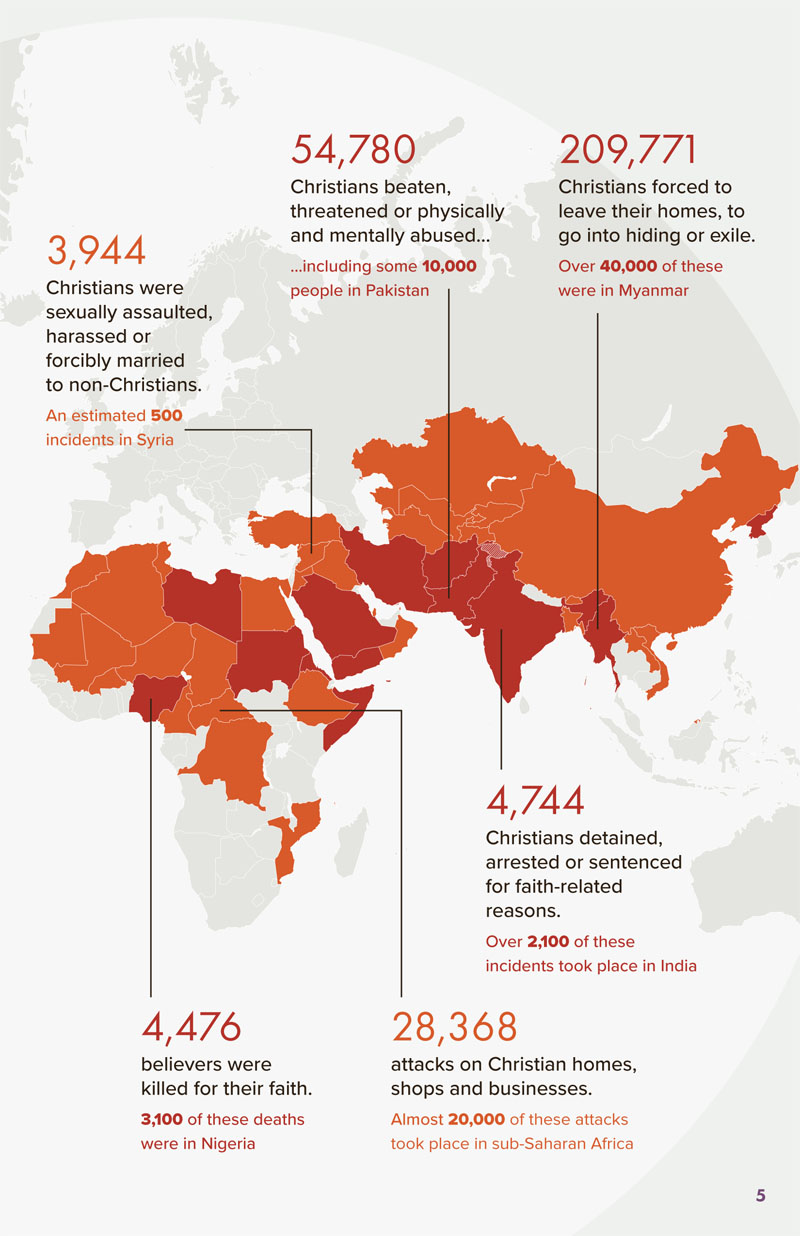
The 2025 World Watch List from OpenDoors released this week. It’s the most authoritative report you can get on locations around the world where Christians face persecution and discrimination because of their faith. OpenDoors conducts on-the-ground research in 150 countries around the world, then shares the top 50 most dangerous countries each year. The organization has a presence in 70 nations where Christians face heavy persecution, lending substantial aid and standing alongside those suffering for their faith in Jesus.
You can download a copy of this year’s World Watch List by clicking here (you can also order print copies for your church, if you want). I encourage you to take some time to thoughtfully read through the reports on each country, the requests from our brethren who live there, and the individual stories bravely shared. Then, if you can, visit the Arise Africa page and add your name to the petition that Open Doors will present to the African Union, the United Nations, other groups as part of a four-year campaign to aid God’s people in sub-Saharan Africa.
One thing that struck me deeply is that when asked how other people can help, persecuted Christians ask for prayer. “Pray for my child,” asks a man who escaped North Korea (p. 9). “Pray that God will give me strength,” asks a woman secretly ministering in Yemen (p. 11). Manga from Nigeria, who was nearly killed for refusing to deny Jesus, asks us to pray “for strength to remain firm” and “that fire for Jesus” would keep burning in their hearts (p. 15). Pastor Soré from Burkina Faso requests prayers that Christians there “stay firm in their faith” (p. 29). A man from Mexico requests prayers for hope, strong hearts, and growth of the church (p. 41). A believer in China shares, “Thank you for praying. I feel that I am not by myself. Through your prayers, I can feel that God has been looking after me to make me feel secure” (p. 23). It’s just like what the early church did–facing persecutions, encouraging each other to stand steadfast in the faith, and praying for one another.
Finally, pray for us, brothers and sisters, that the Lord’s message may spread quickly and be honored as in fact it was among you, and that we may be delivered from perverse and evil people. For not all have faith. But the Lord is faithful, and he will strengthen you and protect you from the evil one. And we are confident about you in the Lord that you are both doing—and will do—what we are commanding. Now may the Lord direct your hearts toward the love of God and the endurance of Christ.
2 Thessalonians 3:1-5, NET
As I mentioned in my 2024 blog recap, we have readers coming to LikeAnAnchor from all around the world. That includes thousands of people in Nigeria and India, as well as hundreds more from many other countries that appear in the World Watch List. I’m very grateful to have you here reading and, as the Apostle Paul frequently said, I remember you and make “mention of you in my prayers.” I don’t know most of you personally, but you are in my thoughts.
My friends, we might feel discouraged or powerless when we think about the opposition that we and/or our brethren in the world are facing, but we must remember the power of the God we serve. Praying to Him isn’t just something we do because we can’t do something more; prayer is one of the most powerful things that we can do to help others. Let’s never forget to pray for our brothers and sisters around the world.
A quick note on next week’s post: if you read my newsletter, you’ll know that I’d planned on sharing a study this week on the connection between waiting and hoping in the Hebrew language. I needed more time for that study, and when I read the World Watch List report this week, I felt moved to share this instead. We’ll be back to our regular Bible study posts next week.
I’ve missed a couple weeks of blogging since our daughter was born, but I’m hoping to get back to weekly posts soon. For now, bi-weekly might be more doable (we’ll see how things go). Today’s post is our final study of Jesus’s model prayer. We’ve been focusing on the version in Matthew, which is part of the Sermon on the Mount where He’s talking about good and bad examples for how to pray (Matt. 6:5-15). There’s also a near-identical prayer recorded in Luke, where Jesus responded to a disciple’s request that Jesus teach them to pray (Luke 11:1-13).
So pray this way: Our Father in heaven, may your name be honored, may your kingdom come, may your will be done on earth as it is in heaven. Give us today our daily bread, and forgive us our debts, as we ourselves have forgiven our debtors. And do not lead us into temptation, but deliver us from the evil one.
Matthew 6:9-13, NET
Luke’s version is a little shorter than the one in Matthew, and the final line there simply reads, “And do not lead us into temptation” (see NET footnotes on manuscript evidence for a shorter reading in Luke). Whichever recorded version we’re looking at, we can think of this prayer as a helpful outline for our own prayers. And if we want to include this “do not lead us into temptation” sentiment when we pray, it’s helpful to understand what it does (and doesn’t) mean.
Image by Claudine Chaussé from Lightstock
Do Not Lead Us Into Temptation
The last line of this prayer is a little tricky to interpret, at least at first glance, in light of other scriptures. James 1:13 says, “Let no one say when he is tempted, ‘I am tempted by God,’ for God cannot be tempted by evil, and he himself tempts no one” (NET). The English translation of Matthew 6, at least, makes it appear that Jesus is advising us to pray against something (God leading us into temptation) that wouldn’t happen anyways. Looking at another piece of prayer advice that He gave his disciples helps clear this confusion up.
Then they went to a place called Gethsemane, and Jesus said to his disciples, “Sit here while I pray.” …Then he came and found them sleeping, and said to Peter, “Simon, are you sleeping? Couldn’t you stay awake for one hour? Stay awake and pray that you will not fall into temptation. The spirit is willing, but the flesh is weak.”
Mark 14:32, 37-38, NET
This is actually very similar to what Jesus told his disciples to pray in the model prayer. Both verses use the same Greek word for temptation, periasmos (G3986). This word involves putting something to the test. It’s “an experiment, attempt, trial, proving” that can include an internal or external “enticement to sin” for the purpose of making a “trial of man’s fidelity, integrity, virtue, constancy” (Thayer). In both cases, Jesus advised them to pray that this didn’t happen. Testing isn’t a pleasant experience. God will let it happen sometimes, though, when it’s for our good and when He knows we could succeed.
My brothers and sisters, consider it nothing but joy when you fall into all sorts of trials (periasmos), because you know that the testing of your faith produces endurance. …
Happy is the one who endures testing (periasmos), because when he has proven to be genuine, he will receive the crown of life that God promised to those who love him.Let no one say when he is tempted, “I am tempted by God,” for God cannot be tempted by evil, and he himself tempts no one. But each one is tempted when he is lured and enticed by his own desires.Then when desire conceives, it gives birth to sin, and when sin is full grown, it gives birth to death. Do not be led astray, my dear brothers and sisters.
James 1:2-3, 12-16, NET
Testing serves a purpose. It can strengthen our faith, provided that we overcome the test and not give into the temptation to sin. The NET footnote on Matthew 6:13 says “The request do not lead us into temptation is not to suggest God causes temptation, but is a rhetorical way to ask for his protection from sin.” In other words, we might see this as a prayer that we not be tested but we can also see it as a prayer that if we’re tested, we won’t fail the test.
So let the one who thinks he is standing be careful that he does not fall. No trial (periasmos) has overtaken you that is not faced by others. And God is faithful: He will not let you be tried beyond what you are able to bear, but with the trial (periasmos) will also provide a way out so that you may be able to endure it.
1 Corinthians 10:12-13, NET
When God allows tests and trials, He intends for us to successfully overcome them and prove the genuineness of our faith. If we couldn’t endure the test, He wouldn’t let it happen. We need to be cautious and humble, though, and not just assume we’ve hit a point in our spiritual growth where we won’t be tempted or that we won’t fall if tempted. I think that’s also what Jesus is hinting at in the model prayer. Our prayers should include an acknowledgment that we need God’s help “delivering us from evil” to avoid sin and overcome tests when they do come.
Deliver Us From the Evil One
Image by Pearl from Lightstock
Depending on the translation you’re reading, the end of Matthew 6:13 might read “deliver us from evil” or “deliver us from the evil one.” The Greek word poneros (G4190) can mean evil in a general sense, but here “it is most likely personified since it is articular (τοῦ πονηροῦ, tou ponērou)” (NET footnote). You can see other examples of this word being personified and standing in for the devil in Matt. 13:19, 38; John 17:15; 1 John 2:13-14. One of those examples is from the prayer that Jesus prayed right before his death.
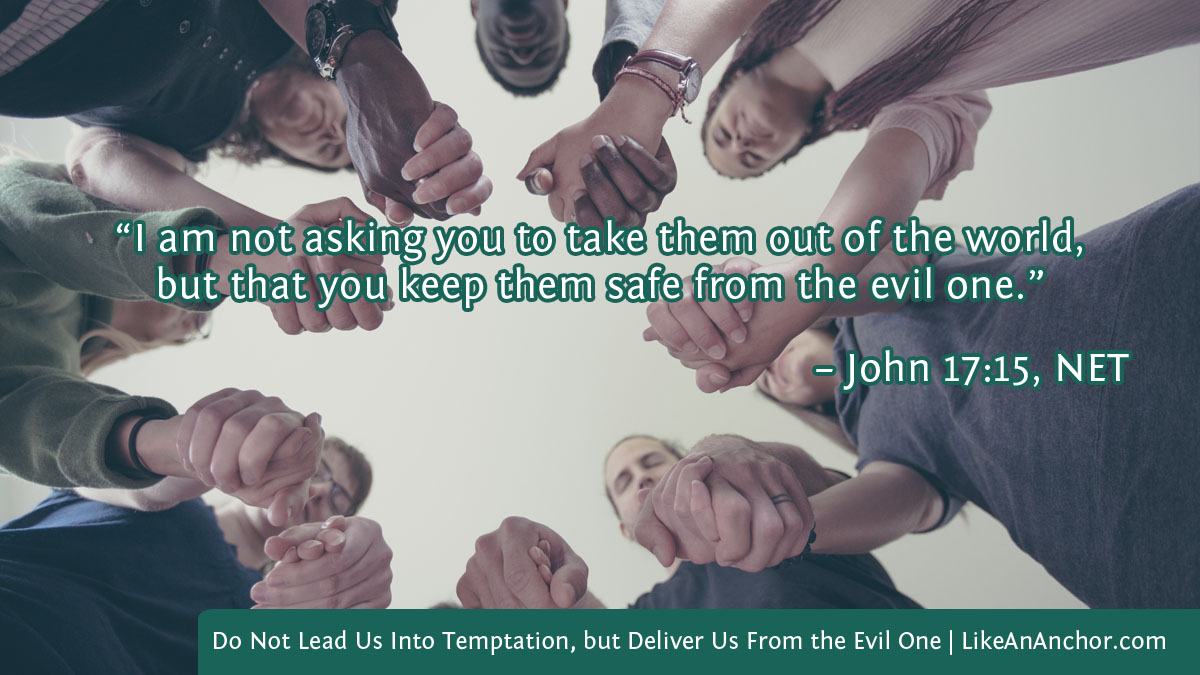
I am no longer in the world, but they are in the world, and I am coming to you. Holy Father, keep them safe in your name that you have given me, so that they may be one just as we are one. … I have given them your word, and the world has hated them, because they do not belong to the world, just as I do not belong to the world.I am not asking you to take them out of the world, but that you keep them safe from the evil one.
John 17:11, 14-15, NET
Jesus told us to pray for deliverance from evil, and he modeled that by praying the Father would keep us safe from the evil one. Jesus’s followers later wrote about God faithfully delivering us from evil people, evil deeds, and the evil one, or Satan (2 Thes .3:2-3; 2 Tim. 4.18; 1 John 5:18-19). We are also counseled to take up the armor of God to provide defense against the evil one.
Clothe yourselves with the full armor of God, so that you will be able to stand against the schemes of the devil. For our struggle is not against flesh and blood, but against the rulers, against the powers, against the world rulers of this darkness, against the spiritual forces of evil in the heavens. For this reason, take up the full armor of God so that you may be able to stand your ground on the evil day, and having done everything, to stand.Stand firm therefore, by fastening the belt of truth around your waist, by putting on the breastplate of righteousness, by fitting your feet with the preparation that comes from the good news of peace,and in all of this, by taking up the shield of faith with which you can extinguish all the flaming arrows of the evil one.
Ephesians 6:11-16, NET
I have a whole book on the armor of God (Like An Anchor Study Guide: Armor of God), so we won’t go into it in too much detail in this post. But if we’re going to pray “do not lead us into temptation, but deliver us from the evil one,” we need to have some understanding of what sort of evil we’re praying to be delivered from and that includes knowledge of the fight that we’re in. “The whole world lies in the power of the evil one” (1 John 5:19), but we are people of God whom God protects, promises to strengthen against temptations, and delivers from the devil.
Quick note for those wondering why there isn’t going to be another post titled “For yours is the Kingdom, the power, and the glory forever:” manuscript evidence suggests that this phrase was added at some point, possibly for use in church liturgy (NET footnote on Matt. 6:13). Since it likely wasn’t part of the original prayer, I decided not to include it in this blog series.
Today’s post is our 5th on Jesus’s model prayer. If you need/want to catch up on the previous posts, here are the links: “Hallowed Be Your Name,” “May Your Kingdom Come,” “May Your Will Be Done On Earth As It Is In Heaven,” and “Give Us Today Our Daily Bread.” As mentioned in those posts, we find versions of Jesus’s model prayer in two gospels. We’ve been focusing on the one in Matthew, which is part of the Sermon on the Mount when He’s talking about good and bad examples for how to pray (Matt. 6:5-15). There’s also a near-identical one in Luke, where Jesus responds to a disciple’s request that Jesus teach them to pray (Luke 11:1-13).
So pray this way: Our Father in heaven, may your name be honored, may your kingdom come, may your will be done on earth as it is in heaven. Give us today our daily bread, and forgive us our debts, as we ourselves have forgiven our debtors. And do not lead us into temptation, but deliver us from the evil one
Matthew 6:9-13, NET
We can think of this prayer as a helpful outline for our own prayers. We’re not locked into repeating it word-for-word; He’s showing us the way to pray rather than giving us a specific prayer to recite (though there can be a time and place for that, too, just like we can read or sing psalms other people wrote at times when we can’t think of what to say or the psalms/prayers speak to our own situations). In this post, we’re looking at the second personal request that’s part of the model prayer: “forgive us our debts, as we ourselves have forgiven our debtors.”
Image by Jantanee from Lightstock
Forgiving Debts
“Forgive us our debts, as we ourselves have forgiven our debtors” is the only point in this prayer that Jesus explains in more detail. Right after wrapping up the outline, He adds this:
“For if you forgive others their sins, your heavenly Father will also forgive you. But if you do not forgive others, your Father will not forgive you your sins.”
Matthew 6:14-15, NET
There are two different Greek words used here, which is reflected in the English translations “debts” and “sins.” In the prayer, the word used is opheilema, which means “that which is owed” as “a debt” (Thayer’s Dictionary, entry G3783). It’s metaphorically used of sins. “Debtors” is the related word opheiletes, which as you might guess means the person who owes something to another (Thayer; G3781). This word for debtor is also used in Matthew 18, which we’ll be looking at in a moment.
“Sin” is translated from paraptoma, which means “to fall beside or near” or “a lapse or deviation from truth and uprightness” (Thayer; G3900). When it appears in the New Testament it’s translated with English words like “trespass,” “offense,” “fault,” or “sin.” Interestingly, this still isn’t the most commonly used Greek word for sin. That would be hamartia, which means “to miss the mark” or “that which is done wrong, sin, and offense, a violation of the divine law” (Thayer; G266). Harmartia is the word used for “sin” in the version of Jesus’s model prayer that Luke records (Luke 11:4).
Despite the different words, “forgive us our debts, as we ourselves have forgiven our debtors” is clearly connected with “forgive others their sins” so your Father will forgive you. Jesus uses parallel wording to make the connection, and the word for “forgive” is the same in both cases. It’s translated from aphiemi, which means “to let go, give up a debt, forgive, to remit” (Thayer; G863). When we sin, it’s like we owe God something because we messed up. When Jesus died, He paid the penalty in our place, remitting our debts. We need to understand this sin-debt analogy if we’re going to make sense of what’s going on in this part of the model prayer.
Image by MarrCreative from Lightstock
The Necessity of Forgiveness
It might feel kind of weird to think that God’s forgiveness of us is conditional on our forgiveness of others. We like to think of His forgiveness and grace as something freely given that we don’t need to do anything in order to receive. But though we can’t do anything to earn His grace or forgiveness, there are some things we can do to reject them. Later in Jesus’s ministry, He shares a parable that sheds light on the connection between us forgiving others and us receiving forgiveness from God.
Then Peter came to him and said, “Lord, how many times must I forgive my brother who sins against me? As many as seven times?”Jesus said to him, “Not seven times, I tell you, but seventy-seven times!
“For this reason, the kingdom of heaven is like a king who wanted to settle accounts with his slaves.As he began settling his accounts, a man who owed 10,000 talents was brought to him. Because he was not able to repay it, the lord ordered him to be sold, along with his wife, children, and whatever he possessed, and repayment to be made. Then the slave threw himself to the ground before him, saying, ‘Be patient with me, and I will repay you everything.’ The lord had compassion on that slave and released him, and forgave him the debt.
Matthew 18:21-27, NET
This is mercy. The man was an opheiletes, a debtor, who was incapable of repaying what he owed. Just one talent was “equal to 6,000 denarii. One denarius was the usual day’s wage for a worker” (NET footnote on Matt. 18:24). That means for a typical worker at the time, 10,000 talents was equal to 60,000,000 day’s wages, or about 164,384 years of work. A slave could never dream of repaying that, just like human beings can never do enough to make up for the sins we’ve committed against God (Rom. 3-6). As readers or listeners, we’re supposed to appreciate just what an incredible gift this lord gave the slave.
After he went out, that same slave found one of his fellow slaves who owed him 100 silver coins. So he grabbed him by the throat and started to choke him, saying, ‘Pay back what you owe me!’Then his fellow slave threw himself down and begged him, ‘Be patient with me, and I will repay you.’But he refused. Instead, he went out and threw him in prison until he repaid the debt. When his fellow slaves saw what had happened, they were very upset and went and told their lord everything that had taken place. Then his lord called the first slave and said to him, ‘Evil slave! I forgave you all that debt because you begged me! Should you not have shown mercy to your fellow slave, just as I showed it to you?’ And in anger his lord turned him over to the prison guards to torture him until he repaid all he owed. So also my heavenly Father will do to you, if each of you does not forgive your brother from your heart.”
Matthew 18:28-35, NET
The fellow slave owed only 100 silver coins, or denarii, so about 3 months’ pay (NET footnote on Matt. 18:28). It’s a real debt, but compared to what the first slave owed the lord it’s a tiny sum. The difference between what the slave was forgiven and what he refused to forgive is enormous. We can see how ridiculous he’s being. But it’s just as ridiculous if we refuse to forgive another human being’s offenses against us after God has forgiven our offenses against Him.
It’s not just crazy for us to hold on to a tiny debt someone owes us when God has forgiven us a huge debt against Him. It’s dangerous. Jesus doesn’t leave room for ambiguity in interpreting this parable. The lord takes back His forgiveness, and Jesus says, “So also my heavenly Father will do to you, if each of you does not forgive your brother from your heart.” It’s exactly like He said after sharing the model prayer: “if you forgive others their sins, your heavenly Father will also forgive you. But if you do not forgive others, your Father will not forgive you your sins” (Matt. 6:14-15, NET). There’s an “if” in these verses, making forgiveness conditional. We need to show forgiveness if we want to receive forgiveness.
How To Let Go
Earlier, I said that aphiemi, the Greek word translated “forgive” means “to let go, give up a debt, forgive, to remit” (Thayer; G863). That’s the sense in which it usually applies to forgiveness. But it’s a complex word, and it can also mean “to send away,” “yield up,” “let alone, let be,” or “to leave, go away from one.” If we forgive, we stop holding on to the sins, offenses, debts, and trespasses of other people. We “let it alone,” send away our resentment, and walk away from what we might be owed. It’s much the same thing as our English definition of forgiveness.
Notice that none of the things involved with forgiveness require the other person to take action. We can grant forgiveness–let go of resentment and yield any claim to payment owed us–without the other person asking for it. In fact, we should forgive as soon as possible regardless of the other person because we want God to respond positively when we ask Him to forgive us.
Image by Shaun Menary from Lightstock
One of the things I’ve struggled with related to forgiveness is how to tell if I’ve actually forgiven someone. Some things are relatively easy to forgive, and you might legitimately forget them when you release the debt. There are others, though, that can still color your perception of a person even if you don’t feel resentment or think they owe you something. In certain situations, that can be okay. It’s not always safe to reconcile or restore a relationship, but it’s always right to let go of resentment and the feeling that someone who hurt us owes us for something.
“If your brother sins, go and show him his fault when the two of you are alone. If he listens to you, you have regained your brother. But if he does not listen, take one or two others with you, so that atthe testimony of two or three witnesses every matter may be established.If he refuses to listen to them, tell it to the church. If he refuses to listen to the church, treat him like a Gentile or a tax collector.
Matthew 18:15-17, NET
This short formula for Christian reconciliation comes before Peter’s question about forgiveness and Jesus’s parable about the unforgiving slave. Ideally, we should reconcile if there’s an issue with a “brother” or “fellow believer.” The primary goal is reconciliation and restored relationship. But if that doesn’t work after repeated attempts, you don’t “associate with such a person” (NET footnote on Matt. 18:17). It’s our responsibility to try to reconcile, especially with a fellow believer, but regardless of how that goes we have an obligation to forgive and “live peaceably with all people” (Rom. 12:18, NET; see Rom. 12:16-21).
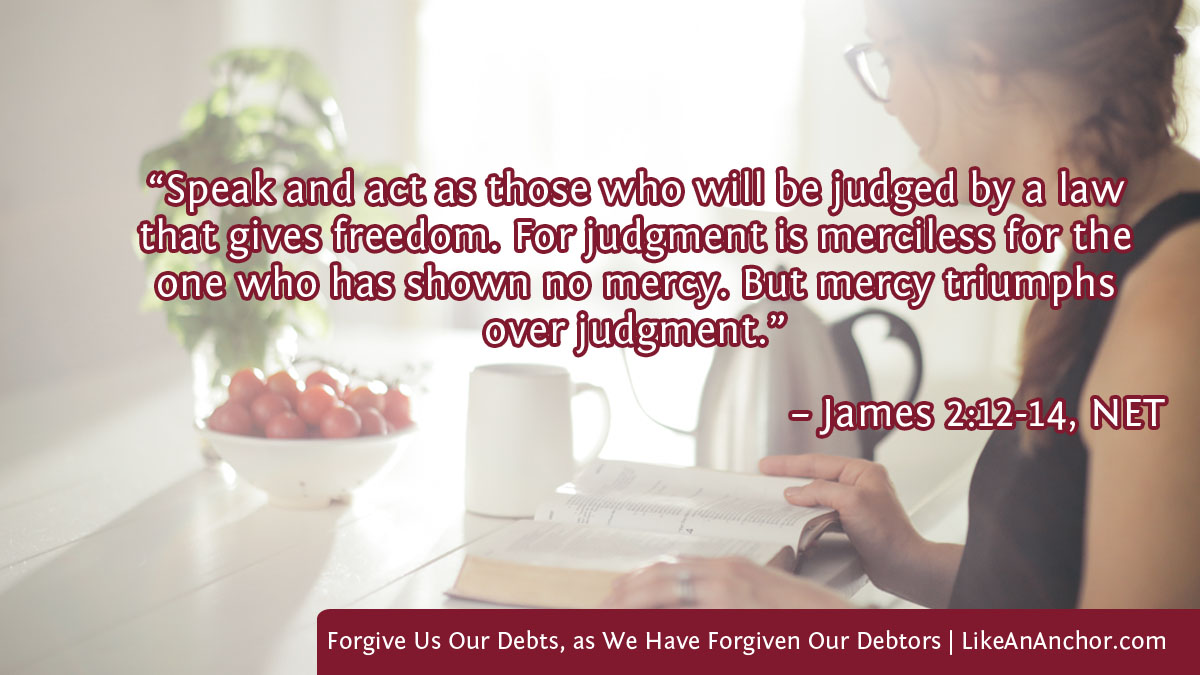
The conditionality of forgiveness from God should prompt us to extend forgiveness to others. But I don’t think He wants that to be the main reason why we forgive (just like the threat of punishment shouldn’t be the main reason we obey His laws). When we realize what a great debt God forgives us, we should want to forgive others. Similarly, as recipients of God’s great mercy, we should be eager to show mercy to others. Like forgiveness, there’s a reciprocity involved in mercy: “Blessed are the merciful, for they will be shown mercy” (Matt. 5:7, NET) and “For judgment is merciless for the one who has shown no mercy” (James 2:13, NET). One of our main goals as Christians is to become like God. That involves learning to be loving, merciful, and forgiving just the same way that He is. When we pray, “Forgive us our debts, as we ourselves have forgiven our debtors,” we acknowledge that we have an essential role to play in giving and receiving forgiveness.
Today, we’re continuing our study of Jesus’s model prayer. If you missed any of the others, here are the links: “Hallowed Be Your Name,” “May Your Kingdom Come,” and “May Your Will Be Done On Earth As It Is In Heaven.” As mentioned in those posts, we find versions of Jesus’s model prayer in two gospels. In Matthew, it’s part of the Sermon on the Mount when He’s talking about good and bad examples for how to pray, and that’s the one we’ve been focusing on (Matt. 6:5-15). In Luke, He uses a similar prayer to respond to a disciple’s request that Jesus teach them to pray (Luke 11:1-13).
So pray this way: Our Father in heaven, may your name be honored, may your kingdom come, may your will be done on earth as it is in heaven. Give us today our daily bread, and forgive us our debts, as we ourselves have forgiven our debtors. And do not lead us into temptation, but deliver us from the evil one
Matthew 6:9-13, NET
You don’t have to repeat this prayer word-for-word to pray correctly, but it’s a very helpful outline for our own prayers. The first personal request included in this prayer is, “Give us today our daily bread.”
One of the things we need to remember when reading the New Testament is how profoundly connected it is to the Old Testament. For the people of Jesus’s day, these weren’t two separate books. All they had was what we call the Old Testament. It was the the holy scriptures, and anytime Jesus or His followers reference the word of God that’s what they’re talking about. Even when they don’t reference these writings directly, chances are their listeners would have stories and principles from the Old Testament in the back of their minds. Everyone in Jewish society studied the scriptures as children and heard them read each week on Shabbat for the rest of their lives. When Jesus said, “Give us today our daily bread,” I imagine it would have been almost impossible for people not to think of the Exodus story.
They took their journey from Elim, and all the congregation of the children of Israel came to the wilderness of Sin, which is between Elim and Sinai, on the fifteenth day of the second month after their departing out of the land of Egypt. The whole congregation of the children of Israel murmured against Moses and against Aaron in the wilderness; and the children of Israel said to them, “We wish that we had died by Yahweh’s hand in the land of Egypt, when we sat by the meat pots, when we ate our fill of bread, for you have brought us out into this wilderness to kill this whole assembly with hunger.”
Then Yahweh said to Moses, “Behold, I will rain bread from the sky for you, and the people shall go out and gather a day’s portion every day, that I may test them, whether they will walk in my law or not. It shall come to pass on the sixth day, that they shall prepare that which they bring in, and it shall be twice as much as they gather daily.”
Exodus 16:1-5, WEB
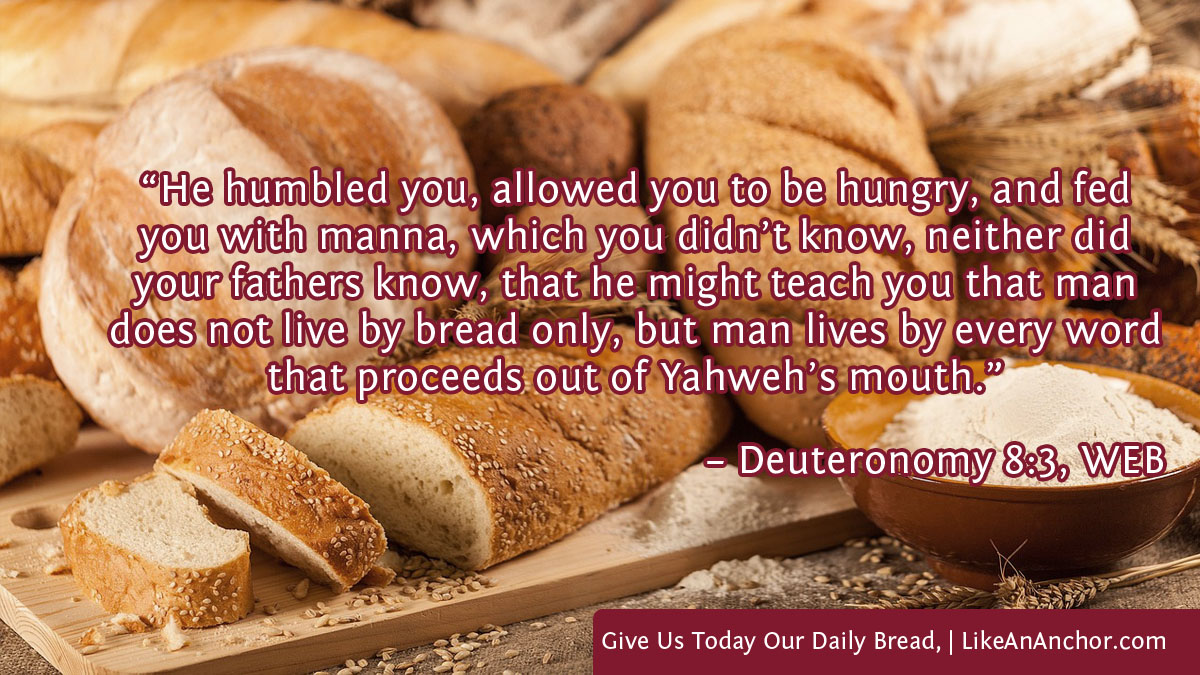
When Yahweh miraculously provided manna to feed ancient Israel, He gave them bread day-by-day. He didn’t dump a week’s worth of bread on them all at once, or give them extra that they could keep on hand “just in case.” The manna even rotted if they tried to save it over, making it impossible to eat anything but “daily bread.” The only exception to this rule was extra manna on Friday that would stay fresh until Saturday, so no one had to work to gather bread on Shabbat (Ex. 16). Ancient Israel had to trust God would provide for them each day, just like we still need to today even if it’s not as obvious as it was for them with the manna.
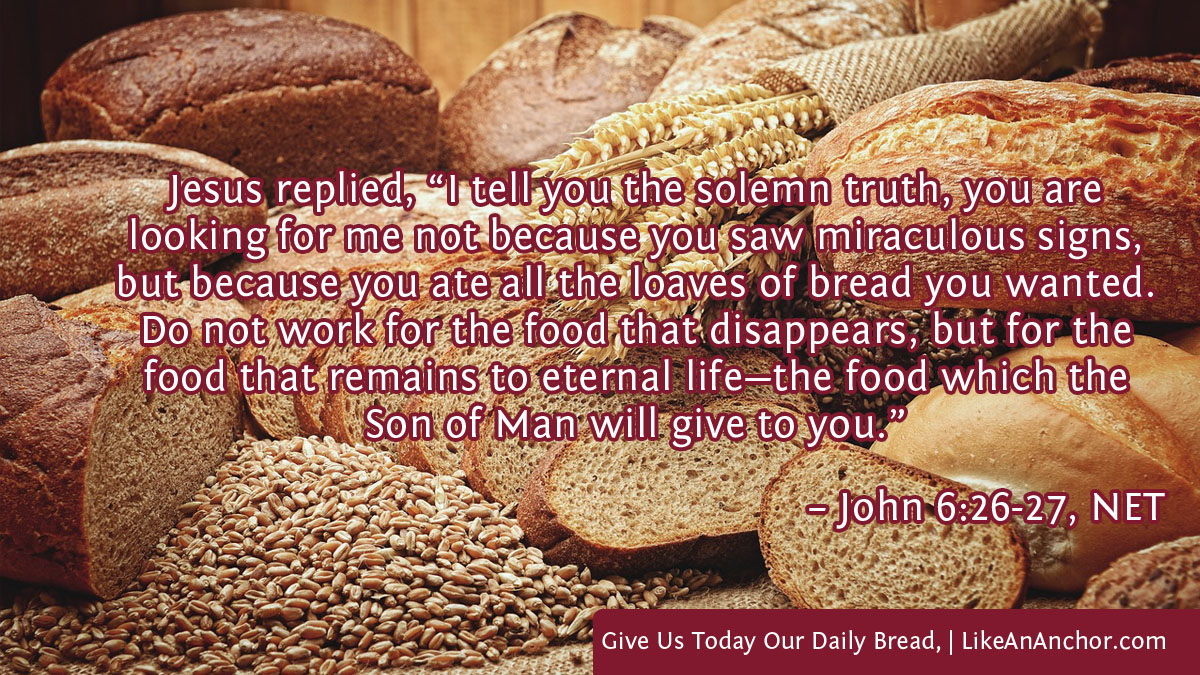
Later in His ministry, Jesus discussed manna directly. After miraculously feeding 5,000 people, Jesus tried to travel to a new place but the people who’d eaten the food followed Him. Even after partaking of that miracle, they had the nerve to ask, “what miraculous sign will you perform, so that we may see it and believe you? What will you do? Our ancestors ate the manna in the wilderness, just as it is written, ‘He gave them bread from heaven to eat’” (John 6:30-31, NET, quoting Ps. 78:24). It appears that they were challenging Him to keep providing physical daily bread for them, but Jesus redirected their focus.
Then Jesus told them, “I tell you the solemn truth, it is not Moses who has given you the bread from heaven, but my Father is giving you the true bread from heaven. For the bread of God is the one who comes down from heaven and gives life to the world.” So they said to him, “Sir, give us this bread all the time!”
Jesus said to them, “I am the bread of life. The one who comes to me will never go hungry, and the one who believes in me will never be thirsty.” …
“I am the bread of life.Your ancestors ate the manna in the wilderness, and they died. This is the bread that has come down from heaven, so that a person may eat from it and not die.I am the living bread that came down from heaven. If anyone eats from this bread he will live forever. The bread that I will give for the life of the world is my flesh.”
John 6:32-35, 48-51, NET
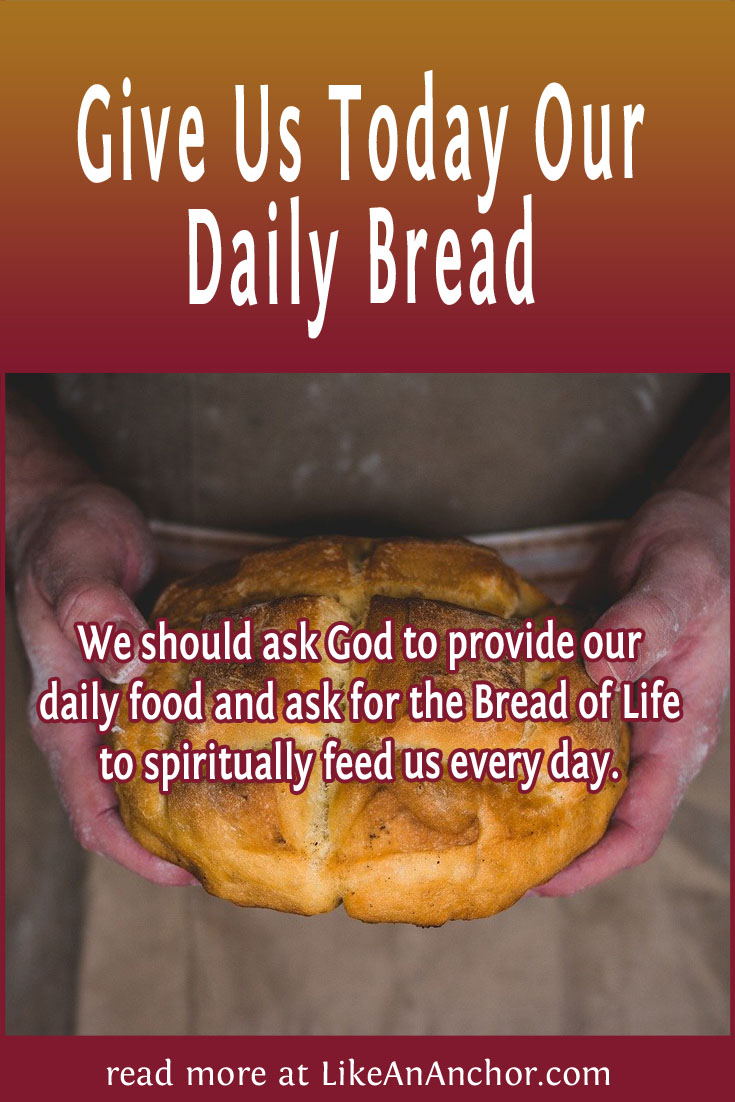
It’s very possible that when Jesus told His followers to pray, “Give us today our daily bread,” He meant both physical necessities and spiritual ones. We need Him every day even more than we need actual food. Just like Jesus cared about providing food to the 5,000 AND teaching them about Him as the Bread of Life, so we should care about asking God to provide our daily food AND asking for the Bread of Life to feed us every day.
You might say that I’m reading too much into “give us today our daily bread” to say that it’s spiritual food as well as physical food. On the surface, it’s just a simple, straightforward statement: “Please provide the food we need for today.” But as Jesus points out just a short while later in this Sermon on the Mount, God already knows that we need things like food and clothing. He doesn’t really need the reminder, and we don’t really need to worry about it.
“Therefore I tell you, do not worry about your life, what you will eat or drink, or about your body, what you will wear. Isn’t there more to life than food and more to the body than clothing? Look at the birds in the sky: They do not sow, or reap, or gather into barns, yet your heavenly Father feeds them. Aren’t you more valuable than they are? … So then, don’t worry saying, ‘What will we eat?’ or ‘What will we drink?’ or ‘What will we wear?’ For the unconverted pursue these things, and your heavenly Father knows that you need them. But above all pursue his kingdom and righteousness, and all these things will be given to you as well. So then, do not worry about tomorrow, for tomorrow will worry about itself. Today has enough trouble of its own.
Matthew 6:25-26, 31-33, NET
There’s nothing wrong with asking for day-to-day necessities. Just because God already knows something and intends to provide it doesn’t mean He won’t appreciate us asking rather than taking His provision for granted. But we shouldn’t spend time worrying about what we’ll eat or drink, and especially not worrying about it long-term and borrowing trouble from tomorrow. And even if we’re famished, there’s still something more important than physical bread to focus on.
Then Jesus was led by the Spirit into the wilderness to be tempted by the devil. After he fasted forty days and forty nights he was famished.The tempter came and said to him, “If you are the Son of God, command these stones to become bread.”But he answered, “It is written, ‘Mandoes not livebybread alone, but by every word that comes from the mouth of God.’”
Matthew 4:1-4, NET (bold italics mark a quotation from Deut. 8:3)
Jesus was in a unique situation here, but the principle in the verse He quoted still applies to us. Like ancient Israel did with manna, we’re supposed to learn to rely on God every day and we’re supposed to learn that listening to His words sustains life. Food isn’t the only thing we need to keep us alive, at least not to give us the abundant life that Jesus wants for us (John 10:10). We also need the Bread of Life and the words of God.
After writing about the phrases “Hallowed Be Your Name” and “May Your Kingdom Come” from Jesus’s model prayer, I think it might be good to just keep going and study the whole prayer line-by-line. I wasn’t going to continue this study because I’m pretty sure I know what Jesus means by “may your will be done,” but then I remembered what Paul said: “If someone thinks he knows something, he does not yet know to the degree that he needs to know” (1 Cor. 8:2, NET). We need to beware of intellectual pride that makes us think there’s nothing more to learn from “basic” concepts about God that we’ve already “mastered.” There’s always more to learn where God is concerned.
Prioritizing God’s Will
We find versions of Jesus’s model prayer in two gospels. In Matthew, it’s part of the Sermon on the Mount when He’s talking about good and bad examples for how to pray (Matt. 6:5-15). In Luke, He uses this prayer to respond to a disciple’s request that Jesus teach them to pray (Luke 11:1-13). You don’t have to repeat this prayer word-for-word to pray correctly, but it’s a very helpful outline for our own prayers.
So pray this way: Our Father in heaven, may your name be honored, may your kingdom come, may your will be done on earth as it is in heaven. Give us today our daily bread, and forgive us our debts, as we ourselves have forgiven our debtors. And do not lead us into temptation, but deliver us from the evil one
Matthew 6:9-13, NET
Submitting to God’s will isn’t the very first thing in the prayer, but it is in the first half. It comes before other, more personal requests but after the proper acknowledgement of God’s holiness and the request that His kingdom come. I’m not sure how important the order is, but it strikes me as interesting that Jesus put the Father’s will before other, more individual requests like daily bread or personal deliverance. That’s a priority list Jesus modeled in His own life.
Image by Anggie from Lightstock
Jesus and the Father’s Will
Remember, it’s our Father that we’re talking with here. We come before God not as some distant petitioners, but as His own children. There’s a relationship established before we even get to this prayer, and it’s the same type of relationship that Jesus has with the Father (John 16:27; 17:23; 1 John 3:1-2).
Before Jesus’s death, He prayed, “My Father, if possible, let this cup pass from me! Yet not what I will, but what you will” (Matt. 26:39, NET; see Matt. 26:36-46; Mark 14:32-42; Luke 22:39-46). This wasn’t the first time He’d prioritized the Father’s will. Doing the Father’s will was one of His main focuses in life, as John records several times in his gospel.
Jesus said to them, “My food is to do the will of the one who sent me and to complete his work.”
John 4:34, NET
“I can do nothing on my own initiative. Just as I hear, I judge, and my judgment is just, because I do not seek my own will, but the will of the one who sent me.”
John 5:30, NET
“For I have come down from heaven not to do my own will but the will of the one who sent me.”
John 6:38, NET
I imagine with this focus that the model prayer and the prayer in Gethsemane were not the only times Jesus prayed, “may your will be done.” It was likely at the forefront of His mind frequently, whether He was formally praying at the time or not. And since we’re supposed to become like Jesus, doing the Father’s will should be a priority for us as well.
“Not everyone who says to me, ‘Lord, Lord,’ will enter into the kingdom of heaven—only the one who does the will of my Father in heaven.”
Matthew 7:21, NET
“For whoever does the will of my Father in heaven is my brother and sister and mother.”
Matthew 12:50, NET
Jesus has a close, personal, familial relationship with people who do the Father’s will. Additionally, only those who do His will can enter the kingdom of heaven. The emphasis that Jesus placed on following His Father’s will and the way He talked about it as a requirement for us reveals just how important it is that we do this. We need to align ourselves with God’s will, as Jesus did, if we want to spend forever in His family.
Image by Alyssa Marie from Lightstock
What Is God’s Will?
When Jesus talked about God’s will, He often emphasized how it relates to God’s overall plan. The Father is making a family, and it’s His will that as many people as possible receive salvation and eternal life (John 6:38-40; Matt. 11:25-27; 18:14). That gives us an overall view of God’s will, desire, and purpose. But it still doesn’t tell us what it means for us to do God’s will.
“What do you think? A man had two sons. He went to the first and said, ‘Son, go and work in the vineyard today.’ The boy answered, ‘I will not.’ But later he had a change of heart and went. The father went to the other son and said the same thing. This boy answered, ‘I will, sir,’ but did not go. Which of the two did his father’s will?” They said, “The first.” Jesus said to them, “I tell you the truth, tax collectors and prostitutes will go ahead of you into the kingdom of God!”
Matthew 21:28-31, NET
Jesus shared this parable shortly before His death. He “entered the temple courts” and “the chief priests and elders of the people came up to him as he was teaching” to question Him and challenge His authority (Matt. 21:23, NET). These were the religious leaders, the people who probably thought they were doing God’s will better than anyone else and living more righteous lives. But as Jesus pointed out several other times, thinking you’re righteous isn’t the same thing as actually living by God’s words (Matt. 5:17-20; 23:1-3). If you want to do the father’s will, then you actually need to follow His commands.
Image by Shaun Menary from Lightstock
There are several things that Paul, Peter, and John describe as “God’s will” for us in their writings. It was God’s will that Jesus save us from our sins (Gal. 1:4; Eph. 1:11). It’s His will that we obey Him from the heart, become holy, give thanks always, do good, and live in accordance with His ways rather than fleshy human desires (Eph. 6:6; 1 Thess. 4:3; 5:18; 1 Pet. 2:15; 4:2). Sometimes, it’s in accordance with His will that we suffer even while doing good (1 Pet. 3:17; 4:19). But we also know that it’s His will that we’ll grow, mature, and “receive the promise” of eternal life if we align ourselves with His will (Col. 4:12; 1 John 2:17; Heb. 10:36).
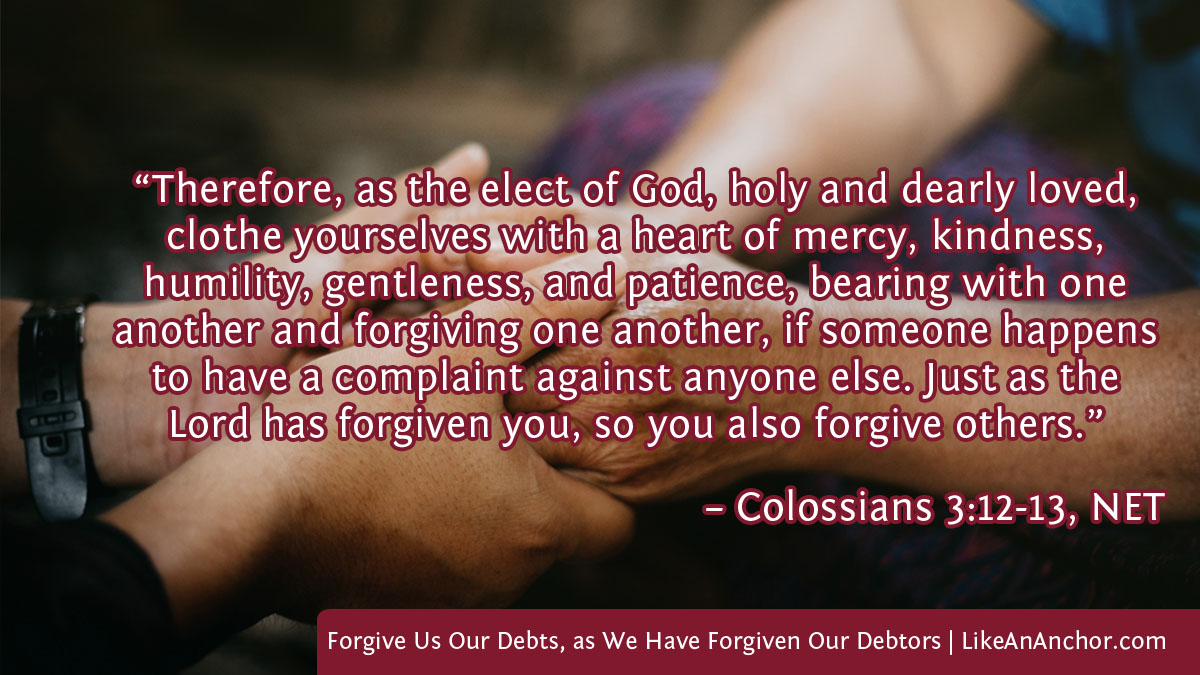
Therefore I exhort you, brothers and sisters, by the mercies of God, to present your bodies as a sacrifice—alive, holy, and pleasing to God—which is your reasonable service. Do not be conformed to this present world, but be transformed by the renewing of your mind, so that you may test and approve what is the will of God—what is good and well-pleasing and perfect.
Romans 12:1-2, NET
The will of God isn’t just one thing. It includes all His desires and plans, for the universe and for us. In some ways it’s very simple–it’s God’s will to save humanity and doing His will involves following Him. In other ways, it’s something complex enough we can spend our whole lives learning to understand. Developing knowledge of His will and doing His will are key parts of our ongoing Christian walk.
For this reason we also, from the day we heard about you, have not ceased praying for you and asking God to fill you with the knowledge of his will in all spiritual wisdom and understanding, so that you may live worthily of the Lord and please him in all respects—bearing fruit in every good deed, growing in the knowledge of God, being strengthened with all power according to his glorious might for the display of all patience and steadfastness, joyfully giving thanks to the Father who has qualified you to share in the saints’ inheritance in the light.
Colossians 1:9-12, NET
Look at why Paul says he asked God to fill people with “the knowledge of His will.” It’s so that we can “live worthily of the Lord,” please Him, bear fruit, do good deeds, grow “in the knowledge of God,” receive strength, display “patience and steadfastness,” and “joyfully give thanks.” As God shares deeper understanding of His will with us and we learn to pray “may your will be done on earth as it is in heaven,” our lives will be transformed. We will “live out the message ” rather than “merely listen to it” (James 1:22, NET). We’ll align ourselves with what He’s doing to accomplish His will. We’ll even be doing His will, helping fulfill the prayer “may your will be done on earth” as we live our lives in accordance with His will
Featured image by Claudine Chaussé from Lightstock
When I wrote about the phrase “hallowed be your name” at the beginning of Jesus’s model prayer (also known as the Lord’s Prayer), I hadn’t intended to write any follow up posts. But I recently found myself pondering the next phrase in that prayer: “may your kingdom come,” and I wanted to study that more deeply as well.
I notice that when I pray, I tend to add a sentiment like “your kingdom come, your will be done” at the end of my prayers. I don’t think this is unusual. I remember reading a book about prayer where the author said he does the same thing, feeling it makes a better summation than an opening idea. Still, Jesus put this phrase at the beginning of His model prayer. We don’t have to follow that model exactly (it’s a guide and outline rather than a prayer to just repeat word-for-word all the time), but I have to think there’s a reason He organized the model prayer the way that He did.
Image by Pearl from Lightstock
Prioritizing the Kingdom
Two gospels record the model prayer. In Matthew, Jesus gives this outline as part of the Sermon on the Mount when He’s talking about good and bad examples for how to pray (Matt. 6:5-15). In Luke, He uses this prayer to respond to a disciple’s request that Jesus teach them to pray (Luke 11:1-13). Both versions are about the same, though Luke’s is a little shorter depending on the translation (it seems that later manuscripts borrowed from Matthew’s gospel to expand the prayer in Luke’s [NET footnotes on Luke 11:2, 4). Let’s look at the version recorded by Matthew.
So pray this way: Our Father in heaven, may your name be honored, may your kingdom come, may your will be done on earth as it is in heaven. Give us today our daily bread, and forgive us our debts, as we ourselves have forgiven our debtors. And do not lead us into temptation, but deliver us from the evil one
Matthew 6:9-13, NET
We begin by addressing “our Father in heaven.” It’s an intimate, relational way to speak to the one true God. Also, by saying “our” instead of “my,” we’re reminded that He’s the Father of a whole family that we’re part of. “May your name be honored” continues properly aligning how we view and approach God. We should regard Him as holy, and we should also pray that others come to the same realization.
Then, Jesus says, “may your kingdom come.” It’s the first thing He prays for after acknowledging God’s holiness. I wonder if He prioritizes this part of the prayer for the same reason that He counsels us to prioritize God’s kingdom just a little later in this Sermon on the Mount.
So then, don’t worry saying, ‘What will we eat?’ or ‘What will we drink?’ or ‘What will we wear?’ For the unconverted pursue these things, and your heavenly Father knows that you need them. But above all pursue his kingdom and righteousness, and all these things will be given to you as well. So then, do not worry about tomorrow, for tomorrow will worry about itself. Today has enough trouble of its own.
Matthew 6:31-34, NET
We shouldn’t get preoccupied by worry about physical things. God already knows that we need them and we can trust Him to take care of us. More of our focus should be on pursuing His kingdom and righteousness. Other translations often use the phrase “seek first” (Matt. 6:33, WEB). If we arrange our prayers so all of our requests for ourselves crowd into the first part of the prayer and then tack on “your kingdom come” at the end, maybe that’s a sign that we’ve gotten into the habit of prioritizing something other than His kingdom and righteousness.
Image by Matt Vasquez from Lightstock
What Is the Kingdom?
What does it mean to “seek first” or “pursue” God’s kingdom? To answer that, we first need to understand what His kingdom is. Jesus spoke often about the kingdom in the gospels (especially as recorded by Matthew and Luke). At the beginning of His public ministry, “Jesus began to preach this message: ‘Repent, for the kingdom of heaven is near!'” (Matt. 4:17, NET). He came here to preach the good news about God’s kingdom (Matt. 4:23; 9:35; Luke 4:42-44; 8:1). The kingdom of heaven, or God’s kingdom, is a central part of the gospel message.
The kingdom of God is both a future thing and a present reality. It’s where we’re heading, and it’s also our homeland right now. For example, John’s opening salutation in Revelation says Jesus has already “appointed us as a kingdom, as priests serving his God and Father” (Rev. 1:6, NET). But we’re also still waiting on the future time when the seventh angel will sound his trumpet and voices proclaim, “The kingdom of the world has become the kingdom of our Lord and of his Christ, and he will reign for ever and ever” (Rev. 11:15, NET). When we entered into a covenant relationship with God, we placed ourselves under His authority and became citizens of the kingdom of heaven (Phil. 3:20) even though that kingdom isn’t physically present on earth yet.
giving thanks to the Father who has qualified you to share in the saints’ inheritance in the light. He delivered us from the power of darkness and transferred us to the kingdom of the Son he loves,in whom we have redemption, the forgiveness of sins.
Colossians 1:12-14, NET
The kingdom of God is where God rules and where His people belong. Right now, it’s growing in the world in little pockets. It’s like yeast kneaded in flour, grain sowed in a field, or hidden treasure (Matt. 13:23-51). In certain senses, the kingdom is already here among us. It “came near” when Jesus or His followers arrived in a city to preach the good news and heal the sick. At one point, Jesus even said “the kingdom of God is in your midst” (Luke 10:9-11; 11:19-20; 17:20-21). But at the same time, He had to correct people who “supposed that God’s Kingdom would be revealed immediately” (Luke 19:11, NET; see Luke 19:9-28). The kingdom was there in Jesus, it’s here now in His people, but Jesus hasn’t yet visibly taken up the authority God the Father has given Him to directly rule the entire world.
We’re still waiting on the full realization of the promise that Jesus “will be great, and will be called the Son of the Most High, and the Lord God will give him the throne of his father David. He will reign over the house of Jacob forever, and his kingdom will never end” (Luke 1:32-33, NET). Most of that has already happened. We’re just waiting for His kingdom to fully arrive here on this earth (Luke 21:5-36; 1 Cor. 15:20-28). When we pray, “may your kingdom come,” we’re looking forward to that time.
Keep On-Track Toward the Kingdom
Image by Anggie from Lightstock
In the future, Jesus will come, separate out the kingdom-people, and settle accounts with them (Matt. 18:23-35; 20:1-16; 25:1-46). He’s hoping to pass good judgement and welcome them fully into His kingdom, but there are also warnings. You don’t get into the kingdom of God at the end of the age unless you’re doing God’s will, living righteously, and producing good fruit (Matt. 5:18-20; 7:21; 18:1-3; 21:43-22:14). In other words, as Paul says, those practicing unrighteous things have no inheritance in the kingdom (1 Cor. 6:9-10; Gal. 5:19-21; Eph. 5:5). The warnings are to motivate us out of complacency so that we actually live the lives that God called us to live, not to terrify us.
“Do not be afraid, little flock, for your Father is well pleased to give you the kingdom.Sell your possessions and give to the poor. Provide yourselves purses that do not wear out—a treasure in heaven that never decreases, where no thief approaches and no moth destroys. For where your treasure is, there your heart will be also.”
Luke 12:32-34, NET
God chose us out of this world and made us “heirs of the kingdom that he promised to those who love him” (Jas. 2:5, NET). That has already happened. We could choose to leave that kingdom, but God is highly invested in making sure we stay part of His family. His kingdom is unshakable (Heb. 12:28) and He can bring us “safely into His heavenly kingdom” (2 Tim. 4:18, NET). We just need to do our part to “live in a way worthy of God who calls you to his own kingdom and his glory” (1 Thess. 2:12, NET).
Therefore, brothers and sisters, make every effort to be sure of your calling and election. For by doing this you will never stumble into sin.For thus an entrance into the eternal kingdom of our Lord and Savior, Jesus Christ, will be richly provided for you.
2 Peter 1:10-11, NET
By praying, “may your kingdom come,” we remind ourselves of our goal. It helps put our lives into perspective to remember that we belong in God’s kingdom and, because we’re under His authority, we’re supposed to live a certain way. It also helps us remember not to get bogged down in the day-to-day stuff, and instead remember that we’re part of something bigger and longer-lasting than this present world.













 Like An Anchor