Wisdom and the Proverbs 31 Woman

As I was recently re-reading Proverbs 31, I was struck by the opening line: “The words of King Lemuel—the revelation which his mother taught him” (Prov. 31:1, WEB). Taking the text at face-value, it seems that this section of Proverbs was written by someone called King Lemuel, but he’s recording his mother’s advice rather than writing something of his own composition. Unless Priscilla is indeed the author of Hebrews (which is a distinct possibility), this is probably the closest thing we have to a section of scripture written by a woman.

On the one hand, it is not remarkable that God would include a woman’s writings in scriptural canon. Men and woman are spiritually equal in His eyes (Gal. 3:28) and He has used women throughout history to serve in many roles including leader, teacher, and prophet. Of course God could include women’s writings in His Bible if He wanted to. But on the other hand, it is important to recognize this unnamed woman’s contribution because so many people don’t think God uses women in any sort of formal teaching role.

As I studied this passage of scripture this week, a footnote in the New English Translation caught my eye. The translators suggested that we might read Proverbs 31:10-31 not only as part of King Lemuel’s mother’s advice but as the conclusion for the whole Book of Proverbs. Some have said that “The poem captures all the themes of wisdom that have been presented in the book and arranges them in this portrait of the ideal woman” (Claudia V. Camp, Wisdom and the Feminine in the Book of Proverbs, qtd. in NET study note on Prov. 31:10). The Biblical proverbs frequently personify wisdom as a woman (Proverbs 1:20-33; 4:4-13; 8:1-9:11), and it would be in keeping with that to wrap-up the Book of Proverbs by talking about a good and wise woman.
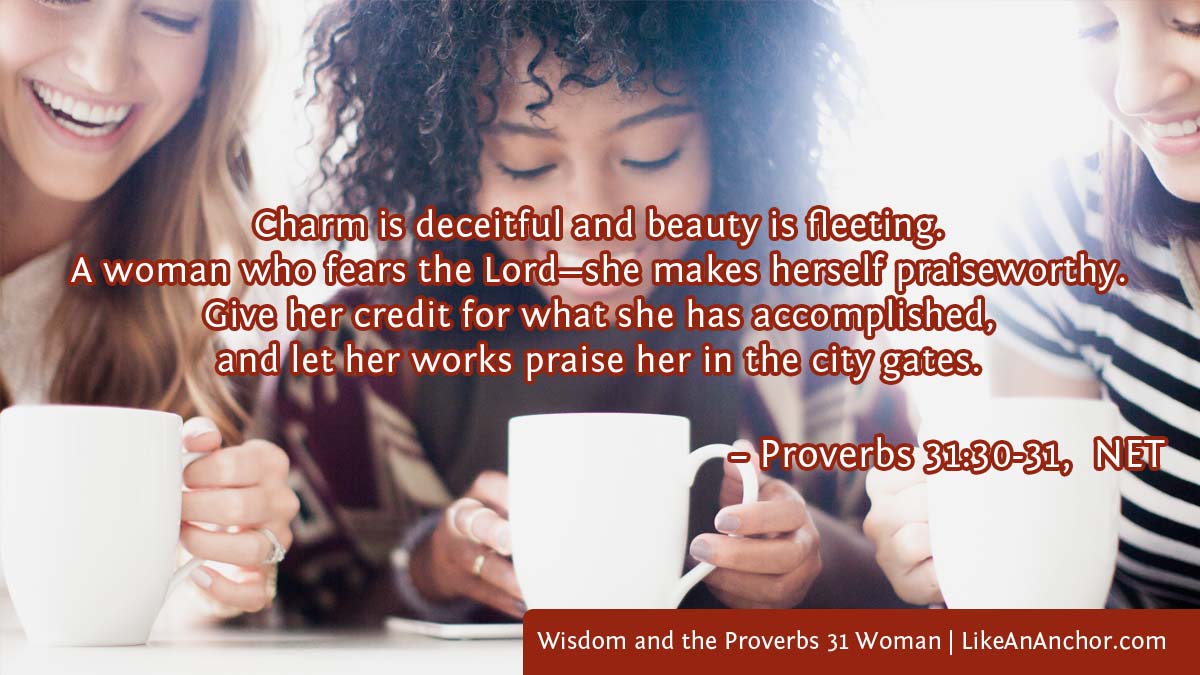
Image of three happy women overlaid with text from – Proverbs 31:30-31,  NET version:  Charm is deceitful and beauty is fleeting. A woman who fears the Lord—she makes herself praiseworthy. Give her credit for what she has accomplished, and let her works praise her in the city gates.
Image by Pearl from Lightstock

Comparing Scriptures Side-By-Side

King Lemuel is a mysterious figure. We don’t know anything about him other than that his mother gave him the advice recorded in Proverbs. There are no other clues to his identity or where and when he ruled. The first part of Proverbs 31 focuses on advice about being a good king (Prov. 31:2-9). The advice includes don’t spend all your energy enjoying women and alcohol, secure legal rights for those who can’t speak for themselves, and judge righteously.

The remainder of the chapter is the famous “Who can find a virtuous woman?” passage. In Hebrew, this is an acrostic poem (each verse starts with the letters of the Hebrew alphabet, in order). It has often been read as a template for all godly women, though this seems to be stretching the meaning. For one thing, the woman talked about here is a wife and mother, which leaves some of the roles she fills out of reach for single or childless women. For another, the woman is wealthy and entrepreneurial, something that is not necessarily true of all godly women. If this is part of Lemuel’s mother’s advice for her son, we can read this as a description of the type of wife King Lemuel’s mother wanted him to look for. We can apply it more broadly as a pattern of wisdom and valor that both women and men can learn from (see NET study note on Prov. 31:10), but it does not seem that Proverbs 31:10-31 is meant as an exact pattern all women must follow.

Remember this quote we started with: “The poem captures all the themes of wisdom that have been presented in the book and arranges them in this portrait of the ideal woman” (Claudia V. Camp, qtd. in NET study note on Prov. 31:10). In light of that thought, I thought it might be interesting to put the virtuous woman passage alongside some of the sections of Proverbs where wisdom is personified as a woman.

Who can find a worthy woman?
For her value is far above rubies.

Proverbs 31:10, WEB

For wisdom is better than rubies.
All the things that may be desired can’t be compared to it.

Proverbs 8:11, WEB

The heart of her husband trusts in her.
He shall have no lack of gain.
She does him good, and not harm,
all the days of her life. …

Her husband is respected in the gates,
when he sits among the elders of the land.

Proverbs 31:11, 23, WEB

Wisdom is supreme.
Get wisdom.
Yes, though it costs all your possessions, get understanding.
Esteem her, and she will exalt you.
She will bring you to honor when you embrace her.
She will give to your head a garland of grace.
She will deliver a crown of splendor to you.

Proverbs 4:7-9, WEB

She seeks wool and flax,
and works eagerly with her hands.
She is like the merchant ships.
She brings her bread from afar. …

She arms her waist with strength,
and makes her arms strong.
She perceives that her merchandise is profitable. …

She makes linen garments and sells them,
and delivers sashes to the merchant.
Strength and dignity are her clothing.
She laughs at the time to come. …

Give her of the fruit of her hands!
Let her works praise her in the gates!

Proverbs 31:13-14, 17-18a, 24-25, 31 WEB

“I, wisdom, have made prudence my dwelling.
Find out knowledge and discretion. …
With me are riches, honor,
enduring wealth, and prosperity.
My fruit is better than gold, yes, than fine gold,
my yield than choice silver.
I walk in the way of righteousness,
in the middle of the paths of justice,
that I may give wealth to those who love me.
I fill their treasuries.”

Proverbs 8:12, 18-21, WEB

She opens her arms to the poor;
yes, she extends her hands to the needy.
She is not afraid of the snow for her household,
for all her household are clothed with scarlet. …

She opens her mouth with wisdom.
Kind instruction is on her tongue.
She looks well to the ways of her household,
and doesn’t eat the bread of idleness.

Proverbs 31:20-21, 26-27, WEB

Wisdom has built her house.
She has carved out her seven pillars.
She has prepared her meat.
She has mixed her wine.
She has also set her table.
She has sent out her maidens.
She cries from the highest places of the city:
“Whoever is simple, let him turn in here!”
As for him who is void of understanding, she says to him,
“Come, eat some of my bread,
Drink some of the wine which I have mixed!
Leave your simple ways, and live.
Walk in the way of understanding.”

Proverbs 9:1-6, WEB

Charm is deceitful, and beauty is vain;
but a woman who fears Yahweh, she shall be praised.

Proverbs 31:30, WEB

The fear of Yahweh is the beginning of wisdom.
The knowledge of the Holy One is understanding.
For by me your days will be multiplied.
The years of your life will be increased.

Proverbs 9:10-11, WEB

Virtue and Wisdom

Image of a man and woman studying the Bible together, overlaid with blog's title text and the words, " The "virtuous woman" of Proverbs 31 isn't just a list of things for godly women to do. It's something men and women can learn from as we apply the Book of Proverbs' lessons about wisdom in our lives."
Image by Anggie from Lightstock

Modern readers often think of “virtue,” particularly related to women, as involving chastity and meekness. There’s a lot more to it than that, though. Proverbs 31:10 is one of several passages where the meaning has become obscured at the English language changes. Back in 1611, King James translators chose “virtuous woman” knowing that the word had been connected with “moral life and conduct, uprightness of life, the opposite of vice; a particular moral excellence” since around the year 1200 (“virtue,” etymonline.com). They may have chosen “virtue” instead of “valor” because around the 1590s, “virtue” also started to refer to women’s “chastity, sexual purity,” but it was an accurate translation choice at the time. Modern translations typically try to get away from those connotations of “virtuous” by using phrases like “a worthy woman” (WEB), “a wife of noble character” (NET, NIV), or “a capable wife” (CJB).

“a woman of valor.” This is the same expression used to describe Ruth (e.g., Ruth 3:11). The term חַיִל (khayil) here means “moral worth” (BDB 298 s.v.); cf. KJV “a virtuous woman.” Elsewhere the term is used of physical valor in battle, e.g., “mighty man of valor,” the land-owning aristocrat who could champion the needs of his people in times of peace or war (e.g., Judg 6:12). Here the title indicates that the woman possesses all the virtues, honor, and strength to do the things that the poem will set forth.

NET translation note on Prov. 31:10

The Proverbs 31 portrait of a woman who posses moral worth, virtues, honor, and strength isn’t just a list of things that godly women should do (a list which, as I have written about before, can seem intimidating or out of reach for some women). It is an example of what godly women can look like, the conclusion to the Book of Proverbs, and perhaps a continuation of themes personifying wisdom as feminine. This is a passage that men and women can learn from, particularly in the sense of examples for how to apply wisdom in our lives.


Featured image by MarrCreative from Lightstock

What if the Proverbs 31 Woman Was Less Intimidating?

When I’m in a group of church ladies and someone mentions the Proverbs 31 woman, there’s often a collective groan. She’s such a high standard of Biblical womanhood that she seems intimidating–like we’ll never measure up to something like her and even suggesting we should is a scary thought. But is that really why she’s here at the end of Proverbs? To make us feel bad about ourselves or to show us exactly what a godly woman looks like? Maybe there’s a way that we can find her encouraging rather than threatening.

I will be addressing this post mostly to the women reading, and using words like “we” throughout. I apologize to the guys this leaves out. I hope you might still find some value in reading this, though. Perhaps you’ll think of it next time you read Proverbs, or the Proverbs 31 woman comes up in conversation, or one of the women in your life is feeling discouraged.

Translating Chayil

When we first start reading about the Proverbs 31 woman, we see a question. In the familiar King James it reads, “Who can find a virtuous woman?” (Prov. 31:10, KJV). I wrote about the translation choice here years ago in a post called “Mighty Women.” The Hebrew word translated “virtuous” is chayil (Strongs H2428). According to the Theological Wordbook of the Old Testament, this word basically means “strength,” which leads to translations like “power,” “might,” “valiant,” “army,” and “wealth” depending on how the word is used in context. Chayil is used of God’s power about 20 times, and of “valiant men,” “able men,” or “mighty men of valor” about 85 times (TWOT, 624a). Now look at how the word is translated in the KJV when used of women:

And now, my daughter, fear not; I will do to thee all that thou requirest: for all the city of my people doth know that thou art a virtuous woman. 

Ruth 3:11, KJV

A virtuous woman is a crown to her husband: but she that maketh ashamed is as rottenness in his bones. 

Proverbs 12:4, KJV

Who can find a virtuous woman? for her price is far above rubies … Many daughters have done virtuously, but thou excellest them all. 

Proverbs 31:10, 29, KJV

Now, to be fair, “virtue” originally meant “force; strength; vigor; moral strength” (Online Etymology Dictionary). However, by the 1590s (before the 1611 release of the KJV), it had taken on the meaning of “especially (in women) ‘chastity, sexual purity.'” The KJV translators only used “virtue” for chayil when it’s used for women. Modern translations often opt to soften the sex-based translation choice by using “worthy,” “noble,” and occasionally “valiant” in these verses (see Ruth 3:11; Prov. 12:4; 31:10, 29 in WEB and NET).

Fixing the translation probably doesn’t make her any less intimidating of a role model, though. “Virtuous” carries some historical baggage, but noble, worthy, and valiant are still high standards to live up to. I find the more accurate translation a little more inspiring, though. And maybe clarifying how to translate chayil is a good starting point for approaching the whole Proverbs 31 passage differently than we may have in the past.

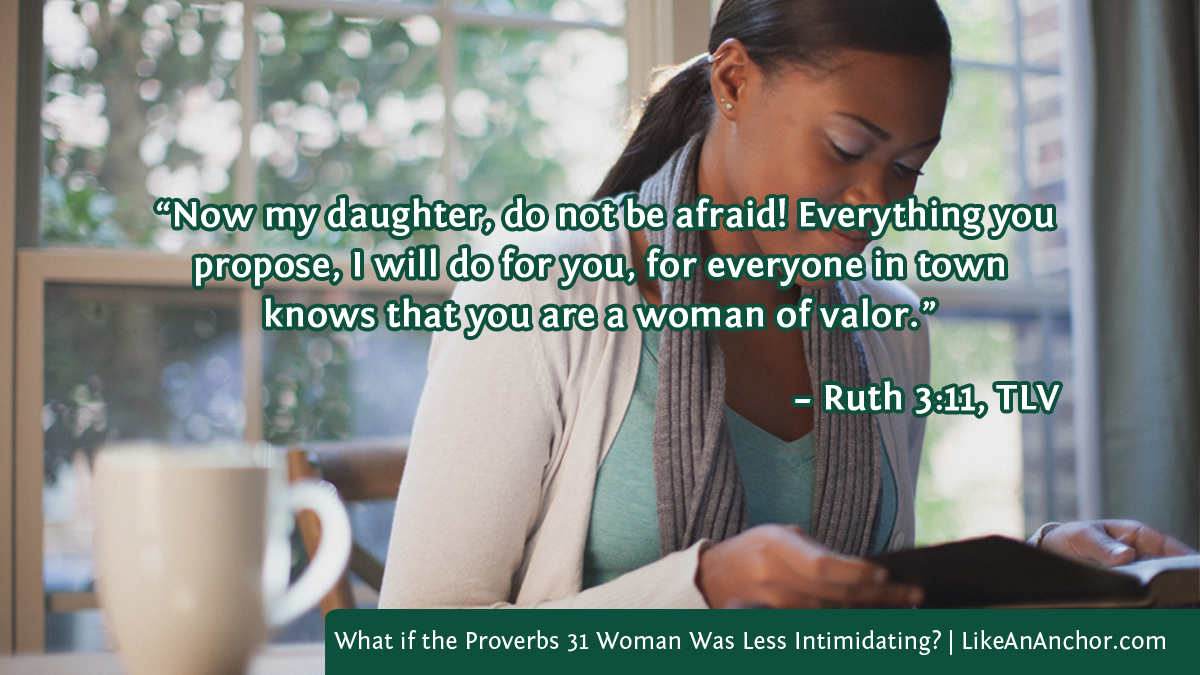
Image of a woman reading a Bible overlaid with text from Ruth 3:11, TLV version: "Now my daughter, do not be afraid! Everything you propose, I will do for you, for everyone in town knows that you are a woman of valor.”
Image by Pearl from Lightstock

A Mother’s Advice

It had been a while since I’d read through Proverbs, but not long ago I found myself back there reading Proverbs 31. (I think it was for one of the scripture writing studies our ladies’ group is doing at church.) This was the first time I’d read it since I’d started thinking about planning a wedding. I was also reading it, I think for the first time, in the NET translation. I’ll just quote the whole passage here so we can look at it together:

1 The words of King Lemuel, an oracle that his mother taught him: …

10 Who can find a wife of noble character?
For her value is far more than rubies.
11 Her husband’s heart has trusted her,
and he does not lack the dividends.
12 She has rewarded him with good and not harm
all the days of her life.
13 She sought out wool and flax,
then worked happily with her hands.
14 She was like the merchant ships;
she would bring in her food from afar.
15 Then she rose while it was still night,
and provided food for her household and a portion to her female servants.
16 She considered a field and bought it;
from her own income she planted a vineyard.
17 She clothed herself in might,
and she strengthened her arms.
18 She perceived that her merchandise was good.
Her lamp would not go out in the night.
19 She extended her hands to the spool,
and her hands grasped the spindle.
20 She opened her hand to the poor,
and extended her hands to the needy.
21 She would not fear for her household in winter,
because all her household were clothed with scarlet,
22 because she had made coverings for herself;
and because her clothing was fine linen and purple.
23 Her husband is well-known in the city gate
when he sits with the elders of the land.
24 She made linen garments then sold them,
and traded belts to the merchants;
25 her clothing was strong and splendid;
and she laughed at the time to come.
26 She has opened her mouth with wisdom,
with loving instruction on her tongue.
27 Watching over the ways of her household,
she would not eat the bread of idleness.
28 Her children have risen and called her blessed;
her husband also has praised her:
29 “Many daughters have done valiantly,
but you have surpassed them all!”
30 Charm is deceitful and beauty is fleeting.
A woman who fears the Lord—she makes herself praiseworthy.
31 Give her credit for what she has accomplished,
and let her works praise her in the city gates.

Proverbs 31:1, 10-31, NET

I like starting with the beginning of chapter 31 because that clarifies the context for this passage. This whole chapter is advice from a mother to her son. It’s about the type of woman he should want to marry and how highly he ought to value that woman.

That’s an important piece of information. It clarifies that the stated purpose of this passage is not to say, “Here’s the type of woman that all women should be.” We can use Proverbs 31:10-31 as an example of a good woman who follows the Lord, but it’s not a prescriptive list for everyone. It’s also specifically about married women; there are aspects which can relate to singles but not the whole thing.

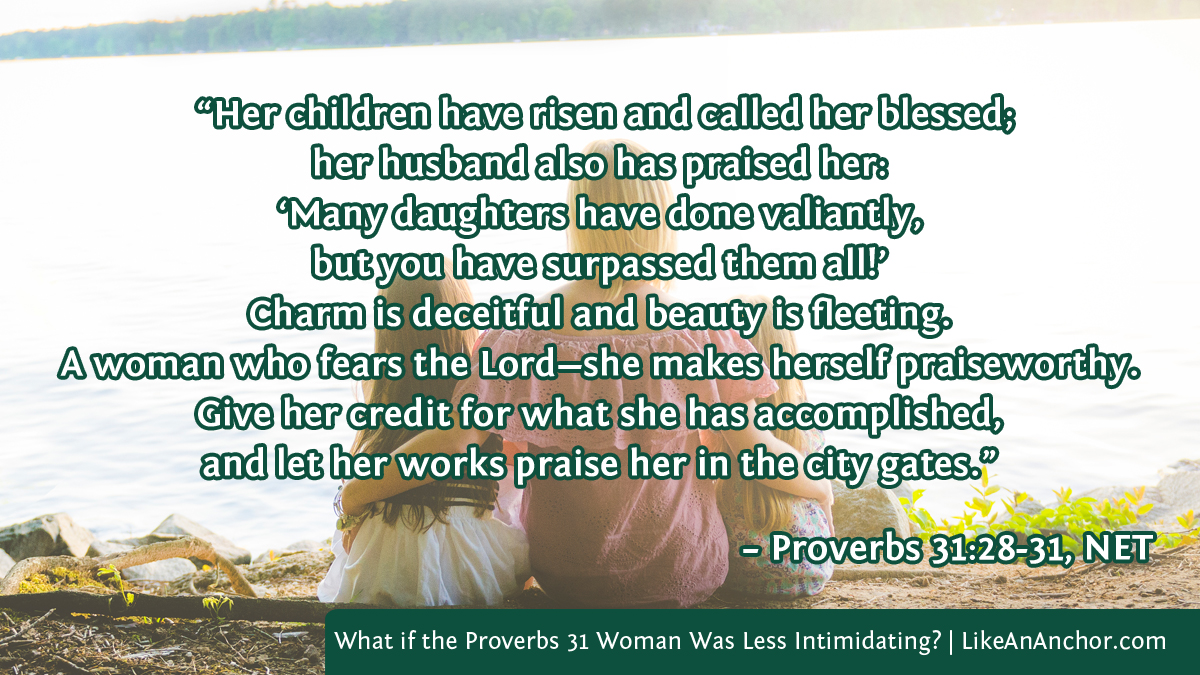
Image of a woman with her arms around two little girls overlaid with text from Proverbs 31:28-31, NET version: “Her children have risen and called her blessed; her husband also has praised her: ‘Many daughters have done valiantly,
but you have surpassed them all!’
Charm is deceitful and beauty is fleeting. A woman who fears the Lord—she makes herself praiseworthy. Give her credit for what she has  accomplished, and let her works praise her in the city gates.”
Image by David Clark Photography from Lightstock

Qualities of the Proverbs 31 Wife

As I read through the description of the Proverbs 31 wife, it seems like many of the specific descriptions could be summed up in general character traits. For example, “She perceived that her merchandise was good … She made linen garments then sold them, and traded belts to the merchants” shows us that she makes quality things and sells them. If we’re going to model her behavior, we don’t need to craft clothing; we need to do something productive with our time and make sure the things we’re producing are good quality. Here are the other qualities that stand out to me while reading:

  • Chayil–noble, strong, valiant
  • Trustworthy
  • Industrious and hardworking
  • A provider for her family and those working for her
  • Creator of quality goods, which she sells
  • Generous to the poor and needy
  • Fearless because she’s prepared
  • Wise and able to instruct
  • God-fearing
  • Accomplished, and given credit and praise for those accomplishments

Depending on when and where you grew up, you might have been told women shouldn’t work a job or get an education. You might have felt like your accomplishments should be hidden lest you appear too intelligent, too proud, or too intimidating. But the exact opposite is happening here.

King Lemuel’s mother supports the idea of a wife who works a job (specifically, her own business that she runs from her house while also caring for her family), manages and invests her own money, has wisdom and knowledge that she teaches to others, and who is publicly praised for her accomplishments. And that’s the kind of woman that she tells her son he should hope to find in a wife. (Perhaps the person who said no Christian guy would marry me after I got my bachelor’s degree should reread this chapter.)

We’re All Still Growing

Image of three women holding Bibles and talking with the blog's title text and the words "Becoming a valiant woman of strength, virtue, and courage is a process. The Proverbs 31 woman isn’t a standard to judge you against, but a friend you can imitate as you grow."
Image by Shaun Menary from Lightstock

When I read the Proverbs 31 woman passage most recently, I realized I didn’t find her all that intimidating. I wanted to mimic her, but in a good way rather than like I was under a weight of pressure. I want to be a wife for my soon-to-be husband who improves his life by being with him. And this passage reassures me I can do that with my talents, gifts, accomplishments, and knowledge.

Also, as I read this passage, I remember that God calls people “perfect” as long as they’re following Him and working toward perfection. Maybe the same is true here. If you’re working on following the Lord and growing as a woman of noble character, then perhaps you too can be described in the glowing terms of praise used here. I know many women–my mother, ladies at church, friends–who I’d say line up with this description of the Proverbs 31 woman pretty much exactly even though I know they’d say they’re far from perfect.

Reading passages like this, where we’re given an ideal to strive toward, should inspire us to keep doing our best and keep growing. Remember, our goal is “to build up the body of Christ, until we all attain to the unity of the faith and of the knowledge of the Son of God—a mature person, attaining to the measure of Christ’s full stature.” (Eph. 4:12-13, NET). That doesn’t all happen at once, and that’s okay. There’s a reason the Christian life is described as one of growing and building. It’s a process, and becoming a valiant woman of strength, virtue, and courage is no exception to that rule. So maybe next time you read Proverbs 31, think of her not as a standard to judge you against, but as a friend you can imitate as you grow.


Featured image by Shaun Menary from Lightstock

Song Recommendation: “Overcomer” by Mandisa

Mighty Women

It seems odd to me that I’ve read the “virtuous woman” passage scores of times without bothering to look up the word “virtuous.” The Hebrew word, chayil, was mentioned in the first message given as my Feast of Tabernacles (Sukkot) site this year. I even had it in my notes, but forgot about it. God brought it to my attention again at the end of the Feast, when a man handed me a booklet titled “A Mighty Warrior: The Hebrew-Biblical View of A Woman” by Dr. Frank T. Seekins. I can take a hint — one Bible study/blog post coming right up!

Mighty Women | marissabaker.wordpress.com

Into The Hebrew

Chayil (H2428) carries the basic meaning of “‘strength,’ from which follow ‘army’ and ‘wealth'”(Theological Wordbook OT, entry 624). It’s used about 20 times of God’s might or power, and about 85 times to describe an attribute of people.

When chayil is used of people, there’s a marked difference in how it’s translated for men and women. For men, we find translations like “mighty man” or “mighty men of valor.” The Theological Wordbook of the Old Testament notes, “The individual designated seems to be the elite warrior similar to the hero of the Homeric epic.” For women, however, “it is translated ‘virtuous’ (ASV, RSV ‘worthy’ or ‘good’), but it may well be that a woman of this caliber had all the attributes of her male counterpart.”

While Biblical women were not typically warriors and did not serve in the army, we do have the example of Deborah acting the part of a “mighty woman of valor.” We also know from passages like Ephesians 6:11-13 and 2 Timothy 2:3-4 that all Christians are spiritual warriors. God’s women must be just as valiant as His men!

Your neck is like the tower of David, built for an armory, on which hang a thousand bucklers, all shields of mighty men. (Song 4:4)

O my love, you are as beautiful as Tirzah, lovely as Jerusalem, awesome as an army with banners! (Song 6:4)

Both these passages from Song of Solomon are descriptions that the male lover, who represents Christ, uses toward the female lover, who represents the church. Great men aren’t frightened of strong women; they embrace them as allies.

A Little More History

You might wonder why English translators decided to use “virtuous” or “good”for chayil when the Hebrew leans more toward “strong” and “mighty.” I suspect there were two reasons. Firstly, the original meaning of “virtue” in English was closer to chayil. It arrived in English around 1200 from Old French with the meanings, “force; strength; vigor; moral strength.” Originally, the Latin virtatum meant “high character; goodness; manliness; valor; bravery” (Online Etymology Dictionary).

Secondly, with prevailing attitudes of gender around the time early Bibles like the 1611 King James Version were released, translators were probably hesitant to call women “mighty” or “powerful.” By the 1590s, “virtuous” was losing the more martial aspects of the meaning, shifting toward moral characteristics. In reference to women, “virtuous” became used as a synonym for “chastity.” In the King James Version you can still see this word used for “power” in the New Testament passages where dunamis (G1411) is translated “virtue” (Mark 5:30; Luke 6:19, 8:46). In the New King James, references to Christ were changed from “virtue” to “power,” but the “virtuous woman” in Proverbs 31 only changes to a “virtuous wife.”

It’s true that high moral standards are essential for godly women. Commands regarding modesty and chastity are recorded elsewhere (1 Tim. 2:9), and the character of the Proverbs 31 woman is beyond reproach. But there’s more to being a “virtuous woman” than we might assume from what we’ve grown up hearing about “traditional gender roles.” The word “virtue” has suffered a similar fate as “meekness,” which our culture thinks of as synonymous with “doormat” while the original meaning carried the idea of strength submitted to God.

Mighty Women | marissabaker.wordpress.com

Allies in Battle

God created men and women to fight for Him together. They’re both supposed to be strong and they’re both supposed to support each other.

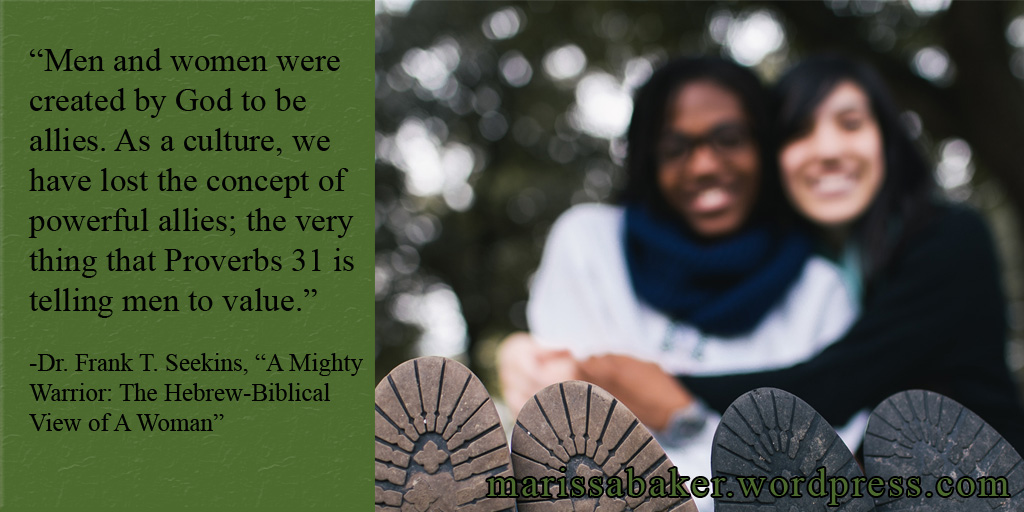
Men and women were created by God to be allies. As a culture, we have lost the concept of powerful allies; the very thing that Proverbs 31 is telling men to value. …

When a woman’s power is undercut, a situation is created where men and women become enemies. Instead of supporting each other, we battle and undermine God’s call to reflect Jesus relationship with His bride, the church. …

The Biblical concept is clear — A woman of power is to be valued and supported. It is God’s call for women (and men) to become mighty and powerful. (Seekins, p. 2)

I think many women balk at the Proverbs 31 model because it seems so domestic and submissive. “I don’t want to be a stay-at-home barefoot-and-pregnant good little wife,” some protest. “Why would God ask for such an outdated model of femininity?” But when we look closer at Proverbs 31, we find that’s not actually what it’s saying.

The first two descriptions show a woman who does her husband “good and not evil,” and who has earned his complete trust (Prov. 31:11-12). Her husband is respected by all, and it’s implied this is in no small part owing to her support as his ally (Prov. 31:23). In addition, she cares for the poor and needy, practicing the command to “love your neighbor” (Prov. 31:20). She’s respected by her children, husband and the community, and her opinion is highly valued (Prov. 31:28-29, 31).

The Proverbs 31 woman is shown actively doing productive things. She works with her hands, engages in trade “like the merchant’s ships,” and oversees workers in her household (Prov. 31:13-16, 19, 22, 24). She’s not full of anxiety because she has confidence in her ability to care for her business and family (Prov. 31:18, 21, 27).

Strength and honor are her clothing; she shall rejoice in time to come. She opens her mouth with wisdom, and on her tongue is the law of kindness. (Prov. 31:25-26)

It’s still an intimidating picture to try and live up to, but there’s no reason to reject it as demeaning to women. If anything, this “outdated” model is far more powerful than anything modern women’s empowerment movements have come up with.

When a woman understands her calling to be a mighty warrior and a perfect ally, she will conquer and control life. She will remember that the men in her life are not the enemy; her weapons are not meant to be used against them. The weapons of her strength and power are to be used against their enemies (Seekins, p. 23).

God calls all of us to “be strong in the Lord and in the power of His might” (Eph. 6:10). Both men and women need to recognize this, and embrace our roles as “heirs together of the grace of life” (1 Pet. 3:7), fighting as allies for and alongside the Captain of our Salvation, Jesus Christ.

Save