
Two Sabbaths ago, my dad gave a message in our church group about personal revival, specifically on the topic of rekindling a waning interest in Bible study. I was feeling a bit down emotionally at the start of that following week, and I remembered he mentioned a Hebrew word often translated “revive” that I thought it might be encouraging to look at more closely. It turned into such an interesting study that I didn’t get this post finished for last week and skipped posting so I could spend two weeks studying and writing.
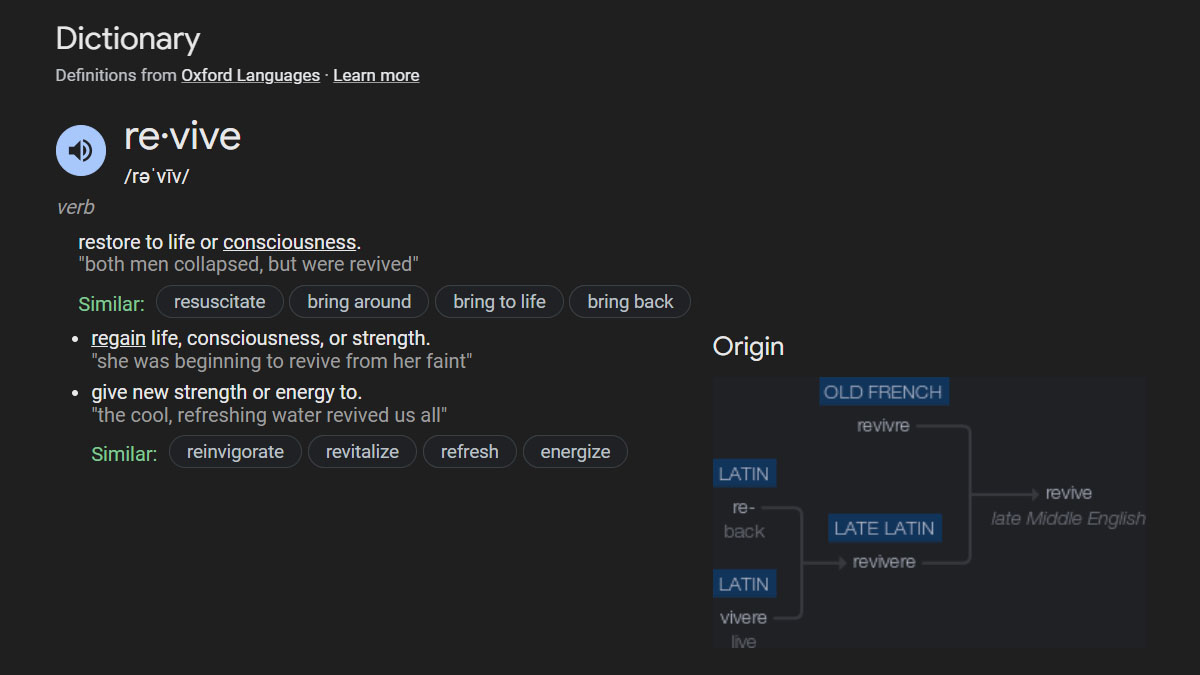
The Hebrew word in question is chayah or haya (depending on how you want to transliterate it into the English alphabet). It’s Strong’s number H2421 and entry 644 in the Theological Wordbook of the Old Testament (TWOT), where the authors devote nearly three full pages to haya and its derivatives. It’s a very important word in the Old Testament writings, with the root word appearing 270 times, and it’s translated as “live,” “alive,” “quicken,” “nourish,” “recover,” and “revive” (along with a few other less frequent phrases) in the King James Version. The closely related derivative chay (H2416) appears 498 times, and it’s most often translated “life” or something that is alive, e.g. “a living thing.” Today, let’s take a closer look at these words and see what we can learn.
“Life” In Hebrew
The TWOT says the root verb haya means “to live or have life” (in the simple Qal stem) or “giving or restoring life” (in the word’s two other verb stems) (p. 279). The “range of meaning” also includes “‘to preserve or sustain life’ or ‘to nourish’ … ‘or to restore to health, to heal, recover'” (p. 280). Key to understanding this word is that it is usually very concrete rather than an abstract idea.
“The OT speaks of life as the experience of life rather than as an abstract principle of vitality which may be distinguished from the body. This is because the OT view of the nature of man is holistic, that is, his function as body, mind, spirit is a unified whole spoken of in very concrete terms. Life is the ability to exercise all one’s vital power to the fullest; death is the opposite.”
R. Laird Harris, Gleason L. Archer, Jr., and Bruce K. Waltke; TWOT entry 644, p. 279
We might think this is a very different viewpoint from the New Testament, but that’s because we’ve been influenced by modern ideas about people being bodies with spirits or souls rather than unified wholes. The idea that humans have a soul that’s separate and immortal came into Christianity from Neoplatonic philosophy about 200-300 years after Christ’s human life (see “Rethinking Heaven: Capturing A Vision Of The Resurrection” and “Relational Faith: A Book Review and Theological Reflection“). We’re “spirit, soul, and body” (1 Thes. 5:23, WEB) as a unified whole, living our lives as human beings made in God’s image.
While chayah can have slightly “less concrete” meanings, such as living “by the words of God ‘not by bread alone’ (Deut 8:3; Ps 119:50, 93)” even these uses are grounded in “the biblical unity of man’s nature” and seem to refer to both physical “prosperity as the gift of obedience” and “the spiritual quality of life” (TWOT, p. 280). There are also hints in the Old Testament that chayah refers to the eternal, spiritual life God offers after death, not just the physical life that He gives us (Ps. 49:9; Prov. 12:28; 15:24; Dan. 12:2). The concreteness of the word ties in well with the Biblical teaching that there will be a bodily resurrection (i.e. we’ll be resurrected as spirit beings with spirit bodies, not something ghostly or disembodied).
Walking with God for Life
Since chayah is used so many times in the Bible, I thought I’d focus today’s study on the ways that it’s used in the Psalms (just to make things a little more manageable). I did this by looking up chayah (H2421) and chay (H2416) with the program eSword, which yielded 82 matches in the psalms (31 chayah, 51 chay). This includes several categories of verses, including ones describing God as “the living God” (Ps. 42:2; 84:2) and talking about us being in the “land of the living” (Ps. 27:13; 56:13; 142:5). I want to focus, though, on the ones that speak of how God impacts our lives (click for examples).
Surely goodness and loving kindness shall follow me all the days of my life,
Psalm 23:6, WEB
and I will dwell in Yahweh’s house forever.
The much beloved Psalm 23 shows Yahweh’s involvement with David’s whole life (and ours as well). God is the shepherd who provides all our needs, restores our souls, guides us, guards us, and comforts us. Chay appears in the last verse, providing a conclusion to the short psalm. When we remember that the life represented by chay can involve nuances of preserving, sustaining, nourishing, and reviving, it deepens our understanding of the quality of life that God wants to give us.
In another section of scripture, Jesus said, “I have come so that they may have life, and may have it abundantly. I am the good shepherd” (John 10:10-11, NET). Obviously, the word chay doesn’t appear here because the New Testament was written in Greek rather than Hebrew, but I think we can see how the meaning is connected. God wants our lives to be good, not just abstractly but in a real, tangible way.
I have set Yahweh always before me.
Psalm 16:8-11, WEB (footnote on v. 10: “Sheol is the place of the dead”)
Because he is at my right hand, I shall not be moved.
Therefore my heart is glad, and my tongue rejoices.
My body shall also dwell in safety.
For you will not leave my soul in Sheol,
neither will you allow your holy one to see corruption.
You will show me the path of life.
In your presence is fullness of joy.
In your right hand there are pleasures forever more.
As with Psalm 23, chay appears in the conclusion of Psalm 16 (also a psalm of David). Long after David’s death, the apostle Peter said that this Psalm is really “about the resurrection of the Christ, that he was neither abandoned to Hades, nor did his body experience decay” (Acts 2:31, NET [italics mark allusions to Psalm 16]). David was a prophet, and he knew he was writing about one of his descendants who would be the Messiah/Christ (Acts 2:22-33). A lot of this psalm also feels personal, though, and I suspect that we can read it on both levels: a messianic prophecy and an expression of David’s assurance that God will take care of him.
I’m not sure how much David understood about God’s ultimate plan to bring human beings into His family, but it is accurate that God won’t leave us in the grave forever. It’s also accurate to say that he shows us “the path of life” in multiple senses: the path to walk in order to have a good life here on this earth, and the path to eternal life with God forever.
Revival from God

I find it ironic that I’ve been struggling to focus on and finish this study, which was inspired by a message about reviving a waning interest in Bible study. For some reason, I’ve just had a very hard time for this post with going from reading Bible scriptures to knowing how to put them together and what to say about them.
In the Psalms, there are several times where chay or chayah are translated “revive” (as well as the more common “life” or “live”). It shows up a lot in Psalm 119. This whole psalm is like a love letter to God’s word; every single verse talks about God’s law, ordinances, statues, precepts, way, etc. Here, we learn that revival (chayah) is found in the words of God.
My soul is laid low in the dust.
Psalm 119:25, WEB
Revive me according to your word!
I will never forget your precepts,
Psalm 119:93, WEB
for with them, you have revived me.
Hear my voice according to your loving kindness.
Psalm 119:149, WEB
Revive me, Yahweh, according to your ordinances.
It seems that the solution to my problem focusing on study is to persistently come back to God and His word even if it takes a while for things to come together and make sense. In fact, that’s the solution to all of our problems. It’s not like there’s anywhere else to go for answers. As Peter said when Jesus asked if the twelve wanted to go away after several other disciples decided not to listen to Him anymore, “Lord, to whom would we go? You have the words of eternal life” (John 6:68, NET).
We can physically survive without having a relationship with God, but we can’t have full, abundant, and eventually eternal life apart from Him. He doesn’t promise that we’ll never have tough times or difficult feelings, but He does promise life-giving revival in Him and His word if we come to Him during those challenges.
Featured image by Sasin Tipchai from Pixabay

Song Recommendation: “Mayim Chaim” by Zemer Levav


 Like An Anchor