Revive Me, Lord

Two Sabbaths ago, my dad gave a message in our church group about personal revival, specifically on the topic of rekindling a waning interest in Bible study. I was feeling a bit down emotionally at the start of that following week, and I remembered he mentioned a Hebrew word often translated “revive” that I thought it might be encouraging to look at more closely. It turned into such an interesting study that I didn’t get this post finished for last week and skipped posting so I could spend two weeks studying and writing.

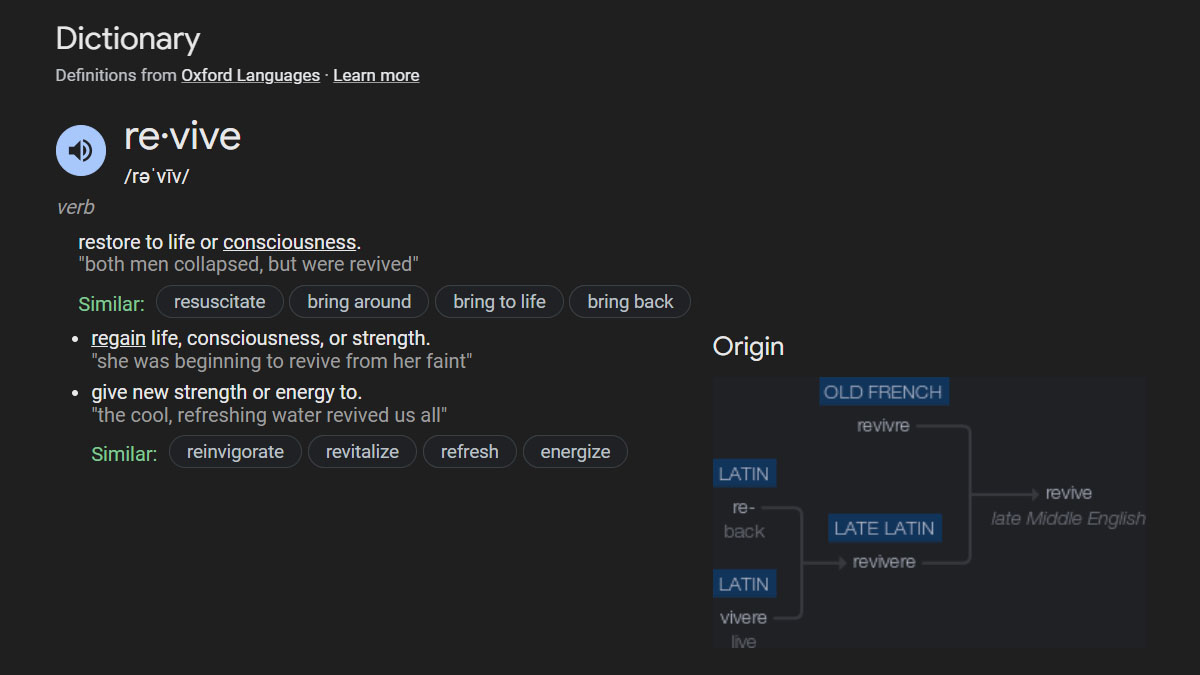
The Hebrew word in question is chayah or haya (depending on how you want to transliterate it into the English alphabet). It’s Strong’s number H2421 and entry 644 in the Theological Wordbook of the Old Testament (TWOT), where the authors devote nearly three full pages to haya and its derivatives. It’s a very important word in the Old Testament writings, with the root word appearing 270 times, and it’s translated as “live,” “alive,” “quicken,” “nourish,” “recover,” and “revive” (along with a few other less frequent phrases) in the King James Version. The closely related derivative chay (H2416) appears 498 times, and it’s most often translated “life” or something that is alive, e.g. “a living thing.” Today, let’s take a closer look at these words and see what we can learn.
“Life” In Hebrew

The TWOT says the root verb haya means “to live or have life” (in the simple Qal stem) or “giving or restoring life” (in the word’s two other verb stems) (p. 279). The “range of meaning” also includes “‘to preserve or sustain life’ or ‘to nourish’ … ‘or to restore to health, to heal, recover'” (p. 280). Key to understanding this word is that it is usually very concrete rather than an abstract idea.

“The OT speaks of life as the experience of life rather than as an abstract principle of vitality which may be distinguished from the body. This is because the OT view of the nature of man is holistic, that is, his function as body, mind, spirit is a unified whole spoken of in very concrete terms. Life is the ability to exercise all one’s vital power to the fullest; death is the opposite.”

R. Laird Harris, Gleason L. Archer, Jr., and Bruce K. Waltke; TWOT entry 644, p. 279

We might think this is a very different viewpoint from the New Testament, but that’s because we’ve been influenced by modern ideas about people being bodies with spirits or souls rather than unified wholes. The idea that humans have a soul that’s separate and immortal came into Christianity from Neoplatonic philosophy about 200-300 years after Christ’s human life (see “Rethinking Heaven: Capturing A Vision Of The Resurrection” and “Relational Faith: A Book Review and Theological Reflection“). We’re “spirit, soul, and body” (1 Thes. 5:23, WEB) as a unified whole, living our lives as human beings made in God’s image.

While chayah can have slightly “less concrete” meanings, such as living “by the words of God ‘not by bread alone’ (Deut 8:3; Ps 119:50, 93)” even these uses are grounded in “the biblical unity of man’s nature” and seem to refer to both physical “prosperity as the gift of obedience” and “the spiritual quality of life” (TWOT, p. 280). There are also hints in the Old Testament that chayah refers to the eternal, spiritual life God offers after death, not just the physical life that He gives us (Ps. 49:9; Prov. 12:28; 15:24; Dan. 12:2). The concreteness of the word ties in well with the Biblical teaching that there will be a bodily resurrection (i.e. we’ll be resurrected as spirit beings with spirit bodies, not something ghostly or disembodied).
Walking with God for Life

Since chayah is used so many times in the Bible, I thought I’d focus today’s study on the ways that it’s used in the Psalms (just to make things a little more manageable). I did this by looking up chayah (H2421) and chay (H2416) with the program eSword, which yielded 82 matches in the psalms (31 chayah, 51 chay). This includes several categories of verses, including ones describing God as “the living God” (Ps. 42:2; 84:2) and talking about us being in the “land of the living” (Ps. 27:13; 56:13; 142:5). I want to focus, though, on the ones that speak of how God impacts our lives (click for examples).

Surely goodness and loving kindness shall follow me all the days of my life,
    and I will dwell in Yahweh’s house forever.

Psalm 23:6, WEB

The much beloved Psalm 23 shows Yahweh’s involvement with David’s whole life (and ours as well). God is the shepherd who provides all our needs, restores our souls, guides us, guards us, and comforts us. Chay appears in the last verse, providing a conclusion to the short psalm. When we remember that the life represented by chay can involve nuances of preserving, sustaining, nourishing, and reviving, it deepens our understanding of the quality of life that God wants to give us.

In another section of scripture, Jesus said, “I have come so that they may have life, and may have it abundantly. I am the good shepherd” (John 10:10-11, NET). Obviously, the word chay doesn’t appear here because the New Testament was written in Greek rather than Hebrew, but I think we can see how the meaning is connected. God wants our lives to be good, not just abstractly but in a real, tangible way.

 I have set Yahweh always before me.
    Because he is at my right hand, I shall not be moved.
Therefore my heart is glad, and my tongue rejoices.
    My body shall also dwell in safety.
For you will not leave my soul in Sheol,
    neither will you allow your holy one to see corruption.
You will show me the path of life.
    In your presence is fullness of joy.
In your right hand there are pleasures forever more.

Psalm 16:8-11, WEB (footnote on v. 10: “Sheol is the place of the dead”)

As with Psalm 23, chay appears in the conclusion of Psalm 16 (also a psalm of David). Long after David’s death, the apostle Peter said that this Psalm is really “about the resurrection of the Christ, that he was neither abandoned to Hades, nor did his body experience decay” (Acts 2:31, NET [italics mark allusions to Psalm 16]). David was a prophet, and he knew he was writing about one of his descendants who would be the Messiah/Christ (Acts 2:22-33). A lot of this psalm also feels personal, though, and I suspect that we can read it on both levels: a messianic prophecy and an expression of David’s assurance that God will take care of him.

I’m not sure how much David understood about God’s ultimate plan to bring human beings into His family, but it is accurate that God won’t leave us in the grave forever. It’s also accurate to say that he shows us “the path of life” in multiple senses: the path to walk in order to have a good life here on this earth, and the path to eternal life with God forever.

Revival from God

I find it ironic that I’ve been struggling to focus on and finish this study, which was inspired by a message about reviving a waning interest in Bible study. For some reason, I’ve just had a very hard time for this post with going from reading Bible scriptures to knowing how to put them together and what to say about them.

In the Psalms, there are several times where chay or chayah are translated “revive” (as well as the more common “life” or “live”). It shows up a lot in Psalm 119. This whole psalm is like a love letter to God’s word; every single verse talks about God’s law, ordinances, statues, precepts, way, etc. Here, we learn that revival (chayah) is found in the words of God.

My soul is laid low in the dust.
    Revive me according to your word!

Psalm 119:25, WEB

I will never forget your precepts,
    for with them, you have revived me.

Psalm 119:93, WEB

Hear my voice according to your loving kindness.
    Revive me, Yahweh, according to your ordinances.

Psalm 119:149, WEB

It seems that the solution to my problem focusing on study is to persistently come back to God and His word even if it takes a while for things to come together and make sense. In fact, that’s the solution to all of our problems. It’s not like there’s anywhere else to go for answers. As Peter said when Jesus asked if the twelve wanted to go away after several other disciples decided not to listen to Him anymore, “Lord, to whom would we go? You have the words of eternal life” (John 6:68, NET).

We can physically survive without having a relationship with God, but we can’t have full, abundant, and eventually eternal life apart from Him. He doesn’t promise that we’ll never have tough times or difficult feelings, but He does promise life-giving revival in Him and His word if we come to Him during those challenges.


Featured image by Sasin Tipchai from Pixabay

Song Recommendation: “Mayim Chaim” by Zemer Levav

Keep Planting, Even If You’re Weeping

Last week, I’d stayed up later than usual and instead of reading a chapter in Acts before bed, I turned to the Psalms to find a short passage to read. I just happened to open the Bible (a Tree of Life Version that I keep in my nightstand) to Psalm 126. Something about this translation caught my eye, and it prompted today’s post. Here’s the full psalm to start us off:

When Adonai restored the captives of Zion,
it was as if we were dreaming.
Then our mouth was filled with laughter,
and our tongue with a song of joy.
Then they said among the nations,
Adonai has done great things for them.”
Adonai has done great things for us
    —we are joyful!
Restore us from captivity, Adonai,
like streams in the Negev.
Those who sow in tears
will reap with a song of joy.
Whoever keeps going out weeping,
    carrying his bag of seed,
will surely come back with a song of joy,
    carrying his sheaves.

Psalm 126, TLV

It’s that last verse that captured my attention: “Whoever keeps going out weeping, carrying his bag of seed, will surely come back with a song of joy, carrying his sheaves.” It might (if you’re at all familiar with American gospel songs and Protestant hymns) make you think of the 1874 hymn “Bringing in the Sheaves.” For me, the part that captured my attention is this “keeps going out” line.

Keeping Going Out

In Psalm 126:6, some translations simply say, “He who goes out weeping” (WEB) but the TLV and others like the NKJV include this sense of continuing to go out while you’re weeping. The setting for this psalm is restoration from captivity. Israel had gone into captivity, and now God delivered them and brought them back to the land. The psalmist is looking back on this and making an agricultural analogy.

Suppose you’re in the spring, ready to plant, but something happens. It’s a set back, a tragedy, a calamity, a grief-inducing event. It’s the sort of thing that would make you weep. At that point, you have a choice. You can “keep going out” and sowing into the future, or you could give up. But you know that if you want to reap a harvest, you need to plant seed. Similarly, the metaphorical future “harvest” that we get in our own lives is determined (at least in part) by what we “sow” now.

Do not be deceived. God will not be made a fool. For a person will reap what he sows, because the person who sows to his own flesh will reap corruption from the flesh, but the one who sows to the Spirit will reap eternal life from the Spirit. So we must not grow weary in doing good, for in due time we will reap, if we do not give up.

Galatians 6:7-9, NET

If the agricultural metaphor isn’t working for you, we can relate it to other things with a cause and effect. If you put a steady diet of unhealthy food into your body, you’ll get an unhealthy body; if you eat healthy foods, you’ll have a healthier body. Sowing (like how we eat and whether we exercise) is an investment in the future, for better or worse.

Notice that Paul says “we must not grow weary in doing good” and that we should “not give up.” Sowing is a long-term investment. It takes time for the seed to sprout, grow, and bear fruit. We might not see the results of it for quite some time. As Psalm 126 says we need to “keep going out” to sow, trusting that God will give us a good harvest.

Planting In Hope

The word “hope” isn’t used in the psalm that we’re looking at today, but it’s an essential ingredient for what we’re talking about here.

 For it is written in the law of Moses, “Do not muzzle an ox while it is treading out the grain.” God is not concerned here about oxen, is he? Or is he not surely speaking for our benefit? It was written for us, because the one plowing and threshing ought to work in hope of enjoying the harvest. 

1 Corinthians 9:9-10, NET (bold italics mark a quotation from Deut. 25:4)

Here, Paul is saying that teachers of the word have the right to make their living by preaching the gospel (1 Cor. 9). The basic principle is that if you put the work into something, you have a right to expect to enjoy the results of that labor. Hope in the Bible isn’t something nebulous. When hope is related to God, there’s a level of certainty to it. God provides a solid anchorage for our hope (Heb. 6:19), giving us good reason to confidently expect that if we keep going out sowing, we will eventually bring in a harvest with joy.

 Not only this, but we ourselves also, who have the firstfruits of the Spirit, groan inwardly as we eagerly await our adoption, the redemption of our bodies. For in hope we were saved. Now hope that is seen is not hope, because who hopes for what he sees? But if we hope for what we do not see, we eagerly wait for it with endurance.

Romans 8:23-25, NET

Come Back Rejoicing

One of the things that we humans can find frustrating is that God is a long-term thinker. When He promises to give us the desires of our heart, for example (Ps. 37:6), we want that to happen immediately. I didn’t expect it to take 15+ years and a healthy dose of heartache before He answered my prayers to be a wife and mother, but then I found myself marrying a wonderful man and just over a year later having a beautiful daughter with him. I don’t think I’d be so blessed now if I hadn’t continued “sowing into” my life and my relationship with God during the season of weeping.

When we read, “all things work together for good for those who love God, who are called according to his purpose” (Rom. 8:28, NET), we often forget that Paul is talking on a cosmic timescale. Before the statement about all things working together for good, he says, “I consider that our present sufferings cannot even be compared to the coming glory that will be revealed to us” (Rom. 8:18, NET; see Rom. 8:18-30). Sometimes–even often–a harvest of joy happens now, in our human lives. But even if it doesn’t happen now, it will certainly happen at the end if we don’t give up.

My aim is to know him [Jesus Christ], to experience the power of his resurrection, to share in his sufferings, and to be like him in his death, and so, somehow, to attain to the resurrection from the dead.

Not that I have already attained this—that is, I have not already been perfected—but I strive to lay hold of that for which Christ Jesus also laid hold of me. Brothers and sisters, I do not consider myself to have attained this. Instead I am single-minded: Forgetting the things that are behind and reaching out for the things that are ahead, with this goal in mind, I strive toward the prize of the upward call of God in Christ Jesus. Therefore let those of us who are “perfect” embrace this point of view. If you think otherwise, God will reveal to you the error of your ways.

Philippians 3:10-15, NET

Scripture encourages us to look beyond our immediate circumstances with hope, trusting in the glorious future that God has planned for us. Long-term, if we’re going to “reap” the future God promises to His firstfruits, we need to keep pressing on toward the goal of eternal life. It’s this perspective that lets us “consider it nothing but joy when you fall into all sorts of trials, because you know that the testing of your faith produces endurance” and endurance helps bring us to perfection (James 1:2-3, NET). You’ll reap blessings in this life as well (especially if you have a mindset that looks for and recognizes them), but the biggest blessings we have are the opportunity to become God’s children and the promise of eternal life forever with Him after He “harvests” us with great joy.


Featured image by vargazs from Pixabay

Song Recommendation: “Bringing In The Sheaves”

Where Does My Help Come From?

As a new parent, I find myself worrying a lot. What if my baby stops breathing in the middle of the night? What if something falls on her and hurts her? How am I supposed to live with knowing that something bad could happen to her?

I had terrible nightmares when I first came home from the hospital, so bad I woke my husband up a couple times as I frantically looked around to find my baby and make sure she was alright. Someone suggested I could follow James’s instruction to call an elder of the church for prayer and anointing as if I was sick (Jam. 5:14-15). I did, and the nightmares stopped that very night, praise God. I didn’t have another one for over two months, and even then it was more of a normal bad dream than the terror-inducing ones from before.

I wasn’t specifically directing these worry-filled questions at God in my mind, but perhaps I should have. He has answers for our fears, worries, anxieties, and what ifs. It’s been over three years since I put together a 30-day scripture writing plan titled “Big Questions,” but I recently dug it back out of my archives to share with my scripture writing group at church for this month and I’ve started considering the topic of questions again.

Thankfully, God lets us ask Him questions. We’re not supposed to rebel against Him and do things our own way (1 Sam. 15:22-23), tempt or put Him to the test (Deut. 6:16; Matt. 4:5-7), or complain, murmur, and argue (1 Cor. 10:10; Phil. 2:14), but He lets us question. He isn’t threatened or put off when we ask something. He might decide not to answer the exact questions we asked (like He did with Job), or He might correct a wrong assumption at the root of our questions (like He did for some of Habakkuk’s questions), or He might indicate that we need to stop asking after we ask for the same thing several times (like He did for Paul), but He doesn’t tell us not to question Him at all.

Image of a man pushing open glass doors to step outside overlaid with text from Deut. 7:9, WEB version: "Know therefore that Yahweh your God himself is God, the faithful God, who keeps covenant and loving kindness to a thousand generations with those who love him and keep his commandments"
Image by Pearl from Lightstock

Where is my help?

One of God’s answers to our fearful questions is found in a psalm that kept coming to mind as I worried about my newborn baby. As is often the case for me, I specifically thought of a song, this one with words from Psalm 121: “He that keepeth Israel neither slumbers nor sleeps” (the version playing in my head is one I heard in-person at a Messianic church, but here’s a link to a version of the same song). Repeating this psalm/singing this song was often the only way I could fall asleep, trusting that God would stay awake to watch my baby while I couldn’t.

I will lift up my eyes to the hills.
    Where does my help come from?
My help comes from Yahweh,
    who made heaven and earth.
He will not allow your foot to be moved.
    He who keeps you will not slumber.
Behold, he who keeps Israel
    will neither slumber nor sleep.
Yahweh is your keeper.
    Yahweh is your shade on your right hand.
The sun will not harm you by day,
    nor the moon by night.
Yahweh will keep you from all evil.
    He will keep your soul.
Yahweh will keep your going out and your coming in,
    from this time forward, and forever more.

Psalm 121, WEB

This psalm starts with a question: “Where does my help come from?” Immediately, the writer answers, “My help comes from Yahweh.” It’s a rhetorical question in this psalm, but for many people it’s a very real question that we wonder about. For those of us asking this question or one of it’s many variations, the psalmist goes on to share reasons that we can count on Yahweh to come through as our helper and keeper.

Image of a woman looking up at the sky overlaid with text from Psalm 86:1-3, WEB version:  Hear, Yahweh, and answer me, for I am poor and needy. Preserve my soul, for I am godly. You, my God, save your servant who trusts in you. Be merciful to me, Lord, for I call to you all day long.
Image by Brightside Creative from Lightstock

The Keeper

Did you notice how many times the word “keep” or “keeper” is used in Psalm 121? This word is translated from the Hebrew word shamar (H8104), which appears 468 times in the Old Testament. The primary meaning is “to keep, guard, observe, give heed” (Brown, Driver, Briggs [BDB]). Digging deeper, the Complete Theological Wordbook of the Old Testament states, “The basic idea of the root is ‘to exercise great care over'” (TWOT entry 2414). The TWOT breaks it into a few broad categories of meaning within that basic idea:

The number of times that we’re told to keep covenant with God or to keep ourselves in the right way would make a fascinating study on their own. For this post, though, I want to spend some more time looking at the ways that God keeps us. First, He keeps His covenant obligations. We’re supposed to “exercise great care” to keep ourselves faithful to Him and do things His way, and He is also careful to keep all of His covenant obligations as well. Unlike us, God keeps covenant perfectly. He’s the perfect “keeper,” which leads us to another facet of this word as it applies to God.

May Yahweh Keep You

Image of a small Bible held in two hands, overlaid with blog's title text and the words, "God really can—and does!—answer when we need Him to show up as our Helper and Keeper who exercises great care over us."
Image by Anggie from Lightstock

God keeps covenant with us and He also “keeps” us, exercising great care over His people. For example, when God spoke to Jacob, He introduced Himself by saying, ““I am Yahweh, the God of Abraham your father, and the God of Isaac” and making a promise: “ Behold, I am with you, and will keep you, wherever you go” (Gen. 28:15, WEB). Later, God instructed the Levitical priesthood to use shamar in the blessing for all the children of Jacob (later renamed Israel).

 Yahweh spoke to Moses, saying, “Speak to Aaron and to his sons, saying, ‘This is how you shall bless the children of Israel.’ You shall tell them,

‘Yahweh bless you, and keep you.
    Yahweh make his face to shine on you,
    and be gracious to you.
Yahweh lift up his face toward you,
    and give you peace.’

“So they shall put my name on the children of Israel; and I will bless them.”

Numbers 6:22-27, WEB

A number of Psalms claim this blessing, with writers calling Yahweh their keeper or asking Him to keep/guard/preserve them (Ps. 16:1; 17:8; 41:2; 86:2; 91:11; 97:10; 116:6; 140:4; 141:9). And these promises aren’t just for people in the Old Testament. As God’s New Covenant people, we can claim these promises of God to His Old Covenant people, as the writer of Hebrews demonstrates here:

Be free from the love of money, content with such things as you have, for he has said, “I will in no way leave you, neither will I in any way forsake you.” (Deut. 31:6) So that with good courage we say,

“The Lord is my helper. I will not fear.
    What can man do to me?” (Ps. 118:6-7).

Hebrews 13:5-6, WEB

Remember the question from Psalm 112, “Where does my help come from?” That word translated “help” is ezer, which is the same Hebrew word family as azar, the word used for “helper” in Psalm 118. When we’re looking for help, we can confidently trust that God is our Helper and that we can count on Him as our Keeper who neither slumbers nor sleeps. We can even count on Him to change our minds so we’re less worried.

For God did not give us a spirit of timidity or cowardice or fear, but [He has given us a spirit] of power and of love and of sound judgment and personal discipline [abilities that result in a calm, well-balanced mind and self-control].

2 Timothy 1:7, AMP

I like the Amplified Bible’s version of this verse because “sound mind” (e.g. KJV) or “self control” (e.g. NET) by themselves don’t quite get at what’s going on with the Greek word sophronismos, which includes the sense of discipline leading to self control and/or sound mindedness. God’s spirit inside us can settle the worries and fears swirling in our minds, helping us accept that God really can answer when we need Him to show up as our Helper, the Keeper who exercises great care over us.


Featured image by Temi Coker from Lightstock

So Many Reasons to Praise

When we think of ways to deepen our relationship with God, we often think of things like Bible study, prayer, scripture-based meditation, and fasting. That’s what I typically hear are the best “tools” for connecting with God. As vital as those are, I think we could add “praise” to that list as well.

Through him then let us continually offer up a sacrifice of praise to God, that is, the fruit of our lips, acknowledging his name.

Hebrews 13:15, NET

Is anyone among you suffering? He should pray. Is anyone in good spirits? He should sing praises.

James 5:13, NET

The type of praise James mentions is relatively easy for us. When we’re happy and things are going well, it’s easy to praise God (provided we remember that He’s the one to thank for our blessings). But the author of Hebrews also says we should continually offer up praise to God as a type of sacrifice. That can be a little bit harder. We might fall into a routine of thanking and praising God for the same things in our life, and not be sure what else to add. Or we might be in a season where there doesn’t seem to be anything in our lives to praise God for.

The psalms provide a wealth of ideas for reasons to praise God, and many of them have nothing to do with our personal circumstances. Keeping these in mind can be helpful whether we’re struggling to praise, or if we’ve simply fallen into a routine and want to connect more deeply with Him.

Praise His Name

In the WEB translation (which is my favorite to use for Old Testament), there are 28 verses in psalms that speak of praising God’s name (out of a total of 151 uses of “Praise” in the whole book).


I will give thanks to Yahweh according to his righteousness, and will sing praise to the name of Yahweh Most High.

Psalm 7:17, WEB

Sing to God! Sing praises to his name! Extol him who rides on the clouds: to Yah, his name! Rejoice before him!

Psalm 68:4, WEB

From the rising of the sun to its going down, Yahweh’s name is to be praised.

Psalm 113:3, WEB

let them praise Yahweh’s name,
    for his name alone is exalted.
    His glory is above the earth and the heavens.

Psalm 148:13, WEB

One of the main reasons to praise the Lord is because He is worthy of it (Ps. 18:3). His nature, name, and reputation should inspire us to praise Him.

Image of a happy man playing piano overlaid with text from Psalm 135:3, WEB version: "Praise Yah, for Yahweh is good. Sing praises to his name, for that is pleasant."
Image by Ben White from Lightstock

Praise Because He Deserves Respect

If we respect God, revere Him, and live righteously, then the psalms present praise as a natural response. Those who fear God praise Him. Those who are righteous do as well. When we’re living godly lives, praise is a natural “fruit of our lips” (Heb. 13:15).


You who fear Yahweh, praise him! All you descendants of Jacob, glorify him! Stand in awe of him, all you descendants of Israel!

Psalm 22:23, WEB

For Yahweh is great, and greatly to be praised!
    He is to be feared above all gods.

Psalm 96:4, WEB

Sing praises to God! Sing praises!
    Sing praises to our King! Sing praises!
For God is the King of all the earth.
    Sing praises with understanding.

Psalm 47:6-7, WEB

I find the phrase “sing praises with understanding” such an interesting instruction. I think sometimes people idealize a sort of blind faith that loves God without wanting to make sense of Him, but God doesn’t expect or want us to be content with something so shallow. He wants to teach us and grow us, and as we mature we should learn to understand Him more and more. That understanding will fuel our praise, for the more we understand Him the more we’ll recognize how worthy He is of our praise.

Image of a woman standing on a mountain with her arms raised in praise, overlaid with text from Psalm 48:1, WEB version: "Great is Yahweh, and greatly to be praised, in the city of our God, in his holy mountain."
Image by Ruby-Rose from Lightstock

Praise for His Words

In addition to praising God for who He is, we can also praise Him for what He does. One of the great things that He does, which we all benefit from, is share His instruction with us. The Bible uses several different words to describe instruction from God, including words, ordinances, and statues. The thing they all have in common is that it’s important for us to listen, hear and internalize, and obey when God speaks.

In God, I will praise his word.
    In Yahweh, I will praise his word.
I have put my trust in God.
    I will not be afraid.
    What can man do to me?

Psalm 56:10-11, WEB

Seven times a day, I praise you, because of your righteous ordinances.

Psalm 119:164, WEB

Let my lips utter praise, for you teach me your statutes.

Psalm 119:171, WEB

We should be thankful for the words God shares with us and the instruction He gives us. But I wonder how often we take the time to marvel at the fact that we can read the Bible, a book that God wrote through human beings and preserved through millennia. Today, most people can read the Bible in their own native language (and for those that don’t yet, organizations like Wycliff Bible Translators are working to make translations). For many of us, we have access to dozens of different translations and formats for reading God’s word. That is a great blessing, one that we should praise God for.

Image of folded hands on an open Bible, overlaid with text from Psalm 105:43-45, WEB version: "He brought his people out with joy, his chosen with singing. He gave them the lands of the nations. ... that they might keep his statutes, and observe his laws. Praise Yah!"
Image by Jantanee from Lightstock

Praise for Salvation and Redemption

Another wonderful thing that God has accomplished is our salvation. Do you ever just sit and think of how amazing that is? The Father and Jesus planned far in advance for Him to save humanity by coming to earth like us, living a perfect life, and then dying a horrible death. Without that intervention, we’d all die permanently. But because of His great love and grace, we’re offered the gift of eternal life. And as if that wasn’t enough, He also offers deliverance from physical dangers as well, which is another type of salvation the psalms speak of.


Why are you in despair, my soul? Why are you disturbed within me? Hope in God! For I shall still praise him for the saving help of his presence.

Psalm 42:5, WEB

He rescues me from my enemies.
    Yes, you lift me up above those who rise up against me.
    You deliver me from the violent man.
Therefore I will give thanks to you, Yahweh, among the nations,
    and will sing praises to your name.

Psalm 18:48-49, WEB


I will also praise you with the harp for your faithfulness, my God.
I sing praises to you with the lyre, Holy One of Israel.
My lips shall shout for joy!
My soul, which you have redeemed, sings praises to you!

Psalm 71:22-23, WEB

God’s deliverance, salvation, protection, and redemption are priceless gifts. Whether it’s the salvation happening on a spiritual level when we accept Jesus’s sacrifice and enter covenant with God, or it’s deliverance from enemies and dangers (physical or spiritual). The fact that God is Savior gives us many reasons to praise.

Image of a man reading the Bible in the woods overlaid with text from Psalm 148:4-5, WEB version: "Praise him, you heavens of heavens, you waters that are above the heavens. Let them praise Yahweh’s name, for he commanded, and they were created."
Image by HarveyMade from Lightstock

Praise His Kindness and Goodness

Closely related to praising God for His salvation and redemption is praising Him for His kindness and goodness. These are key aspects of His character that we benefit greatly from.

Because your loving kindness is better than life,
    my lips shall praise you.
So I will bless you while I live.
    I will lift up my hands in your name.
My soul shall be satisfied as with the richest food.
    My mouth shall praise you with joyful lips,

Psalm 63:3-5, WEB

Praise Yahweh, my soul!
    All that is within me, praise his holy name!
Praise Yahweh, my soul,
    and don’t forget all his benefits

Psalm 103:1-2, WEB

Let them praise Yahweh for his loving kindness,
    for his wonderful deeds for the children of men!
Let them exalt him also in the assembly of the people,
    and praise him in the seat of the elders.

Psalm 107:31-32, WEB

The Lord’s loving kindness drives Him to do marvelous things for humanity, even though we do not deserve it. Even the fact that we have water to drink, food to eat, and air to breathe is due to His loving kindness. As James says, “Every good gift and every perfect gift is from above, coming down from the Father of lights” (Jas. 1:17, WEB). If there’s anything in our lives to be thankful for, we have God to praise for that.

Image of a smiling woman with her hand lifted in praise overlaid with text from Psalm 106:1, WEB version: "Praise Yahweh! Give thanks to Yahweh, for he is good, for his loving kindness endures forever."
Image by Pearl from Lightstock

Praise His Power and Might

Another reason that we can praise God brings us back to the idea of praising Him for who He is as well as what He does. Yahweh our God has great power and might. We can praise Him for that greatness, and we can praise Him for how He choses to use His power.


Be exalted, Yahweh, in your strength, so we will sing and praise your power.

Psalm 21:13, WEB


The heavens will praise your wonders, Yahweh,
your faithfulness also in the assembly of the holy ones.

Psalm 89:5, WEB

Give thanks to Yahweh! Call on his name!
    Make his doings known among the peoples.
Sing to him, sing praises to him!
    Tell of all his marvelous works.

Psalm 105:1-2, WEB

When we think of God’s mighty acts of power, we realize that most of them are incredible demonstrations of His love for His people (though there are also mighty demonstrations of His judgment on sin). We can think of historical events like the creation of the world (Gen. 1-2), the parting of the Red Sea (Ex. 14), the Lord defended Judah against an invading army (2 Kings 18-19), or Jesus raising Lazarus from the dead (John 11). We can also think of miracles we’ve seen in our own lives or heard of from fellow Christians.

Image of a man and woman with their hands lifted in praise, overlaid with blog's title text and the words, "Praise is a way for us to connect with and glorify God. Whatever our current circumstances, we have many reasons to praise Him."
Image by Anggie from Lightstock

No matter what is going on in our lives right now, we have many reasons to praise. And when we’re not quite sure what to say, the Psalms provide us with ideas for how to phrase that praise. You also don’t need to confine yourself to the psalms; the word “praise” shows up 254 times in a search of the WEB translation, and just over 100 of those are in books other than psalms. You might find it an interesting study to go through those 254 uses (not all are about praising God, but most are).

Praise Yah!
    Praise God in his sanctuary!
    Praise him in his heavens for his acts of power!
Praise him for his mighty acts!
    Praise him according to his excellent greatness!
Praise him with the sounding of the trumpet!
    Praise him with harp and lyre!
Praise him with tambourine and dancing!
    Praise him with stringed instruments and flute!
Praise him with loud cymbals!
    Praise him with resounding cymbals!
Let everything that has breath praise Yah!
    Praise Yah!

Psalm 150, WEB

Featured image by PhotoGranary from Lightstock

Psalm 25: A Friendship Covenant With God

I love reading through Psalms, as I’m sure many of you do. They’re among the most beloved passages of scripture. You probably have several at least partly memorized. Many are set to music, and people of God have been singing them for thousands of years. As familiar as they are, there’s still more to learn from them. As we read the Psalms, we might notice something we hadn’t thought of before or the Lord might grant us a deeper understanding of truths we’ve read over and over.

Today, I want to look at one of David’s psalms. We don’t know when he wrote Psalm 25, but there is a note that tells us he was the author. From the psalm itself, we can assume that David was facing some sort of trouble when he wrote it because he asks God for help. It’s not one of the more desperate sounding psalms, though; David seems to have peace in this trouble and confidence that God will hear His prayer and respond.

To you, Yahweh, I lift up my soul.
My God, I have trusted in you.
    Don’t let me be shamed.
    Don’t let my enemies triumph over me.
Yes, no one who waits for you will be shamed.
    They will be shamed who deal treacherously without cause.

Psalm 25:1-3, WEB

In these opening lines, we see David coming to Yahweh (God’s proper name, see Ex. 3:14-15) in prayer. In a respectful, conversational poem, David states his trust, makes a request, and says that he knows Yahweh responds to these types of prayers from His people. David was confident that God can be counted upon to keep His promises, and he also knew that God wants us to ask Him for things. Prayer keeps lines of communication open and builds relationship, even though God already knows exactly what we need.

Forgiveness and Faithfulness

I find it interesting that even though David opens the prayer with a specific request (“Don’t let me be shamed. Don’t let my enemies triumph over me”), he immediately shifts from asking for deliverance to asking for instruction. He wants God to teach him because he’s confident in the God of his salvation.

Show me your ways, Yahweh.
    Teach me your paths.
Guide me in your truth, and teach me,
    For you are the God of my salvation,
    I wait for you all day long.

Psalm 25:4-5, WEB

David doesn’t spend the whole prayer asking for God to rescue him from a physical situation. The bulk of the psalm is spent on discussing relationship. There’s teaching, and covenant-keeping, and claiming the Lord as “my God.” David also discusses his sin, likely because that damages relationship with God. Jesus hadn’t died for our sins yet when this psalm was written, but David knew about the promised Messiah (Acts 2:22-31) and he knew that God is merciful and gracious to forgive. Then, as now, God deeply desires a relationship with His people and He is eager to forgive sins and mend broken relationships if only we’ll turn to Him.

Yahweh, remember your tender mercies and your loving kindness,
    for they are from old times.
Don’t remember the sins of my youth, nor my transgressions.
    Remember me according to your loving kindness,
    for your goodness’ sake, Yahweh.
Good and upright is Yahweh,
    therefore he will instruct sinners in the way.
He will guide the humble in justice.
    He will teach the humble his way.
All the paths of Yahweh are loving kindness and truth
    to such as keep his covenant and his testimonies.
For your name’s sake, Yahweh,
    pardon my iniquity, for it is great.

Psalm 25:6-11, WEB

If you read my new Armor of God study guide or a blog post that mentioned battle prayers of Biblical kings, you might remember that these types of prayers acknowledge God’s power to help, make a request for help, and claim the Lord as their God (2 Chr. 14:9-12; 20:5-12; Is. 37:14-20). The praying person may also remind God of His previous faithfulness, asking that He will continue to guard the people He made a covenant with. We see those elements in David’s battle prayer as well, alongside his request for instruction and restored relationship.

Image of a man reading the Bible, overlaid with text from Psalm 25:12-14, NET version: "The Lord shows his faithful followers the way they should live. They experience his favor; their descendants inherit the land. The Lord’s loyal followers receive his guidance, and he reveals his covenantal demands to them."
Image by Matt Vasquez from Lightstock

Covenant Kindness

Earlier in the psalm, when David prays, “Yahweh, remember your tender mercies and your loving kindness,” the phrase “loving kindnesses” is translated from the Hebrew word chêsêd (H2617). It’s challenging to translate this into English. Often translators choose words like “kindness” or “mercy,” but those miss the word’s deep connection with covenants. There is scholarly argument over whether chesed is faithfulness to covenant obligations, or mercy/kindness as a character trait of God that underlies His covenants, but either way this word is inextricably linked in scripture to the formal relationships God makes with people (Theological Wordbook of the Old Testament entry 698).

What man is he who fears Yahweh?
    He shall instruct him in the way that he shall choose.
His soul will dwell at ease.
    His offspring will inherit the land.
The friendship of Yahweh is with those who fear him.
    He will show them his covenant.

Psalm 25:12-14, WEB

In this psalm, David delights in God’s goodness and faithfulness to the covenant, and also asks for God’s gracious forgiveness so David could be counted as one who keeps covenant with God. Even the most faithful human beings–David himself being called a man after God’s own heart–miss the mark. We sin, which damages relationship and breaks covenant agreements with God. That’s one reason He planned on a New Covenant through Jesus Christ; He knew the Old Covenant wasn’t enough on its own to fix humanity’s rebellion and establish eternal relationships (Heb. 8:6-12). It is His grace that makes it possible for us to keep covenant with Him, and Jesus’s sacrifice that makes it possible for us to be considered righteous.

Verse 14–the one about friendship and covenants–is the one that made me want to look at this psalm more closely. When we receive grace, we have a responsibility to live faithfully with God as His loyal friends. In this psalm, David connects friendship with God to hearing Him and heeding His instructions. Friends of God like Abraham, David, and Jesus’s disciples share a special relationship with God (Isa. 41:8; James 2:23; John 15:14). There’s something precious about loving God in this way, and sharing a covenant relationship with Him.

Emotional Plea for Aid

As David wraps up this psalm, he returns to his plea to God for deliverance from enemies. He’s still confidently looking to God, but he admits to being “desolate and afflicted” with a troubled heart. I like these sorts of psalms, because they reassure me that God wants us to express our honest emotions in our prayers.

My eyes are ever on Yahweh,
    for he will pluck my feet out of the net.
Turn to me, and have mercy on me,
    for I am desolate and afflicted.
The troubles of my heart are enlarged.
    Oh bring me out of my distresses.
Consider my affliction and my travail.
    Forgive all my sins.
Consider my enemies, for they are many.
    They hate me with cruel hatred.
Oh keep my soul, and deliver me.
    Let me not be disappointed, for I take refuge in you.
Let integrity and uprightness preserve me,
    for I wait for you.
God, redeem Israel
    out of all his troubles.

Psalm 25:15-22, WEB

As I write this blog post, there’s war in Israel following recent terrorist attacks. Around the world, “More than 360m Christians suffer high levels of persecution and discrimination for their faith” and 5,621 were killed for their faith last year (Open Doors World Watch List 2023). Even those of us not facing physical persecution fight spiritual battles that take many forms. We can think of many reasons we might want to pray this prayer alongside David today.

While we pray for deliverance for ourselves and God’s people, we can also follow David’s example of focusing not only on our immediate physical needs but also our spiritual ones. We can pray for rescue from enemies and from our own sins. We can pray for God’s friendship, express respect for His covenant and His teachings, and praise Him for the deliverance we confidently expect.


Featured image by Pexels from Pixabay

What Does “I Lift Up My Soul” Mean?

Have you ever been curious about the phrase, “I lift up my soul”? It’s something I’ve heard so much by this point in my life as a Christian that I don’t really think about it anymore. There’s even a “To Thee I Lift My Soul” song in our church hymnal. After hearing, reading, and singing it so often, I just assume I know what it means.

Then I read the first couple verses of Psalm 25 again this past Tuesday, and I started wondering. Is “I lift up my soul” just a poetic phrase for prayer–directing your soul up to God? Or might it be something else; like perhaps David saying he’s lifting up his soul like an offering? Maybe the meaning isn’t as clear as I thought. At the very least, I suspect there’s more here to learn.

Image of a woman with her hands raised to heaven, with text from Psalm 25:1-2, CJB version: "I lift my inner being to you, Adonai; I trust you, my God. Don’t let me be disgraced, don’t let my enemies gloat over me.”
Image by Ruby-Rose from Lightstock

Trusting With The Soul

We find the phrase “I lift up my soul” in three psalms where the writers talk about lifting up their souls to God. Let’s take a look at those verses:

To you, Yahweh, I lift up my soul.
My God, I have trusted in you.
Don’t let me be shamed.
Don’t let my enemies triumph over me.

Psalm 25:1-2, WEB

Preserve my soul, for I am godly.
    You, my God, save your servant who trusts in you.
Be merciful to me, Lord,
    for I call to you all day long.
Bring joy to the soul of your servant,
    for to you, Lord, do I lift up my soul.

Psalm 86:2-4, WEB

Cause me to hear your loving kindness in the morning,
for I trust in you.
Cause me to know the way in which I should walk,
for I lift up my soul to you.

Psalm 143:8, WEB

These psalms are all prayers directed at God asking Him for something. They’re also about trust; every one of these psalms mentions it when they’re talking about lifting up the soul. This makes sense since there isn’t much point in prayer if you don’t trust God enough to think He might answer.

As I read these psalms, I see a deeper level of trust than just the basic thinking God might be paying attention. There’s a hopeful expectation here and a certainty that God can and will respond. This type of trusting prayer involves the direction and dedication of the soul (naphesh in Hebrew, which means a breathing, living being). You don’t point your soul toward someone who doesn’t care or lift up your life to them if you don’t think they’ll help. We need trust if we’re going to have a “lift up the soul” type of relationship with God.

Image of a man walking in the woods reading a Bible, with text from Psalm 86:2-4, TLV version: “Watch over my soul, for I am godly. You are my God—save Your servant who trusts in You.
Be gracious to me, my Lord, for to You I cry all day. Gladden the soul of Your servant, for to You, my Lord, I lift up my soul.”
Image by HarveyMade from Lightstock

A Longing Soul

The NET translators opt for a less poetic and more literal phrase when translating “lift up my soul.” In this version, Psalm 25:1 reads, “O Lord, I come before you in prayer.” A footnote on that verse says, “To ‘lift up’ one’s ‘life’ to the Lord means to express one’s trust in him through prayer.” The translators opt for the “prayer” meaning in this verse, though they also see nuances in the Hebrew that they discuss in another footnote.

Hebrew words often have multiple meanings. The word “lift up” is nasa, and it’s no exception to this rule. The basic meaning is to lift, carry, or take. The phrase can gain slightly different meanings depending on context. In the Psalms, for example, it’s used figuratively rather than of literally picking up and carrying an object.

In a footnote on Psalm 143:8, the NET translators say, “The Hebrew expression נָאָשׂ נֶפֶשׁ (naʾas nefesh, ‘to lift up [one’s] life’) means ‘to desire; to long for.'” From this perspective, nasa seems synonymous with the longing soul spoken of in other psalms and songs where the writers want to be close with God more than anything else (Psalm 63:1; 84:1-2; 130:6).

Yes, in the way of your judgments, Yahweh, we have waited for you.
    Your name and your renown are the desire of our soul.
With my soul I have desired you in the night.
    Yes, with my spirit within me I will seek you earnestly;
    for when your judgments are in the earth, the inhabitants of the world learn righteousness.

Isaiah 26:8-9, WEB

This also makes me think of King Solomon’s prayer at the temple dedication. He asked that God would hear His wayward people’s prayers if they “return to you with all their heart and being … and direct their prayers to you” (1 Kings 8:48, NET). Similarly, Samuel urged Ancient Israel, “direct your hearts to Yahweh, and serve him only” (1 Sam. 7:3, WEB). Paul does much the same thing in one of his letters, praying, “may the Lord direct your hearts toward the love of God and the endurance of Christ” (2 Thes. 3:5, NET).

The desires of our souls and the directions of our hearts show God what matters to us. When things are right between us, our prayers show that He matters to us. Lifting up our longing souls to Him demonstrates that He’s our hearts’ desire.

Image of a woman worshiping with hand raised and a smile on her face, with text from Psalm 143:8, TLV version: “Make me hear Your lovingkindness in the morning,
for in You I trust. Show me the way I should go, for to You I lift up my soul.”
Image by Pearl from Lightstock

Other Things We Could Lift Up

Trusting God with our lives and showing our desire for Him in our prayers is a very good thing. There are also negative things that we could lift our souls to, but shouldn’t. In Psalm 24:4, the writer says that only someone “who has not lifted up his soul to falsehood” can dwell with God. In Hosea 4:8, God charges His people will wickedness when they “set their heart on their iniquity” (“set their heart” is the same phrase in Hebrew as “lift their soul”). We can choose whether we aim our souls in the right direction or turn them toward evil.

The Theological Wordbook of the Old Testament (TWOT) lists three categories of meaning for nasa. The first is a literal or figurative lifting up, which we’ve already looked at. The second is “bearing the guilt or punishment of sin” (entry 1421). There are several Bible verses that say the soul/person who sins will bear/lift/carry their iniquity for that transgression. Here are two examples:

“If anyone (naphesh) sins, doing any of the things which Yahweh has commanded not to be done, though he didn’t know it, he is still guilty, and shall bear (nasa) his iniquity. He shall bring a ram without defect from of the flock, according to your estimation, for a trespass offering, to the priest; and the priest shall make atonement for him concerning the thing in which he sinned and didn’t know it, and he will be forgiven.

Leviticus 5:17-18

The soul (naphesh) who sins, he shall die. The son shall not bear (nasa) the iniquity of the father, neither shall the father bear (nasa) the iniquity of the son. The righteousness of the righteous shall be on him, and the wickedness of the wicked shall be on him.

Ezekiel 18:20, WEB

When we sin, we’re carrying that like something we’ve lifted up and put on our shoulders. We don’t bear the iniquity of someone else, but we are responsible for the things that we do as a living, breathing naphesh. This would be a big problem for us if we had to keep carrying all our sins, but God provides a solution.

Carrying Away Our Sins

Image of a woman looking up at the sky with the blog's title text and the words "As people who've had Jesus lift away our sins, we can lift up our souls and lives to Him trusting that God will continue to hear and deliver us."
Image by Brightside Creative from Lightstock

The third category of meanings for nasa describes the solution to the problem of us bearing the load of our gilt and sin. If you’re carrying something, someone else can come in, lift that burden, and carry it away. That’s what Jesus does with our sins. Because of His sacrifice, “Sin can be forgiven and forgotten, because it is taken up and carried away” (TWOT entry 1421).

Yet it pleased Yahweh to bruise him.
    He has caused him to suffer.
When you make his soul (naphesh) an offering for sin,
    he will see his offspring.
He will prolong his days
    and Yahweh’s pleasure will prosper in his hand.
After the suffering of his soul (naphesh),
    he will see the light and be satisfied.
My righteous servant will justify many by the knowledge of himself;
    and he will bear (nasa) their iniquities.
Therefore I will give him a portion with the great.
    He will divide the plunder with the strong;
because he poured out his soul to death
    and was counted with the transgressors;
yet he bore the sins of many
    and made intercession for the transgressors.

Isaiah 53:10-12, WEB

There are so many verses that speak of Jesus taking away our sins, washing away our sins, and removing sin from us (for example, John 1:29; Rom. 11:26-27; Heb. 9:25-26; 1 John 3:5). Our souls were weighed down with sin, but He lifts that burden off our shoulders. We don’t have to carry our guilt anymore. We get to do something else with our souls now.

The psalmists wrote centuries before Jesus’s sacrifice but (judging by the Messianic psalms he wrote) we know at least David had an idea of the incredible deliverance God promised. These writers also had the Old Covenant sacrifices pointing toward the Messiah’s ultimate sacrifice that would take away sin once and for all. They knew less about God’s plan for redemption than we do today, yet they were still so filled with trust and confidence in God that they lifted up their souls to Him.

How much more should we lift our souls to God now that we’ve been freed from carrying around the burden of sin? Lightened and rescued by Jesus’s sacrifice, we lift our hands, hearts, and souls to God with joy and thanksgiving, confident in His goodness and faithfulness.

For there is one God and one intermediary between God and humanity, Christ Jesus, himself human, who gave himself as a ransom for all, revealing God’s purpose at his appointed time. … So I want the men in every place to pray, lifting up holy hands without anger or dispute.

1 Timothy 2:5-6, 8, NET

Featured image by Temi Coker from Lightstock

Song Recommendation: “Lift” by Sue Samuel