Laid Hold Of By Christ

There is great depth to the entire Bible, but for me, Paul’s writings in particular are something I can come back to over and over again and keep discovering deeper meaning. I wrote about Philippians 3 nine years ago, and I want to go there again today to dig deeper into one particular phrase.

I strive to lay hold of that for which Christ Jesus also laid hold of me.

Philippians 3:12, NET

This is such an evocative phrase. Other possible translations include “I am apprehended of Christ Jesus” (KJV), “the Messiah Yeshua took hold of me” (CJB), “I have been taken possession of by Christ [Jesus]” (DARBY), “Christ grabbed hold of me for just this purpose” (CEB), and “Christ Jesus has made me his own” (ESV). There’s a forward-focus and intentionality here that makes me want to learn more about how and why Jesus laid hold of Paul and, likely, us as well.

Setting the Stage

Let’s start by putting this phrase in context. It’s in the letter that “Paul and Timothy” wrote “to all the saints in Christ Jesus who are in Philippi” (Phil. 1:1, NET). Paul was imprisoned at the time of the writing (Phil. 1:12-14), but it’s a very encouraging letter. It’s full of confidence, hope, and an exhortation to keep living faithful lives. Unlike some letters, Paul wasn’t focused on correcting a problem in this church. Rather, he urged them on to Godly living and unity in the church.

In the section we call chapter 3, Paul talked about his own walk in more detail than we often find. He summarized the earthly credentials that he could have been proud of (Phil. 3:3-6), then said he now regards them as “liabilities” and “dung” compared to the far higher value of knowing Jesus (Phil. 3:7-9).

My aim is to know him, to experience the power of his resurrection, to share in his sufferings, and to be like him in his death, and so, somehow, to attain to the resurrection from the dead.

Not that I have already attained this—that is, I have not already been perfected—but I strive to lay hold of that for which Christ Jesus also laid hold of me. Brothers and sisters, I do not consider myself to have attained this. Instead I am single-minded: Forgetting the things that are behind and reaching out for the things that are ahead, with this goal in mind, I strive toward the prize of the upward call of God in Christ Jesus. Therefore let those of us who are “perfect” embrace this point of view.

Philippians 3:10-15, NET

Here, Paul was talking about himself but then he expands it to others. All those who are “perfect” should embrace the same point of view he has about striving toward the goal and laying hold of the thing “for which Christ Jesus also laid hold of” us. Paul then continued with exhortation to imitate him and others who are faithfully living this way (Phil. 3:17). He concluded with more appeals to unity and more encouragement, urging his readers not to give up and to embrace the peace that God offers (Phil. 4:1-9). Even his appeal for support emphasizes contentment and mutual aid rather than his own pressing needs (Phil. 4:10-20).
Seize the Prize

The Greek word translated “lay hold of” is katalambano (G2638). Spiros Zodhiates lists three primary meanings: 1) “To lay hold of seize, with eagerness, suddenness,” 2) “In allusion to the public games, to obtain the prize with the idea of eager and strenuous exertion, to grasp, seize upon,” and 3) “Figuratively, to seize with the mind, to comprehend.” He links Phil. 3:12 with the second meaning. The word is used 15 times in the New Testament, and looking at some of the other uses can help us get some additional context for the meaning here in Philippians.

One thing we learn from looking at the other uses of katalambano is that it’s not an extremely specific word. Like the English words “take hold of,” the meaning depends a lot on context. Sometimes it’s a bad thing, as when a demon seizes a child (Mark 9:18), being caught in the act of adultery (John 8:3-4), or being overtaken by darkness (John 12:35, see also John 1:5 and 1 Thes. 5:4). Several times, it’s used in the sense of that third, figurative meaning that Zodhiates highlights (Acts 4:13; 10:34; 25:25; Eph. 3:18). The second meaning, the one we’re focusing on today, appears in three of Paul’s letters: Romans 9:30, 1 Corinthians 9:24, and Philippians 3:12-13. The one in 1 Corinthians is particularly relevant to our study today.

 Do you not know that all the runners in a stadium compete, but only one receives the prize? So run to win (katalambano). Each competitor must exercise self-control in everything. They do it to receive a perishable crown, but we an imperishable one.

So I do not run uncertainly or box like one who hits only air. Instead I subdue my body and make it my slave, so that after preaching to others I myself will not be disqualified.

1 Corinthians 9:24-27, NET

This is katalambano in the sense of obtaining or attaining (two words used in other English translations) a prize. When we’re looking at verses where Paul uses the word in this sense, there is an emphasis on continuing on toward a future goal. Jesus called us with purpose and set us on a path toward a prize that everyone can win if we continue striving for our imperishable crown. It’s not a prize that we’re competing against others to win, but one where we all compete together, striving to get ourselves and our brethren to fully grasp that prize.

Grasped For A Purpose

Yet, my brothers, I do not consider myself to have “arrived”, spiritually, nor do I consider myself already perfect. But I keep going on, grasping ever more firmly that purpose for which Christ grasped me. My brothers, I do not consider myself to have fully grasped it even now. But I do concentrate on this: I leave the past behind and with hands outstretched to whatever lies ahead I go straight for the goal—my reward the honour of being called by God in Christ.

Philippians 3:12-14, PHILLIPS

This version translates katalambano as “grasped” three times here in verses 12 and 13. The image of us grasping for eternal life (Phil. 3:11) like a runner racing toward a prize is a familiar one, but I think this is the only time that we have it paired with Jesus grasping on to us. That’s a really amazing thing to think about. He grabs us for the purpose of getting us to eternal life just as eagerly as we strive to grasp onto that prize.

“There are many dwelling places in my Father’s house. Otherwise, I would have told you, because I am going away to make ready a place for you. And if I go and make ready a place for you, I will come again and take you to be with me, so that where I am you may be too. …

 “Just as the Father has loved me, I have also loved you; remain in my love. … No one has greater love than this—that one lays down his life for his friends. You are my friends if you do what I command you.  … You did not choose me, but I chose you and appointed you to go and bear fruit”

John 14:2-3; 15:9,13-14, 16, NET

We can see Jesus’s focus on bringing more children into His Father’s family throughout His life, but perhaps it’s illustrated most clearly in the dialog during this final Passover with His disciples and the prayer that follows. Jesus doesn’t use the phrase “take hold of” here, but it’s a similar idea. He loves us so much He laid down His life for us, and He wants us to walk with Him in this life and finally join Him and His father in their kingdom. He wasn’t just talking about His disciples at the time, either; He makes clear in His prayer that we’re included as well.

 “I am not praying only on their behalf, but also on behalf of those who believe in me through their testimony, that they will all be one, just as you, Father, are in me and I am in you. … The glory you gave to me I have given to them, that they may be one just as we are one—I in them and you in me—that they may be completely one, so that the world will know that you sent me, and you have loved them just as you have loved me.

“Father, I want those you have given me to be with me where I am, so that they can see my glory that you gave me because you loved me before the creation of the world.”

John 17:20-24, NET

Jesus’s desire that those who belong to him will “be with me where I am” will be fully realized when we finally “lay hold of that for which Christ Jesus also laid hold of” us. He wants us to become part of His family and “attain to the resurrection from the dead” (Phil. 3:11, NET). God has grasped onto our lives for an eternal, life-giving reason. They want us to firmly take hold of that same vision for the future and keep moving forward with focus, hope, and commitment. “With this goal in mind,” we should imitate Paul and “strive toward the prize of the upward call of God in Christ Jesus” (Phil. 3:14, NET).


Featured image by Sasin Tipchai from Pixabay

Staying Loyal to Our Core Identity as Children of God, and Using It to Create Unity

Who and what are you?

We can all answer this question a variety of different ways. Our identities are multifaceted things — human, female, Christian, daughter, American, writer, friend, white, Midwestern (to give you some of mine). Some are chosen by us, some are given by God, nature, or other people. The things we identify with, wherever those identities come from, shape who are are.

Sometimes our identities might be in conflict with each other, or with those of other people. We need to be able to handle and resolve those conflicts. On the small scale, it might be something like “student” vs. “friend” (such as finding a balance between needing time to study and finding time to maintain friendships). On a larger scale, it might be something like “national” vs. “religious” (such as wanting to uphold your country’s ideals, but finding some of them at odds with your faith, and needing to choose between them). Or it could be an interpersonal situation where you find yourself interacting with people who have different political affiliations, ethnicities, faiths, and priorities than you do.

How we resolve these inner and outer conflicts says something about who we are and what we value. As Christians, we have an identity that is meant to be first in our priorities and underlie every other part of our lives. But we don’t always live as if this is truly the case. Sometimes we choose to put other beliefs and identities first, and if we do that too often it can damage our relationship with our primary identity as children of God.

Staying Loyal to Our Core Identity as Children of God, and Using It to Create Unity | LikeAnAnchor.com
Photo credit: Claudine Chaussé via Lightstock

The Problem of Conflicting Identities

I recently listened to a podcast episode titled “A First Step Toward Racial Reconciliation,” which was an interview with Mark Vroegop. His book Weep with Me: How Lament Opens A Door For Racial Reconciliation is coming out next month. In this interview, he talks about how the church should be the best place to resolve racial differences because “the gospel creates an identity that gets underneath all other identities.” Read more

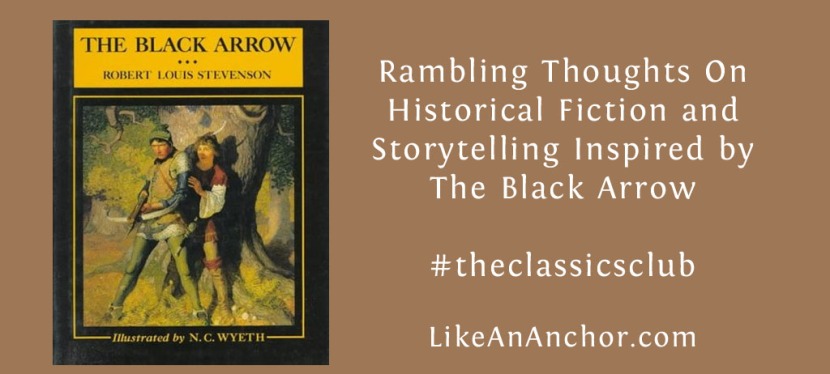
Rambling Thoughts On Historical Fiction and Storytelling Inspired by The Black Arrow

I’m not sure what to write about Robert Louis Stevenson’s The Black Arrow (1888). It’s a fun story, and it makes me want to either read Shakespeare or re-watch The Hollow Crown: War of the Roses. Or both — both would be good. But I don’t feel like there’s a whole lot to talk about for a Classics Club book post.

Maybe I should write a post about BlacKkKlansman instead, since I just watched that movie yesterday and I have lots of thoughts about it swirling around. (In short, I thought it was a very well-done movie about an important subject, but I felt the director undermined its message by adding news footage on the end that tied this story of the past to a specific incident and president of today. You don’t need to spoon-feed viewers your ideas. Let us make the connection ourselves.)

Rambling Thoughts On Historical Fiction and Storytelling Inspired by The Black Arrow | LikeAnAnchor.com
Adam Driver and John David Washington in BlacKkKlansman (2018)

Anyways, that’s off-topic. The Black Arrow is about political and ideological groups fighting each other, characters who feel torn between two sides of an issue, someone who’s pretending to be something they aren’t, villains who think they’re better than everyone else, and a crusader-type character avenging oppression and injustice.

Actually you could use all those descriptions of BlacKkKlansman, too, even though the two stories are really nothing alike. I guess it just goes to show how themes in story telling can span different cultures and centuries. I’m fascinated by this phenomenon. Take fairy tales, for example. There are over 900 versions of Cinderella and nearly every culture has its own take on the story. Why? Did the story start one place and somehow travel that much? Or is it due to something like Jung’s theory of the collective unconscious?

Rambling Thoughts On Historical Fiction and Storytelling Inspired by The Black Arrow | LikeAnAnchor.com
Cinderella stories from around the world

And we’re off-topic again. Back to Stevenson. The Black Arrow is a loosely historical story set during the War of the Roses. The main character is Richard “Dick” Shelton, who i’m afraid I didn’t care about at all for the first couple chapters. Actually, I didn’t care much about him by the end of the book either even though he does experience some basic character growth. He seems stubbornly determined not to think about what’s going on around him and that irritates me.

Initially, young Shelton picks a side in the political conflict just because that’s the side his guardian is on. Then, after he learns his guardian killed his father, Dick declares for the other side. And he sticks with that decision because it’s dishonorable to flop back and forth even though he hasn’t got a clue what he’s fighting against or in support of. I know lots of people fight for causes they don’t really understand, but should the hero of a book be killing people based on what was for him a mostly arbitrary decision?

In similarly oblivious fashion, Dick Shelton seems to be the only character who doesn’t know John Matcham is actually a disguised woman even though he spends several days traveling alone with her. As soon as he finds out John is actually Joanna Sedley, though, Dick promptly proposes marriage. He doesn’t know much more about her than that she’s female and they have a common enemy in their mutual guardian, but apparently it’s enough to avow undying love. I’m not impressed with him.

Rambling Thoughts On Historical Fiction and Storytelling Inspired by The Black Arrow | LikeAnAnchor.com
illustration by N.C. Wyeth

My few complaints aside, The Black Arrow is a fun adventure story and it doesn’t pretend to be anything else. Still, this probably isn’t a book that I’ll re-read again (I’d read it once around high school) nor one of the classics that I’ll think much about. On another side-note, I appreciated the author’s notes about where he changed historical facts to fit his story. I have no problem with writers taking a certain amount of creative liberties with history, but if you’re going to write historical fiction it’s nice to know when and how you’re stepping away from the facts.

Honestly, this is my favorite way to learn history — read it in fictional form, then look-up how close it is to being accurate. Mara: Daughter of the Nile (while not historically accurate) got me interested in ancient Egypt. I really didn’t care much about the founding fathers (though my history-loving mother made sure I read plenty of non-fiction while we were homeschooling) until listening to Hamilton. I guess I’m just more intrigued by stories and characters than by descriptions of events and people, so when someone offers me real events as stories and historical people as characters I’m hooked.

Fictional MBTI – T’Challa (ISFP)

I saw Black Panther yesterday, so naturally today’s post is a new installment in the superhero Myers-Briggs types series. I know I get pretty excited about most of the MCU films, but this one is seriously good. I love the hero characters and the principles they stand for like loyalty and peace. The acting is great, the plot’s tight, I love the music (I’m listening to the score as I type), and while it still has a superhero-movie feel it doesn’t shy away from digging into some really deep and difficult subjects.

T’Challa’s judging functions are pretty easy to pin-point: Fi/Te. But the fact that he uses Introverted Feeling and Extroverted Thinking when making decisions only tells us that he’s either a TJ or FP type. We’re going to need a little more to go on than just those two functions if we’re going to narrow-down a type for him. After Captain America: Civil War came out, most people typed T’Challa as an ISFP. However, a couple of the discussions I found online pointed out that he’s an ENTJ in the comics. I haven’t read the comics, though, so this typing is only going to focus on his film portrayal. From that, I ended up going with ISFP.

A Personal Code

Everyone has and uses both a Thinking and a Feeling mental process as part of their personality type. They’re both a “Judging” function, which means you use them to make decisions and answer “should” questions. The one you’re most comfortable with is either your driver process or co-pilot, and then its opposite is either your inferior or tertiary process.  Personality Hacker uses nicknames for the Jungian cognitive functions, and I think they make it easier to talk about exactly what I mean when saying T’Challa uses Fi/Te when making decisions.

Fictional MBTI - T'Challa (ISFP) | marissabaker.wordpress.com

Introverted Feeling is nicknamed “Authenticity” and it’s an ISFP’s primary function. It’s an internally focused, subjective process that mostly boils down to making decisions based on what “feels right” to you. Unlike the Extroverted Feeling process, it’s not primarily worried about what other people think. Authenticity is concerned with making a decisions that lines up with one’s own personal beliefs. And that’s what we see in T’Challa.

Though T’Challa certainly cares for other people, when he makes decisions they’re in line with what he believes is right rather than what will make the majority of the people around him happy. Fi is the mental process that drives his decision at the end of the film to share Wakanda’s resources with the world (see — I told you we were going to talk spoilers). And this personal code is also why he let his father’s killer live at the end of Civil War. He discovered that killing an unarmed man for revenge wasn’t in line with his moral compass (though making sure he faces justice is). Similarly in this new film, he offered to save his cousin’s life even after the man tried to kill him and steal Wakanda.

Impersonal Logic

Fictional MBTI - T'Challa (ISFP) | marissabaker.wordpress.com

Extroverted Thinking, or “Effectiveness,” is a much more impersonal function than Introverted Feeling, though it’s still used for making decisions. It’s an ISFP’s fourth function — the one they’re least comfortable using.

Effectiveness users look for the most efficient answer to a question. In other words, this process makes decisions based on what’s going to work. This is why in Civil War T’Challa tells Natasha that he doesn’t approve of all the politics. It’s because a hundred people arguing in a room doesn’t seem like an effective or efficient way to actually get things done.

I also don’t think his decision to go after Bucky himself was just fueled by an emotional type of revenge. It was also a coldly logical assessment of the most efficient way to handle the problem since he knows that, as Black Panther, he can take down a super assassin. Since Te is where an ISFP goes when stressed, it makes sense that one of the times we most clearly see T’Challa using it is after his father’s murder.

Interacting With The Real World

Fictional MBTI - T'Challa (ISFP) | marissabaker.wordpress.com

SP types have a certain advantage in physically-demanding tasks since this mental process is so focused on real-time interaction with the outer world. While being the Black Panther certainly enhances T’Challa’s abilities as a warrior, this new film shows us that he’s quite capable without them. He displays the sort of “real-time kinetic” intelligence that Personality Hacker says characterizes types that use the Extroverted Sensing, or “Sensation,” process. On a side-note, the ritualistic combat you see in Black Panther is inspired by real-world African martial arts, which is pretty cool.

SP types thrive on being in the middle of the action. And since Sensation is their Learning/Perceiving function, this is also how they prefer to learn new information. The things they can experience and verify with their five senses are the things that seem most reliable. And they often use their skill for interacting with the real world in creative, productive ways, earning ISFPs nicknames like Artist, Composer, and Producer.

As an SP type, T’Challa isn’t content with delegating tasks and that he can do himself. He goes after his enemies personally, even when not required by tradition and ritual. And he doesn’t just want to read reports or have people come to him to say what’s going on in Wakanda. We see him visiting his people and interacting with their worlds first-hand. He’s also interactive when planing missions. For example, there’s an early scene in Black Panther where he’s watching a projection of a convoy he’s about to attack as part of a rescue mission and he picks up one of the projected trucks to move it around and get a closer look.

Possibilities and Patterns

Fictional MBTI - T'Challa (ISFP) | marissabaker.wordpress.com

As far as we know, T’Challa is the first Black Panther to reveal his powers to the world at large. And he’s certainly the first king of Wakanda to share their country’s secrets with the world. While there is a struggle between the part of him that believes in a vision for Wakanda’s future where they help the world and his duty as king to protect his own people above the others, the idealistic visionary side wins out.

An ISFP has Introverted Intuition as their tertiary or “10-year-old” mental process. It’s also called “Perspectives” and it functions as a pattern-recognition system. ISFPs typically have conscious access to their Perspectives function, but it’s not always reliable.  T’Challa is mature enough to recognize this and does not rely on his Ni too much or make a rash decision based on it.

However, he’s also comfortable enough with Intuition to not shy away from what his friend Nakia and sister Shuri have to say about considering a future where Wakanda and its technology play a larger role in the world. And as an Ni-user myself, I find it very satisfying that Wakanda’s first outreach center will be built in the location where T’Challa’s father killed his own brother and abandoned the brother’s son to protect Wakanda’s secret. It brings the pattern together in a way that feels right.


If you enjoyed this post, check out my other MCU typings:

Bucky Barns – ESTP

Loki – INFJ

Scott Lang -ISFP

Steve Rodgers – ISFJ

Thor – ESTP

Tony Stark – ENTP

Hidden Figures and NT-type Women

Contrary to popular belief, INTJs have emotions. They also express them, though not always to the person they’re having feelings about (for example, an INTJ might tell his best friend he likes a girl, but not tell the girl. Or an INTJ might tell her husband she hates a coworker, but never give the coworker a hint). INTJs tend to compartmentalize their feelings and process them internally, and they hate expressing deep emotions casually or to people they don’t know well.

hidden_ntIf you’re very observant, though, and get to know the INTJs in your life, you’ll start to realize there’s a remarkable depth to their feelings. They’ll even do things, like cry at movies, that are typically associated with Feeling personality types. They might scorn the things that are “supposed” to make you cry (e.g. I’m sniffling at a Pixar film and my INTJ sister laughs out loud in the theater). But then I’ll look over and notice moisture leaking from the corners of her eyes at the end of Hidden Figures (I’ve been informed it was not crying).

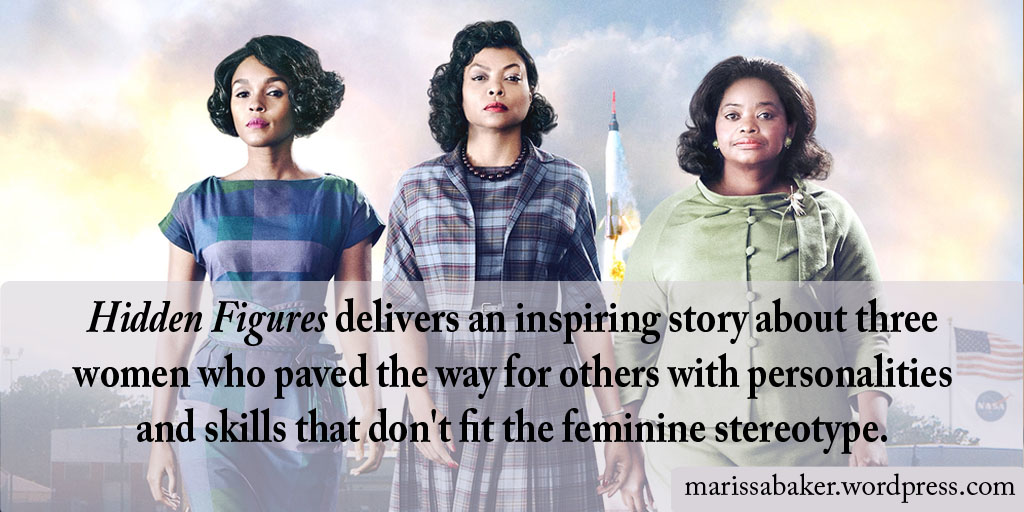
Hidden Figures (2016) is a fantastic film about “a team of African-American women mathematicians who served a vital role in NASA during the early years of the US space program. ” They were among the first African-Americans and the first women to work in such prestigious technical roles. My sister, about to graduate with a degree in Chemical Engineering, gave me one explanation for her emotional response to the film: “these women and others like them made it possible for me to be an engineer.”

As the character Mary Jackson tells a judge, someone always has to be first. These women proved it’s possible for women to be taken seriously and make important contributions as mathematicians and engineers. But I suspect my sister’s words go deeper than referring to breaking down gender stereotypes about the kind of work women can do. It also has to do with people’s expectations for what women should be like.

hidden_nt_2Only 24-35% of women have a personality type that relies on Thinking as their primary or secondary mental process (according to the Center for Applications of Psychological Type). INTJ and INTP women are tied for rarest at 1-3% of the female population. ENTJs come in a close third at 1-4%. ENTPs tie with ESTPs with 2-4%, just slightly more common than ISTPs at 2-3%. The STJ types aren’t nearly as rare, with ESTJs making up 6-8% and ISTJs 7-10% of the female population.

I’m not going to type the women in Hidden Figures, but having seen the film I think it’s safe to say Katherine G. Johnson, Dorothy Vaughan, and Mary Jackson are Thinking types. Their minds are naturally wired to excel at processing facts, figures, and data — a hall-mark of the fact-checking, analytical Thinking functions that use “impersonal criteria to make decisions.” I’d say Katherine at least is probably an Intuitive type as well, pairing pattern-recognition and possibility-seeking with her Thinking side.

That means she wasn’t just a rarity at NASA (an African-American woman working in a highly technical position). She’s also a rarity in society (a woman using both Intuition and Thinking as her most comfortable mental processes). Thinking traits are so strongly stereotyped as masculine that NT women often don’t fit cultural expectations for femininity. One of the many things I loved about Hidden Figures is that these three women seemed to have figured out a way to balance being wives and mothers with working as groundbreakingly successful mathematicians. They’re also portrayed as real people who are admired and respected for who they are instead of as the bitchy, controlling, or cold stereotype we often get when presented with Thinking female characters (take Sandra Bullock’s character in The Proposal as an example). And the men they’re in relationships with aren’t scared of them or trying to fit them back in boxes.

It was really wonderful to see characters that embraced femininity on their own terms. While I do believe God created the two genders to be different and complementary in the roles we fill, I also think there are stereotypes in our culture that do both genders a disservice. One of those is that women are or “should” be more emotion-driven than analytically-minded. There’s room for both. And, as Hidden Figures reminds us, we would do ourselves a terrible disservice if we tried to keep these women hidden.click to read article, "Hidden Figures and NT-type Women" | marissabaker.wordpress.com

Save

Save

Save

Save

Save

History Has Its Eyes On Us

I’m sitting here thinking, “What does one write on Independence Day when one is rather disappointed in the direction one’s country is headed?” Thousands of babies are being slaughtered, we just had the largest mass shooting in US history, there’s a systematized rejection of gender and acceptance of child abuse … the list goes on and on, and our presidential candidates aren’t making things look any better. I wonder if this is something like how Hamilton felt facing the election of 1800.

from sparkitors.tumblr.com

Except I’m not sure which of our current candidates is Burr in this analogy and which is Jefferson. I’m probably just going to not vote at all (side note: for some reason I’ve always felt uncomfortable with/guilty for voting, even though my church doesn’t teach against it. Weird, huh?).

Anyway, this isn’t going to be a depressing post! We’re celebrating Independence Day, and I’m quite certain the best way to do that this year is listening to the Hamilton Original Broadway Cast Recording. It’s on Amazon Prime, Spotify, YouTube — you have no excuse not to listen. Nor any excuse not to think about what you’re listening to.

Hamilton didn’t win 11 out of the record-breaking 16 Tony nominations just because it’s a run-away hit with a unique musical approach. The catchiest music couldn’t have sustained this level of success without a story that resonates deeply with fans. One of the many fantastic things about Hamilton is that it presents the founding father’s as real people. They’re not glorified by rose-eyed historical glasses or torn to shreds by an opposing historical perspective trying to vilify them. They’re just real men with a vision for the future and the necessary skills and commitment to found a country that is now celebrating its  240th birthday. Not too shabby a legacy. So what does that mean for us, real people today who have the chance to influence the course of history?

History Has Its Eye On Us | marissabaker.wordpress.com

A More Accurate Picture of America’s Ethnic Landscape

The only reason I would ever advocate casting with race in mind is for the purpose of historical or cultural accuracy. Now I’m re-thinking even that. A racially diverse cast works perfectly for Hamilton — America of today telling the story of America’s founding. And even though the individual characters’ casting doesn’t match the race of their historical counterparts, a racially diverse group working together to found our country is more accurate than most people think. Peter Salem (hero of the Battle of Bunker Hill), Prince Whipple (who fought alongside Washington), James Armistead (the double-spy who may have “won the revolutionary war”), Wentworth Cheswell (who rode to say “the British are coming” at the same time as Paul Revere) — they were all black, along with many other key figures in America’s founding.

Leslie Odom Jr. (Aaron Burr), Christopher Jackson (George Washington), Daveed Diggs (Marquis de Lafayette/Thomas Jefferson), Phillipa Soo (Eliza Hamilton), Renée Elise Goldsberry (Angelica Schuyler)

Renee Elise Goldsberry, who plays Angelica Schuyler, says that the most beautiful thing about Hamilton is that “it’s told by such a diverse cast with a such diverse styles of music. … We have the opportunity to reclaim a history that some of us don’t necessarily think is our own” (quote from Times article “Why History Has Its Eyes on Hamilton’s Diversity“).

One of the lines in Hamilton is “history has its eyes on me/you.” The founders knew what they were doing was going to make a mark on history, but this phrase can also be true of us today. Every generation has the potential to make its mark on history. Will future Americans look back on us and see a group of people who wouldn’t stand for white-washing of their history any more? or will they see us as complicit in maintaining the accepted historic narrative that all blacks were slaves and all whites were oppressors, even if that means marginalizing blacks who held influential positions at key points in American history?

Redefining The Moral Climate of Our Nation

One of the things Alexander Hamilton is known for is being involved in our country’s first political sex scandal. Perhaps this is one reason he was so often overlooked — he didn’t fit the squeaky-clean mold of a founding father that was popular in history books until very recently (now we seem to be going the other direction, trying to dig up as much dirt as possible on everyone. No one’s ever accused the human race of being balanced, have they?).

History Has Its Eye On Us | marissabaker.wordpress.com

In a post-Clinton age it seems strange to us that when Hamilton’s affair came out the immediate reaction was “Well, he’s never gon’ be President now” (though I’m sure in more historically accurate language). The idea of someone who cheated on his wife and openly confessed it becoming president was unimaginable. Hamilton himself down-played the seriousness of the affair, concentrating on proving he was a virtuous man innocent of the financial crimes he was accused of. Or, as he says in the play, “I have not committed treason, and sullied my good name.” He even wrote that he believed his wife “will approve, that even at so great an expence, I should effectually wipe away a more serious stain from a name, which it cherishes with no less elevation than tenderness. The public too will I trust excuse the confession” (read the full text of Hamilton’s Reynold’s Pamphlet here).

Committed treason he did not, but sully his good name Hamilton certainly did. “Hamilton’s reputation was in tatters,” an article from the Smithsonian says, “Talk of further political office effectively ceased.” Now, 219 years later, can you even imagine living in nation that expects moral behavior from its politicians? Or where the politicians themselves take responsibility for their own behavior? Hamilton was so worried about the possibility of a stain on his reputation that he confessed to an affair. And even though he did down-play its severity in light of the other charges, he still said of the affair, “I bow to the just censure which it merits. I have paid pretty severely for the folly and can never recollect it without disgust and self condemnation.”

It is one of my favorite things about the play Hamilton that Hamilton takes responsibility for the affair, acknowledging that he should have said “no to this.” It doesn’t absolve Maria Reynolds of her role in seducing a married man, but there’s “No Slut Shaming in Hamilton” either (<- that blog post is what prompted me to listen to Hamilton for the first time). Today, we don’t expect people in the public eye to even take responsibility, much less to hold themselves to a certain standard of morality. We’re scandal-hungry and ready to offer judgement on celebrity short-comings, but we don’t expect anything better. Perhaps this trend will continue until there’s no longer any such thing as a socially accepted moral standard, but I hope not. And when history turns its eyes back on us, will they see a generation sliding farther into cultural decay, or one that took a stand and said, “We expect better things of our role-models and leaders”?


There are plenty of other moral, social, and political issues we could discuss. If history’s eyes really are on America today, what would you like to see change for the better in our generation? financial disparity between rich and poor? the foster care system? environmental issues? whether or not to forfeit our second amendment rights? Please share your thoughts in the comments (bonus points for using Hamilton quotes)!