Gulliver in Lilliput, illustration from a 19th-century edition of Jonathan Swift’s Gulliver’s Travels.
If you don’t count the children’s Great Illustrated Classics version of Gulliver’s Travels, then my first encounter with Jonathan Swift’s writings was “A Modest Proposal.” I loved it. Swift’s type of satire is one reason people are still saying, “The pen is mightier than the sword.” Words are powerful, and if used well they can re-make society, destroy high-ranking people, and quite possibly get the writer in serious trouble.
Gulliver’s Travels was one of the first novels I chose for my Classics Club book list. I’d read excerpts from the Lilliput section when putting together a high school British literature course for my homeschooled brother, but this was the first time I’d read the entire novel.
The first two sections — “A Voyage to Lilliput” and “A Voyage to Brobdingnag” — read most like a fantastical travel-log, and if not for the footnotes in my Norton Critical Edition I would have missed quite a bit of the satire here, because so much of it was specific to Swift’s time period and to certain people in power while he was writing. The last two sections — “A Voyage to Laputa” and “A Voyage to the Country of the Houyhnhnms” — contained more general satire about the human race, which I think translated better to today. Here, we have priceless descriptions of things like lawyers:
I said, there was a Society of Men among us, bred up form their Youth in the Art of proving by Words multiplied for the Purpose that White is Black, and Black is White, according as they are paid. To this Society all the rest of the People are Slaves. For example, if my neighbour has a mind to my cow, he has a lawyer to prove that he ought to have my cow from me. I must then hire another to defend my right, it being against all rules of law that any man should be allowed to speak for himself. Now, in this case, I, who am the right owner, lie under two great disadvantages: first, my lawyer, being practised almost from his cradle in defending falsehood, is quite out of his element when he would be an advocate for justice, which is an unnatural office he always attempts with great awkwardness, if not with ill-will. The second disadvantage is, that my lawyer must proceed with great caution, or else he will be reprimanded by the judges, and abhorred by his brethren, as one that would lessen the practice of the law. …
Gulliver in discussion with Houyhnhnms, 1856 illustration by J.J. Grandville
“It is a maxim among these lawyers that whatever has been done before, may legally be done again: and therefore they take special care to record all the decisions formerly made against common justice, and the general reason of mankind. These, under the name of precedents, they produce as authorities to justify the most iniquitous opinions; and the judges never fail of directing accordingly.”
By the end of the novel, I didn’t like Gulliver as a character, but as a narrative vehicle for Swift’s satire he was perfect. He’s annoyingly narrow-minded and Anglocentric for much of the narrative, until he completely flips the other direction after living with the Houyhnhnms. It’s a marvelous bit of writing. First, his criticism of the unfamiliar Lilliputian, Brobdingnag, and Laputa cultures highlights what is most laughable or deplorable in our own society. But just when we’re ready to condemn humanity for it’s lack of logic, ridiculous methods of government, insistence on violence, and a whole host of other flaws Swift brilliantly satirizes, Gullliver decides he hates the very people he’s been defending this whole narrative.
Once he’s expelled by the Houyhnhnms, Gulliver would literally rather die than go back to living among humans. He can’t stand the smell, touch, or society of people who lack the Houyhnhnms “Government of Reason.” You might think Swift is saying, along with Gulliver, that people are disgusting and that’s his take-away message. Yet it is Gulliver who has now become ridiculous, and I think Swift finishes this book by satirizing his own narrator’s conclusions about the human race. Just because Swift notices the flaws in society and his fellow man doesn’t mean he abandons all hope for us.
Click here to get a copy of Gulliver’s Travels. Please note that this is an affiliate link. This means that, at no additional cost to you, I will receive a commission if you click on the link and make a purchase.
This is one of those rare books where the last line sums-up my feelings about the rest of the story.
But since ’tis as ’tis, why, it might have been worse, and I feel my thanks accordingly.
In my own words, “Well, the book ended the way it did, and it might have been worse, so I’m glad it’s over.” Though those were my thoughts, this Classics Club selection actually wasn’t a “bad” book. As a fan of British literature, I enjoyed it — the writing style and way Hardy uses description and dialogue is intriguing, as are his depictions of three very different courtships. As someone who reads for pleasure, though, I don’t really like it — none of the characters really captured my sympathy and the plot didn’t hold my attention except in a few parts.
The story follows Bathsheba Everdene, who first catches the eye of farmer Gabriel Oak as a young woman living with her aunt. He proposes marriage, and she turns him down. They meet again with their fortunes reversed — she has inherited a prosperous farm and he is seeking work as a shepherd. As the novel progresses, she is courted by the next-door farmer, confirmed bachelor William Boldwood, and also handsome womanizer Sergeant Frank Troy. The remainder of the novel can basically be summed up as fairly average people making bad decisions and having to live (or in some cases, die) with the consequences. It does have a happy, if somewhat predictable, ending.
If you’re looking for an alternative to seeing Avengers: Age of Ultron this weekend (and you can find a theater playing it), there’s a new film version of Far From The Madding Crowd released May 1st. It stars Carey Mulligan as Bathsheba Everdene, Matthias Schoenaerts as Gabriel Oak, Michael Sheen as William Boldwood, and Tom Sturridge as Frank Troy. My Avengers weekend has been planned for 6 months, but this looks like a good adaptation — I’ll probably see it when it comes out on DVD.
Click here to get a copy of Far From the Madding Crowd. Please note that this is an affiliate link. This means that, at no additional cost to you, I will receive a commission if you click on the link and make a purchase.
I was going to skip having a post today because of my busy weekend, and then I saw Carissa’s post with this tag. The original tag comes from Raindrops On Roses and Whiskers On Kittens. Since I love my books so much (as you will know by the end of this post if you didn’t already), I thought it would be fun to write about them.
Describe your bookshelf (or wherever it is you keep your books-it doesn’t actually have to be a shelf!) and where you got it from:
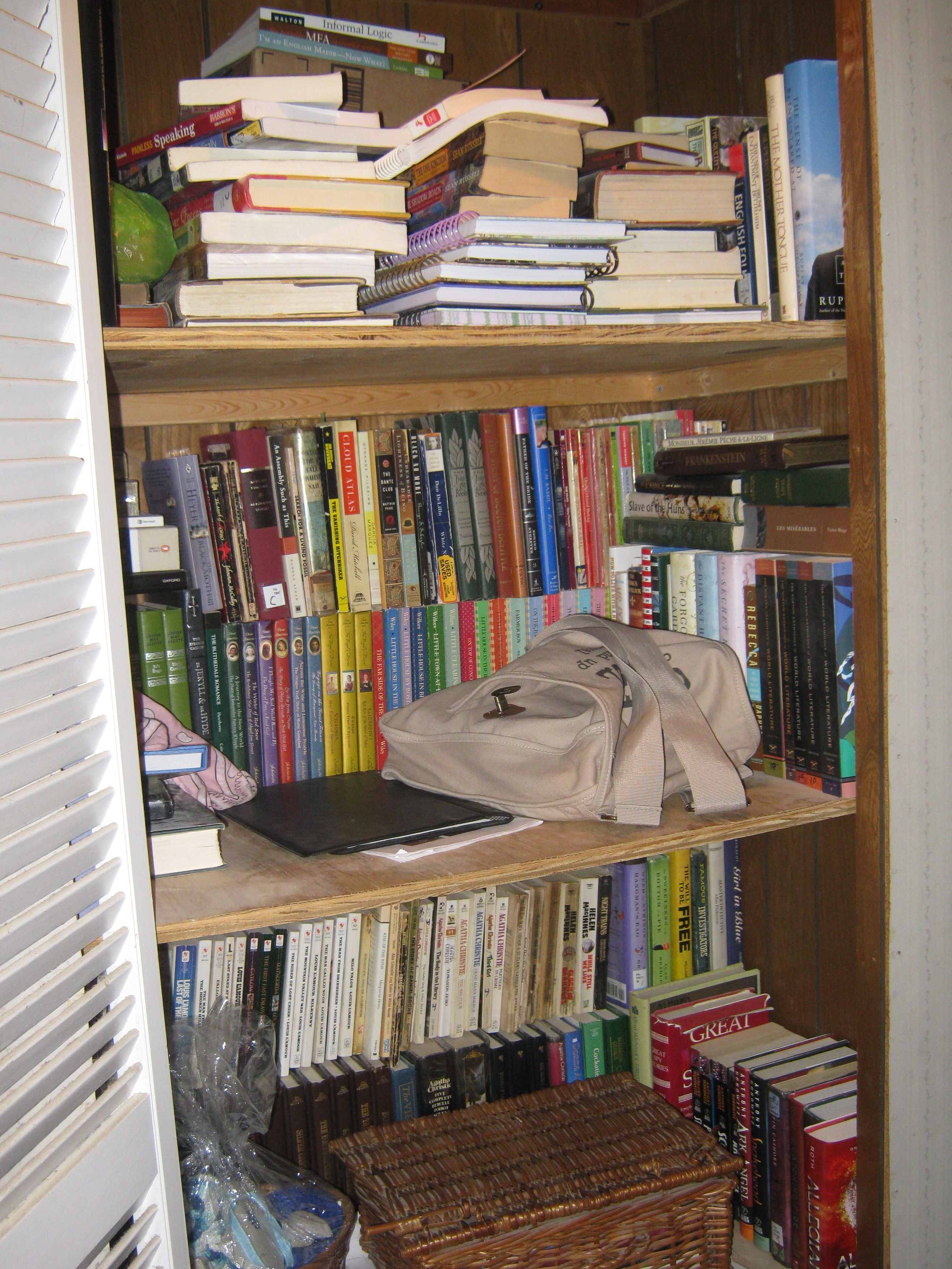
I have multiple book shelves. My computer desk has books on the shelves, then there’s a book shelf next to that and books in the china cabinet as well. One of the closets in my bedroom is a bookshelf, there’s 16-feet of shelf space above my sister’s bed, I have more books a dresser and cabinet that I think were designed for clothes, and a few crates of books in another closet. In total, I have 1,075 books that are on my master list of books I own (I recently cleaned out the book shelves — it was closer to 1,200 a few months ago).
Do you have any special or different way of organizing your books?
I have them loosely organized by subject. The system doesn’t make much sense to anyone else, but it rarely takes me more than 30 seconds to find any book I’m looking for.
What’s the thickest (most amount of pages) book on your shelf?
I’m not checking the page count, but I’m guessing The Riverside Shakespeare has all the others beat.
What’s the thinnest (least amount of pages) book on your shelf?
I have quite a few thin books, so I’m going to go with the thinnest on the shelves around my computer. It’s The 38 Most Common Fiction Writing Mistakes (and how to avoid them) by Jack M. Bickham.
Is there a book you received as a birthday gift?
Several, including Ender’s Game by Orson Scott Card and some of Regina Doman’s fairy tale retellings.
What’s the smallest (height and width wise) book on your shelf?
Robin’s Country by Monica Furlong.
What’s the biggest (height and width wise) book on your shelf?
For width it’s The Riverside Shakespeare again, but for height is The Anglo-Saxon Chronicles as translated and collated by Anne Savage.
Is there a book from a friend on your shelf?
Yes. Friends give me books fairly regularly 🙂
Most expensive book?
They aren’t the most valuable books I own, but my hardcover copies of The Lord of the Rings are probably the ones I spent the most money on.
The last book you read on your shelf?
I own and am currently reading Far From the Madding Crowd by Thomas Hardy.
Of all the books on your shelf, which was the first you read?
I have no idea. Maybe one of the Hardy Boy or Nancy Drew books? Of the ones just out here by my desk it was probably Around the World in 80 Days by Jules Verne.
Do you have more than one copy of a book?
Yes. I have reading copies and display copies for The Lord of the Rings and The Chronicles of Narnia, and I have several versions of some of my favorite classics like Pride and Prejudice.
Do you have the complete series of any book series?
Yes. I probably have more complete series than I do incomplete series.
What’s the newest addition to your shelf?
Shadow of the Giant by Orson Scott Card. I’ve been looking for a nice copy, and finally got one through Paperback Swap.
What’s the most recently published book on your shelf?
I think it’s Allegiant by Veronica Roth.
The oldest book on your shelf (as in, the actual copy is old)?
An 1895 edition of Ivanhoe that I picked up at a little shop in Wisconsin.
A book you won?
I won an English Book Award my last year at The Ohio State University, and was given Equivocal Beings: Politics, Gender and Sentimentality in the 1790s by Claudia L. Johnson, The Iron Pen: Frances Burney and the Politics of Women’s Writing by Julia Epstein, and The Swerve: How The World Became Modern by Stephen Greenblatt.
A book you’d hate to let out of your sight (aka a book you never let someone borrow)?
I’m pretty good about loaning books if people ask and I trust them, but I probably wouldn’t give out my nice copies of The Lord of the Rings or books with sentimental value like my mother’s copy of Freckles by Gene Stratton Porter (technically it’s still hers, but I swiped it from her bookshelf).
Most beat up book?
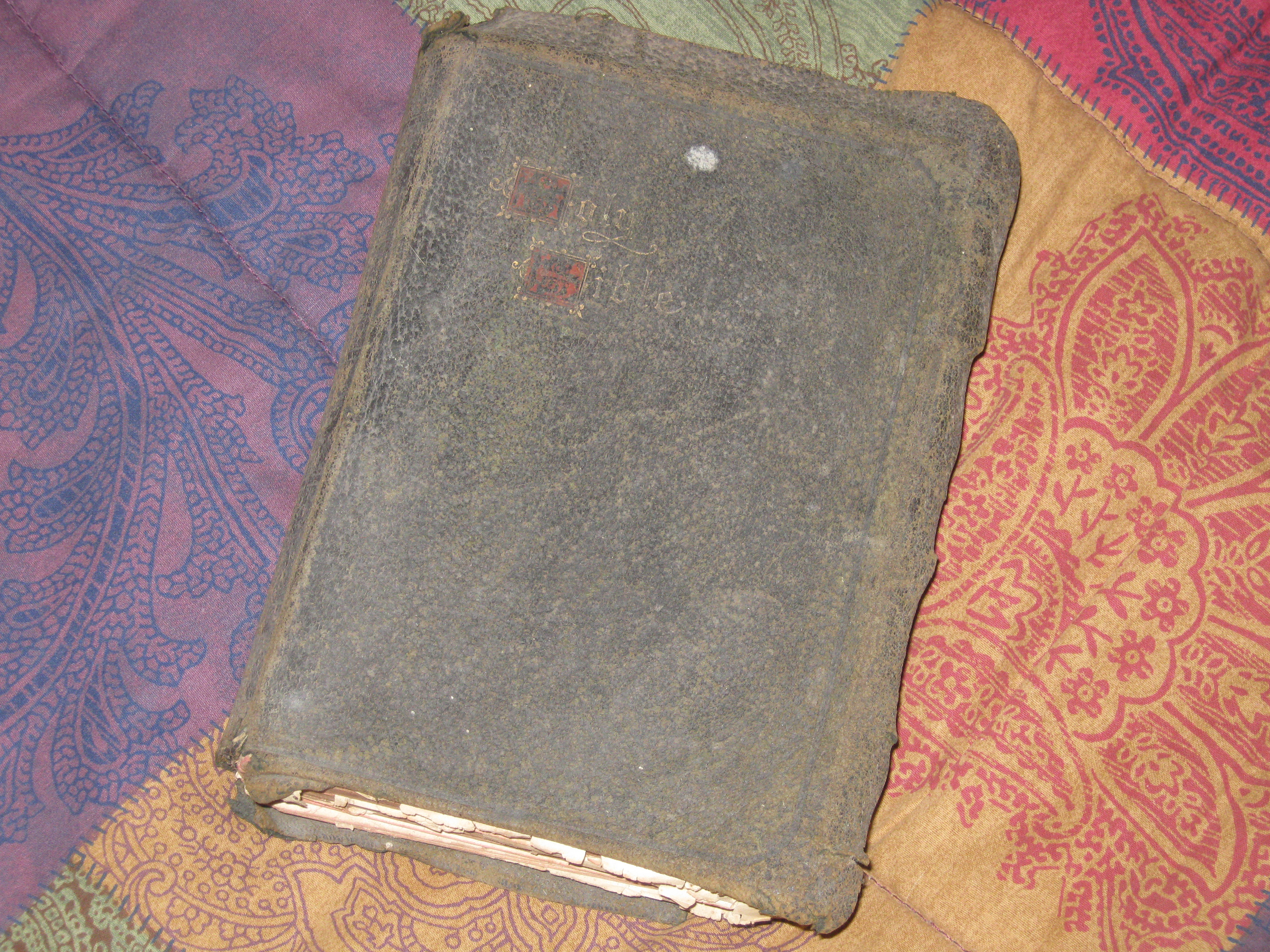
A 1901 King James Bible we found in my grandparent’s house after Grandma died. It’s so fragile I’m scared to open it, but I love it.
Most pristine book?
That’s easy — my gorgeous blue Barns and Noble edition of TheArabian Nights is still in it’s shrink-wrap plastic.
A book from your childhood?
So many — I have most of the original Hardy Boys, Nancy Drew, and Tom Swift Jr. books.
A book that’s not actually your book?
Well, technically some of them may or may not belong to my sister …
A book with a special/different cover (e.g. leather bound, soft fuzzy cover etc.)?
Several of my Louis L’Amour books are leatherette bound, and my copy of The Hobbit has a lovely green cover with green speckles on the page edges.
Book that’s been on your shelf the longest that you STILL haven’t read?
Maybe my collection of Sherlock Holmes. I’ve read several stories from it, but not all of them. Or perhaps it’s one of my Charles Dickens books like Oliver Twist or David Copperfield.
Any signed books?
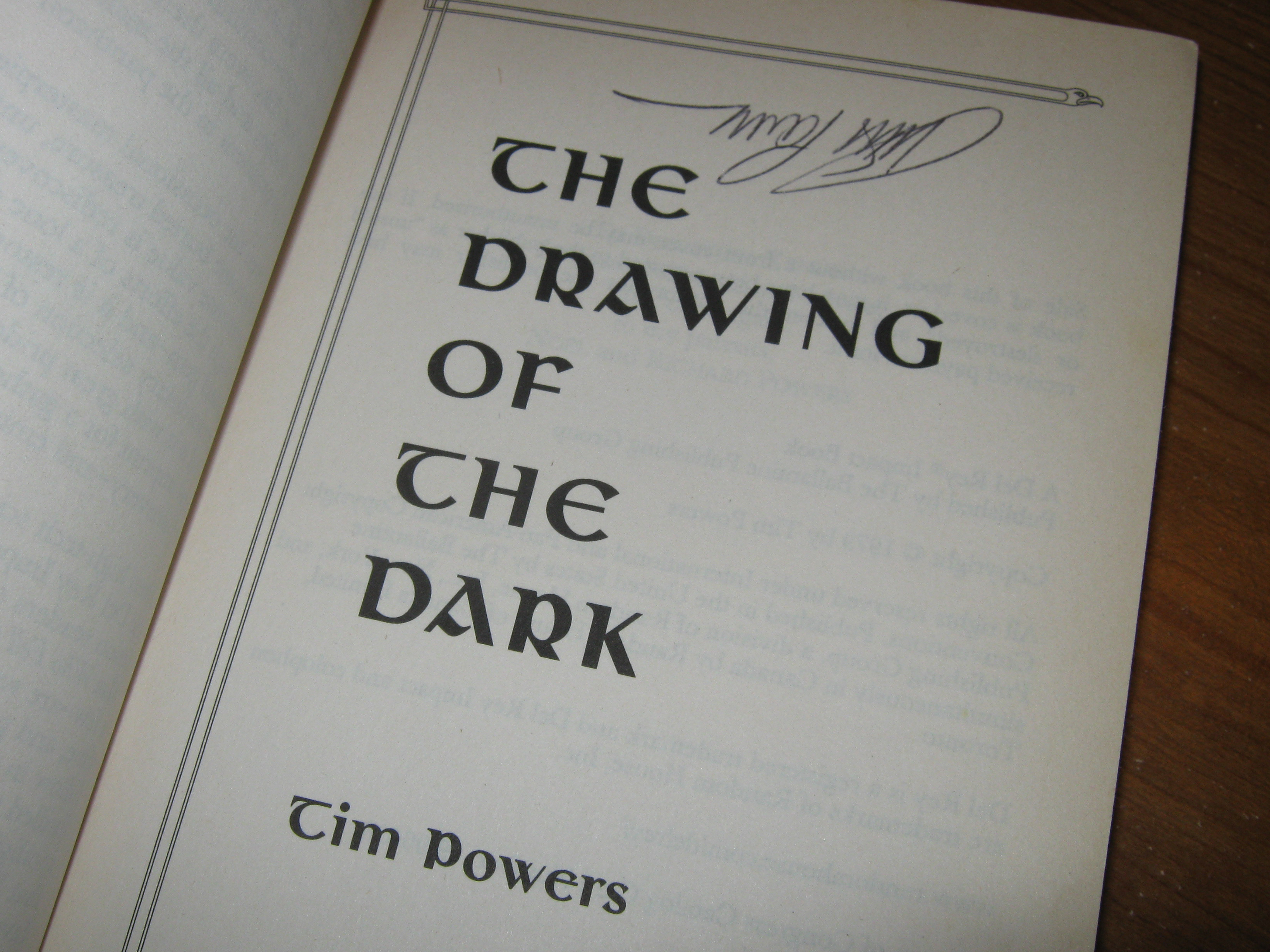
My copy of The Drawing of the Dark by Tim Powers is signed up-side-down on the title page. I got it through Paperback Swap and wonder why someone who went to a book signing got rid of the book.
Fiction affects society, for good or ill, often as much or more than real-life situations. If Charles Dickens had lectured about the plight of real-life orphans in London, would it have had the same effect as writing Oliver Twist? Or to use an example I see as very negative, would as many people have been obsessed with an essay about BDSM as they were with 50 Shades of Gray?
Fiction is powerful. We talked about this a couple weeks ago, but all in a positive light since I was arguing that fiction has value. It can also have a more negative influence as well, which is why I think both writes and readers have a responsibility to self-censor. It’s not up to someone to tell writers not to write a certain kind of book or discuss a specific topic, or to tell readers what they can and cannot read. But it is a good idea (particularly if you’re a Christian) to think carefully about the reading and writing choices we make.
Writer Responsibility
On March 31, 1750, Samuel Johnson published what has become one of the most famous statements in regards to the potential of fiction. While I don’t agree with his arguments against imaginative invention of the fantastic (I write fantasy, after all), this passage intrigues me:
if the power of example is so great as to take possession of the memory by a kind of violence, and produce effects almost without the intervention of the will, care ought to be taken that, when the choice is unrestrained, the best examples only should be exhibited; and that which is likely to operate so strongly should not be mischievous or uncertain in its effects.”
I think what Johnson is saying is that authors have a responsibility not to use the power they weld to influence their readers negatively. Responsible authors exercise a form of self-censorship, which doesn’t necessarily mean they shouldn’t talk about complex or even “bad” ideas. But fiction can be enormously influential, and authors should be conscious of the fact that what they are writing has the potential to fill their readers’ minds.
Writers of fiction set out to create a story that draws readers in, and once this happens the readers are under the writer’s influence. Johnson thought that, “the best examples only should be exhibited” so that there is nothing “mischievous or uncertain” in fiction’s effect. I don’t think we need to go that far, but we should be mindful of the power we have to influence readers.
Reader Responsibility
As readers, we should also be mindful of what we expose our minds to, remembering that we’re giving our reading material the opportunity to change or influence our thinking. I came across a great article titled “Self Censorship Better Than Book Banning” a few weeks ago about teaching your children how to make good decisions about their reading material instead of trusting the schools or government to ban “inappropriate” books (which will be defined differently for each individual).
This is pretty much what my mother did, though I wasn’t required to talk about every book with her after reading it (I usually did anyway, so she didn’t really need a rule). The only time I remember my mother taking away a book was when I broke down sobbing one day and confessed that I was having trouble dealing with the main character losing her father to cancer. There were a few other books that she strongly recommended I give up, and I usually (eventually) agreed with her. Harry Potter was “banned” in our house when it first came out, and that’s the only book I can remember being specifically told not to read.
It seems to have worked for the most part. There are books I wish I hadn’t read (and a few I’m sure that I really I shouldn’t have been reading), but for the most part I’m glad I had that freedom. It helped teach me to think for myself, which, to reference John Keating from Dead Poets Society, is the goal of good education.
“Why would you write fiction? Isn’t it just a bunch of lies?”
It’s been a while since someone asked me that question, but I can re-play the scene clearly. They look smug, like they’d just discovered a great argument against writing and reading fiction. Fiction is not true, and so therefore it is not good. Why make-up stories when there are plenty of good, wholesome things, people, and events that already exist? In fact, why tell stories at all, especially fantasy stories? They just give children unrealistic expectations of the world, and adults an excuse to ignore reality.
Obviously, since I’m still writing and reading fiction, I don’t buy into these arguments. But why?
Escape
Probably the simplest reason for writing fiction is to escape. Much of fiction — both good and bad — falls into this category. Sometimes life isn’t any fun, and reading and writing fiction gives us a way to escape for a while without actually leaving our location or situation. This can be as simple as diving into Middle Earth while waiting for the clothes to finish drying at the laundromat. Would you rather stare at your t-shirts spin, or canoe down the Rauros with the Fellowship of the Ring?
Connect
In a New York Times article, ‘Why Write Novels at All?’ Garth Risk Halberg talks about the idea that “the deepest purpose of reading and writing fiction is to sustain a sense of connectedness, to resist existential loneliness.” Now we’re getting closer to the reason I write fiction. Escape is all well and good, but what are you escaping to? It’s not enough to just take off for Narnia — we have to find Aslan there or the journey means nothing.
We write to share who we are and what we think, and we read to connect with something outside us. Usually this is a new world or characters, but if we’re very lucky we’ll also sense the author as they bleed through the pages of their work. This connectedness is one of the chief arguments for reading and writing, since it carries over into “real” life: people who read fiction are more emphatic than non-readers.
Think
Let’s say you have something you want to say about a controversial topic. We’ll use abortion as an example, and say you’re on the pro-life side. If you write an article telling people that abortion is bad, only the people who already agree with you are going to like it. If you tell a true story about a baby who survived an abortion or a mother whose life was ruined by an abortion, it will affect more people but you’ll still lose a large number of your readers.
Now suppose you write a story where you climb inside the head of a character and show what they are struggling with as she decides whether or not to have an abortion. You don’t just put your words in the character’s mouth – you imagine yourself in her shoes, and realize that she has real reasons to consider both options. You sympathize with her, and whatever your readers believe they sympathize with her too. Your ideas will filter through in decisions you make about how see feels when she sees the baby on an ultrasound, or whether or not she keeps the child at the end of the story. You can let readers know what you think, but you don’t shove your ideas down their throat. You give them a chance to feel with you, and let them think for themselves.
Obviously, I think of the writer of novels and stories and plays as a moral agent. In my view, a fiction writer whose adherence is to literature is, necessarily, someone who thinks about moral problems: about what is just and unjust, what is better or worse, what is repulsive and admirable, what is lamentable and what inspires joy and approbation. This doesn’t entail moralizing in any direct or crude sense.
Serious fiction writers think about moral problems practically. They tell stories. They narrate. They evoke our common humanity in narratives with which we can identify, even though the lives may be remote from our own. They stimulate our imagination. The stories they tell enlarge and complicate—and, therefore, improve—our sympathies. They educate our capacity for moral judgment. ” – Susan Sontag, from a speech at the Los Angeles Public Library
This sort of literature may or may not be an escape for your readers, but should definitely let them connect with something or someone. It should make them think. It should give them a chance to “meet” types of people thy might never come in contact with in their real lives, to question ideas that they take for granted, to consider what is and is not moral. Fiction lets us talk about things that are uncomfortable to discuss in real life, or give a new perspective on issue too charged in reality to have a dialogue about. It lets us ask “what if?” and run with the potential answers before actually changing the world. Yet.
I’m a writer. I spend most of my day with words. I put them together, move them around, edit them out and put new ones in — all trying to find just the right combination to deliver information, move you to tears, make you laugh, or give you something to think about. So when the Bible describes Jesus Christ as “the Word,” I see that from a the perspective of someone who loves words and realizes how powerful they can be. I express myself best through written words, and that is also the main way God has chosen to express Himself to us.
Have you ever wondered why that is? Why did God make sure we had a written record of Him? in theory, He could have taught everything by speaking directly through prophets right up into the present day, much like He did for a good part of Biblical history. Even through there was a written record in the Torah, then the complete Old Testament and finally the canonized Bible, throughout most of history people simply didn’t have access to a written copy of God’s word. For the past couple thousand years or so, though, God has communicated to His people primarily through His written words.
I suspect part of this is because the church is now scattered over the entire world rather than concentrated in a single nation — God was expanding His family, and in the new church that Jesus Christ is building it simply isn’t practical or necessary to have His people going to a rabbi or prophet to find out what God wants. Now, every individual who has been called is given the opportunity to have a relationship directly with the Father and with the Word, and that relationship largely depends on us picking up God’s written word and asking Him to teach us.
Re-creating Us
Let the word of Christ dwell in you richly in all wisdom, teaching and admonishing one another in psalms and hymns and spiritual songs, singing with grace in your hearts to the Lord. And whatever you do in word or deed, do all in the name of the Lord Jesus, giving thanks to God the Father through Him. (Col. 3:16-17)
This is the same Greek word, logos (G3056), used to describe Jesus as the Word. Logos means an articulate expression of intelligence. When Christ is named the Word, it is in reference to His role as the One who reveals the intelligent thoughts of the God family. Here in Colossians, what we’re talking about is the words He spoke in His role as the Word.
These verses are telling us to look at every word that Jesus shared with us, and let those words dwell inside us along with the wisdom we need to understand His words. It’s telling us to share those words with others, and let them work a change inside you that alters your own words and deeds. When the word of Christ is in you, then the “intelligent expression” coming out of your mind and mouth will be a reflection of His intelligence.
A good man out of the good treasure of his heart brings forth good things, and an evil man out of the evil treasure brings forth evil things. But I say to you that for every idle word men may speak, they will give account of it in the day of judgment. For by your words you will be justified, and by your words you will be condemned. (Matt. 12:35-37)
This is another Greek word, rema (G4487), which refers to spoken words or commands. Instead of referencing the intelligence behind the words, it refers to the subject matter being discussed. It’s telling us that we will be judged, not just for the motivation behind our words, but also for the subjects we choose to speak about. Christ’s words in us are good treasures of our hearts, and with Him inside us the words we speak will become good, and glorify God.
If you abide in Me, and My words abide in you, you will ask what you desire, and it shall be done for you. By this My Father is glorified, that you bear much fruit; so you will be My disciples. (John 15:7-8)
Our relationship with the Word and the presence of His words in us makes it possible for us to glorify God with the fruits of our life. “The worlds were framed by the word of God” — so just imagine what an amazing work those powerful words can do inside of us! (Heb. 11:3).
Spirit and Life
It is vitally important that Jesus Christ, “the Word of life” (1 John 1:1), and the words that He taught become a part of us. Without a good relationship with the words of God, we will not be saved.
Therefore lay aside all filthiness and overflow of wickedness, and receive with meekness the implanted word, which is able to save your souls. But be doers of the word, and not hearers only, deceiving yourselves. For if anyone is a hearer of the word and not a doer, he is like a man observing his natural face in a mirror; for he observes himself, goes away, and immediately forgets what kind of man he was. But he who looks into the perfect law of liberty and continues in it, and is not a forgetful hearer but a doer of the work, this one will be blessed in what he does. (James 1:21-25)
The words of God speak to our hearts and spirits. They show us who and what we are and give us tools to change and grow. Jesus said, “The words that I speak to you are spirit, and they are life” (John 6:63). Do we treat the word of God like that? Do we hold on to it and treasure it as a source of life and of the Spirit? as a key to intimacy with God?
For this commandment which I command you today is not too mysterious for you, nor is it far off. It is not in heaven, that you should say, ‘Who will ascend into heaven for us and bring it to us, that we may hear it and do it?’ Nor is it beyond the sea, that you should say, ‘Who will go over the sea for us and bring it to us, that we may hear it and do it?’ But the word is very near you, in your mouth and in your heart, that you may do it. (Deut. 30:11-14)
Paul quotes directly from this in Romans 10:5-10, leaving no doubt that this passage is relevant under the New Covenant as well as the Old. It’s like we talked about last week — God “is not far from each one of us; for in Him we live and move and have our being” (Acts 17:27-28).
As we become more and more like the Father and Jesus, our thoughts should be more like Their thoughts, our words more like Their words. We’ve been given a written record of how They think and speak, and we’ve been given His Spirit so we can comprehend what They are telling us (1 Cor. 2:10-12). The Word dwelling in us is an incredible opportunity to know and understand our creator.


 This is one of those rare books where the last line sums-up my feelings about the rest of the story.
 . Please note that this is an affiliate link. This means that, at no additional cost to you, I will receive a commission if you click on the link and make a purchase.



 Like An Anchor