The Beatitudes, Part Two: Blessed Are Those Who Mourn

“Beatitude” means “a state of blessedness,” and it’s used to describe the type of people Jesus spoke about in the beginning of His famous sermon on the mount. We talked about the first one last week, so today we move on to the second.

“Blessed are those who mourn, for they shall be comforted.” (Matt. 5:4, all quotes from WEB translation)

The Greek word translated “blessed” is makarios (G3107), which means blessed and happy (Thayer’s dictionary) and is a state of being “fully satisfied” (Zodhiates’ dictionary). Seems like an odd word to pair with mourning, doesn’t it? I’m not sure about you, but “happy” and “satisfied” aren’t usually what I think of when I think of grief and lament, even if it comes with a promise of comfort. What is Jesus talking about here?

A Time to Weep, A Time To Mourn

For everything there is a season, and a time for every purpose under heaven … a time to weep, and a time to laugh; a time to mourn, and a time to dance (Ecc. 3:1, 4)

Mourning is right and proper in its time. While joy is a fruit of God’s spirit, He does not demand unrelenting cheerfulness from us. There is a time for mourning, weeping, grief, and lament. It can even be good for us to experience those feelings. “The heart of the wise is in the house of mourning,” it says in Ecclesiastes, because death reminds us of what really matters in life (Ecc. 7:1-4).

Draw near to God, and he will draw near to you. Cleanse your hands, you sinners. Purify your hearts, you double-minded. Lament, mourn, and weep. Let your laughter be turned to mourning, and your joy to gloom. Humble yourselves in the sight of the Lord, and he will exalt you. (James 4:8-10)

Mourning is a proper response to realizing that we have personally sinned, and that the world is twisted by humanity’s sins and the devil’s influence. This type of mourning is often connected with a realization of our spiritual helplessness (which is covered in the first Beatitude) and it can lead to the sort of humility that it’s good for us to have in relation to God.

To Comfort All Who Mourn

Of course, not all mourning is a good thing. In many cases, it’s prompted by the sorts of unjust, tragic, grief-inducing events that God intends to put an end to in His kingdom (the sort of events we were reminded of yesterday, on the anniversary of the 9/11 terrorist attacks). One day, God “will wipe away every tear from their eyes. Death will be no more; neither will there be mourning, nor crying, nor pain, any more” (Rev. 21:4). That time has not yet come, but God still cares deeply about us when we’re in pain and He offers comfort.

The Lord Yahweh’s Spirit is on me, because Yahweh has anointed me to preach good news to the humble. He has sent me to bind up the broken hearted, to proclaim liberty to the captives and release to those who are bound, to proclaim the year of Yahweh’s favor and the day of vengeance of our God, to comfort all who mourn, to provide for those who mourn in Zion, to give to them a garland for ashes, the oil of joy for mourning, the garment of praise for the spirit of heaviness, that they may be called trees of righteousness, the planting of Yahweh, that he may be glorified. (Is. 61:1-3)

Jesus fulfilled this scripture by coming to earth and beginning His ministry (Luke 4:16-21). And what an incredible blessing it is that the Word, God, would come from heaven to earth in a human body with the expressed purpose of comforting those who mourn!

Fully Satisfied With and By God
In his definition of makarios, Spiros Zodhiates says, “In the biblical sense, a blessed person is one whom God makes fully satisfied, not because of favorable circumstances, but because He indwells the believer through Christ.” Those who mourn are not blessed simply because they’re in distress, but because God responds to human distress with comfort.

Blessed be the God and Father of our Lord Jesus Christ, the Father of mercies and God of all comfort; who comforts us in all our affliction, that we may be able to comfort those who are in any affliction, through the comfort with which we ourselves are comforted by God. For as the sufferings of Christ abound to us, even so our comfort also abounds through Christ. (2 Cor. 1:3-5)

God knows what it’s like to grieve and, because of Christ’s sacrifice, what it’s like to suffer as a human being. When we turn to Him for comfort, He responds in a way that makes us blessed even when external circumstances are terrible. Though His presence may not take away our reasons for mourning or the unpleasant feelings that go along with that, He is there. He does not abandon us, and that is indeed a blessing.

Featured image credit: Shaun Menary via Lightstock

The Beatitudes, Part One: Blessed Are The Poor In Spirit

We’re only two weeks away from the first of the fall holy days on God’s sacred calendar. Yom Teruah (Day of Trumpets, also called Rosh Hashanah) is on September 19th this year. Yom Kippur (Day of Atonement) follows ten days later. Traditionally, those ten days and the month leading up to Yom Teruah are a time of reflection and self-examination for Jewish and Messianic believers.

There’s been a lot to distract us lately. I wanted to bring my Bible study back to basics, and also use that as a tool to look at myself and how I’m doing as we move into this fall holy day season. Today’s post is the first of a series on the Beatitudes. As an interesting note, I looked up the word history for “beatitudes” in the Online Etymology Dictionary and found that it comes into English “from Middle French béatitude (15c.) and directly from Latin beatitudinem.” It means “a state of blessedness” not, as some clever speakers have said, a “be-attitude” (as in, an attitude you’re supposed to “be”).

No Glory In Ourselves

The beatitudes come at the beginning of the sermon on the Mount, which Jesus delivered to His disciples after withdrawing from the multitude and traveling up onto a mountain (Matt. 4:23-5:2).

“Blessed are the poor in spirit, for theirs is the Kingdom of Heaven.” (Matt. 5:3, all scriptures from WEB translation)

Jesus had a few Greek words He could have picked that would translate into English as “poor.” The one He used is ptochos (G4434). It means “reduced to beggary,” destitute, helpless, powerless, “lacking in anything” (Thayer’s dictionary). This does not refer to someone who is poor but still able to earn a subsistence. The ptochos have nothing (Zodhiates’s dictionary).

Adding “in spirit” means Jesus isn’t talking about physical poverty, though. Being “poor in spirit” involves acknowledging our own spiritual helplessness. We don’t have to be destitute physically, but we do need to realize that none of the physical stuff we have (or don’t have) can stop us from being spiritually destitute.

Yahweh says, “Don’t let the wise man glory in his wisdom. Don’t let the mighty man glory in his might. Don’t let the rich man glory in his riches. But let him who glories glory in this, that he has understanding, and knows me, that I am Yahweh who exercises loving kindness, justice, and righteousness in the earth, for I delight in these things,” says Yahweh. (Jer. 9:23-24)

Blessed are those who don’t let intellect, might, wealthy, or worldly prestige get in the way of their commitment to God. It can be hard to have an accurate view of your spiritual helplessness if you’re wise, mighty, or noble, but we must all become “poor in spirit” if we are to live with God (1 Cor. 1:25-31).

The Right Attitude for Dwelling With God

God is looking for those who have a poor, or humble, spirit. He always has been, and this wasn’t a new Concept for Jesus’s Jewish audience.

For the high and lofty One who inhabits eternity, whose name is Holy, says: “I dwell in the high and holy place, with him also who is of a contrite and humble spirit, to revive the spirit of the humble, and to revive the heart of the contrite.” (Is. 57:15)

God is so mighty, so powerful, so much higher than us. The more we understand Him and His greatness, the easier it is to be of a poor, humble, contrite spirit. Nothing we are is impressive compared to God, and we have nothing worth offering Him but ourselves.

Yahweh says, “Heaven is my throne, and the earth is my footstool. What kind of house will you build to me? Where will I rest? For my hand has made all these things, and so all these things came to be,” says Yahweh: “but I will look to this man, even to he who is poor and of a contrite spirit, and who trembles at my word.” (Is 66:1-2)

Having an understanding of our own relative unimportance and our spiritual helplessness are vital to a relationship with God. He doesn’t work with people who don’t want Him or who refuse to acknowledge they need Him. It is the “poor in spirit” who catch His eye, and they’re invited to dwell with Him forever.

Their’s Is The Kingdom

Not everyone is “given to know the mysteries of the kingdom of heaven” (Matt. 13:10-16). You need an invitation from God, and you need to respond to that invitation by turning to Him and becoming “as little children,” “for the Kingdom of Heaven belongs to ones like these” (Matt. 18:3-4; 19:14).

Therefore, brothers, be more diligent to make your calling and election sure. For if you do these things, you will never stumble. For thus you will be richly supplied with the entrance into the eternal Kingdom of our Lord and Savior, Jesus Christ. (2 Pet. 1:10-11)

God is seeking in us the humility and trusting nature of a child that knows all their needs will be met by loving parents. He wants us to grow and thrive and do great things, but the starting place for all that is a recognition of our spiritual helplessness. We need Him, and we need to know that we need Him in order to inherit the kingdom He has prepared for His people.

Featured image credit: Chris Mainland via Lightstock

How Can A Christian Know When To Follow Human Authority and When To Obey God Rather Than Man?

I’ve been pondering the question posed in today’s title for a number of years now. How much obedience do we owe to human authorities, both inside and outside the church? Is a Christian allowed, per scripture, to speak against people in authority? Are they ever encouraged to stand up and fight against authority that is unjust and immoral? And why are churches, even those that preach the importance of obeying God’s word, so reluctant to talk about submission to authority passages like Romans 13:1-7 and 1  Peter 2:13-19?

Until fairly recently, this was mostly an intellectual puzzle for the American church. Then came questions about baking cakes for same-sex weddings, then whether or not to assemble for services when governors shut down states, now debates over the mask issue, and rising fears that a Covid vaccine might be the Mark of the Beast. We live in confusing times, and they’re forcing us to face questions and wrestle with decisions some of us haven’t had to deal with before.

Those of us who prize our independence might be angry about infringements on our freedom, wrestling with whether to follow our personal choices or do as we’re told. Those of us who struggle with anxiety might be scared — paralyzed, even — both by everything that’s going on and by not knowing what is the right thing to do. Those who are people-pleasers might be running up against the fact that we’ll need to pick a side and can’t make everyone happy.

Today’s post isn’t going to offer answers for the specific issues we’re facing right now. Rather, I hope to highlight scriptures that provide principles which we can use whenever we struggle with how to respond to human authority in a way that honors God. This is a question we will face at some point, if we aren’t facing it already. We need to be prepared to answer these questions, to ourselves and when asked by others, in a Biblically solid way. Read more

Learning From Others’ Spiritual Temperaments: Book Review of “Sacred Pathways” by Gary Thomas

A couple weeks ago, in an article titled “Psychology Isn’t Enough, but It Sure Helps: The Need for Personal, Spiritual Growth in Christianity” I talked about a book by Gary Thomas called Sacred Pathways: Discover Your Soul’s Path To God. I originally read it back in 2017 and I’d planned to write about it here on the blog but for some reason (which I don’t remember now) I never got around to it. So I reread it, and now I’d like to share some thoughts.

Book Overview

Thomas proposes nine “sacred pathways” — spiritual temperaments that describe how we’re most inclined to worship God. In the first chapter, he discusses that in the Christian churches we often expect everyone to worship God the same way. The example he uses is the “quiet time” that became a staple of church training and discipleship programs in the 1970s and ’80s. It involved spending 30 to 60 minutes each morning in prayer, personal worship, and Bible study, then having an accountability partner to check-in that you were keeping up with your routine. Prayer, worship, and study are all good things, but it’s not good if we reduce worship to “rote exercise” or assume everyone has to worship in the exact same way all the time (p. 14-15).

I’ve heard the idea that everyone else should worship “our way” voiced more or less directly by a variety of people in churches I’ve attended. Some think churches that don’t encourage dance are not worshiping Biblically; others worry about the people who aren’t committed enough to follow their example of reading the Bible through every year. I’ve voiced my own frustration with song services that have all the enthusiasm of a funeral dirge, saying we need more life in our worship to make it meaningful. Complaining about those who don’t  worship the way we think they ought is a common thing. But perhaps it betrays a wrong attitude. Read more

Mercies from Yahweh of Armies

Work, work your thoughts and therein see a king at war who holds those guilty that defy him. Behold him facing a besieged town, shouting out all the terrors that await those who persist in defiance, yet offering mercy if only they will yield to his authority. Note his relief when one chooses mercy, his gentleness with those who trust him and his swift vengeance on those who persist in rebellion.

I borrow this scene from my favorite Shakespeare play, Henry V (Act 3, prologue, Scene 2). But it’s also a Biblical image. We sometimes lose sight in the modern world that the KJV phrase “Lord of hosts” literally means “Yahweh of Armies.” One of the most often used titles of God is about Him personally going forth with a host of armies organized for war.

This is a comforting image when God is fighting against our enemies. But sometimes, “Yahweh’s anger burns against his people,” particularly when “they have rejected the law of Yahweh of Armies and despised the Holy One of Israel” (Is. 5:24-25). Even when that happens, though, God deeply desires to show mercy. His justice demands punishment for sin (Heb. 10:30-31), but His mercy offers a path to forgiveness and salvation (1 Pet. 2:24-25).

It’s common in modern churches to say that God was vengeful and frightening in the Old Testament but is gentle and loving in the New. Such a disconnect is not supported by scripture. Both the Father and the Word (who we now know as Jesus) have been active throughout history. They’re unchanging. In order to have a fuller, more accurate vision of who God is and what He is doing, we need to acknowledge that He is both wrathful justice and gentle mercies.

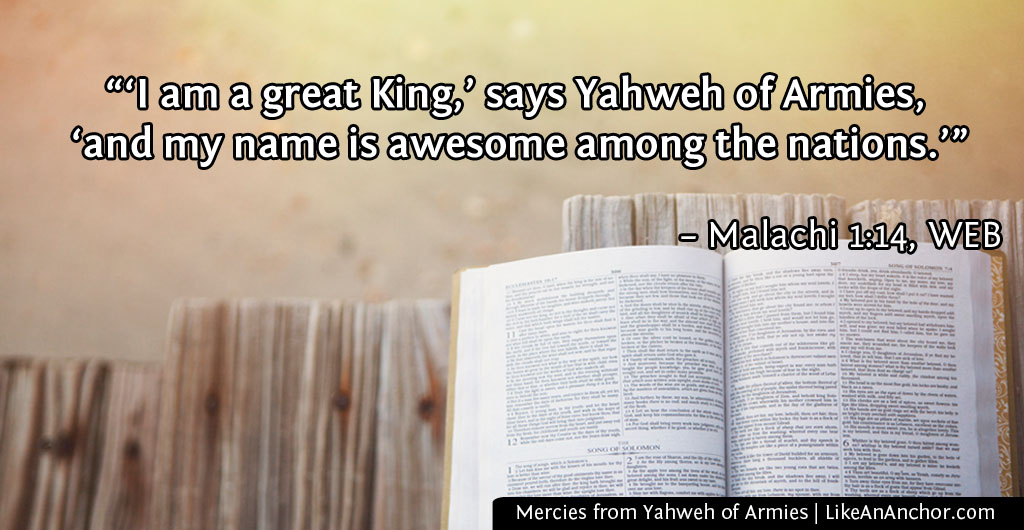
Mercies from Yahweh of Armies | LikeAnAnchor.com
Photo credit: Lamppost Collective via Lightstock

God’s Desire to Forgive

After the death of righteous Josiah, king of Judah, his son Jehohaz reigned for just 3 months before an Egyptian king dethroned him and set up his brother Jehoiakim in his place. This new king “did that which was evil in Yahweh his God’s sight” (2 Chr. 35:25-36:8). At this time, God was actively working through the prophet Jeremiah, and He sent him with a message.

In the fourth year of Jehoiakim the son of Josiah, king of Judah, this word came to Jeremiah from Yahweh, saying, “Take a scroll of a book, and write in it all the words that I have spoken to you against Israel, and against Judah, and against all the nations, from the day I spoke to you, from the days of Josiah, even to this day. It may be that the house of Judah will hear all the evil which I intend to do to them; that they may each return from his evil way; that I may forgive their iniquity and their sin.” (Jer. 36:1-3, all verses quoted from WEB translation unless otherwise noted)

Jeremiah’s prophecies contain warnings, corrections, lessons, and promises. From God’s words here in the passage I just quoted, it seems one of His main goals in sharing all those warnings was to save people from the consequences of their own disobedience.

Read more

Obedience Without Worry

I recently reread C.S. Lewis’ Mere Christianity, and I’d like to start today’s post with one of the many quotes that stood out to me:

“Handing everything over to Christ does not, of course, mean that you stop trying. To trust Him means, of course, trying to do all that He says. There would be no sense in saying you trusted a person if you would not take his advice. Thus if you have really handed yourself over to Him, it must follow that you are trying to obey Him. But trying in a new way, a less worried way. Not doing these things in order to be saved, but because He has begun to save you already.”

It’s a perfect way of describing the relationship between faith and works. We’re not saved by anything we do, but being saved inspires us to obedience and therefore faith-fueled action.

A Different Perspective on Law

This whole idea also makes me think of Psalm 119, which we were just looking at a couple months ago. The writer of Psalm 119 crafted a beautiful poem that pays homage to God’s law, precepts, and ordinances with every line. It’s a celebration of God’s precious words and of the positive effect following his instructions can have on our lives.

Blessed are those whose ways are blameless, who walk according to Yahweh’s law. Blessed are those who keep his statutes, who seek him with their whole heart. (Psalm 119:1-2, all quotes from WEB translation)

I will delight myself in your commandments, because I love them. I reach out my hands for your commandments, which I love. I will meditate on your statutes. (Psalm 119:47-48)

How I love your law! It is my meditation all day. Your commandments make me wiser than my enemies, for your commandments are always with me. (Psalm 119:97-98)

When was the last time you thought of God’s commandments as a delight? Or felt like exclaiming, “I love His law!” All too often, modern churches describe God’s law either as a burden we’re well rid of or as something we still have to put up with and must fear breaking. The people closest to God, though, have historically seen His words as something precious; a gift given for our good. He is to be obeyed, but not out of a sense of obligation. We obey because we love, and because we are loved.

Read more