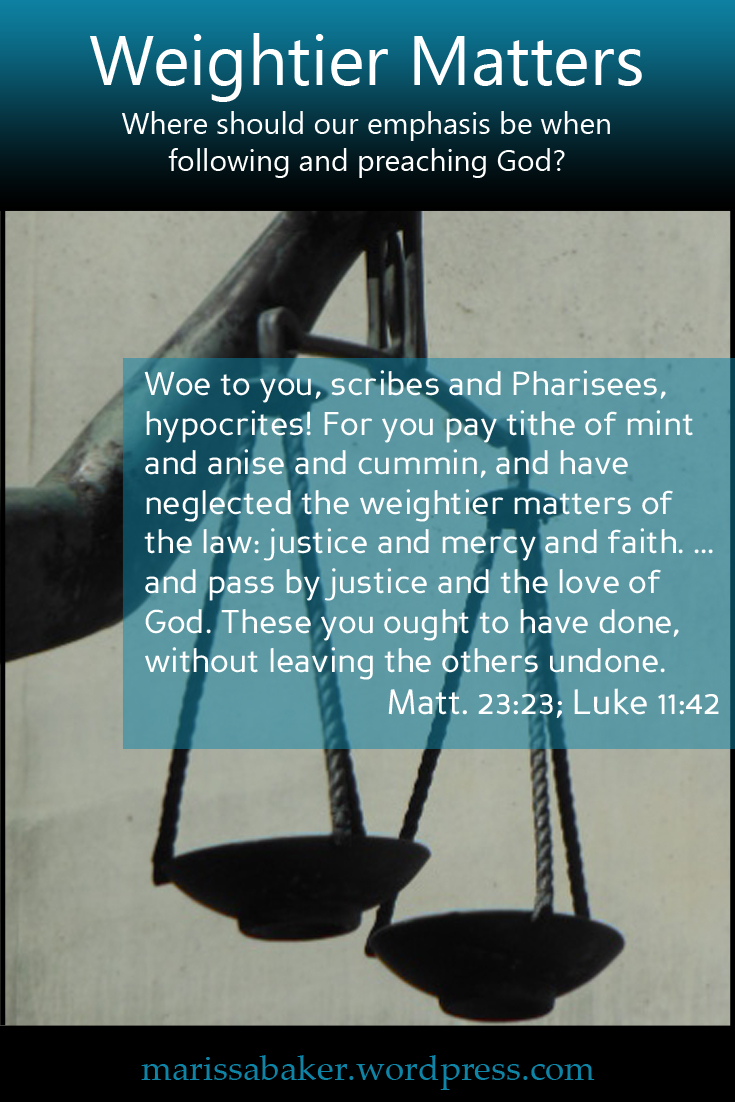
Weightier Matters

The scribes and Pharisees had a lot going for then. They were well-educated, well-respected, and held positions of authority in the community of believers. People thought they were important, and they were. Then this guy Jesus showed up and started condemning them for not following God correctly.

Can you imagine how this looked? Here are these men who’ve been the authority on worship tradition for years confronted by a young carpenter who just appeared out of nowhere. He didn’t even go to a good school! Worse, they know He’s right. But if they admit it, they lose their power.

weighty_matters
photo credit: Michael Coghlan “It Hangs in the Balance,” CC BY-SA

A similar thing can happen in our churches today. When leadership is focused on maintaining church tradition, there’s a danger of developing a Pharisaical attitude. A certain amount of resistance to change is needed to keep from forsaking sound doctrine, but often church tradition isn’t rooted in the Bible at all and if that’s the case it’s fair-game for reexamination. We can also, as the Pharisees did, error in emphasizing certain doctrines to the neglect of others. Read more

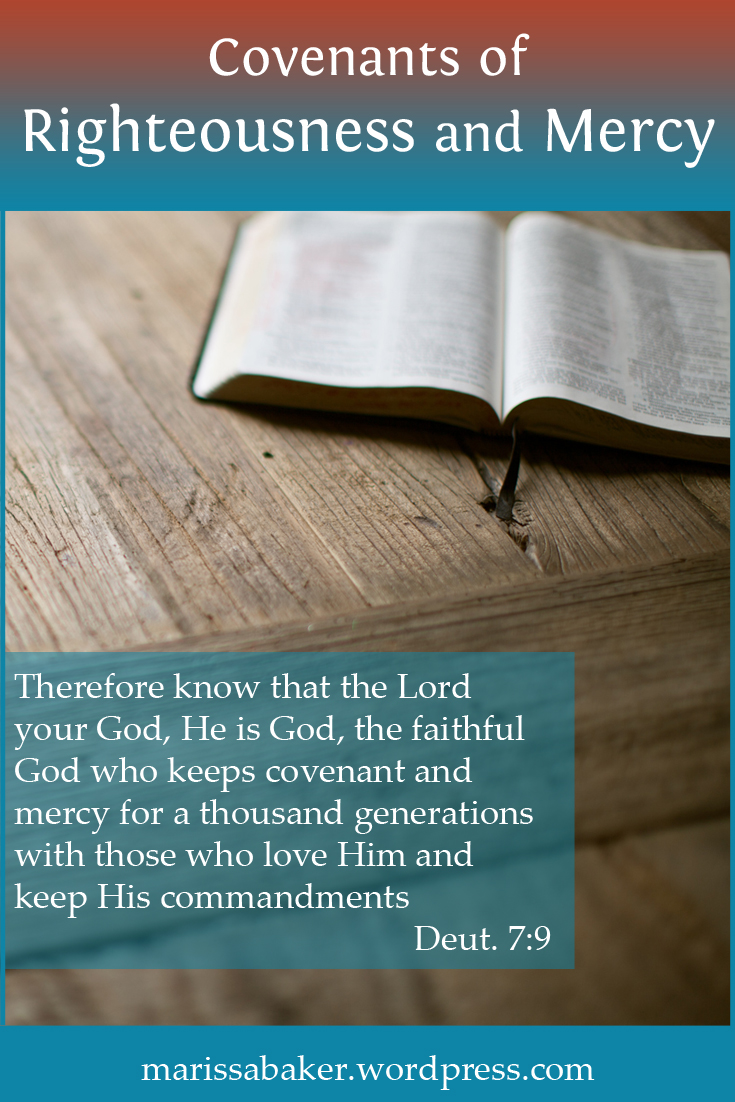
Covenants of Righteousness and Mercy

This isn’t the first time a Bible study has brought tears to my eyes. Usually that happens when I’m studying God’s love, but there’s also something inspiring, humbling and wonderful about His righteousness and mercy. They’re aspects of God’s essential character, and the more I learn about who the Father and Yeshua are, the more inclined I feel to just sit here in awe.

In Matthew 5:48 Jesus said, “you shall be perfect, just as your Father in heaven is perfect.” We have a responsibility to grow toward perfection, developing God’s character inside us. If we’re going to mimic His character, we have to study and learn about who and what He is, so we can display those traits as well.

Covenants of Righteousness and Mercy | marissabaker.wordpress.com

I’ve already written many posts on this blog about “God is love” (there’s even a whole ebook free if you click here), so that’s not what we’re going to focus on today. Instead, I want to spend our time together this Sabbath focusing on two key character traits that are aspects of God’s love.

The Lord is Righteous

If you search for the phrases “the Lord is …” and “God is …” trying to find descriptions of His character, the first you come to is in Exodus.

And Pharaoh sent and called for Moses and Aaron, and said to them, “I have sinned this time. The Lord is righteous, and my people and I are wicked. (Ex. 9:27)

Even a pagan ruler on the receiving end of God’s judgement recognized that “the Lord is righteous.” In Hebrew, the word is tsaddiyq (H6662). For human beings, righteousness involves fulfilling the commands of God. It “consisted in obedience to God’s law and conformity to God’s nature” (Theological Wordbook of the Old Testament, entry 1879). Like love, righteousness isn’t just something God shows toward us — it is one of His essential character traits. We define righteousness by pointing to God’s standard.

“Behold, the days are coming,” says the Lord, “That I will raise to David a Branch of righteousness; a King shall reign and prosper, and execute judgment and righteousness in the earth. In His days Judah will be saved, and Israel will dwell safely; now this is His name by which He will be called: THE LORD OUR RIGHTEOUSNESS. (Jer. 23:5-6)

Covenants of Righteousness and Mercy | marissabaker.wordpress.comNot only is God Himself righteous, but all our righteousness is found in Him. This prophecy points to Christ’s role as the one who makes us righteous. Only by following in Yahweh Tsidkenu’s footsteps can we continue in righteousness.

As we’ve seen, God’s righteousness is closely connected to His law. It follows that as a Being of righteousness He must institute penalties for disobedience as well as rewards for obedience. Daniel recognized this in his prayer for the exiles.

As it is written in the Law of Moses, all this disaster has come upon us; yet we have not made our prayer before the Lord our God, that we might turn from our iniquities and understand Your truth. Therefore the Lord has kept the disaster in mind, and brought it upon us; for the Lord our God is righteous in all the works which He does, though we have not obeyed His voice. (Dan. 9:13-14)

It is righteous for God to let evil befall a nation that broke their covenant with Him. Covenants aren’t just about the good things both parties get out of the agreement — they also include consequences for breaking the covenant, which is what we do when we sin (Dan. 9:4-5). Because God is righteous, He keeps the entire covenant — including the part that stipulates consequences for sin.

The Lord is Mercy

Daniel also calls on another of God’s essential character traits; one that goes hand-in-hand with righteousness.

And I prayed to the Lord my God, and made confession, and said, “O Lord, great and awesome God, who keeps His covenant and mercy with those who love Him, and with those who keep His commandments, we have sinned and committed iniquity, we have done wickedly and rebelled, even by departing from Your precepts and Your judgments.

O Lord, righteousness belongs to You, but to us shame of facebecause we have sinned against You. To the Lord our God belong mercy and forgiveness, though we have rebelled against Him. (Dan. 9:4-5, 7, 9)

If God was not mercy as well as righteousness, we would be in grave straits indeed. We have all sinned, and if God righteously rewarded us for that we would all be dead (Rom. 3:23; 6:23). Yet Jesus Christ took on Himself the death penalty required by covenant. Instead of rewarding us as we deserve He offers mercy, as He did to “a blasphemer, a persecutor, and an insolent man” who became the Apostle Paul (1 Tim. 1:13).

But God, who is rich in mercy, because of His great love with which He loved us, even when we were dead in trespasses, made us alive together with Christ (by grace you have been saved) (Eph. 2:4-5)

Mercy is as much a part of God’s being as love and righteousness, and it has always been this way. Back in the Torah, Moses makes a prayer for Israel very similar to Daniel’s plea. The people have rebelled, and Moses is asking for God’s mercy to mingle with His righteousness.

And now, I pray, let the power of my Lord be great, just as You have spoken, saying, ‘The Lord is longsuffering and abundant in mercy, forgiving iniquity and transgression; but He by no means clears the guilty, visiting the iniquity of the fathers on the children to the third and fourth generation.’ Pardon the iniquity of this people, I pray, according to the greatness of Your mercy, just as You have forgiven this people, from Egypt even until now.” (Num. 14:17-19)

Covenants of Righteousness and Mercy | marissabaker.wordpress.comMoses is directly referencing God’s own description of Himself in Exodus 34:6-7. These are the character traits of “God is love” which back-up the covenant God makes with His people

In the Old Testament verses we’ve been quoting, “mercy” is translated from the Hebrew chesed (H2617). The Theological Wordbook of the Old Testament points out that this word is often connected with covenant — most likely in that God’s covenant is a result of His chesed and includes the promise of His loving kindness. As those in covenant with God, we’re expected to show mercy as well.

Blessed are the merciful, for they shall obtain mercy. (Matt. 5:7)

In Greek, “mercy” is elos (G1656). It’s different from grace, which is a special kind of gift from God that consists of removing the penalty for sin. Mercy goes along with that and takes a step farther by alleviating the miserable consequences of sin (Zodhiates Key-Word Study Bible).

Jesus has compassion and mercy on us because He sympathizes with our weakness, having experienced what it’s like to be human even though He never sinned (Heb. 4:15-16). We, too, should exercise mercy towards others. As sinners ourselves, we’re in a unique position to respond to the suffering we see in others with loving kindness rather than condemnation. We must learn to follow God’s example of mingling righteousness and mercy. We never forget or ignore the covenant laws and our commitment to righteousness, but we also remember to always act out of mercy and love.

The Lord of Hosts

Our study last week reminded me of something else that caught my eye while writing the minor prophets series last year. When I was copying verses over into my handwritten notes, I realized I was writing “the Lord of hosts” quite a lot — sometimes more than once in a single verse.

You’ll often see this name of God written as “Jehovah Sabaoth.” Yahweh Sebaot/Tsebaoth are other ways to transliterate the name, and Elohim Sebaot is used as well. The variations of this name occur some 285 times, mostly in the books of prophecy. In the New Testament, it’s transliterated as “Lord of Sabaoth” (Rom. 9:29; James 5:4).

The Lord of Hosts  | marissabaker.wordpress.com
Photo by Juraj Kubica

Seeing the name “Lord of hosts” again and again in the prophets made me wonder about the significance of this name. Each name of God tells us something important about His character. What does “the Lord of Hosts” teach us? Read more

The Sun of Righteousness

There’s been a phrase stuck in my head since our study of the minor prophets last year. It came to mind over and over — in prayer, randomly while thinking about something else, and after hearing someone had died (which happened quite a lot last year). The phrase comes from Malachi 4:

For behold, the day is coming, burning like an oven, and all the proud, yes, all who do wickedly will be stubble. And the day which is coming shall burn them up,” says the Lord of hosts, “That will leave them neither root nor branch. But to you who fear My name the Sun of Righteousness shall arise with healing in His wings; and you shall go out and grow fat like stall-fed calves. You shall trample the wicked, for they shall be ashes under the soles of your feet on the day that I do this,” says the Lord of hosts. (Mal. 4:1-3)

The Sun of Righteousness | marissabaker.wordpress.com
Photo Credit: “Sunrise” by Always Shooting

Obviously a prophetic context, but what might it mean for us today? What can we learn from, and about, “the Sun of Righteousness” and the “healing in His wings”? Read more

What Is The Church?

The church is a family, not a business. Most people won’t argue with that, or at the very least they’ll make a case that it’s both. But that’s not always the impression you get when listening to church leaders talk.

When I go to church and hear a sermon, I expect to hear a teaching on God’s word, not an up-date on that church organization’s media outreach, how many associate pastors have been hired, or how much money their latest donation campaign brought in. Sermons like that just don’t make it seem like the church group is modeling themselves after the New Testament church established by Jesus Christ. Sometimes (in my more cynical moments) I wonder if we’re even trying.

The Church’s Commission

In John 13-17, Jesus delivers the longest uninterrupted discourse we have record of near the end of His life. Usually we look at “the Great Commission” in Matthew 28:19-20 for Christ’s take-away message to His church, but a good case can be made for viewing this section of scripture in that way as well.

Jesus starts out by demonstrating servant leadership in washing His disciples’ feet. That’s how He wants them to lead after He’s gone — by humbling self and serving others (John 13:12-17). Then He connects their walk as His followers with what He’d previously identified as the Great Commandments: love God, and love your neighbor.

A new commandment I give to you, that you love one another; as I have loved you, that you also love one another. By this all will know that you are My disciples, if you have love for one another. (John 13:34-35)

What Is The Church? | marissabaker.wordpress.comIt might not sell as well as “preaching the gospel,” but love is the succinct mission statement of Christ’s church. It’s not something you tack on as an afterthought — “we’ll do this, this, and this with love.” Love is the essential character of God. If we want to be like God, we have to embody His love.

As we move into John chapter 15, the focus stays on individuals. There are multiple branches abiding in the True Vine, but the message is to each one individually (“every branch in Me,” “a man, “you abide in me”). There’s no diffusion of responsibility for bearing fruit; it’s something every person is told to do.

Sometimes in church, we’re told it’s enough to tithe to an organization that’s bearing fruit. This makes me think of the parable of the talents, when the Master tells the servant who buried his talent, “you ought to have deposited my money with the bankers, and at my coming I would have received back my own with interest” (Matt. 25:24-27). Supporting an organization that’s doing good things is better than nothing, but it doesn’t exempt us from personal action.

If anyone does not abide in Me, he is cast out as a branch and is withered; and they gather them and throw them into the fire, and they are burned. … By this My Father is glorified, that you bear much fruit; so you will be My disciples. As the Father loved Me, I also have loved you; abide in My love. (John 15:6, 8-9)

The first time in this section of scripture that Jesus mentions selecting and sending people to go and do something, it’s to “bear fruit, and that your fruit should remain” (John 15:16). That’s shortly followed by telling the disciples they will “bear witness” of Him (15:27). Fruiting and witnessing will involve preaching, but that’s not the foundation.

When we read Jesus’ final prayer, He mentions several more things His followers should and will do. They will “know You, the only true God, and Jesus Christ whom You have sent” (John 17:3). They will keep His word (17:6). They will believe in Christ and His mission as the One Sent (17:7-8). They will not be like the world, though they are sent into the world (17:14, 16, 18). They will become one with God in His love (17:21-23, 26).

What we’re doing as Christ’s followers involves so much more than systematizing preaching of the word. Individually, our responsibility is to love God, attach ourselves to Him, and keep his commandments. Our connection to the Vine will result in bearing fruit for His glory. If our church’s mission by-passes that and goes straight to “we need to preach the gospel,” then we’re missing the mark.

Works Powered By God

I try not to directly engage with the speakers I hear in my local church on this blog, unless I can be in agreement with or say my writings were “inspired by” what I heard. To introduce this next point, though, I have to reference a message I heard last week where a church leader talked about their vision “to fulfill God’s purpose for humanity by bringing many children to glory.”

This phrase is lifted out of Hebrew 2:10. Whenever anyone quotes an isolated phrase of Biblical text, it’s a good idea to check it out in-context to get a fuller idea of the meaning.

But we see Jesus, who was made a little lower than the angels, for the suffering of death crowned with glory and honor, that He, by the grace of God, might taste death for everyone. For it was fitting for Him, for whom are all things and by whom are all things, in bringing many sons to glory, to make the captain of their salvation perfect through sufferings. For both He who sanctifies and those who are being sanctified are all of one, for which reason He is not ashamed to call them brethren (Heb 2:9-11)

Do you see anything in this passage about our role in bringing God’s children to glory? No — that’s the sole province of God our Father and the Captain of our salvation. We are “those who are being sanctified;” Christ’s brethren who He is bringing to glory. That’s where we show up in this passage of scripture.
What Is The Church? | marissabaker.wordpress.com

It is the height of arrogance to assume we can do “the work of God.” God does God’s work. This does involve equipping His people for certain tasks and giving them what they need to bear good fruit. We can do work that He gives us, as explained here:

Then they said to Him, “What shall we do, that we may work the works of God?” Jesus answered and said to them, “This is the work of God, that you believe in Him whom He sent.” (John 6:28-29)

Belief is a key foundation of our faith. Here, it’s also defined as “the work of God” that we’re given to do. Considering the context — people asking about the miracle of the loaves and the fishes (John 6:5-15, 25-27) — you can also read that belief is a prerequisite for doing works powered by God. This agrees with a later verse in Christ’s last Passover discourse.

Most assuredly, I say to you, he who believes in Me, the works that I do he will do also; and greater works than these he will do, because I go to My Father. (John 14:12)

When we’re in relationship with Jesus Christ and our foundation is strong in Him, we will do works like He did and for the same reasons He did. Christ’s every action on this earth — works of healing, inspired preaching, miracles — all pointed people toward the One True God. That is our mission also.

But this is done through individuals, not organizations. If an organization is doing good works, it’s because there are true Christians within it whom God is working through. The true church is the body of believers that Christ is building — the collection of individuals He is working with. Within the church, God works with each person to help them bear fruit. The fruit won’t look the same for everyone. Some will preach, some will support preaching, some will heal, some will serve within the body, some will have great wisdom, some will model exemplary faith (1 Cor. 12).

Preaching will result whether you treat the church as a business or as a family, but what fuels preaching in each situation is very different. In one case, you have an organization focused on spreading God’s word as much as they can. The emphasis is on what we’re doing, who we’re training, how many we’re reaching. In the other, you have a group of people so in love with God that they have to share His message. The focus is on loving God, rooting yourself in Him, and then bearing fruit for His glory, which involves pursuing the same things He values. Which church would you rather be a part of?

Consider the High Priest

In Hebrews 3:1, the writer tells his “holy brethren, partakers of the heavenly calling” to “consider the Apostle and High Priest of our confession, Christ Jesus.” The word “consider” invites us to “observe fully” (Strong’s G2657) and “fix one’s eyes or mind upon” Jesus (Thayers). That’s what we did in last week’s post for His role as Apostle, and what I hope to do this week for His role as High Priest.

Consider the High Priest | marissabaker.wordpress.com

Changed Priesthood

Christ’s priesthood is “after the order of Melchizedek.” It’s a key point in Hebrews’ discussion of Christ as our High Priest, even though we know very little about Melchizedek from his 3-verse appearance in the Torah. Read more