The Women At Pentecost: Valuing The Contributions of Unnoticed People In Church

We’re in the midst of the countdown to Pentecost, which this year falls on May 28 (just one week before my wedding!). Last weekend, I woke up very early Saturday morning and as I lay there staring toward the ceiling, Acts 1 and 2 started running through my head. I thought about all the women who were there at that first Pentecost after Jesus’s death, and I felt a need to write about them. And if you wake up at 4:00 am with a fully-formed Bible study idea in your head, it doesn’t seem right to just ignore it. I didn’t know where the study was going until I was polishing it up yesterday morning, but as you’ll see this isn’t just about women.

There were actually quite a few people there at that first New Covenant Pentecost, but we usually focus only on Peter and those listening to his sermon. To take note of the other people there, we need to do some close reading. Let’s begin in the first chapter of Acts. Here, Jesus spoke with his eleven remaining disciples before ascending to heaven and told them, “Do not leave Jerusalem, but wait there for what my Father promised, which you heard about from me. For John baptized with water, but you will be baptized with the Holy Spirit not many days from now” (Acts 1:4-5, NET). We pick up the story after they return to Jerusalem.

 When they had entered Jerusalem, they went to the upstairs room where they were staying. Peter and John, and James, and Andrew, Philip and Thomas, Bartholomew and Matthew, James son of Alphaeus and Simon the Zealot, and Judas son of James were there. All these continued together in prayer with one mind, together with the women, along with Mary the mother of Jesus, and his brothers.

Acts 1:13-15, NET

They were there “together with the women.” It’s plural, so there were more women there beyond Mary the mother of Jesus. We know it was “a gathering of about 120 people” (Acts 1:16, NET), but we don’t know who most of those people were or how many of those gathered were women. It’s interesting too see there are women there, but it shouldn’t be surprising; Jesus spoke with and included women throughout His ministry.

The next order of business was to appoint someone to take Judas Iscariot’s place as the 12th apostle. “The lot fell on Matthias” (Acts 1:26, WEB), and then they all continued waiting for Pentecost. Let’s jump back into the story at the start of chapter 2.

Now when the day of Pentecost had come, they were all together in one place. Suddenly a sound like a violent wind blowing came from heaven and filled the entire house where they were sitting. And tongues spreading out like a fire appeared to them and came to rest on each one of them. All of them were filled with the Holy Spirit, and they began to speak in other languages as the Spirit enabled them.

Acts 2:1-4, NET

There’s a chance that the “all” and “each of them” spoken of here only refers to the 12 apostles, but I don’t think that’s the case. There is no mention of the remaining 120 disciples leaving the gathering. And just because it’s “Peter, standing up with the eleven” (Acts 2:14, WEB) who addresses those in Jerusalem that questioned this miracle doesn’t mean there’s no one else there. In fact, by using a prophecy from Joel to explain what’s going on, Peter indicates that the “all with one accord” who received the spirit “on each of them” did include women and unmentioned men as well.

But this is what was spoken about through the prophet Joel:

And in the last days it will be,’ God says,
that I will pour out my Spirit on all people,
and your sons and your daughters will prophesy,
and your young men will see visions,
and your old men will dream dreams.
Even on my servants, both men and women,
I will pour out my Spirit in those days, and they will prophesy.
And I will perform wonders in the sky above
and miraculous signs on the earth below,
blood and fire and clouds of smoke.
The sun will be changed to darkness
and the moon to blood
before the great and glorious day of the Lord comes.
And then everyone who calls on the name of the Lord will be saved.

Acts 2:16-21, NET (bold italics are a quote from Joel 2:28-32)

God’s gift of the Holy Spirit was poured out on sons and daughters; on both men and women. This isn’t a revolutionary concept, but it’s amazing how many people throughout the years have overlooked women’s inclusion in the church as prophets and servants. I wrote last year about Christian women in the 17th century arguing for the right to teach using many of the same arguments I still use today to defend my ability to write this blog.
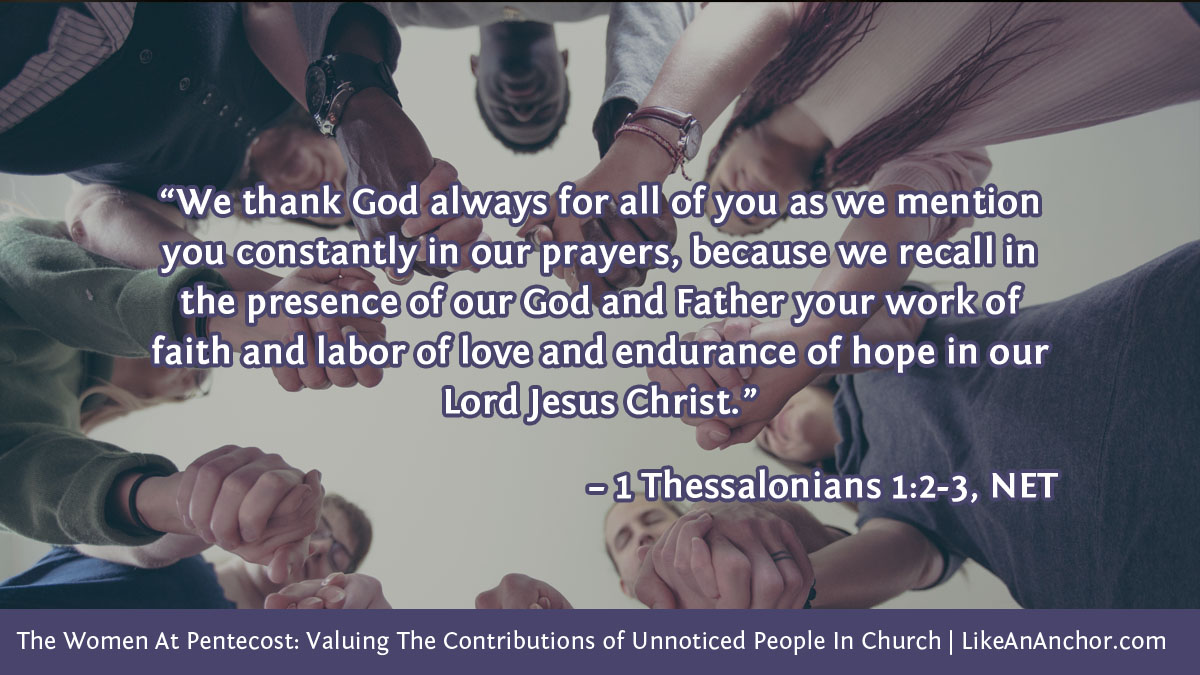
Image of a people holding hands and praying in a circle overlaid with text from 1 Thes. 1:2-3, NET version: “We thank God always for all of you as we mention you constantly in our prayers, because we recall in the presence of our God and Father your work of faith and labor of love and endurance of hope in our Lord Jesus Christ.”
Image by Claudine Chaussé from Lightstock

Women in Acts

As the book of Acts continues, we see women intimately involved in the early church. The apostles continued preaching, and “More and more believers in the Lord were added to their number, crowds of both men and women” (Acts 5:14, NET). When Philip shared “the good news about the kingdom of God and the name of Jesus Christ, they began to be baptized, both men and women” (Acts 8:12, NET). When prominent women in a city began following Jesus, it was worth writing down in the Acts account (Acts 17:4, 12). Some of the believing women were mentioned by name, including Tabitha who “was full of good works and acts of mercy which she did,” “Lydia, a dealer in purple cloth,” and “a woman named Damaris” (Acts 9:36; 16:13-15; 17:33-34).

Some of the women took an active role in preaching the gospel. Lydia, whom we’ve already mentioned, provided a safe place for believers to rest and gather (Acts 16:14-15, 40). Priscilla and her husband Aquila worked together to share God’s word (Acts 18:2, 18-19, 26; Rom. 16:3). “Philip the evangelist … had four unmarried daughters who prophesied” (Acts 21:9, NET). And they’re just a few examples of the women who speak in scripture.

Just as women participated in the early church as disciples, servants, and teachers, so they had a share in the hardships as well. When persecution arose, Saul “dragged off both men and women and put them in prison” and asked for letters granting him permission to keep searching other cities “if he found any who belonged to the Way, either men or women, he could bring them as prisoners to Jerusalem” (Acts 8:3; 9:2, NET). Saul (who later became the apostle Paul) certainly thought the believing women were just as involved in this “new” religion as the men. Evidently he didn’t change his mind about that later, since Paul’s letter to Rome highlighted women who served in the church congregation (Rom. 16:1-7).

And you know what? There are a lot of “overlooked” men here in Acts as well; it’s not just women who might disappear into the background of the stories. We have records of “crowds of both men and women” converting to the faith and Paul dragging unnamed men and women to prison, but most of these men don’t show up joining the ranks of the apostles or mentioned as key teachers. There were a lot of people who don’t make it into the Bible accounts by name, but that doesn’t mean God didn’t notice them or that they didn’t play key roles in their local church gatherings.

God is Not Unjust
Image of a couple women holding Bibles with the blog's title text and the words, "The Acts account mentions "crowds of both men and women" converting to follow Jesus, but most of them fade into the background. Does that make them (or us) any less important than the more prominent Bible figures?"
Image by Shaun Menary from Lightstock

When I began this post, I wasn’t sure what my concluding point for this post should be; just that I needed to write and share it. However, as I kept pondering and praying about it I realized it isn’t just about women. What I’m taking away from this reflection is to remember that God values, notices, and involves the people who seem to fade into the background behind someone who’s more famous and gregarious like Peter (1 Cor. 1:18-31). They’re there, they matter, but they only occasionally show up later in other accounts as people teaching and serving in church.

For God is not unjust so as to forget your work and the love you have demonstrated for his name, in having served and continuing to serve the saints. But we passionately want each of you to demonstrate the same eagerness for the fulfillment of your hope until the end, so that you may not be sluggish, but imitators of those who through faith and perseverance inherit the promises.

Hebrews 6:10-12, NET

As I write this final section, I’m realizing this is a message for everyone in the church who doesn’t do the showy things. It’s for those who quietly run the sound system and go unnoticed unless something goes wrong. It’s for those who set things up before services start and put things away after others go home. It’s for those who quietly visit widows during the week. It’s for those who don’t serve in a role with a title, but show up every week to “rejoice with those who rejoice, weep with those who weep” and contribute to the community with their faithful presence.

God doesn’t forget this sort of service because He’s not unjust. If we wish to imitate Him in being Just, we also will not forget the people who serve like this nor undervalue the hidden or “little” ways that we ourselves serve.


Featured image by José Roberto Roquel from Lightstock

Song Recommendation: “City on the Hill” by Casting Crowns

Our Role As Priests

Jesus is coming again. We know this; it’s promised over and over again in the scripture. We hold on to this promise, letting it contextualize our lives now and give us hope for the future.

That’s not where the story ends, though. There’s still more after Jesus’s second coming. Satan will be locked away, the faithful believers will rise from the dead, and they’ll live and reign with Christ for 1,000 years. This is the time we’re looking forward to now as we celebrate Sukkot (Feast of Tabernacles). And there’s still more to the story after that–when the rest of the dead will live again and God will dwell among people here on earth.

One of the things God reveals about the time after Jesus’s return is that we’ll be filling certain roles. Those who believe in, covenant with, and faithfully follow God now are told they’ll play a role in this future. We’ll either still be alive or we’ll be raised from the dead and welcomed into His family. And in that time, we’ll be priests. In fact, in many ways, we’re priests right now.

Serving in God’s Kingdom

In Revelation, John opens by saying that Jesus “has appointed us as a kingdom, as priests serving his God and Father” (Rev. 1: 6, NET). This is echoed again in a song “the four living creatures and the twenty-four elders” sing to the Lamb before God’s throne.

“You are worthy to take the scroll
and to open its seals
because you were killed,
and at the cost of your own blood you have purchased for God
persons from every tribe, language, people, and nation.
You have appointed them as a kingdom and priests to serve our God, and they will reign on the earth.”

Revelation 5:9-10, NET

Something happened at the cross which changed us and our role in the story. We’re not wandering around on our own anymore; we’re purchased for a specific appointment. God the Father and Jesus Christ choose and work with people from every location and background who are all destined to be part of a kingdom; His kingdom. If we’re part of this group, then we’ll be priests. We’ll even reign with Him, though that role is more about serving people than ruling over them (Matt. 20:25-28; 23:10-12).

I don’t know about you, but I find that an intimidating thought. Rule? As a priest? Me?!? There’s got to be some mistake. But we also know God chooses the sorts of people that don’t seem obvious; those who are unqualified by human standards and/or who realize the qualifications they have don’t mean much (Jer. 9:23-24; 1 Cor. 1:18-31). He wants rulers and priests who are humble; who realize they’re here to serve and help people toward a closer relationship with God.

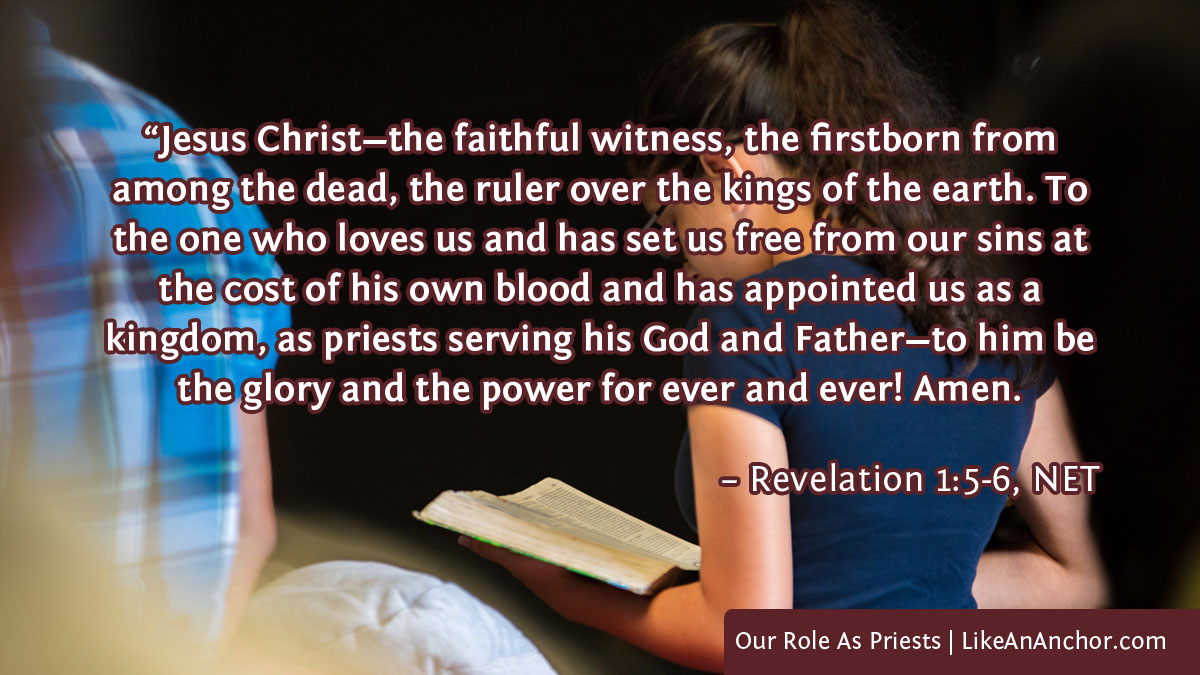
Image of a young woman standing in church reading her Bible, with text from Rev. 1:5-6, NET version: ""
Image by José Roberto Roquel from Lightstock

A Kingdom of Priests

Usually when we talk about priesthood in the Bible, we’re talking about the Levitical priesthood or Jesus’s priesthood “in the order of Melchizedek,” which superseded the Levitical priests. Yet while the Levites were set apart as priests who served in the temple, the whole nation of Israel was described as priestly.

Moses went up to God, and Yahweh called to him out of the mountain, saying, “This is what you shall tell the house of Jacob, and tell the children of Israel: ‘You have seen what I did to the Egyptians, and how I bore you on eagles’ wings, and brought you to myself. Now therefore, if you will indeed obey my voice and keep my covenant, then you shall be my own possession from among all peoples; for all the earth is mine; and you shall be to me a kingdom of priests and a holy nation.’ These are the words which you shall speak to the children of Israel.”

Exodus 19:3-6, WEB

The whole nation wasn’t allowed to serve in God’s tabernacle or temple (that role was just for the Levites), but they were still called priests. God intended for the whole nation to be holy, acting as priests in many ways. Here’s what the NET translators have to say about this phrase:

“This kingdom of God will be composed of a priestly people. All the Israelites would be living wholly in God’s service and enjoying the right of access to him. And, as priests, they would have the duty of representing God to the nations, following what they perceived to be the duties of priests—proclaiming God’s word, interceding for people, and making provision for people to find God through atonement.”

NET note on Ex. 19:6

In his One Year Worship the King Devotional, Chris Tiegreen puts it this way: Israel “was destined to be a priest between the world and its redeemer God” (Sept. 30 devotional). Ideally, the people joined to God in a covenant should fill a mediating, teaching, and worshipping role. They’ll be serving God faithfully and helping others who wanted to know God learn about Him.

Our Priestly Role, Now and Tomorrow

Image of a woman reading her Bible with the blog's title text and the words "As followers of God, we're 'a holy priesthood' today, just as Israel was chosen as 'a royal priesthood' under the first covenant."
Image by MarrCreative from Lightstock

Those of us in covenant with God today are part of modern “Israel” in a spiritual sense (Rom. 9-11). We’re grafted into the people of God and heirs with Jesus to the covenants. As part of that relationship with God, we’re part of His temple–His spiritual house. Jesus is the High Priest, but we have roles to play as well.

So as you come to him, a living stone rejected by men but chosen and precious in God’s sight, you yourselves, as living stones, are built up as a spiritual house to be a holy priesthood and to offer spiritual sacrifices that are acceptable to God through Jesus Christ. For it says in scripture, “Look, I lay in Zion a stone, a chosen and precious cornerstone, and whoever believes in him will never be put to shame.” So you who believe see his value, but for those who do not believe, the stone that the builders rejected has become the cornerstone, and a stumbling-stone and a rock to trip over. They stumble because they disobey the word, as they were destined to do. But you are a chosen racea royal priesthooda holy nationa people of his own, so that you may proclaim the virtues of the one who called you out of darkness into his marvelous light. You once were not a people, but now you are God’s people. You were shown no mercy, but now you have received mercy.

1 Peter 2:4-10, NET (italics/bold in original to mark OT quotes)

Here, Peter says that we’re “a holy priesthood” today, just as Israel was chosen as “a royal priesthood” as part of the first covenant. As priests, we’re supposed to “offer spiritual sacrifices,” obey the word of God, and “proclaim the virtues of” God the Father and Jesus Christ. We get the chance to model service, worship, and faithfulness to the world. We also hold a role that involves teaching and showing people the way. This is a role we’ll hold in the future as well, in the time Isaiah looks forward to when he writes, “your teachers won’t be hidden any more, but your eyes will see your teachers; and when you turn to the right hand, and when you turn to the left, your ears will hear a voice behind you, saying, ‘This is the way. Walk in it'” (Is. 30:20-21, WEB).

In his letter to Rome, Paul said that Jesus called him to “serve the gospel of God like a priest” (Rom. 15:16, NET). Before his conversion, Paul was an influential and knowledgeable religious leader but he wasn’t a Levite (Phil. 3:5). He wasn’t part of the priesthood in his physical lineage, but Jesus Christ called him into a priest-like service. Jesus is doing the same for us today. We’re called into God’s temple as part of His temple for a specific purpose. We’re here to serve, to worship, and to teach. We are starting to fill this priestly role today and we’ll come into it fully after Jesus’s return.

Featured image by Matt Vasquez from Lightstock

How Visible Is Your Commitment to Christ?

The culture we live in is not a godly one. None of us can say we live in a “Christian nation.” While we may share some values with the dominant culture(s), living the way Jesus did involves a very different lifestyle than the ones that are most socially acceptable.

That leaves Christians with a choice. We can either lie-low and try to fit in as much as we can, or we can embrace the fact that a commitment to living like Christ involves living counter-culturally. The later is hard. But if we want to become part of God’s family, we have to become like Him instead of staying like the world.

How Visible Is Your Commitment to Christ? | marissabaker.wordpress.com

We need a transformative relationship with Jesus

It’s not something we like to think about, but the scriptures indicate that not everyone who thinks they’re following Jesus will actually end up in His kingdom. One of these passages is found in Jesus’ sermon on the mount. It’s a serious, scary warning that we do well to pay attention to.

Not everyone who says to me, ‘Lord, Lord,’ will enter into the Kingdom of Heaven; but he who does the will of my Father who is in heaven. Many will tell me in that day, ‘Lord, Lord, didn’t we prophesy in your name, in your name cast out demons, and in your name do many mighty works?’ Then I will tell them, ‘I never knew you. Depart from me, you who work iniquity.’ Everyone therefore who hears these words of mine, and does them, I will liken him to a wise man, who built his house on a rock. (Matt. 7:21-24, WEB)

We learn several important things from this passage. Firstly, it’s possible to think you’re following Jesus and still not be in a relationship with Him. Whether or not He knows you is more important than the showy things you do in His name.

Secondly, He tells us how to become people He knows. We must do His Father’s will, hear His teachings, and act on them. Those actions will give us a strong foundation so that when life pounds on us we won’t fall (Matt. 7:25-27). It’s also going to drastically change how our lives look. Read more

Our Christian Nationality

A number of years ago I was sitting in a church service listening to the minister introduce his sermon topic for the day. One of the first things he said was, “Close your Bibles and put them on the floor. I’ve got something to tell you this morning.” Smacks of Bibles hitting linoleum is a sound I hope never to hear again. While teenage me wasn’t brave enough to stand up and walk out, I did keep my Bible open in my lap so I could do my own study while he lectured on American history.

The United States of America, rather than something out of the Bible, should feel like a strange topic for a sermon. And yet I’ve heard other sermons, though much less extreme, preached about this topic on a fairly regular basis. Typically, it’s presented as something like “the Biblical history of our country” or “America’s Christian heritage.” The speakers usually do turn to scriptures, but they may spend more time quoting founding fathers and presidents than they do Jesus.

Now, please don’t misunderstand me. This isn’t a rant against my country or an article condemning people who love the U.S. of A (which is why I didn’t post this 4th of July weekend, though it would have probably gotten more views then). Nor am I saying Christians teachers shouldn’t quote writings outside the Bible. My concern is that patriotism for our physical nation has gotten muddled up with our Christian faith as if the two are, or should be, interconnected. But I don’t think they should be.Our Christian Nationality | marissabaker.wordpress.com

Not Of The World

When Jesus walked this earth, He said He was “not of this world” (John 8:23, KJV). At the Passover, He started describing His followers that way as well (John 15:19; 17:14-16). We still have to live in this world, as Paul points out in 1 Cor. 5:10, but we don’t belong to it.

“We know that we are of God, and the whole world lieth in wickedness” (1 John 5:19, KJV). The present world is evil because it has fallen into sin and is under Satan’s sway (Gal. 1:4; John 14:30). I think most Christians would agree with that at least to a certain extent, otherwise we’d have no need for a Savior. But often, we think of this world’s evil as an abstraction. The world “out there” is wicked, “society” is evil, or there’s a spirit of wickedness at large “somewhere.” But maybe my neighborhood, this city, our country isn’t really all that bad.

Here in the U.S., we don’t yet face the sort of persecution that would serve as a constant reminder that this world isn’t a Christian’s home. I’m thankful for that, but I also wonder if it has made us lose sight of some important truths. The United States was founded with some Christian principles and a guarantee of a religious freedom, but it was never a “Christian nation” and it hadn’t even looked like one for a long time. And while you have the right as an American to get involved in pushing your country toward where you’d like it to go and a duty as a Christian to stand up for what’s right in God’s sight, this physical nation isn’t where we owe our primary allegiance. Read more

Be The “Anyone”

There are 3,310 pairs of socks in the men’s homeless shelter.

This past weekend, I attended a young adult service and enrichment weekend. After a Friday evening and Saturday of discussion questions, seminars, Shabbat services, and good fellowship we spent Sunday on a service project. Nearly 100 of us descended on a homeless shelter to help tackle some of their needs, including wall painting, deep cleaning, window washing, and sorting the donations room.

I spend quite a bit of time trying to figure out what my gifts are and how to use them effectively. That interest in personal growth and development is, in part, why this blog exists. But somewhat surprisingly (to me, at least), this weekend’s focus on filling your role in the body of Christ barely touched on spiritual gifts and individual talents. Rather, the take-away was finding your identity as a servant of Christ and then following His example no matter what.

Photo: “Helping Hands” by Valerie Everett, CC BY-SA via Flickr

While I’m a staunch advocate for finding, developing, and using your gifts (that’s why you have them, after all), it doesn’t really take any particular gift to count socks. Perhaps someone with a gift for math could have worked more quickly, or a person with a gift for organization sorted them more efficiently. But really the only thing absolutely essential was showing up and doing the work.

In focusing on where we fit best, perhaps we sometimes close ourselves off to areas where anyone could serve. Maybe we think, “Anyone could do that, so I’ll focus on what I do best.” But that doesn’t mean “anyone” will actually step-up and do it.

During your quest to find the best way to use your gifts, don’t overlook the importance of being the “anyone” who will step in and fill needs. Move from theory to practice. Whether it’s in your family, your church, or your community, let’s look for opportunities to help and then actually take them.

Walking by Faith (and next e-book announcement)

I just got back yesterday from an incredible  service-themed Young Adult weekend. It didn’t start out all that well for me, though. The day before I left I started feeling nervous (which is normal for me going into social events) but then by the time I left on Friday I had a shaking-crying-hyperventilating panic attack (which is becoming less and less normal/frequent for me).

I was really caught off-guard by this. I knew several people there — not just as acquaintances, but as friends — and I’d been eagerly looking forward to this event for weeks. I chalked it up to my too-active imagination combined with uncertainty about Friday evening’s schedule, breathed deep, prayed, turned Fallout Boy up, and started driving …

… and hit heavy traffic and rain (my two least favorite things to drive in). That left me running 20 late to met the people I was supposed to be car pooling with to the house I didn’t have an address for. Thankfully, one of the people I was meeting is also one of only 2 out of 100+ people at the weekend with my phone number, and he texted me the address. I proceeded to enter said address in my GPS and it took me to a house with no cars in the driveway.

It is either a testament to my stupidity or my faith that I walked up and rang the doorbell. Turns out, my friend accidentally sent me to another church member’s home (whose name I recognized, though I’d never met them) and they fed me cheese, gave me the correct address, and sent me on my way. Oddly, that’s when I felt a sense of peace for the first time all day. I was late, I was temporarily lost and yet God showed me that these worries coming true weren’t anything He couldn’t handle.

Walking by Faith | marissabaker.wordpress.com
photo credit: Dan4th Nicholas, CC BY via Flickr

Saturday brought a great round of seminars and an excellent sermon on foot washing and Passover. Nothing to worry about, until game night happened. I’m sure I’m in the minority judging by how many people said they had a wonderful time, but any sort of game that involves doing something in front of other people or in a group or on a team makes me intensely uncomfortable, especially if you add competition. The first two games were mixers where you asked someone a question and their name. I literally remember nothing from meeting people this way (does it even count as a “meeting” then?). Next was that game where you tie a balloon to your ankle and try to keep it from getting popped while popping everyone else’s balloon. I could have kissed whoever it was that popped my balloon the moment the game started.

That’s the last game I “played” (I stepped on my own balloon when they started round two) and I thoroughly enjoyed the rest of my evening talking with two other people who saw no appeal in participating. Give me a deep conversation with someone over competitive and/or rambunctious games any day. Now that’s how to meet new people. (Side-track back to the topic of social anxiety: game night continued throughout my conversations and there was a Bag of Doom from which they were drawing names to participate in a novelty challenge which you had to do while standing in the center of a room surrounded by 80-something people watching you. Can anyone say “introvert’s worst nightmare”?)

I think one of the biggest lessons I learned this weekend was that my fears were either 1) groundless or 2) didn’t have the power to hold me back. The fact that I had a panic attack before leaving turned into a blessing because it gave me the choice between either canceling my plans or praying through it and trusting God. I chose the later, and I kept encountering situations that could make me feel nervous and which reminded me to stay in prayer all weekend. Every single one of the things I was worried about worked out for the best, and the only part of that I can take credit for is that I took the step to go to the weekend and start a few conversations. The rest was all God.

This brings us in a very round-about way back to the topic of the weekend — service. Specifically, “Unlocking Your Desire To Serve.” As many of you know, I consider this blog a sort of ministry and it’s been growing in ways that amaze me and make me want to do more. One of the big things that holds me back is my own fears, including my fear of panicking when it’s important that I talk with people about my faith. So for me, blending this weekend’s focus on service with a need to rely on God for help working through my anxiety was a powerful experience.

  • If you gave up reading that long rambling post and started scrolling, here’s the e-book announcement:

Something I haven’t shared with many people is that in my local Messianic congregation I’ve been receiving words, prayers, and hints from brethren for the last several months along the lines of “God’s going to do something big in/with your life soon.” I even finally have a hint as to what that might involve after I came back from services a few weeks ago with a title for an e-book in my head which I promptly sat down and outlined. I’ve barely worked on it since, but this weekend was exactly what I needed to reconfirm that God wants me to be sharing my gifts through writing and that He’s more than capable of overcoming deficiencies on my part.

My first step is officially announcing the project here on this blog. The working title is “Rise Up, My Love” and the focus will be on reigniting the church’s passion for God (so, basically this blog in book form). I’m not committing to a release-date quite yet (it would be lovely to have it out by Sukkot/Feast of Tabernacles this fall, but I think a full year might be more realistic judging by how long it took to write The INFJ Handbook). I’ll keep you posted on details.