The Incredible Reasons God Gives Us For Not Being Afraid

It’s all well and good to say, “God doesn’t want you to be afraid,” like we did in last week’s post. But that doesn’t actually help much with getting rid of our fear. Even knowing He’s patient with our fearfulness doesn’t take the fear away.

Thankfully, God’s doesn’t just order, “Fear not,” and leave it at that. He offers specific promises that give us tangible reasons not to be afraid. And when we are fearful, those promises can help us overcome to act in faith despite our fears. This past week, I went through the Bible looking for all the reasons God gives for us not being afraid. There are many, but I’ve sorted them into four main categories:
The Incredible Reasons God Gives Us For Not Being Afraid Looking At Scriptural Mission Statements For People Following Jesus | marissabaker.wordpress.com
Photo credit: HarveyMade via Lightstock

God Is With You

Before Moses’s death, God inspired Him to share these words with Israel:

Be strong and courageous. Don’t be afraid or scared of them; for Yahweh your God himself is who goes with you. He will not fail you nor forsake you. (Deut. 31:6, WEB)

The number one reason we have for living without fear is that God Himself is with us. And not just as a church or a group of people. Individuals can also receive this promise, as did Isaac (Gen. 26:24), Joshua (Josh. 1:9), David (Ps. 23:4), Solomon (1 Chr. 28:20), and Jeremiah (Jer. 1:8).

Don’t you be afraid, for I am with you. Don’t be dismayed, for I am your God. I will strengthen you. Yes, I will help you. Yes, I will uphold you with the right hand of my righteousness. (Is. 41:10, WEB)

God promises not to let us down or leave us alone. That means the most powerful being in existence is at your side through everything. He doesn’t leave us to figure things out on our own nor abandon us in our struggles. Read more
What Does God Have To Say About Fear?

Is being afraid a sin? I think most of us, me included, would say it isn’t sinful in and of itself. Fear is often a natural gut reaction to things happening around us, and it serves a self-preservation role. It only becomes an issue if we act on it wrongly or let it paralyze us and prevent right action. But maybe I’m wrong. Maybe I’m letting my own fears cloud my perspective on this issue. Because it seems God takes our fearfulness more seriously.

He that overcometh shall inherit all things; and I will be his God, and he shall be my son. But the fearful, and unbelieving, and the abominable, and murderers, and whoremongers, and sorcerers, and idolaters, and all liars, shall have their part in the lake which burneth with fire and brimstone: which is the second death. (Rev. 21:7-8, KJV)

Some translations say “cowardly” instead of “fearful,” but the Greek deilos really does mean timid or afraid. Strong’s dictionary adds that it implies faithlessness. Hence Jesus’ question, “Why are you so afraid? How is it that you have no faith?” to the disciples in a storm (Mark 4:37-40, WEB). Is it really the case that God sees our fears and timidity as lack of faith?

What Does God Have To Say About Fear? | marissabaker.wordpress.com
Photo credit: HarveyMade via Lightstock

The Right Kinds of Fear

The Bible talks about fear in both positive and negative ways. The kind of fear that is connected with reverence and respect for God and His authority is good. In fact, it’s essential.

This is the end of the matter. All has been heard. Fear God, and keep his commandments; for this is the whole duty of man. For God will bring every work into judgment, with every hidden thing, whether it is good, or whether it is evil. (Ecc. 12:13-14, WEB)

Fear of God has long been a commanded part of following Him (Deut. 5:29; 6:2; 10:12). And in the New Testament, the apostles tell us to perfect “holiness in the fear of God” (2 Cor. 7:1, WEB), to “work out your own salvation with fear and trembling” (Phil. 2:12, WEB), and to live our lives on earth “in reverent fear” (1 Pet. 1:17, WEB). Read more

What’s The Church Supposed To Do?

If you ask the church that I’ve spent most of my life in what their mission is they have a ready answer: preaching the gospel and preparing a people. I can’t speak for your churches, but I imagine many (perhaps even most) of them would also point to some version of what we call The Great Commission as their mission statement.

Jesus came to them and spoke to them, saying, “All authority has been given to me in heaven and on earth. Go, and make disciples of all nations, baptizing them in the name of the Father and of the Son and of the Holy Spirit, teaching them to observe all things that I commanded you. Behold, I am with you always, even to the end of the age. (Matt. 28:18-20, WEB)

Is this a commission? yes, it’s “an instruction, command, or duty given to … group of people.” Is it great? since it came from Jesus and involves a responsibility given His disciples, yes. But is it really meant as the defining mission statement for the entire church from Jesus’ resurrection to His return? I’m not so sure.

What's The Church Supposed To Do? Looking At Scriptural Mission Statements For People Following Jesus | marissabaker.wordpress.com
Photo credit: Pearl via Lightstock

A Sobering Warning

The religious leaders of Jesus’ day were the group He spent the most time criticizing and correcting. They professed to follow God’s highest standards but were in reality hypocrites. They did righteous looking things just to get attention (Matt. 23:5). They went to great lengths to convert people only to pervert their faith (Matt. 23:15). They placed too high an emphasis on money received as tithes and offerings (Matt. 23:16-19). They neglected the “weighty matters” of God’s law and instead followed their own traditions. They even turned the temple itself into a marketplace where they exploited people coming to worship God (John 2:14-16).

The scary thing is, these people honestly thought they were the most righteous God-followers out there. That serves as a warning today that church leaders and organizations have to be very careful where they place their focus. And so do we as individual members of Christ’s body.

A Greater “Commission”

We certainly shouldn’t ignore Christ’s instruction to go, disciple, baptize, and teach. But we need to make sure we’re thinking of that command from Matthew 28 in its proper context. Because there are two other commissions that Jesus plainly told us are His greatest commands. Read more

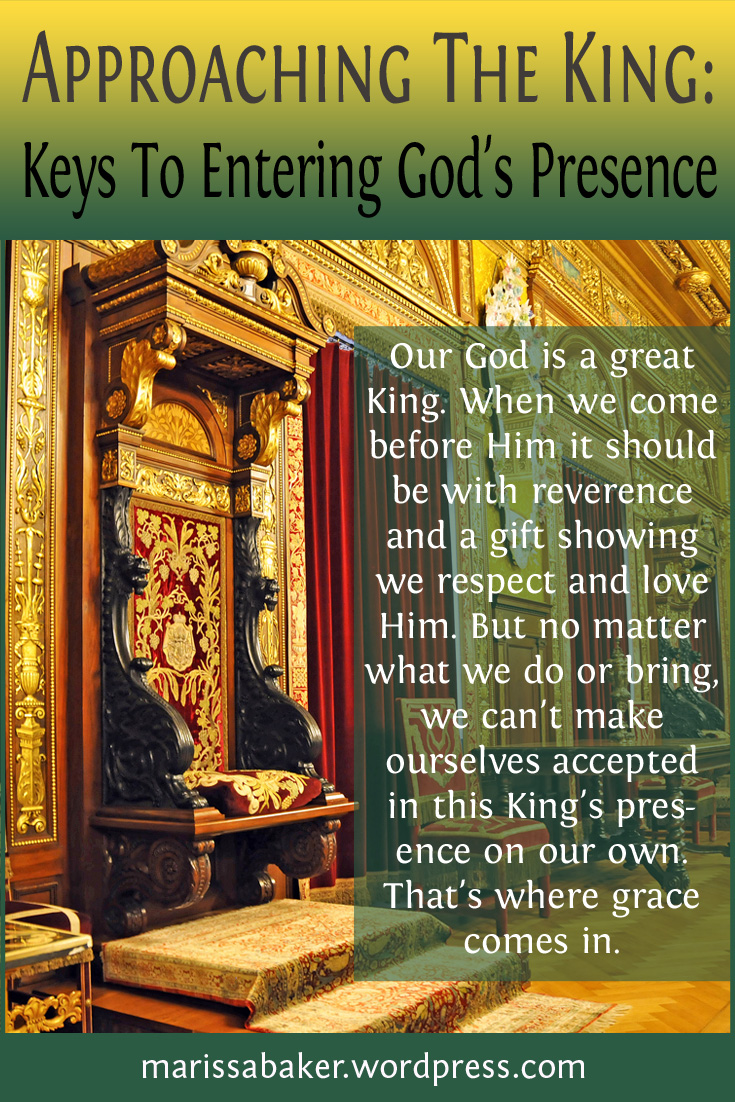
Approaching The King: Keys To Entering God’s Presence

Suppose you’ve been invited to meet the Queen of England. You don’t just walk in, wave, and say, “Hey there Elizabeth.” There are rules, protocol, and etiquette. You should bring a gift, remember to use the right form of address (“Your Majesty” first, then “ma’am”), and not turn reach out and touch her. These days, you won’t get in too much trouble for a slip in convention. But there have been many countries and many times throughout history that approaching royalty in the wrong way could get you killed.

Traditionally, people have recognized something special about royalty. Part of this was religious — rulers were seen as gods, or representatives of the gods, or appointed by God. It’s also a matter of recognizing and respecting an authority role.  Even in countries without a monarchy, we’ll still tend to recognize that some social positions command a certain amount of respect (i.e. you won’t talk with your boss the same way as a close friend and you’d probably show the President even more respect).

Approaching The King: Keys To Entering God's Presence | marissabaker.wordpress.com
Photo Credit: “Romania-1603,” by Dennis Jarvis, CC BY-SA via Flickr

A Question From God

The Bible applies several titles to God that demand respect, including Father, Master, Lord, and King. But do we take them seriously? Historically, God’s people have fallen short in this regard.

A son honors his father, and a servant his master. If I am a father, then where is my honor? And if I am a master, where is the respect due me? Says Yahweh of Armies to you, priests, who despise my name. (Mal. 1:6, WEB)

Yes, God loves you and He wants to be your friend. But we’re not to forget who He is and the respect due Him. “‘For I am a great King,’ says Yahweh of Armies, ‘and my name is awesome among the nations’.” (Mal. 1″14, WEB). God deserves more respect than worldly authority figures, but do we even give Him that much? Read more

Clean Temples For Yom Kippur

Back in the Old Testament when there was a tabernacle or temple standing, it included a room called “the most holy place” or “the holy of holies.” This was where the ark of the covenant was and a heavy veil separated it from the rest of the inner temple. It wasn’t a place that people, even the priests, could just walk into.

and Yahweh said to Moses, “Tell Aaron your brother, not to come at all times into the Most Holy Place within the veil, before the mercy seat which is on the ark; lest he die: for I will appear in the cloud on the mercy seat. (Lev. 16:2, WEB)

The only time someone could enter this most holy place was on the Day of Atonement, or Yom Kippur. Even then only the high priest could go in and only if he followed the proper rules for entering a place God had sanctified.

Clean Temples For Yom Kippur | marissabaker.wordpress.com
Photo credit: “Clean” by Sara Laval, CC BY via Flickr

But why bring this up now? We don’t have a temple or a priesthood or sacrifices anymore. And many Christians will say all that Old Testament stuff belong in the past. Or does it? There actually is a temple today, for “you are a temple of God” (1 Cor. 3:16, WEB). There’s a priesthood, too, because Jesus Christ is the High Priest and He has “an unchangeable priesthood” (Heb. 7:24, KJV). We’re even included in that because we’re meant “to be a holy priesthood, to offer up spiritual sacrifices” (1 Pet. 2:5, WEB). So given these facts, what can we learn from Yom Kippur today?

Temples Defiled By Association

When I was re-reading Leviticus 16, I was surprised to notice that the high priest was told to “make atonement for the Holy Place, because of the uncleanness of the children of Israel, and because of their transgressions, even all their sins” (Lev. 16:16, 33 WEB). I knew he was to make atonement for himself and “all the assembly of Israel,” but hadn’t noticed the holy place needed atoned for as well (Lev. 16:17, 30). There was something about being in the midst of an unclean, sinful people that defiled even the part of the temple where God’s presence appeared.

Today, the church body is described as a temple of God (there’s also a temple talked about in heaven, which we’ll get to later). The Greek word used in those passages is always naos (G3485), which refers to the inner sanctuary rather than the entire temple complex (which would be hieron, G2411). We are now God’s most holy place. And like the other holy of holies, we can become defiled by choice (see 1 Cor. 3:16-17) or by the sinful world around us. Read more

Are We Living A Performance Or Living For God?

I’d meant to just write one post about the Sermon on the Mount. Now here we are three weeks later with a third post on this study. And the first two only got through chapter five! I’m marveling at how much depth there is in such a familiar passage of scripture.

In the first part of this sermon, Jesus focuses on what God expects from those He’s in a relationship with. And it’s not always something that makes sense to human beings. The Beatitudes cover actions and character traits that don’t seem particularly positive from a human perspective, yet Jesus describes them as “blessed.” Then He starts talking about how law-keeping will change under the New Covenant. Walking in the spirit raises the bar higher, aiming for being like God rather than just living by the letter of His law. We end up keeping the law as we live in the spirit. And Jesus sticks with this theme of God’s expectations verses man’s ideas as He continues the sermon.

Are We Living A Performance Or Living For God? | marissabaker.wordpress.com
Photo credit: Ruby-Rose via Lightstock

Righteous Play-Acting

Jesus tells His hearers not to “do merciful deeds,” pray, or fast “as the hypocrites do” (Matt. 6:1-18, WEB). Those things are good — even essential — but they need to come from the right heart. The word hupokrites (G5273) means a stage actor or player who assumes a character’s role. So if you call someone who’s not on stage a hupokrites, you’re accusing them of playing a role in their lives. These people are living a performance, pretending to follow God while having other motives.

Hypocrites pretend to follow God so they can show-off to other people. But if we do that, Jesus warns “you have no reward from your Father who is in heaven” (Matt 6:1, WEB). The hypocrites do things for human praise and when they get it “they have received their reward” (Matt. 6:2, 5, 16, WEB). If your only motive is impressing people, then that’s all you’ll get out of your righteous play-acting. Read more