Knowing The Truth and Loving The Truth

In John 8:32, Jesus said, “You will know the truth and the truth will make you free” (WEB). Truth from God is a powerful thing. And it’s something God wants to share with everyone, because He “desires all people to be saved and come to full knowledge of the truth” (1 Tim. 2:4, WEB). Knowing God’s truth is connected with the salvation offered in Jesus Christ and is a key component of the Christian faith.

according to the faith of God’s elect, and the acknowledging of the truth which is after godliness; in hope of eternal life, which God, that cannot lie, promised before the world began (Tit. 1:1-2, KJV)

But head knowledge isn’t enough. It’s absolutely essential that you study and know about the One you believe in, but knowledge doesn’t get you into the kingdom. Paul says you could even “understand all mysteries, and all knowledge” but without love it would mean nothing (1 Cor. 13:2, KJV). We’re meant to go beyond knowing about God’s truth to doing something with that knowledge. If you don’t care about the truth enough to put it into action, then it’s not making the difference in your life that God intends.Knowing The Truth and Loving The Truth | marissabaker.wordpress.com

We Lose What We Don’t Love

Paul writes in second Thessalonians about a wicked one “whose coming is after the working of Satan” (2:9, KJV). He warns this one will come

with all deceivableness of unrighteousness in them that perish; because they received not the love of the truth, that they might be saved. And for this cause God shall send them strong delusion, that they should believe a lie: that they all might be damned who believed not the truth, but had pleasure in unrighteousness. (2 Thes. 2:10-12, KJV)

Paul doesn’t say these people didn’t know the truth. They weren’t ignorant about God’s message. But they did not believe the truth and they did not love it. Matthew Henry writes, “They could not bear sound doctrine and therefore easily imbibed false doctrines … Had they loved the truth, they would have persevered in it and been preserved by it; but no wonder if they easily parted with what they never had any love to (commentary on 2 Thes. 2:4-12, point #5). Read more


God’s “Real Children”

So, which ones are your kids? I mean, your real children.”

The parent with adopted kids fights to stay civil. “They’re all my children.”

I’m not adopted nor am I an adoptive parent, but it’s a topic near my heart. Partly because I care deeply about helping children and partly because adoption is how God describes His process of making us His children.

Several years ago, I wrote a blog post addressing a booklet I’d read a couple years before that which claimed adoption wasn’t really how God puts us in His family. They said it was a misunderstanding to say Christians are adopted children of God “rather than His actual begotten sons.” And that thought is still around. Just a few weeks ago, I heard a message where the speaker read Romans 8:14-17 and said, “It’s not adoption it is sonship.”

As you might imagine, I’ve got a couple issues with the idea that teaching we’re adopted by God is the same as saying we’re not His “real children.” For one thing, it implies in way that’s not at all subtle that if you’re adopted you’re not really part of the family. And it’s not okay to say things like that to an audience that very likely includes adopted children (and if it doesn’t, it should. The Bible defines true religion as caring for orphans and there are 3 times as many churches as orphans in the U.S.). But as vital as it is to make sure our words don’t injure others, it’s also important to properly represent God’s teachings through scripture.

God's "Real Children" | marissabaker.wordpress.com
Photo credit: Andrew Branch via StockSnap

Placing As Sons

The word translated “adoption” in New Covenant writings is huiothesia (G5206). It’s a compound formed from the words huios (“son” G5207) and tithemi (“to place” G5087). Paul’s the only Biblical writer to use it and it’s not found in classical Greek either (though the phrase thetos huios is used for “adopted son”). Rather, it’s a technical term referring to a legal and social custom in Greek and Roman society.

This sort of “adoption, when thus legally performed, put a man in every respect in the position of a son by birth to him who had adopted him, so that he possessed the same rights and owed the same obligations” (Spiros Zodhiates The Complete WordStudy Dictionary, entry on G5206). While it can be translated “sonship,” it’s a sonship obtained through an adoption process (not sonship instead of adoption). Read more

Instructions To Teachers

In June, I’ll be giving my first seminar at a church-sponsored young adult retreat. The last time I spoke in front of an audience was in a college class five years ago, so I’m a bit nervous. On top of that, teaching the Lord’s people is a serious responsibility. But it’s also one I’m grateful to have an opportunity for here on this blog and soon in-person as well.

While the Bible does talk about female prophets, it’s a bit fuzzy on the subject of women teaching. On the one hand, we have examples of prophetesses advising and instructing and women like Priscilla going out and teaching God’s truth. On the other, we have Paul’s admonitions for women to keep silent in the churches. So if I am going to teach in writing or speech, I want to be particularly careful I go about it in the way God intends.

The New Testament contains several instructions, as well as warnings, for teachers. Many are aimed at people in ministry, but I think in most cases we can apply them to anyone teaching God’s way of life. And to a certain extent, that includes every one of us in the church. Even if we’re not a “teacher,” we’re still serving as examples of God’s way and have a responsibility to faithfully represent Him to others.Instructions To Teachers | marissabaker.wordpress.com

Teach Only Truth

The bulk of the instructions to teachers concerns what they teach. They’re given the responsibility to faithfully share God’s words without straying from His truth. Jesus told the religious leaders of His day that their worship was “in vain” because they taught human traditions instead of sound doctrine (Matt. 15:9; Mark 7:7). That’s a trap we mustn’t fall into.

Jesus’ parting command to His disciples, which we now call the Great Commission, tells them to teach the nations “to observe all things that I commanded you” (Matt. 28:20, WEB). The early disciples followed that command by teaching in Jesus’ name the same things He taught (Acts 4:18; 5:42; 15:35; 28:31).

In Paul’s first letter to Timothy, he spends quite a bit of time warning him not to get distracted from sound doctrine. There will be people people who teach other doctrines, who get distracted from God’s message, who pollute Christ’s teachings with their own ideas. But that’s not what a teacher of God does. They stick to the scriptures, use the law lawfully, and faithfully practice righteousness (1 Tim. 1:3-11; 4:1-12; 6:3-6). Read more

The Gift of Prophecy

In his letter to the Corinthians, Paul discusses a variety of spiritual gifts. But there’s one in particular that he specifically tells them to “earnestly desire.” That gift is prophecy (1 Cor. 14:1, 39, WEB).

A basic definition for this word is to “speak forth by divine inspiration” (Thayer, G4395). Usually when we think of people prophesying, we think about the prophets like Elijah, Isaiah, Jeremiah, and Ezekiel. We think of men God used to foretell future events, confront sinful Israel, and write books of the Bible. We probably don’t think about prophets in the modern age.Why did Paul tell the New Covenant church that they should earnestly desire the gift of prophecy? | marissabaker.wordpress.com

And yet, Paul wrote that the New Covenant church should earnestly desire the gift of prophecy. He said you should want it and if God gives it to you you should use it. But how do we recognize a gift of prophecy (in ourselves or others), and how should it be used? Read more

Fasting

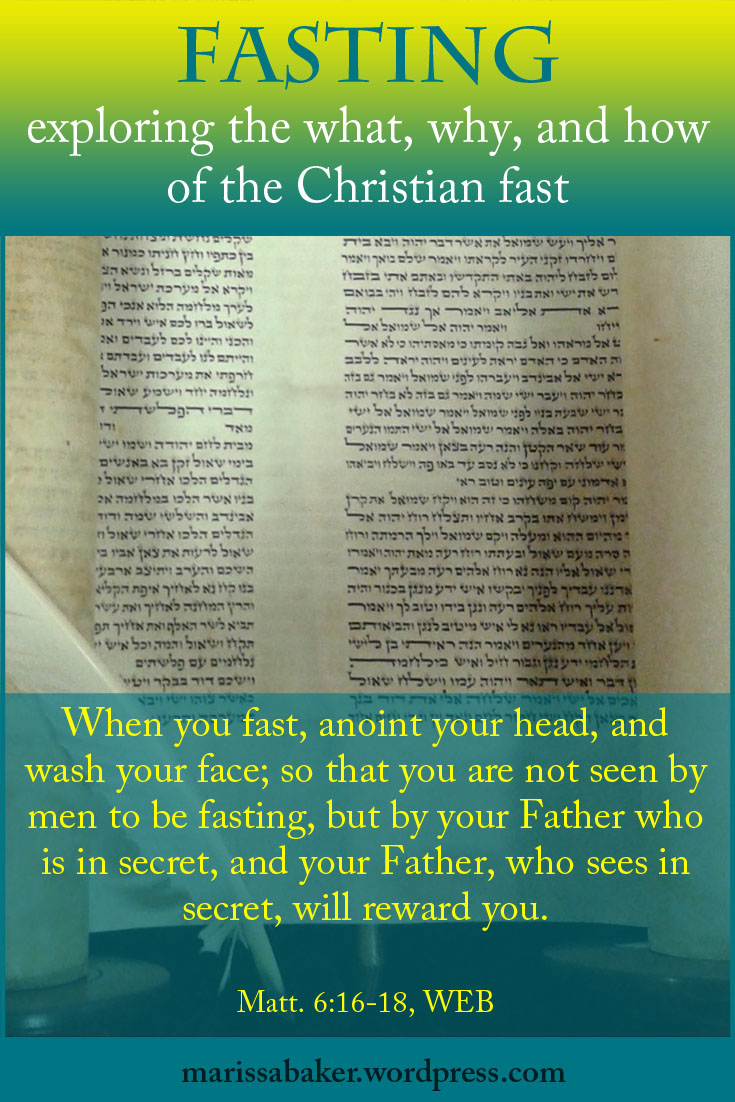
Fasting is one of the things Christians are supposed to do. And it’s something I’ve never done except on the Day of Atonement (Yom Kippur) when it’s strictly commanded. I’ve never even studied it because I didn’t want to be convicted on the subject (a rather embarrassing admission, but an honest one). But faithful followers of God fasted in the past, it’s counted right alongside prayer as a way of drawing nearer to God, and I suspect I should take it more seriously.

One of the churches I attend with recently called a church-wide fast, which had me thinking on the subject again. In this church, it’s generally accepted that “fast” means abstaining from food and drink for 24 hours (unless you have a medical reason you can’t do a full fast). In my Messianic group, though, I’ve heard people talking about different kinds of fasts using phrases like “full fast” and “Daniel fasts.” Having avoided studying the subject in the past, I had no ready answers for the questions this brought to mind about whether or not there really are different types of fasts and what sort of fasting God expects. Hence, this Bible study.Fasting: exploring the what, why, and how of the Christian fast | marissabaker.wordpress.com

Types of Fasting

The Hebrew words for “fast” are tsum (H6684) and its derivative tsome (H6655). The Theological Wordbook of the Old Testament defines it as “depriving the body of nourishment.” In Greek, the basic word for “fast” comes from a compound of ne (not) and estho (to eat). Spiros Zodhiates says nestis (G3523) means “not having eaten” and its derivatives nesteuo (G3522) and nesteia (G3521) mean “to fast or abstain from eating.”

There are three main types of fasting that Christian groups as a whole typically recognize. They all involve not eating food for a set period of time. Some churches/writers also add a fourth kind of fast for abstaining from certain activities (such as watching TV or having sex, which they get from 1 Cor. 7:3-5).

  • A “full,” “absolute,” or “dry” fast means no food or drink.
  • A “normal,” “regular,”  or “liquid” fast means no food, but you can drink water or sometimes juice (some incorrectly refer to this as a “full fast”).
  • A “partial” or “Daniel” fast involves abstaining from a specific meal or certain types of food.

These are also the types of fasts that secular resources discuss when they talk about fasting for health reasons. But does the Bible support these distinctions in fast types? Read more

Grief, Guilt, and Comfort for the Saint

Today’s guest post is by Dani Fisher of A Vapor In The Wind. We met when she contacted me in response to my project about Christianity and MBTI types and I’m thrilled to have her sharing on this blog today.

There are five stages of grief—denial, bargaining, anger, depression, and acceptance. Maybe you are familiar with these stages. If you have suffered any sort of traumatic life event or loss, you know these stages do not necessarily appear in this order. I would add one more stage to this whole process of grief—guilt. While in every big or small scenario of grief, guilt is not necessarily present, I would argue that when it comes to the loss of a loved one, there is always some manifestation of guilt. There is always something you regret, no matter how wonderful your relationship with your loved one might have been. This was my experience and for a long time I was unsure of what to do with my regret, how to respond to it and how to carry it.

When my brother died, one of the first things my father said was, “We have no regrets.” He was right. By all objective standards, my family had no regrets in the life and death of my younger brother. My brother was an exceptional seventeen-year-old. He had a good relationship with his parents and siblings. I would contend that “good” does not do justice to the friendship my brother and father shared. The name Benjamin means “son of my right hand” and Ben fulfilled his name in every respect – he was my father’s right hand man. My brother was full of joy and ambition. He possessed one of the greatest servant-hearted spirits and work-ethics of anyone I have ever known. He was the person you could count on in a crisis. If you needed his help, he would show up and follow through and I know so many of his friends and family can testify to the number of times he dropped everything to help someone in need.

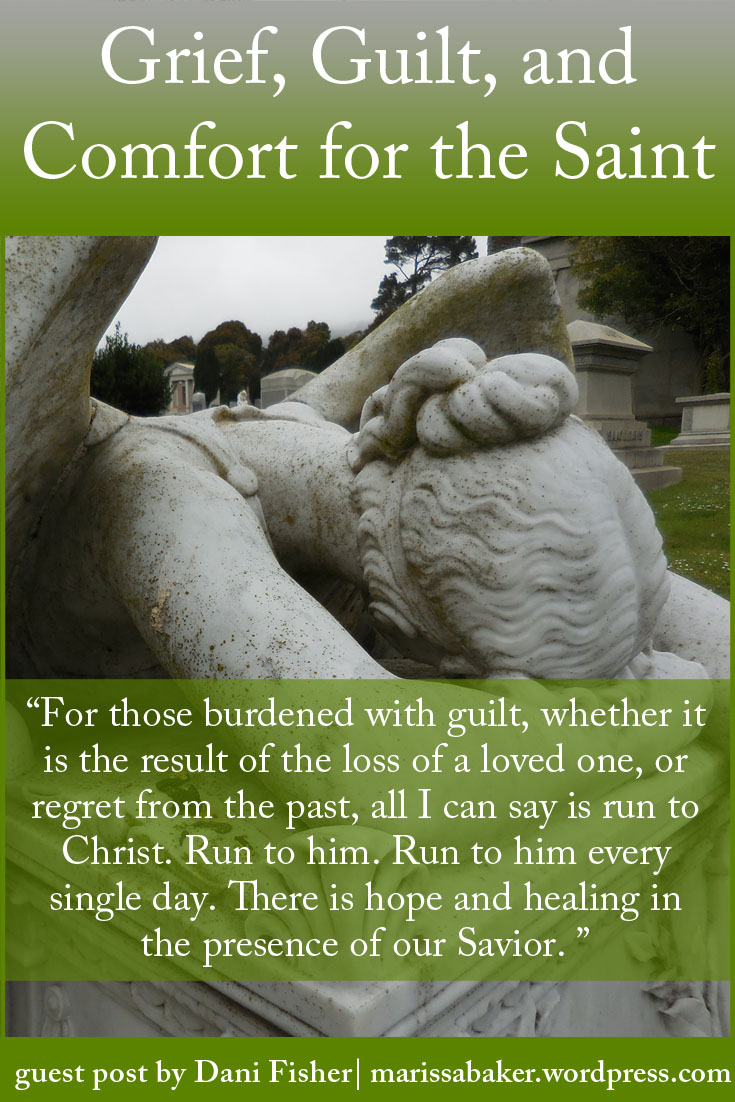
Grief, Guilt, and Comfort for the Saint. Guest post by Dani Fisher at marissabaker.wordpress.com
Photo credit: “Angel of Grief” by Cathy Baird, CC BY via Flickr

More importantly, my brother loved Jesus and he loved the church. We had the privilege and joy of hearing his personal profession of faith and witnessing the evidence of his faith and the fruit of the Spirit in his character and his works. I still envy the grace and lightheartedness with which my brother moved through life. It’s something I continually aspire to.

Ultimately, we had no regrets. My brother’s life was secured in Christ and because of that there was only glory in the blink of an eye for him the night he died. Certainly we had nothing to regret.

Nevertheless, regret is an inevitable symptom of loss in a fallen, sinful world. For me it was a multitude of little things that, when accumulated, resulted in a great weight of guilt. There were the angry, hurtful words I wish I had never said – the encouraging, supportive words I should have said more – the affection and love I wish I had demonstrated more openly, thoughtfully, and generously. There were all the things we said we would together do but never did – all the little ways I should have been a better sister and friend to him. Read more