Our Feelings Don’t Define God’s Truth

“Do what feels right.” “Follow your heart.” That’s the sort of advice we’ve steeped in living in Western culture. Problem is, that’s not really good advice. Sometimes your heart is wrong. Sometimes what feels good isn’t right.

Speaking more specifically to Christians, one of the hard truths we need to learn is that something can feel okay to you yet still be a sin in God’s eyes. Just because you’re okay with something doesn’t mean God is. And, on the flip side, your dislike of something doesn’t make it a sin. In short, how we feel does not define God’s truth.

God defines truth. Those truths are contained in His word (John 17:17), His law (Ps. 119:142), and His commandments (Ps. 119:151). Either you accept His standards as the basis for truth, or you’re not a Christian. You might be a decent sort of person on the whole, but you’re certainly not a follower of Christ. The Bible is our main link with God. It’s how He has revealed Himself to us. Rejecting the standards outlined in God’s word means we reject His mind and block the Spirit’s work to enlighten and transform us.click to read article, "Our Feelings Don't Define God's Truth" | marissabaker.wordpress.com

A Simple Test

Accepting an outside source as our ultimate authority doesn’t sit well with modern society. We tend to focus on individual freedom and self expression to the exclusion of objective morality. But the Bible says “Cursed is the man who trusts in man and makes flesh his strength, whose heart departs from the Lord” (Jer. 17:5). A heart following its own desires is moving away from God.


Read more

Grace To Build An Ark

When we think of “grace” we typically throw out definitions like “unmerited favor,” “free gift,” and “unearned salvation.” And those concepts are certainly included in the meanings of the Hebrew chen (H2580) and Greek charis (G5485). Both words translated “grace” are about good things we don’t deserve being graciously given to us by God.

But we also tend to make assumptions about God’s grace that aren’t necessarily found in scripture. For example, we assume that because the favor is unearned there aren’t any expectations laid on those who accept it. We think because the gift is free it can’t be revoked, rejected, and/or lost. We project cultural and traditional assumptions onto scripture that can cloud the meaning.

Several weeks ago, a Messianic Rabbi gave what’s probably the best message I’ve ever heard on grace (click here to listen to it). My goal in this post isn’t to share his entire message, but to narrow-in on one of the points he made that really captured my attention.click to read article, "Grace To Build An Ark" | marissabaker.wordpress.com

Saved By Grace

The very first time we see the word “grace” in the Bible is in reference to Noah. At this time, God looks down from heaven and sees “the wickedness of man was great in the earth, and that every intent of the thoughts of his heart was only evil continually” (Gen. 6:5). For that reason, God chose to bring judgement on the earth in the form of a flood. “But Noah found grace in the eyes of the Lord” (Gen. 6:6). Read more

Are You Who You Say You Are?

If we say we’re followers of Jesus Christ, there are certain things we should, nay, we must do. As we talked about last week, there are observable markers of being someone who follows God — things we should be able to notice when we examine ourselves. Those things are inseparably connected with Christ’s presence in us.

There is plenty of freedom within the perfect law of liberty, but there are absolutes as well. God is highly personal and He’ll work with you on a personal level. That does not, however, mean He has different requirements for how different people follow and worship Him. He’s also a just God who is not inconsistent in His commandments, laws, and expectations. We might have different understandings of what God expects, but as we grow toward God we should also be growing in unity as we understand His mind more fully. There isn’t one law for you and one law for me. There’s just God telling us all to walk in His ways.click to read article, "Are You Who You Say You Are?" | marissabaker.wordpress.com

Love + Obedience + Indwelling

John begins both his gospel and his first epistle with a focus on Jesus Christ’s role as the Word of life. Then, in the epistle, he focuses on how we can have fellowship with this great Being and His Father. We must “walk in the light as He is in the light,” “confess our sins” so He’ll forgive us, and then keep His commandments (1 John 1:5-2:3). We cannot claim to know God unless we’ve keeping His word and walking as Jesus walked (1 John 2:4-6). God wants us to be part of His family and that means becoming like Him (1 John 3:1-2). Read more

Watching Your Spiritual Condition

We’re each getting closer to the time when we’ll stand face-to-face with God. At that time, “each of us shall give account of himself to God” for the way we lived our lives, including “every idle word” spoken (Rom. 14:12; Matt. 12:36-37). How we conduct ourselves now matters to God.

click to read article, "Watching Your Spiritual Condition" | marissabaker.wordpress.com
Photo credit: “Watching Sunset,” CC BY via Flickr

If we’re in His family, then our time of judgement has already begun (1 Pet. 4:17). God is determining right now who will end up in His family by calling whom He wills, choosing those who respond, and then watching to see who remains faithful (Rev. 17:14). His mercy is unfailing and God is ever ready to forgive those who repent, but the simple truth is that He won’t have the sort of people in his family who chose to reject His teachings on how to live our lives. When God tells us how to live, it actually matters to Him that we listen.

Be a Growing Person

In his second letter, Peter talks about Christ’s approaching return and the day of judgement. He asks an important question: “What manner of persons ought you to be in holy conduct and godliness”? (2 Pet. 3:11). Even in the question, we start to get an answer. The type of person we should be involves holy conduct patterned after God’s example. Peter goes on, counseling, “be diligent to be found by Him in peace, without spot and blameless” (2 Pet. 3:14). Read more

“You’re Okay” Doesn’t Help A Sick Man

Imagine you’ve noticed something wrong and you go to the doctor. They run their tests and scans, take their samples, and sit you down with the results. You were right — you’re sick and quite probably dying without prompt attention. But instead of offering a cure, the doctor says he can alter the test results. You’ll still be dying, but you can pretend you’re not and tell all your friends the doctor says you’re fine.

"You're Okay" Doesn't Help A Sick Man | marissabaker.wordpress.com
Photo credit: Luis Llerena via StockSnap

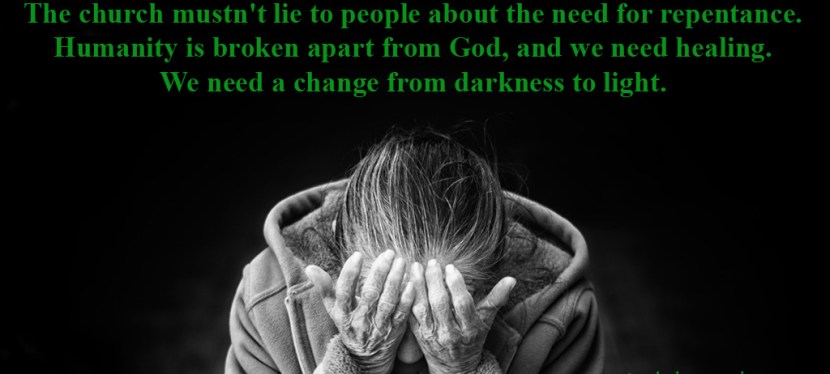
Sounds ridiculous, right? I’m not sure any of us would take that deal. But that’s what churches are doing on a spiritual level if they hold out the idea of salvation without repentance.

Our Western society is uncomfortable with objective morality. It’s unpopular to think certain actions are inherently wrong. We don’t want to acknowledge a higher power with the right to determine what is and is not sin. Yet that’s exactly what you must do when you become a Christian. My decision to follow Jesus means I’m not the ultimate authority in my life. He and Our Father are.

Repenting From What?

When Jesus began preaching, He said, “The time is fulfilled, and the kingdom of God is at hand. Repent, and believe in the gospel” (Mark 1:15). It has become popular in some Christian churches to say God’s commands aren’t relevant today. If you accept Jesus as your personal savior that’s it — you’re saved. There’s a measure of truth to this last statement, for God sent Jesus “that whoever believes in Him should not perish but have everlasting life” (John 3:16). But Jesus also commanded repentance and that begs the question, “What are we repenting of?” Read more

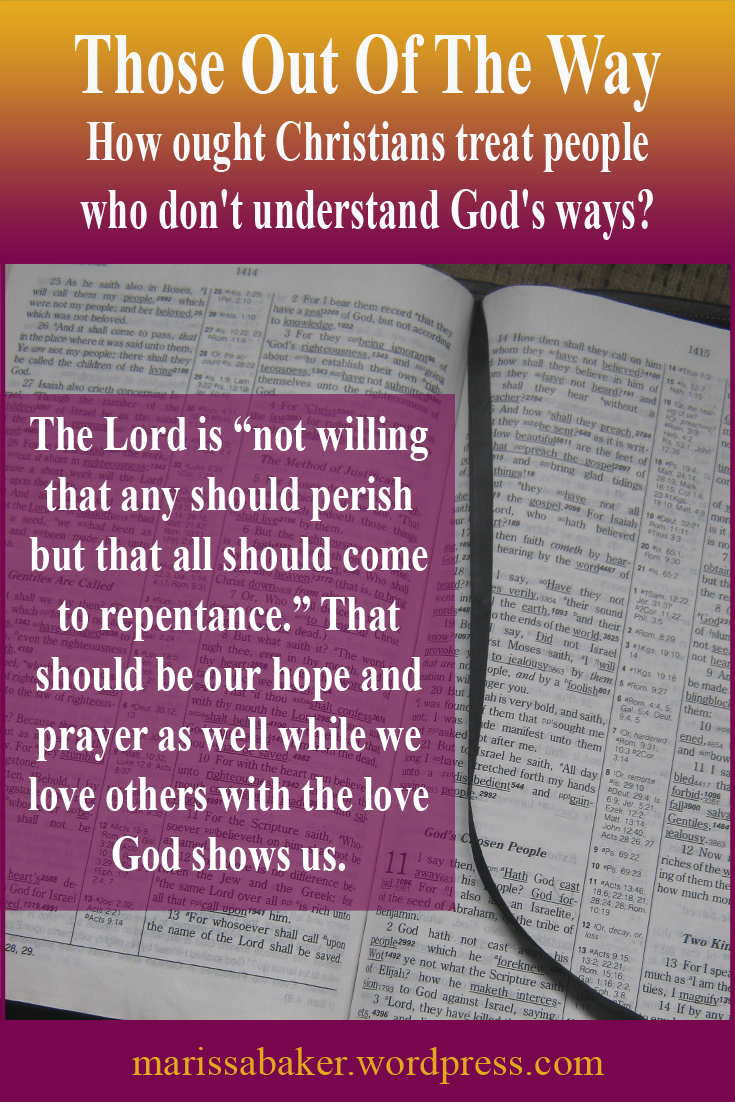
Those Out Of The Way

How ought Christians treat people who don’t understand God’s ways? There’s a very real temptation to belittle and criticize others for not believing the same things we do. Yet that’s not the sort of spirit God looks for in those who follow Him.

While keeping the Feast of Tabernacles (Sukkot) this year, one of the speakers shared a story from his time at a Bible college (click here for sermon recording). He and his classmates were assigned to read Emily Dickinson and analyze her theology. They picked it to bits, critiquing every way she didn’t understand their church’s teachings on the purpose and future of mankind. When they presented it to their teacher, they expected high marks.

Instead, the teacher grew angry. “You’re belittling the miracle of your calling,” he said. When we as Christians expect those who’ve not been called into God’s truth to understand, we aren’t acknowledging the miracle God performed when He enlightened us. When we condemn those who are earnestly seeking God and don’t have all the pieces, we condemn ourselves for a lack of compassion (and for arrogance in thinking we have all the right answers). We become like those Jesus criticized “who trusted in themselves that they were righteous, and despised others” (Luke 18:9-14).click to read article, "Those Out Of The Way" | marissabaker.wordpress.com

Seeking Their Good

God never intended for His people to stand in condemnation on those who don’t understand His ways. Yes we’re to know the difference between right and wrong and urge people to repent of their sins and build a relationship with God, but we’re not to attack them. We have a command to judge ourselves and we’re given limited judgement within the church (e.g. not allowing someone who openly practices sin, in spite of their profession to follow Jesus, to fellowship in the church see 1 Cor. 5:1-13). But is not godly to belittle and criticism people. Instead, we should respect the potential God has placed within all humans. Read more