Holy Spirit in the Book of Acts, Part 2

As you may know if you read my blog regularly, my Bible study for last week’s post was a bit too large to fit in one article. Hence, part 2 about the role of the Holy Spirit as revealed in the Book of Acts. All the intro is in last week’s post, so without further ado …

Filled With The Spirit

Several times when the Holy Spirit is mentioned in the book of Acts, it talks about people being “filled with” the Spirit. Sometimes it is referring to an individual’s character and relationship with God, such as Stephen (Acts 6:3,5) and Barnabas (Acts 11:24), and sometimes this filling with the Holy Spirit occurs after a specific event. For example, here’s what happened after the disciples prayed in Acts 4:24-30 following Peter and John being arrested and forbidden to speak in Jesus’ name.

And when they had prayed, the place where they were assembled together was shaken; and they were all filled with the Holy Spirit, and they spoke the word of God with boldness. (Acts 4:31)

It seems that God gave an extra dose of His Spirit when the disciples asked for strength to keep going through persecution. Notice also that the Spirit prompted them to speak, giving them the strength they needed to continue preaching in Jesus’ name (we’ll get back to that in a moment).

A similar thing seems to have happened in Acts 13:51-52, when Paul and Barnabus showed up in Iconium after being expelled from Antioch. The disciples here “were filled with joy and with the Holy Spirit,” though I’m not clear on whether this was new disciples receiving the Holy Spirit because of Paul and Barnabus’ preaching or established followers of Christ being giving an extra measure of the Holy Spirit as a result of persecution (any thoughts?)

Speaking By The Spirit

In several cases, being filled with the Holy Spirit precedes speaking. Take, for example, Peter and John before the Jewish leaders in Acts 4:8, as they witness to the life and power of Jesus Christ. This puts me in mind of Luke 21.

But before all these things, they will lay their hands on you and persecute you, delivering you up to the synagogues and prisons. You will be brought before kings and rulers for My name’s sake. But it will turn out for you as an occasion for testimony. Therefore settle it in your hearts not to meditate beforehand on what you will answer; for I will give you a mouth and wisdom which all your adversaries will not be able to contradict or resist. (Luke 21:12-15)

The Holy Spirit also inspires prophetic utterances, such as when Agabus predicted a famine (Acts 11:28) and when Isaiah spoke in the Old Testament (Acts 28:25). The thing I like to note here is that no one questioned that the Holy Spirit could and would do this sort of thing — the disciple’s response to Agabus was to organize relief efforts for the predicted famine (Acts 11:29).

Another important thing to note is what people say when speaking by the Holy Spirit. In Acts 4, Peter and John spoke God’s word boldly, bearing witness to Jesus Christ. In Acts 7:55-56, Stephen said, “I see the heavens opened and the Son of Man standing at the right hand of God.” In Acts 13:9-10, Paul spoke out against a sorcerer who was “perverting the straight ways of the Lord.”

The common thread here is presented in 1 Corinthians. In short, the test for answering the question, “Is someone speaking by the Holy Spirit?” is to look at how they talk about Jesus Christ.

Therefore I make known to you that no one speaking by the Spirit of God calls Jesus accursed, and no one can say that Jesus is Lord except by the Holy Spirit. (1 Cor. 12:3)

Getting The Holy Spirit

We generally assume that, with the exception of the the remarkable Pentecost in Acts 2,  baptism of the Spirit accompanies baptism in water, as it did for Saul/Paul in Acts 9:17-18. Similarly, believers at Ephesus “were baptized in the name of the Lord Jesus. And when Paul had laid hands on them, the Holy Spirit came upon them, and they spoke with tongues and prophesied” (Acts 19:5-6).
"Holy Spirit in the Book of Acts, Part 2" by marissabaker.wordpress.comThe situation is similar in Samaria, but with a greater time between the two baptisms. The new disciples here were “baptized in the name of the Lord Jesus,” but did not receive the Holy Spirit until Peter and John came and “ laid hands on them, and they received the Holy Spirit” (Acts 8:14-17).  Not sure why this is — was it to help establish the apostles’ role in the early church? Set a precedent for laying on of hands?

Another thing we can learn from this story is how not to get the Holy Spirit. The sorcerer Simon tried to buy the power to give God’s Spirit with the laying on of hands and was told, “your money perish with you, because you thought that the gift of God could be purchased with money! You have neither part nor portion in this matter, for your heart is not right in the sight of God” (Acts 8:18-21).

God can also give the Holy Spirit without laying on of hands or water baptism. This was done in Acts 10 to prove that “God has also granted to the Gentiles repentance to life” (Acts 11:18).

While Peter was still speaking these words, the Holy Spirit fell upon all those who heard the word. And those of the circumcision who believed were astonished, as many as came with Peter, because the gift of the Holy Spirit had been poured out on the Gentiles also.  For they heard them speak with tongues and magnify God. Then Peter answered, “Can anyone forbid water, that these should not be baptized who have received the Holy Spirit just as we have?” And he commanded them to be baptized in the name of the Lord. Then they asked him to stay a few days. (Acts 10:44-48)

God can give His Spirit to whomever He pleases, whenever it suits Him. It’s not something that follows a set formula or automatically comes with water baptism (see Simon’s story above). This gift is much more complicated and wonderful than something that just happens to accompany being dunked in water.

Roles and Actions of the Holy Spirit

Here’s where we get into what the Holy Spirit is credited with doing in the early church. I think the easiest way to organize this is just to go through them chronologically.

  • Acts 8:29the Spirit said to Philip” to speak to the Ethiopian eunuch
  • Acts 8:39the Spirit of the Lord caught Philip away, so that the eunuch saw him no more,” and Philip found himself at Azotus.
  • Acts 9:31 the Holy Spirit acts as a comforter, as was promised in John 14:16, 26; 15:26; 16:7.
  • Acts 10:19-20 the Spirit told Peter to go with Cornelius’ messengers and to doubt nothing.
  • Acts 13:2 As they ministered to the Lord and fasted, the Holy Spirit said, ‘Now separate to Me Barnabas and Saul for the work to which I have called them.’” Since the Holly Spirit itself does not call people, I think it safe to assume God was peaking through the Spirit. Still, they were hearing the Holy Spirit clearly enough to record a line of dialogue.
  • Acts 15:28 the letter to Antioc read, “it seemed good to the Holy Spirit, and to us” — collaborative letter writing with the Spirit?
  • Acts 16:7 “after they had come to Mysia, they tried to go into Bithynia, but the Spirit did not permit them.”
  • Acts 20:23the Holy Spirit testifies in every city, saying that chains and tribulations” await Paul. Two examples of this: Acts 21:4, 11.
  • Acts 20:28 speaking to the Ephesian elders, Paul said, “the Holy Spirit has made you overseers, to shepherd the church of God”

This is not at all how we interact with the Spirit today. we don’t hear it talking to us (and would we listen if we did? or think we were going mad?). We don’t act like it’s real and tangible enough to physically move us from one location to another if God had good reason. We credit it with inspiring messages and study, but that’s about it. Why is that? Are we so frightened of the supernatural that we shoot ourselves in the foot when it come to using the Spirit God has given us?

Grieve Not The Spirit

"Holy Spirit in the Book of Acts, Part 2" by marissabaker.wordpress.comThere is a very real danger in not giving God’s Spirit the respect it deserves as a gift from Him and an aspect of His power. Ananias and Sapphira dropped down dead when the lied to and tempted the Holy Spirit (Acts 5:3-9). Stephen told his murderers, “You stiff-necked and uncircumcised in heart and ears! You always resist the Holy Spirit; as your fathers did, so do you.” (Acts 7:51). Resistance to the Holy Spirit was their legacy — we do not want it to be ours.

We are told, “do not grieve the Holy Spirit of God” (Eph. 4:30), “do not quench the Spirit” (1 Thes. 5:19), and “do not neglect the gift that is in you” (1 Tim. 4:14), which could refer to the Spirit itself or to one of the Spiritual gifts (2 Tim. 1:6; 1Cor. 12:1-11). We have been given something incredible, and should not undervalue it.

Holy Spirit in the Book of Acts, Part 1

I did not mean for this to be a multi-part blog post, but I didn’t get all the way through studying the book of Acts this week so I’ll have to split the post in half. When I was in Cincinnati last weekend for Sabbath services and square dancing, there was one particular part of the sermon message that caught my attention. The speaker said “We can’t use the Holy Spirit if we don’t understand what it is” and that we don’t talk about the Holy Spirit today the way it was viewed by the early church in the Book of Acts.

That got me thinking, just how did the early church talk about the Holy Spirit? We usually look at the first two chapters, which chronicle the baptism of the Holy Spirit at Pentecost, and then go no further in Acts when we talk about the Holy Spirit. That’s where I’ll start as well, and then next week I’ll plan to write a post about what my study turns up in the remainder of Acts.

Enter The Holy Spirit

There were people who had the Holy Spirit before this notable Pentecost, but not many. So few, in fact, that it says in John’s gospel that “the Holy Spirit was not yet given, because Jesus was not yet glorified” (John 7:39). Before Jesus ascended to heaven in the first chapter of Acts, He promised the disciples, “you shall be baptized with the Holy Spirit not many days from now” and “you shall receive power when the Holy Spirit has come upon you” (Acts 1:5, 8). That promise was fulfilled in the next chapter.

And suddenly there came a sound from heaven, as of a rushing mighty wind, and it filled the whole house where they were sitting. Then there appeared to them divided tongues, as of fire, and one sat upon each of them.  And they were all filled with the Holy Spirit and began to speak with other tongues, as the Spirit gave them utterance. (Acts 2:2-4)

Not only was the Holy Spirit given to the disciples, but a miracle was performed at the same time which left no doubt of the effectiveness of the power God was giving. Men “from every nation under heaven … heard them speak in his own language” (Acts 2:5, 8). As we’ll discuss more in next week’s post, this is not the only time this particular miracle accompanied the giving of the Holy Spirit (Acts 10:44-48).

Receiving the Spirit

When some doubted what was going on, Peter said this:

Men of Judea and all who dwell in Jerusalem, let this be known to you, and heed my words. For these are not drunk, as you suppose, since it is only the third hour of the day. But this is what was spoken by the prophet Joel: “And it shall come to pass in the last days, says God, that I will pour out of My Spirit on all flesh; your sons and your daughters shall prophesy, your young men shall see visions, your old men shall dream dreams. And on My menservants and on My maidservants I will pour out My Spirit in those days; and they shall prophesy. (Acts 2:16-18)

He also revealed a recipe for receiving the Holy Spirit which is repeated several times in later chapters.

Repent, and let every one of you be baptized in the name of Jesus Christ for the remission of sins; and you shall receive the gift of the Holy Spirit. For the promise is to you and to your children, and to all who are afar off, as many as the Lord our God will call. (Acts 2:38-39)

I am finding it interesting, and inspiring, to read through the book of Acts taking note of every time the Holy Spirit is mentioned and seeing how the promises and prophesies mentioned in chapter 2 enfold in the early Church. I look forward to sharing more of my thoughts on this with you next week, and hope you’ll weigh-in as well — it seems like a topic that could lend itself well to discussion.

Much Too High A Price

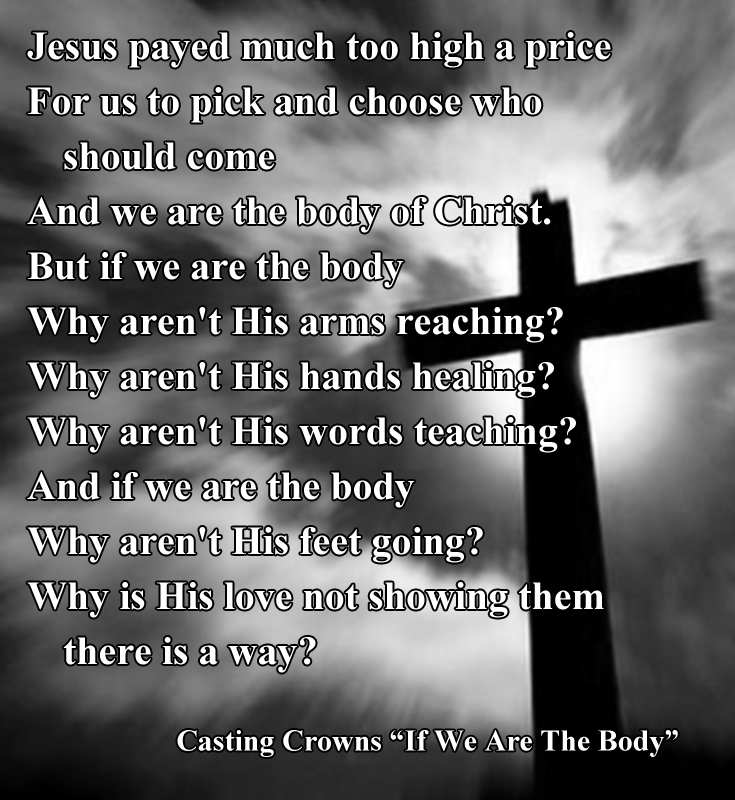
I wrote last week about questions the church can ask herself regarding our role as the body of Christ. Like the Casting Crowns song “If We Are The Body,” it was meant as a challenge for the church as a whole to reach out with compassion, heal others, teach Jesus Christ’s words, walk in His steps, and love everyone. The reason for this is mentioned in the line which provides me with a title: “Jesus payed much too high a price / For us to pick and choose who should come / And we are the body of Christ.”

What Price?

Christ said, “I am the good shepherd. The good shepherd gives His life for the sheep” (John 10:11). That, in a nutshell, is the price paid. He willingly gave up first His eternal existence with the Father and then His human life to be a sacrifice for sins (John 1:1-2, 14). A more complete picture of what this entailed can be found in Isaiah 52:13-53:12. Here’s a few verses:

He is despised and rejected by men, a Man of sorrows and acquainted with grief. And we hid, as it were, our faces from Him; He was despised, and we did not esteem Him. Surely He has borne our griefs and carried our sorrows; yet we esteemed Him stricken, smitten by God, and afflicted. But He was wounded for our transgressions, He was bruised for our iniquities; the chastisement for our peace was upon Him, and by His stripes we are healed. (Is. 53:3-5)

I have a hard time thinking of what to write after this. It’s so deeply moving to think of how much He suffered for my sake, and for your sake, and for the entire world (John 1:29; 4:42; 6:33; 12:47).

For God so loved the world that He gave His only begotten Son, that whoever believes in Him should not perish but have everlasting life. For God did not send His Son into the world to condemn the world, but that the world through Him might be saved. (John 3:16-17)

I find it interesting that John 3:16-17 doesn’t say that Christ died to save the church — it says He died for the entire world. The goal is to save as many people as possible (2 Pet. 3:9).

Paid For Whom?

No one can come to Christ unless the Father draws them (John 6:44), and once that happens “he who believes in the Son has everlasting life” (John 3:36). If someone shows up at church with that one requirement — belief in Jesus Christ — then we have no right to turn them away. Their belief is a sign that God is working with them. Look how strongly Christ rebuked His disciples when they thought certain people were not worth His time:

Then they brought little children to Him, that He might touch them; but the disciples rebuked those who brought them. But when Jesus saw it, He was greatly displeased and said to them, “Let the little children come to Me, and do not forbid them; for of such is the kingdom of God. Assuredly, I say to you, whoever does not receive the kingdom of God as a little child will by no means enter it.” (Mark 10:13-15)

"Much Too High A Price." marissabaker.wordpress.comIn Matthew, Jesus further said, “Whoever receives one little child like this in My name receives Me. Whoever causes one of these little ones who believe in Me to sin, it would be better for him if a millstone were hung around his neck, and he were drowned in the depth of the sea” (Matt. 18:5-6) Since we are all God’s children, whatever age we are, I think it safe to extend what Christ says concerning His little ones to every new believer. James 2 talks about not showing partiality, or respecting people based on how much money they have. This principle can be extended to other factors as well. Take the example of “strangers” who joined Israel in the Old Testament.

“Also the sons of the foreigner who join themselves to the Lord, to serve Him, and to love the name of the Lord, to be His servants — everyone who keeps from defiling the Sabbath, and holds fast My covenant — even them I will bring to My holy mountain, and make them joyful in My house of prayer. Their burnt offerings and their sacrifices will be accepted on My altar; for My house shall be called a house of prayer for all nations.” The Lord God, who gathers the outcasts of Israel, says, “Yet I will gather to him others besides those who are gathered to him.” (Is. 56:6-8)

In our modern churches of God, a similar situation might be new people coming into the church without a Worldwide background and no clue who Mr. Armstrong was. Or maybe people in other groups that we not-so-secretly wonder if they are really part of the body. It is not our place to make judgements about who is and who is not part of Christ’s body and living in His sheepfold (John 10:16). If someone believes in Him, we should welcome them with open arms. If they keep His Sabbaths and enter into covenant with Him, like the strangers in Israel, we must not dismiss them.

Then Peter opened his mouth and said: “In truth I perceive that God shows no partiality. But in every nation whoever fears Him and works righteousness is accepted by Him.” (Acts 10:34-35)

This statement should disabuse us of any notion that people of a certain social class or church background or ethnic group are in some way better or worse than others. The Pharisees had that idea — “We have Abraham as our father” — and John the Baptist told them they were a “brood of vipers” and “that God is able to raise up children to Abraham from these stones” on the ground near the river. Their background did not matter, only that they repent and “bear fruits worthy of repentance” (Matt. 3:7-9).

What Should We Do?

"Much Too High A Price." marissabaker.wordpress.comThe Father and Jesus want to save every single person who will let them. Are we helping them in that goal as members of the body of Christ? Or are people “tripping over me” when they try to reach God (Rom. 14:13)? We are so quick to take and cause offense, to indigently puff up and bluster at people over even trivial things like music selection, whether or not to worship with hands raised, and are jeans appropriate for church services. But look at Paul’s attitude:

Give no offense, either to the Jews or to the Greeks or to the church of God, just as I also please all men in all things, not seeking my own profit, but the profit of many, that they may be saved. (1 Cor. 10:32-33)

How much less strife would there be within the church and in our interactions with those who do not yet believe if this were our attitude!

Let each of us please his neighbor for his good, leading to edification. For even Christ did not please Himself; but as it is written, “The reproaches of those who reproached You fell on Me.” (Rom. 15:2-3)

When we set aside our selfishness and look after other people before ourselves, we are following in Christ’s footsteps. When we are becoming like the “head over all things to the church,” we truly begin acting like the body of Christ (Eph. 1:22-23). We are supposed to imitate God and “walk in love, as Christ also has loved us and given Himself for us, an offering and a sacrifice to God for a sweet-smelling aroma” (Eph. 5:2). In the night He was betrayed, Jesus said, “This is My commandment, that you love one another as I have loved you” (John 15:12). Lest we think this statement is ambiguous, John spells it out clearly in his first epistle: “By this we know love, because He laid down His life for us. And we also ought to lay down our lives for the brethren” (1 John 3:16). Still, we might try to find some wiggle-room in this command. It only says to love the brethren — I don’t have to love all those other people, right? Wrong.

But I say to you, love your enemies, bless those who curse you, do good to those who hate you, and pray for those who spitefully use you and persecute you, that you may be sons of your Father in heaven; for He makes His sun rise on the evil and on the good, and sends rain on the just and on the unjust. For if you love those who love you, what reward have you? Do not even the tax collectors do the same? And if you greet your brethren only, what do you do more than others? Do not even the tax collectors do so? Therefore you shall be perfect, just as your Father in heaven is perfect. (Matt. 5:44-48)

Well there it is — not a smidgin of wiggle-room left. We have to love everyone the way God loves them and the way He loves us. Jesus paid the highest price ever paid so that the world could be saved. He is not going to look kindly on our actions if we try to pick and choose who is worth our love and who we should “let in” to His body. That’s not our call.

"Much Too High A Price." marissabaker.wordpress.com

If We Are The Body

If we are the body, why is HIs love not showing? marissabaker.wordpress.comToday’s post is inspired by a Casting Crowns song called “If We Are The Body.” I’ll add a video of it at the end of this post, so you can listen to it if you’re not familiar with the song. It is basically a challenge to the Christian church — if we really are Christ’s body (and we know from verses like Colossians 1:18 that we are), why isn’t the church as a whole acting more like Jesus Christ?

Arms Reaching

♪ ♫ But if we are the body, Why aren’t His arms reaching?

Do we have the same kind of compassion that Christ showed? He wept over Jerusalem because His people rejected His attempts “to gather your children together, as a hen gathers her chicks under her wings” (Matt. 23:37; Luke 19:41-42). He was constantly reaching out to help, encourage, and teach people.

But when He saw the multitudes, He was moved with compassion for them, because they were weary and scattered, like sheep having no shepherd. (Matt. 9:36)

Each of us can bear witness to the compassion and mercy of God in our lives. Take just a moment to think about all the forgiveness He has shown you, all the times He picked you up out of hopelessness — and then look at the next chapter in Matthew.

When Jesus sent out His twelve disciples, He instructed them to do the same thing He was doing: “preach, saying, ‘The kingdom of heaven is at hand.’ Heal the sick, cleanse the lepers, raise the dead, cast out demons. Freely you have received, freely give” (Matt. 10:7-8). It’s this last sentence that I want to focus on. Are we giving compassion, forgiveness, and help to others as freely as Christ gives those things to us? Or are we holding ourselves back from reaching out to certain people?

Hands Healing

♪ ♫ Why aren’t His hands healing?

We often seem to gloss over the phrase “gifts of healing” when reading about spiritual gifts in the church. We say that since we don’t see people today performing the same kinds of miracles that were happening in Acts 3:1-10 and 5:12-16, that these gifts are not present in today’s church. Paul did not, however, indicated that there will be a time when certain gifts simply are not around.

But the manifestation of the Spirit is given to each one for the profit of all: for to one is given the word of wisdom through the Spirit, to another the word of knowledge through the same Spirit, to another faith by the same Spirit, to another gifts of healings by the same Spirit, (1 Cor 12:7-9)

If we are the body, why aren't His hands healing? marissabaker.wordpress.comThe word translated “healing” here is iama (G2386). It is much like our English word, and means a “cure, the result of the process of healing.”It is used in the gospels of Christ healing with a touch or by a “word of power.” Of the gifts in 1 Corinthians 12, Zodhiates points out that iama is always plural, and that the Lord gave “gifts or abilities to provide the means of various healings in His divine providence whether they be with or without medicine.”

I suspect that the gifts of healing can include a wide range of emotional, physical, mental, and spiritual healing. Some people have a gift for counseling others through emotional distress. Others with a gift for physical healing might practice a form of medicine. Those with a gift of faith can pray, trusting this promise:”the prayer of faith will save the sick, and the Lord will raise him up” (James 5:15).

There is no reason to assume the lack of showy miracles means there are no gifts of healing in the church. Not every person in the body of Christ will have a gift of healing (1 Cor. 12:28-30), but if those who have been given this gift are using it, then the overall body will have healing hands.

Words Teaching

♪ ♫ Why aren’t His words teaching?

The verse I most often see/hear people turn to in the context of the church’s responsibility to teach is at the end of Matthew. Jesus told His followers, “Go therefore and make disciples of all the nations … teaching them to observe all things that I have commanded you” (Matt. 28:19-20). Often, I think churches approach this verse one of two opposite and extreme directions. One is to adopt disciplining the nations as the chief and greatest occupation of the church. The other is to ignore it completely and say it’s not our place to “shove our religion down someone’s throat.”

As in many things, the balanced view is both rarer and a better goal. We cannot afford to ignore a clear instruction from Jesus Christ to teach, but if we adopt this as the one great commission of the church, we risk overlooking Christ’s instruction to “feed My sheep” — to care for and teach people who are already in the church. In Paul’s continuing discussion about spiritual gifts, he says,

Even so you, since you are zealous for spiritual gifts, let it be for the edification of the church that you seek to excel. (1 Cor. 14:12)

The reason to want spiritual gifts is so that we might build-up, teach, and help each other within the church. Then, when conditions inside the church are as they should be, God will bring in new believers.

But if all prophesy, and an unbeliever or an uninformed person comes in, he is convinced by all, he is convicted by all. And thus the secrets of his heart are revealed; and so, falling down on his face, he will worship God and report that God is truly among you. (1 Cor. 14:24-25)

How many of our church congregations would inspire this kind of reaction in someone who just walked through the door? TV shows, radio spots, websites, magazines, and booklets might help someone find a church group, but it’s the people who will inspire them to stay. If a new believer doesn’t see evidence that God is truly among us and hear His words being taught, they will keep looking for a church that actually acts like part of the body of Christ.

Feet Going

♪ ♫ And if we are the body, Why aren’t His feet going?

If we are the body, why aren't His feet going? marissabaker.wordpress.comWhen studying for this section, I was surprised to find how prominently feet figure in the Bible. The Lord “will not allow your foot to be moved” (Ps. 121.3), He delivers “my feet from falling” (Ps. 116:8), and His “word is a lamp unto my feet” (Ps. 119:105). The Israelites “feet did not swell” during all their years of wandering in the wilderness (Neh. 9:21). People sat at and anointed Jesus’ feet (Luke 7:38; 8:35; 10:39; John 12:3). Jesus washed the feet of His disciples (John 13:5-6). John the Baptist’s father prophesied that he would “guide our feet into the way of peace” (Luke 1:79).

Where our feet are going indicates the direction of our lives. Are our feet headed toward evil, such as “feet swift to shed blood” (Rom. 3:15)? Or are our feet beautiful like “the feet of those who preach the gospel of peace,” and shod with that same gospel as part of our spiritual armor (Rom. 10:15; Eph. 6:15)?

In Jeremiah, it says that “it is not in man who walks to direct his own steps” (Jer. 10:23). The only one who can direct our steps rightly is God, and He directs us to walk in the steps of Jesus.

For to this you were called, because Christ also suffered for us, leaving us an example, that you should follow His steps (1 Pet. 2:21)

The context here is that to endure “grief, suffering wrongfully,” is commendable before God because it gives us the opportunity to mimic Christ’s actions (1 Pet. 2:18-20). As His body, we must be willing to walk in His footsteps, wherever that might lead.

He who says he abides in Him ought himself also to walk just as He walked. (1 John 2:6)

Love Showing

♪ ♫ Why is His love not showing them there is a way? There is a way

Love — agape (G26) — is the key to relationships. It is called “a more excellent way” compared to gifts of leadership, prophecy, healing, and working miracles. Even “the best gifts” are of no value if separated from love (1 Cor. 12:28-13:3).

A new commandment I give to you, that you love one another; as I have loved you, that you also love one another. By this all will know that you are My disciples, if you have love for one another. (John 13:34-35)

Jesus said that love among the breathren is how the entire world will recognize us as His disciples. This builds right upon the idea of someone being able to walk into a gathering of the church and see “that God is truly among you” (1 Cor. 14:25). As the discussion continues, Jesus also connects love to the idea following in His footsteps.

This is My commandment, that you love one another as I have loved you. Greater love has no one than this, than to lay down one’s life for his friends. (John 15:12-13)

Like in 1 Peter 2, following Christ includes the very real possibility of suffering. Here, with the focus on love, it also includes the idea of voluntary sacrifice for the good of another person. That is the kind of attitude that the entire church is to have.

And if one member suffers, all the members suffer with it; or if one member is honored, all the members rejoice with it. Now you are the body of Christ, and members individually. (1 Cor. 12:26-27)

I am so blessed to regularly fellowship with a congregation like this. As we individually and collectively grow more and more like Jesus and learn to use our spiritual gifts “for the edifying of the body of Christ,” we will be better able to serve Him by serving other people (Eph. 4:12).

What Makes Us Remarkable

After healing a lame man in Acts 3, Peter and john are brought before the Jewish leaders to explain their actions. After hearing from Peter “that by the name of Jesus Christ of Nazareth … this man stands here before you whole,” the leaders marveled at them.

Now when they saw the boldness of Peter and John, and perceived that they were uneducated and untrained men, they marveled. And they realized that they had been with Jesus. (Acts 4:13)

When looking at Peter and John, the only exceptional thing the Jewish leaders noticed about them was that they had been with Jesus. Even the people working against Christ’s teachings could recognize that being in His presence had changed these fishermen who would otherwise be considered unremarkable.

Wisdom of the Poor Man

Not surprisingly, a similar thing happened to Jesus. He was not what people expected the Messiah to be, and some people rejected Him because He seemed so ordinary.

And when the Sabbath had come, He began to teach in the synagogue. And many hearing Him were astonished, saying, “Where did this Man get these things? And what wisdom is this which is given to Him, that such mighty works are performed by His hands! 3 Is this not the carpenter, the Son of Mary, and brother of James, Joses, Judas, and Simon? And are not His sisters here with us?” So they were offended at Him. (Mark 6:2-3)

"What Makes Us Remarkable" by marissabaker.wordpress.comThese people missed out on knowing the son of God because they rejected the wisdom of the poor man (Ecc. 9:16). All too often, we fall into the trap of rejecting someone because of an unfavorable first impression based on a stereotype rather than actually knowing them. Rejecting someone because of their lack of education and credentials isn’t solely confined to intellectuals, but I’m afraid it’s a trap that educated people might be more likely to fall into than others.  I’m very much in favor of education, but I do agree with this quote by Dr. J. Budziszewski: “there are some forms of stupidity that one must be highly intelligent and educated to commit.”

Now about the middle of the feast Jesus went up into the temple and taught. And the Jews marveled, saying, “How does this Man know letters, having never studied?” (John 7:14-15)

Instead of asking how they could know Jesus better, or listening when He explained that “My doctrine is not Mine, but His who sent Me,” the people accused Him of having a demon (John 7:16-20). Seeing this kind of rejection towards Jesus, it should not surprise us if people reject us as well. Christ warned His followers,

“If the world hates you, you know that it hated Me before it hated you. If you were of the world, the world would love its own. Yet because you are not of the world, but I chose you out of the world, therefore the world hates you. Remember the word that I said to you, ‘A servant is not greater than his master.’ If they persecuted Me, they will also persecute you.” (John 15:18-20)

That’s Not Fair

Not only will we be considered ignorant and foolish by the world for our belief in God, but in addition to that we are not usually remarkable by worldly standards before our calling either.

But God has chosen the foolish things of the world to put to shame the wise, and God has chosen the weak things of the world to put to shame the things which are mighty; and the base things of the world and the things which are despised God has chosen, and the things which are not, to bring to nothing the things that are,  that no flesh should glory in His presence. But of Him you are in Christ Jesus, who became for us wisdom from God — and righteousness and sanctification and redemption — that, as it is written, “He who glories, let him glory in the Lord.” (1 Cor. 27-31)

There’s a verse in Ecclesiastes that I’ve often seen used to talk about how life doesn’t always seem logical or fair that comes to mind in this context.

I returned and saw under the sun that — the race is not to the swift, nor the battle to the strong, nor bread to the wise, nor riches to men of understanding, nor favor to men of skill; but time and chance happen to them all. (Ecc. 9:11)

"What Makes Us Remarkable" by marissabaker.wordpress.comUsually when we talk about the unfairness of life, we only think of what is working against us. But “unfairness” happens in our favor as well. We just read in 1 Corinthians that we’re the weak, base, and poor of the world — where would we be if God only let the swift run the race (Heb. 12:1), only worked with the strong to win battles (Eph. 6:12-12), only fed those who were already wise (Mark. 6:34-42), only gave understanding to rich men (Mark. 10:23-25), and only showed favor to those who are skilled (Ex. 4:10-12)?

Times and Seasons

I’ve been studying Ecclesiastes this past week, and a thought popped into my head that I would like to share with you. If you agree, disagree, or just feel like weighing in on this topic, let me know what you think.

To everything there is a season…

"Times and Seasons" by marissabaker.wordpress.comIn reading Ecclesiastes, I spent Thursday morning pondering the first half of chapter 3. The idea of time as portrayed here fascinates me — it seems cyclic, steady, patterned. In my KeyWord Study Bible, Zodhiates says that what Solomon discovers here “is that there is One who keeps the world in order — that is God.”

To everything there is a season, a time for every purpose under heaven: a time to be born, and a time to die; a time to plant, and a time to pluck what is planted; a time to kill, and a time to heal; a time to break down, and a time to build up; a time to weep, and a time to laugh; a time to mourn, and a time to dance; a time to cast away stones, and a time to gather stones; a time to embrace, and a time to refrain from embracing; a time to gain, and a time to lose; a time to keep, and a time to throw away; a time to tear, and a time to sew; a time to keep silence, and a time to speak; a time to love, and a time to hate; a time of war, and a time of peace. (Ecc. 3:1-8)

Another take-away from this section of scripture is the necessity of trusting in God for our security in life. Just a few lines later, Solomon reminds readers that “no one can find out the work that God does from beginning to end” (Ecc. 3:11). Though we cannot know what is coming in our lives or exactly how the times and seasons will play-out for us, we can have confidence in God and say with Solomon, “I know that whatever God does, it shall be forever. Nothing can be added to it, and nothing taken from it” (Ecc. 3:14).

For I know the thoughts that I think toward you, says the Lord, thoughts of peace and not of evil, to give you a future and a hope. (Jer. 29:11)

No Man Knows

With this in mind, let’s go to another place in the Bible where times and seasons are mentioned. Before Christ’s ascension to His Father in the book of Acts, His disciples asked, “Lord, will You at this time restore the kingdom to Israel?” (Acts 1:6). His response is interesting. “And He said to them, ‘It is not for you to know times or seasons which the Father has put in His own authority'” (Acts 1:7).

"Times and Seasons" by marissabaker.wordpress.comThis started me wondering if trying to pin down a date for Christ’s return is another symptom of the age-old problem people have of trying to find stability and control by taking matters into their own hands. I’m not talking about being watchful and knowledgeable about how events are prophesied to unfold — we are clearly instructed to do that (Mark 13:33; Luke 21:36; 1 Pet. 4:7). I’m talking about predictions regarding something we are specifically told is not for us to know.  In another place, Jesus Christ said even He did not know the day or hour: “But of that day and hour no one knows, not even the angels in heaven, nor the Son, but only the Father” (Mark 13:32).

Like Solomon, we have to learn to accept God’s timing and trust Him to be in control. He will work out all things for good, just like He has promised (Rom. 8:28).