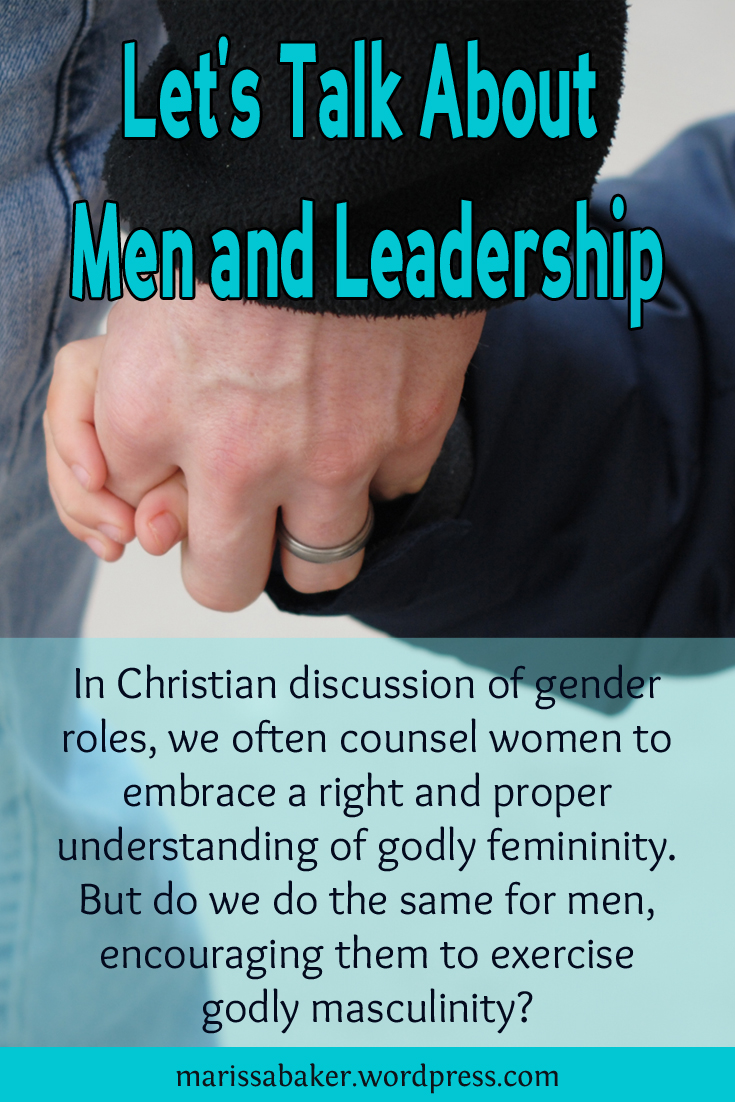
When people in the Christian churches talk about gender roles, it often ends up being a discussion about women and submission. If you’ve been keeping up with these discussions even a little, you’ve surely learned that good Christian women should view their role as a blessing. You’ve been told that submission isn’t a dirty word, but rather part of God’s ordained order for the church and the family. When we submit, we’re following the example of Jesus Christ and putting ourselves under His authority.
Even though I still hear ministers joke about how discussing submission will get them in trouble, I actually talk with very few women in the churches today who haven’t embraced, or at least acknowledge, the value of being a virtuous woman with a meek and gentle spirit. We might disagree on exactly what it looks like and we all still have much to learn about being godly women (though it really should be simple — a godly woman is a woman who’s following God), but we have a pretty good idea what our gender role is.
We talk about men’s roles in the church far less often (at least from what I’ve heard and seen). Women hear “submission is a good thing. It’s not always easy but it’s part of God’s plan and sometimes you just have to do it.” But how often do men hear, “leadership is a good thing. It’s not always easy but it’s part of God’s plan and sometimes you just have to do it”?
I wonder if one reason we overlook this is because we don’t understand why men might not want to take on their role as head, lover, provider, and protector. We might think, Why wouldn’t men want to be the ones in charge? Isn’t it much easier to “love your wife” than “submit to your husband”? They should be thankful they get to be leaders in the family and that they’re the ones who hold public ministry positions. After all, that’s the role everyone wants. That’s why we have to talk about submission for woman so much, because otherwise she’d be trying to steal men’s role, right?
But maybe that’s not an accurate viewpoint. Maybe both genders are tempted to shirk the responsibilities God has given us and avoid living up to His expectations. Maybe this is a human struggle we all share, and which also impacts how we live as godly men and women.
Almost 80 degrees and Tiger wants to snuggle with me in a blanket.
Today’s post is a bit different than usual. During my Tuesday morning Bible study, my cat looked so comfortable snuggled up on my lap that I spent some extra time meditating on the Word. I’d been in Genesis writing about our Creator, and a thought popped into my head. I want to share this idea with you today and ask for feedback. Please comment! Diving deeper into God’s mysteries shouldn’t be done in a void — I believe God wants us to grow together and “sharpen” each other (and also to call each other out if we notice someone studying something that’s not in line with scripture).
Okay, so we know that God has had a plan in mind since before creation and that plan involves building a family (Eph.1:3-6). We also know that the church is described as the bride of Jesus Christ (2 Cor. 11:2; Rev. 19:6-9) and we’re told that human marriage is a “great mystery” that points to the relationships between Christ and His church (Eph. 5:22-33).
What if God began revealing these aspects of His plan from the very beginning in the way He chose to create man and woman? or, to put it another way, what if the way God created man and woman teaches us that He didn’t want to be alone and that He’s fashioning a helper comparable to Him? Read more →
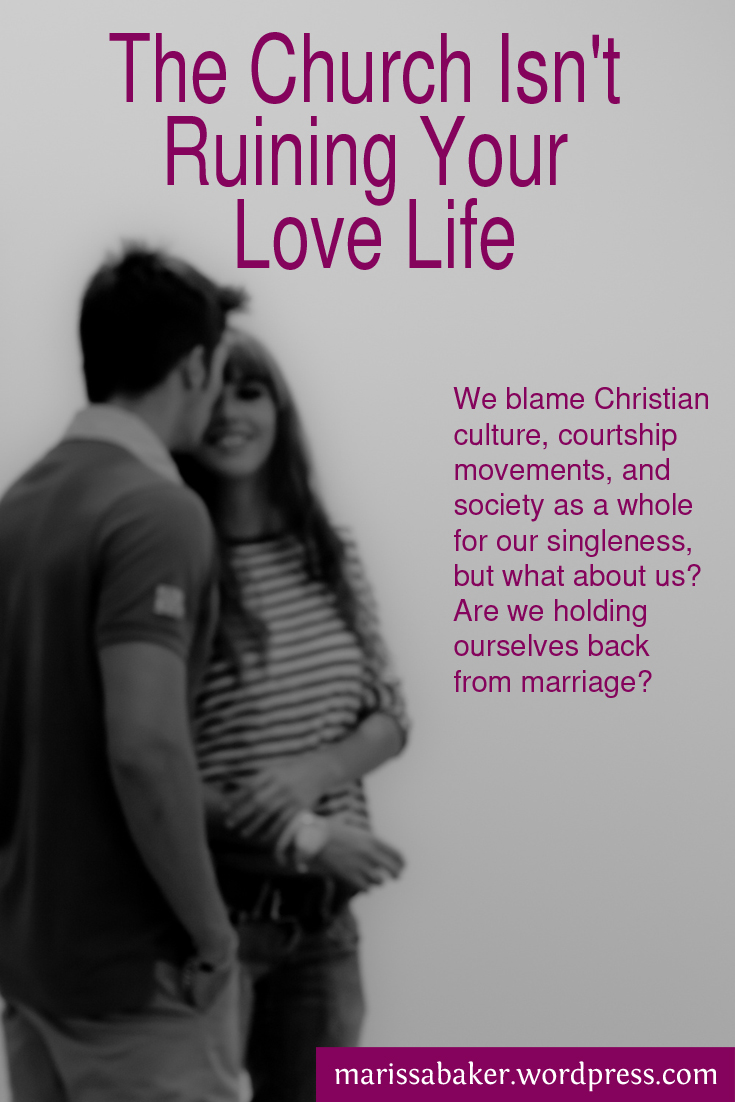
This past week, Boundless.org shared two posts related to Joshua Harris and courtship culture on their Facebook page. One was an NPR interview with Harris and the other was a link to Harris’ call for feedback on the ways I Kissed Dating Goodbye has affected you. It’s a popular topic, since so many people in the churches blame courtship culture for problems in their relationships and hurt in their lives. They say the church’s attitude towards dating and courtship made them feel ashamed of their bodies and their sexual desire, that it set up intimidating expectations for relationships, and it is why they’re still single (or, for some, unhappily married).
The complaints aren’t all directed at courtship culture, either. Another article I saw this week was published by Relevant Magazine and didn’t mention courtship at all. How Christians Ruin Dating is specifically addressing ways that singles in the church feel their fellow Christians are ruining their dating lives. There’s too much obsession with romance, too much gossiping about couples, too much emphasis on marriage. We just need to chill, they argue.
For those of us who are single young adults in the church, there’s no denying that the culture we grew up in influences how we view dating and relationships. But we’re also grown-ups and it’s time to stop blaming the church for all our relationship problems and take responsibility for the choices we’re making. We can’t keep using the argument “Christians ruin dating” as an excuse for not finding relationships. Courtship culture, church gossips, the pressure to get married … those don’t keep us from finding a spouse. We do that when we use the problems surrounding Christian dating as an excuse to not ask someone out, or to turn someone down when they ask us out, or to sabotage potential relationships.Read more →
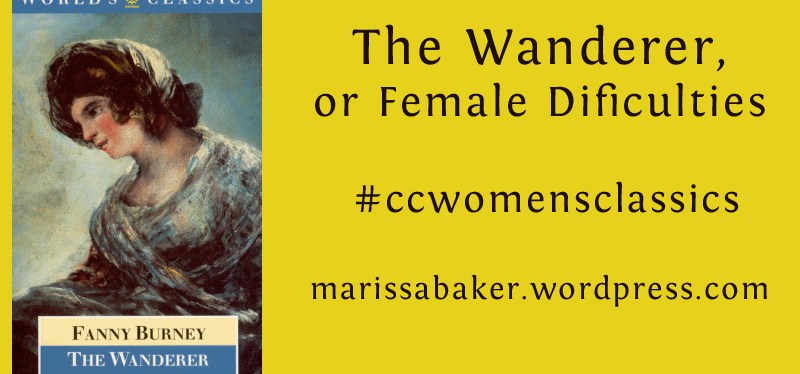
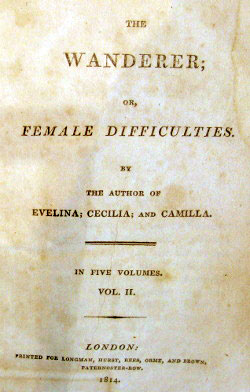
My title for this post is the subtitle for Frances Burney’s final novel, The Wanderer. It was one of the first books I put down when compiling my Classics Club Book List, and I’m reading it this year for the Women’s Classic Literature Event. Finishing this book means I’ve now read all Burney’s major fiction works (that is a grand total of 3,133 pages of text, so it’s a pretty big deal). I am Reader, hear me roar.
Note: spoilers follow for this 202 year old book.
The Wanderer, or Female Difficulties is the tale of a penniless emigree from revolutionary France trying to earn her living in England while guarding her own secrets. Combining the best elements of the gothic and historical novels, this newly appreciated work is an extraordinary piece of Romantic fiction. Burney’s tough comedy offers a satiric view of complacent middle-class insularity that echoes Godwin and Wollstonecraft’s attacks on the English social structure. The problems of the new feminism and of the old anti-feminism are explored in the relationship between the heroine and her English patroness and rival, the Wollstonecraftian Elinor Joddrel, and the racism inherent within both the French and British empires is exposed when the emigree disguises herself as a black woman. (Goodreads summary)
This is probably the Burney novel that I found most frustrating. Evelina, her first novel, is the easiest to read, though it still engages with the darker side of 18th century romance. Her next two, Cecelia and Camilla, are more difficult (especially if you’re expecting an Austen-style romance). The heroines are persecuted relentlessly, in grave danger several times, and the heroes fail to live up to the name. The Wanderer takes these themes a step further. Instead of giving her characters ineffective guardians, Burney doesn’t leave the Wanderer, who goes by the name “Ellis” for much of the book, anyone to turn to at all. Instead of revealing the plight of a young woman having difficulty navigating the marriage market, Burney shows the struggles of a woman completely alone without name or resources to protect and support her.
The Wanderer is a scathing rebuke of society on many different levels. Burney takes full advantage of her lengthy text to discuss the French Revolution, snobbery in the upper classes, gender inequalities, racial stereotypes, modern suspicion of an afterlife, suicide, social perceptions and stereotypes, abusive/coercive relationships, and duty to family (just to name the ones that come to mind within a minute). The amount of ground she covers is really quite impressive. Even more impressive is that she manages to show both sides of most issues. Sometimes you can easily tell where Burney stands, but not always. For several of the ideas discussed, it seems she just wants readers to open their eyes and see that things aren’t always black and white.
What frustrated me when reading The Wanderer wasn’t the issues being discussed or even so much the drawn-out plot line. It was Ellis’ character. The narrative stays with Ellis but maintains a distance that makes it very difficult to sympathize or identify with her. For the better part of the book, we don’t know any more than the other characters about who she is and what her motivations are. We rarely even know what she’s thinking. What’s worse, we seldom hear her say anything. There are a few scenes where Ellis speaks clearly and decisively, but mostly she stands mute. She is silent while other characters misconstrue her motivations, put words into her mouth, accuse her unjustly, and even propose romantic connections. A few words pass her lips, but mostly she stands in acute emotional agony hoping the other characters will understand her inarticulate protests. Even Mr. Harleigh, the heroic figure in this story, becomes so frustrated by this that there are times he is almost violent in his insistence that she give him a straight answer.
Silencing the main character frustrated me, but it also draws attention to the difficulties Burney is discussing. It might be tempting to read the subtitle “Female Difficulties” simply as a critique of the challenges women faced in 18th century society. We could say that it is the other characters who make life difficult for Ellis because society is set-up to be suspicious of a woman alone and to limit her options. But it goes even deeper than that. The type of femininity ingrained the naturally elegant and lady-like Ellis make her situation even more difficult. She is one of her own worst enemies because of her limiting view of her own role as a woman. It’s not seemly for a lady to perform in public, so she refuses to give a concert until she’s shamed into it by a need to pay her debts. It’s not ladylike to accept pecuniary aid from a man, so she becomes entangled in a host of embarrassing situations trying to return gifts that were made anonymously to spare her delicacy. It’s a shame for a woman to run away from her husband, so she conceals the fact that she was forced into a marriage that’s barely recognizable under the law even when it means leading on another man who’s falling in love with her.
Like today, 18th Century culture was struggling with ideas surrounding gender definitions, roles, and expectations. Burney recognized that the problems regarding inequalities between men and women weren’t just external, but also ingrained in prevailing ideas about what constitutes masculinity and femininity. I argued when writing my undergrad thesis about her other novels that Burney countered the gender crisis of her day by advocating for a return to Biblical gender ideals where men and women are recognized as having unique strengths and roles yet also viewed as equally important. In this book, published 18 years after Camilla, there’s little evidence of that hope. Burney seems more cynical about society’s ability to change and points out problems without offering a way to fix things. It’s up to us, the readers, to try and find a solution or to live with the consequences of inaction.
Click here to get a copy of The Wanderer. Please note that this is an affiliate link. This means that, at no additional cost to you, I will receive a commission if you click on the link and make a purchase.
In Genesis 29, we’re briefly introduced to a woman who plays a key role in Biblical history. Though she is largely overlooked, her legacy shaped the religion we now call Christianity in fascinating ways.
Now Laban had two daughters: the name of the elder was Leah, and the name of the younger was Rachel. Leah’s eyes were delicate, but Rachel was beautiful of form and appearance. (Gen 29:16-17)
The matriarchs of Genesis see themselves as filling their godly role when they have children who grow up to play key roles in Biblical history. These women are heroes of motherhood as well as of faith. They have their own speaking lines, personalities, and relationships with God, but they’re typically remembered in terms of the children they raised.
Leah mothered 6 of Jacob’s 12 sons, as well as the only daughter recorded for any patriarch. Her sons Levi and Judah were the ones God used to found lines of priests and kings. Though the story of Rachel and her son Joseph overshadow the other sons in Genesis, kingship and priesthood play a huge role in God’s plan and there’s much we can learn from Leah’s take on the birth of her sons. Read more →
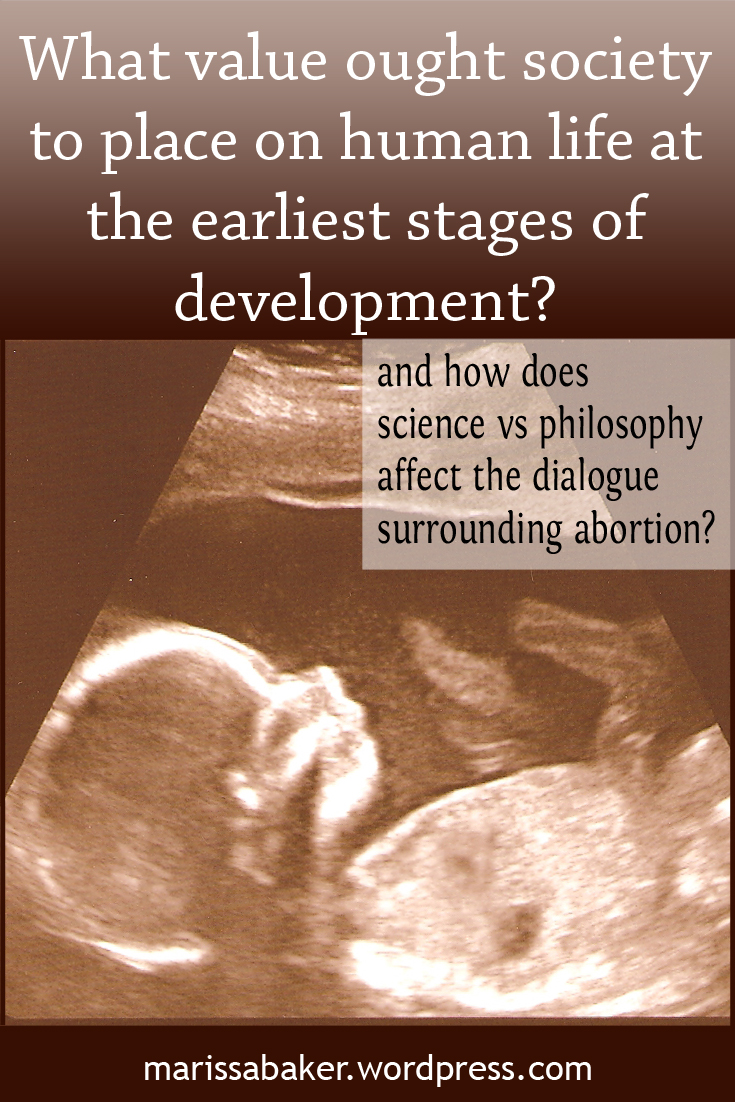
In the abortion debate, one of the things people like to argue is at what point the fetus qualifies as a living human being. Is it when the heart starts beating around 3 weeks? Is it when we can detect higher brain functions at at 22–24 weeks? Is it when the fetus is “viable” without the mother? Or after the baby has been born?
There’s plenty of science to indicate that a unique human entity is created either at the moment of conception or at cellar division about 24 hours later. The zygot, and then the fetus, is alive when a genetically unique cell forms that can grow, metabolize, and respond to stimuli. You can click here to read an excellent white paper on the subject written by Maureen L. Condic, Ph.D, Associate Professor of Neurobiology and Anatomy at the University of Utah School of Medicine. She concludes,
This view of the embryo is objective, based on the universally accepted scientific method of distinguishing different cell types from each other, and it is consistent with the factual evidence. It is entirely independent of any specific ethical, moral, political, or religious view of human life or of human embryos. Indeed, this definition does not directly address the central ethical questions surrounding the embryo: What value ought society to place on human life at the earliest stages of development?
I was on a pro-choice action network website, and they’re perfectly willing to admit that the fetus is alive and that it’s human (click here for the article I was reading). What they contend is that the fetus isn’t a human being yet (they distinguish “human being” from “human”). They also contend that a fetus does not have the right to live parasitically at the expense of its mother if she doesn’t want to carry to term because her person-hood and right to choose is not in dispute. They’ll then turn the argument to the “rights of the woman,” asking why we’re so ready to sacrifice her right to decide whether or not to have a baby on the altar of a fetus’s “hypothetical” right to be born.
Even at this point in the argument, you can see it really isn’t about science or objective fact. The facts are that the fetus is genetically unique, human, and alive from the moment of conception. That’s not in dispute. In reality, the question we should be asking is not, “When does the fetus become human?” but rather, “At what point do we value human life?”
The main leg the pro-life movement has to stand on is convincing society that we should value the life of unborn people so much that killing them is legally considered murder. We can use the science, but ultimately that’s not going to convince people to fight against abortion. People who support the legal right to terminate pregnancies know fetuses are alive — they just don’t think it matters. Our battle needs to be fought on philosophical and moral grounds.
Recent polls show that while more American’s describe themselves as pro-choice than pro-life right now, 51% think abortion should only be legal “under certain circumstances” verses 19% saying legal “under any circumstances (Gallup Polls). Getting into more detail about exactly what this means, we see 84% of Americans want tight restrictions on abortion: 25% say it should be legal in the first 3 months, and the others are divided between only in cases of rape or incest, to save the life of the mother, and not legal at all. (Marist Poll).
The Marist Poll also reports that even though only 13% of respondents favored banning abortion under every circumstance, 60% believe abortion is morally wrong. In today’s America we hate the idea of imposing our morality on other people, but we still do that every day we continue to (rightly!) maintain that murder, rape and pedophilia are wrong. Why is it so hard for us to extend that moral stand to protecting unborn life? And how far are we going to let this go? When we as a society set arbitrary limits on what makes a human life qualify as a human being, we’re on a very slippery slope. In 2011, two researchers in Australia published a paper titled “After-birth abortion: why should the baby live?” I’ve not read the whole paper, but this is the researcher’s own succulent abstract statement of what their work is about:
Abortion is largely accepted even for reasons that do not have anything to do with the fetus’ health. By showing that (1) both fetuses and newborns do not have the same moral status as actual persons, (2) the fact that both are potential persons is morally irrelevant and (3) adoption is not always in the best interest of actual people, the authors argue that what we call ‘after-birth abortion’ (killing a newborn) should be permissible in all the cases where abortion is, including cases where the newborn is not disabled.
While these researchers were not widely supported and later claimed their argument was taken out of context, it was a step in a disturbing trend. Informal evidence suggests college students are increasingly in favor of “after-birth abortions” up to 4 or 5 years old because they believe children that age aren’t “self-aware” yet (never mind that psychologists say children become “self-aware” between 1 to 3 years, usually 18 months).
It’s ridiculous to suggest that a fetus suddenly becomes a human being at 3 months, or at birth, or whatever age you decide to go with, but that he or she isn’t a human being a few minutes, hours, or days earlier. When you take such an argument to it’s farthest extent, you either have to believe human life is precious from conception or arbitrarily define a point at which humans are protected and before which they are not.
While we’re on the subject of valuing human life, I want to point out that a pro-life argument should never be anti-women. As one blogger who works with at-risk women points out, “Abortion isn’t so much about a woman having a choice — but a woman feeling like she has no choice at all.” While I want abortion to be illegal because I firmly believe no human being has the right to decide they can kill another, I also want to create a world where women don’t feel they have to or should have abortions. Where violence against pregnant women who want to keep their child stops. Where people are honest about what actually happens to both the mother and unborn child during an abortion. Where we consider the physical, emotional and psychological risks to the mother and stop pretending abortion is pro-woman.
It is our right and it is our duty to stand up to injustice, to speak out against moral wrongs and fight to correct them. And if we’re Christians, this is doubly the case. We’re called to “choose life, that both you and your descendants may live” (Deut. 30:19). God talks about knowing His people pre-birth and calling prophets and judges “from the womb” (Judg. 13:5; Is. 49:1, 5; Jer. 1:5; Gal 1:15). Other verses talk about Him forming children inside the womb and being involved in birth (Job 31:15; Ps. 22:9; 139:13; Is 44:2), and about in-womb children reacting like and being treated as people (Gen 25:23; Luke 1:41). For Christians to say that murder is wrong but killing an unborn child is not just doesn’t add-up. There are certain areas in which we cannot be like our culture, and this is one of them.




 . Please note that this is an affiliate link. This means that, at no additional cost to you, I will receive a commission if you click on the link and make a purchase.

 Like An Anchor