Women’s Classic Literature Event

Extra post this week because I’m so excited about the Women’s Classic Literature Event hosted by The Classics Club. I’ve read many great classics written by women, and look forward to discovering more over the next year. Even if you’re not part of the Classics Club reading challenge, you’re still welcome to jump on board with this event using the #ccwomenclassics hashtag to share what you’re reading.

A Survey for the Women’s Classic Literature Event

Introduce yourself. Tell us what you are most looking forward to in this event.

  • As a female writer, I’m all for reading literature written by women. I studied English at The Ohio State University, and my undergraduate research project focused on Frances Burney and Mary Wollstonecraft. For this event, I’m most looking forward to seeing my fellow readers discover amazing classics by women writers, and then gathering suggestions from them for my own “to-read” list.

Have you read many classics by women? Why or why not?

  • I have read quite a few. We picked out some for my high school curriculum (homeschooled), then in college I was blessed to take classes from English professors who made sure to teach fine books written by both men and women.

Pick a classic female writer you can’t wait to read for the event, & list her date of birth, her place of birth, and the title of one of her most famous works.

  • Mary Shelley, born 30 August 1797 in London, England. I’ve read some of her mother’s writings, but nothing by her. Frankenstein is Mary Shelley’s most famous work.

Favorite classic heroine? (Why? Who wrote her?)

  • Jane Eyre, written by Charlotte Bronte. I love first-person narrative when it’s well written, and Bronte makes Jane a spectacular narrator. She’s a strong, clever woman and I admire her moral strength and unabashed living out of her Christian faith. (Bonus: Jane’s a fictional example of my INFJ personality type.)

Recommend three books by classic female writers to get people started in this event. (Again, skip over this if you prefer not to answer.)

  • Evelina by Frances Burney. I did my undergraduate research project on Burney, and highly recommend her work to fans of Jane Austen. Evelina is the shortest and most manageable of her novels, so I suggest trying that one out before jumping into the 900+ page Cecelia or Camilla.
  • Jane Eyre by Charlotte Bronte. If you haven’t read this famous classic yet, I hope you will. It’s one of my favorite books of all time, and I love the characters.
  • North and South by Elizabeth Gaskell. I love this book and the BBC adaptation staring Daniela Denby-Ashe and Richard Armitage. The casting is perfect, and my only quibble with the plot adaptation is the ending/proposal scene … but no more on that for fear of spoilers.

Will you be joining us for this event immediately, or will you wait until the new year starts?

  • I’ll probably write about Tenant of Wildfell Hall in November or December.

Do you plan to read as inspiration pulls, or will you make out a preset list?

  • I’ll pull from the women writers already on my Classics Club list, and maybe add a few more as inspiration strikes.

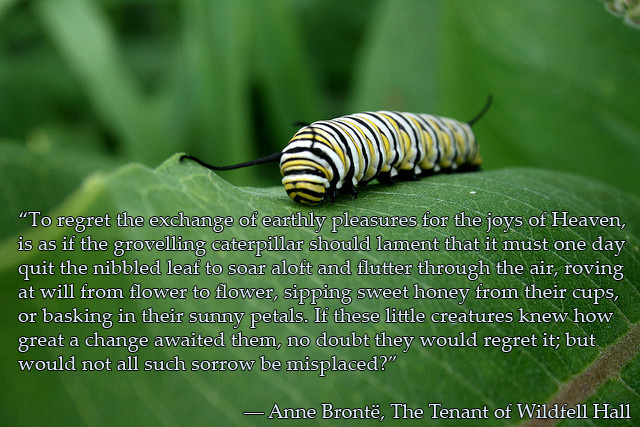
Share a quote you love by a classic female author — even if you haven’t read the book yet.

  • Here’s one I took note of when reading Anne Bronte’s Tenant of Wildfell Hall.
Women’s Classic Literature Event | marissabaker.wordpress.com
caterpillar credit: Eli Duke, CC BY-SA via Flickr

Classics Club — The Iliad

I’m not actually all that far behind on my reading for the Classics Club book challenge — I’m just behind on blogging about the books. Right now, I’m halfway through Anna Karenina, and I recently finished Tenant of Wildfell Hall and The Iliad. Since I also have to write about The Iliad for the high school curriculum I’m building (which my brother is trying out this year), that’s the one I wanted to talk about today.

Usually, I like to read something about the author’s history and the time period framing their writings when I explore a piece of classic literature. Unfortunately, we don’t know much about Homer. There’s even debate about whether or not he’s the one who wrote down the epic poems he (probably) composed. The introduction to the Robert Fagles translation seems to lean toward Homer writing his own poems down once the art of writing was reintroduced to Greece, though it’s all “pure speculation.” I suppose in some way the mystery surrounding these texts makes them even more intriguing.

Having once been told by a nihilistic classmate that nothing original has been written since Homer, I was rather curious to finally read The Iliad. While I can’t say I agree with him, it’s not hard to see The Iliad‘s influence on modern literature, and when I get around to reading The Odyssey (also on my Classics list) I’m sure I’ll notice even more themes that show up in modern plot and characterization.

What intrigued me most, though, was the portrayal of women in The Iliad. Though several women have lengthy passages of dialogue (including Helen and Hector’s wife Andromache), and goddesses play a huge role in the plot, they’re all show in some kind of captivity to men. No matter how strong of a character Andromache is, once she loses Hector she has no social position and no hope of avoiding slavery. Paris stole Helen, and she makes no secret of how badly that has affected her and how little she respects him. Other female characters, like Briseis, are already captives in the Achaean camp. Even the goddesses are under Zeus’s power, and his threats toward Hera starting in Book 1 portray an eyebrow-raising level of domestic abuse on Olympus.

The intriguing part is that Homer doesn’t give the impression that this portrayal of women is entirely okay. He does imply it’s “normal” for that time period, but he takes great care to show the womens’ side of the story more than one might expect in a poem mainly about the wars of gods and men. We see goddesses scheming to get around restrictions of the gods. We get plenty of dialogue from Helen, showing that ten years haven’t simply turned her into a submissive or entirely complicit captive even though her inner turmoil is ignored by both Aphrodite and Paris. Even Briseis — the captive Agamemnon steals from Achilles — has a chance to give her side of the story and make sure no one forgets that she (and by extension the other female captives mentioned as spoils of war or offered as prizes at Patroclus’ funeral games) is a human being.

It makes me miss having University access to databases full of scholarly journals — I’d love to read what people who have the time/resources to study these characters better are writing. I did find one interesting article, though: The Portrayal of Women in the Iliad by S. Farron. He says, “Homer had different attitudes from his characters. He knew that women are complete human beings and constantly emphasized how deep and intense their feelings are.” I’d agree with this writer that Homer was trying to craft real characters, not urge social reform, but it’s still intriguing that he realized women were worth writing well. He treated them as real characters with emotions and thoughts that were relevent to the story, which is more than his male characters did.


Click here to get a copy of The Iliad. Please note that this is an affiliate link. This means that, at no additional cost to you, I will receive a commission if you click on the link and make a purchase.
Behaviors, Boundaries and Bromance

Is what we consider appropriate behavior and boundaries as Christians based on the Bible, or on our culture?

Clearly, it’s a little of both. We avoid plain “thou shalt nots” (e.g. the culture says sex is great in many contexts; we teach sex is only appropriate in the type of marriage God set up in the garden of Eden), yet we tend to go with what’s culturally appropriate in how we interact with others (e.g. in Western churches we don’t “greet all the brethren with a holy kiss” though Paul and Peter both tell their readers to).

Part of this makes perfect sense. You don’t dress exactly like people did in Bible times because 1) you can’t find ankle-length robes for everyday wear in stores, 2) clothing designed for a Middle Eastern climate isn’t practical world-wide, and 3) these styles would be considered inappropriate or even immodest in some cultural contexts. So we apply the principle of dressing appropriately rather than trying to recreate Biblical fashion.

But what about other topics? How much should we go with what is culturally appropriate verses what is traditionally appropriate in Christian communities?

Brotherly Affection

marissabaker.wordpress.com

After my brother came back from teen camp, I learned that a pastor’s wife was concerned about the hand-holding, arms around shoulders, and hugging going on between the young men at camp. She was especially worried by the use of the term “bromance,” and how the teens’ behavior might be seen in light of the recent Supreme Court decision.

I understand why this upsets adults who have seen their culture change from “men don’t have feelings” to one that encourages male expression of emotion and accepts homosexuality (two things not necessarily related, except in this sort of discussion). I know why young men expressing affection for their guy friends scares middle aged and older adults. I’m just not sure God shares their fears.

Then he [Joseph] fell on his brother Benjamin’s neck and wept, and Benjamin wept on his neck. Moreover he kissed all his brothers and wept over them, and after that his brothers talked with him.(Gen 45:14-15)

Similar scenes play out when Esau and Jacob are reunited (Gen. 33:4), when Joseph sees his father again (Gen. 46:29), when the Prodigal son returns (Luke 15:20), and when Paul says good-bye to the Ephesians elders (Acts 20:36-37). Now, you might say they just got swept away in emotional reunions or partings and that this wasn’t common among friends and brothers, but what about this scene?

When Jesus had said these things, He was troubled in spirit, and testified and said, “Most assuredly, I say to you, one of you will betray Me.” Then the disciples looked at one another, perplexed about whom He spoke. Now there was leaning on Jesus’ bosom one of His disciples, whom Jesus loved. Simon Peter therefore motioned to him to ask who it was of whom He spoke. Then, leaning back on Jesus’ breast, he said to Him, “Lord, who is it?” (John 13:21-23)

Obviously Jesus wasn’t doing anything wrong — He never sinned! Yet if our young men in the church lean against each other at a supper table, we lecture them on the evils of “bromance.” We make a digression every time we teach on 1 Samuel 20 to explain that David and Jonathan weren’t gay and that there’s nothing wrong with close friendships between guys, but then we lecture young men who have close friends? Talk about mixed signals!

There are appropriate and inappropriate ways to interact with other people, but we can’t just make the blanket statement that the Bible forbids physical expressions of affection between two men (or two women, but “besties” aren’t my topic right now). I think we do our young people a grave disservice when we imply that there’s something unnatural about their friendships and make no effort to teach them how to express affection as men and as women. Just saying, “That’s bad, so don’t do it” isn’t going to work–touch is too important as a bonding mechanism among humans and there simply isn’t a Biblical basis for putting distance like that between friends.

Men and Women

All that being said about affection in friendships, there are stricter rules governing the interactions between men and women. I do think it is possible for men and women to be “just friends,” but the closer male and female friends get (physically or emotionally), the harder it is to keep the friendship casual. God created men and women to be attracted to each other–the very first human relationship was a romantic one (Gen. 2:18-24).

I find it interesting that in Genesis 20, when Abimelech takes Sarah away from Abraham thinking she is his sister, that God tells Abimelech in a dream, “I also withheld you from sinning against Me; therefore I did not let you touch her” (Gen 20:6). While this Hebrew word can euphemistically mean “to lie with a woman,” it’s not the typical word used for sex in the bible. Rather, it’s the word used to command Adam and Eve not to touch the forbidden fruit (Gen 3:3). For Abimelech, just touching another man’s wife would have been sin even though he did it in ignorance.

Flee sexual immorality. Every sin that a man does is outside the body, but he who commits sexual immorality sins against his own body. Or do you not know that your body is the temple of the Holy Spirit who is in you, whom you have from God, and you are not your own? For you were bought at a price; therefore glorify God in your body and in your spirit, which are God’s. (1 Cor. 6:18-20)

Though I appreciate the fact that we now live in a culture where I can give my guy friends a quick hug when I see them or put a hand on their shoulders in comfort, I wonder sometimes if we’ve reacted so strongly against the whole courtship idea of “never touch someone of the opposite sex” that boundary lines are becoming blurred.

More and more often at church events, I’m seeing guys and girls hanging on each other, sitting in each other’s laps and cuddling. Some of this is more than is even culturally acceptable among people who are “just friends,” and it confuses people when you try to explain you’re not in a romantic relationship (sometimes, it even confuses one of the two people involved in the friendship). I see no evidence that the Bible encourages or permits unrelated men and women to be as affectionate toward one another as they would be with their male or female friends.

Do not rebuke an older man, but exhort him as a father, younger men as brothers, older women as mothers, younger women as sisters, with all purity. (1 Tim. 5:1-2)

Notice that not only should we treat our brethren as family, but that we should do so “with all purity.” The woman in Song of Solomon wishes her beloved were seen by others as her brother so she could show him affection in public (Song. 8:1-2) — implying we can show our relatives a level of affection that would be inappropriate among friends and brethren (just as there are things you don’t do with your friends or siblings because they progress to a deeper level of intimacy only allowed in marriage).

Physical touch implies a certain level of intimacy, and different touches belong to different levels of closeness. I use this in my fiction writing all the time — a touch on the arm signals two people are comfortable with each other, an arm around the shoulder is a more intimate boundaries-invading touch that you don’t let just anyone do, hands on someone’s waist or lower back is even closer, and touching someone’s face is extraordinarily intimate (in writing romantic scenes, this often accompanies a kiss). We need to be aware of what our touch is communicating to people–both those we’re interacting with, and those observing us.

Judging What’s Right

In addition to the explicit and implied Biblical guidelines for interacting with same-sex and opposite-sex friends, there are a few other principles we need to consider.

Prove all things; hold fast that which is good. Abstain from all appearance of evil. (1 Thes. 5:21-22, KJV)

We’re not supposed to do things that appear evil or may be perceived as sin, even if we think it’s right and acceptable —  “do not let your good be spoken of as evil” (Rom. 14:16). Let’s say you’re a young person and you know in your heart that hugging and cuddling with your best friend is part of a pure, godly relationship. But what do you do if several people confront you about it, saying that it appears wrong and it’s causing other young people to stumble?

Therefore let us not judge one another anymore, but rather resolve this, not to put a stumbling block or a cause to fall in our brother’s way. (Rom. 14:13)

The freedom we feel knowing we did nothing immoral isn’t always enough. If it’s a question of whether or not to follow a clear command, then we always “ought to obey God rather than men” (Acts 5:29). But if it’s a case of something being permitted rather than commanded, we have to use our best judgement and think about how it impacts others.

There’s nothing “wrong” with a group of close male friends sharing hugs and acting closer than brothers. There’s nothing “wrong” with two female friends sharing a close, affectionate relationship. There’s nothing “wrong” with a woman greeting her brother in Christ with a chaste hug. But all these things can have a hurtful affect if we’re not careful. Just as a couple examples, how do our relaxed boundaries in female friendships affect women struggling with homosexual desires? how does a girl’s feeling that it’s okay to give her guy friends long hugs play with their emotions (or vice versa)? how do “bromances” affect the members of Christ’s body who are offended by the casual play on words?

It is good neither to eat meat nor drink wine nor do anything by which your brother stumbles or is offended or is made weak. Do you have faith? Have it to yourself before God. Happy is he who does not condemn himself in what he approves. But he who doubts is condemned if he eats, because he does not eat from faith; for whatever is not from faith is sin. (Rom. 14:21-23)

God is watching to see why we do what we do. He’s looking for faith, purity of heart, and a concern for how our actions affect other people. This might be as simple as young men avoiding the word “bromance,” two girls putting an arm around each other’s shoulders instead of sitting in each others laps, or guys and girls giving each other quick hugs instead of an embrace. Or it might require more thoughtfulness and self-examination about how your boundaries and behaviors are affecting other people, and yourself.

Update 9/22/2017: I don’t mean to imply that we must conform ourselves to other people’s standards. We are told to show consideration for our brethren and not do things with the intent that they stumble into sin, but our primary concern should be following God. So if we are going to do something that other Christians may consider unacceptable  we should be able to respectfully respond to them with Biblical evidence that we are behaving in a right and proper manner in God’s eyes. We don’t have to change just to make them happy but we should be able to support our actions from the Bible, just as we’d expect someone who asked us to change something to support their request from the Bible.

marissabaker.wordpress.com

Credits: Background picture for the images used in this post by Hernán Piñera, CC BY-SA via Flickr.

Save

Writing A “Husband List”

Every girl who wants to be married has dreamed about what he will be like. Many of us have written lists of the traits our ideal man will have. Over the years, we’ve also heard various views on writing husband lists. Some people say you should have a list, so you know what you’re looking for. Others say that having a list makes your focus too narrow and that you’re “limiting God.”

Writing A "Husband List"  | marissabaker.wordpress.com
bg image credit: Anonymous on Flickr

I had a nice long list when I was in my teens, then a short list of “must haves,” and now a more specific idea that’s not written down. Recently, though, a married friend encouraged me to write a new list to pray over. She had a list, and when she was in her 30s she met a man who fit every thing she’d been praying for (right down to the kind of car he drove) and married him 2 weeks after their first meeting (yes, you read that right. They’re still happily married and have two teenage kids). I know other girls who’ve been told their standards were “too high” yet found guys who matched everything on the list they were praying for, and there are also ladies like blogger Lucinda McDowell who prayed for 24 things in a husband, and God gave her 23. Writing a list doesn’t make you “too picky” — it means you have standards, and that’s a good thing.

So I started work on my new list. And I thought perhaps other girls might find it useful to read about how I decided what to include. There are articles out there offering lists of non-negotiables for you to base your list on, but even the essential qualities are going to look a bit different for everyone. For example, if you’re Christian, some form of “He’s a practicing believer” is probably at the top of your list, but what does “practicing believer” mean to you?

Just a quick note … guys can write “wife lists” too, and I suspect that much of what I talk about here might be useful for that as well. Since I’m a girl thinking about a future husband, though, that’s what I’m going to focus on for this post.

Free Writing

I’ll be honest — I actually didn’t start with this step, but I think now I should have. You want your list to reflect the things you feel like you “should want” as well as what you truly desire, and so there’s often a feeling of not being able to ask for “little thing” or mention appearance at all. But if we’re honest, things that might seem shallow at first glance are still there in the back of our minds, which means they do matter on some level. Starting with free writing gives us a chance to put those little dreams on paper without feeling bad about them.

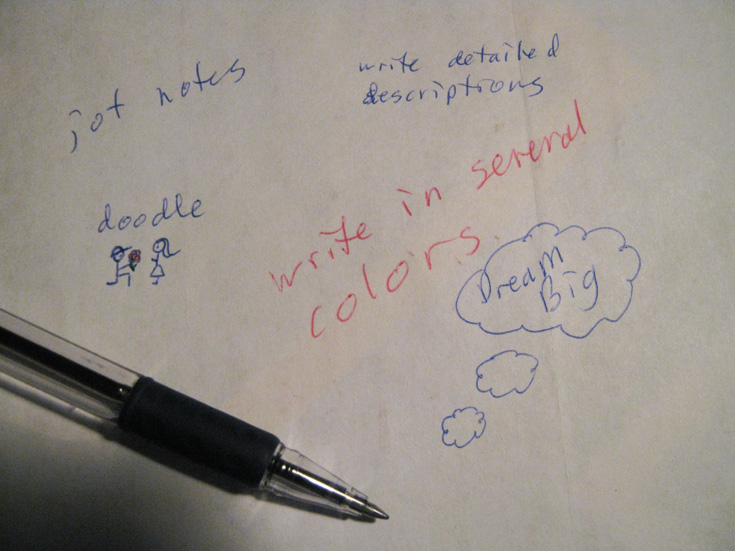
Writing A "Husband List" | marissabaker.wordpress.comGrab a piece of paper and just start writing the first phrases and descriptions that pop into your head when you think about what kind of guy you would like to marry. Think about guys (real and fictional) you’ve had crushes on and list the things about them you found attractive. Think about guys you’ve dated and list things that you liked about them, and the opposite of the reason you broke up with him (i.e., if you’re boyfriend didn’t respect your boundaries, you might add “respects my boundaries”). Think about happily married couples you know and list things you want to see in your own marriage. Write down literally anything that you think of, no matter how unrealistic it sounds.

Now look back over your list. Circle anything that 1: doesn’t have to do with physical appearance and 2: you consider absolutely essential in a relationship. You’re looking for things that have to do with who he is as a person, like “loves God,” “good communicator,” and “we worship together.”

Next, look at the things you haven’t circled yet. Cross-out anything that you know is 1: not essential for you in a relationship (I crossed out “rich singing voice”), 2: only related to physical appearance (such as “taller than me), and/or 3: completely unrealistic. While you’re doing this, you might find that you can replace an unrealistic goal with a related realistic goal. For example, instead of “rich as Mr. Darcy” you might list, “able to provide financially for a family.” I would encourage you to pray about the things you want but know are unrealistic. Sometimes, we use unrealistic expectations to push other people away and shield ourselves from being vulnerable in relationships.

Now you have a sheet of paper with things crossed out, things circled, and a few things that are neither. For now, set this list aside.

Red, Yellow, Green

There’s a book called True Love Dates by Christian relationship counselor Debra Fileta that recommends writing three separate lists, and that’s where we’re going to start. Before you spend any more time writing down the things you want in a relationship, we’re going to write a list of things that are never okay.

“Stop” and “Slow”

The first thing you’re going to write is a Red list of traits that always mean “stop” when you notice them in a relationship. If a guy has any characteristic from your Red list, you do not pursue a relationship with him (no matter how many good traits he has). My Red list includes things like “does not believe in God/won’t respect my belief” and “refusal to communicate,” along with others like the examples Debra Fileta gives in her book:

  • Abusiveness (physical, verbal, emotional, or sexual)
  • Dangerous and uncontrolled temper or displays of aggression
  • Pattern of dishonesty or betrayal

The next step is writing a Yellow list. This is for things you’re not sure about and would need serious consideration and discussion before moving forward in a relationship. They give you pause, but don’t mean the relationship can’t work. A few on my list are “previously married” and “trouble handling money.” Here are more examples from True Love Dates:

  • Family of origin issues and problems
  • Unhealthy habits or behaviors
  • Lacks motivation, goals, and dreams

“Go” For It!

green light
credit: Raymond Brown

Now for the fun part — the Green list or “husband list” of things you want to have in your relationship. If Red means stop and Yellow means slow down and reevaluate, Green means you can feel good about going forward with a relationship. Here’s where we get to go back to the free writing exercise.

I sorted my list into four categories: “Personal Values,” “Family and Relationships,” “Makes Me Feel …” and “Personality.” The circled phrases from my free writing exercise ended up in the first three categories, and many of the phrases that were neither circled nor crossed out ended up in one of the last two categories (you might even list a couple of the ones you crossed-out if they are still important to you). I saw the “Personality” category as representing things I want, but some of which could be negotiable. Here’s a few specific items from each list, so you can see what I’m talking about without me sharing a copy of the whole thing:

  • Personal Values
    • follows God and Christ first
    • uses his gifts to serve in some way
    • demonstrates integrity, commitment, faithfulness
  • Family and Relationships
    • respects and helps set boundaries
    • wants children
    • hospitable; welcomes guests and visitors to our home
  • Makes Me Feel …
    • protected and cherished
    • listened to and understood
    • like I’m valuable and contributing to his life
  • Personality
    • slow to anger
    • good communicator
    • enjoys discussing ideas

Looking At Yourself

Now that you have your list, turn it back on yourself and ask if you have those qualities. Would the guy you’ve written about want to date, or marry, you? Some of this should match pretty easily — you wouldn’t list a guy who wants 6 kids if you didn’t want 6 kids.

Others might be harder. If you listed a man who spends time with God every day, will he want to marry you if you regularly forget to study? Or if you ask for a guy who will never cheat on you, are you prepared to be faithful to him? If you want an Ephesians 5 husband, will you be an Ephesians 5 wife?

I hope this post was helpful to you — writing the list that inspired it has certainly helped me. While we know that God knows exactly what we need without us telling Him, I think it is helpful for us to have something more to ask Him than “please give me a good husband.” You’re putting effort into pursuing a relationship by figuring out what it is you’re looking for. God bless you, my dear readers.

Delight yourself also in the Lord, and He shall give you the desires of your heart. (Ps. 37:4)


“Thinking” Women and “Feeling” Men

One of the ways we relate Myers-Briggs type to culture is by saying most Feeling types are women and most Thinking types are men. This seems to work quite nicely as a partial explanation for gender stereotypes in Western culture. In spite of social pushes to break-down gender distinctions, Feeling-type attributes (emotionally expressive, nurturing, relational, etc.) are typically considered “female” and Thinking attributes (impersonal, fact-oriented, business-like, etc.) are considered more “male.”

If we fit this generalization, we probably haven’t even noticed it. If you’re a woman with traditionally feminine traits or a man with traditionally masculine traits, there’s little pressure to change (though there are exceptions, of course). But if you’re a woman whose mind naturally makes decisions in an impersonal way or a man who prefers harmony to competition chances are someone has told you at some point that there’s something wrong with you.

Type Distribution

As with many generalizations, there’s a whole slew of problems related to this observation. According to the Center for Applications of Psychological Type, about 57 to 84 percent of women are Feeling types and about 47 to 72 percent of men are Thinking types. It’s hard to get exact numbers on type distribution, but even these broad estimates show that, while the generalization holds true, there are also quite a few Feeling men and Thinking women.

"Thinking" Women and "Feeling" Men | LikeAnAnchor.comJust in my family of 5, there are three good examples of exceptions to the general rule that most men are Thinkers and most women are Feelers. My dad (ISFJ) and brother (ENFJ) are both Feeling types, and my sister (INTJ) is a thinking type. My mother has asked me not to type her, but as an INFJ I might be the only one in my family who fits the “women are Feeling types” generalization.

Thinking vs. Feeling

Lest these generalizations lead you to conclude Thinking people don’t have emotions or that Feeling people can’t be intelligent, let’s take a quick look at what Thinking and Feeling refer to when we’re talking about Myers-Briggs types. Both Thinking and Feeling are Judging functions, meaning they describe how you like to make decisions. Read more

All I Ask Of You

I’ve been reading Captivating by John and Stasi Eldredge (or rather, re-reading, though it’s been 6 or 7 years and I only realized I read it once before when I recognized passages that spoke to my heart the first time). One of the main themes, and the one that left an impression on me from my first reading, is how much God wants me. He truly longs for a relationship with each of us, and it goes far beyond what we often mean when we say “God loves me.” God loves everyone. He has to, right? But when God tells us He loves us, He doesn’t mean an automatic benevolence that happens just because “God is love.” He means a real, passionate desire to be in relationship with you.

To be spiritual is to be in Romance with God. The desire to be romanced lies deep in the heart of every woman. It is for such that you were made. And you are romanced, and ever will be.” – from Captivating

This is speaking directly to women, so perhaps it won’t resonate so much with my guy readers. But God’s longing to be in relationship with us applies to both men and women in His church. Perhaps a glimpse of how being romanced by God looks to a woman will give you gentlemen some insight into what it means when Christ calls the Church His bride.

Almost 10 years ago, I started collecting favorite quotes in a notebook. One of the very first things I wrote down were the lyrics to “All I Ask Of You” from The Phantom of the Opera. On the opposite page, I lined it up with scriptures that spoke about the love between us and Jesus. Years later, I turned that into a video I never shared. For today’s post, I went back and updated that video with a few new scriptures. I think perhaps this is the best way to share what I’m trying to say today. Enjoy 🙂