I’ve been reading Captivating by John and Stasi Eldredge (or rather, re-reading, though it’s been 6 or 7 years and I only realized I read it once before when I recognized passages that spoke to my heart the first time). One of the main themes, and the one that left an impression on me from my first reading, is how much God wants me. He truly longs for a relationship with each of us, and it goes far beyond what we often mean when we say “God loves me.” God loves everyone. He has to, right? But when God tells us He loves us, He doesn’t mean an automatic benevolence that happens just because “God is love.” He means a real, passionate desire to be in relationship with you.
To be spiritual is to be in Romance with God. The desire to be romanced lies deep in the heart of every woman. It is for such that you were made. And you are romanced, and ever will be.” – from Captivating
This is speaking directly to women, so perhaps it won’t resonate so much with my guy readers. But God’s longing to be in relationship with us applies to both men and women in His church. Perhaps a glimpse of how being romanced by God looks to a woman will give you gentlemen some insight into what it means when Christ calls the Church His bride.
Almost 10 years ago, I started collecting favorite quotes in a notebook. One of the very first things I wrote down were the lyrics to “All I Ask Of You” from The Phantom of the Opera. On the opposite page, I lined it up with scriptures that spoke about the love between us and Jesus. Years later, I turned that into a video I never shared. For today’s post, I went back and updated that video with a few new scriptures. I think perhaps this is the best way to share what I’m trying to say today. Enjoy 🙂
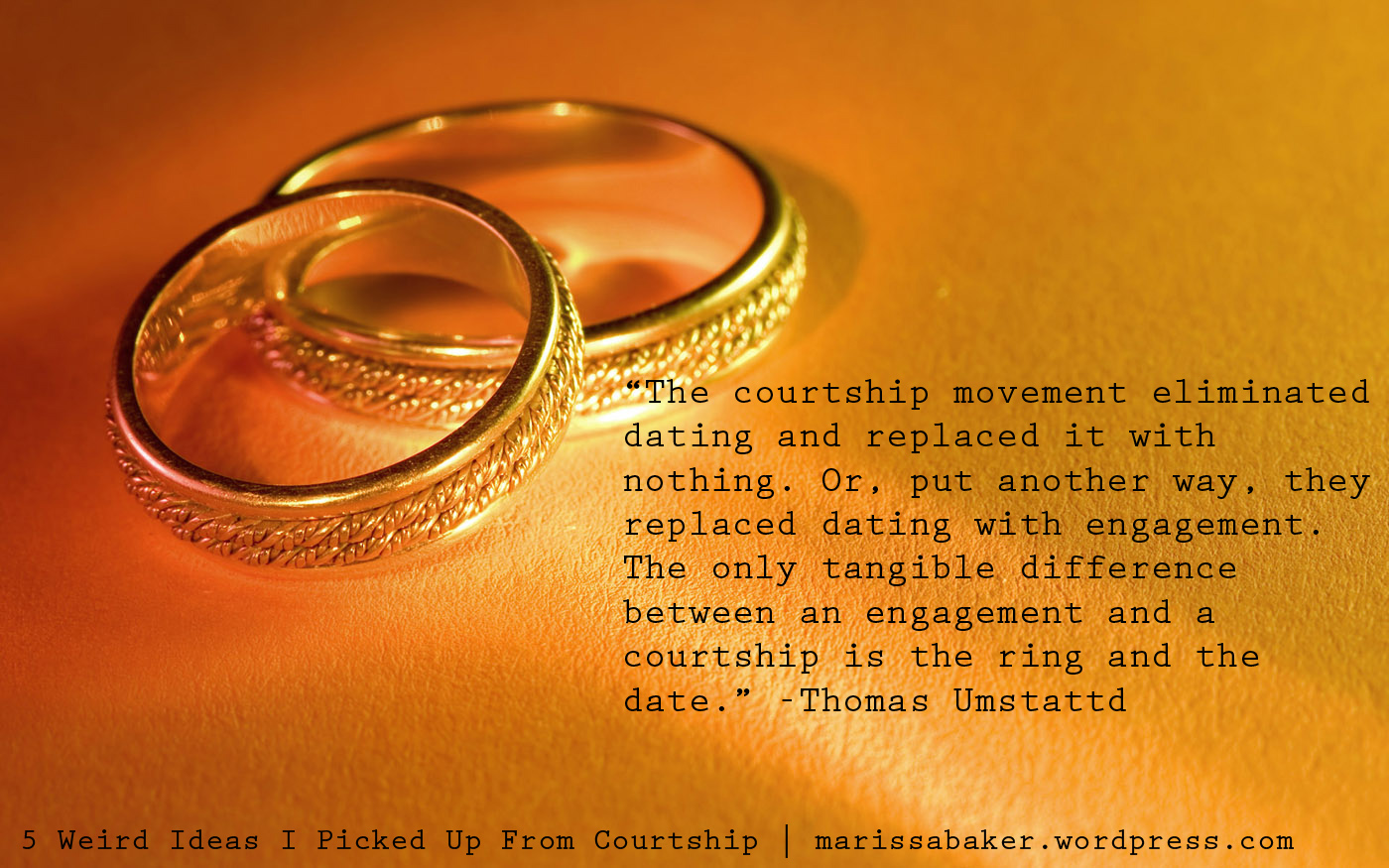
If you grew up in a conservative Christian setting or the home-school community of the late 1990s and early 2000s, you mostly likely read I Kissed Dating Goodbye by Joshua Harris. After its release in 1997, it quickly became the go-to book in the courtship-vs-dating debate. If your friends didn’t hand it to you with an enthusiastic, “You have to read this book,” your mom probably thought it “would be good for you.” Or maybe you just picked it up on your own because of that suave guy on the cover tipping his hat (you know what I’m talking about, girls).
When I first read this book as a very “Christian” never-been-kissed teenager, all this courtship stuff seemed like a good idea. I mean, who doesn’t want a relationship guaranteed to lead to true love while keeping both God and your parent’s happy? The problem is, courtship doesn’t reliably work, and it gives you some pretty weird ideas to carry around if you eventually start trying to date like a semi-normal person.
Never Be Alone With A Guy
After reading I Kissed Dating Goodbye, my teenage self wrote up a list of things I would and wouldn’t do now that I knew the “right” way to interact with guys. Number 4 on my list was “ I will not put myself in a potentially compromising situation by being alone with a guy unless there are other people in the near vicinity.”
For us girls, this idea makes interacting with both married and single men awkward because you just know if you’re alone with them for any length of time you’re practically forcing them to have impure thoughts about you. This simply isn’t true (for one thing, people are responsible for their own feelings and thoughts), but having that idea in the back of your mind can make you feel guilty even in completely innocent situations.
Brothers, Not Boyfriends
That cute guy you walked past at the supermarket? the coworker who smiles at you every morning? They are not potential dating material–you’re are supposed to treat every man you meet just like you would your brother. If you start to even think about him as a potential boyfriend, you need to get your thoughts under control because you’re defrauding him and his future wife (who probably won’t be you). And courtship says the same thing to guys as well–think of every woman you meet as your sister until you’re ready to get married to her.
There are several problems with this idea. 1) Even after being told how “wrong” this is, you might still wonder (even briefly) if every attractive man or woman you meet is “the one.” The only difference is you feel guilty about it. 2) I’m perfectly comfortable leaning against my brother’s shoulder, looping my arm through his, going to him when I need help with something, and laughing and talking freely with him. That’s okay, because he actually is my brother. If I treat another guy like that, he’ll think I’m flirting and people will ask if we’re dating. 3) if you really do succeed in thinking of all your friends in a completely unromantic way, you’re less likely to pursue a romance.
Dad Has To Approve
Ideally in courtship, a man will decide he wants to pursue a relationship with a girl he is friends with, and then he will ask her father for permission to court her. As a young teen, having parental approval before you go out on a date makes sense when you have involved, caring parents. But courtship extends this principle to any age, and it becomes more and more impractical as you get older. If a girl plans to move out of her parent’s house, go to school, or work outside their home, she’ll end up interacting with men who’ve never even met her parents and who haven’t heard of courtship. Have fun trying to explain to a really great guy who just asked you out for coffee that he needs to talk with your dad first because there’s no such thing as a casual date.
Personally, I have a good relationship with both my parents and I want them to approve any man I marry or even seriously date. However, they haven’t met all the guys I know, and I’d be comfortable going out with a guy who hasn’t met my parents but is respected by our mutual friends. Other girls don’t have a good relationship–or any relationship–with their parents. Courtship gives the impression that if her father is not in the picture, the guy better hope there’s a male authority figure in her life to talk to because heaven forbid she make up her own mind about something like this.
First Comes Courtship, Then Comes Marriage
Up until a couple is officially courting, they aren’t supposed to be alone or interact romantically in any way. Groups outings are the rule. Then as soon as they’re courting, they are set on the fast-track to marriage (it’s basically like an engagement, which makes proposals almost a moot point). Either you’re “just friends,” or you’re “exploring the possibility of marriage.” There’s no in between.
This brings us to a problem with courtship that underlies all the ones we’ve talked about already–courtship assumes that every interaction between men and women is extremely weighty and romantically charged. You can’t go on a casual date hoping to get to know someone better because courtship tells you there’s no such thing as a “casual date.” You’re either friends, or you’re on the road to marriage.
Most people I know who’ve bought into the idea of courtship don’t actually get to the courtship part. It’s too intimidating of a commitment. When you leave courtship and try to date normally, though, you still have this idea that if a guy asks a girl out, that must mean he’s thinking of marrying her someday. It’s a really weird headspace to be in.
No Touching!
Courtship rules say absolutely no physical intimacy before you’re married. Depending on who you talk to, this even includes hand holding, hugs, or a quick kiss. Also, they add in the idea of “emotional sex” so that even having feelings for someone becomes wrong. Now, I do believe that God intends His people to save sex until marriage, but going to this extreme is a recipe for–you guessed it–more guilt.
People have written whole articles about how the teachings of physical and emotional purity from courtship books like I Kissed Dating Goodbyeactually damage healthy relationships. You second-guess every hand-hold and shoulder touch, wondering if you’re sending the “wrong message.” You’re scared to fall in love because you don’t want to give pieces of your heart away to someone you might not marry, as if caring about someone leaves you with less capacity to care about someone else later (I wrote a whole post addressing this idea).
So what’s the alternative? The Christian community ran away from worldly dating for a reason, and problems like shallow short-term relationships and accelerated intimacy are still there. But courtship didn’t give us a viable alternative. Instead, I rather like the idea of going back to a more old-fashioned version of dating (as suggested by Thomas Umstattd, whom I also linked to in the intro). Debra Fileta supports a similar idea in her book and website True Love Dates. It’s not perfect, and I don’t think relationships will every be easy, but at least it sounds better than courtship!
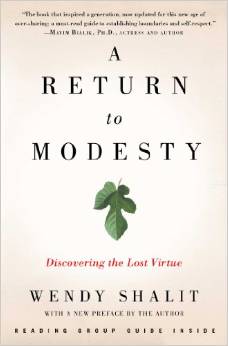
I mentioned a couple weeks ago that I recently read a book called A Return to Modesty: Discovering the Lost Virtue by Wendy Shalit. One of the first things she tackles in this book is the “polarized debate about sex,” particularly between the conservatives and the feminists.
She challenges conservatives to “take the claims of feminists seriously,” because you can dismiss however many studies and stories you like as “exaggeration” but the fact remains that “a lot of young women are very unhappy …. I want conservatives to really listen to these women, to stop saying boys will be boys, and to take what these women are saying seriously.”
To the feminists, Shalit writes, “I want to invite them to consider whether the cause of all this unhappiness might be something other than the patriarchy.” We’ve gotten rid of that just about as much as possible, and things have gotten worse rather than better. Perhaps men aren’t the enemy.
This book was published in 1999. That was almost 16 years ago, and we are still dealing with the exact same issues. On the one side, we see conservative Rush Limbaugh respond to a street harassment video by describing it as not a big deal because the men were just being polite. On the other side, there are still rants about patriarchy on Jezebel.com (language/content warning).
But just a little over two months ago Emma Watson, British actress and UN Women Goodwill Ambassador, gave a speech about feminism where her vision for gender equality sounded remarkably similar to ideas Wendy Shalit arrives at while defending the power of modesty. Are we starting to find common ground, and is there hope for a peaceful resolution to “the war between the sexes”?
A Trip to the 18th Century
It might seem odd to take a 3-century detour when talking about issues in modern culture. But when I started reading Francis Burney’s novels Cecelia (1782) and Camilla (1796) as part of an independent study my junior year of college, I was struck by how the gender issues facing those heroines were so remarkably like what women in my church regularly complain about. Where are the “real men?” we ask, looking around and seeing adult men who act like overgrown boys and have little interest in committing to marriage. We typically blame feminism, for telling boys that it was wrong to be “masculine” and to stop oppressing girls by taking care of them.
Portrait of Francis Burney by her relative Edward Burney
A contemporary of Burney, Mary Wollstonecraft wrote a book called A Vindication of the Rights of Women (1792), which is often considered one of the first feminist writings. When you actually read her book, however, it becomes clear that she is arguing for arguing for a reexamination, not a dismissal, of the traditional roles between men and women. She believes men and women are equal in God’s eyes, but that argument doesn’t mean they don’t both have distinct roles to fill.
Both these writers were responding to a moment called “sentimentality,” which encouraged men to indulge their emotions and abandon their traditional roles of protectors and providers. The result was something like what we see today — when men are no longer encouraged to protect or respect women, more and more women are victimized. That’s where we made our mistake, both in the 18th and the 20th/21st centuries. We thought men would treat women better if we told them to stop being manly, when in fact the opposite is true.
HeForShe
When Emma Watson introduced her talk about gender equality and the #HeForShe campaign, she first addressed issues people have with the word “feminism.”
the more I spoke about feminism, the more I realized that fighting for women’s rights has too often become synonymous with man-hating. If there is one thing I know for certain, it is that this has to stop. For the record, feminism by definition is the belief that men and women should have equal rights and opportunities. It is the theory of political, economic and social equality of the sexes.
One of the key points of Watson’s speech is that both men and women must be working together if we are ever to achieve a gender equality that benefits and protects both men and women.
How can we effect change in the world when only half of it is invited or feel welcome to participate in the conversation? Men, I would like to take this opportunity to extend your formal invitation. Gender equality is your issue, too. Because to date, I’ve seen my father’s role as a parent being valued less by society, despite my need of his presence as a child, as much as my mother’s. I’ve seen young men suffering from mental illness, unable to ask for help for fear it would make them less of a man. …
If men don’t have to be aggressive in order to be accepted, women won’t feel compelled to be submissive. If men don’t have to control, women won’t have to be controlled. Both men and women should feel free to be sensitive. Both men and women should feel free to be strong.
When we turn issues of gender into a “battle of the sexes” instead of a friendly discussion or a cause to work on together, both men and women lose the battle. You can’t build peaceful relations on a foundation of strife.
Courteous Men
Wendy Shalit discusses essentially the same issue, though she comes from the perspective of restoring part of the traditional gender roles (I suspect Burney and Wollstonecraft would both approve). Rather than pushing for an increasingly “nonsexist” approach to raising boys (in this example), she argues for “a good dose of sexist upbringing: how to relate as a man to a woman.”
Today we want to pretend there are no differences between the sexes …. We try to cure them of what is distinctive instead of cherishing these differences and directing them towards each other in a meaningful way. We can never succeed in curing men and women of being men and women, however, and so these differences emerge anyway — only when they do, the emerge in their crudest, most untutored form (p.153).
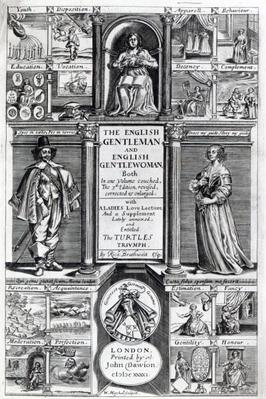
She also goes back to a previous century to illustrate her arguments, all the way to 1630 and 1631 — the years Richard Brathwait’s The English Gentleman and The English Gentlewoman were published. Shalit’s reading of these texts is that there was a “link between male obligation and female modesty” where men attained “perfection” by treating women with respect (p.99-102). In this century, men were not compelled to respect women by an outside authority — they were taught that this was the only way for real men to behave.
The argument from external authority labels a man as evil if he date-rapes or sexually harasses a woman. From the standpoint of modesty, he is behaving abominably, but more crucially, he is really missing the whole point. He hasn’t understood what it means to be a man (p.104).
The feminists who see patriarchy as oppressive balk at this idea, but Shalit assures them, “I doubt that if men are taught to relate courteously to women, women would be suddenly thrown out of all the professions, as some contend. Maybe, on the contrary, it would be much easier for the sexes to work together.” Isn’t this, at its core, what Emma Watson’s brand of feminism is asking for? men and women who can work together toward common goals with mutual respect. Isn’t that something we all want?
If you’re single (and you don’t want to be), you’ve probably asked yourself the question, “Am I being too picky?” There’s got to be a reason why you’re not in a relationship with someone, right? and you’re sure the reason has something to do with you. People of the opposite sex do exist, and if you’re not in a relationship with one of them you might think that 1) you’re not attractive and so they aren’t asking you out, or 2) you’re too picky and so you’re avoiding/turning down relationships with certain people.
As a 25-year-old single woman, I ask myself this question, too. And I’ve been encouraged to do so by much of the relationship advice I’ve read. You might have read some of this, too. I’m talking about those articles that tell girls to tear-up their “perfect man” list and give any decent guy a chance if he asks them out. Which sounds pretty good in theory, but that’s pretty much how two of the three dates I’ve been on were with guys literally old enough to be my father, and the third was with an atheist who obviously didn’t meet my first requirement that a guy I date have a strong, Christian faith.
Now, I’m not saying you should hang onto unrealistic expectations that will leave you like this skeleton over here –> but you do need to have some standards, and you don’t have to feel guilty for insisting people meet those standards. You are under no obligation to “pity date” anyone, or fling yourself at the first living breathing human who shows the slightest bit of interest in you.
“The One”
This weekend, I spent a good bit of time catching up on Boundless.org articles that I’d missed and checking out TrueLoveDates.com. What stood out to me on Boundless was two articles that offer step-by-step guides for men and for women on how to get married. They can both be summed up in the deceptively simple advice “be more attractive.”
Well, thank you Boundless-author. Previous to reading this article I was going for unattractive. I’ll change that now, and dates will magically appear.
Or not.
“What if I meet the one?”
These articles are part of a three-part relationship series. The first article was devoted to debunking the myth of “the one.” I actually agree with most of what he writes in this one — many Christian singles are too passive, waiting for God to drop their perfect match in their lap or hit them with a revelatory bolt of lightning when he or she shows up. But usually when people tell you to stop looking for “the one”/”your soulmate,” they are also telling you “you’re too picky” (also see my article “Why I Still Believe In Soul Mates“). And I think it’s a little more complicated than this Boundless authors seems to think.
He says that if you’re a guy, there are only two reasons you’re not in a relationship: “1. You’re not asking. 2. No one’s saying yes.” The solutions are equally simple: “Man up” and “Be awesome.”
If you’re a girl, the reasons you’re single are “1. You’re saying “no” a lot” or “2. No one’s asking.” We’re given three things we can do to turn this around: “Demonstrate respect,” “Look good,” and “Be fun.”
Be (at least a little) Picky
Much as I love Boundless, TrueLoveDates.com had much more helpful tips this time. It’s a website run by Christian relationship counselor Debra Fileta. I’m really looking forward to reading more of her blog posts, and eventually her book. She has some great insight into the whole dating vs. courtship thing, but I won’t digress on that topic right now.
Her most recent articles have been 10 Guys You Should NEVER Date, 10 Girls You Should NEVER Date, and The Boyfriend Checklist: 10 Guys You SHOULD Date (I assume her next post will be a girlfriend checklist). They are focused on qualities you should either avoid or look for in a potential boyfriend or girlfriend, and eventually spouse. And they presuppose a certain level of picky-ness — that you won’t settle for Mr. On Again & Off Again, or Ms. Nothin’ In There But Air, or Mr. Sorta Spiritual, or Ms. One-Way-Street.
Even more helpful lists can be found in Fileta’s article What Women Really Want in a Man and What Men Really Want in a Woman. They are great, both for “this is what you should look for” and “this is the kind of person you need to be.” She says women want honesty, purity, strength, compassion, and humility. Men want realness, confidence, beauty, and passion. These aren’t impossible standards, and you really should be “picky” enough not to settle for less.
In 2014, when I was studying the gift of prophecy as related to the role of women in the church, I started wondering about the women that God interacted with in the Bible. How many were there? What did He say to them, and what did they say to Him?
After compiling a list of women who talked with God, I double-checked my list by looking up other bloggers’ articles about biblical women God spoke to and women in authority roles. As I did this research, I came across other questions some people were asking: “Why doesn’t God talk with women the way He does with men?” and even “Why does God hate women?”
I’m sure most of my readers will agree with me right away that God doesn’t hate women–the Bible reveals that God places a high value on women. Sometimes that can be hard to see because of modern preconceptions or extra-biblical church teachings, but it’s there when you look. We can see one of the proofs that God loves women (as He does all people) when we look at how He interacts with women in the Bible.
For purposes of this blog post, I’m including women God spoke to directly, women whose prayers were answered, women God spoke to through an angelic messenger, and women Jesus interacted with. I’m sure I could have missed some “women who spoke with God,” so if you think of any more please leave a comment.
Eve
God interacted with the first woman in a unique way. She was the crowning achievement of His creation. God didn’t make her at the same time as Adam, as He did with both sexes of animals, but created her only after Adam realized how incomplete he was without a wife (Gen. 2:18-23). She and Adam were both instructed by God (Gen. 3:2-3), and God spoke to each of them personally when He had to pass judgement on them for their sin.
Yahweh God said to the woman, “What have you done?” The woman said, “The serpent deceived me, and I ate.” … To the woman he said, “I will greatly multiply your pain in childbirth. You will bear children in pain. Your desire will be for your husband, and he will rule over you.”
Genesis 3:13, 16, WEB
Not a very nice conversation with God, but unfortunately one that Eve deserved, just as Adam deserved his more lengthy reprimand (Gen. 3:8-12, 17-19). I think the main takeaway from this (in terms of today’s post) is that God cared about and respected both Adam and Eve enough to address their sin and it’s consequences with them individually. God didn’t just talk with Adam and tell him to pass the sentence along to Eve (for example).
Sarah
Another woman whom the Lord spoke to directly was Abraham’s wife, Sarah. Their actual conversation was short, but we’ll have to quote a lengthy passaged to get the context since she is eavesdropping on the Lord’s conversation with her husband.
They asked him, “Where is Sarah, your wife?”
He said, “There, in the tent.”
He said, “I will certainly return to you at about this time next year; and behold, Sarah your wife will have a son.”
Sarah heard in the tent door, which was behind him. Now Abraham and Sarah were old, well advanced in age. Sarah had passed the age of childbearing. Sarah laughed within herself, saying, “After I have grown old will I have pleasure, my lord being old also?”
Yahweh said to Abraham, “Why did Sarah laugh, saying, ‘Will I really bear a child when I am old?’ Is anything too hard for Yahweh? At the set time I will return to you, when the season comes around, and Sarah will have a son.”
Then Sarah denied it, saying, “I didn’t laugh,” for she was afraid.
He said, “No, but you did laugh.”
Genesis 18:9-15, WEB
It is worth noting that before having this conversation with Abraham, the Lord made sure Sarah was within hearing range. God had already made this promise to Abraham in Genesis 17:19, and now He reiterated it to Sarah as well.
Hagar
I find God’s interactions with Hagar fascinating. She didn’t go looking for Him (as Rebekah would years later) but when He spoke to her she didn’t react in fear (as Sarah did). She may not have spoken with God directly; the Bible says “the angel of the Lord” was the one who spoke with her. However, “Angel of the Lord” is capitalized in some translations, where it is assumed to be a pre-incarnate appearance of Jesus. Either she spoke to the Word of God Himself, or she spoke to a messenger directly from Him.
He said, “Hagar, Sarai’s servant, where did you come from? Where are you going?”
She said, “I am fleeing from the face of my mistress Sarai.”
Yahweh’s angel said to her, “Return to your mistress, and submit yourself under her hands.” Yahweh’s angel said to her, “I will greatly multiply your offspring, that they will not be counted for multitude.” Yahweh’s angel said to her, “Behold, you are with child, and will bear a son. You shall call his name Ishmael, because Yahweh has heard your affliction. He will be like a wild donkey among men. His hand will be against every man, and every man’s hand against him. He will live opposed to all of his brothers.”
She called the name of Yahweh who spoke to her, “You are a God who sees,” for she said, “Have I even stayed alive after seeing him?”
Genesis 16:8-13, WEB
Not only did Hagar speak with “Yahweh’s angel,” but she also gave God a name — El Roi (H410 and H7210)–that is not used anywhere else in scripture. When I was reading Liz Curtis Higgs’ bookSlightly Bad Girls of the Bible, one of the things she pointed out about Hagar was that she named God. It’s much the same thing the Psalmists do when saying things like, “You are the God who does wonders” (Ps. 77:14, WEB).
This wasn’t the only time God talked with Hagar, either. Years later, after Isaac was born, Abraham sent Hagar and Ishmael away. She found herself lost in the desert with her son dying of thirst.
The angel of God called to Hagar out of the sky, and said to her, “What troubles you, Hagar? Don’t be afraid. For God has heard the voice of the boy where he is. Get up, lift up the boy, and hold him with your hand. For I will make him a great nation.”
God opened her eyes, and she saw a well of water. She went, filled the container with water, and gave the boy a drink.
Genesis 21:17-19, WEB
If we ever feel too insignificant for God to notice, Hagar’s story is a good place to turn. She was an Egyptian slave girl mistreated by her masters, yet God spoke to her more often than to the women who were married to the patriarchs. For Hagar, as well as for us, He is El Roi, the God Who Sees.
Rebekah
Here we come to the first woman on our list who brought a prayer before God that He responded to directly. In this case, she was the one who started the conversation.
Isaac prayed to the Lord on behalf of his wife because she was childless. The Lord answered his prayer, and his wife Rebekah became pregnant. But the children struggled inside her, and she said, “Why is this happening to me?” So she asked the Lord,and the Lord said to her,
“Two nations are in your womb, and two peoples will be separated from within you. One people will be stronger than the other, and the older will serve the younger.”
Genesis 25:21-23, NET
It’s so short you can almost read over it without noticing what’s going on. But what this tells us is that when Rebekah had an important question, she took it straight to God. She didn’t ask her husband, who had prayed for these babies, to inquire for her. She had a personal relationship with her Lord, and He answered when she called.
Deborah
When people start talking about strong women of the Bible, Deborah is usually the first on their list. She was one of the judges–“a mother in Israel”–who delivered God’s words to the people and who rode to battle alongside Israel’s general.
Now Deborah, a prophetess, the wife of Lappidoth, judged Israel at that time.She lived under Deborah’s palm tree between Ramah and Bethel in the hill country of Ephraim; and the children of Israel came up to her for judgment. She sent and called Barak the son of Abinoam out of Kedesh Naphtali, and said to him, “Hasn’t Yahweh, the God of Israel, commanded, ‘Go and lead the way to Mount Tabor, and take with you ten thousand men of the children of Naphtali and of the children of Zebulun? I will draw to you, to the river Kishon, Sisera, the captain of Jabin’s army, with his chariots and his multitude; and I will deliver him into your hand.’”
Barak said to her, “If you will go with me, then I will go; but if you will not go with me, I will not go.”
She said, “I will surely go with you. Nevertheless, the journey that you take won’t be for your honor; for Yahweh will sell Sisera into a woman’s hand.” Deborah arose, and went with Barak to Kedesh.
Judges 4:4-9
We can see why people like her so much. Two whole chapters are devoted to her, while some other judges get only a verse (like Shamgar in Judges 3:31). She had a gift of prophecy shown in Judges 4:6, 9, and 14. She wrote a song of praise recorded in Judges 5 that has much in common with songs of the more famous Moses and David.
Image by Jantanee from Lightstock
Samson’s Mother
We come next to another story in Judges. Though she is named only as “the woman” or “Manoah’s wife,” her interactions with God’s messenger are particularly interesting.
Yahweh’s angel appeared to the woman, and said to her, “See now, you are barren and childless; but you shall conceive and bear a son.
Judges 13:3, WEB
The angel proceeded to give her instruction regarding her child and a prophecy that “He shall begin to save Israel out of the hand of the Philistines” (Jud. 13:5, WEB). She told her husband about this, who prayed, “Oh, Lord, please let the man of God whom you sent come again to us, and teach us what we should do to the child who shall be born” (Jud. 13:8, WEB).
God listened to the voice of Manoah, and the angel of God came again to the woman as she sat in the field; but Manoah, her husband, wasn’t with her.
Judges 13:9, WEB
Manoah came on the scene in the next few verses, but I’m struck by the idea that either the Angel of the Lord had poor timing or there was a reason that He initiated contact with the woman rather than her husband. I don’t know why this was, but I have a couple of theories. It could have something to do with the level-headedness she displays in verses 22-23. Or perhaps she was less skeptical/more faithful than her husband and more likely to accept a message delivered by God. Whatever the reason, God responded to Manoah’s prayer by sending an angel to visit his wife again.
Hannah
In the cases we’ve seen so far where a woman was childless, either her husband prayed for children (like with Isaac and Rebekah) or God told her she would have a child (like Sarah and Samson’s mother) Here in 1 Samuel, we find Hannah herself begging for a child.
She was in bitterness of soul, and prayed to Yahweh, weeping bitterly. She vowed a vow, and said, “Yahweh of Armies, if you will indeed look at the affliction of your servant and remember me, and not forget your servant, but will give to your servant a boy, then I will give him to Yahweh all the days of his life, and no razor shall come on his head.”
1 Samuel 1:10-11, WEB
The Lord answered her prayer and, in accordance with her vow, little Samuel was dedicated as a Nazarite (like Samson) and taken to serve in God’s temple. Hannah’s response to God’s favor and faithfulness was a beautiful prayer of praise, too long to quote here but which I encourage you to read: 1 Samuel 1:27-2:10.
Huldah
Huldah was only briefly referenced in my original version of this post, but she is a prophetesses whom God used to speak to men in power. We can assume the other prophetesses likely spoke with God as well (e.g. Miriam [Ex. 15:20), Isaiah’s wife (Is. 8:3), and Anna [Luke 2:36-38]), but we don’t have direct record of those conversations.
So Hilkiah the priest, Ahikam, Achbor, Shaphan, and Asaiah, went to Huldah the prophetess, the wife of Shallum the son of Tikvah, the son of Harhas, keeper of the wardrobe (now she lived in Jerusalem in the second quarter); and they talked with her.
She said to them, “Yahweh the God of Israel says, ‘Tell the man who sent you to me, “Yahweh says, ‘Behold, I will bring evil on this place, and on its inhabitants, even all the words of the book which the king of Judah has read. Because they have forsaken me, and have burned incense to other gods, that they might provoke me to anger with all the work of their hands, therefore my wrath shall be kindled against this place, and it will not be quenched.’” But to the king of Judah, who sent you to inquire of Yahweh, tell him, “Yahweh the God of Israel says, ‘Concerning the words which you have heard, because your heart was tender, and you humbled yourself before Yahweh, when you heard what I spoke against this place, and against its inhabitants, that they should become a desolation and a curse, and have torn your clothes, and wept before me; I also have heard you,’ says Yahweh. ‘Therefore behold, I will gather you to your fathers, and you will be gathered to your grave in peace. Your eyes will not see all the evil which I will bring on this place.’”
2 Kings 22:14-20, WEB
Huldah delivered God’s message, and King Josiah listened (2 Kings 23:1-30). There was no question of whether or not God could speak through her because she was a woman; He simply did, and that was that.
Mary
No list of this sort would be complete without mentioning Mary. She is probably the woman God interacts with most in the Bible, both in recorded conversations and during the years of Jesus Christ’s life as He grew up with her as His mother (Luke 2:48-49; John 2:3-4, 19:26-27).
Mary was a truly remarkable woman. When the angel Gabriel told her she will be the Messiah’s mother in Luke 1:26-38, she didn’t respond with skepticism, laughter, or protests to this extraordinary message. She simply asked a clarifying question and then said, “Yes, I am a servant of the Lord; let this happen to me according to your word” (Luke 1:38, NET).
She reminds me very much of Hannah. Both describe themselves as the Lord’s handmaid or servant, both are respectful and clever, and both have a song or prayer of praise recorded in scripture. You can read Mary’s in Luke 1:46-55.
Women Jesus Spoke With
An entire book could be written about Jesus’s interactions with women. For purposes of space, I’ll just mention them briefly. Here are the ones I found, in no particular order:
The bleeding woman who was healed by touching His garment (Matt. 9:20-22).
There are a number of important, godly women mentioned in the Bible that this list leaves off. There are no conversations recorded between them and God, but He was clearly working with them and I do want to mention them at least briefly. These include notable names like Rahab, Ruth, and Bathsheba who are counted in the genealogy of Jesus. It includes Ester and Abigail, who stopped bloodshed using their faith and diplomatic skills. It includes the wailing women in Jeremiah 9:17-21, King Lemuel’s mother whose words are recorded in Proverbs 31, and Priscilla whom Paul called a “fellow worker” in the faith. There was also the wise woman who lived in the city Abel of Beth Maachah, and was apparently a leader of the city (2 Sam. 20:15-22).
We can see from God’s interactions with women and the key roles they played in scripture that He places a high value on women, just as He does on men. We’re all made in God’s image, and He includes us in His church, His family, and His plan.
As a jumping-off point for today’s post, I want to tell you a bit about a booklet my mother recently dredged up from an old filing cabinet. It was “The Christian Woman” by Ronald L. Dart (published 2000 by Christian Education Ministries). The first part was about the history of women’s (mis)treatment in the church over the years, contrasting that with the high value Jesus placed on women. After that he moved into more controversial waters of women’s role in the church, which is what I want to dive into today as well.
One of the things I appreciated about this booklet was the distinction Dart drew between personal and public ministries to explain why our churches have traditionally assigned preaching and teaching roles to men. He does not believe that women were not meant to have an active role in the church, but rather that their role should look different than men. It’s basically an extension of the different-but-equal mentality we’ve adapted toward the roles of godly men and women.
Prophetic Gifts
Near the end of this booklet, Dart addresses the idea of spiritual gifts in the church. He argues that because “There are diversities of gifts, but the same Spirit” that no one should be exulted or demeaned based on the gift they do or do not have, i.e. women should not be looked down on because they do have a gift/calling to preach. Quoting page 38, “there are many other gifts that are vital to the church — faith, healing, prophecy, discernment, and especially the greatest gift of all, love.”
This surprised me a bit, because I know of people who wouldn’t include “prophecy” in a list of gifts that women might have. If you go with “inspired speaking” as the meaning of “prophecy” in this context, that’s too close to preaching and teaching for them to be comfortable with the idea of women being involved.
Yet God would not give someone a gift He did not intend them to use, and we can see quite clearly in Acts 21:9 that Philip the Evangelist “had four virgin daughters who prophesied.” This word translated “prophesied” is the Greek propheuo (G4395) and it can either mean “to foretell things to come” or “to tell forth God’s message.” A prophet in this sense is “one who speaks out the counsel of God with the clearness, energy, and authority which springs from the consciousness of speaking in God’s name and having received a direct message from Him to deliver” (Zodhiates). Women may not have been giving sermons in church, but they were not keeping silent about God’s message.
Another example in the New Testament of women prophesying is found on the Day of Pentecost in Acts 2. The opening verses say “they were all with one accord in one place” and that “they were all filled with the Holy Spirit and began to speak with other tongues, as the Spirit gave them utterance” (Acts 2:1, 4). We know from Acts 1:14 that this “all” included women, which is also mentioned when Peter explains what is going on.
But this is what was spoken by the prophet Joel: “And it shall come to pass in the last days, says God, that I will pour out of My Spirit on all flesh; your sons and your daughters shall prophesy, your young men shall see visions, your old men shall dream dreams. And on My menservants and on My maidservants I will pour out My Spirit in those days; and they shall prophesy.” (Acts 2:16-18)
My Gift?
I first became interested in exactly what the word “prophecy” refers to several years ago. There was a Bible study in our local church group about discovering your spiritual gifts. A quiz was passed out to help point you in the right direction, and my result was tied between the “cognitive” gift of prophecy and the “emotional” gift of mercy/compassion. I’m starting to see the mercy/compassion side more now as I become more aware of strengths in my personality type. The prophecy part, though, has been terribly confusing for me.
The word translated “prophecy” in the spiritual gifts passage in 1 Corinthians 12 is propheteia (G4394), and it is derived from the word used in Acts. The 5th, 6th, and 7th definitions in Zodhiates’ Complete WordStudy Dictionary of the New Testament help shed some light on what someone is supposed to do with a gift of prophecy.
(V) A prophecy is something that any believer may exercise as telling forth God’s word. …
(VI) Prophecy was a distinctive charisma (5486), gift, distinguishable from that of the apostle and the teacher. While the apostle was a traveling missionary, the prophets and teachers were in general attached to a specific church. … Neither the prophet nor teacher was appointed by the apostles, as were bishops and elders; the gifts were an endowment of the spirit and both fulfilled the function of speaking in the Spirit.
(VII) That which is revealed constitutes a prophecy. The reception of such revelation and its communication did not entail states of rapture or ecstasy accompanied by unintelligible utterances. … Prophecy was a gift exercised with a consciousness of the subject, and it issued in something logically intelligible.
For years I had absolutely no idea what to do with this if it was indeed my gift. This blog has now given me an outlet, but I still wonder if there is something more I ought to be doing. Paul says, “he who prophesies speaks edification and exhortation and comfort to men” (1 Cor. 14:3). By this definition, the role of someone with a gift of prophecy is to build up others, encourage them towards virtue, and to console them. This can certainly be done in writing, and I pray my posts here could be described as words that edify, exhort, and comfort. But that doesn’t quite seem like enough.
I beseech you therefore, brethren, by the mercies of God, that you present your bodies a living sacrifice, holy, acceptable to God, which is your reasonable service. … Having then gifts differing according to the grace that is given to us, let us use them: if prophecy, let us prophesy in proportion to our faith (Rom. 12:1, 6)
Any one have thoughts on this? What should one do if one has the gift of prophecy? As we grow in the faith, our use of the gifts given by God should become more noticeable and effective, right? How should that look in “women professing godliness” (1 Tim. 2:10)?
Ways to Teach
I just quoted part of 1 Timothy 2 where Paul speaks about the conduct of women in the church. Reading on, we come to one of the (in)famous verses about women keeping silent in church.
Let a woman learn in silence with all submission. And I do not permit a woman to teach or to have authority over a man, but to be in silence. For Adam was formed first, then Eve.(1 Tim. 2:11-13)
The focus of these verses seem to be about not upsetting God’s ordained order, much like in 1 Corinthians 14. Because husband and wife relationships model the relationship between Christ and the church, husbands are the head in a marriage (Eph. 5:22-32). It would be indecent for the church to try and take over Christ’s roles, and it would be similarly unseemly for women to “usurp authority over a man” (as the KJV reads). While the conduct of unmarried women is not mentioned directly, I think we can infer that they should also behave in a respectful manner toward men in authority in the church, though no specific man has the authority of a husband over them.
This does not mean women could never teach under any circumstances. The word “teach” here in 1 Timothy 2:12 is didaskalia (G1319). Like prophecy, it is a spiritual gift (Rom. 12:7). Zodhiates says that “Prophecy was a specialized form of teaching,” and has the following to say about differences between the two.
The differences between the two apparently lay in the fact that while prophecy was the utterance of a revelation received directly from God, teaching was the utterance of what one had gained by thought and reflection. The teacher must be led and guided by the Spirit to be a true teacher and have genuine spiritual teaching, but what he said was in a real sense his own. Some prophets were able also to teach, but not all teachers were able to prophesy.
I’m not exactly sure which scriptures he uses to arrive at this distinction, so I quote it as “food for thought” and to segue into connecting teaching and prophecy as what I’ll call “gifts of meaningful instruction.”
We can find several examples of godly women in instructive roles. Both Priscilla and her husband were involved in teaching Apollo (Acts 18:26) and Paul calls them his “fellow workers in Christ Jesus” (Rom. 18:3). There’s the aforementioned daughters of Philip who prophesied (Acts 21:9). We can assume Timothy’s mother and grandmother both taught him (2 Tim. 1:5). Paul instructs older women to be “teachers of good things” and in particular to “admonish the young women” (Tit. 2:3-4). Women are described as praying and prophesying (1 Cor. 11:5). Miriam (Ex. 15:20), Deborah the judge of Israel (Judges 4:4), Huldah (2 Kings 22:14; 2 Chron. 34:22), Isaiah’s wife (Is. 8:3), and Anna (Luke 2:36-37) are all called prophetesses.
Decently and In Order
The important thing to remember if we want to teach as women in the church is that we must still hold to the instructions for godly femininity. If we are not adorned with a “a gentle and quiet spirit” while teaching, then we’re doing something wrong (1 Pet. 3:4). If our teaching challenges proper godly authority or is inconsistent with instruction that believers submit “to one another in the fear of God,” then something’s wrong (Eph. 5:21). We must not contribute to confusion in the church, but “Let all things be done for edification” (1 Cor. 14:26)
Let two or three prophets speak, and let the others judge. But if anything is revealed to another who sits by, let the first keep silent. For you can all prophesy one by one, that all may learn and all may be encouraged. And the spirits of the prophets are subject to the prophets. For God is not the author of confusion but of peace, as in all the churches of the saints.
Let your women keep silent in the churches, for they are not permitted to speak; but they are to be submissive, as the law also says. And if they want to learn something, let them ask their own husbands at home; for it is shameful for women to speak in church. (1 Cor. 14:29-35)
Both the booklet I referenced at the beginning of this post and Zodhiates’ commentary in my study Bible agree that this instruction of silence for women is specific rather than general. The church at Corinth apparently had a problem with maintaining order in church gatherings. The phrase “keep silent” is also used in verse 28 to instruct a man who speaks in an unknown tongue to stay silent if no interpreter is present.
The word “to speak” used in this chapter is laleo (G2980) which, depending on the context, can simply mean to utter words or “to talk at random.” In the context of verse 34, Zodhiates says it should be interpreted as “uttering sounds that are incoherent and not understood by others.” It is less an instruction for women to never speak, than it is a warning not to babble meaninglessly just for the sake of being heard.
I also find the emphasis on asking their husbands “if they want to learn something” interesting. That seems to indicate some women were interrupting the church meeting to ask clarifying questions or to debate something they really didn’t understand. That would conflict with Paul’s wrap up for this chapter: “Let all things be done decently and in order” (1 Cor. 14:40)
But I want you to know that the head of every man is Christ, the head of woman is man, and the head of Christ is God. Every man praying or prophesying, having his head covered, dishonors his head. But every woman who prays or prophesies with her head uncovered dishonors her head, for that is one and the same as if her head were shaved. (1 Cor. 11:3-5)
I’m not going to get into the head coverings discussion. I just want to point out here that Paul was discussing “God’s ordained order” (as my study Bible titles this section) and the fact of women praying and prophesying was mentioned rather casually. It is not the subject of this passage — it’s simply accepted as one of the things both men and women were doing in the church. There is a right way and a wrong way to pray or prophesy, but both men and women were speaking about God’s message. As far as I can tell, we should be doing this still.
I don’t know for sure what this should look like in the churches today. I’m not ready to advocate women giving formal sermons, but women are studying their Bibles and many of us are learning things we feel like we should be sharing. There have to be more ways for us to serve than by supervising the snack table.









 Like An Anchor