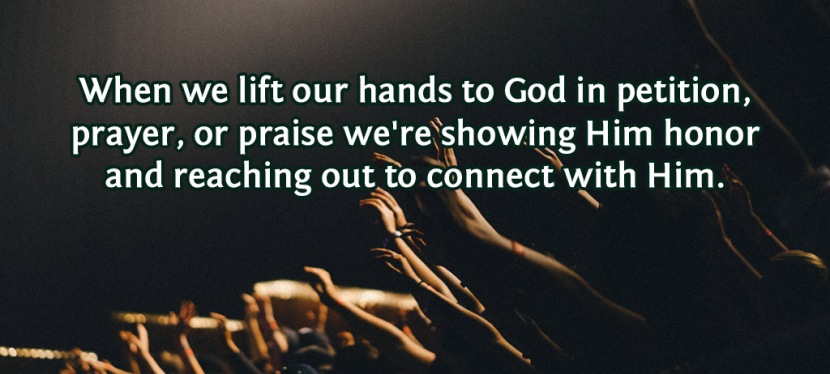
How do you use your hands to praise God? Maybe you lift your hands in worship, or use them to minister to God’s people. Or maybe you haven’t really thought about there being a connection between hands and praise, so this seems like an odd question.
Idioms involving hands abound in the Hebrew language. Being in someone’s hands is to be in their power. Putting one’s hand to something means you’re working on it. Raising your hand against someone is rebellion. Open hands express giving, and closed hands withholding, something.
Hands were lifted when making an oath to God, as Abraham did (Gen. 14:22-23). God lifts His hand when He delivers His people (Ps. 10:12). Priests stretch their hands out when they bless the people and people lift their hands when they bless God (Lev. 9:22; Neh. 8:6). Hands, and specifically lifted hands, can mean different things depending on the context.
Last week, we talked about the Hebrew word yadah (H3034), which means to confess or acknowledge as well as to praise and thank. There’s one other meaning we didn’t touch on, though. Yadah also means to throw or cast (Zodhiates’ dictionary). It’s connected with the Hebrew word for hand, yad (H3027), and as such yadah is considered the Hebrew word which “means to worship with extended hands” (see“8 Hebrew Words for ‘Praise’ Every Christian Needs to Know”).
We can think of yadah as a type of praise we “throw” to God with lifted hands as we declare how wonderful He is and confess that we follow Him. Today, we’re going to look at the ways we petition, pray to, and praise God with our hands. Read more →
Due to wisdom tooth surgery on Thursday I’m not dancing this morning (it all went very well, praise God and thanks to a good dentist, but I’ve been advised not to risk dislodging the blood clot that’s helping it heal by any sort of vigorous exercise so soon after surgery). But I was very tempted to risk it and I’m still wishing I could have danced. (Update: 1 hour after this posted, I showed up at church and they’d changed to slower songs so I did get to dance. Hallelujah!)
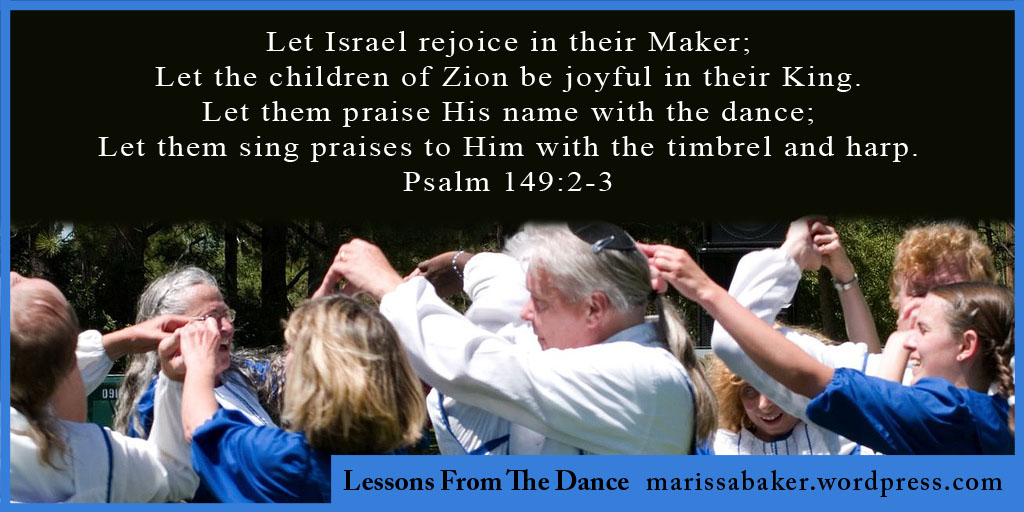
For those who that last paragraph left a bit confused, I’m referring to what’s known as Davidic or Messianic dance. It’s easier to show a video than to try to describe it in words. Here’s my dance team (several years before I met them) dancing to one of our very favorite songs:
I joined a Messianic dance team early in 2015. My first introduction to the dance was about a year before that, when a dancer shared some basic lessons at a Feast of Unleavened Bread event in Michigan. I absolutely loved it, and I picked up the dances so quickly my mentors say that God has given me a gift for the dance (there’s really no other way to explain why I’m good at it — normally I’m rather clumsy).
Dancing at church, especially to open the service, seems a bit odd to many Christian denominations. But there is Biblical precedent for dance as part of worship and I’ve found the inclusion of dance (and especially being involved in the dance) is a blessing I hadn’t expected. And it has taught me some valuable lessons about dancing in unity with God on a spiritual level.
Basics First
When you’re first learning to dance, you have to start with the basic steps. We don’t just expect new students to know how to do the Hallelu dance. First, we teach them how to do the mayim, tcherkessia, coupe, and 3-point turn that make up the Hallelu step combination. As they learn the basic steps, we start putting the steps together into patterns to match the different songs. And we keep going over and over those basic steps for the first couple months after new dancers join because they’re the basis for every dance we do.
It’s much the same when we first begin our Christian journey. We start out learning about the foundations of repentance and faith. We learn that we should “love the Lord your God with all your heart, with all your soul, and with all your mind” and “love your neighbor as yourself.” Then we learn how to apply those truths in every day situations.
As we grow, God deepens our understanding and adds more foundational principles like “the doctrine of baptisms, of laying on of hands, of resurrection of the dead, and of eternal judgment” (Heb. 6:1-3). Then we learn more about His expectations for those following Him, what grace truly means, how He wants us to view His commandments, and practical ways to follow Jesus with every step we take. But it all starts with the basics.
Listen To The Music
Even if you know the basic dance steps, they’re not worth much until you set them to music. Music is so much a part of the dance that our dance leader often has trouble recollecting the steps of a dance when she’s trying to walk through and teach them slowly without music. As soon as the music plays, though, it all comes back to her.
You can’t dance without listening to the music. A waltz calls for different steps than a tune in 4/4 time. In some songs, you need to wait for pauses in the music. For others, you have to be thinking two steps ahead because the music moves so fast. Often, listening to the lyrics tells you which part of the dance you’re supposed to be doing in multi-part dances.
In the same way, we have to “tune” our Christian walks to the song God plays through His scriptures. While the Bible doesn’t use the dancing analogy much, it does talk about Jesus coming “to guide our feet into the way of peace” (Luke 1:78) and of God directing the steps of good men (Psalm 37:23, 31; 119:133). We have to study His words so we know the right steps and we need to listen for the guiding of His spirit for how to apply what we learn.
Dance Together
Davidic dance isn’t a solo endeavor. We dance in circles of unity. Every dancer is responsible for knowing the steps to a given dance and how to follow the music. But there are some songs that just don’t stick in your mind as well and there are times (even when you’re no longer a beginner) that you just can’t remember what comes next.
If you can’t remember a step, you can follow one of the other dancers. You’re already watching them to keep in unity, and you know you can count on them for reminders. In turn, they should know they can count on you to know what you’re doing for when they can’t remember a step. We help keep each other on track.
Walking as Christians is made easier by fellowship with other believers. While God will certainly work with people who are isolated from other Christians, His intention is for the body of believers to come together and grow as we build each other up and learn to use our gifts (1 Cor. 12:1-31). We’re on this walk of faith together and we have the opportunity to help each other find the right steps to stay in unity with God.
We talk quite often about how we ought to live our lives as Christians — the things we should and should not do, which laws we must keep, the characteristics of Jesus Christ that should show up in our lives. We also talk about what motivates this way of living. If our hearts aren’t right, the outward stuff doesn’t matter. God cares about why we do what we do as much (or more) as He cares about our actions.
The “why” is connected with how we view God. Are we obeying His rules because we see Him as an intimidating authority figure, or because we respect Him as Creator? Do we follow Jesus because of what we hope to get out of being Christian, or because we love Him and trust that He wants what’s best for us?
Those questions are concerned with how God relates to us. Beyond that is the question of how we view God as Himself. God is the self-existent One who inhabits eternity. We often think of Him in terms of how He relates to humanity, but there’s far more to Him than that. How should we view God simply because He is God?
In Hebrew, the word translated glory and honor in the verses we’ll cover literally means “to be heavy.” It’s not an abstract or subjective concept. There’s substance behind the honor and glory discussed in the Bible. Kabod (H3519) and the related word kabad (H3513) are used figuratively of an honorable social position backed-up with a “weightiness of character.” This makes the recipient of glory worthy of that honor (TWOT entry 943). Read more →
It’s been a year since I first started really digging into 1 Corinthians 11 and began wearing a head covering when I attend church services. I’d been wondering about 1 Cor. 11 for years, but hadn’t really looked into it all that deeply. None of the explanations about why we don’t cover today satisfied me, but I didn’t feel I had a good enough argument in favor of covering to go against my church tradition. I’d discussed it with a few women in my congregation, but they seemed confused by the passage and had decided that your hair is your covering and the “we have no such custom” phrase meant veiling/covering in church wasn’t necessary today.
Then a year ago I stumbled upon The Head Covering Movement through a blogger. Here was a group who took this passage seriously. They were ready to talk about what “because of the angels” might mean. They engaged directly with a variety of arguments against covering in a respectful way solidly rooted in scripture and history. They even had a good explanation for the phrase “we have no such custom.”
How I started covering
Flea market find — head covering for $1!
My first reaction was to talk with my mother, who was suspicious of the whole idea. I then reached out to a friend who’d been sending me “rants” about scriptures that didn’t make sense to him. My own “rant” went something as follows: “should I start wearing a scarf because this makes sense to me? or did I miss something in their interpretation of these verses that I shouldn’t agree with? Maybe my mother’s right that it’s not a big deal and it would be too distracting to people around me in church.”
Even before I heard back from him, I wore a wide headband to church that Sabbath. I thought it was big enough to count as a covering, yet not something I hadn’t worn before so it wouldn’t attract much attention. A few days later, my friend wrote something that helped confirm my decision: “It is good that you’re mindful of not causing a ruffling of feathers among fellow congregants, but we can only control so much of other people. … So, I would just encourage you to follow your conviction wherever that leads you. If people have a problem, it is their Christian duty to confront you about it, and I doubt anyone would still have a problem with you/your apparel upon inquiring about your intent in doing so.”
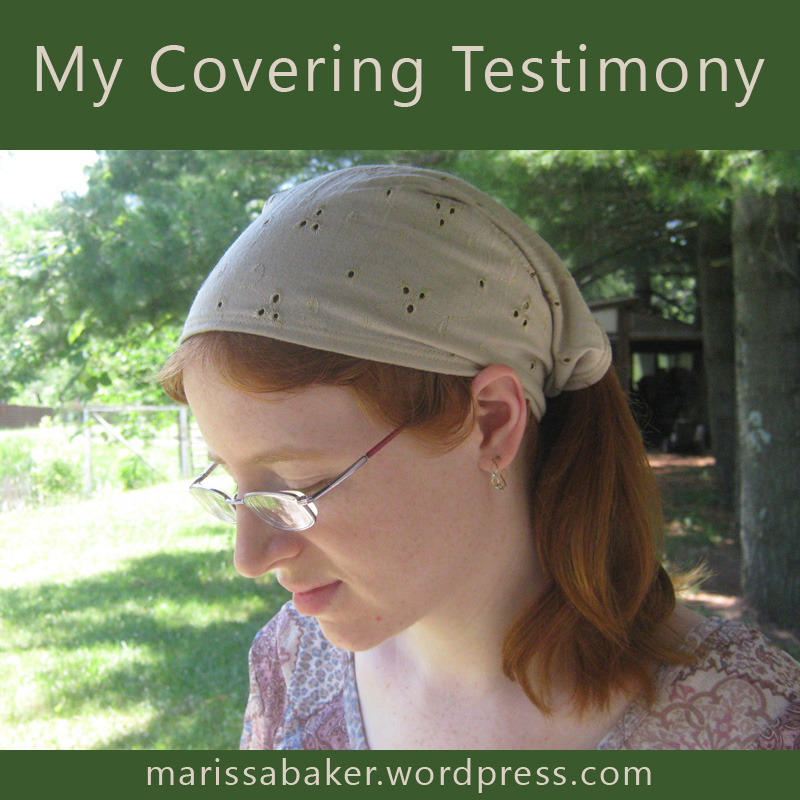
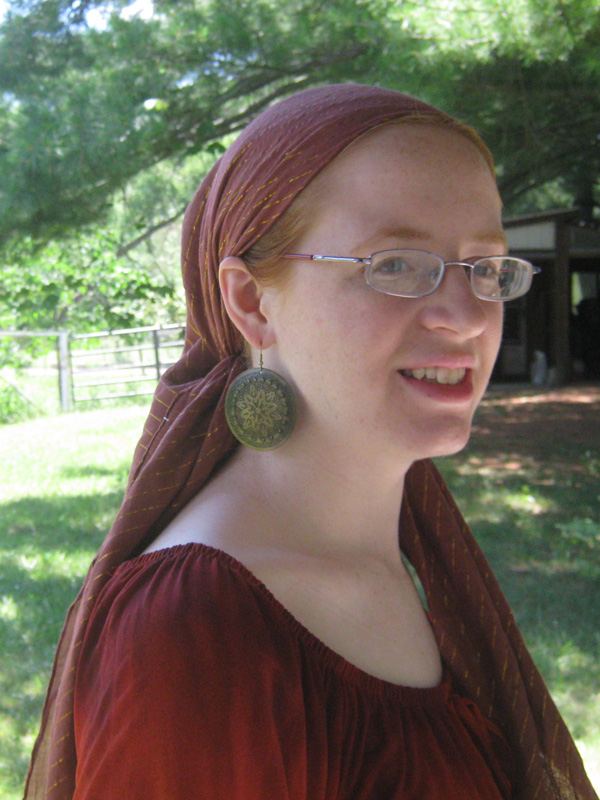
My friend is a smart man. I’d already taken baby-steps toward covering, but his encouragement was reassurance that I wasn’t just going “off the deep end.” I ordered my first cover from Garlands of Grace on July 15 (pictured in the featured image), and started building a collection of head scarfs. Since then, I’ve only had one person in the United Church of God groups I attend ask about the fact that I cover my head, but at my Messianic group there are a few other women who cover and the topic comes up more often. I’ve received compliments on how I wear them, as well as on the fact that I’m covering. One person said, “I appreciate that you wear a cover when you dance.” I’m not doing this to seek attention of course, but for someone whose love language is Words of Affirmation this support was invaluable.
Support for covering
In terms of scripture, the passage in 1 Corinthians 11:1-16 is the main support for the practice of Christian head covering. A few other scriptures tie in to it (such as Num. 5:18 instructing the priest to uncover the head of a woman accused of adultery), but this is the only place where it’s focused on. You can check out The Head Covering Movement for more in-depth analysis, but here’s what convicted me that covering is for the church today:
God’s created order for headship is the foundational reason for covering (v.2-3, 7-12).
It’s described as a dishonor and a shame for women to “pray or prophecy” uncovered (v. 4-6).
Paul says “nature itself” (including the examples of short hair on men and long hair on women) teach us covering is proper (v. 13-15). I also think this is support for the hair acting as a covering sometimes and an additional cover only being required when “praying and prophesying.”
The “we have no such” custom phrase grammatically refers back to the question in v. 13 of women praying uncovered. No where in scripture does Paul suggest people can ignore a command he writes about simply because they are contentious over it.
On top of those reasons, the arguments most people use against head covering are, for me, an argument in favor of it. They say it was a strictly cultural matter that no longer applies — that in Corinth, only prostitutes went about with uncovered heads and we don’t want to be mistaken for prostitutes. But Paul mentions no such thing and when we start throwing out commands because we think they’re strictly cultural we’re on a very slippery slope. On top of that, historical evidence shows the prostitutes referenced in this argument belonged to a Corinth of about 200 years before Paul’s writings and art of the time shows respectable women both covered and uncovered. The covering Paul talks about wasn’t based on a Greek or Roman practice (or even a Jewish practice, since both men and women covered in Judaism).
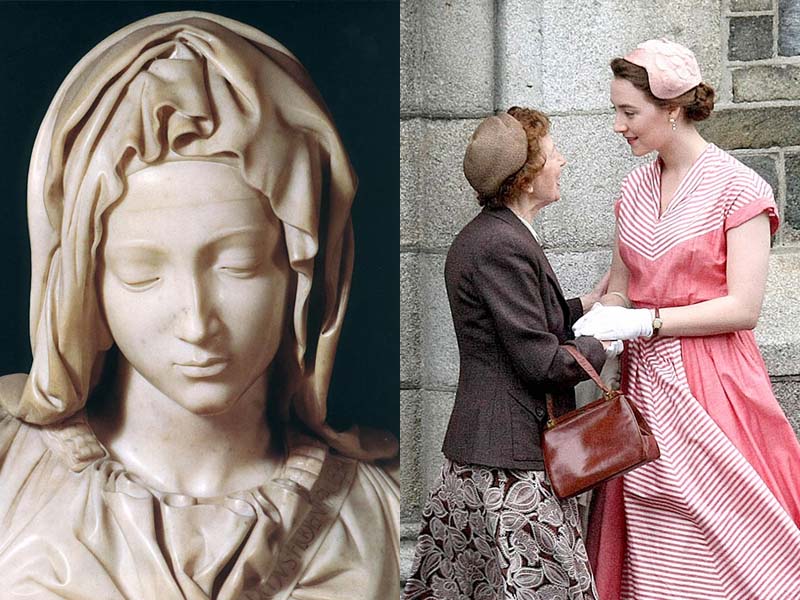
Left: Michelangelo’s The Pietà (1498-1499). Right: film still from Brooklyn (2015, setting 1952)
In reality, history shows us that head covering was practiced unanimously among Christian women for centuries. I hate to cite Wikipedia as a source, but in this case their article on Christian headcovering throughout history is unusually well-researched and more thoroughly cited than many other articles I’ve found online. Until a little over 50 years ago (with the sexual revolution and the feminist movement gaining traction), covering was the norm in church and often in public as well. Even fairly recently, no respectable lady would leave the house without a hat of some kind and she was expected to keep it on during church services. If you’re looking closely, you’ll notice this in well-researched historical dramas. Last year’s film Brooklyn, for example, was set in 1951 and ’52, and you’ll see Eilis removing a veil as she leaves a church in one scene and another scene where she’s wearing a pink cover at church.
While I don’t like to seem as if I’m pushing the notion of headcoverings on other people, I am doing this for a reason and a year of covering has only confirmed my choice. My encouragement to you today is to just take a closer look at this passage of scripture, and not to ignore it because we’re not sure what to do about it. Don’t start covering just because someone tells you to — study it and see if you’re convicted. And if you are, then don’t be afraid to start covering in church. Sure some people will probably think it’s strange, but as my friend said, “we can only control so much of other people.” If you’re convicted that you should be covering at church, then you’re doing it for God and not for what other people think (though you do want to try and avoid offending our brethren by how we practice covering).
Now, I don’t mean to sound like covering has been without its struggles or that it wasn’t a little weird at first or that I don’t still have questions. For example, how often to cover is still something I’m not clear on. I’m convicted of covering at church services (which is all The Headcovering Movement sees as necessary), but “praying and prophesying” could apply to other times as well. Do Bible studies count? What about dance practice, since the dancers pray as a group and sometimes I’m asked to pray aloud? I cover at home when praying in private, but should I cover for blessings on meals? or when writing these Sabbath blog posts, since that’s a sort of prophesying/inspired speaking? I’m not sure.
While thinking these things over, I’m keeping in mind that we can’t turn this into a legalistic thing, and I do think God hears prayers of uncovered women. Covering should be a way of honoring God, never something that stands between us and our Lord. But if it is indeed a command, and I believe it is, then it’s meant for our good, and that has been my experience. I’ve found that covering draws me closer to God and reminds me that I’m here to worship and to honor the Lord.
I was in Michigan over the weekend for Last Day of Unleavened Bread and the Sabbath, heard some thought-provoking messages, and had some interesting discussions. One of these messages (and related discussion) touched on the role physical actions play in our Christian walk.
By itself the message I heard would have prompted many thoughts on the subject, but taken together with a book I’ve been reading it’s quite a chunk of spiritual meat to chew on. I’ll probably write more about this topic when I’m not functioning on ~5 hours sleep and a chocolate hangover, but those are my thoughts right now.
Blocking the Light?
In the message I’m referencing, the speaker talked about Passover symbols (foot washing, bread, and wine) and said “the physical acts are irrelevant” but we keep them because they’re good reminders. That wrinkled my eyebrows a bit, but I thought I’d keep an open mind and hang in there to see where this went.
It went to Colossians 2:16-17: “So let no one judge you in food or in drink, or regarding a festival or a new moon or sabbaths, which are a shadow of things to come, but the substance is of Christ.” He took this and defined shadow as the absence of light, and then called the holy days that we were gathered to keep “blocked light.” The next place he took the analogy was back to the Passover, asking, “Why would Jesus partake of a shadow that’s blocking the light?” The message then jumped to saying that since “He wouldn’t do something like that” the words must function on another level, as in Luke 22:18 referring to our communion with the kingdom of God inside us today rather than an actual event in the future.
Obviously I’ve oversimplified his points, but you get the basics of what I want to cover. The crux of his message rested on the idea that “the physical acts are irrelevant.” That led to talking the implication that because holy days, sabbaths, etc. are described as “shadows” they may distract us from living in the Light. But the word for “shadow” in the Greek can mean two different things, much like it can in English. You have the physical absence of light in the sense of “darkness and gloom,” and you have the metaphorical sense. For the Greek word skia (G4639), that means a foreshadowing of a full and perfect image not yet seen clearly. You have to infer the meaning from context. And when the context is discussing Sabbaths that are a key part of God’s covenants and saying that they point to Christ, I have to go with the metaphorical meaning as most likely.
Embodied Liturgy
Then on the other side of the spectrum we have the book I’ve been reading called Desiring the Kingdom: Worship, Worldview, and Cultural Formation by James K. A. Smith (between this and Fill These Hearts, I’ve been reading a surprising amount of truly fascinating Catholic theological works lately). I haven’t yet finished this book and it’s a deeply academic text that defies easy summary. One of his main points, however, is that humans are primarily lovers (“I love, therefore I am” rather than “I think/believe, therefore I am) and that we require embodied liturgies to aim our desires in a correct direction.
While my church does have many physical things we do as part of worshiping God (like resting on the Sabbath day, the Passover symbols, and water baptism) this particular view of physicality in worship was new to me. He seems to be prioritizing physical acts of worship over learning theology and understanding doctrines, which makes me uncomfortable, but the idea of doing what God tells us to just because He says so before we understand why does make sense. I also find the argument that we should engage with God on every level — including emotional — very compelling, especially in light of the many scriptures talking about the role of our hearts in our walk with God.
Balance
I’m thinking something between these views is probably closest to right. Yes, the physical isn’t the main point because it’s largely there to teach us more important spiritual lessons. Focusing too much on physical is one of the things that got the pharisees in trouble — you need to have a right relationship with God or it doesn’t matter how good you look on the outside or how closely you keep the letter of the law.
Still, the physical is vitally important. God created us as physical beings full of desires that He tells us to direct toward Him. If the physical didn’t matter, God wouldn’t spend so much time telling us what to do and what not to do. The state of our hearts is of paramount importance and we’re supposed to control our thoughts, but that results in physical actions. And if we’re in a right relationship with God, we’ll be walking in Jesus’s footsteps (including the physical things He did, like Passover) and keeping His commandments.
What about you? any thoughts on the role physical actions should (or shouldn’t) play in our Christian walk?
If you could ask God one question, what would it be?
Several years ago, I heard a speaker say that he thought most of us would ask, “When is Christ returning? How much longer do we have to wait?” That’s not what I’d ask, though. Does it really matter to you whether it’s 10 months, or 10 years, or 10,000 years? We could quite literally die today (though we don’t like to think about it), so we should be working on being ready to meet God at any moment. We should be watchful, yes, but the focus is on growing to be like Him and knowing Him more fully.
With that in mind, I think my question would be more like that of the rich young man in Matthew 19 and Mark 10.
The First Question
Now behold, one came and said to Him, “Good Teacher, what good thing shall I do that I may have eternal life?”
So He said to him, “Why do you call Me good? No one is good but One, that is, God. But if you want to enter into life, keep the commandments.”
He said to Him, “Which ones?”
Jesus said, “‘You shall not murder,’ ‘You shall not commit adultery,’ ‘You shall not steal,’ ‘You shall not bear false witness,’ ‘Honor your father and your mother,’ and, ‘You shall love your neighbor as yourself.’ ” (Matt. 19:16-19)
I get the impression that this is the bare minimum required to get into God’s kingdom. We know from Hebrews that the law by itself isn’t enough to save us, so we’ll assume this list implies that we also repent and accept Jesus Christ’s sacrifice for our sins. There’s also a relational aspect implied.
If you keep My commandments, you will abide in My love, just as I have kept My Father’s commandments and abide in His love. (John 15:10)
So, to get into God’s kingdom we need to repent and be cleansed of our sins, keep the commandments, and walk in relationship with God. But what if we feel like we’re doing all this, and still there’s something missing?
The Second Question
The young man said to Him, “All these things I have kept from my youth. What do I still lack?”
Jesus said to him, “If you want to be perfect, go, sell what you have and give to the poor, and you will have treasure in heaven; and come, follow Me.”
But when the young man heard that saying, he went away sorrowful, for he had great possessions. (Matt. 19:20-22)
That’s the question I would ask — “What’s missing from my Christian walk? What do I still lack?” Honestly, though, the thought of getting an answer is kinda scary. I think Jesus would look into my heart and find the biggest thing that is pulling me toward this life instead of Him, and tell me to give it up. Would I be like the disciples, who could say, “we have left all and followed You” (Matt. 19:27), or would I be like this young man who wasn’t ready to go that far for Jesus?
Paul had a proper perspective on this sort of situation. He didn’t even ask the question, but Jesus answered it anyway. Once Paul realized that faith in Jesus as the Messiah was what his walk with God needed, he gave up his prestige as a pharisee to become a persecuted, itinerant preacher.
But what things were gain to me, these I have counted loss for Christ. Yet indeed I also count all things loss for the excellence of the knowledge of Christ Jesus my Lord, for whom I have suffered the loss of all things, and count them as rubbish, that I may gain Christ …. Not that I have already attained, or am already perfected; but I press on, that I may lay hold of that for which Christ Jesus has also laid hold of me. (Phil. 3:7-8, 12)
Both here and in Matthew 19, the word “perfect” is translated from teleios (G5046), which we talked about last week. It is connected with growth as a Christian; becoming more mature as we become more like Christ.
We might be able to get by doing the bare minimum, but that’s not how we reach perfection. We become perfect by learning to think like God (Matt. 5:43-48) and giving up anything that keeps us from fully committing to Christ. Let’s not allow fear to hold us back from taking a good, hard look at ourselves and asking God, “What do I still lack?”





 Like An Anchor