Writing Heroines

Last week, I wrote a post about the eight hero archetypes listed in The Complete Writer’s Guide to Heroes and Heroines: Sixteen Master ArchetypesI’ve used this book extensively since I discovered it in the library, and I’ve found it a great help in crafting dynamic characters. Characters I wrote before reading it even fit in the archetypes, which I’m taking as a sign that I was on the right track with character development. For these characters, the descriptions have helped me edit them to be stronger and more consistent.

If you’re a writer and you can find a copy of the book, I highly recommend using it. If not, here’s a brief overview of each description for the eight female archetypes. All the quotes below are from the descriptions in the book.

Heroine Archetypes
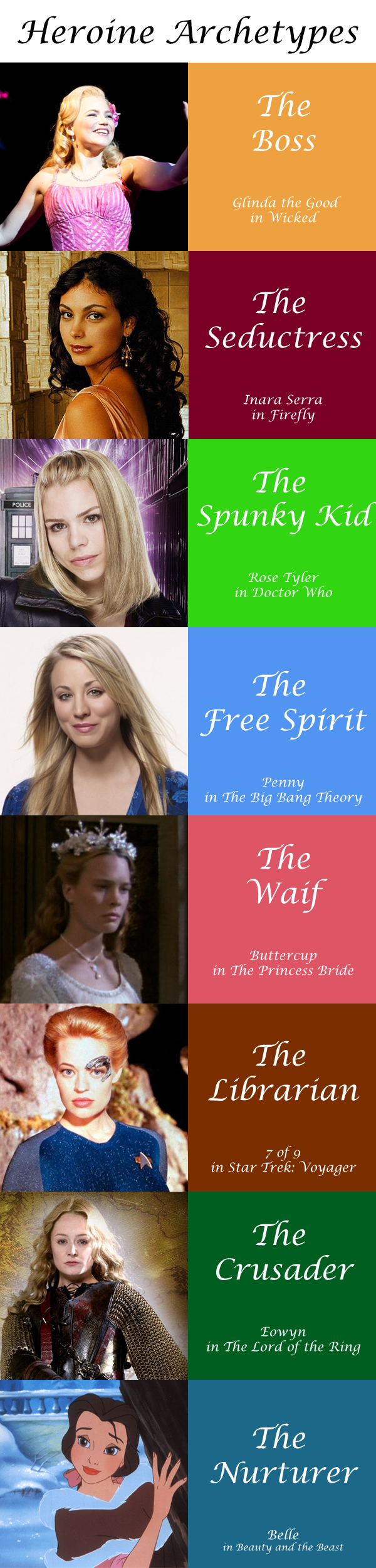
Heroine ArchetypesThe Boss

This is a strong, tough character who wants to win at all costs. Typically, such a character always got her own way growing up and wants that to continue. “She will shade the truth in order to gain her objective and she is not above manipulating circumstances to make things go her way.”

The Seductress

Assertive, strong, and clever, this type of character learned at a young age she could charm people into doing what she wanted. She is cynical, driven, manipulative. “Her true desires and motives are carefully concealed behind a sensual smile. Knowledge is power, so she makes sure no one knows her” and instinctively distrusts people.

The Spunky Kid

This is the “heroine underdog.” She has a sense of humor and is reliable, supportive, unassuming, and skeptical. Sometimes, she “hides behind her sarcastic wit, and her lack of confidence may make her play down her best attributes, but she is spirited, cheerful and the most loyal of friends.”

The Free Spirit

Sincere, upbeat, and imaginative, this type of character can also be impulsive, meddling, and undisciplined. They have a strong sense of individuality and never plan anything, but always seem to land on their feet.  She is a natural entertainer, and “may be a handful for anyone who has to deal with her, but she makes the experience worthwhile in her zany, high-spirited way.”

The Waif

This character is trusting, easily influenced, kind, and insecure. She inspires others to want to save her, and is generally content to let herself be rescued. “Her delicate fragility makes her an easy target … [and] she adapts to any situation she falls into without complaint.” You’re far less likely to see her in fiction of today than the other archetypes, but that does not mean she should be avoided.

There is something refreshing about a heroine who does not talk back or fight every battle, but rather, allows a man to be a man and believes that if left well enough alone, situations will resolve themselves.

The Librarian

This type of character likes to organize everything. She is efficient, serious, dependable, rigid, repressed, and a perfectionist. She assumes she has all the answers and, “more often than not, she is right, but she can be a bit stubborn about considering other opinions.” She is also portrayed as having a passionate side when she “lets her hair down.”

The Crusader

“This is a heroine in the truest sense — deeds of valor are right up her alley.” She is courageous, resolute, and persuasive. Her flaws include obstinacy, rashness, and being outspokenly opinionated. She wants to set the word straight and “has no faith in the intrinsic merit of human nature; no belief that all will end well if left alone.”

The Nurturer

A character of this type needs to be needed. She is optimistic, capable, idealistic, self-sacrificing, and willing to compromise so she won’t hurt anyone’s feelings. Before thinking of herself, “she makes sure that all her loved ones are happy and content … Her serene, capable and patient manner invariably soothes troubled souls or hurting hearts.”

Writing Characters

There are three approaches to using these archetypes to create characters. A character could be a “core archetype,” fitting into a singe archetype and remaining consistent through the course of the story. Characters can also evolve, changing from one archetype to another because of the events of the story. Layered characters have elements of two archetypes, which may take turns being dominant but will not change over the course of the story.

An example of evolving archetypes is the Beast in Beauty and the Beast, who changes from a Lost Soul into a Chief as a result of Belle’s nurturing character. Layered characters include MacGyver (Warrior and Professor), Eliza Doolittle in My Fair Lady (Waif and Spunky Kid), and Princess Leia (Boss and Crusader).

I hope you’ve enjoyed reading about these character types, and that it sparks an idea for your own writing (or at least provided some interesting reading while procrastinating from writing 😉 ).
Those Who Never Knew

Since I was very young, I’ve been taught what happens after death. At a basic level, I understood what our faith teaches and believed it — those who die in faith will be resurrected when Christ returns and live and reign with Him for 1000 years, then those who did not believe during their lifetime will be resurrected and given a chance to learn before the final judgement. I could not, however, give anyone who asked about my beliefs a more thorough explanation than the brief outline I just gave here.

Recently, I’ve been spending most of my study time in Romans as I work on a paper about Old and New Covenants — the differences and similarities, what was changed/updated by Christ’s sacrifice, what stayed the same, things like that. I think my prayers for guidance in studying this topic are being answered, and I’ve been pleasantly surprised to learn more about other aspects of my faith as well. I’m sure my understanding is still shallow, but I feel like I can finally start writing about both the covenants (the subject of future blog posts, I’m sure) as well as today’s subject, which is an aspect of the question, What happens after death?

Going to hell?

God our Savior ... desires all men to be saved and to come to the knowledge of the truth. For there is one God and one Mediator between God and men, the Man Christ Jesus, who gave Himself a ransom for all, to be testified in due time   1 Timothy 2:3-6One thing I’ve always wondered about groups I would call “mainstream Christianity” is how they are comfortable believing that God would condemn people to hell simply for never having heard the truth. I know some wonderful people who do believe this, but it puzzles me. Think how many people that includes throughout history. There were people in the years before Christ who never even heard of the God of Israel, much less understood Him. There were people beyond the reach of the early Christian church who never heard the gospel preached. There were people whose first encounter with “Christianity” was a forced baptism before they were enslaved to mine gold or work plantations. There are children who were aborted or killed as infants who never had a chance to live at all or learn anything.

Why would a God who loved the world so much “that He gave His only begotten Son” and Who “is longsuffering toward us, not willing that any should perish but that all should come to repentance”  condemn people who have never understood His truth? (John 3:16; 2 Pet. 3:9).

Those who “perish without law”

Ever since creation, all human beings have sinned (Rom. 3:9). No one is inherently righteous, not matter how closely they adhere to the letter of the law —  “by the deeds of the law no flesh will be justified in His sight, for by the law is the knowledge of sin” (Rom. 3:20). In other words, the law given in the Old Testament lets us know we are sinning, but until Jesus Christ’s sacrifice there was no way for us to be cleansed of sin.

So, what about people who never understood or heard the law which gives “knowledge of sin”? In Romans 5:13, it states that “until the law sin was in the world, but sin is not imputed when there is no law.” This hearkens back to a statement made in Romans 2:12: “For as many as have sinned without law will also perish without law, and as many as have sinned in the law will be judged by the law.”

These verses give us key insight regarding how God will judge the world. He is not unrighteous or cold-hearted, and does not delight in seeing people perish because of ignorance. For many, this means He will be patient beyond their deaths and give them a chance to know Him in the resurrection.

Then I saw a great white throne and Him who sat on it, from whose face the earth and the heaven fled away. And there was found no place for them. And I saw the dead, small and great, standing before God, and books were opened. And another book was opened, which is the Book of Life. And the dead were judged according to their works, by the things which were written in the books (Rev. 20:11-12)

Reason for hope

The incredible grace that God and Jesus offer includes not condemning people who don’t have a clue what they are doing. While Their righteousness does demand a penalty for sin, They are also defined by love (1 John 4:8, 16) and allow for repentance once people acknowledge the truth and turn from their sin (2 Tim. 2:25). For some, that is happening now or will happen in their physical lifetimes. For others, this will not be until the resurrection.

Still No Oven / Hero Archetypes

Since I am still without an oven, I’m going to depart from my schedule and post something other than a recipe today. The repairman is supposed to come this afternoon so, in lieu of writing about food, I’m going to write about writing.

Over on MarisMcKay.com, I’ve been working on a series of blog posts about character archetypes. I’ve spent too much time on the accompanying images not to try and broaden the audience, so this post will be devoted to heroes and I’ll dedicate Monday’s post to heroines. While collecting the examples of each type, I noticed sci-fi/fantasy may be overrepresented, but that’s what I’m most familiar with and I’ve decided not to apologize for it.

This theory of character development is contained in a book titled The Complete Writer’s Guide to Heroes and Heroines: Sixteen Master Archetypes. The ideas are based on Jung’s theory of collective unconscious. He identified major archetypes that arise from memories of shared human experience and serve as models for personalities.  For this book, the authors suppose that

 At the very core of a character, every hero can be traced back to one of eight major archetypes, as can every heroine. The core archetype tells the writer the most basic instincts of heroes or heroines — how they think and feel, what drives them and how they reach their goals.

Hero Archetypes

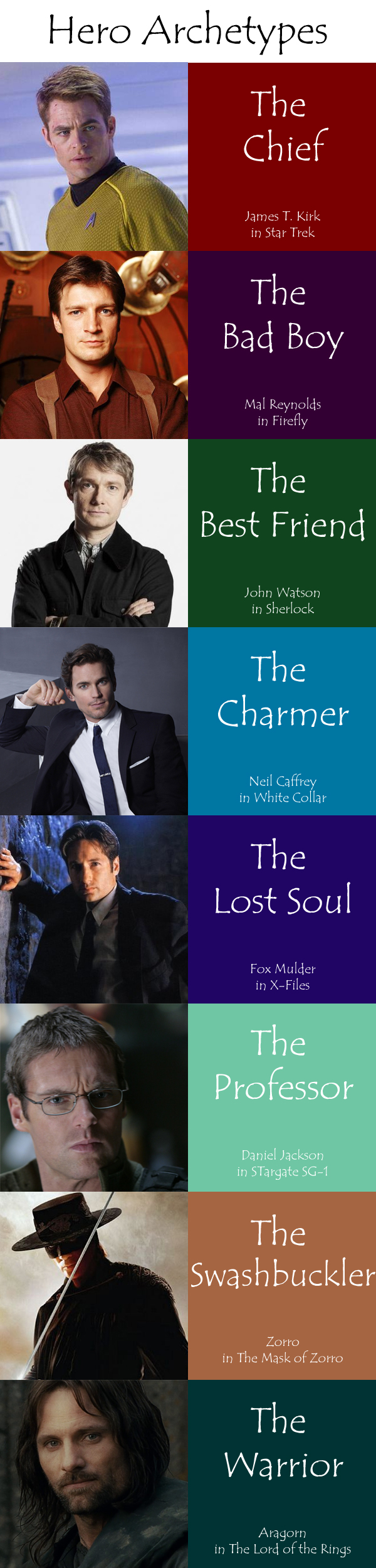
Eight hero archetypesThe Chief His major virtues are that he is goal-oriented, decisive, and responsible. He can also be stubborn, unsympathetic, and dominating. “He is a man who seizes control whenever possible. Active, dynamic, and strong-willed, he urgently needs to fix problems and produce results.” This type of character is not discouraged by challenge, and is typically a born leader or a conqueror type of character.

The Bad Boy This type is succinctly described as “every schoolgirl’s fantasy and every father’s nightmare.” He is typically charismatic, street smart, and intuitive, but is also pessimistic, bitter, and volatile. This character “struts into every room, daring one and all to knock the chip from his shoulder. … All his life, he has been pointed out as a bad example, so he does his best to maintain that reputation.”

The Best Friend “Decent, kind and responsible … He fits in everywhere and is universally liked. Whether he operates out of a sense of duty or genuinely enjoys giving of himself, he is always there.” His main virtues are stability, a supportive nature, and tolerance. His flaws are that he can be complacent, myopic, and unassertive.

The Charmer This is the likable rogue type who can “make you believe in fairy tales” but “is not always there in the ever-after”. He is creative, witty, and smooth, but also manipulative, irresponsible, and elusive.  “Exuding enormous charisma, he showers the people in his life with gifts of laughter and happiness. He is always fun, often irresistible, and frequently unreliable.”

The Lost Soul This character is devoted, vulnerable, discerning, brooding, unforgiving, and fatalistic. He is defined by an isolating event from his past. He “drifts through life with a heavy heart and a wounded spirit. He is dramatic, intriguing, and secretive. … This man has a poet’s voice, an artist’s creative genius, and a writer’s grasp on emotions.”

The Professor Some of my favorite characters — Daniel Jackson, Spock, Sherlock Holmes — share this type. They are “used to being the smartest man in the room,” are experts in their field, and can be absent minded or highly organized. They are analytical and genuine, but also insular, inhibited, and inflexible.

The Swashbuckler This character is an explorer or a daredevil,  fearless and foolhardy. He is exciting but unreliable, capable of finding a solution to any problem, but selfish in pursing his goals. “He loves to leave his mark on every exploit, so he chooses the most rash and flamboyant method of achieving his aim. Impulsive and creative, this man lives for the next adventure.”

The Warrior Tenacious, principled, and noble, this character type is compelled to see justice done. They can be self righteous, relentless, and merciless with their enemies. A character of this type “believes evil cannot go unpunished. He cannot allow the bad guys to walk away, so trouble seems to follow him wherever he goes.” He defends the weak and is the perfect protector.

Writing With Archetypes

I’ve found this book helpful in coming up with ideas for strong characters. For one character, who was disappearing into the background of my finished novel, it’s helped me flesh him out so much that the sequel will be his story. He is a Warrior, and I’m going to layer on some Lost Soul characteristics to make him even more unique.

There is a wide variety within each type, so even if you don’t combine them there is plenty of room for character development. As the writers of this book said, Henry Higgins from My Fair Lady is a chief, like Captain Kirk, but you wouldn’t want him commanding a Starship. If you’re a writer and you can find a copy (the book is out of print, so I use one from the library), I highly recommend this resource.

The INFJ Stare

Last week, I noticed that one of the Google searches that led to my blog was “INFJ stare.” My reaction was, “We have a stare?” I immediately posted the question to Facebook and performed a Google search of my own. One of my friends sent me this image of the dreaded “INFJ Death Stare:”

INFJ death stare

Apparently, only non-INFJs consider this a “stare of death.” We INFJs don’t really think about it much at all until someone points it out. But other types do notice. In one forum I found, an ISTP asked, “What’s going on in your head when you do it? Why do INFJ girls stare at me after every other thing I say? It makes me feel like I’m creeping them out or something, but they continue to talk to me regardless how creepy I may/may not be.”

What’s Going On Behind The Stare

Among INFJs, the consensus is that we don’t meant to give you a death stare. It’s simply our default thinking expression. The INFJs who know that they stare actually spend quite a bit of time trying not to creep people out with it. We’re awkward enough as it is without having to worry about people asking why we’re giving them the death stare.

This isn’t the same thing as “resting bitch face.” People don’t generally describe the INFJ death stare as being rude or angry. It’s just hard for other people to read. And once I’d read several comments along those line, I realized I do indeed have an INFJ stare. I just didn’t realize it at first because the people who’ve asked me about it generally describe it as “spacing out.”

INFJ Eyes

Benedict Cumberbatch Sherlock stareEven though there’s a “J” in INFJ, we’re a Perception-Dominant type Introverted intuition is a perceiving function, and that’s what we lead with (click here for more information about Myers-Briggs® Functions).

According to an analysis on infjs.com, eyes are the “most prevailing part” of a perception-dominant type’s faces. The typical INFJ will maintain a very steady focus on people or objects for long stretches of time, and when we shift our gaze to something new our whole head turns to look. Of the infamous stare, this writer says, “The eyes fall into a dream-like state and stare off into the distance. The eyes will appear to be looking through the object of it’s focus, rather than being fixated on it.”

One of the results that I found while looking up INFJ stares was an extensive two-part analysis of why Benedict Cumberbatch might be an INFJ. That’s where I found this gif. It’s no secret that I’m a fan of his, but this was a little over-the-top-obsessed even for me.  I did, however, find it an amusing read. It also demonstrates that INFJ eyes are apparently interesting enough that some people will spend hours of time analyzing them.

Dealing With the Death Stare

The INFJ Stare | LikeAnAnchor.com
Photo credit: luxstorm via Pixabay

While listening to a church service this past weekend, I realized I was making an effort to soften my eyes and smile a little instead of just staring at the speaker. I hadn’t really thought about before, but I have been trying to teach myself a more open and welcoming “default expression.” My sister once described this as my “interview face.” I suppose even though I hadn’t been thinking that I had a “death stare,” I still realized it made people uncomfortable and was trying to change it.

If you’re an INFJ, you’re probably already trying not to make people uncomfortable with you’re staring (which also makes it more effective when you want to give someone a death stare, since they won’t have seen it before).

If you’re talking to an INFJ and we do start staring off into the distance or through you, try not to be offended by it. We really don’t mean to make you uncomfortable. At least, not usually 😉


Featured image credit: Free-Photos via Pixabay


If you’d like to know more about the INFJ personality type, check out my book The INFJ Handbook. I just updated it with a ton of new information and resources. You can purchase it in ebook or paperback by clicking this link.

Who Is My Neighbor?

Some time ago, I was reading through the parable of the good Samaritan, and asking much the same question as the certain lawyer who prompted the parable: “who is my neighbor?” (Luke 10:25-37). The parable itself makes this answer pretty clear, but I still decided to look up the Greek word for “neighbor,” just to see if there was something I might have missed.

The word is plesion (G4139). It means generally the same thing as our English word “neighbor,” someone who lives near us. Even so, I found the way Zodhiates phrases the definition in my study Bible worth sharing:

It means neighbor, fellow man or fellow creature, indicating primarily an outward nearness or proximity. Occurs in Luke 10:29, the parable of the Good Samaritan, which teaches that he who is outwardly near us should be the object of our concern in spite of the fact that there are no ties of kindred or nation between us.

Other words, if someone is anywhere near you — if you can see, hear, or know of them — they are your neighbor and you have a responsibility to them.

Love Your Neighbor

Thinking about this fact has made me feel guilty on numerous occasions. For example, I had classes with some people I disagreed with and flat-out didn’t like, but at least for the four hours a week that we were in the same classroom, they were my neighbors.

Jesus Christ said, “the first and great commandment” is to “love the Lord thy God with all thy heart, and with all thy soul, and with all thy mind.” The second commandemnt “is like unto it, Thou shalt love thy neighbour as thyself.  On these two commandments hang all the law and the prophets” (Matt. 37-40). The commands to love sum up a main message of the Bible.

Owe no man any thing, but to love one another: for he that loveth another hath fulfilled the law. For this, Thou shalt not commit adultery, Thou shalt not kill, Thou shalt not steal, Thou shalt not bear false witness, Thou shalt not covet; and if there be any other commandment, it is briefly comprehended in this saying, namely, Thou shalt love thy neighbour as thyself. Love worketh no ill to his neighbour: therefore love is the fulfilling of the law. (Romans 13:8-10)

It is vitally important that we learn to love our neighbors. And not just the ones we like, because the same word for love — agape — is used when Jesus tells us, “Love your enemies” (Matt. 5:44).

Learning to Love

In Mere Christianity, C.S. Lewis said, “Do not waste time bothering whether you ‘love’ your neighbor; act as if you did. As soon as we do this we find one of the great secrets. When you are behaving as if you loved someone, you will presently come to love him.”  Acting as if we love a person is a better first step than trying to develop warm fuzzy feelings for someone we don’t like. The feelings we usually associate with love are optional, caring about the person’s well-being is not.

Agape (G26) and its root word agapao (G25) are best defined as “affectionate regard, good will, benevolence.” They indicate “a direction of the will” and differ “from phileo (5368), to love, indicating feelings, warm affection” (Zodhiates). The agape kind of love can involve emotions, and frequently does, but it is more concerned with an active decision to care about the well being of another person. Love is a choice, and if we want to become like God, it is a choice we must learn to make.