Update 6/7/2016: Since publishing this post, I’ve become increasingly unsatisfied with MBTI charts that try to find a character from a film or TV series to fit each type. Not every one of the 16 types appears in a given film or show and many charts (including mine here) include incorrect/forced typings. I leave this post here for archival purposes, and may do an up-dated LOTR chart in the future.
With the The Hobbit: Desolation of Smaug coming out this past weekend, I thought it was time to release my Lord of the Rings MBTI chart. My original idea was make this my 111th blog post so there would also be a tie-in with Bilbo’s fateful birthday party, but after missing some posts I decided just to release it now. This was inspired by the Star Wars chart by Geek in Heels that has been going around the social media sites, and I’m grateful to her for the idea.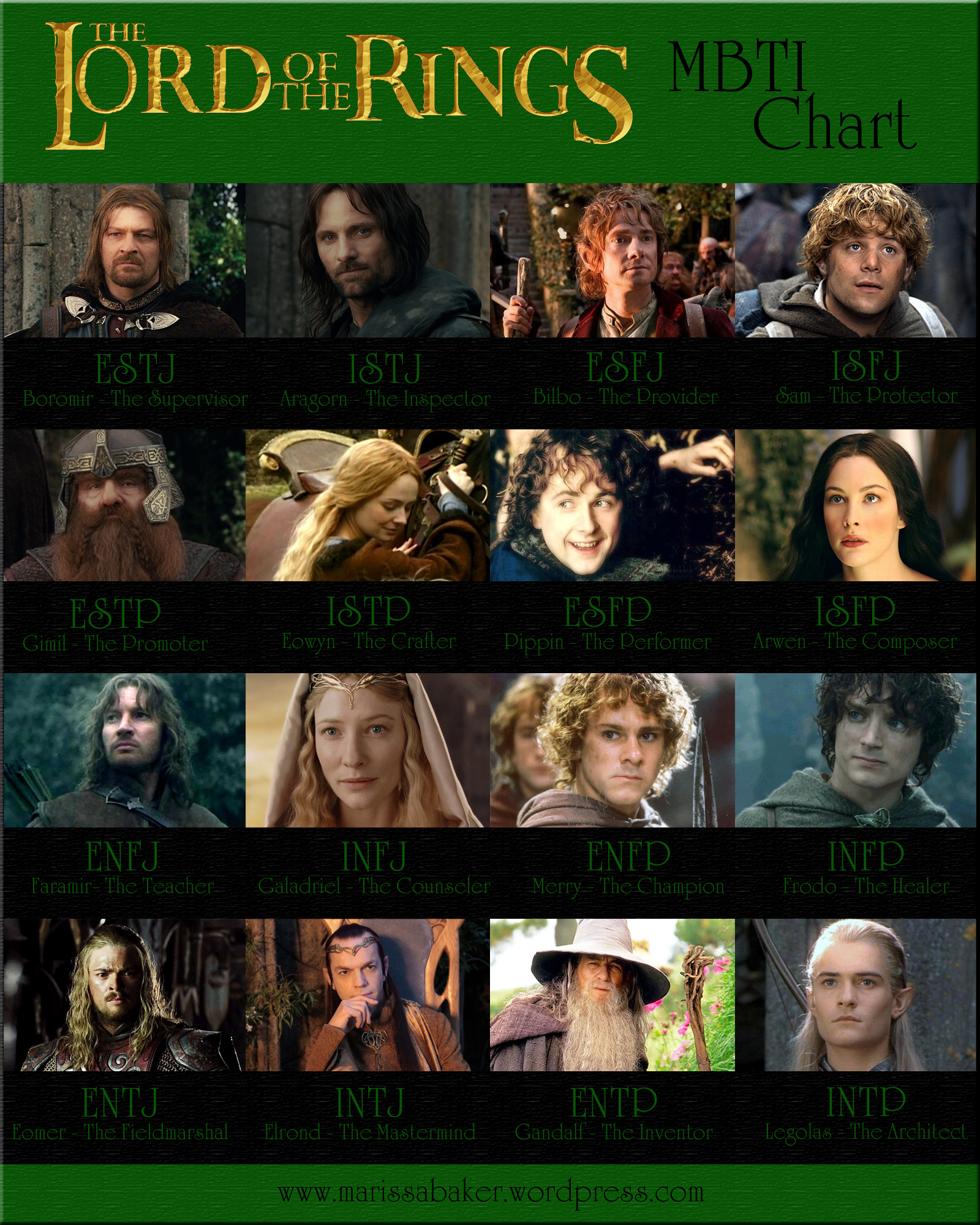
I admit not every one of these characters fit perfectly where I put them. This is partly because typing fictional characers is always subjective, partly because I’m not an expert, and partly because there just don’t seem to be that many extroverts in Tolkein’s world. I also wanted to give everyone a good-guy character that they could relate to, which is why you don’t see people like Sauromon or Denethor on this chart (this is for you, INTJs). I do mention them in the discussion below. For the sake of convenience and consistency, I’ve grouped the 16 Myers-Briggs types into the four categories used by David Keirsey’s Temperament Sorter. You can take his test here, or try out an online test that will give you an idea of your Myers-Briggs type here or here.
What follows is an explanation of why I chose each type for these particular characters, so you can see the reasoning behind my choices and pick-apart my ideas if you disagree 🙂 Since there are so many characters in Lord of the Rings and The Hobbit, I’ve also mentioned other characters which might share each type. For the following information about cognitive functions and different Myers-Briggs types, I rely heavily on Dr. A. J. Drenth’s Personality Junkie website. For the sake of time, I’m mainly focused on the first two functions in each type’s function stack.
Tolkein’s Guardians
Supervisor (ESTJ) — Boromir
Extroverted thinking (Te) is an ESTJ’s dominant function. This makes ESTJs quick to express their ideas, usually in the form of judgements and measurable goals. Take, for example, Boromir’s eagerness to speak out at the Counsel of Elrond and his insistence that his plan for using the ring was the right one. An ESTJ’s auxiliary function is Introverted Sensing (Si). Supporting Te, this can make ESTJ’s appear stubborn because they prefer life to be predictable.They like tradition rather than change — “Gondor has no king. Gondor needs no king.”
Inspector (ISTJ) — Aragorn
Most characters seem to have fairly consistent personalities between the books and the films. Aragorn may be an exception. It’s been a while since I read Lord of the Rings, but I think if I was typing Aragorn from the books he might be an extravert. I’ve also seen the film version typed as an INTJ, an ISFx, and an ISxP.
Si is an ISTJ’s first function. Like ESTJs, this makes them interested in preserving old ways of doing things and resistant to change. For Aragorn, you can see this in his conflict about whether to take his rightful place as king or leave things the way they are. As an auxiliary function, Te manifests itself as a tendency for ISTJs to think out loud and share their ideas and plans. They like order and control, and this helps make Aragorn an efficient and effective leader.
Other ISTJs: this might be a good match for Treebeard — I would definitely describe him as an introverted Guardian type.
Provider (ESFJ) — Bilbo
Keirsey calls providers “the most sociable of all Guardians” and says they are “friendly, outgoing, [and] neighborly” to the point that they become “restless when isolated from people.” He also adds that they are careful to remember birthdays. Starting to sound like a hobbit?
An ESFJ’s primary function is Extroverted Feeling (Fe). This makes them quick to express their opinions and judgements, though they like to do this in a way that maintains peaceful social functions. Note how Bilbo responds to the arrival of all the dwarves — he is not shy about letting them know what he thinks about their unexpected arrival, yet he still plays the perfect host. Like other types with Si as an auxiliary function, ESFJs can become set in their ways and comfortable with routine (which is what makes him appear introverted when he is upset about being disturbed by company).
Protector (ISFJ) — Sam
Not many fictional characters are as easy to type as Samwise Gamge. He is the perfect ISFJ. Like the ISTJ, an ISFJ’s primary function is Si and they tend to resist change and be comfortable with traditional ways of doing things. They tend to settle down and be comfortable with routine (Sam never considered leaving The Shire until Frodo went on his quest). With Fe as an auxiliary function, ISFJs are very people-oriented and attuned to the needs of others, especially their close friends. They have a strong sense of responsibility and loyalty, and readily serve others — “Come on, Mr. Frodo. I can’t carry it for you… but I can carry you!”
Tolkein’s Artisans
Promoter (ESTP) — Gimli
Gimli might not seem an obvious choice for the ESTP character, since they are often charming, life-of-the-party types who enjoy stylish dressing and living well. But translate all that into a dwarf, and I’d say Gimli probably thinks fits the description. Extroverted Sensing (Se) is an ESTP’s primary function. This tends to make them seek out thrills, take risks, and flirt with danger (“Certainty of death, small chance of success… What are we waiting for?”). They also love food, drink, and merry making — which you can see in Gimli as he celebrates after the Battle of Helm’s Deep. Introverted Thinking (Ti) is his auxiliary function, and he can become serious and intense when called upon to make decisions or deal with feelings.
Crafter (ISTP) — Eowyn
According to Dr. A. J. Drenth, there are about three times as many ISTP men as women. Perhaps this is one reason Eowyn felt so out of place. An ISTP has the same functions as an ESTP, but reversed so Ti is first and Se is second. Keirsey calls them “crafters” because they have an impressive ability to master the use of tools. For Eowyn, the tools she chooses to focus on are weapons, and she is an accomplished fighter. ISTPs love action, crave excitement, and feel frustrated if they can’t act impulsively. They prefer to show their feelings through actions rather than words (Eowyn making soup for Aragorn and wanting to fight at his side).
Other ISTPs: Thorin — man of few words, inwardly thoughtful, physically active and skilled with weapons. Also known as one of several dwarves who make me want to cry every time they are on-screen because I know what’s going to happen to them in the next film 😦
 Bonus round: My cousin and I were talking last night about what type Smaug might be. I decided on introvert, since he is so comfortable with being alone, and SP since they are the types most likely to be both concerned with physical wealth and unconcerned with what people think of how they acquire that wealth. He’s not caring or people-oriented, which rules out ISFP. So, I’m going with narcissistic ISTP in dragon-form.
Performer (ESFP) — Pippin
Pippin was the first character I added to the chart. I keep picturing him dancing on a table and singing “The only brew for the brave and true comes from the green dragon!” Performers/ESFPs are talkative, engaging, like to be around people, and become the center of attention wherever they go. Like the ESTP, they enjoy good food and drink and will rush into things without stopping to weigh the consequences (asking “Where are we going?” after joining the Fellowship). Introverted Feeling (Fi) is his auxiliary function, and that adds a seriousness to Pippin’s character which is not readily visible (because usually introverted). It shows up during the siege of Minas Tirith.
Composer (ISFP) — Arwen
Though they share functions with ESFPs (Fi and Se), ISFPs tend to look very different. They are people-oriented, caring deeply for others and having a heightened sensitivity to suffering. This can be seen in Arwen’s deep attachment to Aragorn, her willingness to risk the Ringwraiths to save Frodo’s life, and starting to waste away because of “the evil that now spreads from Mordor.” She’s not as playful as typical SP types are usually described, but I think part of that is the fact that she is an elf and that Fi (which seems emotionally mature and serious) is her dominant function.
Tolkein’s Idealists
Teacher (ENFJ) — Faramir
I had such a hard time deciding who to put on the chart for this personality type. I’m not entirely convinced Faramir fits, but he’s the closest I could up with and the more I think about it the more I think this might be right. Extroverted Feeling (Fe) as a primary function means that an ENFJ’s sense of self is largely tied-up in their relationships with others. Growing up with Denethor constantly belittling him would have been devastating for little ENFJ Faramir, and would contribute to making him less sure of himself than a typical ENFJ. However, you can still see ENFJ traits of good leadership and an intuitive understanding of people when you look at the loyalty Faramir’s men have for him and his encounter with Frodo and Sam. His Introverted Intuition (Ni) helps explain why Faramir went with his gut feeling and let Frodo and Sam go.
Other ENFJs: Watching The Hobbit: Desolation of Smaug yesterday made me think Balin might be an example of a mature ENFJ character.
Counselor (INFJ) — Galadriel

Galadriel seems like a fairly standard INFJ character — otherworldly, introverted, wise, cares about others. INFJs have such a strong intuition that even some human INFJs report visions much akin to Galadriel’s and the feeling that they could almost be telepathic. As an elf in a fantasy world, Galadriel really is telepathic and can glimpse the future. She can also see right through people to discern their motives, as shown by her reaction to Boromir (or more tellingly, his reaction to her). They appear serious on the outside and are usually content to passively observe until they feel moved to speak. For more on INFJs, see this post.
Champion (ENFP) — Merry
With Extroverted Intuition (Ne) instead of sensing as his dominant function, Merry is more serious and given to reflection than Pippin. Unlike most hobbits, Merry is open-minded about the outside world and restless. He joins Frodo’s quest not just for the change of pace but because he recognizes the importance of destroying the ring. His commitment to fighting with the Rohirim and supporting Eowyn is typical of the ENFP championing causes they believe in.
Healer (INFP) — Frodo
In spite of the memes going around showing Frodo as an INFJ, he is generally considered an INFP by people who are more serious about their typology hobby. Fi is an INFP’s dominant function, and like ISFPs their emotions run deep. They are loyal to their friends and enjoy people, though at the same time can become loners who like to spend time in the outdoors. Sharing Ne (as their auxiliary function) with ENFPs, INFPs are also interested in championing causes. In the INFP’s case, they seek to heal conflicts and bring the world into a state of goodness.
Tolkein’s Rationalists
Fieldmarshal (ENTJ) — Eomer
ENTJs are natural leaders, and often find themselves in command even without seeking it. When leadership skills are encouraged, as with Eomer being trained to fight and lead, they become skilled commanders. Te as a primary function means ENTJs like order and rationality and planning is one of their strengths. They will respect authority to a point, but disobey orders if they feel the situation calls for it (Eomer standing up to Wormtongue). Ni adds a reliable gut instinct. Others might see them as hurried, wanting people to “cut to the chase,” and abrupt when making judgments (see the scene where Eomer meets and rapidly interrogates Aragorn, Gimli, and Legolas).
Other ENTJs: Possibly Theodin. I’m not sure.
Mastermind (INTJ) — Eldrond
I asked my INTJ sister who she thought might share her type in LOTR, and this is who she thought of. The primary function Ni gives them a view of the big picture and a keen insight for how the world works. Unlike INFJs, though, they use Te as an auxiliary function which makes them theorists who always have a plan or two (Plan A: send Arwen to the Undying lands. Plan B: reforge the sword and make Aragorn king). They often appear as aloof intellectuals and share a natural bent for leadership with ENTJS, but prefer to stay in the background until called upon to take charge for a short while (Counsel of Elrond).
Other INTJs: Masterminds make excellent villains, which I suppose would be why I’ve seen all the main villains typed as INTJs at one point or another. Saruman and Sauron I can see as INTJs, but I’m not convinced about Grima Wormtongue and Denethor.
Inventor (ENTP) — Gandalf
Gandalf is another character people don’t agree on how to type. I’ve seen him variously classified as an INTJ (most often), INTP, INFJ, and ENTP. I tend to lean toward this last one. He’s not focused enough to be an INTJ and instead of taking charge at a crucial moment, he steps back from leadership and says “Let the Ring-bearer decide” whether or not to go through the Mines of Moria.
As an ENTP, Ne is his primary function. He is curious, likes to collect data and use it to discover patterns, can see both sides of an issue, and uses his inventiveness to work with people as well as try to change social systems. Dr. Drenth says they “brainstorm aloud” and “may not always seem to ‘have a point,’” which Gandalf will do for page after page in the book. Auxiliary Ti gives him a respect for logic and reason. ENTPs are typically non-conformist and have many friends (enjoys Bilbo’s party, knows people all over Middle Earth).
Architect (INTP) — Legolas
An INTP’s primary function is Ti, followed by Ne as the auxiliary function. Kiersey notes that it is hard for them to listen to discussions without pointing out a speaker’s error (Legolas correcting Boromir at the Counsel of Elrond), and they would rather talk about ideas than about daily events or people. They are highly disciplined, which can help them achieve proficiency with something like archery, and also makes them appear serious.
UPDATE: Several people have pointed out (here and on other sites) that typing Legolas as an INTP is … controversial. For me, he is a hard character to type, and I’m not entirely sure about labeling him an INTP. I’m not sure what else to call him, though, or who else in LOTR might qualify as an INTP. Any thoughts?
Further Reading
There are a few other bloggers I found who did Myers-Briggs typologies for Lord of the Rings Characters. Sometimes my types agree with theirs, sometimes we interpret things a little differently. Here are their websites:
Myers-Briggs Type Indicator (MBTI): LORD OF THE RINGS AND MBTI
Which MBTI Type: Which MBTI type are the characters from Lord of the Rings?
Church Mag: Which Lord of the Rings Personality Type Are You? [Chart]






 Like An Anchor