
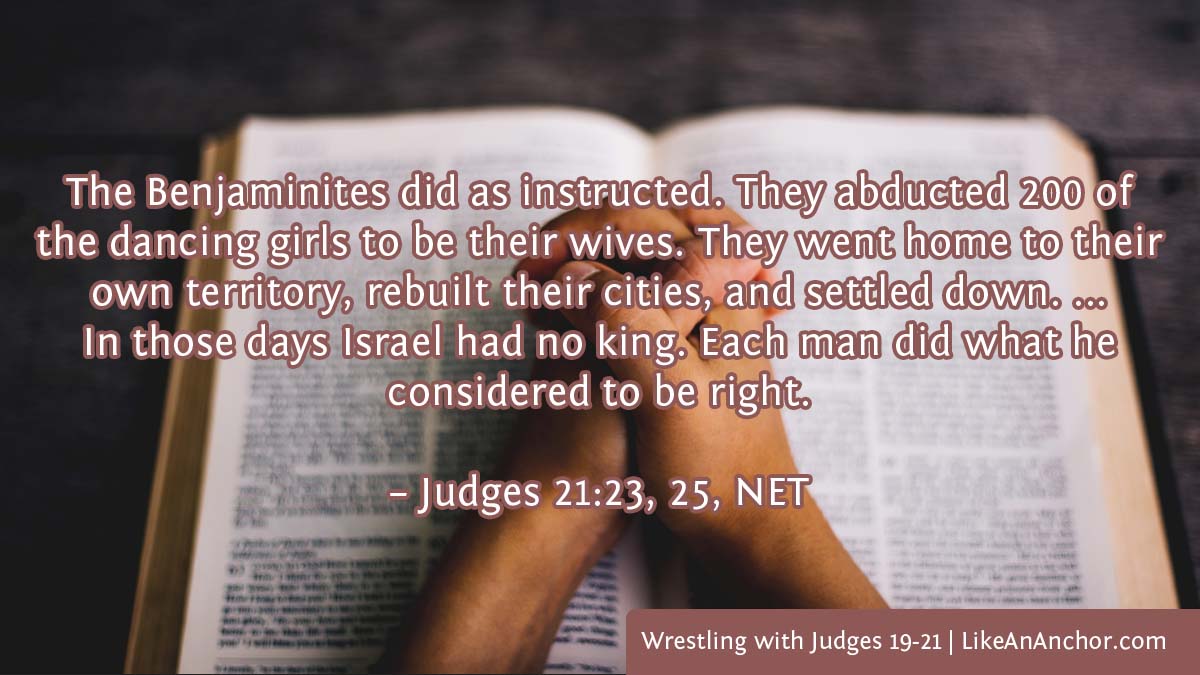
Judges 19-21 is undeniably one of the most troubling narratives in the Bible. The story begins horrifically and keeps going from bad to worse. A Levite man’s concubine is raped and murdered in the town of Gibeah in the territory of Benjamin after he shoves her out the door into a mob. He cuts her body up, sends her to each of the tribes of Israel, and the men respond by raising a huge army of 400,000 warriors and sending them against Benjamin to demand justice. The Benjaminites met with an army of 26,700 men. In a series of three day attacks, Israel lost 30,000 men before overrunning the men of Benjamin. Only 600 Benjaminite survivors escaped into the wilderness.
It is not explicitly stated that the Israelite army then murdered every woman and child in the territory of Benjamin, just that they burned every city in Benjamin’s land, but by the time they are done there are no women left for those 600 escaped Benjamite soldiers to marry and rebuild the tribe. Realizing this, “The Israelites regretted what had happened to their brother Benjamin. They said, ‘Today we cut off an entire tribe from Israel! How can we find wives for those who are left?’” (Jud. 21:6-7, NET). The “solution” involves killing everyone in the town of Jabesh Gilead except for 400 virgins they give to Benjamin. Then the elders of Israel give the remaining 200 men from the mascaraed tribe of Benjamin permission to steal virgins gathered for an annual festival in Shiloh to be their wives.
I can’t even begin to wrap my head around how many people died in this horrific chapter in ancient Israel history. The numbers we are given tell us 65,100 fighting men died. That doesn’t include the remainder of the tribe of Benjamin (men past fighting age, women, and children) or all the people of Jabesh Gilead. It’s horrific. And the solution is almost equally horrifying: turn 600 women over to those 600 men and force them to rebuild the tribe. The Bible doesn’t shy away from discussing violence, but there is “atypical and excessive use of violence within Judges 19–21” (Matheny, 2018, p. 286). It stands out even among other violent stories as particularly horrible.
A Biblical Fiction Perspective
Whenever I read this section of scripture, I wonder what it was like for those women. This is the longest narrative in the book of Judges (Matheny, 2018), yet it still only gives us a history-level narrative rather than a human-level one. One of the reasons that I love reading well-researched Biblical fiction is because it helps bring the Bible narratives down to an individual, human level as the author and reader explore what life would could have been like to live in those days. Books like that give voices (albeit fictional ones) to people who are silent in historic records. It would be very, very easy to write any book about this incident as a horror story. I am a hopeless romantic, though, so I desperately want to believe that at least some of these poor women found good lives with their unexpected husbands.
As far as I can find out, there are only two fictionalized accounts of this moment in Biblical history. I read Building Benjamin: Naomi’s Journey by Barbara M. Britton back in 2019 and after recently rereading the book of Judges, I read Warrior of the Heart by Mary Ellen Boyd just this past week. Both follow the story of one of the women captured during the feast at Shiloh. Both hypothesize a man (strangely, named Eliab in both novels) scarred by the past few months, repentant for his role in the atrocities, and committed to making the best of the situation and treating his new wife well. Both show a woman wrestling with whether to accept this as God’s will and eventually falling in love with her husband.
Violence against women (though certainly not exclusively against women) is so much a part of world history, and it can be especially discouraging to see it in scripture because sometimes we wonder if that means God is okay with this sort of thing. One of the things we have to remember when reading passages like this is that just because it’s in the Bible doesn’t mean God approved of what happened. There are a lot of stories, especially in the Old Testament, that are a cautionary tales and proof that human beings mess things up horribly when they don’t follow God’s way.
Perspective from Ruth
This story in Judges begins with the words, “In those days Israel had no king” (Jud. 19:1, NET) and it ends by saying, “In those days there was no king in Israel. Everyone did that which was right in his own eyes” (Jud. 21:25, WEB). They weren’t following God as their king the way they were supposed to, there wasn’t a righteous human ruler there to enforce God’s law, and people just did whatever seemed right in their own eyes. This story shows just how very wrong people can be when they think they are doing what is right. It provides context for why God answered the way He did when Israel asked for a king: “The Lord said to Samuel, ‘Do everything the people request of you. For it is not you that they have rejected, but it is me that they have rejected as their king’” (1 Sam. 8:7, NET). The community cannot be trusted to govern themselves even when they have God’s Law, as the tragedy in Judges 19-21 proved (Cohen, 2020).
In traditional English Bibles, the reading order of books in the Hebrew Bible goes from Judges, to Ruth, to 1 Samuel. Originally, the order was Judges immediately followed by 1 Samuel (Ruth was placed with Psalms, Proverbs, etc.). The original placement underscores the connection between everything that happened in Judges and the transition to Israel as a monarchy. The more recent placement, though, makes sense from a historic and literary level. Ruth takes place during the time of Judges (Ruth 1:1) and some scholars believe that “its placement in the Septuagint and Vulgate immediately after Judges” helps show “Judges 19–21 and Ruth are in dialogue” with each other (Matheny, 2018, p. 1-2). The silent, violated women of the book of Judges give way to the vocal, respected women in Ruth. In her thesis (which I will admit I have not read in it’s entirety yet), Matheny argues that “the story of Ruth can be read as a voice of canonical ethical response” to the Judges narrative, offering “an alternative voice of non-violence” after the horrors of Judges 19-21 (2018, p. 2-3). She bases her claim on close readings of the text, their position in canon, genre similarities (both can be read as parables/fables), and the use of language.
Ruth is one of my favorite Biblical stories. It has an “early and almost undisputed acceptance in the canons” of scripture, and there is no reason not to think it was meant to stand alongside the Law and the Prophets, perhaps even “as a commentary on those sections of scripture” (along with the other Writings like Psalms and Proverbs) (Matheny, 2018, p. 12). The Book of Ruth bridges the time of Judges and the time of Kings, both in a literary sense by coming between Judges and 1 Samuel in modern canon and in a literal sense as she and Boaz are King David’s great-grandparents (Ruth 4:17). Interestingly, the first king of Israel, Saul, was from the tribe of Benjamin (1 Samuel 9:17-21) and the next king, David, was from the town of Bethlehem in the tribe of Judah, just like the woman killed in Judges 19 (Judges 19:1-2; 1 Samuel 17:12). I’m not sure if that means anything, but it sure is intriguing.
Another connection between Ruth and the Judges 19-21 story can be found in the original Hebrew language. For example, Naomi’s sons are not said to have “‘taken’ a wife, they השא אשנ ‘lifted/carried’ wives for themselves. The verb … which means ‘to lift’ or ‘to carry’ connotes the issues of Ruth and Orpah as other, as foreign women. This is the same verb used at the end of Judges in the scene where the Benjamite men ‘lift’ and ‘carry’ wives for themselves at the festival dance in Judges 21:23″ (Matheny, p. 299). That does not necessarily mean that Ruth and Orpah were taken against their will (it may simply underscore their status as non-Israelites) but it does provide a concrete link in the language of the two texts.
Ruth serves as a way pointing forward with an extraordinary display of חסד (“loving–kindness,” “covenant–faithfulness”), of self-sacrifice for the other. With the story of Ruth beginning with death and ending with life, it becomes clear that this story was meant to be one of the canonical voices of answerability to the horror and violence witnessed in Judges. It is as if the text of Judges 19–21 is calling out for a king to make things right and one reply comes in the form of a story about women, and in particular, a Moabite woman named Ruth.
Matheny, 2018, p. 327
Reading Biblical fiction and examining the Book of Ruth as a possible answer to what happened in Judges 19-21 does not make the account any less horrific. But it can help us gain perspective on why the story might be included in scripture, and reassure us that the hopelessness and horror at the end of Judges was not God’s final word on the topic of women or on the subject of building a righteous community.
References
- Coetzee, J. H. (2002). The’outcry’of the dissected woman in Judges 19-21: embodiment of a society. Old Testament Essays, 15(1), 52-63. https://journals.co.za/doi/pdf/10.10520/EJC85453
- Cohen, R. (2020). Judges 19-21: The disasters of the Community of Virtue. Religions, 11(10), 531. https://www.mdpi.com/2077-1444/11/10/531
- Matheny, J. M. (2018). Judges 19-21 and Ruth: canon as a voice of answerability. University of Kent (United Kingdom). https://kar.kent.ac.uk/75992/
Featured image by MarrCreative from Lightstock

Song Recommendation: “Even If” by MercyMe


Leave a comment