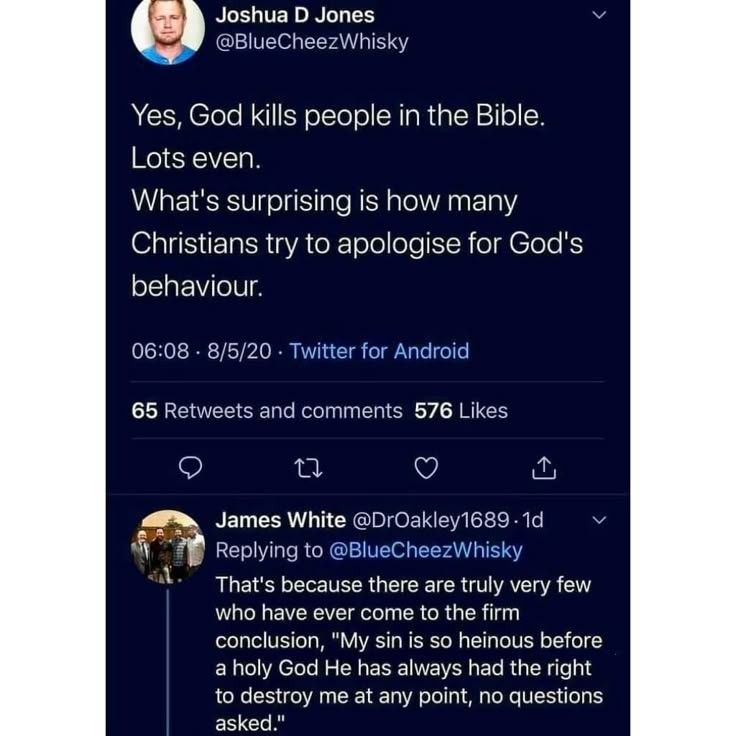
A couple weeks ago, I came across a post on Pinterest that I can’t stop thinking about. It was a screenshot of a Twitter exchange from 2020 between Joshua D. Jones and James White. Jones’s original post talks about how it’s surprising that so many Christians try to apologize for the fact that God kills people in the Bible. The part that struck me, though, was White’s reply. He said, “That’s because there are truly very few who have ever come to the firm conclusion, ‘My sin is so heinous before a holy God He has always had the right to destroy me at any point, no questions asked.’”
Quick disclaimer: I don’t know anything about Jones and very little about White (though I do recognize the name). I’m not necessarily endorsing either of them, but this particular exchange has given me a lot to think about and I want to spend some time on the topic today.
The Sovereignty of God
When we read about cities, people groups, and individuals in the Bible that God chose to wipe out, we often wonder how He could be so cruel. But as I ponder this James White quote and some of the news stories I’ve read in the past few weeks about horrible things that people do to each other, I think that’s the wrong perspective. We shouldn’t be shocked when God kills people; we should marvel at His incredible mercy for not killing more of us.
This mental shift still doesn’t entirely make me comfortable with some of the stories in the Bible. There are many times when God instructed His people to slaughter all the inhabitants of a city, including children and infants. The thought makes me feel ill. I know, though, that God has a different perspective on death than we do and that those people will be resurrected in the future. I also know, and this is aligned with White’s point, that God is sovereign. He has the right to give or take life (Job 1:21; John 10:17-18), the right to issue legal judgements, and the authority to carry out those judgments in line with His righteous Law (Ps. 7:10-12; 9:7-8; Lam. 1:18; Ezekiel 18). My feelings about it don’t change the fact that God has the right to decide who lives and dies or that He can order their deaths, then bring them back to life another time.
Faith often involves trusting God even when we don’t understand what He is doing. Usually, we talk about that on a personal level. We know we need to trust God even though we don’t know why some people are battling cancer, some are struggling to get out of poverty, and some are mourning loved ones who died young. It’s not easy to accept, but Christians talk about these sorts of things and encourage each other. Sometimes, we also talk about needing to trust Him with big-picture stuff. Usually, that’s in the context of trusting God while things in the world get worse and worse. But we don’t often talk about the times when it seems like God is the one that caused something bad because it’s harder for us to rationalize. I say “seems to” because no matter what we might think from our limited human perspectives, God is always good. It is hard to accept that His judgement is just as much motivated by goodness as His mercy is, but scripture indicates that is true even when we don’t understand how.
The Gravity of My Sin
Going back to the Twitter post that motivated this article, one of the things I was struck by is how personal White makes his statement. He said people are surprised by God killing people “because there are truly very few who have ever come to the firm conclusion, ‘My sin is so heinous before a holy God He has always had the right to destroy me at any point, no questions asked.’” White doesn’t say that people don’t realize that others’ sins are bad enough for God to kill them. He reminds us that all of us have sinned and that means God has the right to destroy any one of us at any point.
We spend so much time focused on God’s grace and mercy (as we rightly should) that we sometimes forget why we need grace and mercy in the first place. It might slip our minds that we’re included when Paul says “all have sinned and fall short of the glory of God,” that “you once presented your members as slaves to impurity and lawlessness leading to more lawlessness,” and that “the payoff of sin is death” (Rom. 3:23; 6:19, 23, NET). God has the right to execute us for our sins. He told humanity that from the beginning: if we follow Him we’ll live, but if we sin even once we’ll die.
Thankfully, that’s not the end of the story. Those verses I just quoted from Romans are interspersed with the Good News: “they are justified freely by his grace through the redemption that is in Christ Jesus” and “now, freed from sin and enslaved to God, you have your benefit leading to sanctification, and the end is eternal life” (Rom. 3:24; 6:22, NET). We don’t have to die for our sins because Jesus died in our place. We need to hold the truth of the severity of sin and the incredible grace of God in our minds at the same time, lest we despise the Lord’s grace, forget what He has done, and become unrepentant sinners again (1 Cor. 6:9-11; 2 Pet. 1:3-11). Note that I said “unrepentant sinners.” God knows we’re not perfect, and Jesus continues to wash us clean when we repent after missing the mark. The danger comes when we decide our sins are no big deal and we can live however we like without bothering to obey God.
For if we deliberately keep on sinning after receiving the knowledge of the truth, no further sacrifice for sins is left for us, but only a certain fearful expectation of judgment and a fury of fire that will consume God’s enemies. … For we know the one who said, “Vengeance is mine, I will repay,” and again, “The Lord will judge his people.” It is a terrifying thing to fall into the hands of the living God. …
But we are not among those who shrink back and thus perish, but are among those who have faith and preserve their souls.
Hebrews 10:26-27, 30-31, 39 NET (bold italics mark quotations from Deut. 32:35-36)
The Fear of the Lord
As I write this post, it reminds me of a line from a Christian song: “I think I made you too small. I never fear you at all” (Addison Road, 2008, “What Do I Know of Holy?”). Over and over, we hear that “fear the Lord” in the Bible really means to respect God. And that is true, but the Hebrew word used in all those verses in Proverbs is yare, and it has five main meanings (Theological Wordbook of the Old Testament, entry 907). Those meanings include “the emotion of fear” as well as “reverence or awe.” It can also be synonymous with “righteous living,” possibly because of ancient people seeing “fear,” in either the terror or awe sense, “as the motivation which produced righteous living” (TWOT). Our respect should include the knowledge that God can be terrifying to the unrighteous. “With the Lord as the object,” the word yare “captures the tension of shrinking back in fear and drawing close in awe and adoration” (NET translation note on Prov. 1:7).
The beginning of wisdom is to fear the Lord,
and acknowledging the Holy One is understanding. …Fearing the Lord prolongs life,
Proverbs 9:10; 10:27, NET
but the life span of the wicked will be shortened.
Sometimes, we might think we have God figured out. We might think that He is safe, predictable, or fits into a box. But when we underestimate Him or limit our right and proper fear of Him, we risk falling into the condemnation of ancient Israel when they decided it was okay to offer lesser sacrifices, described serving the Lord as a tiresome burden, and said things that God made holy are common. Then, they had the nerve to be surprised when God said they dishonored His name (Mal. 1:6-14).
God doesn’t mind us asking questions. He doesn’t condemn us for wrestling with doubts. He doesn’t berate us when we don’t understand something. But if we approach questions like, “Why does God kill people in the Bible?” and then come away with the conclusion that God must have been wrong, then it’s a problem. He is not okay with it when we decide we know better than He does. In essence, it’s committing idolatry as we put ourselves before God. Right and proper fear of God–not our own human reasoning–is the foundation for discernment, wisdom, and understanding. We need to remember that God’s ways and thoughts are higher than ours (Is. 55:8-9), that He sees and understands things we don’t even know about, and that our feelings about His actions don’t change the essential rightness of everything He does.
It requires humility to truly acknowledge the Lord is righteous while we are wicked, but that is the truth of the matter (Dan. 9:4-5). We shouldn’t be shocked when God decided that people groups or individuals had to die for their wickedness. It should impress us with fear, awe, and reverence for Him, much the same as Ananias and Sapphira’s deaths did to the fledgling New Testament church (Acts 5:1-11). It can also make us think of God’s mercy towards wicked people that He does not kill and affords an opportunity for repentance; we have all benefited from that and humanity continues to do so today (2 Pet. 3:8-9). And for those who did die in those Bible stories that make us uncomfortable, we can remember that God has a different perspective on death than we do and that He will bring everyone back to life in one of the resurrections after Jesus’s return (see “Rethinking Heaven” and “Rethinking Hell”). He has a plan, and it’s a good plan that we can trust even when we are uncomfortable and lack full understanding.
Featured image by Jantanee from Lightstock

Song Recommendation: “What Do I Know Of Holy” by Addison Road


Leave a Reply