
I’m a pretty fast reader. For reference, Goodreads tells me I’ve read 47 books so far this year. This is great when I’m in school or if I want to hit reading goals for the year or I need to quickly gather information. But it’s not all that helpful in Bible study. When we’re pondering the Bible, it helps to slow down and read carefully. This is a book for close reading, not for skimming.
My women’s scripture writing group at church started the topic “Spiritual Gifts” for July. I don’t have that list posted (we take turns compiling scripture lists and that one isn’t mine), but you can click here to download similar lists. For “Spiritual Gifts,” the first 12 days of the month are verses from 1 Corinthians, most from chapter 12 and a few in 13 and 14. As I started writing them this week, it forced me to slow down and I noticed some things I hadn’t before. Today, I’d like to take a deep-reading stroll through this chapter together.
Background for Discussing Gifts
With regard to spiritual gifts, brothers and sisters, I do not want you to be uninformed. You know that when you were pagans you were often led astray by speechless idols, however you were led. So I want you to understand that no one speaking by the Spirit of God says, “Jesus is cursed,” and no one can say, “Jesus is Lord,” except by the Holy Spirit.
1 Corinthians 12:1-3, NET
Why does Paul introduce the spiritual gifts section by talking about idols? It seems off topic, yet what he’s giving us is a way to tell if someone is “speaking by the spirit of God.” This is very relevant to discussing gifts fueled by God’s spirit. We’ll come back to this point in a moment, but Paul has some more groundwork to lay first.
Now there are different gifts, but the same Spirit. And there are different ministries, but the same Lord. And there are different results, but the same God who produces all of them in everyone.
1 Corinthians 12:4-6, NET
The Corinthian church had an issue with people breaking into factions (1 Cor. 1:10-13; 11:18), and Paul continues to address that here. He doesn’t want them to make the mistake of thinking that the different gifts and ministries provide a reason for dividing the church or devaluing certain people. Before informing them about spiritual gifts, he contextualizes it by sharing how to identify someone the holy spirit is working in (they acknowledge Jesus as Lord) and with a reminder that unity is important to God. The Lord works with different people differently, but that’s so they can all benefit the church body as a whole.
To each person the manifestation of the Spirit is given for the benefit of all.
1 Corinthians 12:7, NET
Here’s the final piece of foundational information for discussing spiritual gifts. God gives these spiritual gifts to each individual for the benefit of all. Also, remember that this is the letter where Paul says twice that you (plural) are the temple (singular) of God (1 Cor. 3:16-17; 6:19-20). He really wants to make sure his readers understand that God is building a unified church led by Jesus Christ (with many groups scattered around the world, all acknowledging Jesus as Head), not a bunch of little churches headed by Paul, or Apollos, or Peter, or any other human being.
Examining the Gifts
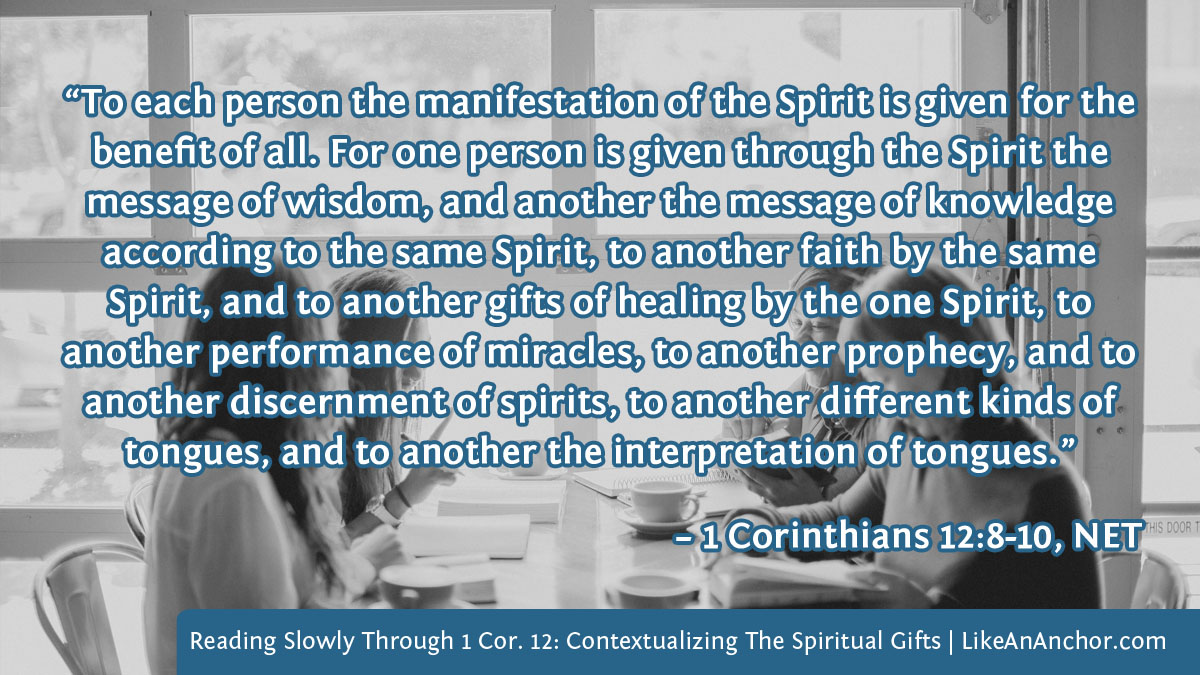
1 Corinthians 12:8-10 is one of a few different passages in the Bible that lists spiritual gifts. In Romans, Paul talks about the gifts of prophecy, service, teaching, exhortation, contributing, leadership, and mercy (Rom. 12:6-8). In Ephesians, he focuses on roles God gave in the church and talks about apostles, prophets, evangelists, pastors, and teachers (Eph. 4:7-13). Peter talks about love, hospitality, speaking, and service in relation to gifts (1 Pet. 4:8-11). Each list is a bit different. We’ll just focus on the one in 1 Corinthians today.
For one person is given through the Spirit the message of wisdom, and another the message of knowledge according to the same Spirit
1 Corinthians 12:8, NET
Let’s think back to the opening line about idols and understanding. Remember, Paul said, “I want you to understand that no one speaking by the Spirit of God says, ‘Jesus is cursed,’ and no one can say, ‘Jesus is Lord,’ except by the Holy Spirit.” This is particularly important to keep in mind for the spiritual gifts that also have non-spiritual counterparts.
Wisdom (G4678, sophia, intelligence, skill, expert knowledge) and knowledge (G1108, gnosis, knowledge and general intelligence) aren’t words exclusively related to Christianity. People can seem wise or knowledgeable without really having the type of true, divine wisdom and knowledge that comes from God (as Paul has already addressed in 1 Cor. 1-2). Given how much emphasis Paul put on the difference between human and divine knowledge at the beginning of this letter, I think he wants to make sure we don’t mistake human intelligence for the spiritual gifts of wisdom and knowledge. No matter how smart something sounds, if it doesn’t line up with truth then it isn’t the message (G3056, logos, word, intelligent speech) of wisdom or knowledge.
to another faith by the same Spirit, and to another gifts of healing by the one Spirit, to another performance of miracles, to another prophecy, and to another discernment of spirits, to another different kinds of tongues, and to another the interpretation of tongues.
1 Corinthians 12:9-10, NET
Seeing “faith” on a list of spiritual gifts puzzles me, kind of like seeing “mercy” and “service” on lists in Romans and 1 Peter. Those are attributes that all Christians are supposed to have. It is impossible to please God without faith (Heb. 11:6), so it’s something every one of His followers needs and which we all can have. This makes me wonder if some of the spiritual gifts have “levels” of sorts. Maybe we all have faith but perhaps some have a gift of super-abundant faith. And perhaps many of us–or maybe even all of us–have the potential to prophecy or heal or discern spirits, but some have that talent as a gift and are more likely to do so regularly.
Paul even says that we can pursue specific gifts and advises that we ask God for prophecy, which in this case means speaking “to people for their strengthening, encouragement, and consolation” (1 Cor 14:1-5). This seems to indicate that people can have multiple spiritual gifts and that we can ask God for more gifts, though of course we also need to accept that He’s the one who chooses which gift(s) will be best for each person.
Reiterating Unity

After listing some spiritual gifts, Paul returns to the topic of unity in the body. This point is integral for understanding how to use the gifts God has given us and how to perceive the gifts God gives other people.
It is one and the same Spirit, distributing as he decides to each person, who produces all these things. For just as the body is one and yet has many members, and all the members of the body—though many—are one body, so too is Christ. For in one Spirit we were all baptized into one body. Whether Jews or Greeks or slaves or free, we were all made to drink of the one Spirit. For in fact the body is not a single member, but many.
1 Corinthians 12:11-14, NET
Paul elaborates on this analogy by pointing out how silly it would be for one part of the human body to say it isn’t really part of the body, or for a part like an eye to tell another part, like a hand, that there’s no need for it (1 Cor. 12:15-26, NET). It’s the same level of ridiculousness if one person thinks, “Because I have this gift I understand more than everyone else so I’m leaving,” or if another were to say, “I don’t like people with this gift or role, so they shouldn’t be here in my church.”
Now you are Christ’s body, and each of you is a member of it. And God has placed in the church first apostles, second prophets, third teachers, then miracles, gifts of healing, helps, gifts of leadership, different kinds of tongues. Not all are apostles, are they? Not all are prophets, are they? Not all are teachers, are they? Not all perform miracles, do they? Not all have gifts of healing, do they? Not all speak in tongues, do they? Not all interpret, do they? But you should be eager for the greater gifts.
And now I will show you a way that is beyond comparison. If I speak in the tongues of men and of angels, but I do not have love, I am a noisy gong or a clanging cymbal. And if I have prophecy, and know all mysteries and all knowledge, and if I have all faith so that I can remove mountains, but do not have love, I am nothing. If I give away everything I own, and if I give over my body in order to boast, but do not have love, I receive no benefit.
1 Corinthians 12:27-13:3, NET
We talked about this “way that is beyond comparison” a couple weeks ago in my post “The Necessity of Godly Conflict Resolution and Forgiveness.” Wanting spiritual gifts is good because when they’re used rightly, they benefit the entire church body. But unless love is guiding our actions, all the good things we do and all the gifts we might have are empty.
When we think of spiritual gifts, we often focus on figuring out which gift we have or how we can use our gifts. As we do that, though, we need to keep in mind the other points Paul makes to contextualize the right desire for such gifts. We need to remember that gifts are given to strengthen the whole body. They’re given to individuals so that we can contribute to God’s church. And the gifts aren’t the only important thing. They’re not even the most important. Love–which in today’s world is often seen as simple or weak and not nearly as important as something like knowledge or power–is actually the most important thing for followers of God to have inside them and display in their lives. Agape-love for God and others is the foundation for using God’s spiritual gifts properly “for the benefit of all.”
Featured image by Inbetween from Lightstock

Song Recommendation: “Come Alive (Dry Bones)” by Lauren Daigle

 Like An Anchor