Should We Find Our Identities in Christ?

Sometimes, as Christians, we hear and use phrases that sound good but aren’t actually in the Bible. Many common Christian phrases like “What would Jesus do?” are inspired by scriptures, but aren’t actually a quote from anywhere in the Bible. For phrases like this, we need to make sure that we’re not just using them because they sound good. We need to check if they’re actually backed up by the Bible. Sometimes they’re accurate according to scripture, and sometimes they’re not.

We talked about one example earlier this year: “Spare the rod, spoil the child.” This sounds like something from Proverbs, but it’s really from a 17th-century poem by Samuel Butler. In this case, the popular phrase distorts the meaning of similar (though not identical) Bible scriptures.

Another common phrase in modern Christianity is “find your identity in God” or “find our identity in Christ.” There is no scripture that tells us to do this exact thing; it’s not a quote from the Bible. That doesn’t necessarily make it inaccurate, but it does mean we need to check it out carefully and examine the underlying assumptions.

Based on the tagline for this blog (“Finding our true selves in the people God created us to be”), you can probably guess that I think finding our identity in God is a solid Biblical idea. But it is good to remain open to questioning our assumptions and being corrected by the Bible, particularly for topics like this where it’s not a quote from scripture. It’s good for us to study to prove whether our assumptions are right or wrong.

Image of people standing in a circle, holding hands to pray, overlaid with text from Genesis 1:27, NET version: “God created humankind in his own image, in the image of God he created them, male and female he created them.”
Image by Matt Vasquez from Lightstock

What Does It Mean?

When someone says you should “find your identity in Christ,” what do they mean? Answering this question is a first-step toward checking if the phrase lines-up with scripture.

The word “identity” in this context means “the fact of being who or what a person or thing is” and “the characteristics determining who or what a person or thing is” (Google/Oxford Languages definition). It’s about who you are and who you or others think you are. In today’s world, it’s become increasingly common to talk about how we identify ourselves. We’re told we can fill in the blank in, “I identify as …” however we want. People today want to determine their own identities.

In a Christian context, the phrase “find your identity in Christ” generally means a couple similar things. It means we should let God define who we are rather than listening to our own “I am” or the world’s “you are” statements. In other words, we believe what He says about us is true even (especially) when it contradicts what we might say about ourselves or what others say about us.

It can also mean becoming more and more like Jesus until His identity becomes our own. If identity is “who or what a person” is and “the characteristics determining” who they are, then having the same identity as Christ is just another way of saying we should become like Him. For the purposes of this post, we’ll operate on the assumption that “find your identity in Christ/God” means 1) believe the things God says about who you are, and 2) become like Jesus Christ. As we’ll see, both of those ideas do show up in the Bible.
Image of two hands, palms up, overlaid with text from Matt. 5:13, 14, NET version: "You are the salt of the earth. ... You are the light of the world."
Image by Who Is Like The Lord from Lightstock

What God Says About You

I’ve written about this topic before, but it’s worth revisiting in today’s context. There are many places in the Bible where God makes “you are” statements to His people or where God’s people make “I am” statements that we can identify with. From scripture, we know that we are (collectively) the temple of God (1 Cor. 3:16-17; 2 Cor. 6:16-18) and we belong to Him (1 Cor. 6:19-21). God also describes us as people worth dying for (Rom. 5:8), as salt and light in this earth (Matt. 5:13-14), as called and chosen (1 Pet. 2:9), and as friends and siblings of Jesus Christ (John 15:14, Rom. 8:16-17). We are greatly loved and highly valued by both the Father and the Son (John 3:16; 15:13-14).

We can also look at examples of how God interacted with specific people to see how He encouraged them to redefine how they see themselves to line-up with how He saw them. Let’s consider Moses for a moment. When God appeared to him in the burning bush, He called Moses to free his people from slavery in Egypt. Moses did not think he was qualified (Exodus 4:1-17). He protested, “they will not believe me, nor listen to my voice” and “I am not eloquent … for I am slow of speech, and of a slow tongue” (Ex. 4:1, 10, WEB)).” God answered both these protests; He could make Moses believable and give him the ability to speak. God did agree to make Aaron Moses’s spokesperson, but with God’s help Moses eventually grew to the point that he could speak on his own (all of Deuteronomy, for example, is an address from Moses to God’s people). God knew who Moses could be, and He helped Him get there. God did a similar thing for Jeremiah.

The Lord’s message came to me,
“Before I formed you in your mother’s womb I chose you.
Before you were born I set you apart.
I appointed you to be a prophet to the nations.” 

I answered, “Oh, Sovereign Lord, Really I do not know how to speak well enough for that, for I am too young.” The Lord said to me, “Do not say, ‘I am too young.’ But go to whomever I send you and say whatever I tell you. Do not be afraid of those to whom I send you, for I will be with you to protect you,” says the Lord. Then the Lord reached out his hand and touched my mouth and said to me, “I will most assuredly give you the words you are to speak for me. Know for certain that I hereby give you the authority to announce to nations and kingdoms that they will be uprooted and torn down, destroyed and demolished, rebuilt and firmly planted.”

Jeremiah 1:4-10, NET

In terms related to our topic today, Jeremiah didn’t identify as a prophet. He identified as a poor speaker too young for the Lord’s important work. But God had a different identity for him that was backed-up by God’s protection and power. Later, God offered even more reassurance, saying, “I, the Lord, hereby promise to make you as strong as a fortified city, an iron pillar, and a bronze wall. You will be able to stand up against all who live in the land” (Jer. 1:18, NET). Like many of us today, Jeremiah probably wouldn’t have described himself as a strong person, but with God’s help he became someone who can stand against any foe (as we can today with God’s armor [Eph. 6:10-18]).
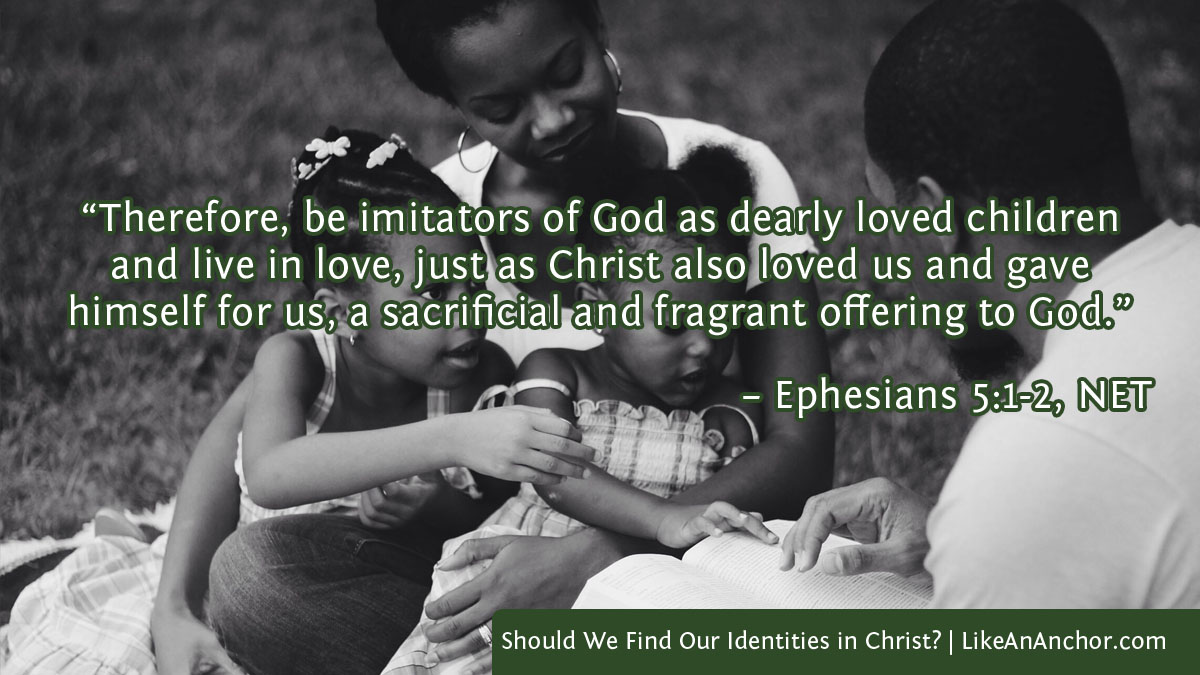
Image of a couple reading the Bible to their two daughters overlaid with text from Eph. 5:1-2, NET version: “Therefore, be imitators of God as dearly loved children and live in love, just as Christ also loved us and gave himself for us, a sacrificial and fragrant offering to God.”
Image by Marcus from Lightstock

Becoming Like Jesus Christ

Jesus is our model for living a Christian life. If we say we have a relationship with Him and His Father, then we ought “to walk just as Jesus walked” (1 John 2:6, NET). He left “an example for you to follow in his steps” (1 Pet. 2:21, NET; see also John 13:14-15). Over and over, New Testament writers point to Jesus as the one we’re supposed to be like. We “walk in love, even as Christ also loved us” (Eph. 5:2, WEB), we’re told to “please his neighbor for his good to build him up” because that’s what Christ did (Rom. 15:1-3, NET), and “have the same attitude toward one another that Christ Jesus had” (Phil. 2:5, NET).

One of the goals of our Christian walk is to become like Jesus, inside and out. When Paul wrote to the Corinthians about how we understand the things of God because God’s spirit is inside us, he also said “we have the mind of Christ” (1 Cor. 2:16, NET). In the same passage, he talks about those who are “mature” (1 Cor. 2:6) and those who are “infants in Christ” (1 Cor. 3:1, NET). I think the implication here is that the more mature we are as Christians, the more we understand the things of God and have the mind of Christ (see also Heb. 5:11-6:3). Becoming like God is our goal.

(See what sort of love the Father has given to us: that we should be called God’s children—and indeed we are! For this reason the world does not know us: because it did not know him. Dear friends, we are God’s children now, and what we will be has not yet been revealed. We know that whenever it is revealed we will be like him, because we will see him just as he is. And everyone who has this hope focused on him purifies himself, just as Jesus is pure).

1 John 3:1-3, NET

Much of what we are told to do as God’s followers is “so that you may be like your Father in heaven” (Matt. 5:45, NET; see Matt. 5:43-48). He is making us fully part of His family, to the point that “we will be like him” in the future. When we have that hope of eternal life with God as His family members, the natural and necessary response is to work on making ourselves like God the Father and Jesus Christ.

A Higher Identity

Being part of God’s family is an identity that is higher, better, and far more important than our other identities. Paul is a great example of someone who had an “identity” that most people of his time would envy, but he gave it up so that he could identify with Christ.

If someone thinks he has good reasons to put confidence in human credentials, I have more: I was circumcised on the eighth day, from the people of Israel and the tribe of Benjamin, a Hebrew of Hebrews. I lived according to the law as a Pharisee. In my zeal for God I persecuted the church. According to the righteousness stipulated in the law I was blameless. But these assets I have come to regard as liabilities because of Christ. More than that, I now regard all things as liabilities compared to the far greater value of knowing Christ Jesus my Lord, for whom I have suffered the loss of all things—indeed, I regard them as dung!—that I may gain Christ, and be found in him, not because I have my own righteousness derived from the law, but because I have the righteousness that comes by way of Christ’s faithfulness—a righteousness from God that is in fact based on Christ’s faithfulness. My aim is to know him, to experience the power of his resurrection, to share in his sufferings, and to be like him in his death, and so, somehow, to attain to the resurrection from the dead.

Philippians 3:4-11, NET

Paul didn’t stop being an Israelite, Benjamite, or highly-educated Pharisee when he started following Jesus. Those identities just didn’t matter nearly as much anymore. Similarly, I don’t stop being a wife, mother, American, red-head, or someone with a master’s degree when I follow Jesus, but those identities aren’t nearly as important as my primary identity as a Christian. Being Christian makes me a better wife and mother, putting both of those roles in a new perspective. My citizenship in heaven (Phil. 3:20) supersedes my identity as an American. My visible/ethnic identities like red-head and white take a back seat to knowing I’m a child of God, part of one human race He created (Acts 17:26-28). My education becomes something that’s not worth boasting about because knowing God is so much more important (Jer. 9:23-34; 1 Cor. 1:26-31).

There isn’t a Bible verse telling us to find our identities in Jesus, but the phrase does reflect solidly Biblical ideas: believe what God says about who you are and become like Jesus Christ. Believing God is a first-step of faith (Heb. 11:6), and that includes believing the things He says about us and about the future He has planned for us as His family members. As we grow in our relationships with God and follow the example of Jesus Christ, we’re supposed to become more and more like Him. Just like Moses, Jeremiah, Paul, and other faithful men and woman throughout the ages, we should find our primary identity–the fact of our being and the characteristics of who we are–in God.


Featured image by Respostas com Você from Pixabay

Song Recommendation: “You Say” by Lauren Daigle

Learning from the Context of John 3:16

We all know John 3:16. Even non-Christians know this verse. It’s displayed and quoted perhaps more than any other part of the Bible.

But do you know where it is, contextually? I’m fairly good at remembering where scriptures are, but it’s easy to get your memories mixed up and if I’d had to guess, I might have said it’s in one of Jesus’s many addresses to crowds of people. It’s actually part of his answer to a question Nicodemus asked when he came to Jesus privately, at night after the crowds were gone.

Knowing the context doesn’t change the profound truth that “God so loved the world, that he gave his one and only Son, that whoever believes in him should not perish, but have eternal life” (John 3:16, WEB). But it does enhance our understanding of Jesus’s point if we know what else Jesus said when He made this statement.

Image of a man reading the Bible overlaid with text from John 3:1-3, NET version: Now a certain man, a Pharisee named Nicodemus, who was a member of the Jewish ruling council, came to Jesus at night and said to him, “Rabbi, we know that you are a teacher who has come from God. For no one could perform the miraculous signs that you do unless God is with him.” Jesus replied, “I tell you the solemn truth, unless a person is born from above, he cannot see the kingdom of God.”
Image by Inbetween from Lightstock

Setting the Stage

Unlike other gospel writers, John begins not with Jesus’s human birth but with pre-Creation. He establishes Jesus’s divinity before anything else (John 1:1-18), then goes into John the Baptist’s testimony about Jesus (John 1:19-26), and the first disciples gathering to Jesus (John 1:27-51). Then he records Jesus’s first miracle (John 2:1-11), then the first Passover during Jesus’s ministry, when He cleared those buying and selling out of the temple and began attracting attention from the religious leaders (John 2:12-25). Then, while Jesus is in Jerusalem for Passover, we come to the conversation we’re studying today.

Now a certain man, a Pharisee named Nicodemus, who was a member of the Jewish ruling council, came to Jesus at night and said to him, “Rabbi, we know that you are a teacher who has come from God. For no one could perform the miraculous signs that you do unless God is with him.” Jesus replied, “I tell you the solemn truth, unless a person is born from above, he cannot see the kingdom of God.” Nicodemus said to him, “How can a man be born when he is old? He cannot enter his mother’s womb and be born a second time, can he?”

John 3:1-4, NET

We learn several things about Nicodemus in this introduction. First, he was a Pharisee, a member of an influential religious and political group whose members “were strict and zealous adherents to the laws of the OT and to numerous additional traditions” (NET footnote on John 1:24). In addition, he was “a member of the Sanhedrin, the highest legal, legislative, and judicial body among the Jews” (NET footnote on John 3:1). He was an expert in the scriptures and how to interpret them. It was enough to recognize Jesus as a teacher sent by God, based on the miracles He performed, and to prompt him to come to speak with Jesus privately to learn more. I have to wonder if he might have suspected Jesus to be the Messiah, but came privately because he didn’t want others to know what he was thinking.

As is often the case, Jesus jumped right in with a statement that doesn’t seem like a logical reply to the other person’s remark, but which starts the conversation that they need to have with Him. In this case, one of the words He uses has a double meaning in Greek. When Jesus says, “unless a person is born from above,” the word translated “from above” (anōthen) can also mean “again” (NET footnote on John 3:3). Nicodemus seems to assume Jesus meant the second meaning, since he asks if a man can be born from his mother a second time.

Jesus answered, “I tell you the solemn truth, unless a person is born of water and spirit, he cannot enter the kingdom of God. What is born of the flesh is flesh, and what is born of the Spirit is spirit. Do not be amazed that I said to you, ‘You must all be born from above.’ The wind blows wherever it will, and you hear the sound it makes, but do not know where it comes from and where it is going. So it is with everyone who is born of the Spirit.”

Nicodemus replied, “How can these things be?” Jesus answered, “Are you the teacher of Israel and yet you don’t understand these things?”

John 3:5-10, NET

I often marvel at how much people in New Testament times knew based just on reading the Old Testament. I’m not sure if I could have read those scriptures and realized what signs to look for to recognize the promised Messiah (of course, the main thing it would have depended on is if God decided to open my eyes). But here, Jesus is marveling at the fact that Nicodemus was a “teacher of Israel” and didn’t understand that someone would need to be born of the spirit. He should have known this already, at least in part, just like he should have been able to recognize from the law, prophets, and psalms that Jesus is the promised Messiah (Luke 24:44; John 5:39). Jesus doesn’t hold Nicodemus’s lack of knowledge against him, though. He continues the conversation and reveals more of God’s amazing plan.

Image of a man sitting in a pew and praying overlaid with text from John 3:16-18, NET version:  “For this is the way God loved the world: He gave his one and only Son, so that everyone who believes in him will not perish but have eternal life. For God did not send his Son into the world to condemn the world, but that the world should be saved through him. The one who believes in him is not condemned. The one who does not believe has been condemned already, because he has not believed in the name of the one and only Son of God.”
Image by Shaun Menary from Lightstock

Earthly and Heavenly Things,

Jesus answered, “Are you the teacher of Israel and yet you don’t understand these things? I tell you the solemn truth, we speak about what we know and testify about what we have seen, but you people do not accept our testimony. If I have told you people about earthly things and you don’t believe, how will you believe if I tell you about heavenly things? No one has ascended into heaven except the one who descended from heaven—the Son of Man. Just as Moses lifted up the serpent in the wilderness, so must the Son of Man be lifted up, so that everyone who believes in him may have eternal life.”

John 3:10-15, NET (italics mark an allusion to Num 21:5-9)

I find this part a little confusing. When Jesus said, “we speak,” who is “we”? I’m not sure if He’s referring to Him and His disciples or to Him and His Father. And what did He mean, “I have told you people about earthly things and you don’t believe?” Their conversation up to this point is about spiritual rebirth and resurrection, but is that an earthly thing? Or is He referring to something that happened earlier during Passover, like rebuking people for making the temple a marketplace?

We’re not the first to ask these questions. The NET translators have an extensive footnote on John 3:12. They suggest that, since it’s most logical to assume Jesus is speaking of what He just told Nicodemus, that “earthly things are not necessarily strictly physical things, but are so called because they take place on earth, in contrast to things like v. 16, which take place in heaven.” This would make “the necessity of a regenerating work from above, by the Holy Spirit” an “earthly thing,” but God’s love motivating His plans a “heavenly thing.”

Maybe we could think about it like this: the “earthly things” are related to what God is doing here on earth. Being “born of water and spirit” sounds like something that begins with baptism. The process of being born into God’s family as spirit beings starts now, during the physical lives of those who commit to following Him. It’s a process initiated by something God in heaven chose to do, a “heavenly thing” that’s described in the next part of this conversation.

 “For this is the way God loved the world: He gave his one and only Son, so that everyone who believes in him will not perish but have eternal life. For God did not send his Son into the world to condemn the world, but that the world should be saved through him. The one who believes in him is not condemned. The one who does not believe has been condemned already, because he has not believed in the name of the one and only Son of God.”

John 3:16-18, NET

We don’t have record of Nicodemus saying anything after verse 9, but I have to wonder what he was thinking at this point. Was he struck with awe at the revelation that God had sent His own Son to earth as the promised Messiah? Did he understand what Jesus was telling him here? Or did he walk away confused, unsure what it meant for God to give His son to save the world? We don’t know, but he does speak up for Jesus when other Pharisees tried to arrest Him (John 7:45-52) and he helped Joseph of Arimathea bury Jesus after His crucifixion (John 19:38-40). It seems logical to assume Nicodemus became one of Jesus’s disciples, though perhaps not very openly.

Life in the Son

Image of an open Bible with sunlight shining on it, overlaid with blog's title text and the words, "Knowing the context doesn't change the profound truth of John 3:16, but it does enhance our understanding of Jesus's point if we know what else He said when He made this statement."
Image by Lamppost Collective from Lightstock

We’re here to look at John 3:16, one of the most famous Bible verses. It shows up near the middle of Jesus’s conversation with Nicodemus. We’ve already looked at the lead-up to this verse and the discussion of being born from above/again. Now, let’s look at how Jesus concludes this discussion.

 “For this is the way God loved the world: He gave his one and only Son, so that everyone who believes in him will not perish but have eternal life. For God did not send his Son into the world to condemn the world, but that the world should be saved through him. The one who believes in him is not condemned. The one who does not believe has been condemned already, because he has not believed in the name of the one and only Son of God. Now this is the basis for judging: that the light has come into the world and people loved the darkness rather than the light, because their deeds were evil. For everyone who does evil deeds hates the light and does not come to the light, so that their deeds will not be exposed. But the one who practices the truth comes to the light, so that it may be plainly evident that his deeds have been done in God.”

John 3:16-21, NET

It might seem a little weird to read about judgement and condemnation right after reading that Jesus came to save the world. But it really does fit very neatly into a whole-Bible understanding of the plan of God. When people choose sin (as all do [Rom. 3:23]) the natural consequences of that is death (Deut. 30:15-19; Rom. 5:12-15; 6:23). God’s justice and righteousness specifies that there is a consequence for sins. He also has the right to judge His creation. Now that the Light has come into the world, it is time for people to repent and change before the judgment (Acts 17:30-31).

When God judges, He doesn’t want to condemn. That’s one possible outcome, but that’s not His goal. God loves (agape) everyone and wants them to come to repentance, receive salvation, and gain eternal life (1 Tim. 2:1-4; 2 Pet. 3:8-9). That is made possible through Jesus and because of His and the Father’s love: “for God so loved the world, that he gave his one and only Son, that whoever believes in him should not perish, but have eternal life” (John 3:16, WEB). This incredible truth ought to prompt us to believe in Jesus, practice the truth, and come to the light to walk with our God.


Featured image by Pearl from Lightstock

We Need To Watch Our Words

In the aftermath of another polarizing United States election, I think it’s a good time to revisit the topic of how God’s people should use language, especially when speaking about other people. Even though most of us in the U.S. agree) that there aren’t any really good politicians we could vote for, we often have very strong opinions about which is the “lesser of two evils” and equally strong opinions about people who come to a different conclusion than we ourselves did. These other people are very likely in a similar position to us, not agreeing 100% with either candidate but coming to a different conclusion about which option is a little better.

There’s a temptation to mock, belittle, and despise others who vote differently than us or have different viewpoints (whether or not they chose to vote). But when we stand before Christ, we will answer for every idle or worthless word we speak (Matt. 12:36), the times we judged, despised and condemned other people (Matt. 5:22; Rom. 14:10), and our coarse jesting or foolish talking (Eph. 5:4). Our thoughtless, angry words or the things we excuse by saying, “I was just joking,” might be something that God takes very seriously.

Today, we’re going to look at three key areas where we need to be careful about what we say: 1) passing judgement on others, 2) despising them or calling them foolish, and 3) coarse jesting. Finally, we’ll look at one overriding principle for how we ought to interact with other people: love.

Passing Judgement

There’s a difference between passing judgement (condemning) and making a judgement call (discernment). That’s one reason that you see seemingly contradictory scriptures like “Judge not” (Matt. 7:1) and “judge righteous judgement” (John 7:24). We must be careful not to usurp a role that God reserves for Himself as judge, and so bring harsher judgement on ourselves (Matt. 7:1-5; James 2:13).

Now receive the one who is weak in the faith, and do not have disputes over differing opinions. One person believes in eating everything, but the weak person eats only vegetables. The one who eats everything must not despise the one who does not, and the one who abstains must not judge the one who eats everything, for God has accepted him. Who are you to pass judgment on another’s servant? Before his own master he stands or falls. And he will stand, for the Lord is able to make him stand. …

But you who eat vegetables only—why do you judge your brother or sister? And you who eat everything—why do you despise your brother or sister? For we will all stand before the judgment seat of God. For it is written, “As I live, says the Lord, every knee will bow to me, and every tongue will give praise to God.” Therefore, each of us will give an account of himself to God. Therefore we must not pass judgment on one another, but rather determine never to place an obstacle or a trap before a brother or sister.

Romans 14:1-4, 10-13 NET (bold italics mark a quotation from Isa 45:23)

Here, Paul used the example of disagreements about what we should or shouldn’t eat to make a point. When you disagree with someone about an opinion, your duty as a Christian is to refrain from passing judgement or despising them. Rather, you should guard your behavior to make sure you’re not putting a stumbling block in front of them.

To be clear, this does not mean we can’t make judgement calls about sinful actions. It is love (agape) to point out a sin in a fellow Christian for the purpose of restoring someone to a right relationship with fellow believers and with God (Matt 18:15-22; 2 Tim. 2:24-26). Our goal should always be restoration rather than condemnation, even when we have to stop associating with someone because they refuse to repent (1 Cor. 5). Even when Paul ” judged the one who” committed “the kind of immorality that is not permitted even among the Gentiles” (1 Cor. 5:1-2, NET), it wasn’t to mock the sinner or call them names. We should be grieved by other’s sins and moved by love to help them reach a point of repentance. How much more, then, should we withhold condemnation when we disagree with someone on an opinion?

Despising Others

When someone disagrees with us on something we see as important, fails to see our point of view, or cannot be convinced by our arguments, the natural human response is to label them a fool. But despising someone else, particularly a “brother” (either by blood or because they’re fellow children of God), is not the way Jesus said to do things.

“You have heard that it was said to an older generation, ‘Do not murder,’ and ‘whoever murders will be subjected to judgment.’ But I say to you that anyone who is angry with a brother will be subjected to judgment. And whoever insults a brother will be brought before the council, and whoever says ‘Fool’ will be sent to fiery hell.”

Matthew 5:21-22, NET (bold italics mark a quotation from Exod 20:13Deut 5:17)

Let’s look at two of the original words used in this passage. “Whoever insults a brother” could also be translated, “whoever says to his brother ‘Raca,'” which is “an Aramaic word of contempt or abuse meaning ‘fool’ or ’empty head'” (NET footnote “b” on Matt. 5:22). The word translated “fool” is the Greek moros, which is where the English word “moron” comes from. Most scholars assume it means “you fool” but a few argue it could mean “rebel” (NET footnote “e” on Matt. 5:22). God holds His followers to a high standard of conduct, higher even than what was outlined in the Old Testament laws like “do not murder.”

Remind them to be subject to rulers and authorities, to be obedient, to be ready for every good work.  They must not slander anyone, but be peaceable, gentle, showing complete courtesy to all people. For we too were once foolish, disobedient, misled, enslaved to various passions and desires, spending our lives in evil and envy, hateful and hating one another. 

Titus 3:1-3, NET

In Paul’s letter to Titus, he instructs this pastor to remind the people he’s teaching that they need to be mindful of their speech. Specifically, “they must not slander” (“‘discredit,’ ‘damage the reputation of'” [NET translators’ note]) anyone. This verse is also translated with the instruction, “to speak evil of no one” (Tit. 3:2, WEB). When we’re considering how to talk about someone else, we must remember that if we think someone is foolish, misled, evil, or hateful that we were once like that too, and we’re not supposed to be like that anymore now that we have God’s spirit and have committed to following Him. We have to stop talking out of bitterness or malice, and remove slander and insults from our speech (Eph. 4:31-32; 1 Peter 3:9).

Coarse Jesting

Humor is such a tricky subject (as I mentioned in my newsletter earlier this week). One person might find something hilarious that another person would find offensive, repulsive, or hurtful. What people find funny varies between cultures and individuals. Because it’s so subjective, people often say that if someone is offended by our humor they just “didn’t get the joke” or they “need to lighten up.” But just because we find something funny doesn’t mean it can’t hurt someone else. All too often, people use humor to cover up the fact that they’re being mean or thoughtless. Jokes that hinge on cruelly mocking, belittling, and hurting people shouldn’t be something we find funny.

You must let no unwholesome word come out of your mouth, but only what is beneficial for the building up of the one in need, that it would give grace to those who hear. And do not grieve the Holy Spirit of God, by whom you were sealed for the day of redemption. You must put away all bitterness, anger, wrath, quarreling, and slanderous talk—indeed all malice. Instead, be kind to one another, compassionate, forgiving one another, just as God in Christ also forgave you.

Therefore, be imitators of God as dearly loved children and live in love, just as Christ also loved us and gave himself for us, a sacrificial and fragrant offering to God. But among you there must not be either sexual immorality, impurity of any kind, or greed, as these are not fitting for the saints. Neither should there be vulgar speech, foolish talk, or coarse jesting—all of which are out of character—but rather thanksgiving. For you can be confident of this one thing: that no person who is immoral, impure, or greedy (such a person is an idolater) has any inheritance in the kingdom of Christ and God.

Ephesians 4:29-5:5, NET

In this passage, Paul covers a lot of sins that are related to our speech. These include:

  • unwholesome word” (translated from sapros [G4550] and logos [G3056])– “unwholesome” refers to something that’s corrupt, rotten, putrefied, or worthless and “word” is speech or communication. Hebrews 13:5 tells us the “fruit of our lips” should praise God and acknowledge his name, but this is the opposite: disgusting, rotting, foul words.
  • vulgar speech” (translated from aischrotes [G151])–obscenity, filthiness. Comprises “improper conduct whether in action or word or even thought and intent” that brings shame when it is “exposed by the light” (Zodhiates).
  • foolish talk” (translated from morologia [G3473])–“silly talk, that is, buffoonery” (Strong). It’s from the same Greek root word as our English word “moron.” This is the “type of speech that betrays a person as foolish” (Zodhiates).
  • coarse jesting” (translated from eutrapelia [G2160])–in a bad sense, this word for “humor” includes “scurrility, ribaldry, low jesting” (Thayer). Basically, it is someone skilled at twisting their words wittily, which can be used to amuse others or to manipulate (Zodhiates).

Clearly, there are some types of humor that God would not excuse as “just a joke.” If the words we’re speaking are rotten and disgusting, improper or shameful, moronic and foolish, or twisted to amuse others with coarse or scurrilous jests, then they’re not funny–they’re sinful. And right after telling us these things are wrong, Paul warns that we “can be confident of this one thing: that no person who is immoral, impure, or greedy (such a person is an idolater) has any inheritance in the kingdom of Christ and God” (Eph. 5:5, NET). This is a very serious matter. People who misuse their words to hurt others are not going to be in God’s kingdom.

Love

Now that we’ve looked at scriptures telling us what not to do with our words, let’s turn our attention to what we ought to do instead. It’s not enough to just take the ungodly types of speech out of our conversation; we also have to put godly speech in. Thankfully, there are plenty of guidelines in the bible for how to do that.

Some of the verses we’ve already looked at include instructions on how we should talk right alongside the instructions about what not to say. In Titus, Paul said, “be peaceable, gentle, showing complete courtesy to all people” (Tit. 3:2, NET). In Ephesians, he said, “be kind to one another, compassionate, forgiving one another” (Eph. 4:32, NET). And if we keep reading in Romans 14, we come to this passage:

Therefore we must not pass judgment on one another, but rather determine never to place an obstacle or a trap before a brother or sister. … For if your brother or sister is distressed because of what you eat, you are no longer walking in love. Do not destroy by your food someone for whom Christ died. Therefore do not let what you consider good be spoken of as evil. For the kingdom of God does not consist of food and drink, but righteousness, peace, and joy in the Holy Spirit

Romans 14:13, 15-17 NET

Here, Paul continues addressing the disagreement about whether to eat meat, the principle applies to how we interact with each other through our words as well. Peace, gentleness, courtesy, kindness, compassion, forgiveness, righteousn0ess, joy–all those should be characteristics of our speech. It’s summed-up by the second greatest commandment: “You shall love your neighbor as yourself” (Matt. 22:36-40).

 “I give you a new commandment—to love one another. Just as I have loved you, you also are to love one another. Everyone will know by this that you are my disciples—if you have love for one another.”

John 15:34-35, NET

We’re supposed to love our fellow Christians so much that people observing our interactions can tell that we’re followers of Jesus Christ. And it isn’t confined just to fellow Christians: it’s for our neighbors as well (i.e. anyone we’re aware of and have any sort of interaction with). As Paul said in Romans (shortly before the passage about not judging those with different opinions), “Love does no wrong to a neighbor. Therefore love is the fulfillment of the law” (Rom. 13:10, NET). Unless we’re loving “in deed and truth” as well as in our words, we’re not Jesus’s disciples (1 John 3:18, NET; see 1 John 3:10-18; 4:20-21).

All of our words, thoughts, and actions have to be motivated by love. That’s how God is, and that’s how He wants us to be. Will we do it perfectly? Of course not, but we still need to try. We also need to study the Bible, learn what God expects from us (i.e. how to become more like Him and to walk in obedience with Him), and repent when we catch ourselves missing the mark. Ultimately, the goal is to “take every thought captive to make it obey Christ” (2 Cor. 10:5, NET) and then to speak out of the abundance of good and godly things in our hearts “for by your words you will be justified, and by your words you will be condemned”(Matt. 12:37, NET; see Matt. 12:33-37).


Featured image by Petra from Pixabay

Song Recommendation: “Speak Life” by TobyMac