Are You Ready To Find Your Weirdness?

What makes you weird?

Last week, I listened to a JP Sears podcast titled “You’re Weirder Than You Can Think,” which is all about discovering and expressing your weirdness. Now, maybe you think your weirdness is a bad/scary thing that you need to hide from others. Or maybe you think you’re normal and not weird at all. Why on earth would you want to discover and express your weirdness?

JP defines “weirdness” as the things that make you uniquely you. In other words, “weirdness” is the traits of your authentic self. It’s your personality, your quirks, your passions, your defining features, the things you love to talk about, and so much more. What makes you “weird” is what makes you “you,” and figuring out what that is can be a great step in your personal growth journey. With that framework, he challenged everyone to do a 4-step exercise:

  1. Write down three things that make you weird.
  2. Thank each of these things for making you uniquely you.
  3. Find a way to express each of those weird traits in your life today.
  4. Check-in at the end of the day to assess how you did on completing Step 3.

And then you do that each day for seven days in a row.

Journeying Into My Weirdness

I’m sharing this post on the last day of my weirdness journey. I thought for sure I’d have no problem coming up with 21 examples of my weirdness, but it was actually more challenging than I’d anticipated.

It’s not that I don’t have unique traits or perspectives. Rather, I was getting hung-up on Step 3 before I wrote anything down for Step 1. I didn’t want to write something in the first step that would end up being hard, uncomfortable, or impossible to express that day.

Of course, avoiding an aspect of my weirdness because I find it uncomfortable probably misses the point of this whole exercise. Read more

As For Me, I Will Serve The Lord: INTJ Christians

Today’s post about INTJ Christians is the fifth in a series talking with Christians of different personality types. I started this series because when I began discussing faith with different personality types, I noticed they don’t all feel equally valued and understood in Christian churches. If Christianity is a faith meant for all people (and I believe it is), then why aren’t we doing a better job of connecting with all personality types?

Our walks with God don’t all look the same. We’re influenced by our backgrounds, variations in beliefs, and individual personalities. And even though the goal is for us all to become “like God,” that doesn’t mean we become indistinguishable from each other. God created great variety in people and I believe He did that for a reason. So let’s spend today’s post hearing from and talking about the unique perspectives of INTJ Christians.

Identifying With Bible Characters

The first question I asked for this project was which Bible characters and/or stories you identify with most. INTJs tended to chose Bible Character who they felt shared their perspective on the world. Because an INTJ’s dominant function of Introverted Intuition (Ni) gives them a perspective on things that’s unique to them, I wasn’t surprised that the six INTJs who shared their stories with me each chose a different character except for two who mentioned Paul. Read more

The Importance of Accepting Correction

I think, in theory at least, we can agree that being able to accept correction is a valuable skill. We might even be able to say we appreciate feedback and constructive criticism, or modestly say that we’re big enough to acknowledge our faults and change when needed.

But even though we can learn to appreciate criticism and correction that helps us improve, hearing such things isn’t always easy. In fact, I’m not sure it ever gets “easy,” though it can become easier. Most of us have a tendency to get defensive and feel some degree of resentment when people offer a critique or dare correct us. This is especially true if we haven’t asked for feedback but they offer it anyway. Such criticism might also pull us toward depression or make us feel like giving up.

As Christians, though, we’re suppose to be open to correction. Primarily, we have a duty to listen to correction from God, which comes through His word and His spirit. Godly correction can also come through people who are guided by the Lord. This sort of correction is often harder for us to hear because we might feel like other people haven’t any right to judge us.

Correction From The Lord

Before we get back to the topic of people correcting us, let’s talk about correction from God. If anyone has a right to tell us how to live our lives, it’s the one who created us, the universe, and the Laws that govern both. When we commit to following Him, we also commit to living our lives the way He tells us to and changing when/if He points out that we’re doing something wrong. Read more

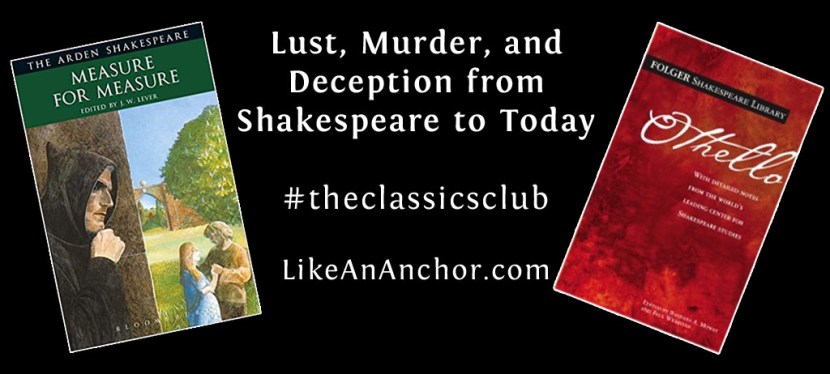
Lust, Murder, and Deception from Shakespeare to Today

I know this blog isn’t really about literature and reading, but I just finished two Shakespeare plays that I can’t resist writing about. I hope some of you will find this an interesting digression from our usual topics of Christianity, Myers-Briggs, and personal growth. And if not, don’t worry — I’ll get back to my more usual type of posts this weekend.

Four and a half years ago, I committed to reading 50 Classics in 5 years. You’d think someone who read 74 books just last year wouldn’t have any trouble doing that, but I let other books distract me too much and I have some catching-up to do before August 18 arrives. Today’s article is about two of the four Shakespeare plays on my classics club list (click here to read my thoughts on the other two).

These last two plays are The Tragedy of Othello, the Moor of Venice and Measure for Measure. On the surface they’re very different stories, but I was surprised to find they touch on the same core themes. Lust, murder, and deception lie at the center of both plays, and these topics are handled in a way that puts me in mind of things happening today in our modern society.

Read more

7 Fictional Characters That You’ll Relate to If You’re An ENTJ

What fictional characters do you relate to as an ENTJ?

Just as we can describe real people using the Myers-Briggs® typology system, we can also use the system to type well-written fictional characters. Some of fiction’s most iconic and intriguing characters are ENTJs, and today we’re going to talk about seven of them that I think real-life ENTJs will find relatable.

Another great thing about looking at character personality types is that it helps us to better understand people who have different types than we do. Fictional ENTJs can serve as examples for what real-life ENTJs might be like, and also show how much variation can exist between individuals with the same type.

Dana Scully

Lenore Thomson types Dana Scully from X-Files as an ENTJ in her book Personality Types: An Owner’s Manual. She talks about the “inspired” decision to pair INTJ Fox Mulder “not with an ESP action hero (which is the usual gambit in a science fiction series), but with an ENTJ pathologist.” Thomson further says, “Scullys’ by-the-book Judgement is consistently subverted by Mulder’s appeal to her secondary function” of Introverted Intuition (p. 233).

Many real-life ENTJs can relate to Dana Scullys’ desire for logical, objective truths. That’s what ENTJs, as dominant Extroverted Thinkers, prefer to rely on. But their Introverted Intuition is too good at seeing things from other perspectives to completely ignore an intriguing idea even when the evidence for it doesn’t line-up with established theories. This makes Scully a perfect choice to work on the X-Files because she questions everything while also thinking outside the box enough to dig for the truth rather than dismissing Mulder’s theories out-right. Read more

Are We Making The Most Of God’s Gifts?

Salvation is a free gift that we cannot earn, but which we can lose or refuse because God always gives people a choice. Adam and Eve had access to a close relationship with God, but they also had the option to choose sin and death instead. Ancient Israel was asked to choose between “life and prosperity, and death and evil,” and implored to pick life (Deut. 30:15, 19). The Lord is not willing that any should perish (1 Tim. 2:4; 2 Pet. 3:9), but He also won’t force you into His kingdom. You need to choose, and then act on your choice.

We also can’t say “I choose life” and then keep living as if we chose death. We will be judged by what we do with the gifts given to us by God, and for those in His church today this judgement has already started (1 Pet. 4:17). God is watching us now to see what we do with all the gifts He gives us.

As we think about our relationship with God and examine ourselves as Christians, we all need to ask if we’re doing what God would want us to do with the gifts He’s entrusted us with. That includes examining how we respond to salvation, how we heed and use His Spirit inside us, and whether or not we’re truly following the example of Jesus Christ.

The Parable of The Talents

Shortly before His death, Jesus told a parable that illustrates how important it is for us to do something with the gifts we’ve been given. He compares His absence from earth between His first and second coming to “a man, going to another country, who called his own servants, and entrusted his goods to them” (Matt. 25:14, WEB).

This man divided his goods between his servants, entrusting each with a certain number of talents (a “talent” is  measure of weight, typically used for silver, that is equal to 30 kg or 66 lb). This pictures the time that we’re in now as servants awaiting our master’s return. Like the servants in the parable, we’ve each been given gifts “according to his own ability” and must now decide what to do with them (Matt. 25:15). Read more