The Simplest Guide to Myers-Briggs® Functions Ever

The most complicated aspect of Myers-Briggs® personality types is also one of the things that makes it a useful theory. It’s the answer to criticisms like “But people aren’t 100% introverts or extroverts” and “Sometimes I use thinking and sometimes feeling, so the test must be wrong.”

Myers-Briggs® theory describes complex, nuanced, dynamic personalities using something called “function stacks.” That term refers to mental processes (functions) that people use in a certain order (stack) of preference. But when you start trying to study function stacks and people are throwing around phrases like “Extroverted Intuition” and “Introverted Thinking” it starts getting confusing, especially after you learn ENxJs don’t even use Extroverted Intuition and IxTJ types don’t use Introverted Thinking. What on earth is going on?

I’ve written about cognitive functions before, but I feel like I’ve always fallen short of explaining the concept both simply and concisely. I’ll link to those more in-depth posts at the end of this article, but right now let’s try and break this topic down for the simplest function stack guide on the Internet.The Simplest Guide to Myers-Briggs Functions Ever | LikeAnAnchor.com
What J and P Really Mean

Contrary to popular opinion, Judging and Perceiving aren’t a sliding scale. They aren’t even meant to stand on their own as an aspect of your personality — they’re just in your four-letter type to describe how you use the other letters. Thinking and Feeling are both Judging functions because they’re involved in how you make decisions. Sensing and Intuition are both Perceiving functions because they’re about how you learn information. Read more
Make It A Spring

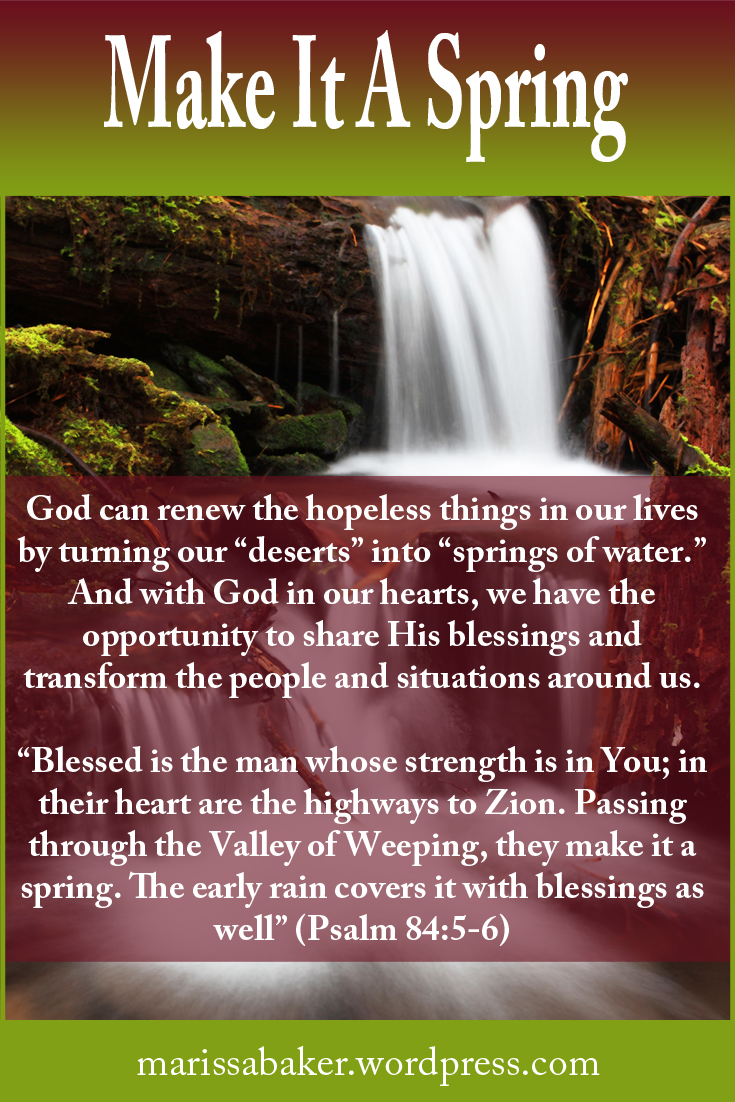
Sometimes we walk through a season of life that feels like a wilderness. Barren, lonely, forsaken. We might even feel like this is the end. That things are hopeless.

That’s where Elijah was when he fled Jezebel. He went out in the wilderness, sat by a tree, and asked God to let him die. Instead, God gave him food and water and sent him to Mount Horeb (1 Kings 19:1-8). There, Elijah made his complaint. “Then he said, ‘I have been very zealous for Yahweh the God of hosts, for the Israelites have forsaken your covenant. They have demolished your altars, and they have killed your prophets with the sword. I alone am left over, and they seek to take my life'” (1 Kings 19:10, LEB).

Yahweh responds by showing His power, reassuring Elijah that he was not the only believer left, and giving him a job to do (1 Kings 19:11-18). Elijah thought things were hopeless but God had other ideas. He had a plan for Elijah and an even larger plan Elijah didn’t know about.

click to read article, "Make It A Spring" | marissabaker.wordpress.com
Photo Credit: “Spring Runoff” by Ian Sane, CC BY via Flickr

Transforming Your Wilderness

For all of us, it’s easy to feel like we’re insignificant to God’s plan. But no one is too small for God to do marvelous things with. In fact, God often chooses the poor, weak, and little because those are the ones easiest for Him to work powerfully in (1 Cor. 1:26-31; 2 Cor. 12:9-10)

When the poor and needy seek water, and there is none, and their tongue faileth for thirst, I the Lord will hear them, I the God of Israel will not forsake them. (Is 41:17, KJV)

Read more

Not Ashamed of Modesty

Feminism constantly tells women we have no reason to be ashamed of our bodies, our desires, our gender, our career goals – of anything really. We can do and be whatever we want and nothing should hold us back. It sounds good in theory, but like many things humans do it can be taken to extremes.

Take the Women’s March from a few weeks ago as an example. If you want to march around with what one blogger I follow delicately called a pink taco on your head I won’t stop you. But those of us who don’t do things like that aren’t any less “women” than you are, nor are we less interested in being treated with dignity, respect, and equality. In fact, that’s a big reason we express our notions of feminism (and femininity) in different ways.

click to read article, "Not Ashamed of Modesty" | marissabaker.wordpress.com
Photo credit: “Day 68” by Quinn Dombrowski, CC BY-SA via Flickr

Today, I’m going to take society’s claim that there’s no need to feel shame about the kind of woman you are to heart and say I’m not ashamed of modesty. Depending on your background this word may have provoked a strong reaction. Perhaps you think modesty is a repressive, old-fashioned list of rules telling women how not to dress and act. Or maybe you think modesty sounds safe – a way to hide from attention you don’t want any more. But modestly is about so much more than a set of rules for covering yourself up. It’s more powerful and – dare I say it? – sexy than we often think.

Let’s start with a working definition of modesty: Modesty is concealing what you do not want everyone to know or see so that you can reveal yourself only to someone you trust. It’s typically associated with the idea of sex and how much skin you show, but it has to do with other things as well. For example, you might also exercise modesty by not calling undue attention to yourself or by reserving certain parts of your personality for people you know well. Read more

Expecting Persecution: Responding To The World’s Hate

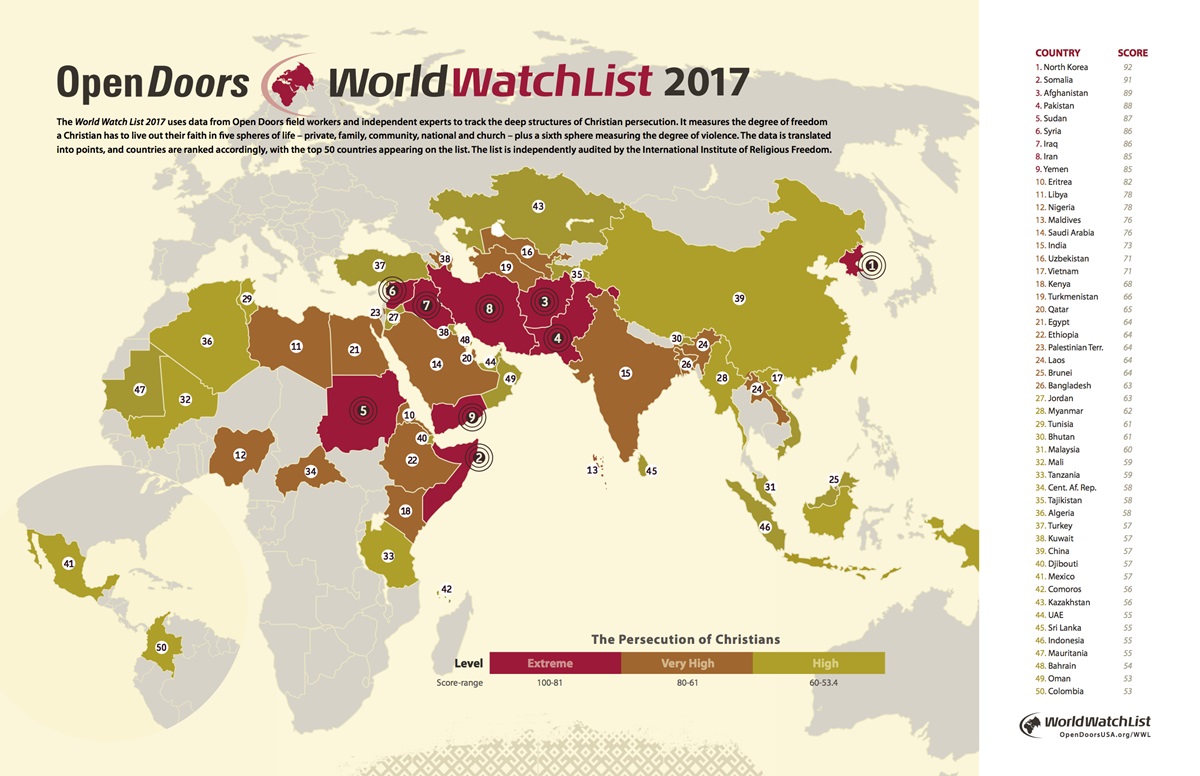
Last year, the persecution of Christians during the past quarter century hit a record high for the third year in a row. The World Watch List, released by Open Doors every year for the past 25 years, examines the pressures Christians face and levels of religiously motivated violence to rank the top 50 countries where “Christians face the most persecution.”click to read article, "Expecting Persecution: Responding To The World's Hate" | marissabaker.wordpress.com

Here in the United States, I’ve heard the Christians around me talk about being persecuted. “It’s getting bad,” they say. You might lose your business for not baking a cake or go to jail for not issuing a gay “marriage” license. You might be scared to say “I’m a Christian” because people will laugh at or ridicule you. Your kid might be told they can’t bring a Bible to school.

While that does qualify as persecution, the U.S. isn’t anywhere on this list, nor on the expanded list of countries to watch. India, on the other hand, comes in at #15. There are 64 million Christians in India and “approximately 39 million experience direct persecution.” That means about “40 incidents were reported per month, including pastors beaten, churches burned and Christians harassed.” A little closer to home, last year “23 Christian leaders in Mexico and four in Colombia were killed specifically for their faith.”

In 35 out of the 50 countries, including most of the top-ranked countries, Christians are being persecuted by Islamic extremists. In a rising number of Asian countries, the driving force is religious and ethnic nationalism. In summary, “Christians throughout the world continue to risk imprisonment, loss of home and assets, torture, beheadings, rape and even death as a result of their faith.”

Why The World Hates Us

Many U.S. Christians don’t even know about the level of persecution our brethren face overseas. And if we do, I think all too often our response is an American knee-jerk reaction that the solution is to export more of our ideas like religious freedom, tolerance, and equal justice. Those same ideals drive the indignation we feel seeing any sort of persecutions happen here in the United States.

click to read article, "Expecting Persecution: Responding To The World's Hate" | marissabaker.wordpress.com
Photo credit: “Sign: Religious Persecution in Progress” by John Nakamura Remy, CC BY-SA via Flickr

As Americans, we think we deserve religious freedom. Under U.S. law, we’re right and I do believe we should continue to fight for that on a political level. But we should also realize the level of freedom we’ve enjoyed to practice our faith in the U.S. is an anomaly in world history. And while U.S. citizens should be able to count on freedom from persecution because of the Constitution, as Christians we’re never promised exemption from persecution. In fact, we’re told the opposite. Read more

Send Me Your Stories: Christianity and MBTI Types

I have a blog post (or more likely series) that I’d really like to write and I need your help.

When I started this blog, I worried it would seem like an awkwardly smooshed together amalgam of INFJ blog and Christian blog. You’re supposed to find a niche or theme of some kind and focus your blogging there. Not start two blogs on the same site and post one on Mondays and one on Saturdays. But I felt this what what I should do and so I did. And it’s been wonderful.

I’ve heard from so many INFJs who find my blog through the Myers-Briggs posts and then comment because they discovered I’m Christian. I’ve also heard from other types. Most surprisingly, quite a large number of NTs want to talk about their faith. It’s been fascinating to hear from the types stereotyped as the least religious. Many talk about the challenges they face, especially in connecting with other Christians or in feeling like their faith walk doesn’t follow the “normal” pattern.Send Me Your Stories: Christianity and MBTI Types | marissabaker.wordpress.com

That has me wondering: if Christianity is a faith meant for all people then why aren’t we doing a better job of connecting with all personality types? It’s a very broad generalization, but most Christians in the United States seem to be Sensing types and/or Feeling types. And that’s who many churches cater toward. They’re focusing on the sort of traditions that make SJ types comfortable, or trying to engage SP types in sensory worship experiences, or appealing to the spiritual interests of a few NF types.

I firmly believe God created personality variations for a reason and that He longs for a relationship with all people. There are already Christians of every personality type who have strong walks with God. But they’re not all equally valued and understood in the churches. And I’d very much like to start changing that.

List of Finished Posts:

As this project continues, I’ll post links to the finished posts here. If you see your type on the list, you’re welcome to head over to that post to read what your fellow believers wrote about their faith and leave your perspective in the comments section. I’m hoping to turn this project into a book eventually, and I greatly value your perspective even if I’ve already published a post on your type.

My Questions For You

Here’s where you guys come in. I want to hear from Christians of as many different personality types as possible. If you want to contribute and don’t know your personality type yet, please check out my post Finding Your Real Myers-Briggs Type (if you can’t narrow it down to a single type or just want to take one online test instead of researching typeology in-depth, that’s okay. I’d still love to hear from you).

I’m asking you to please share your personality type and answer some (or all, if you like) of these questions:

  • Which Bible characters and/or stories do you most identify with?
  • Do you have gifts or talents that you feel are not appreciated or that you don’t have an opportunity to use in the church?
  • Do you have gifts or talents that are particularly encouraged and supported in the church?
  • Are there expectations from other Christians that you have a hard time meeting because of how your mind naturally works?
  • Which teaching/preaching styles connect with you best? How do you like to hear and learn about God and His word?
  • In what ways could the church better connect with someone like you when preaching the gospel?
  • What’s one of the biggest challenges you face as a Christian?
  • Why are you a Christian? In other words, what makes you believe this faith is the right one?

You can either leave a comment here or send me a private message through my Contact Me form. Unless you tell me otherwise, I’ll assume that by getting in touch you agree I can quote you directly and credit you by first name (or screen name) and Myers-Briggs type.

Please spread this around! The more people sending in their ideas and perspectives the better. Hopefully we’ll get enough feedback for several posts. Maybe it will even grow into an ebook. I can’t wait to read what you all have to say!

Save

Save

Save

Save

Save

Save

Save

Save

Too Proud To Follow God

I’ll bet none of us would just come out and say, “I know better than God” or “God’s wrong and I’m right.” We recognize that as arrogant, inaccurate, and fool-hardy. But far too often, we act like that’s what we think even if we’re not saying or even consciously thinking those words. We come up with reasons why we don’t have to keep His commands, or decide we have a better idea for how to obey than what’s instructed in scripture. We try to come figure out what being Christian means to us rather than seeking what it means to God.

The stories of Israel’s first two kings perfectly illustrate the different ways we humans can approach following God. Saul did what was right in his own eyes while pretending to follow God, and God wasn’t impressed. He took the kingdom away from Saul and his family to set up David, someone who would truly follow after God’s heart and listen to His commands.

click to read article, "Too Proud To Follow God" | marissabaker.wordpress.com

Saul’s Prideful Disobedience

God chose Saul out of all the people, just as He later would David. It wasn’t His intention that Saul fail. But just two years into his reign, Saul found himself facing an army so terrifying his own troops ran and hid in caves. He waited seven days for Samuel the priest to come and offer sacrifice to God, but Samuel didn’t show.

That’s when Saul committed a sin that cost him the kingdom (1 Sam. 13). He made the decision to offer the sacrifice himself, showing a presumptuous disregard for God’s instructions. When Samuel showed up, Saul had all sorts of arguments to justify his actions but they didn’t change the fact that he’d ignored God’s will. Read more