Learning from Our Stress Function – Inferior Feeling

Disclaimer: some of the links in this post are affiliate links. This means that, at no additional cost to you, I will receive a commission if you click on the link and make a purchase on that website.

If we’re describing someone’s personality type in the Myers-Briggs system, we usually talk about their primary and secondary “functions” (also called mental processes). An ISTP, for example, leads with a process called Introverted Thinking (a judging/decision making function), which is supported with Extroverted Sensing (a perceiving/learning function). An ENTJ, on the other hand, leads with Extroverted Thinking, supported by Introverted Intuition. Using Personality Hacker’s car model,* we can compare our primary function to an adult driving a car, and the secondary function to a second adult navigating in the passenger seat.

Each type also has a tertiary function (the opposite of their secondary function), and an inferior function (the opposite of their primary function). These are less well developed. In the car model, our tertiary function is like a 10-year-old sitting behind the co-pilot, and the inferior function is like a 3-year-old sitting behind the driver. The processes you use most readily are the ones typically visible, and they define your personality as others usually see it. Our less developed functions play a significant role as well, though. Today, we’ll be looking at types which use Feeling as an inferior function.
Learning from Our Stress Function - Inferior Feeling | marissabaker.wordpress.com

Everyday Life

As with other types, ISTPs, INTPs, ESTJs, and ENTJs do use their inferior function in everyday life.  They use Thinking for most decision-making, but Feeling still shows up in several ways. For Extroverted types, it often influences the causes they champion and/or is connected with their religion. Their Feeling function helps them connect with the human community and drives them to contribute in a way that meshes with their sense of authentic self.

Introverted Thinking types are often (unfairly, I might add) stereotyped as areligious, coldly analytical and unconcerned with other people’s feelings. They can come across that way, but they really do have a feeling side. ISTPs and INTPs can be deeply spiritual and they value their friendships just as much as dominant Feelers do (though they often have fewer close friends and aren’t as comfortable expressing emotion).

Characteristics of Inferior Feeling

ESTJs and ENTJs use dominant Extroverted Thinking, which makes Introverted Feeling their inferior function. It’s their least developed function, and has different characteristics than the Introverted Feeling used by types like ISFPs and INFPs. In her book Was That Really Me?* Naomi Quenk says inferior Introverted Feeling displays the following traits (I’ve put the traits of dominant Fi in parenthesis):

  • Hypersensitivity to inner states (Inner harmony)
  • Outbursts of emotion (Economy of emotional expression)
  • Fear of feeling (Acceptance of feeling as nonlogical)

ISTPs and INTPs also lead with a thinking function, in this case Introverted Thinking. This makes Extroverted Feeling their stress function, and it looks different than the Feeling used by ENFJ and ESFJ types. Here are the traits Quenk associates with inferior Extroverted Feeling (and their counterparts in Fe-dominant types).

  • Logic emphasized to an extreme (Comfortable inattention to logic)
  • Hypersensitivity to relationships (Sensitivity to other’s wellfare)
  • Emotionalism (Sharing of emotions)

Stress Reactions

When stressed out, both introverted and extroverted types which use inferior Feeling are hypersensitive to anything having to do with understanding their own or other people’s emotions. They often misinterpret other people’s intentions, seeing them as overly critical and judgmental. They might become distressed, anxious and annoyed, but this won’t be readily apparent from the outside (Quenk p. 130).

Because Thinking types are often uncomfortable expressing their feelings, they still struggle to maintain an appearance of control when stressed-out. To make up for being unsure how to express what they’re struggling with, stressed Thinkers may excessively focus on logic to counteract feelings of uncertainty and being overwhelmed. From the outside, they start to look short tempered and unreasonable.

When pushed far enough (either by an external stressor or something going on inside their minds), Thinkers may blurt out their own feelings in a way that seems totally out of character. ESTJs and ENTJs, especially women, often say that losing control and crying in public or lashing out in anger is typical of their “grip experiences” (Quenk p. 84). For some INTPs and ISTPs, an “intense expression of emotion” can actually help them deal with stress and be the push they need to back to normal (p. 140).

Getting Out of Stress

Both the introverted and extroverted thinkers need plenty of alone time to process their feelings when dealing with stress. This is particularly important for ISTPs, INTPs and ENTJs (one of the most “introverted extroverts”). Whether or not they want to talk about it with a friend varies from person to person. One thing that’s consistent, though, is that they don’t want someone trying to fix things for them or pressure them to open up. Other people are most helpful if they can act as a low-pressure sounding board.

Naomi Quent reports that ESTJs and ENTJs experience “very few or quite minor eruptions of their inferior function” compared to other types (p.92). Often, finding a distraction through entertainment or a change of scenery is enough to bring them out of their stress function. Physical activity, a change of scenery, and “light problem solving … such as reading a mystery novel” can also help INTPs and ISTPs (p.140).

Learning From the Inferior

For many people, the side of their personality that’s related to their inferior function stays a mystery throughout their lives. Type theorists say that most people who successfully incorporate their inferior function typically do so around middle age. However, Isabel Meyer suggested that every type exercise all their functions on a regular basis when making decisions. Dominant Thinking excels at impersonal analysis, predicting cause and effect, and considering the cost involved in any decision. Incorporating Feeling adds a people-oriented level that checks decisions against your personal values and take into consideration the good other people (Meyers, Gifts Differing*, 197).

According to Naomi Quenk, ESTJs and ENTJs who successfully use their Introverted Feeling learn to value relationships highly. They (occasionally) loosen their high standards and cut themselves and others a little slack (p. 94-95). Much the same thing can happen for INTPs and ISTPs, who become increasingly sensitive “to the nuances of important relationships” and learn to express and accept their emotions more readily (p. 141-142).

Learning from Our Stress Function - Inferior Feeling | marissabaker.wordpress.com

credits for pictures used in blog images:

*indicates affiliate links

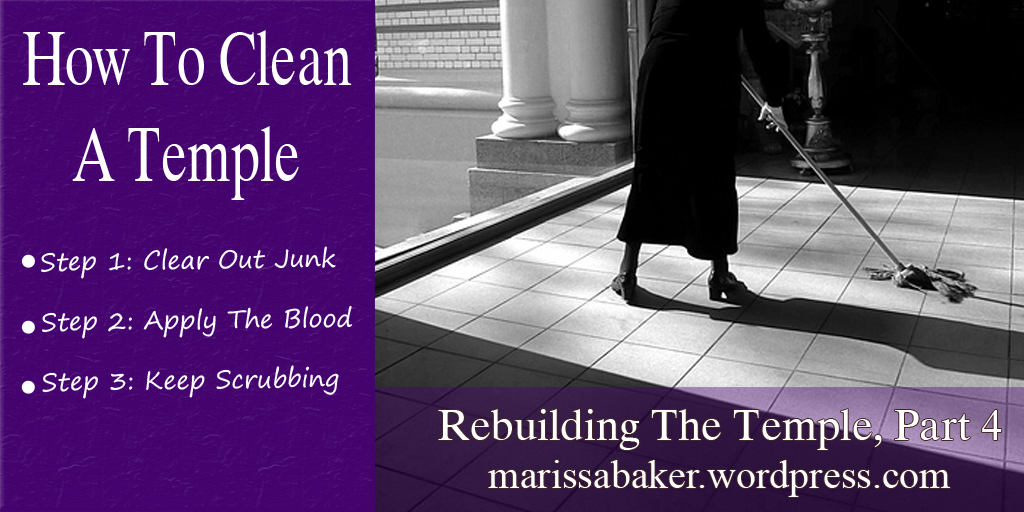
How To Clean A Temple

We’ve talked about how to build up spiritual temples and the fact that the churches today need a good temple cleaning, but not much about the practical how-to for cleaning temples. Back when there was a physical temple standing, God gave specific instructions about how to purify the temple and clean it when things got dirty. You couldn’t just throw some soapy water across the floor and say, “Clean!” Today, we are the temple of God, and He has set in place ways of cleaning us out as well.

How To Clean A Temple| marissabaker.wordpress.com

Step One: Clear Out Junk

One of the most complete Old Testaments accounts we have of cleansing a temple took place in the days of king Hezekiah.

In the first year of his reign, in the first month, he opened the doors of the house of the Lord and repaired them. Then he brought in the priests and the Levites, and gathered them in the East Square, and said to them: “Hear me, Levites! Now sanctify yourselves, sanctify the house of the Lord God of your fathers, and carry out the rubbish from the holy place. For our fathers have trespassed and done evil in the eyes of the Lord our God; they have forsaken Him, have turned their faces away from the dwelling place of the Lord, and turned their backs on Him. They have also shut up the doors of the vestibule, put out the lamps, and have not burned incense or offered burnt offerings in the holy place to the God of Israel. (2 Chr. 29:3-7)

And they gathered their brethren, sanctified themselves, and went according to the commandment of the king, at the words of the Lord, to cleanse the house of the Lord. Then the priests went into the inner part of the house of the Lord to cleanse it, and brought out all the debris that they found in the temple of the Lord to the court of the house of the Lord. And the Levites took it out and carried it to the Brook Kidron.
Now they began to sanctify on the first day of the first month, and on the eighth day of the month they came to the vestibule of the Lord. So they sanctified the house of the Lord in eight days, and on the sixteenth day of the first month they finished.
Then they went in to King Hezekiah and said, “We have cleansed all the house of the Lord, the altar of burnt offerings with all its articles, and the table of the showbread with all its articles. Moreover all the articles which King Ahaz in his reign had cast aside in his transgression we have prepared and sanctified; and there they are, before the altar of the Lord.” (2 Chr. 29:15-19)

I find it very interesting that, in addition to purifying the house and cleansing it (presumably with water and blood) the priests had to carry out debris and rubbish. There were things inside the temple defiling it that needed to be thrown out before the other purification could take place.

This puts me in mind of two incidents that took place during Jesus’ ministry. In several Bibles I’ve read, the section heading here reads “Jesus Cleanses The Temple.”

Now the Passover of the Jews was at hand, and Jesus went up to Jerusalem. And He found in the temple those who sold oxen and sheep and doves, and the money changers doing business. When He had made a whip of cords, He drove them all out of the temple, with the sheep and the oxen, and poured out the changers’ money and overturned the tables. And He said to those who sold doves, “Take these things away! Do not make My Father’s house a house of merchandise!” Then His disciples remembered that it was written, “Zeal for Your house has eaten Me up.” (John 2:13-17)

This happened in John chapter 2, at the first Passover during Jesus’ ministry. That means one of the very first things He did as part of His ministry was throw certain things and people out of God’s temple. It was a pivotal moment, and it didn’t just happen once. A very similar incident occurs right before His last Passover.

Then Jesus went into the temple of God and drove out all those who bought and sold in the temple, and overturned the tables of the money changers and the seats of those who sold doves. And He said to them, “It is written, ‘My house shall be called a house of prayer,’ but you have made it a ‘den of thieves.’” (Matt. 21:12-13)

Look how important this was to Jesus. He made a whip to drive out sheep, oxen and people. He poured the exchangers’ money onto the floor, and threw tables over. He probably raised His voice as He ordered out people who’d made His father’s house a vehicle for personal gain. He spent the time leading up to two Passovers before His sacrifice, which fulfilled all the blood sacrifices of the Old Testament, throwing defiling elements out of the temple.

Is there anything that needs thrown out of our lives before God can really start to work with us? The temple today is in our minds, so that’s where we need to look. Anything inside us that is crowding God out of His temple must be thrown out. Jesus can help with that if we ask Him, but – like the priests in Hezekiah’s day – we have to be willing to carry out the rubbish and dump it somewhere it won’t come back.

Step Two: Apply The Blood

Back in the Old Testament, the physical temple had to be cleaned and purified before God would put His presence there. Even when the first tabernacle was built and things started out exactly as God commanded, purification was a daily necessity. I suspect this was because people were involved, and no matter how hard we try we still can’t keep things clean enough for God on our own.

And you shall offer a bull every day as a sin offering for atonement. You shall cleanse the altar when you make atonement for it, and you shall anoint it to sanctify it. (Ex. 29:36)

As Israel fell into sin, the temple was often neglected. Throughout history, it was forgotten by Israel, defiled with idols, and ravaged by conquers. Whenever Israel came back to God, the temple needed fresh purification.

Thus says the Lord God: “In the first month, on the first day of the month, you shall take a young bull without blemish and cleanse the sanctuary. The priest shall take some of the blood of the sin offering and put it on the doorposts of the temple, on the four corners of the ledge of the altar, and on the gateposts of the gate of the inner court. And so you shall do on the seventh day of the month for everyone who has sinned unintentionally or in ignorance. Thus you shall make atonement for the temple. (Ezk. 45:18-20)

The animal sacrifices used to purify the physical temple were a stand-in pointing to how Jesus’s sacrifice would purify His people. “It is not possible that the blood of bulls and goats could take away sins,” but Jesus was able with one offering” to have “perfected forever those who are being sanctified” (Heb. 10:4, 14).

Remember that the tabernacle and then the temple layouts were divided into different sections. In the book of Hebrews, it talks about how there was a main section of the tabernacle where the priests served throughout the year, and then the Holy of Holies which the high priest could only enter once a year on the Day of Atonement (Yom Kippur).

Now when these things had been thus prepared, the priests always went into the first part of the tabernacle, performing the services. But into the second part the high priest went alone once a year, not without blood, which he offered for himself and for the people’s sins committed in ignorance; the Holy Spirit indicating this, that the way into the Holiest of All was not yet made manifest while the first tabernacle was still standing. It was symbolic for the present time in which both gifts and sacrifices are offered which cannot make him who performed the service perfect in regard to the conscience — concerned only with foods and drinks, various washings, and fleshly ordinances imposed until the time of reformation. (Heb. 9:6-10)

What’s really interesting is that in the Greek, there’s one word to describe the entire temple complex and another word to describe the inner sanctuary or Holy of Holies. It’s this second word, naos, which is used when talking about us as the temple of God. The book of Hebrews tells us there is a spiritual version of the Holy of Holies in heaven, where Christ presented His blood to atone for our sins, but each Christian today is also a type of spiritual Holy of Holies.

And according to the law almost all things are purified with blood, and without shedding of blood there is no remission. Therefore it was necessary that the copies of the things in the heavens should be purified with these, but the heavenly things themselves with better sacrifices than these. For Christ has not entered the holy places made with hands, which are copies of the true, but into heaven itself, now to appear in the presence of God for us; not that He should offer Himself often, as the high priest enters the Most Holy Place every year with blood of another — He then would have had to suffer often since the foundation of the world; but now, once at the end of the ages, He has appeared to put away sin by the sacrifice of Himself. (Heb. 9:22-26)

The high priest was the only one ever allowed into the Holy of Holies, just as Jesus Christ was the only one who could clean the spiritual temple. The law requires blood purification of holy things, and Jesus is the only one who’s blood is precious enough to cleans a polluted spiritual temple. Accepting Him as our Savior and asking Him to wash away our sins is a vital step in cleaning the spiritual temple.

Step Three: Keep Scrubbing

As the great High Priest over the church today, Jesus is the only one with a right to come into the temple and clean it out. We can help as best we can, but we must never forget that He’s the one doing the cleansing. It was His sacrifice that removed sin once and for all, and He’s the one continually working to clean His people.

looking for the blessed hope and glorious appearing of our great God and Savior Jesus Christ, who gave Himself for us, that He might redeem us from every lawless deed and purify for Himself His own special people, zealous for good works. (Tit. 2:13-14)

John the Baptist testified of Jesus Christ that He would baptize His people “with the Holy Spirit and fire” (Luke 3:16). When we accept Jesus Christ as our savior and are baptized in His name, we’re washed with His blood and covered in the spirit of God. That’s just the beginning of our purification process, though.

Husbands, love your wives, just as Christ also loved the church and gave Himself for her, that He might sanctify and cleanse her with the washing of water by the word, that He might present her to Himself a glorious church, not having spot or wrinkle or any such thing, but that she should be holy and without blemish. (Eph. 5:25-27)

The church today is God’s temple – His personal dwelling place – and we must do all we can to set it to rights by working on ourselves individually and collectively under the Headship of our High Priest Jesus Christ. The closer we draw to Christ and the more we point others to Him, the cleaner this temple will get.

Back in the Old Testament, the priests were assisted by Levites whose “duty was to help the sons of Aaron in the service of the house of the Lord, in the courts and in the chambers, in the purifying of all holy things and the work of the service of the house of God” (1 Chr. 23:28). This was supposed to keep happening on a continual basis. In much the same way, we have to continue repenting when we fall short and continue submitting to the refining process Christ is accomplishing in our lives.

How To Clean A Temple| marissabaker.wordpress.com

credits for photos used in blog images:


Learning from Our Stress Function – Inferior Sensing

Disclaimer: some of the links in this post are affiliate links. This means that, at no additional cost to you, I will receive a commission if you click on the link and make a purchase on that website.

When we’re talking about someone’s personality type in the Myers-Briggs system, we usually discuss their primary and secondary functions (also called mental processes). An INFJ, for example, leads with a process called Introverted Intuition (a perceiving/learning function), which is supported with Extroverted Feeling (a judging/decision making function). An ENTP, on the other hand, leads with Extroverted Intuition, supported by Introverted Thinking. Using Personality Hacker’s car model,* we can compare our primary function to an adult driving a car, and the secondary function to a second adult navigating in the passenger seat.

Each type also has a tertiary function (the opposite of their secondary function), and an inferior function (the opposite of their primary function). These are less well developed. In the car model, our tertiary function is like a 10-year-old sitting behind the co-pilot, and the inferior function is like a 3-year-old sitting behind the driver. The two processes you use most are more visible, and they define your personality as others typically see it, but our less developed functions play a significant role as well. Today, we’ll be looking at types which use Sensing as an inferior function.

Learning from Our Stress Function - Inferior Sensing | marissabaker.wordpress.com

Everyday Life

ENTPs, ENFPs, INFJs, and INTJs usually rely on their dominant Intuition and then, to a lesser extent, their Thinking and Feeling functions. Inferior Sensing can, however, still show up in their everyday lives, often through hobbies and interests that don’t seem to quite fit with the more visible aspects of their personalities.

Often, dominant Intuitive types will excel in one or more particular area that requires using Sensing to notice details and interact with physical things in the world around you. This could be something like doing your own accounting, specializing in a certain kind of cooking, or maintaining a nice garden. It could also be a more active hobby like horseback riding, hiking, or team sports for the extroverts. Listening to music, attending concerts, and reading escapist literature is also popular.

Characteristics of Inferior Sensing

ENTPs and ENFPs use dominant Extroverted Intuition, which makes Introverted Sensing their inferior function. In her book Was That Really Me?* Naomi Quenk says inferior Introverted Sensing displays the following traits (I’ve put the traits of Si-dominant ISFJs and ISTJs in parenthesis):

  • Withdrawal and depression (Solitude and refection)
  • Obsessiveness (Attention to facts and details)
  • Focus on the body (Awareness of internal experience)

INFJs and INTJs also lead with an intuitive function. They primarily use Introverted Intuition, so that makes Extroverted Sensing their stress function. Here are the traits Quenk associates with inferior Extroverted Sensing (and their counterparts in Se-dominant types like ESTPs and ESFPs).

  • Obsessive focus on external data (Focus on external data)
  • Overindulgence in sensory pleasures (Seeking sensual/aesthetic pleasure)
  • Adversarial attitude toward the outer world (Delight in the outer world)

As you can see, there are similarities in how a dominant Sensing type and an inferior Sensing type use their sensing functions. In the case of ENFPs, ENTPs, INFJs, and INTJs however, sensing is poorly developed and rarely used effectively.

Stress Reactions

Though Sensing plays a role in the everyday lives of ENFPs, ENTPS, INTJs, and INFJs, it shows up most often when these types are stressed. The sort of stressors we usually think about (running out of time, feeling overwhelmed, grief, etc.) can all trigger an inferior function episode. Some extra things that intuitive types are sensitive to include someone pointing out a sensing/factual mistake, physical exhaustion, and having to keep track of lots of details at once.

Both introverted and extroverted intuitive types have have trouble with focusing on their bodies too much when stressed. Dominant Sensing types are usually comfortable in their own skins and enjoy sensory experiences like eating nice food or drinking a good wine. But stressed intuitives might develop hypochondria and blow any sort of medical concern out of proportion, or over-indulge by eating and drinking too much. They can also binge on other sensory pleasures, like obsessively gaming or watching too much TV to escape the outer world (Quenk p.197-201, 245-521).

Stressed intuitives often retreat from the world. It seems particularly hostile when we’re stressed, and all the incoming sensory data is simply too much to handle. The extroverted types will isolate themselves and fall into depression, while introverts tend to get angry, suspicious and hostile (I also know ENFPs who get angry when stressed, and INTJs who get depressed. It’s not just an Introvert/Extrovert thing).

Getting Out of Stress

Not everyone gets out of  their stress reaction using the same techniques. For INFJs and INTJs, as for many introverts, “space and a low-pressure environment” are key to returning to equilibrium. Quenk also notes that “INTJs and INFJs agree that the worst thing others can do when they are in this state is to give them advice or try to fix the problem” (p. 207). When stressed, we’re not processing things logically and if you try to convince us that how we feel isn’t valid, we don’t take it well. Eventually some Introverted Intuitives want someone to talk with, especially INFJs, but not at first.

Extroverted Intuitives also need significant amounts of alone time. They really need people to “back off and avoid patronizing them.” They’re more likely than introverts to talk it out with other people, but, like the INFJs and INTJs, ENTPs and ENFPs just need someone to listen, not try to fix things. ENFPS in particular eventually want someone to validate their feelings and reassure them (Quenk p. 258).

Getting out and taking a walk or exercising is often helpful for all the types using inferior Sensing. Introverted types prefer to do this alone, while extroverts might want more company. Quenk says that extroverted types are also more likely use getting adequate sleep, eating good food, and doing something relaxing to climb out of a grip experience (p. 258), but I can say from experience that some INFJs also find that useful.

Learning From the Inferior

Integration of the inferior function into everyday life generally happens in mid-life. However, Intuitive types can start learning to use their Sensing function any time. Isabel Meyer suggested that every type exercise all four of their functions when making a decision. Your dominant Intuition is able to gather and generate possibilities, which is great for creative problem solving. When we add Sensing, instead of ignoring it, we can start to use more of an impartial, realistic approach to problem solving. It’s useful for finding out exactly what the problem is so we can use our intuition to solve it (Meyers, Gifts Differing*, 197).

Introverted Intuitives who integrate their Sensing function often find enjoyable ways of indulging their sensing side through hobbies, and become more comfortable with their outer environment and with other people (p. 209). Extroverted Intuitives who integrate their inferior Sensing give themselves permission to slow down and enjoy life. They also start to tap into their introverted side and enjoy times of quite reflection (p. 260). Both types experience less guilt as they mature. They also start to take better care of themselves, and often become self-aware enough to avoid many grip experiences (p. 210, 261)

Learning from Our Stress Function - Inferior Sensing | marissabaker.wordpress.com

credits for pictures used in blog images:

  • My Shadow” by Scarleth Marie, CC BY via Flickr
  • Shadow” by Nicola, CC BY via Flickr

*indicates affiliate links
Obstacles To Temple Building (Lessons from Haggai, part three)

Both letters to the Corinthian church remind them, “You are the temple of God.” Each member of Christ’s church is a temple, and we’re being built up into a spiritual house of God. This applies to the body as a whole, as well as to individuals.

We’ve been spending time in the book of Haggai the past couple weeks, talking about God’s challenge to the people who were neglecting His temple and what we can do about building up the temple we have today. Like those of us in the modern churches of God, the people of Haggai’s time faced a number obstacles to temple building. They let these obstacles discourage them for many years, but it turns out they weren’t really anything to worry about. Once the people turned back to God and started working on what He commanded, the obstacles didn’t seem so significant.

Obstacles To Temple Building | marissabaker.wordpress.com

Droughts

This isn’t so much an obstacle as it is a result of neglecting the temple in the first place. God tells the people their lives lacked good things “because of My house that is in ruins, while every one of you runs to his own house” (Hag. 1:9).

Therefore the heavens above you withhold the dew, and the earth withholds its fruit. For I called for a drought on the land and the mountains, on the grain and the new wine and the oil, on whatever the ground brings forth, on men and livestock, and on all the labor of your hands.” (Hag. 1:10-11)

Confronted with these struggles, the people might have said, “We can’t build God’s house while so many bad things are happening.” It would have been an understandable reaction from a human perspective. Nothing we do is bearing fruit, so why bother with the temple? God wouldn’t be happy if that falls apart like everything else. But in reality, all the problems they were seeing came as a result of neglecting the temple.

In our own lives, we often find ourselves discouraged from contributing in our local churches, or distracted by other worries from building-up the people around us. We might think we have very little time or ability to contribute to  God’s temple because there’s so much other stuff going on, and often going wrong. In reality, if we prioritize God’s temple, the other things in our lives will start to fall into place (or at least get easier to deal with because we have God on our side).

Then Haggai, the Lord’s messenger, spoke the Lord’s message to the people, saying, “I am with you, says the Lord.” So the Lord stirred up the spirit of Zerubbabel the son of Shealtiel, governor of Judah, and the spirit of Joshua the son of Jehozadak, the high priest, and the spirit of all the remnant of the people; and they came and worked on the house of the Lord of hosts, their God (Hag. 1:13-14)

We need to let God “stir up” our spirits. Focusing only on things that are going wrong in our lives, and then trying to fix them without working on God’s temple, is just going to make things worse.

Comparisons

The previous temple had been the one built by Solomon. Physically speaking, it was the most glorious temple ever built for God. The people working on this new temple knew they couldn’t approach that magnificence, and it was discouraging.

Who is left among you who saw this temple in its former glory? And how do you see it now? In comparison with it, is this not in your eyes as nothing? Yet now be strong, Zerubbabel,’ says the Lord; ‘and be strong, Joshua, son of Jehozadak, the high priest; and be strong, all you people of the land,’ says the Lord, ‘and work; for I am with you,’ says the Lord of hosts. ‘According to the word that I covenanted with you when you came out of Egypt, so My Spirit remains among you; do not fear!’ (Hag. 2:3-5)

You’ll hear something similar today in the church – people looking back to a time when the church was larger, or had more money, or seemed more influential, or had more respect in U.S. Culture. But God doesn’t want His people looking backwards except for productive reasons.

We can learn from past mistakes or take encouragement from past examples of God’s goodness, but being paralyzed in the present because you’re living in the past is unacceptable. God is moving us toward a great and glorious future, and that’s where we must look if we want His blessing now as we build the temples of our lives and churches.

Unstable Foundations

Whatever you’re building, it has to start with a firm foundation. The temple of God is no exception.

“For thus says the Lord of hosts: ‘Once more (it is a little while) I will shake heaven and earth, the sea and dry land; and I will shake all nations, and they shall come to the Desire of All Nations, and I will fill this temple with glory,’ says the Lord of hosts. ‘The silver is Mine, and the gold is Mine,’ says the Lord of hosts. ‘The glory of this latter temple shall be greater than the former,’ says the Lord of hosts. ‘And in this place I will give peace,’ says the Lord of hosts.” (Hag. 2:6-9)

These passages are prophetic, reaching beyond the completion of that physical temple to a new house constructed by God Himself. Part of it is being fulfilled today, as we are “being built up a spiritual house, a holy priesthood” (1 Pet. 2:5), and part will be fulfilled in the future.

but now He has promised, saying, “Yet once more I shake not only the earth, but also heaven.” Now this, “Yet once more,” indicates the removal of those things that are being shaken, as of things that are made, that the things which cannot be shaken may remain.
Therefore, since we are receiving a kingdom which cannot be shaken, let us have grace, by which we may serve God acceptably with reverence and godly fear. For our God is a consuming fire. (Heb. 12:26-29)

The author of Hebrews looked back to these verses in Haggai when talking about our future kingdom. To get there, we’re going to have to go through “shakings.” In my Messianic congregation, the Rabbi has given several messages where he reminds us that “everything which can be shaken will be shaken.” In other words, things that are not firmly grounded on Jesus Christ will topple over.

Unclean Hearts

Sometimes, we ourselves can be the obstacles standing in the way of building up a people that glorifies God. Other people can also act as obstacles, of course, but we have to be very careful to make sure we’ve gotten any beams out of our own eyes before trying to pick slivers out of someone else. We must examine our own hearts for uncleanness before we can hope to help others who are engaged in temple building.

And Haggai said, “If one who is unclean because of a dead body touches any of these, will it be unclean?”
So the priests answered and said, “It shall be unclean.”
Then Haggai answered and said, “‘So is this people, and so is this nation before Me,’ says the Lord, ‘and so is every work of their hands; and what they offer there is unclean. And now, carefully consider from this day forward: from before stone was laid upon stone in the temple of the Lord – since those days, when one came to a heap of twenty ephahs, there were but ten; when one came to the wine vat to draw out fifty baths from the press, there were but twenty. I struck you with blight and mildew and hail in all the labors of your hands; yet you did not turn to Me,’ says the Lord. (Hag. 2:13-17)

This takes us right back to where we started this chapter. If bad things are happening in our lives, it should prompt us to engage in self-examination and turn back to God – not stop building up God’s house.

What sort of things do you see holding the church back from growth? what steps could we take to overcome them?

Obstacles To Temple Building | marissabaker.wordpress.com

credits for photos used in blog images:

  • Roadblock” by Greg Westfall, CC BY via Flickr
  • Roadblock” by Olle Svensson, CC BY via Flickr

Stop Killing God’s Children

photo by Sander van der Wel, CC BY-SA via Flickr

I can’t watch the Planned Parenthood videos. I’ve been reading articles by people who have seen them, though, and that’s enough to break my heart. How could we as a society and a nation have reached the point where chopping up living infants is not a crime?

It boggles my mind that any sort of decent person can condone this, but what’s even more disturbing is that some professing Christians still support abortion. We sometimes look at the Old Testament and wonder how a loving, merciful God could be so harsh and cruel, yet we overlook passages where God talks about looking at His own people with horror. As a God of both mercy and justice, there are some things He simply cannot stand for.

And they built the high places of Baal which are in the Valley of the Son of Hinnom, to cause their sons and their daughters to pass through the fire to Molech, which I did not command them, nor did it come into My mind that they should do this abomination, to cause Judah to sin.’ (Jer. 32:35)

God found the idea of a nation murdering its children completely repulsive. It never even crossed His mind that Israel should do such a thing, and He certainly didn’t command it. But just in case it ever popped into their heads, He made sure to expressly forbid human sacrifice.

You shall not worship the Lord your God in that way; for every abomination to the Lord which He hates they have done to their gods; for they burn even their sons and daughters in the fire to their gods. (Deut. 12:31)

photo by Harald Groven, CC BY-SA via Flickr

Child sacrifice was the epitome of the sins these nations committed. It’s one of the chief reasons God decided they deserved the sort of punishment — often complete annihilation — that makes us so squeamish today. And yet here we are in the United States, doing pretty much the same thing. We’re not killing babies as part of a worship practice, but it has the same result. We’re voluntarily slaughtering infants because we’ve put other concerns before God’s laws.

In Proverbs 6, God talks about seven things that He hates. “Hands that shed innocent blood” is the one that most clearly applies to abortion. What blood could be more innocent than that of an unborn child? But other abominable things play a role as well. “A lying tongue” tells women who feel trapped that abortion is their best or only option. “A heart that devises wicked plans” came up with the modern abortion movement in the first place, killing babies for convenience, profit, and to eliminate populations seen as “undesirable”.

When a nation starts killing its own children, you know God’s judgement is just around the corner. When Israel was taken into captivity in 2 Kings 17, for example, God said one reason was that they’d instituted child sacrifice (2 Kings 17:17). He lays this sin to His people’s charge again in the prophets.

Moreover you took your sons and your daughters, whom you bore to Me, and these you sacrificed to them to be devoured. Were your acts of harlotry a small matter, that you have slain My children and offered them up to them by causing them to pass through the fire? (Ezk. 16:20-12)

photo by Bridget Coila, CC BY-SA via Flickr

God sees child murder as a personal affront against Him. Children belong to God, and He is invested in their well-being as a faithful and compassionate Creator. That’s why He’s so harsh on people who kill babies.

King Ahaz of Judah was another evil man who was sacrificing his own children around the time Israel was carried into captivity for the same sin (2 Kings 16:2). Yet Judah was not punished for one very important reason. The next king — a son who’d been allowed to live — “did what was right in the sight of the Lord” (2 Kings 18:3). Hezekiah removed idolatry, including child sacrifice, from Judah, and the country prospered (2 Kings 18:4-8).

These examples give us reason for both hope and fear — hope that we can change our culture and fear of what will happen if we don’t. Through these Planned Parenthood videos, our country has been given a wake-up call. We can either choose to remove evil from our land, as Hezekiah removed the institutionalized evils of previous generations in Judah, or we can face judgement as the unrepentant land of ancient Israel did.

Keep Reading: When Should We Value Human Life?

Learning from Our Stress Function – Inferior Intuition

Disclaimer: some of the links in this post are affiliate links. This means that, at no additional cost to you, I will receive a commission if you click on the link and make a purchase on that website.

When we’re talking about someone’s personality type in the Myers-Briggs system, we usually talk about their primary and secondary functions (also called mental processes). An ISFJ, for example, leads with a process called Introverted Sensing (a perceiving/learning function), which is supported with Extroverted Feeling (a judging/decision making function). An ESTP, on the other hand, leads with Extroverted Sensing, supported by Introverted Thinking. Using Personality Hacker’s car model,* we can compare our primary function to an adult driving a car, and the secondary function to a second adult navigating in the passenger seat.

Each type also has a tertiary function (the opposite of their secondary function), and an inferior function (the opposite of their primary function). These are less well developed. In the car model, our tertiary function is like a 10-year-old sitting behind the co-pilot, and the inferior function is like a 3-year-old sitting behind the driver. The processes you use most readily are the ones typically visible, and they define your personality as others usually see it. Our less developed functions play a significant role as well, though. Today, we’ll be looking at types which use Intuition as an inferior function.

Learning from Our Stress Function - Inferior Intuition | marissabaker.wordpress.com

Characteristics of Inferior Intuition

ESTPs and ESFPs use dominant Extroverted Sensing, which makes Introverted Intuition their inferior function (this is also sometimes mistakenly called the “shadow”). Types like mine (INFJ) use Introverted Intuition comfortably, but for ESTPs and ESFPs it’s their least developed function. In her book Was That Really Me?* Naomi Quenk says inferior Introverted Intuition displays the following traits (I’ve put the traits of dominant Ni in parenthesis):

  • Internal confusion (instead of intellectual clarity)
  • Inappropriate attribution of meaning (accurate interpretation of perceptions)
  • Grandiose Vision (visionary insight)

ISFJs and ISTJs also lead with a sensing function. They primarily use Introverted Sensing, so that makes Extroverted Intuition their stress function. Here are the traits Quenk associates with inferior Extroverted Intuition (and their counterparts in Ne-dominant types like ENTPs and ENFPs).

  • Loss of control over facts and details (instead of comfortable inattention to sense data)
  • Impulsiveness (flexibility, adaptability, and risk taking)
  • Catastrophizing (optimism about future possibilities)

There are similarities in how a dominant Intuitive type and an inferior Intuitive type use their intuitive functions, but intuition in ESFPs, ESTPs, ISFJs, and ISTJs is poorly developed.

Everyday Life

For most types, the inferior function isn’t always visible. In ISFJs and ISTJs, though, it “seems to color the everyday personality” and they are typically seen as worriers (Quenk, Was That Really Me?, 215). It’s not all bad, though. When an Introverted Sensing type enjoys creative pursuits like writing poetry or music and creating a work of art (especially arts in an abstract form), they are tapping into their intuitive side. They might also daydream or enjoy escaping reality via fantasy and sci-fi. An interest in spirituality — especially aspects of God that cannot be understood with the five senses — might also be tied to the intuitive side.

Worries related to inferior Intuition frequently show up in ESFPs and ESTPs, who are often challenged by society for their apparent lack of seriousness. They rarely stay worried for long, though. Like the introverts, Extroverted Sensing types might also be avid readers, enjoy the arts, and can be attracted the spiritual or metaphysical as a way of explaining their intuition.

Stress Reactions

Learning from Our Stress Function - Inferior Intuition | marissabaker.wordpress.comMost of us don’t use our inferior processes on a regular basis. We’re so used to using the better-developed processes that we don’t spend much time worrying about the ones we don’t use. But under certain stressful conditions, we lose touch with our primary and secondary mental processes and fall-back on the undeveloped inferior function. Think back to the car model we mentioned, and imagine that something unexpected happened (like you swerve to avoid hitting a construction cone or small animal). It shakes up the passengers, the 3-year-old starts crying and suddenly the only thing anyone in the car can focus on is calming the baby.

Unknowns and future plans can trigger stress in all types that use dominant Sensing. ESTPs and ESFPs are most sensitive to situations and people that want them to make a commitment or think about what the future holds. They don’t like feeling trapped by planning, or being judged by people who are more serious and goal-oriented (Quenk 174). ISFJs and ISTJs experience anxiety about “the prospect of unknown, previously unexperienced activities” (Quenk, 218) They also hate it when someone contradicts evidence they can see with their eyes (e.g. they’re having a particularly bad day and someone tells them everything will be fine).

When Sensing types are “in the grip” of inferior Intuition (to borrow a term from Naomi Quenk), they display the characteristics associated with inferior Introverted Intuition or Extroverted Intuition. They are more likely to feel panicked, confused, and as if they’ve lost control over their lives. Intuition is great at coming up with future possibilities, but for dominant Sensing types the possibilities coming out of inferior Intuition often look terrifying. They’ll be distracted by worst-case-scenarios, and may seem paranoid. Instead of processing sensory information with their typical speed and accuracy before acting, they’ll second-guess everything and without careful thought.

Getting Out of Stress

Once we know what our inferior function is an how it affects us, we can start to learn from this hidden side of our personalities. Just knowing it’s there is reassuring, since now we have an idea of why we react to stress the way we do. It also opens up tools for understanding how our minds work, getting back to “normal” after we’ve gone through a stressful situation, and learning to use our inferior function effectively.

ESFPs and ESTPs frequently experience “inferior function episodes,” but they rarely last long. Their brains work quickly, and they don’t tend to dwell on things. If you are an ESFP or ESTP trying to get out of a stress-reaction, it often helps to have a contingency plan that you can fall-back on but still feel free to change. Talking it over with someone works for many ESFPs and ESTPs (both men and women), especially if they encourage you to reconnect with reality and find logical explanations for what’s troubling you. Others Extroverted Sensing types find that working through the experience and doing some hands-on activities also grounds them in their Sensing function (Quenk, 184-185).

As introverts, ISFJs and ISTJs need more alone-time to process the eruption of their inferior function. They might use this alone time to analyze and re-frame the situation to solve the original problem or plan how they can react better next time. Most people with these two types say physical exercise is one of the best ways for them to return to normal. The exception is female ISFJs, who rarely list exercise as useful. Female ISFJs are also more likely to want to talk about their stress reaction with someone else after they’ve had a chance to think (Quenk, 231-232).

Learning From the Inferior

Most type theorists will say people rarely start to incorporate their inferior function until mid-life, but you can start learning to use your Intuition any time. Isabel Meyer suggested that every type exercise all four of their functions when making a decision. Your dominant Sensing helps with analyzing facts, facing reality, and understanding exactly what sort of situation you’re facing. Tapping into Intuition (instead of being scared of it) allows for discovering possibilities you might not have otherwise considered, like how you might change the approach and attitudes that you and others bring to this particular situation (Meyers, Gifts Differing*, 197).

As they learn to incorporate Intuition more fully, ISFJs and ISTJs seem to “mellow” and become more relaxed toward shortcomings in themselves and other people. They’re also less stressed by unexpected events (Quenk, 233-234). ESTPs and ESFPs who use their intuition more fully start to seem (a little) more mature. They also feel more comfortable and secure in themselves (Quenk, 186-187).

Learning from Our Stress Function - Inferior Intuition | marissabaker.wordpress.comcredits for pictures used in blog images:

  • The Shadow” by WhatiMom, CC BY-SA via Flickr
  • Shadow” by Nicola, CC BY via Flickr

*indicates affiliate links