
Still Struggling Even When Life Is Good? It’s Not Just You

Do you ever feel like everything’s going really, really well in all the parts of your life except inside your head? That’s where I’ve been at for a while now. I started grad school and that’s going really well. I’m teaching and tutoring a wide range of ages and subjects and that’s going really well. I have great relationships with my parents and siblings, I’m getting a new sister next year when my brother gets married, and I have a stable, supportive church family. It’s all fantastic. This is probably the best my life has ever been.

And yet, I keep finding myself sinking into depression and struggling with anxiety. What if all this goes away? Going to grad school was always my back-up plan and if that doesn’t work I don’t have anything in mind to fall back on. I look at what’s going on in the world today, and I don’t really have a lot of confidence that society’s going to remain stable. I tell myself that I’m okay with being 32 and single–that I’m not sure I even want a relationship at this point–but then I feel like I might be lying to myself. So I start worrying, and then I feel guilty for worrying, and then I worry about how my glumness is affecting the people around me. And when people who care about me notice there’s something wrong I struggle to tell them what’s wrong because there’s no good reason for all this worry.

This post isn’t just about me sharing my struggles, though. I’m going to be okay–I’m seeing a counselor again a couple times a month to help get myself back on track with my mental health. My reason for writing today is to get us thinking about how to work through the guilt, shame, and disconnected feeling that can go along with having mental health struggles when everything in life seems to be going well. I often hear people talk about how it’s normal to struggle with depression and anxiety when things in your life aren’t good, or recommendations to focus on the positive and get engaged with your life so those feelings will go away on their own. But what if things are already good, and you are engaged with all the positive things in your life, and you still struggle? That can be “normal” too. Not normal in the sense that it’s a good thing to stay there, but normal in the sense that there are lots of other people struggling with it as well.

Fighting the Battles in our Heads

Some time ago, I wrote a post called “Fighting Something You Can’t See.” I’ve been thinking about that idea recently, and I just went back and read what I wrote three years ago. Near the end of that post, I said, “It’s so hard for me to turn anxiety over to God. In a way, letting go of the thoughts demanding constant attention doesn’t seem safe. … [but] God doesn’t want us to cower in the face of attacks inside our minds. He wants to help us fight back. Casting our anxieties on God frees us to let Him help us fight the real battle behind all the other struggles we face.” Past-me had some wise advice, and I think I need to tell myself this once again.

This idea that God wants us to keep trusting Him during the tough times is also something I’ve been studying recently, sort of by accident. It came up when I was reading Peter’s letters as part of studying for the next post in my new series on the general epistles (you can read my post on James here). Peter spends a lot of time, especially in his first letter, reminding people that confronting trials is a normal part of being a Christian and that the source of those is the adversary, the devil who stalks about like a lion seeing to devour God’s people. Peter is also very clear that, with God’s help, we can resist this adversary.

And God will exalt you in due time, if you humble yourselves under his mighty hand by casting all your cares on him because he cares for you. Be sober and alert. Your enemy the devil, like a roaring lion, is on the prowl looking for someone to devour. Resist him, strong in your faith, because you know that your brothers and sisters throughout the world are enduring the same kinds of suffering. And, after you have suffered for a little while, the God of all grace who called you to his eternal glory in Christ will himself restore, confirm, strengthen, and establish you. To him belongs the power forever. Amen.

1 Peter 5:6-11, NET

May grace and peace be lavished on you as you grow in the rich knowledge of God and of Jesus our Lord!

I can pray this because his divine power has bestowed on us everything necessary for life and godliness through the rich knowledge of the one who called us by his own glory and excellence.

2 Peter 1:2-3, NET

God gives us tools for success. He does not promise we won’t face trials or that we will not need to fight battles. Rather, He says He’ll be with us through those things. James and Peter even agree that we can have joy during the challenges and trials we face. That joy comes from us having faith faith and hope that provide context for understanding what we’re going through (James 1:2-3; 1 Peter 1:3-9).

Practical Steps We Can Take

Image by Foundry Co from Pixabay

It’s all very well to talk about having faith, hope, and joy when we face trials and using the tools God gives us, but how does that work in real life? As I think most Christians who struggle with mental health issues can attest, it’s not like we haven’t tried praying about these things. We know we’re supposed to turn things over to God and stop worrying, but if you’re like me you’re not really sure how to do that.

I’m going to share a few tips now for practical steps that we can take. Some of these work for me already, while others are recommendations that others have shared and which I’m working on trying out. It’s not an exhaustive list, and since we’re all so different they won’t all work for everyone. I hope, though, that you’ll find something here that’s helpful for you or which sparks an idea of something that might help.

  • Practice mindfulness. My dad, sister, and counselor have all stressed this to me recently. It’s not a good idea to live in the fearful “what ifs” of the future. They might not happen at all, and we don’t really have control over them anyways. As Jesus says, “So then, do not worry about tomorrow, for tomorrow will worry about itself. Today has enough trouble of its own” (Matt. 6:34, NET). Being mindful of the present is a conscious choice/effort. It’s part of taking “every thought captive to make it obey Christ” (2 Cor. 10:5, NET).
  • Keep the context in mind. When we’re struggling with something inside our minds, we need to remember that we’re not alone and that this is a very real fight. Paul counsels us to remember that “though we live as human beings, we do not wage war according to human standards, for the weapons of our warfare are not human weapons, but are made powerful by God for tearing down strongholds,” including ones inside our own minds (2 Cor. 10:1-5, NET). When you feel like your mind’s under attack or like you’re fighting against something, you’re not going crazy. We are fighting in spiritual battles, and we are not doing it alone. Remind yourself of this, and go to God in prayer. Ask Him to keep His promise to fight alongside you.
  • Sing and praise. One way to counter the dark things inside our minds is to speak light out of our mouths. Did Paul and Silas sing in prison because they were so happy to be there, or because they knew that praise would connect them with God, who is the source of the strength and joy they’d need to get through this? (Acts 16:24-26). I’m not sure, but I’m starting to suspect that it’s not very helpful to try and muster up joy silently when we’re struggling. We need to speak/sing to God whether we feel like it or not, and then the joy may follow that. I know I tend to feel better when I sing and listen to Christian music, but I’ve gotten away from that recently. Today as I write this, I’m listening to a lot of Jean Watson and I find that music very uplifting. I also find Jason Gray’s “Sparrows” very fitting for how I feel right now.
  • Talk with someone. I know it’s tempting to keep everything to yourself and not let people know how much you’re struggling. But the people who love you would rather have you let them know what’s going on and how they can help and support you than to have you struggle on your own. And if you don’t have anyone you can talk with (or even if you do have someone but your struggles are still having a negative impact on your life), I highly encourage you to seek professional counseling. Click here to start searching for therapists in your area.

Those are the four things I’m using right now to try and work through the anxiety and depression that I’ve been dealing with recently. I’d love to hear from anyone else who wants to share their experiences in the comments or who has advice for others going through similar things. What tips do you have for maintaining a focus on God and holding on to joy during times of inner struggle?

Featured image by StockSnap from Pixabay

Crash-Course In James: Pre-Reqs for Paul, Part One

There’s evidence that when the books of the New Testament were first put together, they were in a different order than we’re familiar with today. Most notably, James, Peter, John, and Jude’s letters that we call the “general epistles” or “catholic epistles” used to be located between Acts and Romans (click here to learn more). At one time, if you read the New Testament from Matthew to Revelation you’d read the general epistles before getting to Paul’s letters. This makes a great deal of sense because the general epistles are phrased in simpler language and provide a foundation for linking Jesus’s teachings, the Old Testament, and our lives as New Covenant believers. They’re sort of like a pre-requisite course to help us with understanding Paul, much like you should take an intro to biology class before you try to tackle advanced genetics.

James’s epistle/letter is the first of these general epistles. While there’s controversy about which James wrote this letter, he has typically been accepted as an apostle who could write authoritatively on the Christian faith. He addresses his letter “to the twelve tribes dispersed abroad” (James 1:1, NET), and the focus of this letter remains on those people. Adam Clarke’s commentary says, “The epistle itself is entirely different in its complexion from all those in the sacred canon; the style and manner are more that of a Jewish prophet than a Christian apostle. … It may be considered a sort of connecting link between Judaism and Christianity, as the ministry of John Baptist was between the old covenant and the new” (see Clarke’s introduction to James). This emphasis on the Jewish people shouldn’t be shocking–Jesus and all His first followers (including the many people named James mentioned in scripture) were Jewish or from another Israelitish background (e.g. the Samaritans).

The fact that James spends time bridging the gap between Old and New Testaments and that he speaks generally about a variety of Christian-living topics makes this letter great background reading for Paul. In books like Romans and Galatians, Paul deep-dives into the relationships between Jews, Gentiles, Law, and Covenants. It’s hard to understand what he’s talking about in those letters if we aren’t already familiar with the law and covenants that Paul references or if we’re not clear on how Jesus’s coming updated/changed that law and covenants for modern believers (both Jew and Gentile). James and the other general epistles talk about the sort of foundational things of our faith that we need to understand before moving forward into the deeper things God teaches, and which we need to keep reinforcing so that we can stay aligned with truth.

Active, Living Faith

James begins his letter by jumping right into this: “My brothers and sisters, consider it nothing but joy when you fall into all sorts of trials” (1:2, NET). No preamble or introductions–we’re right into talking about joy and trials. It’s a message we need to hear today as well, and it leads-in to one of the strongest themes of James’s letter: faith. We’re to consider the trials a joy “because you know that the testing of your faith produces endurance” (1:3, NET) and that this testing proves the genuineness of your faith (1:12). After that, endurance’s effect is that we become “perfect and complete, not deficient in anything” (1:4). That’s another key theme to James’s letter: faith is meant to have a tangible effect.

But be sure you live out the message and do not merely listen to it and so deceive yourselves. For if someone merely listens to the message and does not live it out, he is like someone who gazes at his own face in a mirror. For he gazes at himself and then goes out and immediately forgets what sort of person he was. But the one who peers into the perfect law of liberty and fixes his attention there, and does not become a forgetful listener but one who lives it out—he will be blessed in what he does

James 1:22-25, NET

We’re supposed to “do” the law–to live it out–rather than violate or ignore it. James emphasizes for his readers that the law they’d been familiar with for so long isn’t gone, and the same God who gave that Law is still sovereign. James does not, however, promote legalistic application of the law. Rather, he provides groundwork for Paul’s teachings about how the law operates on a spiritual level today. James also assures his readers that “mercy triumphs over judgement” (2:8-13). We don’t need to freak-out about trying to make others do what’s right or worry that God will cut us off the moment we slip up. Rather, we ought to focus on living out “the royal law as expressed in this scripture, ‘You shall love your neighbor as yourself'” (2:8, NET). That will make our faith genuine.

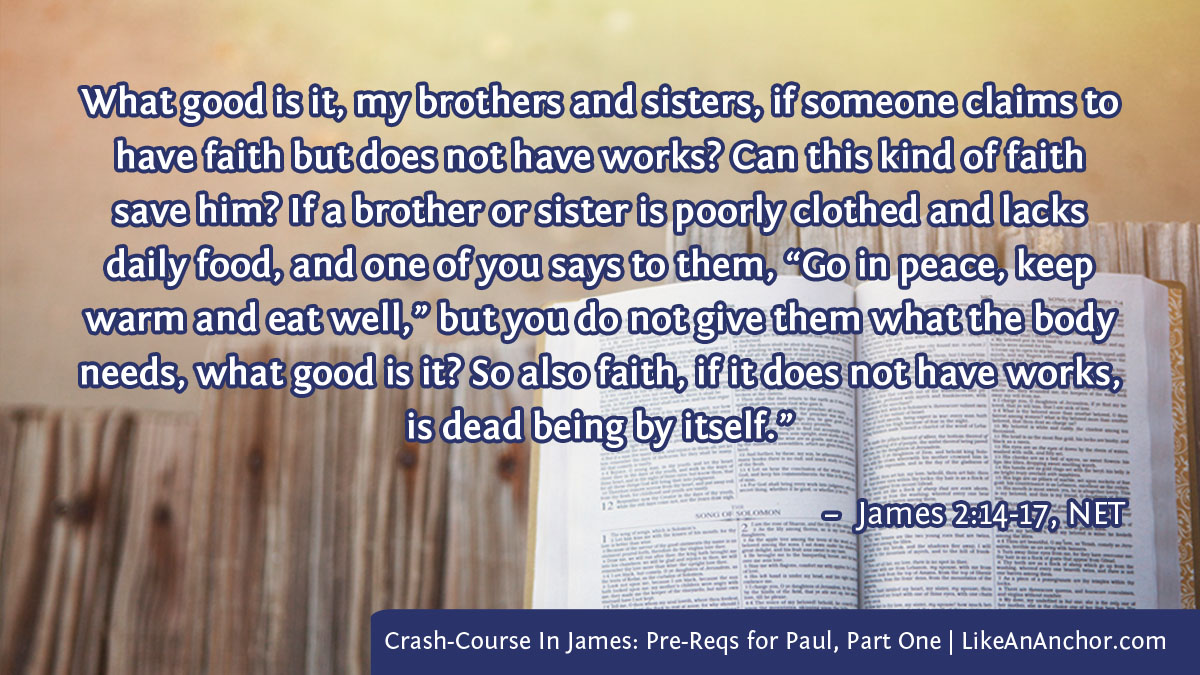
So also faith, if it does not have works, is dead being by itself. But someone will say, “You have faith and I have works.” Show me your faith without works and I will show you faith by my works. You believe that God is one; well and good. Even the demons believe that—and tremble with fear. …  For just as the body without the spirit is dead, so also faith without works is dead.

James 2:17-19, 26, NET

This is part of a longer section on faith and works (click here to read the whole thing). James seems to be confronting the idea that faith is the only thing we need now that Jesus has come. This is an idea we can find in some churches today as well, where people teach grace as if it means we have license to sin because God is willing to forgive. James counters that sort of idea by saying belief which does not result in action is as useless as the sort of “faith” that demons have. It seems a bit harsh to compare a person’s profession of faith to a demon’s belief in God, but I assume that indicates how serious James believed this problem is. Faith without works is dead. If we want living faith, then it needs to produce something good.

Life-Changing Faith

In the early New Testament church, as in many places today, there were those who believed that Jesus did away with all God’s laws and made it so Christians could have a relationship with Him but still go on and live however they wanted. That idea horrified the apostles. It’s one of the things James combats by saying that “faith without works is useless” (2:20, NET). Only foolish people would think that God’s grace should be used as an excuse not to live a godly life.

Who is wise and understanding among you? By his good conduct he should show his works done in the gentleness that wisdom brings. But if you have bitter jealousy and selfishness in your hearts, do not boast and tell lies against the truth. Such wisdom does not come from above but is earthly, natural, demonic. For where there is jealousy and selfishness, there is disorder and every evil practice. But the wisdom from above is first pure, then peaceable, gentle, accommodating, full of mercy and good fruit, impartial, and not hypocritical. And the fruit that consists of righteousness is planted in peace among those who make peace.

James 3:13-18, NET

Good and evil are very real things, and God cares deeply about which one we practice. Becoming friends with the world and giving into the baser “passions that battle inside you” makes you a hostile enemy of God (4:1, 4). We must “resist the devil,” make our hearts pure, and humble ourselves” before the Lord” (4:7-10). We cannot maintain a good relationship with God while also giving into whatever we desire. Trying to live according to our lusts and according to God’s way at the same time is one of the things that makes someone “a double-minded individual, unstable in all his ways” (1:8, NET, see also 4:8). We need to be committed to our faith, and participate in God’s work as He makes us more and more like Him. Once God teaches us what “good” is, then we ought to do what is good. And we also need to recognize that if we’re not doing what is good we are guilty of sin. If we don’t recognize that, then we won’t know to repent, ask for forgiveness, and keep coming back to God when we “miss the mark” (a Hebrew idiom for sin). God is eager to give grace, mercy, and forgiveness but we also play a role in that since we need to know to ask for it as part of our participation in His covenant.

So whoever knows what is good to do and does not do it is guilty of sin.

James 4:17, NET

Our Responsibilities

Once of the main things that holds people back from truly living in faith is pride. Again and again James warns against this tendency. He tells us to never let our own successes make us proud (1:9-11), not to base our judgements of a person’s value on anything external, nor on what we might get from them (2:1-9), not to be ruled by our own lusts (4:1-7), and never to exploit others or prioritize ourselves over them (5:1-6). We’re not even supposed to “speak against one another,” for that makes us “not a doer of the law but its judge” (4:11-12, NET). The Lawgiver is the only qualified judge; our job is to do what is right, not to arbitrate God’s law (though there are a few exceptions where believers are expected to pass certain types of judgements within the church, such as Paul talks about in 1 Corinthians).

It’s challenging enough trying to control the use of our own tongues (3:1-12) and to live within the Lord’s will (4:13-17). Policing others is outside our responsibilities. Rather, our relationships should be based on fulfilling “the royal law as expressed in this scripture, ‘You shall love your neighbor as yourself'” (2:8, NET). In that spirit, if we see someone wandering from the truth we can help them back to God in a humble, loving way without becoming a judge in the way James condemns (5:19-20). Basically, our primary responsibility is to live a godly life that produces fruitful faith.

So be patient, brothers and sisters, until the Lord’s return. Think of how the farmer waits for the precious fruit of the ground and is patient for it until it receives the early and late rains. You also be patient and strengthen your hearts, for the Lord’s return is near. Do not grumble against one another, brothers and sisters, so that you may not be judged. See, the judge stands before the gates! As an example of suffering and patience, brothers and sisters, take the prophets who spoke in the Lord’s name. Think of how we regard as blessed those who have endured. You have heard of Job’s endurance and you have seen the Lord’s purpose, that the Lord is full of compassion and mercy.

James 5:7-11, NET

These lines near the close of James’s letter bring us full-circle. We’re back to the idea of patient endurance while going through trails. And I don’t think it just means the sort of major trials alluded to by referencing a story like Job; it also includes the “smaller,” ongoing struggle of living a godly life every day in a world that’s hostile to godly things. We need the sort of patience and strength that James talks about here so that we can endure to the end. This is also something Peter is going to talk about in the next general epistle, which (if everything goes well with writing that) we’ll be talking about in next week’s post.

“Instead, I am single-minded”: Learning from Paul’s Focus on Jesus

This is a bit shorter than most of the Bible Study posts I share on Saturdays. I’ve been working on a study of James and it’s just not ready yet (an understatement, since I’m guessing I’ve only written about 1/3 of it so far). So for today, I want to share some thoughts about yet another scripture that relates to that double-minded study that we started back in January and which I wrote more about in May when my scripture writing group at church was writing out double-minded scriptures. Here’s the scripture:

Not that I have already attained this—that is, I have not already been perfected—but I strive to lay hold of that for which Christ Jesus also laid hold of me. Brothers and sisters, I do not consider myself to have attained this. Instead I am single-minded: Forgetting the things that are behind and reaching out for the things that are ahead, with this goal in mind, I strive toward the prize of the upward call of God in Christ Jesus. Therefore let those of us who are “perfect” embrace this point of view. If you think otherwise, God will reveal to you the error of your ways.

Philippians 3:12-15, NET

There are only two or three (depending on the translation) scriptures that directly talk about double-mindedness. Similarly, there aren’t many that talk about the opposite: single-mindedness. Once again, how often “single-minded” appears (if at all) depends on translation. The NET version of Philippians 3:13 is one that does talk about being single-minded, though a footnote on that verse says a more literal translation of the Greek phrase here is “But this one thing (I do).”

As you might know if you’ve been reading for a while, I love Philippians 3 (you can click here to read a whole post on it). This is where Paul shares his thoughts on following Jesus. He talks about everything he gave up and the terrible things he as suffered since his conversion, and boldly proclaims that it was all worth it because following Jesus is worth so, so much more than anything he lost.

But these assets I have come to regard as liabilities because of Christ. More than that, I now regard all things as liabilities compared to the far greater value of knowing Christ Jesus my Lord, for whom I have suffered the loss of all things—indeed, I regard them as dung!—that I may gain Christ, and be found in him, not because I have my own righteousness derived from the law, but because I have the righteousness that comes by way of Christ’s faithfulness—a righteousness from God that is in fact based on Christ’s faithfulness. My aim is to know him, to experience the power of his resurrection, to share in his sufferings, and to be like him in his death, and so, somehow, to attain to the resurrection from the dead.

Philippians 3:7-11, NET

Paul’s wording here stirs something in me every time I read it. What a high level of commitment and engagement, and what an expression of love and joy! This is one passage I go to if I’m feeling discouraged or if I ever catch myself wondering if this way of life is worth it. Paul went through a lot more severe trials than I have, and he thought following Christ was well worth any suffering or loss. More than that, Paul was eager to keep going and to know Christ more deeply. For him, even suffering could be a joyful thing because it was shared with Christ. Though “single-minded” might not be a direct translation of the Greek words Paul used in verse 13, it is an accurate representation of his level of focus. Let’s look at those verses one more time.

Not that I have already attained this—that is, I have not already been perfected—but I strive to lay hold of that for which Christ Jesus also laid hold of me. Brothers and sisters, I do not consider myself to have attained this. Instead I am single-minded: Forgetting the things that are behind and reaching out for the things that are ahead, with this goal in mind, I strive toward the prize of the upward call of God in Christ Jesus. Therefore let those of us who are “perfect” embrace this point of view. If you think otherwise, God will reveal to you the error of your ways.

Philippians 3:12-15, NET

Here, Paul calls on all who are “perfect” to share his single-minded focus on God. He wants us to “embrace this point of view” or, in other words, to “have this mind” that’s wholly focused on God (Phil. 3:15, NKJV). This is something we can all work on even if we don’t feel “perfect.” The really encouraging thing about how the Bible talks about people who are “perfect” is that God applies that title to anyone who is on the path toward perfection. For example, God describes Job as “perfect” at the beginning of the book, before Job grows and deepens his relationship with God during the course of the story. As long as we’re trying to become perfect and following God with our whole hearts, souls, and minds then He considers us “perfect.”

Nevertheless, let us live up to the standard that we have already attained. Be imitators of me, brothers and sisters, and watch carefully those who are living this way, just as you have us as an example.

Philippians 3:16-17, NET

Today, let’s follow Paul’s example of being single-minded in following God. There are so many ways we can distract ourselves in today’s world but one thing is worth focusing on more than all the other stuff. Rather than letting ourselves excessively dwell on things that aren’t nearly as important as our relationship with God, let’s have the same mind that Paul models and be whole-hearted in our devotion to God.

Now Available! Like An Anchor Study Guide: The Beatitudes

The first book from my new Like An Anchor Study Guide series is now available! (Release date was actually yesterday, but there was a slight delay with the paperback, so I’m posting this today.) I’m so happy to finally share this book with you, and I’ve been thrilled to hear from beta readers and early reviewers how much they’ve enjoyed this book. You can read some of those early reviews here:

Lynn’s review

Peregrine Arc’s review

If you read my blog series on The Beatitudes that started back in September of last year, then you’ve already seen the first draft of this book. The Study Guide version expands on those posts significantly and each chapter includes discussion/journaling prompts for personal study or for use with book clubs. The book also has a brand new introduction and conclusion, as well as scripture lists with each chapter to provide a starting place to continue studying each Beatitude on your own. Here’s the official description:

It’s safe to say most Christians are familiar with the Beatitudes. Yet even these short, well-known “Blessed are …” phrases contain a treasure-trove of Biblical truth that can deepen our faith and our understanding of the gospel. In this study guide, you’ll find chapters that dive deep into the historic and Biblical context for each beatitude, questions to use as journaling prompts or book club guides, and a wealth of scripture references to support your personal study of God’s word.

As an anchor keeps a ship from drifting with the changing waters, so does a defining belief in God help us ride the waves of life. In this study guide series, we cast our anchors deep into God’s word to seek stability and truth in Him.

Where To Get The Book

The best place to get this book is through Amazon. It’s available in both ebook and paperback formats. It should be showing up in every country’s Amazon store that Kindle distributes to (if you don’t see it in yours, let me know).

Click here to Order The Beatitudes ebook

Click here to Order The Beatitudes paperback

Do You Want To Become Well?

How would you answer if Jesus asked, “Do you want to become well?”

For most, if not all, of us, I think our first instinctive response would be something like, “Yes! Of course I want to be well.” But let’s ponder this a little more. The man Jesus addressed this question to in John 5 “had been disabled for 38 years” (5:5, NET). We don’t know how old he was, but I’m guessing that was at least half his life. Healing would have been a major change to his status-quo. I don’t have experience being physically disabled, but the idea that healing involves a huge change is something I talked about years ago with my first counselor. I was there to overcome and manage anxiety and depression, but the idea of living without those things made me anxious. They’d been such a big part of me for so long that I didn’t know who I’d be without them. My answer to, “Do you want to be made well?” was “I think so?”

What if the question was specifically about spiritual healing? As Chris Tiegreen says in 365 Pocket Devotions, “Jesus knows that sometimes, as much as we think we want to change, we’re comfortable with the status quo. We say we want to be delivered of our sins, but we still look for ways to be tempted by them. … we must be prepared for radical change if we want a real encounter with him” (p. 160). Being healed by Jesus involves a significant change in our lives. The analogy C.S. Lewis uses is that we’re not a field that Jesus needs to mow to get the overgrown grass under control; we’re one that needs to be plowed up and re-sown to produce wheat. Truly becoming well involves a radical, whole-life alteration of our status quo.

We need to be healed

Jesus preached repentance and forgiveness of sins to the world. This message wasn’t received well by those who thought they didn’t need to repent. In fact, those people judged Jesus for spending time “with tax collectors and sinners” (Matt. 9:11, WEB). That attitude didn’t impress Jesus, though. He wasn’t there just to focus on people who thought they didn’t need Him. He came to heal people.

Behold, they brought to him a man who was paralyzed, lying on a bed. Jesus, seeing their faith, said to the paralytic, “Son, cheer up! Your sins are forgiven you.”

Behold, some of the scribes said to themselves, “This man blasphemes.”

Jesus, knowing their thoughts, said, “Why do you think evil in your hearts? For which is easier, to say, ‘Your sins are forgiven;’ or to say, ‘Get up, and walk?’ But that you may know that the Son of Man has authority on earth to forgive sins—” (then he said to the paralytic), “Get up, and take up your mat, and go to your house.”

He arose and departed to his house.

Matthew 9:2-7, WEB

With this miracle, Jesus dramatically changed a man’s life. He proved He could heal both physically and spiritually, and He taught that His power to heal physically pointed to His power to heal spiritually. Right after this healing, Jesus called Matthew (a tax collector) to follow Him, then overheard the Pharisees asking His disciples why their rabbi would associate with tax collectors and sinners.

When Jesus heard it, he said to them, “Those who are healthy have no need for a physician, but those who are sick do. But you go and learn what this means: ‘I desire mercy, and not sacrifice,’ for I came not to call the righteous, but sinners to repentance.”

Matthew 9:12-13, WEB

When Jesus looks at sinners (a group we’re all part of), He sees people who need healing. When we resist repentance or don’t recognize our need for His forgiveness, it’s as crazy as running away from someone who could stop you from having a heart attack or falling prey to a nasty virus.

Jesus’s healing is able to save us

Jesus is willing to heal and cleanse us. He invites all of us to come to Him, repent, ask for His help, and receive forgiveness and renewed spiritual health. Sometimes (and for a whole host of reasons) we may not receive the physical healings we ask for, but He always grants forgiveness to repentant sinners. Some sins may still have consequences (e.g. when God forgives someone for breaking “thou shalt not steal” it may not stop them from facing fines or prison time) but when Jesus heals us spiritually, He ensures that those consequences will not include us dying for our own sins.

He himself bore our sins in his body on the tree, that we may cease from sinning and live for righteousness. By his wounds you were healed. For you were going astray like sheep but now you have turned back to the shepherd and guardian of your souls.

1 Peter 2:24-25, NET

Even when God disciplines us, it’s for the purpose of healing (Heb. 12:11-13). We should also work alongside God to “be healthy in the faith” (Tit. 1:13, NET). In that verse from Titus, the word for “healthy” is the same word used in Luke’s version of “Those who are well don’t need a physician, but those who are sick do” (Luke 5:31, NET). In Greek, it’s hugiainō, which means “to be sound, to be well, to be in good health” (Thayer’s dictionary entry G5198). Interestingly, this word is also used of “sound doctrine/words” (1 Tim. 1:10; 6:3; 2 Tim. 1:13; 4:3; Tit. 1:9; 2:1). In order to stay sound and healthy after we’re initially healed, we need to keep doing things related to good spiritual health. That includes taking in the “sound words” of God and asking Jesus for continued healing/forgiveness as we make mistakes.

Accepting Jesus’s offer of healing means a radical change in our lives. It means admitting we need healing and wanting it enough to ask for forgiveness and let Him heal us. It means putting off the “old man” (Eph. 4:22; Col. 3:9) and following Jesus, being remade in His image. It means learning from God’s correction and discipline as we hold on to sound, healthy doctrine and do our best to follow Him. And it means joy, peace, and spiritual health like we can’t find anywhere else. There’s so much to look forward to about the changes that happen as Jesus continues to work with, heal, and befriend us.

So, do you want to become well?

Holding on to Our Joy in the Lord

We don’t often give the minor prophets much attention, beyond telling the story of Jonah or studying some sections if you’re curious about future and fulfilled prophecies. I find, though, that when I do study them or run across a verse from one in word searches that their messages are often surprisingly relevant for today. The section of a minor prophet’s book to most recently catch my eye is a verse at the end of Habakkuk.

The short book of Habakkuk records an exchange between the prophet and God, then ends with a psalm/prayer. At the beginning, Habakkuk looked at the nation around him and cried out to the Lord about how “the law lacks power, and justice is never carried out” (Hab. 1:4, NET). He wants God to intervene and make things right, as so many of us want today. However, when God answers it is not the way Habakkuk hoped or expected. God says He’s going to “empower the Babylonians” (Hab. 1:6) to take over Israel.

Habakkuk is so horrified that he argues with God (Hab. 1:12-2:1). God is not obligated to explain Himself to people, yet in this case he does. He talks about how people of integrity ought to live (“the righteous will live by his faith,” see Hab 2:4; Rom. 1:17; Gal. 3:11; Heb. 10:38), and contrasts how He relates to those people with what awaits the wicked. He proclaims, “Woe!” to those who’ve rejected Him and promises that “recognition of the Lord’s sovereign majesty will fill the earth” (Hab. 2:14, NET). It’s quite a lengthy response (Hab. 2:2-20), and Habakkuk seems satisfied with it since the next part of the book is a prayer, likely set to music, praising God. That’s where we’ll focus today.

Receiving Good and Evil from the Lord

Earlier, Habakkuk protested the Lord’s plan to punish His people, but now after talking with God the prophet’s perspective changed. In the prayer recorded at the end of this short book, there’s an odd mix of talking about destruction and salvation. People today often struggle to reconcile the idea of a God that would allow suffering with a God that is salvation, deliverance, and love. Habakkuk doesn’t seem to have that trouble.

Yahweh, I have heard of your fame.
I stand in awe of your deeds, Yahweh.
Renew your work in the middle of the years.
In the middle of the years make it known.
In wrath, you remember mercy. …

Plague went before him,
and pestilence followed his feet.
He stood, and shook the earth.
He looked, and made the nations tremble. …

You went out for the salvation of your people,
for the salvation of your anointed.
You crushed the head of the land of wickedness.
You stripped them head to foot. Selah.

Habakkuk 3:2, 5-6, 13, WEB

This reminds me of a question Job asked his wife: “Should we not receive what is good from God and not also receive what is evil?” (Job 2:10, NET). If we believe God is sovereign and that He is responsible for all the good things that happen in our lives, then we ought to trust Him through the bad things as well. There could be something going on that we don’t know about, such as Job suffering as part of God showing that one man’s faith, tested by fire, could make a cosmic difference. Or maybe God is punishing an unfaithful nation and we get caught up in that even though we’re faithful, as happened here with Habakkuk. Or maybe He’s allowing suffering in order to test, refine, and strengthen us (which is the context that the New Testament writers usually mean when they talk about God testing or trying us. See, for example, 1 Pet. 1:6-8; 4:12-13). Whatever the reason for the suffering, the message Habakkuk holds onto is that God is still worthy of trust. He has a plan. He will take salvation action. The timing for that might not make sense to us (yet), but that does not cancel-out the fact that we can have faith in the Lord’s plan and His goodness.

Holding on to Joy

At the end of the prayer, Habakkuk voices some very understandable nervousness. He talks of trembling, knowing that he “must wait quietly for the day of trouble, for the coming of the people who will invade us” (Hab. 3:17, WEB). He has talked with God about what will happen in the future, accepted the Lord’s response, and decided to trust. He is still nervous, but then he makes a very powerful statement of radical faith.

For though the fig tree doesn’t flourish,
nor fruit be in the vines;
the labor of the olive fails,
the fields yield no food;
the flocks are cut off from the fold,
and there is no herd in the stalls:
yet I will rejoice in Yahweh.
I will be joyful in the God of my salvation!
Yahweh, the Lord, is my strength.
He makes my feet like deer’s feet,
and enables me to go in high places.

Habakkuk 3:17-19, WEB

Even if the food supply collapses and the country is overrun by invaders, Habakkuk intends to rejoice. He is not rejoicing because those bad things happen, but because they have no power to take away the true cause of Habakkuk’s joy. God is sovereign! He is salvation and strength! That’s not going to change, and holding on to that truth lets us rejoice in Him and claim Him as our savior. No matter what comes, we can imitate Habakkuk’s faith and boldly say, “I will be joyful in the God of my salvation!