What Is Real?

I’ve been thinking about reality lately, for several reason. I recently started a new job where I’m tutoring younger kids than I’ve worked with before, and one of the things taught alongside reading skills is how to identify clues that let you know whether a story is realistic or fantasy. As a writer and avid reader, though, I know how easy it can be to blur those lines. You might do tons of research to write a very accurate, realistic setting (for example) then throw a dragon or werewolves into the story. Also, people can define “realistic” differently. A flood covering the world or a dead man coming back to life seem like fantasy to many, but for Christians the Bible is realistic and it’s non-fiction.

The question, “What’s really going on here?” is one that the Bible asks and answers, mostly indirectly. Satan started out his attacks on both Eve and Jesus by questioning the nature of reality. To Eve, he said, “Has God really said, ‘You shall not eat of any tree of the garden’?” ( Gen. 3:1, WEB, emphasis added). To Jesus, he called the reality of who He is into question by saying, “If you are the Son of God…” (Matt. 4:3, 6, WEB, emphasis added). In sharp contrast to the adversary’s scheming and questioning, God is very open with us about the nature of reality. He tells us how things are, what will happen in the future, what the consequences are for different choices, and which things will endure forever so we know where to put our focus and energy. In other words, God shares truth with us about what is real.

The Best Place to Find Real Truth

Truth, and along with it the notion of an objective reality, has largely been rejected by modern society. Faced with the realization that there are an infinite number of perspectives and ideas, the world has made the terrible decision to try and act as if they were all equally valuable no matter how contradictory or crazy they seem. We can’t even agree on a “fact” anymore. There’s no need for such confusion, though. There is such a thing as reality and truth and the Bible, along with the holy spirit, is the key to figuring out what that is.

This notion doesn’t sit well with many people. Even some believers might balk at the idea at times. We all want so badly to be right. We want our take on things to be real. We’ve been told for years to follow our hearts and trust ourselves. And yet, “the human mind is more deceitful than anything else” (Jer. 17:9, NET). The inside of our own heads is a terrible place to look for truth. According to psychological studies, we can’t even trust that our own memories are accurate. Spiritually speaking, we might even be dead, “wretched, pitiful, poor, blind, and naked” without realizing it! (Rev. 3:1, 17, NET). If we want to know how things really are and what truth is, we need to look to God.
Focusing on What is Most Important

I feel like I’ve been spending a lot of time in 1 Corinthians 2 over the past few months (both in blog posts and for the double-minded scripture writing theme), and we’re back here again today. In this section of scripture, Paul talks about the difference between worldly wisdom and spiritual wisdom, showing us how God transforms our spirits, minds, and hearts with His Spirit. Much like the spirit (G4151, pneuma, spirit, soul, life, breath) inside us understands us better than we understand other people, the Spirit in God knows “the deep things of God” (1 Cor. 2:9-11).

But we received not the spirit of the world, but the Spirit which is from God, that we might know the things that were freely given to us by God. … Now the natural man doesn’t receive the things of God’s Spirit, for they are foolishness to him, and he can’t know them, because they are spiritually discerned. … “For who has known the mind of the Lord, that he should instruct him?” But we have Christ’s mind.

1 Corinthians 2:14, 16, 18, WEB

We can only understand the Truth behind perceived reality through God’s spirit in us. Specifically, what we see physically only hints at what is the most real. This creation will pass away, replaced by a new, more enduring creation. The battles we fight today are not as they appear; they are really “against spiritual forces of wickedness in heavenly places” (Eph. 6:12, WEB). Even the Law possesses only “a shadow of the good things to come but not the reality itself” (Heb. 10:1, NET)–“The reality is Christ!” (Col. 2:17, NET).

The physical seems very real, and in many ways it is. We’re not living in a fake world, but one that God created and gave to us. And yet, when we start to perceive things with the mind of Christ it changes how we look at reality. We start to understand why it makes sense for Jesus to tell us we shouldn’t worry about things like food and clothing and should instead focus on seeking “God’s kingdom and his righteousness” (Matt. 6:25-34). It’s not the things we can see and touch that are most important, but the spiritual things which God invites us to take part of.

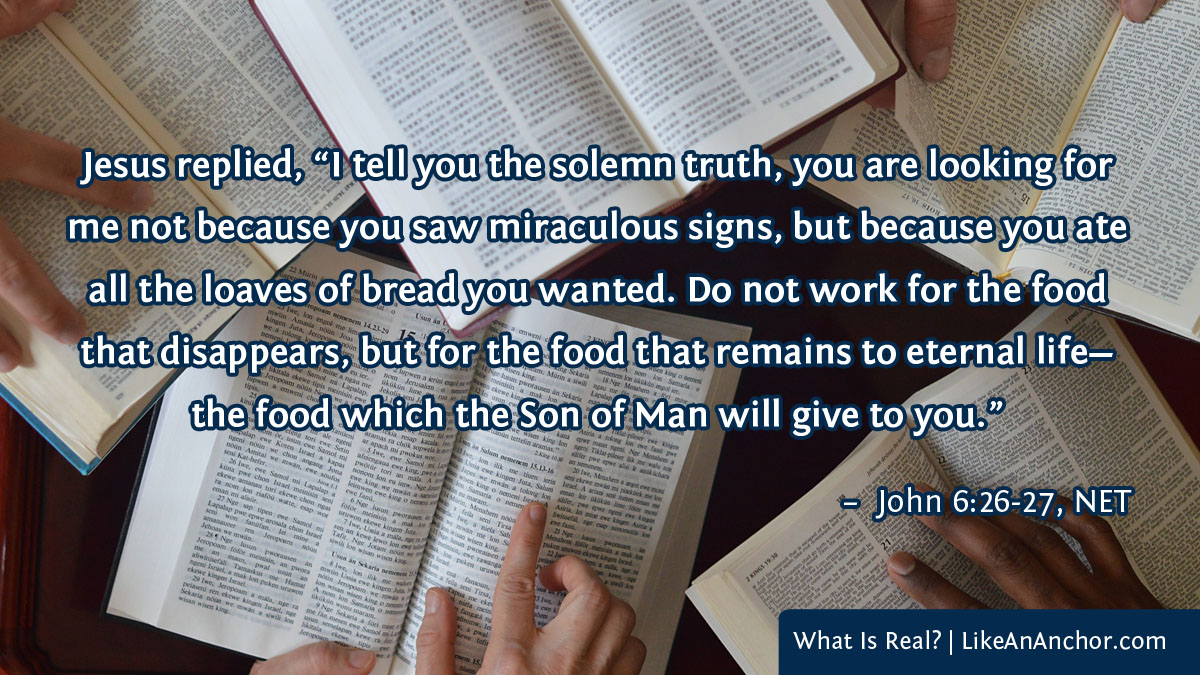
So we fix our eyes not on what is seen, but on what is unseen, since what is seen is temporary, but what is unseen is eternal.

2 Corinthians 4:18, NET

Making Time for Our Real Lives With God
The Bible never tells us that this physical life doesn’t matter or that God doesn’t care about how we choose to live these lives. God’s word does, however, tell us the physical matters less than the spiritual. We must not let temporary things distract us from the true riches that can be found eternally with God.

Do not store up for yourselves treasures on earth, where moths and vermin destroy, and where thieves break in and steal. But store up for yourselves treasures in heaven, where moths and vermin do not destroy, and where thieves do not break in and steal. For where your treasure is, there your heart will be also.

Matthew 6:19-21, NET

Investing in the spiritual ensures that our hearts are in the right place (i.e. with God) and that the things we spend our time on are real, true, and lasting. In today’s world, there are many possible distractions. We might be distracted worrying about bad news or the threat of future troubles. We might loose ourselves in entertainment like movies, books, and video games (something I personally find very tempting). Or we could just be so busy with our daily lives that we push spending time on the spiritual off until later. But we need to commit ourselves to prioritizing our relationship with God and investing in what will really, truly last beyond this physical life.

Featured image by Anggie from Lightstock
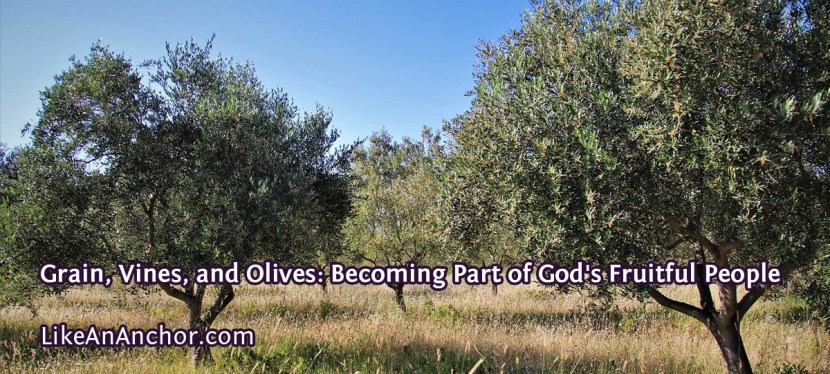
Grain, Vines, and Olives: Becoming Part of God’s Fruitful People

The Bible uses a lot of agricultural imagery. You’re probably most familiar with this from Jesus’s parables about sowers and fields, or His statement “I am the vine.” These sorts of analogies are rooted both in the culture of Jesus’s day and in the Old Testament writings, and they focus on three types of plants: grain, vines, and olive trees. Those plants are also the three main agricultural products of Palestinian farming: “grain, new wine, and oil” (Theological Wordbook: Old Testament, entry 1040a). These three things figured prominently in scripture, mostly in tithes and offerings (Lev. 23:13; Deut. 14:23; 18:4; 2 Chr. 31:5; Neh. 10:39; 13-12) and promised blessings (Deut. 11:14; Jer. 31:12; Hos. 2:8, 22; Joel 2:19, 24).

Grain, vines, and olive trees were a key part of culture in Bible times and they’re used in teachings that are a key part of our faith. The study I’m sharing today started out with the question, “How can we bear fruit for God?” and the more I looked into it the more fascinated I became with the way God and the writers He inspired use these three plants to tell us about His plan, kingdom, and relationship with people. At first, I planned to divide this up into three posts (one for each type of plant), but the way the Bible talks about them is so intertwined I don’t think that would be useful. That means today’s post is a little on the long side, but I hope you’ll find this study as interesting as I do 🙂

A Brief History of God’s Vineyard

Obviously, grain, vines, and olives are useful for physical things. They were key to food production, they were used extensively for tithes and offerings, and olive wood played an important role in construction. In addition to these uses (and perhaps because these plants were so well-known and widely used), the Bible also talks about metaphors and spiritual parallels for us using these three types of plants and their produce. Hosea offers a great example of this.

Near the beginning of Hosea’s book, God brings a complaint against Israel, His unfaithful wife who “has refused to acknowledge that I was the one who gave her the grain, the new wine, and the olive oil” (2:8, NET). God’s punishment for her idolatry was to “take back my grain … and my new wine,” turning the cultivated land for food production into an “uncultivated thicket” (2:12, 15). That’s not the end of the story, though.

I will commit myself to you in faithfulness;
then you will acknowledge the Lord.
“At that time, I will willingly respond,” declares the Lord.
“I will respond to the sky,
and the sky will respond to the ground;
then the ground will respond to the grain, the new wine, and the olive oil;
and they will respond to ‘God Plants’ (Jezreel)!
Then I will plant her as my own in the land.

Hosea 2:20-23, NET

When a new covenant is restored with God’s people Israel, the agricultural blessings return. God’s people are compared to “a fertile vine that yielded fruit” (Hos. 10:1, NET). In this passage, Israel is also counseled to plow up the ground of their lives and bear new crop–righteousness and love rather than wickedness and injustice (10:11-13). Here in Hosea, we see the fruit of grain, grape, and olive plants used to speak of blessings, punishment, and (most relevant to today’s topic) the state of human hearts. Are we planted by God, or growing wild? Are we sowing with a good harvest in mind, or investing in bearing bad fruit?

Cultivating a Faithful People

In the Old Testament, Israel is often compared to a vine. Typically, it’s in a negative context. Israel was a vine that betrayed God and so He withdrew His protection from them (Psalm 80:8-16). It was a vineyard where the grapes went sour, rotten, and foul (Is. 5:1-7; Jer. 2:21). It was a fruitful vine that used its fruit to worship a false god (Hos. 10:1). The consequences of all this unfaithfulness was to be punished, burned like a dried-out vine cut away from a plant (Ezk. 15:1-7; 19:10-14). There is, however, a promise of restoration. The Lord will protect and water His vineyard, and Israel will blossom and thrive (Is. 27:1-6; Hos. 14:4-8).

The way the prophets talked about Israel as a vine would have been very familiar to the Jewish people of Jesus’s day. When He taught parables which compared the kingdom of God to a vineyard (Matt. 20:1-16; 21:33-46), His listeners would have connected it to what they heard read in the temple about Israel as God’s vineyard. And when Jesus spoke of a vineyard where the people tending it betrayed the owner, the “chief priests and the Pharisees … realized that he was speaking about them” when Jesus said, “for this reason I tell you the kingdom of God will be taken from you and given to a people who will produce it’s fruit” (Matt. 21:43-46, NET).

Jesus–as the Word who delivered God’s message to the prophets–knew exactly what He was doing when He compared the kingdom of God to a vineyard, showed that the Lord is the only one with the right to decide how that vineyard is managed, and warned that the unfaithful would not be allowed to grow in the kingdom/vineyard forever (Matt. 15:12-13). Much like the parables where Jesus compares His people and people’s reactions to His word to grain (Matt. 13:18-30), the way Jesus talks about vines shows that the kingdom’s inhabitants are not a group which automatically includes any one type of people based on their background. He’s specifically cultivating a field/vineyard full of faithful people, regardless of where they started out “growing.”

All Nations Grafted In

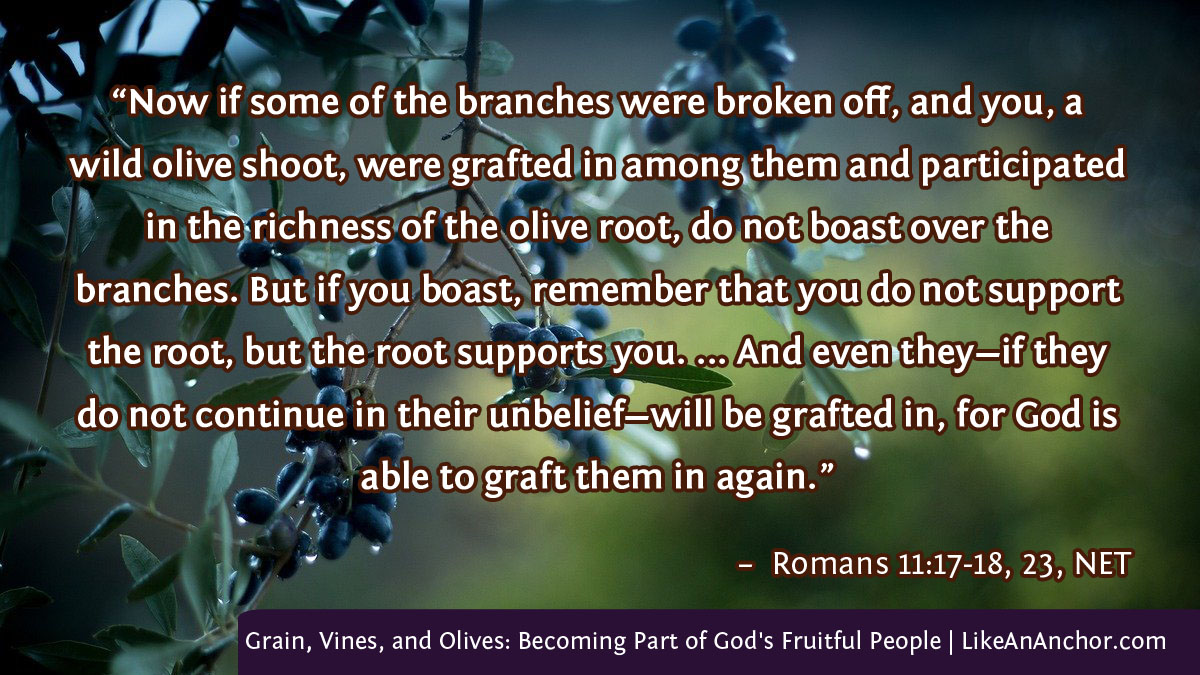
We’ll come back to the idea of fruitfulness, but this last point about a change in the composition of the field/vineyard also connects to an olive tree analogy that Paul uses in Romans. Like vines and grain, olives figure prominently in scripture. Olive oil was used to anoint kings and priests, and as part of the offerings. Olive wood was used to build sukkas (Neh. 8:15) and in the temple construction (1 Kings 6:23, 31-33). Someone who trusts “in God’s loyal love” is “like a flourishing olive tree” (Ps. 52:8, NET). Much like the vine imagery, Israel was also called a once fruitful and “thriving olive tree” that became “good for nothing” through unfaithfulness and was set on fire (Jer. 11:16, NET).

It’s with that background that Paul uses olive trees imagery to show his gentile readers how they relate to the Jews (which represented one tribe of Israel, Judah, though Paul uses them to stand-in for all of physical Israel). Even in the Old Testament, the name “Israel” referred to both a physical nation and to a smaller group of spiritual, faithful believers (Rom. 11:1-4). A similar thing is happening today, only now this faithful remnant doesn’t just include descendants of Abraham, Isaac, and Jacob. It includes those who were once outside Israel as well and who’ve responded to God’s call (Rom. 11:5-16).

To illustrate this, Paul compares Israel to a cultivated olive tree and the Gentiles (ethnos in Greek; tribes, peoples, nations) to a wild olive tree. Both groups are olives–people made in the image of God–but one has a longer history of being chosen, tended, and cultivated by God for a specific purpose. Now, the Master Gardener is expanding His cultivation project. He’s pruning out those who do not believe and grafting in those who have faith. Which olive tree you came from doesn’t matter; only the state of your heart (Rom. 11:17-24). In other words, God is still working in the same vineyard/field/orchard that He has always had, cultivating a kingdom people, but He is bringing new vines and branches in and grafting them all onto one Root.

How to Bear Fruit for God

Jesus is the holy root which makes the branches grafted into Him holy (Is. 11:1-10; 53:1-5; Rom. 11:16; 15:8-13; Eph. 3:16-19; Col. 2:6-7; Rev. 5:5; 22:16). Remember all those verses about Israel as an unfaithful, fruitless vineyard and the prophecy about future growth? Jesus is how that prophecy is fulfilled.

“I am the true vine and my Father is the gardener. He takes away every branch that does not bear fruit in me. He prunes every branch that bears fruit so that it will bear more fruit. You are clean already because of the word that I have spoken to you. Remain in me, and I will remain in you. Just as the branch cannot bear fruit by itself, unless it remains in the vine, so neither can you unless you remain in me.

“I am the vine; you are the branches. The one who remains in me—and I in him—bears much fruit, because apart from me you can accomplish nothing. If anyone does not remain in me, he is thrown out like a branch, and dries up; and such branches are gathered up and thrown into the fire, and are burned up. If you remain in me and my words remain in you, ask whatever you want, and it will be done for you. My Father is honored by this, that you bear much fruit and show that you are my disciples.”

John 15:1-8, NET

See how this echoes so many of the prophecies we’ve looked at? Jesus reveals that He is the one we need to have a relationship with in order to be fruitful. Without Him, we wither away like ancient Israel so often did as they strayed into unbelief. The emphasis on being rooted also echoes other prophresies that talk of God’s people being rooted (Is. 27:6; 37:31-21; Jer. 17:7-8). The closer we are to God, the more firmly we’re rooted and the more we thrive. And the more we study what the whole Bible says about the way God’s people are like grain, vines, and olives the better we understand what Jesus is teaching us in passages like this one where He says, “I am the vine.”

God is looking for fruit from the people growing in His vineyard. He exercises patience, encouraging us to grow, but if we refuse to keep abiding in Him, He won’t force us to stay and bear fruit (Luke 13:6-9). We can’t grow and fruit without Him (1 Cor. 3:6-9), but we are also active participants in this fruitfulness and we are free to disconnect from the root and be unfruitful if we choose (as so many Jewish people of Jesus’s day chose to do when they rejected Him as the Messiah). When we choose to abide in Jesus, though, we will abound in the fruits of His spirit (Gal. 5:22-23; Eph. 5:8-11; 2 Pet. 1:5-8). In His grace, goodness, and love, God has opened the way through Jesus’s sacrifice for all people everywhere to become part of His kingdom-garden. Let’s stay close to Him, rooted with faith and trusting Him to supply all we need to grow and thrive and bear fruit that glorifies our Father.

Featured image by pasja1000 from Pixabay

Like An Anchor Study Guide: The Beatitudes available for preorder and ARC

I’m so very excited to announce that the first book in my Like An Anchor Study Guide series is available for preorder. The Beatitudes releases on June 22nd, and you can order an ebook copy now. If you’d rather have a print copy, then you’ll need to wait until June 22nd to order it (for some reason I can’t set up a preorder option for print books).

This book has been a labor of love for several months now and I’m so happy I can finally share it with you all. If you read my blog series on The Beatitudes that started back in September of last year, then you’ve already seen the first draft of this book. The Study Guide version expands on those posts in each chapter and includes discussion/journaling prompts. The book also has a brand new introduction and conclusion, as well as scripture lists with each chapter to provide a starting place to continue studying each Beatitude on your own. Here’s the official description:

It’s safe to say most Christians are familiar with the Beatitudes. Yet even these short, well-known “Blessed are …” phrases contain a treasure-trove of Biblical truth that can deepen our faith and our understanding of the gospel. In this study guide, you’ll find chapters that dive deep into the historic and Biblical context for each beatitude, questions to use as journaling prompts or book club guides, and a wealth of scripture references to support your personal study of God’s word.

As an anchor keeps a ship from drifting with the changing waters, so does a defining belief in God help us ride the waves of life. In this study guide series, we cast our anchors deep into God’s word to seek stability and truth in Him.

ARC Information

In preparation for this books release, I’m looking for volunteers who would be willing to read and review this book before the release. I’d email you a free, PDF copy of this book and ask that you post reviews online by the end of June. If you are interested in this opportunity, please fill out this form:

ARC Request Form for The Beatitudes (now closed)

Please note that I will be closing this form on June 8th, two weeks before the release date, so if you’re interested please apply before then. Ideally, I’m looking for people who could post a review of this book to Goodreads before or shortly after the release date and to Amazon shortly after the release date. Sharing the review on a personal blog or promoting the book on social media is also much appreciated, but not required.

Preorder Information

If you’re not interested in reviewing and promoting this book but you’d still like to read it, you can preorder the book through the Amazon Kindle Store. The paperback will be available for order on June 22nd (which is also when the Kindle copy will be automatically delivered if you preorder the book).

Click here to Preorder The Beatitudes

Hearts of Shalom: Nothing Missing, Nothing Broken

I had a completely different post planned for today, but then I started looking more closely at 2 Chronicles 16:9 on Wednesday (it’s Day 19 of the Double-Minded scripture writing list that I brought up in last week’s post) and I just had to keep studying it. Here’s that verse in a few different translations to start us out:

“For Yahweh’s eyes run back and forth throughout the whole earth, to show himself strong in the behalf of them whose heart is perfect toward him.” (WEB)

“Certainly the Lord watches the whole earth carefully and is ready to strengthen those who are devoted to him.” (NET)

“For the eyes of Adonai move here and there throughout the whole earth, to show himself strong on behalf of those who are wholehearted toward him.” (CJB)

“For the eyes of the Lord range throughout the earth to strengthen those whose hearts are fully committed to him.” (NIV)

2 Chronicles 16:9

I think it’s fascinating to realize God is actively looking to be strong in and on behalf of certain people. The description of those people is what I want to focus on today. Even though I’ve looked up the Hebrew words used here before I hadn’t really thought that deeply about what they mean, and I’ve found studying deeper into this topic of “perfect” hearts both fascinating and encouraging.

A short Hebrew study

As you can see, the description of the people who catch God’s eye is translated in several different ways–“them whose heart is perfect,” “those who are devoted to him,” “those who are wholehearted toward him,” and “fully committed to him” (and there are even more in other translations). In Hebrew, the word “heart” is leb or lebab, and it is “the richest biblical term for the totality of man’s inner or immaterial nature” (Theological Wordbook of the Old Testament, entry 1071a). While leb can just mean the muscle that pumps blood through your body, in a context like this it means your inner person, mind, emotions, will, understanding, and soul (BDB lexicon, H3824). It’s because this word encompasses so much of our minds, wills, and natures that I think “whole-hearted” is the opposite of “double-minded.”

Though “heart” is a fascinating study, it’s the “wholeness” part that caught my eye this time. The word that’s behind the translators’ decision to use words like “whole,” “perfect,” “devoted,” and “committed” is shalem (H8003). If that looks a lot like shalom (the Hebrew word for peace, H7965), it should. They are both part of the same word family derived from the root sh-l-m (TWOT, 2401). Shalom is used most often (over 250 times); shalem is an adjective form used 26 times.

Of all those times that shalom is used in the Bible, it only means “absense of strife” about 50-60 times (TWOT, 2401a). Far more often, it means something that a single English word like “peace” is woefully inadequate to express. Trying to fix this problem, the King James Version used about 30 different words in the Old Testament to translate shalom.

The root meaning of the verb shālem better expresses the true concept of shālôm. Completeness, wholeness, harmony, fulfillment, are closer to the meaning. Implicit in shālôm is the idea of unimpaired relationships with others and fulfilment in one’s undertakings.

TWOT by Laird R. Hariss, Gleason L. Archer, Jr., and Bruce K. Waltke, entry 2401

My favorite short version of a definition for shalom is one I’ve heard used by a Messianic rabbi. Shalom is wholeness–nothing missing, nothing broken. That’s the kind of heart that God creates in us (filling in the missing things and healing the brokenness) and which He is looking for as His eyes roam the earth.

Hearts of shalom

All the times when shalem is paired with “heart” are found in discussions of Israel’s kings. As you read through the books of Kings and Chronicles (and one verse in Isaiah), you’ll see phrases like “his heart was not perfect with Yahweh his God, as the heart of David his father” (1 Kings 15:3, WEB) or sometimes “the heart of Asa was perfect all his days” (2 Chron. 15:17, WEB). Once, when talking about Amaziah, there’s even the curious phrase, “He did that which was right in Yahweh’s eyes, but not with a perfect heart” (2 Chr. 25:2, WEB). Apparently, you can “do what’s right” without actually being wholehearted (which makes sense when we think of the hypocrisy that the Jesus called-out the Pharisees on because they “say and don’t do“).

I find all this fascinating. First, I’m puzzled why a shalem heart is only used in very specific contexts. It’s used by a king talking to the next king (1 Chr. 28:9), the people in relation to a king (1 Chr. 12:38), a king instructing the people (1 Kings 8:55, 61; 2 Chr. 19:9), those keeping records about kings, or a prophet speaking to a king, which is where we started this post. Even David, the man after God’s own heart who was held up as the exemplar of what it meant to be a king with a perfect heart, doesn’t pair shalem or shalom with leb in his psalms (at least not in the same verse, see Psalm 4:4, 8 and 37:4, 11, 31, 37).

Still, though the use of this phrase is limited to one particular section of the Bible, we can see the benefits of having a whole, perfect, and complete heart. There’s great value in cultivating a relationship with God where nothing’s missing or broken. He wants that from kings serving Him, and Revelation tells us that God intends for us to become kings and priests (or in some translations a kingdom of priests; Rev. 1:6; 5:10). We might not be ruling monarchs of ancient Israel, but God still wants us to have hearts like David’s.

Characteristics of David’s heart

Though David doesn’t link hearts and peace directly, he does write extensively about the heart’s relationship with God. Since we know he had a shalem heart, reading his writing on hearts can help us develop hearts like this as well. According to the psalms, a heart like David’s is …

That’s quite a list. And this wasn’t even a super in-depth study (I ran out of time to study this topic any more before today’s post)–just a search on MySword Bible app for psalms attributed to David that mention “heart.” Still, it gives us a fantastic starting point for developing hearts that are whole, perfect, and complete in their relation to God. I also find it really encouraging that it’s David who’s held up as an example for us to follow. God doesn’t need to start with perfect people in order for us to have whole hearts with “nothing missing, nothing broken.” David was far from perfect–he even killed the husband of the woman he committed adultery with–and yet God still loved Him and kept working with him after David repented and asked for a clean heart.

If God didn’t give up on David, then I know He’s not going to give up on me. And He’s not going to give up on you. We just need to make sure we don’t give up on ourselves either and keep coming back to God, cultivating a heart that’s wholly focused on Him. Then, God will make sure to give us hearts full of shalom.

Now may the God of hope fill you with all joy and peace in believing, that you may abound in hope, in the power of the Holy Spirit.

Romans 15:13, WEB

Featured image by Prixel Creative from Lightstock

Combating Doubt with Faith, Hope, and Love

I’ve been thinking about the topic of “double-minded” again. The phrase only appears two or three times in the Bible (depending on the translation), but I wrote a whole post on it a few months ago and this month it’s the topic for my church’s scripture writing group (click here to download a copy for yourself). As I write out these scriptures each day, other scriptures keep coming to mind related to how we can avoid being double-minded and instead be whole-hearted for God.

Being able to maintain a whole-hearted level of commitment is very important for us. We don’t want to be “like a wave of the sea, blown and tossed around by the wind … a double-minded individual unstable in all his ways” (James 1:6, 8, NET). Doubt like that has no place in a faithful life. But saying we need to have faith without doubting and really living that way are two different things. What is it that can keep us from being tossed around like this by turmoil, questions, and fear?

Fixed on Jesus

The double-minded person is described as “tossed around” and “unstable.” You could say they are wavering between two ways of being and thinking: faith and doubt. So that means we need to find something unwavering to hold on to if we’re going to avoid being trapped in this sort of mindset.

we must get rid of every weight and the sin that clings so closely, and run with endurance the race set out for us, keeping our eyes fixed on Jesus, the pioneer and perfecter of our faith.

Hebrews 12:1-2, NET

Jesus endured the cross without wavering, and He’s now sitting at God’s right hand advocating for us (Heb. 12:2; Rom. 8:34). He isn’t going to leave us on our own, and that gives us confidence. We can come to God the Father through Jesus at any time from anywhere with anything we need to talk about.

Therefore, brothers and sisters, since we have confidence to enter the sanctuary by the blood of Jesus, by the fresh and living way that he inaugurated for us through the curtain, that is, through his flesh, and since we have a great priest over the house of God, let us draw near with a sincere heart in the assurance that faith brings

Hebrews 10:19-22, NET

Holding on to Jesus is the first step in combatting doubts and fears that would make us double-minded, unstable people. Faith is where our journeys as Christians start, and if we feel ourselves wavering then we need to go back to that foundation and focus on Jesus. He’s where our confidence to keep enduring comes from.

Anchored in Hope

Continuing to read in Hebrews 10, the author adds another layer to how we can hold fast to Jesus: “And let us hold unwaveringly to the hope that we confess, for the one who made the promise is trustworthy” (Heb. 10:23, NET). Being double-minded makes us wavering; hope in Jesus is something we can hold on to unwaveringly. For Christians, hope isn’t a nebulous possibility. It is a sure and certain thing.

so that we who have found refuge in him may find strong encouragement to hold fast to the hope set before us through two unchangeable things, since it is impossible for God to lie. We have this hope as an anchor for the soul, sure and steadfast

Hebrews 6:18-19, NET

We have faith in God, He proves Himself faithful, and that gives use a solid foundation for hope. If we can hold on to faith and hope, then we have an anchor to keep us from being tossed around like a wave on the sea. We have a way to combat double-mindedness as we keep moving forward in faith and hope.

Brothers and sisters, I do not consider myself to have attained this. Instead I am single-minded: Forgetting the things that are behind and reaching out for the things that are ahead, with this goal in mind, I strive toward the prize of the upward call of God in Christ Jesus. Therefore let those of us who are “perfect” embrace this point of view. If you think otherwise, God will reveal to you the error of your ways.

Philippians 3:13-15, NET

And the Greatest is Love

Faith and hope are commonly paired in scripture (Rom. 5:2; Gal. 5:5; Col. 1:23; 1 Thes. 1:3; Heb. 11:1; 1 Pet. 1:21). They’re also spoken of alongside love as something we ought to put on (1 Thes. 5:8). Indeed, Paul tells us “faith, hope, and love” are what endure and remain, and of the three “the greatest is love” (1 Cor. 13:13, NET). It would make sense, then, that love would also play a vital role in keeping us whole-heartedly focused on God.

One of the scribes came, and heard them questioning together, and knowing that he had answered them well, asked him, “Which commandment is the greatest of all?”

Jesus answered, “The greatest is, ‘Hear, Israel, the Lord our God, the Lord is one: you shall love the Lord your God with all your heart, and with all your soul, and with all your mind, and with all your strength.’ This is the first commandment. The second is like this, ‘You shall love your neighbor as yourself.’ There is no other commandment greater than these.”

Mark 12:28-31, WEB

Loving God wholly–with all the focus of our hearts, souls, and minds–leaves no room for being double-minded. Being whole-hearted for our God, who “is love” helps us become love as well (1 John 3:10; 4:7-12; 5:2). That transformation toward being like God changes our minds as well as our actions.

The Spirit God gives us (a gift we commemorate tomorrow on Pentecost) is a spirit “of power and of love and of a sound mind” (1 Tim. 1:7, NKJV). Modern Bibles often translate sophonismos (G4995) as “self-control” or “self-discipline,” but it also means “soundness of mind.” The root words refer to someone who is “sane” or restored to their senses (Thayer’s dictionary, G4994 and G4998). If we want to avoid being double minded, we need to have faith in God, trust Him and hope in His word, and be filled with His spirit of love. That’s what will make our minds “single” as we follow Paul’s example of continuing to press on toward the wonderful future God promises us.

Featured image by Shaun Menary from Lightstock

What Should We Do When the World’s Evil Makes Us Feel Sad, Angry, or Hopeless?

I don’t read most of the e-newsletters that show up in my email, but sometimes I do. Open Doors shares prayer requests and updates about persecuted Christians around the world, and Hope Outfitters partners with charities to donate all the money they make off clothing sales to a good cause. I’ll read their newsletters, and often when I do, I become angry and sad. When I read about Christians in India being denied food and medicine unless they renounce their faith or a little girl here in the U.S. whose parents started selling her for sex when she was 6 months old, I want someone do do something about it. People are trying to help–that’s part of what the newsletters talk about–but I want a more permanent solution. I want God to do something about it. The more I hear stories like this, better I understand why David wrote Psalms asking God to “break the teeth of the wicked” (Ps. 3:7, NET) and “pay them back for their evil deeds. Pay them back for what they do. Punish them” (Ps. 28:4, NET).

And yet, even though we have the Psalms as models for the range of emotions that godly people can feel and it is okay to take our anger to God in this way, we are also told not to give into that anger or be consumed by a desire for vengeance. Indeed, Jesus says, “love your enemy and pray for those who persecute you” (Matt. 5:44, NET). This command seems terribly counter-intuitive, especially when the things some people do are so clearly evil.

To be clear, loving our enemies does not mean we ought to “call evil good” or make darkness out to be light (Is. 5:20). God defines what is righteous and what is not, and it is not our place to excuse what He calls wicked. We must beware that our mercy doesn’t turn into a permissive tolerance of sin (1 Cor. 5:1-6). Yet we’re also not to become raging, unforgiving avengers or legalistic judges who take it upon themselves to condemn others. There’s a challenging balance to strike in this, and I think there are several things we can keep in mind to help with that.

God’s Fairness to All

We have certain ideas about fairness and justice that come from a mix of our cultures, our gut reactions, and our thoughts and experiences. Typically, those ideas don’t match up exactly with what God thinks of as right and just. We can see this in the parable of the laborers in the vineyard, whom the landowner gave the same payment whether they’d worked an hour or the whole day (Matt. 20:1-16). The men complained because those who’d worked less were treated as equal to them, but the landowner did give them what he’d agreed and he had the right to pay people what he chose. Whether someone has been a Christian all their life or just a few months, God can give them the same reward while still being impartial and just.

Something similar happens in God’s dealings with the wicked. He is always just, but it doesn’t always look the way we want or expect. And because we are to become like God, Jesus tells us God’s perfect justice should inspire us to treat people the way that God does.

But I say to you, love your enemy and pray for those who persecute you, so that you may be like your Father in heaven, since he causes the sun to rise on the evil and the good, and sends rain on the righteous and the unrighteous. … So then, be perfect, as your heavenly Father is perfect.

Matthew 5:44-45, 48, NET

The Greek word here for “love” is agapao. We don’t have to see our enemies as close friends with whom we have a lot in common and a closed bond (which would have been expressed by the word phileo) but we do need to love everyone, including our enemies, with the same active goodwill and benevolence that God has as a key part of His being. When we struggle to understand why God doesn’t punish certain people right now or stop them before they could do bad things, we need to keep in mind that He is loving and patient as well as good and just (2 Pet. 3:9).

Image by Pearl via Lightstock

His Justice With Us

Whenever we’re tempted to grumble about the fact that God shows mercy and patience to certain people, it’s good to remember how He deals with us. Don’t you appreciate God’s patience with your sin? Aren’t you grateful that His idea of justice means showing you mercy and grace? Doesn’t it make you rejoice and praise Him to know that instead of giving us what we fairly deserved (i.e. death for our sins) Jesus died in your place? To quote Chris Tiegreen, “we who have received a clean slate from our Savior can have no complaints against our God of justice. Justice once directed at us was poured out on Another, so we can hardly insist that others receive it” (365 Pocket Devotions, Day 128).

Therefore, as the elect of God, holy and dearly loved, clothe yourselves with a heart of mercy, kindness, humility, gentleness, and patience, bearing with one another and forgiving one another, if someone happens to have a complaint against anyone else. Just as the Lord has forgiven you, so you also forgive others.

Colossians 3:12-13, NET

When we receive mercy, God expects us to show mercy. It’s such a big issue that Jesus even says God will withhold forgiveness from us if we don’t forgive others (Matt. 18:23-35). As God’s people, we’re to put on things like mercy, kindness, gentleness, and patience, remembering all the times we benefit because God treats us with mercy, kindness, gentleness, and patience. The more we remember how much undeserved mercy we have received, the better we can wrap our minds around God’s choice to treat others with mercy as He patiently provides opportunities for them to repent (Rom. 2:4; 1 Tim. 2:3-4; 2 Pet. 3:9).

True Justice is a Promise

Another thing we can keep in mind when we wonder what God’s going to do about evil (and why doesn’t He do it now!?) is His promise that there will be justice. “Our God is a consuming fire” (Heb. 12:29, WEB) who claims vengeance as His own and promises “I will repay” (Rom. 12:19). It’s not our place to try to pay people back for what they’ve done (Prov. 24:29). We ought to care about justice, since it is a godly thing, but only God–who is the Lawgiver and has perfect perspective on human beings’ motives and actions–can administer justice in the way we’re talking about here.

Live in harmony with one another; do not be haughty but associate with the lowly. Do not be conceited. Do not repay anyone evil for evil; consider what is good before all people. If possible, so far as it depends on you, live peaceably with all people. Do not avenge yourselves, dear friends, but give place to God’s wrath, for it is written, “Vengeance is mine, I will repay,” says the Lord.

Romans 12:16-19, NET

There is a day coming “when God will judge the secrets of human hearts,” including our own (Rom. 2:16, NET). We ought to “sigh and cry” and “groan and lament” over the abominable and detestable things done in our world (Ezk 9:4, WEB & LEB). We’re also to pray “thy kingdom come,” and trust in God’s timing. His patience and mercy and love means that He wants to give as many people as possible time to repent. These character traits do not mean He has forgotten the injustices done on this earth or that He will not avenge those who’ve been wronged.

Take Your Thoughts Captive

As we ponder the things we ought to focus on instead of anger and vengeance or apathetic helplessness, we probably also realize this is a hard thing to do. Changing the way we think and taking responsibility for the way we feel isn’t easy, but it is possible. It’s particularly doable with the help of the holy spirit. With God’s power working in us to wage war on a spiritual and mental level, we can even “take every thought captive to make it obey Christ” (2 Cor. 10:3-5, NET). Our thoughts often feel outside our control, but with God’s help we can choose what to think and how we react to what’s going on around us.

Finally, brothers and sisters, whatever is true, whatever is worthy of respect, whatever is just, whatever is pure, whatever is lovely, whatever is commendable, if something is excellent or praiseworthy, think about these things.

Philippians 4:8, NET

This is where we want to keep our focus. It’s not that we ignore all the bad things or pretend the world is full of nothing but sunshine and goodness. Rather, we ought not to dwell on the evil as if that were all there is. Then, instead of feeling helplessness or rage when we read or hear about an evil deed we can think on the truth of God’s promised, perfect justice. We can look for respectable, commendable ways to help people in need. We can pray for those excellent, praiseworthy people who are doing things like standing faithfully in the face of persecution or fighting to end sex trafficking. We can keep bringing our thoughts into alignment with Christ’s mind over and over again, asking God to help us hold fast to Him and live with faith, hope, and love until His kingdom comes.

Featured image by WhoisliketheLord Studio via Lightstock