The Beatitudes, Part Three: Blessed Are The Gentle

Gentleness is not seen as a strength in today’s world. The meek and mild aren’t the ones who do well; they’re the ones other people walk all over. You gotta toughen up if you want to stay alive. To quote Mordred from the musical Camelot, “It’s not the earth the meek inherit, it’s the dirt.”

God doesn’t think like that, though. Gentleness is a trait He commends as godly, useful, and blessed. And it’s not, “blessed are the gentle, for I’ll protect them from their own weakness” or “blessed are the gentle for they’ll do no harm.” Nope. It’s a promise that those who use their power gently will receive an incredible inheritance.

“Blessed are the gentle, for they shall inherit the earth.” (Matt. 5:5, all quotes from WEB version)

Using Power Gently

The Greek word translated “gentle” here and “meek” in the King James Version is praus (G4239). Of this and the closely related word prautes (G4239), Spiros Zodhiates says that it’s an “attitude of spirit in which we accept God’s dealings with us as good and do not dispute nor resist.” He also references Aristotle as saying the word represents a balance between two extremes: “getting angry without reason” and “never getting angry at all.” Praus is hard to translate because English doesn’t really have a word for gentleness expressed in power, not weakness, but that’s what this word means (Key Word Study Bible).

“Take my yoke upon you and learn from me, for I am gentle and humble in heart; and you will find rest for your souls.” (Matt. 11:29)

Balanced power perfectly submitted to God is a key characteristic of Christ as a meek and gentle person. It’s not really all that commendable if you’re gentle when you’re also incapable of causing harm — you have no choice but to be harmless. But when you have power and you choose to use it gently, that truly means something.

Strength in Weakness

For us, being filled with the power of Jesus Christ is connected to having a submitted spirit. We submit any power we have to Him (while also recognizing our weakness and spiritual helplessness). Then we receive power, which we continue submitting to God by using it in the same way our gentle, meek, Savior would.

He has said to me, “My grace is sufficient for you, for my power is made perfect in weakness.” Most gladly therefore I will rather glory in my weaknesses, that the power of Christ may rest on me. Therefore I take pleasure in weaknesses, in injuries, in necessities, in persecutions, and in distresses, for Christ’s sake. For when I am weak, then am I strong. (2 Cor. 12:9-10)

It’s incredible to think that power lies in weakness, meekness, and gentleness. That doesn’t make sense from a human perspective, but God specializes in doing things that seem impossible. All the Beatitudes fly in the face of what “makes sense,” and yet God works works even through situations where we seem powerless or hopeless. “Blessed are the poor in spirit,” who recognize their own spiritual helplessness. “Blessed are those who mourn,” who take their helplessness and griefs to the God who fully satisfies our needs. And now, “Blessed are the gentle,” who use the power they receive by going to God in a right and proper way.

Heirs to the Kingdom

The idea of inheritance is a key component of the covenants God makes with people. We are “heirs of God and joint heirs with Christ” because we’ve received the spirit of adoption from God (Rom. 8:14-17).

giving thanks to the Father, who made us fit to be partakers of the inheritance of the saints in light, who delivered us out of the power of darkness, and translated us into the Kingdom of the Son of his love, in whom we have our redemption, the forgiveness of our sins. (Col. 1:12-14)

Our inheritance is connected with Christ’s saving power, God’s holy spirit inside us, and with our gentleness. When a certain lawyer asked Jesus, “What shall I do to inherit eternal life?” Jesus told him to keep the law, and expanded on how to love your neighbor with the parable of the good Samaritan. His final instruction to this young lawyer was to tell him to emulate the one person in this story who used the power they had to care for and serve someone else (Luke 10:25-37).

Similarly, the people to whom Jesus will say, “Come, blessed of my Father, inherit the kingdom prepared for you from the foundation of the world” are the ones who used their power in gentle ways. They fed the hungry, gave drink to the thirsty, took in strangers, clothed the naked, visited the sick, and went to those in prison (Matt. 25:34-40). God cares a great deal about how we use the power we have to interact with the people around us, and He will count those who are gentle among the heirs of His kingdom.

Featured image credit: Jantanee via Lightstock

Why INFJs Make Such Good Peacemakers

When you read about INFJ strengths or dig-in to tips for personal growth, one of the things that often comes up is the potential for INFJs to act as peacemakers. As an INFJ, you might have mixed feelings about that idea. Sure peace sounds nice — we love peace — but peacemaking assumes that there’s a lack of peace when you start out. In order to make peace out of conflict, you need to be able and willing to wade-in to that conflict.

Many INFJs, including me, find conflict extremely uncomfortable. Our palms get sweaty. Our insides start to shake, and possibly our hands or whole bodies as well. Our throats start to close up and our thoughts race to worst-case scenarios for how this might end. We’d often far rather quietly slip away from the conflicts, hold our tongues, or give-in on issues that don’t seem “all that important” right now than risk escalating a conflict. If we can get past that fear, though, INFJs have innate skills that we can build on to become good at conflict resolution.

We Value Harmony

Because external emotions affect us so much and we’re quick to notice disconnects between people, INFJs typically have a heightened sensitivity to conflict. We notice when something is off between two people (whether or not it directly involves us). INFJs place a high value on peace and we’ll do almost anything to preserve it.

For many INFJs, that means avoiding conflict even when something really should be addressed. We fear conflict rather than resolve it because we want harmony so much. But we need to learn that sometimes in order to create harmony, we have to deal with conflict.

Read more

The Beatitudes, Part Two: Blessed Are Those Who Mourn

“Beatitude” means “a state of blessedness,” and it’s used to describe the type of people Jesus spoke about in the beginning of His famous sermon on the mount. We talked about the first one last week, so today we move on to the second.

“Blessed are those who mourn, for they shall be comforted.” (Matt. 5:4, all quotes from WEB translation)

The Greek word translated “blessed” is makarios (G3107), which means blessed and happy (Thayer’s dictionary) and is a state of being “fully satisfied” (Zodhiates’ dictionary). Seems like an odd word to pair with mourning, doesn’t it? I’m not sure about you, but “happy” and “satisfied” aren’t usually what I think of when I think of grief and lament, even if it comes with a promise of comfort. What is Jesus talking about here?

A Time to Weep, A Time To Mourn

For everything there is a season, and a time for every purpose under heaven … a time to weep, and a time to laugh; a time to mourn, and a time to dance (Ecc. 3:1, 4)

Mourning is right and proper in its time. While joy is a fruit of God’s spirit, He does not demand unrelenting cheerfulness from us. There is a time for mourning, weeping, grief, and lament. It can even be good for us to experience those feelings. “The heart of the wise is in the house of mourning,” it says in Ecclesiastes, because death reminds us of what really matters in life (Ecc. 7:1-4).

Draw near to God, and he will draw near to you. Cleanse your hands, you sinners. Purify your hearts, you double-minded. Lament, mourn, and weep. Let your laughter be turned to mourning, and your joy to gloom. Humble yourselves in the sight of the Lord, and he will exalt you. (James 4:8-10)

Mourning is a proper response to realizing that we have personally sinned, and that the world is twisted by humanity’s sins and the devil’s influence. This type of mourning is often connected with a realization of our spiritual helplessness (which is covered in the first Beatitude) and it can lead to the sort of humility that it’s good for us to have in relation to God.

To Comfort All Who Mourn

Of course, not all mourning is a good thing. In many cases, it’s prompted by the sorts of unjust, tragic, grief-inducing events that God intends to put an end to in His kingdom (the sort of events we were reminded of yesterday, on the anniversary of the 9/11 terrorist attacks). One day, God “will wipe away every tear from their eyes. Death will be no more; neither will there be mourning, nor crying, nor pain, any more” (Rev. 21:4). That time has not yet come, but God still cares deeply about us when we’re in pain and He offers comfort.

The Lord Yahweh’s Spirit is on me, because Yahweh has anointed me to preach good news to the humble. He has sent me to bind up the broken hearted, to proclaim liberty to the captives and release to those who are bound, to proclaim the year of Yahweh’s favor and the day of vengeance of our God, to comfort all who mourn, to provide for those who mourn in Zion, to give to them a garland for ashes, the oil of joy for mourning, the garment of praise for the spirit of heaviness, that they may be called trees of righteousness, the planting of Yahweh, that he may be glorified. (Is. 61:1-3)

Jesus fulfilled this scripture by coming to earth and beginning His ministry (Luke 4:16-21). And what an incredible blessing it is that the Word, God, would come from heaven to earth in a human body with the expressed purpose of comforting those who mourn!

Fully Satisfied With and By God

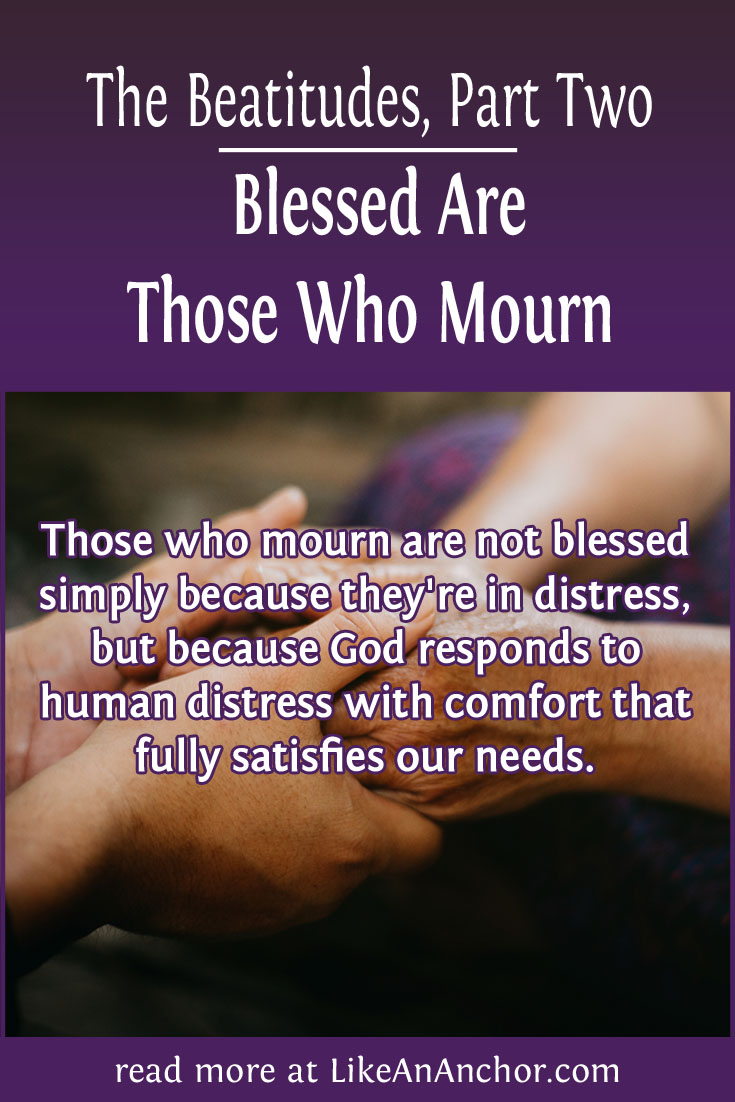
In his definition of makarios, Spiros Zodhiates says, “In the biblical sense, a blessed person is one whom God makes fully satisfied, not because of favorable circumstances, but because He indwells the believer through Christ.” Those who mourn are not blessed simply because they’re in distress, but because God responds to human distress with comfort.

Blessed be the God and Father of our Lord Jesus Christ, the Father of mercies and God of all comfort; who comforts us in all our affliction, that we may be able to comfort those who are in any affliction, through the comfort with which we ourselves are comforted by God. For as the sufferings of Christ abound to us, even so our comfort also abounds through Christ. (2 Cor. 1:3-5)

God knows what it’s like to grieve and, because of Christ’s sacrifice, what it’s like to suffer as a human being. When we turn to Him for comfort, He responds in a way that makes us blessed even when external circumstances are terrible. Though His presence may not take away our reasons for mourning or the unpleasant feelings that go along with that, He is there. He does not abandon us, and that is indeed a blessing.

Featured image credit: Shaun Menary via Lightstock

The Beatitudes, Part One: Blessed Are The Poor In Spirit

We’re only two weeks away from the first of the fall holy days on God’s sacred calendar. Yom Teruah (Day of Trumpets, also called Rosh Hashanah) is on September 19th this year. Yom Kippur (Day of Atonement) follows ten days later. Traditionally, those ten days and the month leading up to Yom Teruah are a time of reflection and self-examination for Jewish and Messianic believers.

There’s been a lot to distract us lately. I wanted to bring my Bible study back to basics, and also use that as a tool to look at myself and how I’m doing as we move into this fall holy day season. Today’s post is the first of a series on the Beatitudes. As an interesting note, I looked up the word history for “beatitudes” in the Online Etymology Dictionary and found that it comes into English “from Middle French béatitude (15c.) and directly from Latin beatitudinem.” It means “a state of blessedness” not, as some clever speakers have said, a “be-attitude” (as in, an attitude you’re supposed to “be”).

No Glory In Ourselves

The beatitudes come at the beginning of the sermon on the Mount, which Jesus delivered to His disciples after withdrawing from the multitude and traveling up onto a mountain (Matt. 4:23-5:2).

“Blessed are the poor in spirit, for theirs is the Kingdom of Heaven.” (Matt. 5:3, all scriptures from WEB translation)

Jesus had a few Greek words He could have picked that would translate into English as “poor.” The one He used is ptochos (G4434). It means “reduced to beggary,” destitute, helpless, powerless, “lacking in anything” (Thayer’s dictionary). This does not refer to someone who is poor but still able to earn a subsistence. The ptochos have nothing (Zodhiates’s dictionary).

Adding “in spirit” means Jesus isn’t talking about physical poverty, though. Being “poor in spirit” involves acknowledging our own spiritual helplessness. We don’t have to be destitute physically, but we do need to realize that none of the physical stuff we have (or don’t have) can stop us from being spiritually destitute.

Yahweh says, “Don’t let the wise man glory in his wisdom. Don’t let the mighty man glory in his might. Don’t let the rich man glory in his riches. But let him who glories glory in this, that he has understanding, and knows me, that I am Yahweh who exercises loving kindness, justice, and righteousness in the earth, for I delight in these things,” says Yahweh. (Jer. 9:23-24)

Blessed are those who don’t let intellect, might, wealthy, or worldly prestige get in the way of their commitment to God. It can be hard to have an accurate view of your spiritual helplessness if you’re wise, mighty, or noble, but we must all become “poor in spirit” if we are to live with God (1 Cor. 1:25-31).

The Right Attitude for Dwelling With God

God is looking for those who have a poor, or humble, spirit. He always has been, and this wasn’t a new Concept for Jesus’s Jewish audience.

For the high and lofty One who inhabits eternity, whose name is Holy, says: “I dwell in the high and holy place, with him also who is of a contrite and humble spirit, to revive the spirit of the humble, and to revive the heart of the contrite.” (Is. 57:15)

God is so mighty, so powerful, so much higher than us. The more we understand Him and His greatness, the easier it is to be of a poor, humble, contrite spirit. Nothing we are is impressive compared to God, and we have nothing worth offering Him but ourselves.

Yahweh says, “Heaven is my throne, and the earth is my footstool. What kind of house will you build to me? Where will I rest? For my hand has made all these things, and so all these things came to be,” says Yahweh: “but I will look to this man, even to he who is poor and of a contrite spirit, and who trembles at my word.” (Is 66:1-2)

Having an understanding of our own relative unimportance and our spiritual helplessness are vital to a relationship with God. He doesn’t work with people who don’t want Him or who refuse to acknowledge they need Him. It is the “poor in spirit” who catch His eye, and they’re invited to dwell with Him forever.

Their’s Is The Kingdom

Not everyone is “given to know the mysteries of the kingdom of heaven” (Matt. 13:10-16). You need an invitation from God, and you need to respond to that invitation by turning to Him and becoming “as little children,” “for the Kingdom of Heaven belongs to ones like these” (Matt. 18:3-4; 19:14).

Therefore, brothers, be more diligent to make your calling and election sure. For if you do these things, you will never stumble. For thus you will be richly supplied with the entrance into the eternal Kingdom of our Lord and Savior, Jesus Christ. (2 Pet. 1:10-11)

God is seeking in us the humility and trusting nature of a child that knows all their needs will be met by loving parents. He wants us to grow and thrive and do great things, but the starting place for all that is a recognition of our spiritual helplessness. We need Him, and we need to know that we need Him in order to inherit the kingdom He has prepared for His people.

Featured image credit: Chris Mainland via Lightstock

The Feeling of Being Different: Interplay of INFJ and Enneagram Four

I’ve talked with dozens, perhaps hundreds, of INFJs since I started this blog and wrote the first edition of The INFJ Handbook. One thing that most of us have in common is the feeling that we’re alien; that we don’t belong in the cultures, social groups, and/or families that we find ourselves in. Even if the people around us are welcoming, accepting, and seem to love us as we are we often feel as if there’s still something different about us.

Part of an INFJ’s feelings of alienation can be explained through type theory. Intuitives only make up about 30% of the population, and that means the way we process information and perceive the world is different than the way most people do. That difference is neither good nor bad; it’s just how our minds are hardwired. But as INFJs, we’re also FJ types who interact with the outer world using Extroverted Feeling. This is a cognitive function that’s keenly aware of values, ideals, behaviors, and cultural expectations. We notice when there’s something about us that doesn’t fit in, and it often bothers us.

Since I discovered the Enneagram and, years later, decided it might actually be a useful tool, I’ve started wondering if part of this feeling of being different might be connected to our Enneagram types. While INFJs can have any Enneagram type, some are more common than others. According to a survey conducted by Heidi Priebe in 2016, just over 30% of INFJs are Fours on the Enneagram, which makes it the most common Enneagram number for INFJs. It’s also my Enneagram type, and that’s the one I’m going to focus on today. If you’re wondering how different Enneagram types show up for INFJs, check out Susan Storm’s article “Your INFJ Personality Type and Your Enneagram Type.”

Why Fours Are Different

Myers-Briggs® types are typically describe in neutral or positive terms. You’ll also find information about the dark side of each type, but for the most part you’re likely to feel pretty good about yourself after reading your type description. That’s not the case with the Enneagram. When I first started reading about the Enneagram, what I noticed most is that it describes the core wounding message you internalized as a child and which you’re stuck with you your entire life.

I did not like this view. Truly, though, I probably wouldn’t have been so upset by the Enneagram’s description of Fours if part of me didn’t already believe that I was broken, abandoned, and envious of people who seem to have whatever basic human ingredient I’m missing. It wasn’t until years later, when I started seeing a counselor about my anxiety, that I realized I had internalized messages like this even though I grew up in a loving, supportive, stable home.

According to my favorite Enneagram book — The Road Back To You: An Enneagram Journey to Self-Discovery by Ian Morgan Cron and Suzanne Stabile — “The wounding message Fours hear all the time is, ‘There’s something off about you. No one understands you, and you’ll never belong.’” Fours feel as if there’s something essential lacking; like we missed out on some important ingredient when God was putting people together. We’re not sure what it is, but we’re sure others have it and we don’t.

Photo credit: tookapic via Pixabay

Wanting To Be Different, but Maybe Not Too Much

While some INFJs feel that their uniqueness is a burden, I’d venture a guess that most of us don’t really want to give it up (at least not entirely). The whole “otherworldly INFJ thing” can get ridiculous at times but many of us not-so-secretly like our unicorn status. I wonder if perhaps this might have to do with Fours being a common Enneagram type for INFJs

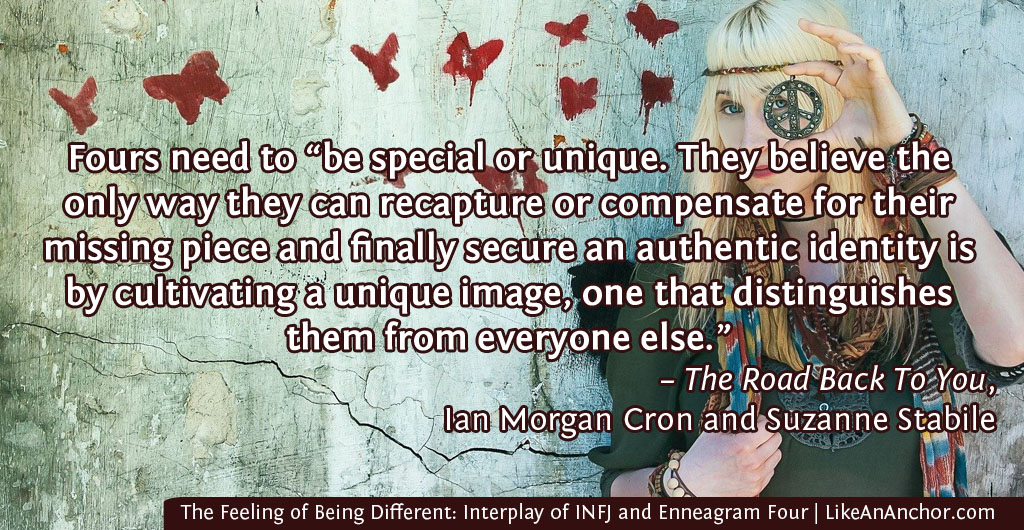
The Road Back To You says that Fours need to “be special or unique. They believe the only way they can recapture or compensate for their missing piece and finally secure an authentic identity is by cultivating a unique image, one that distinguishes them from everyone else.” I don’t know about you, but reading that connected with something deep inside me.

As an INFJ, part of me wants to be a chameleon to fit in with the people around me, but another part strongly wants an authentic identity (so much so that for a while I thought I might be an INFP, since Introverted Feeling is often associated with authenticity). This is probably the reason I started “dressing like a hippy” (to quote family members and friends who noticed my style change). I wanted a way to make myself visibly unique without stepping too far outside accepted behavior.

I suppose the holy grail for type Four INFJs is to find a way to express their individuality without feeling as if they have nowhere they fit. We want to be unique and different, but not so much that it messes with the harmony we need to have in our relationships.

Healing The Broken Things

The Feeling of Being Different: Interplay of INFJ and Enneagram Four | LikeAnAnchor.com
Photo credit: JoBischPeuchet via Pixabay

I’ve come to realize that if there’s something inside us that feels broken, missing, and wrong, then running away from it or pushing it deep down inside us isn’t a good idea. It’s far better to let ourselves feel things and process our complicated emotions, particularly if they keep coming back to bite you after you think you shut them down (note: I’m not a therapist or psychologist. There are exceptions to every rule, and some things are best dealt with in a therapy setting. If you’re struggling with something, I encourage you to seek out professional help).

The Enneagram can be a useful tool for helping us identify and face unhelpful messages we’ve internalized. And it’s not depressing to read about those messages once you realize the Enneagram does include descriptions of healthy, average, and unhealthy versions of all the types, along with advice for how to grow into a healthier version of your type. What form that advice takes depends on who’s using the Enneagram. For example, The Road Back To You is written from a Christian perspective, and so the advice in that book is framed through that lens.

Before offering their 10 tips for Fours’ personal growth the authors write, “Fours need to hear this loud and clear: there’s nothing missing. It may be hard to believe, but God didn’t ship them here with a vital part absent from their essential makeup.” I teared up reading that the first time. I’m not convinced of it all the way deep down inside yet, but I want to be. And I’ve been heading that direction a lot more steadily over the past couple years thanks to  tools like schema therapy.

Grow As Yourself

One of the most important messages an INFJ hears from Myers-Briggs® is that you’re not broken. You’re a perfectly normal INFJ, and it’s okay if that’s different than the majority of other people.

One of the most important messages we can hear from the Enneagram is that it’s okay to feel broken. None of us are perfect and we don’t have to be; we just need to grow, and realizing what sorts of foundations we’re starting with can be a great first step for that.


If you’d like to know more about the INFJ personality type, check out my book The INFJ Handbook. I’ve updated it with a ton of new information and resources. You can purchase it in ebook or paperback by clicking this link.


Featured image credit: congerdesign via Pixabay

How Can A Christian Know When To Follow Human Authority and When To Obey God Rather Than Man?

I’ve been pondering the question posed in today’s title for a number of years now. How much obedience do we owe to human authorities, both inside and outside the church? Is a Christian allowed, per scripture, to speak against people in authority? Are they ever encouraged to stand up and fight against authority that is unjust and immoral? And why are churches, even those that preach the importance of obeying God’s word, so reluctant to talk about submission to authority passages like Romans 13:1-7 and 1  Peter 2:13-19?

Until fairly recently, this was mostly an intellectual puzzle for the American church. Then came questions about baking cakes for same-sex weddings, then whether or not to assemble for services when governors shut down states, now debates over the mask issue, and rising fears that a Covid vaccine might be the Mark of the Beast. We live in confusing times, and they’re forcing us to face questions and wrestle with decisions some of us haven’t had to deal with before.

Those of us who prize our independence might be angry about infringements on our freedom, wrestling with whether to follow our personal choices or do as we’re told. Those of us who struggle with anxiety might be scared — paralyzed, even — both by everything that’s going on and by not knowing what is the right thing to do. Those who are people-pleasers might be running up against the fact that we’ll need to pick a side and can’t make everyone happy.

Today’s post isn’t going to offer answers for the specific issues we’re facing right now. Rather, I hope to highlight scriptures that provide principles which we can use whenever we struggle with how to respond to human authority in a way that honors God. This is a question we will face at some point, if we aren’t facing it already. We need to be prepared to answer these questions, to ourselves and when asked by others, in a Biblically solid way. Read more