We Need To Watch Our Words

In the aftermath of another polarizing United States election, I think it’s a good time to revisit the topic of how God’s people should use language, especially when speaking about other people. Even though most of us in the U.S. agree) that there aren’t any really good politicians we could vote for, we often have very strong opinions about which is the “lesser of two evils” and equally strong opinions about people who come to a different conclusion than we ourselves did. These other people are very likely in a similar position to us, not agreeing 100% with either candidate but coming to a different conclusion about which option is a little better.

There’s a temptation to mock, belittle, and despise others who vote differently than us or have different viewpoints (whether or not they chose to vote). But when we stand before Christ, we will answer for every idle or worthless word we speak (Matt. 12:36), the times we judged, despised and condemned other people (Matt. 5:22; Rom. 14:10), and our coarse jesting or foolish talking (Eph. 5:4). Our thoughtless, angry words or the things we excuse by saying, “I was just joking,” might be something that God takes very seriously.

Today, we’re going to look at three key areas where we need to be careful about what we say: 1) passing judgement on others, 2) despising them or calling them foolish, and 3) coarse jesting. Finally, we’ll look at one overriding principle for how we ought to interact with other people: love.

Passing Judgement

There’s a difference between passing judgement (condemning) and making a judgement call (discernment). That’s one reason that you see seemingly contradictory scriptures like “Judge not” (Matt. 7:1) and “judge righteous judgement” (John 7:24). We must be careful not to usurp a role that God reserves for Himself as judge, and so bring harsher judgement on ourselves (Matt. 7:1-5; James 2:13).

Now receive the one who is weak in the faith, and do not have disputes over differing opinions. One person believes in eating everything, but the weak person eats only vegetables. The one who eats everything must not despise the one who does not, and the one who abstains must not judge the one who eats everything, for God has accepted him. Who are you to pass judgment on another’s servant? Before his own master he stands or falls. And he will stand, for the Lord is able to make him stand. …

But you who eat vegetables only—why do you judge your brother or sister? And you who eat everything—why do you despise your brother or sister? For we will all stand before the judgment seat of God. For it is written, “As I live, says the Lord, every knee will bow to me, and every tongue will give praise to God.” Therefore, each of us will give an account of himself to God. Therefore we must not pass judgment on one another, but rather determine never to place an obstacle or a trap before a brother or sister.

Romans 14:1-4, 10-13 NET (bold italics mark a quotation from Isa 45:23)

Here, Paul used the example of disagreements about what we should or shouldn’t eat to make a point. When you disagree with someone about an opinion, your duty as a Christian is to refrain from passing judgement or despising them. Rather, you should guard your behavior to make sure you’re not putting a stumbling block in front of them.

To be clear, this does not mean we can’t make judgement calls about sinful actions. It is love (agape) to point out a sin in a fellow Christian for the purpose of restoring someone to a right relationship with fellow believers and with God (Matt 18:15-22; 2 Tim. 2:24-26). Our goal should always be restoration rather than condemnation, even when we have to stop associating with someone because they refuse to repent (1 Cor. 5). Even when Paul ” judged the one who” committed “the kind of immorality that is not permitted even among the Gentiles” (1 Cor. 5:1-2, NET), it wasn’t to mock the sinner or call them names. We should be grieved by other’s sins and moved by love to help them reach a point of repentance. How much more, then, should we withhold condemnation when we disagree with someone on an opinion?

Despising Others

When someone disagrees with us on something we see as important, fails to see our point of view, or cannot be convinced by our arguments, the natural human response is to label them a fool. But despising someone else, particularly a “brother” (either by blood or because they’re fellow children of God), is not the way Jesus said to do things.

“You have heard that it was said to an older generation, ‘Do not murder,’ and ‘whoever murders will be subjected to judgment.’ But I say to you that anyone who is angry with a brother will be subjected to judgment. And whoever insults a brother will be brought before the council, and whoever says ‘Fool’ will be sent to fiery hell.”

Matthew 5:21-22, NET (bold italics mark a quotation from Exod 20:13Deut 5:17)

Let’s look at two of the original words used in this passage. “Whoever insults a brother” could also be translated, “whoever says to his brother ‘Raca,'” which is “an Aramaic word of contempt or abuse meaning ‘fool’ or ’empty head'” (NET footnote “b” on Matt. 5:22). The word translated “fool” is the Greek moros, which is where the English word “moron” comes from. Most scholars assume it means “you fool” but a few argue it could mean “rebel” (NET footnote “e” on Matt. 5:22). God holds His followers to a high standard of conduct, higher even than what was outlined in the Old Testament laws like “do not murder.”

Remind them to be subject to rulers and authorities, to be obedient, to be ready for every good work.  They must not slander anyone, but be peaceable, gentle, showing complete courtesy to all people. For we too were once foolish, disobedient, misled, enslaved to various passions and desires, spending our lives in evil and envy, hateful and hating one another. 

Titus 3:1-3, NET

In Paul’s letter to Titus, he instructs this pastor to remind the people he’s teaching that they need to be mindful of their speech. Specifically, “they must not slander” (“‘discredit,’ ‘damage the reputation of'” [NET translators’ note]) anyone. This verse is also translated with the instruction, “to speak evil of no one” (Tit. 3:2, WEB). When we’re considering how to talk about someone else, we must remember that if we think someone is foolish, misled, evil, or hateful that we were once like that too, and we’re not supposed to be like that anymore now that we have God’s spirit and have committed to following Him. We have to stop talking out of bitterness or malice, and remove slander and insults from our speech (Eph. 4:31-32; 1 Peter 3:9).

Coarse Jesting

Humor is such a tricky subject (as I mentioned in my newsletter earlier this week). One person might find something hilarious that another person would find offensive, repulsive, or hurtful. What people find funny varies between cultures and individuals. Because it’s so subjective, people often say that if someone is offended by our humor they just “didn’t get the joke” or they “need to lighten up.” But just because we find something funny doesn’t mean it can’t hurt someone else. All too often, people use humor to cover up the fact that they’re being mean or thoughtless. Jokes that hinge on cruelly mocking, belittling, and hurting people shouldn’t be something we find funny.

You must let no unwholesome word come out of your mouth, but only what is beneficial for the building up of the one in need, that it would give grace to those who hear. And do not grieve the Holy Spirit of God, by whom you were sealed for the day of redemption. You must put away all bitterness, anger, wrath, quarreling, and slanderous talk—indeed all malice. Instead, be kind to one another, compassionate, forgiving one another, just as God in Christ also forgave you.

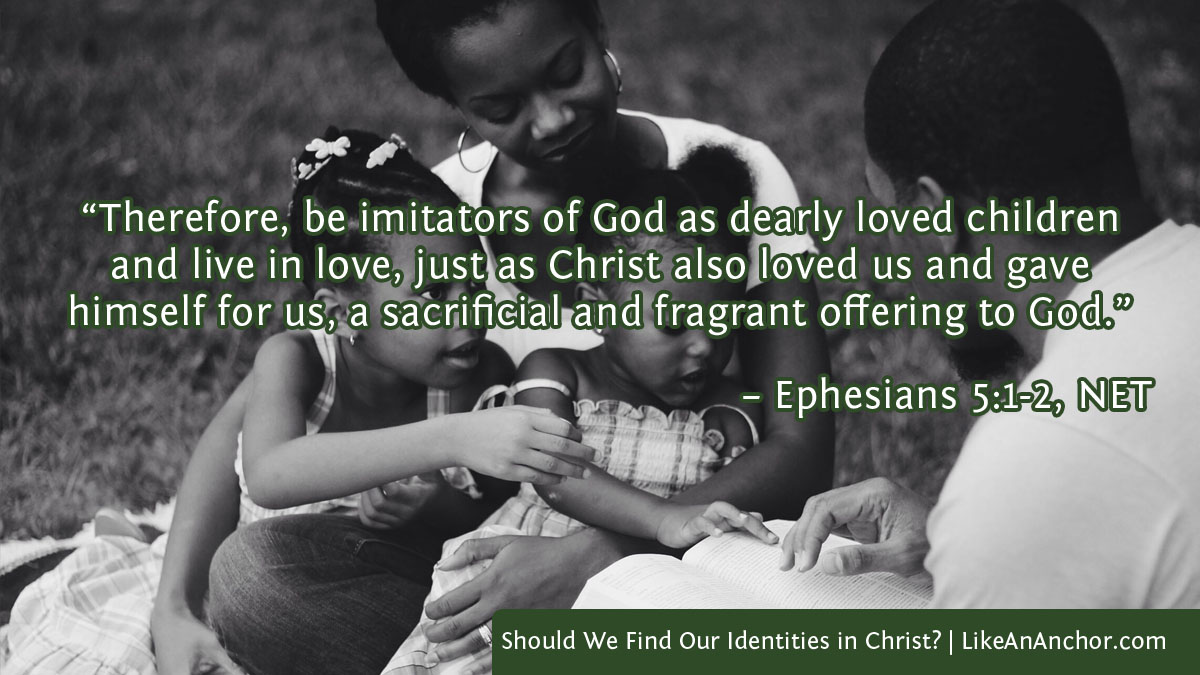
Therefore, be imitators of God as dearly loved children and live in love, just as Christ also loved us and gave himself for us, a sacrificial and fragrant offering to God. But among you there must not be either sexual immorality, impurity of any kind, or greed, as these are not fitting for the saints. Neither should there be vulgar speech, foolish talk, or coarse jesting—all of which are out of character—but rather thanksgiving. For you can be confident of this one thing: that no person who is immoral, impure, or greedy (such a person is an idolater) has any inheritance in the kingdom of Christ and God.

Ephesians 4:29-5:5, NET

In this passage, Paul covers a lot of sins that are related to our speech. These include:

  • unwholesome word” (translated from sapros [G4550] and logos [G3056])– “unwholesome” refers to something that’s corrupt, rotten, putrefied, or worthless and “word” is speech or communication. Hebrews 13:5 tells us the “fruit of our lips” should praise God and acknowledge his name, but this is the opposite: disgusting, rotting, foul words.
  • vulgar speech” (translated from aischrotes [G151])–obscenity, filthiness. Comprises “improper conduct whether in action or word or even thought and intent” that brings shame when it is “exposed by the light” (Zodhiates).
  • foolish talk” (translated from morologia [G3473])–“silly talk, that is, buffoonery” (Strong). It’s from the same Greek root word as our English word “moron.” This is the “type of speech that betrays a person as foolish” (Zodhiates).
  • coarse jesting” (translated from eutrapelia [G2160])–in a bad sense, this word for “humor” includes “scurrility, ribaldry, low jesting” (Thayer). Basically, it is someone skilled at twisting their words wittily, which can be used to amuse others or to manipulate (Zodhiates).

Clearly, there are some types of humor that God would not excuse as “just a joke.” If the words we’re speaking are rotten and disgusting, improper or shameful, moronic and foolish, or twisted to amuse others with coarse or scurrilous jests, then they’re not funny–they’re sinful. And right after telling us these things are wrong, Paul warns that we “can be confident of this one thing: that no person who is immoral, impure, or greedy (such a person is an idolater) has any inheritance in the kingdom of Christ and God” (Eph. 5:5, NET). This is a very serious matter. People who misuse their words to hurt others are not going to be in God’s kingdom.

Love

Now that we’ve looked at scriptures telling us what not to do with our words, let’s turn our attention to what we ought to do instead. It’s not enough to just take the ungodly types of speech out of our conversation; we also have to put godly speech in. Thankfully, there are plenty of guidelines in the bible for how to do that.

Some of the verses we’ve already looked at include instructions on how we should talk right alongside the instructions about what not to say. In Titus, Paul said, “be peaceable, gentle, showing complete courtesy to all people” (Tit. 3:2, NET). In Ephesians, he said, “be kind to one another, compassionate, forgiving one another” (Eph. 4:32, NET). And if we keep reading in Romans 14, we come to this passage:

Therefore we must not pass judgment on one another, but rather determine never to place an obstacle or a trap before a brother or sister. … For if your brother or sister is distressed because of what you eat, you are no longer walking in love. Do not destroy by your food someone for whom Christ died. Therefore do not let what you consider good be spoken of as evil. For the kingdom of God does not consist of food and drink, but righteousness, peace, and joy in the Holy Spirit

Romans 14:13, 15-17 NET

Here, Paul continues addressing the disagreement about whether to eat meat, the principle applies to how we interact with each other through our words as well. Peace, gentleness, courtesy, kindness, compassion, forgiveness, righteousn0ess, joy–all those should be characteristics of our speech. It’s summed-up by the second greatest commandment: “You shall love your neighbor as yourself” (Matt. 22:36-40).

 “I give you a new commandment—to love one another. Just as I have loved you, you also are to love one another. Everyone will know by this that you are my disciples—if you have love for one another.”

John 15:34-35, NET

We’re supposed to love our fellow Christians so much that people observing our interactions can tell that we’re followers of Jesus Christ. And it isn’t confined just to fellow Christians: it’s for our neighbors as well (i.e. anyone we’re aware of and have any sort of interaction with). As Paul said in Romans (shortly before the passage about not judging those with different opinions), “Love does no wrong to a neighbor. Therefore love is the fulfillment of the law” (Rom. 13:10, NET). Unless we’re loving “in deed and truth” as well as in our words, we’re not Jesus’s disciples (1 John 3:18, NET; see 1 John 3:10-18; 4:20-21).

All of our words, thoughts, and actions have to be motivated by love. That’s how God is, and that’s how He wants us to be. Will we do it perfectly? Of course not, but we still need to try. We also need to study the Bible, learn what God expects from us (i.e. how to become more like Him and to walk in obedience with Him), and repent when we catch ourselves missing the mark. Ultimately, the goal is to “take every thought captive to make it obey Christ” (2 Cor. 10:5, NET) and then to speak out of the abundance of good and godly things in our hearts “for by your words you will be justified, and by your words you will be condemned”(Matt. 12:37, NET; see Matt. 12:33-37).


Featured image by Petra from Pixabay

Song Recommendation: “Speak Life” by TobyMac

Keep Planting, Even If You’re Weeping

Last week, I’d stayed up later than usual and instead of reading a chapter in Acts before bed, I turned to the Psalms to find a short passage to read. I just happened to open the Bible (a Tree of Life Version that I keep in my nightstand) to Psalm 126. Something about this translation caught my eye, and it prompted today’s post. Here’s the full psalm to start us off:

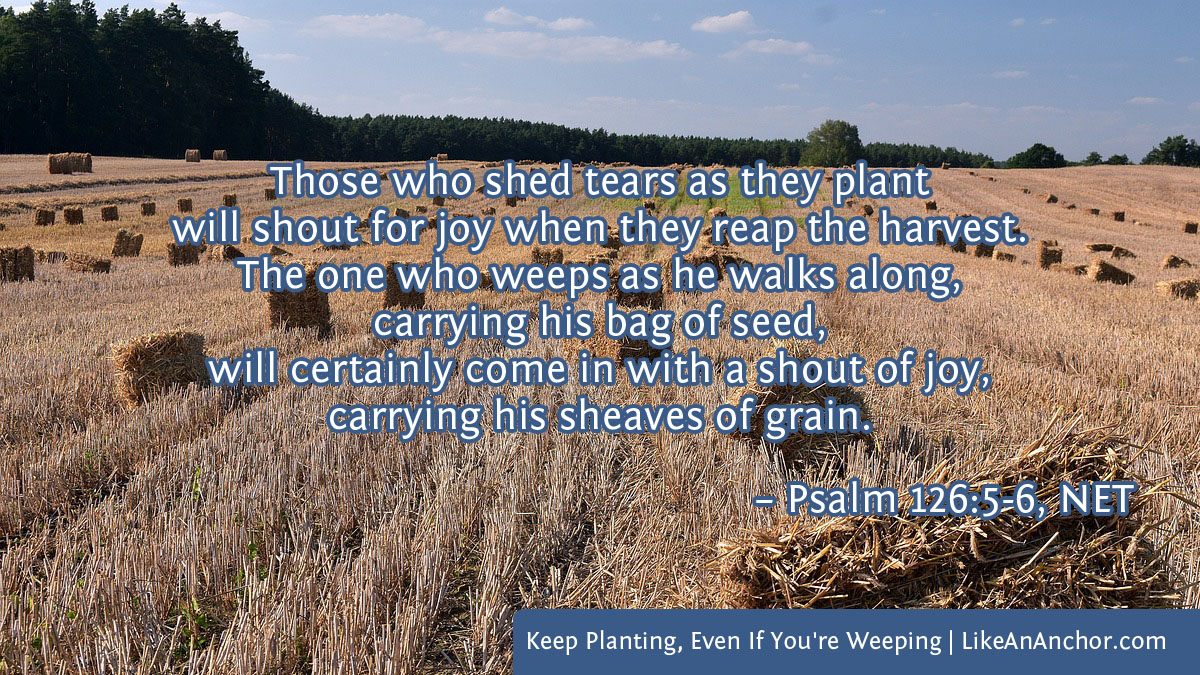
When Adonai restored the captives of Zion,
it was as if we were dreaming.
Then our mouth was filled with laughter,
and our tongue with a song of joy.
Then they said among the nations,
Adonai has done great things for them.”
Adonai has done great things for us
    —we are joyful!
Restore us from captivity, Adonai,
like streams in the Negev.
Those who sow in tears
will reap with a song of joy.
Whoever keeps going out weeping,
    carrying his bag of seed,
will surely come back with a song of joy,
    carrying his sheaves.

Psalm 126, TLV

It’s that last verse that captured my attention: “Whoever keeps going out weeping, carrying his bag of seed, will surely come back with a song of joy, carrying his sheaves.” It might (if you’re at all familiar with American gospel songs and Protestant hymns) make you think of the 1874 hymn “Bringing in the Sheaves.” For me, the part that captured my attention is this “keeps going out” line.

Keeping Going Out

In Psalm 126:6, some translations simply say, “He who goes out weeping” (WEB) but the TLV and others like the NKJV include this sense of continuing to go out while you’re weeping. The setting for this psalm is restoration from captivity. Israel had gone into captivity, and now God delivered them and brought them back to the land. The psalmist is looking back on this and making an agricultural analogy.

Suppose you’re in the spring, ready to plant, but something happens. It’s a set back, a tragedy, a calamity, a grief-inducing event. It’s the sort of thing that would make you weep. At that point, you have a choice. You can “keep going out” and sowing into the future, or you could give up. But you know that if you want to reap a harvest, you need to plant seed. Similarly, the metaphorical future “harvest” that we get in our own lives is determined (at least in part) by what we “sow” now.

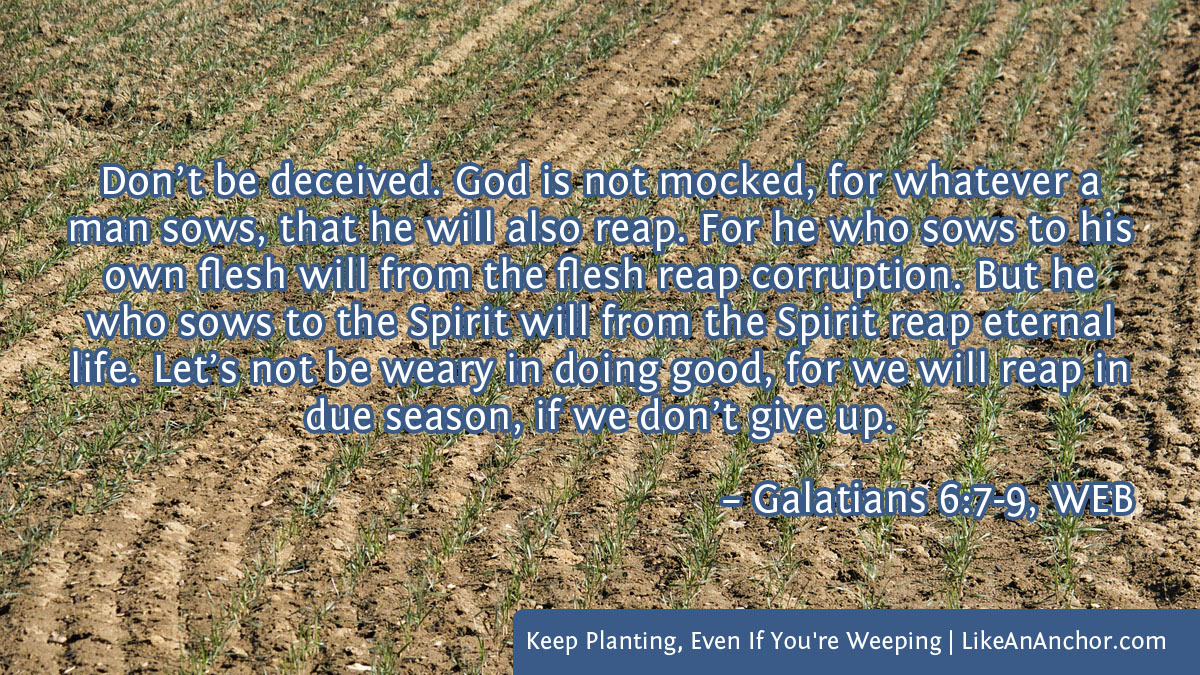
Do not be deceived. God will not be made a fool. For a person will reap what he sows, because the person who sows to his own flesh will reap corruption from the flesh, but the one who sows to the Spirit will reap eternal life from the Spirit. So we must not grow weary in doing good, for in due time we will reap, if we do not give up.

Galatians 6:7-9, NET

If the agricultural metaphor isn’t working for you, we can relate it to other things with a cause and effect. If you put a steady diet of unhealthy food into your body, you’ll get an unhealthy body; if you eat healthy foods, you’ll have a healthier body. Sowing (like how we eat and whether we exercise) is an investment in the future, for better or worse.

Notice that Paul says “we must not grow weary in doing good” and that we should “not give up.” Sowing is a long-term investment. It takes time for the seed to sprout, grow, and bear fruit. We might not see the results of it for quite some time. As Psalm 126 says we need to “keep going out” to sow, trusting that God will give us a good harvest.

Planting In Hope

The word “hope” isn’t used in the psalm that we’re looking at today, but it’s an essential ingredient for what we’re talking about here.

 For it is written in the law of Moses, “Do not muzzle an ox while it is treading out the grain.” God is not concerned here about oxen, is he? Or is he not surely speaking for our benefit? It was written for us, because the one plowing and threshing ought to work in hope of enjoying the harvest. 

1 Corinthians 9:9-10, NET (bold italics mark a quotation from Deut. 25:4)

Here, Paul is saying that teachers of the word have the right to make their living by preaching the gospel (1 Cor. 9). The basic principle is that if you put the work into something, you have a right to expect to enjoy the results of that labor. Hope in the Bible isn’t something nebulous. When hope is related to God, there’s a level of certainty to it. God provides a solid anchorage for our hope (Heb. 6:19), giving us good reason to confidently expect that if we keep going out sowing, we will eventually bring in a harvest with joy.

 Not only this, but we ourselves also, who have the firstfruits of the Spirit, groan inwardly as we eagerly await our adoption, the redemption of our bodies. For in hope we were saved. Now hope that is seen is not hope, because who hopes for what he sees? But if we hope for what we do not see, we eagerly wait for it with endurance.

Romans 8:23-25, NET

Come Back Rejoicing

One of the things that we humans can find frustrating is that God is a long-term thinker. When He promises to give us the desires of our heart, for example (Ps. 37:6), we want that to happen immediately. I didn’t expect it to take 15+ years and a healthy dose of heartache before He answered my prayers to be a wife and mother, but then I found myself marrying a wonderful man and just over a year later having a beautiful daughter with him. I don’t think I’d be so blessed now if I hadn’t continued “sowing into” my life and my relationship with God during the season of weeping.

When we read, “all things work together for good for those who love God, who are called according to his purpose” (Rom. 8:28, NET), we often forget that Paul is talking on a cosmic timescale. Before the statement about all things working together for good, he says, “I consider that our present sufferings cannot even be compared to the coming glory that will be revealed to us” (Rom. 8:18, NET; see Rom. 8:18-30). Sometimes–even often–a harvest of joy happens now, in our human lives. But even if it doesn’t happen now, it will certainly happen at the end if we don’t give up.

My aim is to know him [Jesus Christ], to experience the power of his resurrection, to share in his sufferings, and to be like him in his death, and so, somehow, to attain to the resurrection from the dead.

Not that I have already attained this—that is, I have not already been perfected—but I strive to lay hold of that for which Christ Jesus also laid hold of me. Brothers and sisters, I do not consider myself to have attained this. Instead I am single-minded: Forgetting the things that are behind and reaching out for the things that are ahead, with this goal in mind, I strive toward the prize of the upward call of God in Christ Jesus. Therefore let those of us who are “perfect” embrace this point of view. If you think otherwise, God will reveal to you the error of your ways.

Philippians 3:10-15, NET

Scripture encourages us to look beyond our immediate circumstances with hope, trusting in the glorious future that God has planned for us. Long-term, if we’re going to “reap” the future God promises to His firstfruits, we need to keep pressing on toward the goal of eternal life. It’s this perspective that lets us “consider it nothing but joy when you fall into all sorts of trials, because you know that the testing of your faith produces endurance” and endurance helps bring us to perfection (James 1:2-3, NET). You’ll reap blessings in this life as well (especially if you have a mindset that looks for and recognizes them), but the biggest blessings we have are the opportunity to become God’s children and the promise of eternal life forever with Him after He “harvests” us with great joy.


Featured image by vargazs from Pixabay

Song Recommendation: “Bringing In The Sheaves”

Our Roles As Keepers

Two weeks ago, we examined God’s role as our keeper, focusing on Psalm 121. Part of that examination included looking at the definition for the Hebrew word shamar, which is translated “keep” or “keeper” in this Psalm. As with many Hebrew words, shamar includes a range of meanings depending on the context. The Complete Theological Wordbook of the Old Testament states, “The basic idea of the root is ‘to exercise great care over'” (TWOT entry 2414). As we looked at in the previous post, the TWOT breaks the nuances of meaning into these broad categories:

Today, I want to look at our roles as keepers. We are told to keep covenant with God, to keep ourselves in the right way, and to keep care of other people.

Image of a woman reading the Bible overlaid with text from Psalms 103:17-18, WEB version: But Yahweh’s loving kindness is from everlasting to 
everlasting with those who fear him, his righteousness to children’s children; to those who keep his covenant, to those who remember to obey his precepts. 
Image by Pearl from Lightstock

Keeping Covenant

God faithfully keeps covenant with us. We don’t have to worry that He’ll change His mind, forget about us, or decide His commitments aren’t worth honoring. He’s absolutely faithful and reliable. The same can’t be said about human beings, but with God’s help we can commit to covenant keeping and keep coming back and recommitting when we miss the mark.

You shall do my ordinances. You shall keep my statutes and walk in them. I am Yahweh your God. You shall therefore keep my statutes and my ordinances, which if a man does, he shall live in them. I am Yahweh.

Leviticus 18:4-5, WEB

The obligation to keep God’s laws as part of our covenant relationship with Him isn’t just an Old Testament thing. It’s also part of the New Covenant. It’s actually even more important in the New Covenant because now, keeping covenant with God sinks in at a heart level. God wanted this sort of heart connection under the Old Covenant, but didn’t get it (Deut. 5:29). Now, with His holy spirit inside us and Jesus’s sacrifice to reconcile us to God, we can more fully obey the command to love God with all our hearts, minds, and souls and to keep His commandments because of that love (Matt. 22:36-40; John 14:15, 21; 15:10-12).

I will give them one heart, and I will put a new spirit within you. I will take the stony heart out of their flesh, and will give them a heart of flesh; that they may walk in my statutes, and keep my ordinances, and do them. They will be my people, and I will be their God. 

Ezekiel 11:19-20, WEB

When we think of shamar as “to exercise great care over,” we might then ask how we can do that to the covenant we have with God. For one thing, it involves knowing what the covenant obligations are. At the most basic level, it’s to fully love God and to love our neighbors. All the other commands hinge on those two (Mark 12:28-34). That doesn’t mean the other commandments aren’t important–it just means that our keeping of the other commandments happens because we love God and others. Sabbath keeping, for example, it something that God instituted at creation, that Jesus did, and which God describes as “a perpetual covenant” for His people to keep (Ex. 31:13-16).

Image of a man reading the Bible overlaid with text from Ecclesiastes 12:13, WEB version: This is the end of the matter. All has been heard. Fear God and keep his commandments; for this is the whole duty of man.
Image by Matt Vasquez from Lightstock

Keeping Ourselves

As people in covenant with God, we have a responsibility to “exercise great care” over our own conduct. We see one example of this in Deuteronomy, when Moses warns the people of ancient Israel to “keep the commandments of Yahweh your God which I command you” then to “be careful, and keep your soul diligently, lest you forget the things which your eyes saw, and lest they depart from your heart all the days of your life; but make them known to your children and your children’s children” (Deut. 4:2, 9, WEB). This involves carefully guarding our conduct, soul, and words (Prov. 13:3; 21:23) to make sure we’re following God the way He tells us to.

I said, “I will watch (shamar) my ways, so that I don’t sin with my tongue.
    I will keep (shamar) my mouth with a bridle while the wicked is before me.”

Psalm 39:1, WEB

Doing things according to God’s instructions is key to this: we must be careful to keep ourselves from breaking covenant with Him or following other Gods (Deut. 4:23; 11:16). It’s actually a matter of life and death. On a broad scale, our choice between living in covenant with God (which involves obedience, righteousness, and repentance when we miss the mark) or walking contrary to Him is a choice between life and death (Deut. 30:19).

We can see the seriousness of keeping ourselves in God’s instructions in phrases like, “Be very careful (shamar) if you value your lives! Do not carry any loads in through the gates of Jerusalem on the Sabbath day” (Jer. 17:21, NET). The NET footnote on this verse notes that the Hebrew phrase used here could also be translated, “Be careful at the risk of your lives.” In the context leading up to this, God talks about the grave sins of His people, the curse associated with trusting your human heart verses the blessing associated with trusting Him, and the healing available in Yahweh (Jer. 17:1-18). Then, He goes into Sabbath keeping as a key example of the commandments His people broke and that they must begin keeping again if they value their lives and their relationship with Him (Jer. 17:19-27).

The Hebrew word shamar obviously doesn’t appear in the Greek New Testament, but how people “conduct themselves in the household of God” (1 Tim. 3:15, NET) still matters. For example, Jesus told people, “Keep yourselves from covetousness” (Luke 12:15, WEB), the apostles wrote to new Christians that they should “keep themselves from” things like eating blood and committing sexual immorality (Acts 15:28-29), and Paul told Timothy, “Keep yourself pure” (1 Tim. 5:22, NET). When we enter a covenant relationship with God, we’re also committing to keeping ourselves by a certain standard of conduct that He expects from His people.

Keeping Others

Image of a woman sitting at a table reading the Bible, overlaid with blog's title text and the words, "The Hebrew word shamar is often translated “keeper,” and it means “to exercise great care over.” The Bible tells us to keep covenant with God, keep ourselves in the right way, and to keep caring for other people."
Image by MarrCreative from Lightstock

The final application of shamar that we’re going to look at today involves heeding, guarding, or attending to something important. The word can also be used to refer to the person who is guarding or keeping watch (Josh. 10:18; 2 Kings 11:5-9; Est. 2:21; Is. 21:11-12). The most famous use of shamar in this sense is a negative example.

The man knew Eve his wife. She conceived, and gave birth to Cain, and said, “I have gotten a man with Yahweh’s help.” Again she gave birth, to Cain’s brother Abel. Abel was a keeper of sheep, but Cain was a tiller of the ground. …

Cain said to Abel, his brother, “Let’s go into the field.” While they were in the field, Cain rose up against Abel, his brother, and killed him.

 Yahweh said to Cain, “Where is Abel, your brother?”

He said, “I don’t know. Am I my brother’s keeper?”

Genesis 4:1-3, 8-9, WEB

Yahweh warned Cain before all this that sin was crouching at his door like a predatory animal ready to pounce if he didn’t subdue it (Gen. 4:6-7). Cain knew he failed in that task, yet when Yahweh asked him where his brother is, he shot back this question: “Am I my brother’s keeper?” Perhaps it’s to hearken back to Abel’s profession, i.e. “Am I responsible for keeping my brother the way he’s responsible for keeping his flocks of sheep?”

The obvious answer should be yes, you are responsible to take care of the people around you. I find it very interesting that Cain, who “was a tiller of the ground” was no longer allowed to “cultivate and keep” the earth after he killed his brother (Gen. 2:15; 4:10-12). Failing in his familial duty, he was not entrusted with other shamar duties.

God makes it even more clear in the New Testament that He expects us “to exercise great care over” other people, especially those who are our brothers and sisters in Christ (Gal. 6:10) but also our neighbors (i.e. anyone we’re aware of and able to help [Luke 10:25-37]). Caring for each other and loving each other is the responsibility of every Christian (John 13:35; Phil. 2:1-5). There’s a particular responsibility, though, laid on those who are leaders in the churches to “keep watch” over people’s souls (Heb. 13:17).

As those who follow the God who keeps covenant with and keeps watch over His people, we should follow His example. That includes keeping covenant with Him, keeping ourselves held to His standards, and acting as “keepers” for the people around us. These three things are aspects of our lives that deserve our careful attention and the effort that it takes to exercise great care over them.


Featured image by Jantanee from Lightstock

Who Pays For Other People’s Sins?

I’d planned to write more about the Hebrew word shamar (which we covered last week) today, but I heard an excellent sermon on the Parable of the Prodigal Son that made me want to write about this topic today. The main point was that we can learn from all three of the characters in this parable. At different points in our lives, we can be the prodigal son, the compassionate father, or the angry brother. The speaker made a point near the end of the message when talking about the angry brother that really stood out to me. He said, “We don’t pay the price of others’ sins.”

Now, at first, something in me grew hot and angry hearing this. I thought, “I’ve absolutely paid a price for other people’s sins when they’ve hurt me.” But then I realized that wasn’t the point of this statement. Yes, other people’s sins can affect us, sometimes very badly. However, the price of their sins that we’re talking about here refers to the price that God’s justice demands a sinner pay for violating His law. Ultimately, this price is death, or it would be without the sacrifice of Jesus (Rom. 6:23).

You see, while we can still suffer because of other people’s sins, we’re not the ones paying the price for forgiveness. We couldn’t; we also deserve a death penalty for our sins and we can’t offer ourselves in exchange for someone else’s soul even if we wanted to (Ezk. 18:20). This also means we don’t have the right to withhold forgiveness.

Image of a man pushing open doors to go outside overlaid with text from Col. 2:13-14, NET version: "And even though you were dead in your transgressions and in the uncircumcision of your flesh, he nevertheless made you alive with him, having forgiven all your transgressions. He has destroyed what was against us, a certificate of indebtedness expressed in decrees opposed to us. He has taken it away by nailing it to the cross."
Image by Pearl from Lightstock

Forgiveness and Restoration

Forgiveness can be a tough subject for many of us. Many of us struggle with forgiveness even if we know we should do it, or we come up with reasons why we don’t need to forgive in particular cases. Trust me, I know it’s hard. It’s not like I’ve never been hurt by anyone and I’m saying “just forgive them” without knowing how hard that is. But even if you go through something traumatic and still have occasional panicked flashbacks, you need to forgive. Even if you ended up in counseling for 3 years trying to figure out how to process what happened, you need to forgive.

For if you forgive others their sins, your heavenly Father will also forgive you. But if you do not forgive others, your Father will not forgive you your sins.

Matthew 5:14-15, NET

We think of forgiveness as something God offers us freely, but in reality it’s conditional on something. If we want forgiveness, then we need to forgive others. There’s no wiggle room in here. There are, however, some things forgiveness doesn’t necessarily entail.

Forgiveness doesn’t always mean restoring relationships–sometimes it’s not safe or healthy to continue having any kind of relationship with the person who wronged you. This is especially true if they don’t repent. For example, Paul told the Corinthians to stop associating with someone who was flagrantly sinning without repentance (1 Cor. 5), then later told them to restore someone that we assume is the same man to their fellowship of believers after his repentance (2 Cor. 2:5-11; 7:8-12). The relationship wasn’t restored until the person repented and changed his conduct. Jesus also gave step-by-step instructions for attempting to reconcile with a fellow believer if they sin, but also said that if it doesn’t work you don’t have to keep trying (Matt. 18:15-17).

Reconciliation, peace, and restored relationships is the goal for Christians, but there’s also only so much we can do if the other person isn’t repenting, changing, or trying. We’re only responsible for our own actions and can’t control others (Rom. 12:9-21). One of the actions that we can take on our own without the other person doing anything is forgive. In the New Testament, sin is often framed as a debt (e.g. when we sin, we owe God something that we can’t pay back). This is reflected in one line from Jesus’s model prayer: “forgive us our debts, as we ourselves have forgiven our debtors.” If someone owes you something, you can cancel that debt. In other words, we can let go of bitterness, anger, resentment, and the sense that we’re owed something. Forgiveness is a necessary and healthy thing to do, whether or not the other person asks for it.

Image of a woman's peaceful face overlaid with text from Col. 2:13-14, NET version: "Therefore, as the elect of God, holy and dearly loved, clothe yourselves with a heart of mercy, kindness, humility, gentleness, and patience, bearing with one another and forgiving one another, if someone happens to have a complaint against anyone else. Just as the Lord has forgiven you, so you also forgive others."
Image by PhotoGranary from Lightstock

Why We Must Forgive

One of Jesus’s parables expands on why forgiveness is something He can and does command us to do (Matt. 18:21-35). In this parable, a king (who pictures God) forgives a servant who owes him a massive sum of money. His debt is 10,000 talents, which is equal to about what a typical person could earn in 164,384 years of work (1 talent=6,000 denarii, and 1 denarius=1 day of work; see NET footnote on Matt. 18:24). Incredibly, the king forgives the debt. Then, right after receiving forgiveness, the man goes out and shakes down a fellow slave who owed him just 100 denarii, or about 3 months’ wages. He refuses to forgive right after he’s been forgiven.

 “When his fellow slaves saw what had happened, they were very upset and went and told their lord everything that had taken place. Then his lord called the first slave and said to him, ‘Evil slave! I forgave you all that debt because you begged me! Should you not have shown mercy to your fellow slave, just as I showed it to you?’ And in anger his lord turned him over to the prison guards to torture him until he repaid all he owed. So also my heavenly Father will do to you, if each of you does not forgive your brother from your heart.”

Matthew 18:31-35, NET

As people who’ve received God’s forgiveness, we’re obligated to forgive others. As in this parable, we should be able to recognize how ridiculous it is for someone forgiven an unfathomably large debt to then refuse to forgive others a paltry sum. No matter how much someone “owes” us (or seems to) for their sin, they owe God more. If He, who is owed so much, can choose to forgive and remove the death penalty for sin, how much more should we, who are owed comparatively little, choose to stop inflicting a penalty on people who’ve wronged us.

God’s instruction to forgive should be enough for us. But there’s also research to back-up the importance of forgiveness for our own wellbeing. According to surveys by the American Bible Society published in their ebook “State of the Bible USA 2024,” people who can forgive are much better off than those who can’t or won’t. The survey asked if the respondent agreed with the statement, “I am able to sincerely forgive whatever someone else has done to me, regardless of whether they ever ask for forgiveness or not.” Those who agreed also scored higher on Human Flourishing and Hope Agency (p. 54-55), demonstrated more pro-social behaviors (p. 73), and were significantly less lonely than unforgiving people (p. 166). Forgiveness is healthy for us, helps us move forward with hope, and improves relationships with other people. God tells us to do this for our own good.

Who Paid For Sin?

Image of a woman in a flowered dress sanding on old railroad tracks holding a book, overlaid with blog's title text and the words, " We might suffer because of other people's sins, but we're not the ones paying the price for forgiveness and we don’t have the right to withhold forgiveness."
Image by Kristen McDow from Lightstock

One of the things that Jesus didn’t touch on in the parable we just looked at is who paid the price for sins. When God forgives a sin, it’s not quite like the king who just waved a hand and made the debt go away. Someone still pays for that debt, and that someone is Jesus Christ.

 For to this you were called, since Christ also suffered for you, leaving an example for you to follow in his steps. He committed no sin nor was deceit found in his mouth. When he was maligned, he did not answer back; when he suffered, he threatened no retaliation, but committed himself to God who judges justly. He himself bore our sins in his body on the tree, that we may cease from sinning and live for righteousness. By his wounds you were healed. For you were going astray like sheep but now you have turned back to the shepherd and guardian of your souls.

1 Peter 2:21-25, NET (bold italics mark quotations from Is. 53:5-6, 9; 53:4, 12)

Jesus took our sins on Himself. He “is the atoning sacrifice for our sins, and not only for our sins but also for the whole world” (1 John 2:2, NET). We often think of Jesus as “my savior,” but we might not always think of the implications of Him being the savior of the whole world. God didn’t just love me and send Jesus for me: He agape-loves everyone and sent Jesus to save the whole world (John 3:16).

I’m not preaching universal salvation here. God doesn’t apply salvation to everyone automatically–we have to accept the gift by repenting, believing, and entering a covenant relationship with God. But He does make salvation available to everyone because “he does not wish for any to perish but for all to come to repentance” (2 Pet. 3:9, NET). In other words, He’s already decided to forgive people if they ask Him for it.

Here, we come back to the point we started with: “We don’t pay the price of others’ sins.” Jesus did that when He offered His own life in exchange for the world. He canceled the debts of everyone who will come to God and take advantage of that offer. We don’t (and can’t) pay the final, cosmic price of others’ sins and we don’t have the right to withhold forgiveness from them. This is especially true if they repent and ask us to cancel their debt, but it’s also true that we need to let go and let God handle things even if the other person doesn’t repent or ask us for forgiveness.


Featured image by Chris Mainland from Lightstock

Where Does My Help Come From?

As a new parent, I find myself worrying a lot. What if my baby stops breathing in the middle of the night? What if something falls on her and hurts her? How am I supposed to live with knowing that something bad could happen to her?

I had terrible nightmares when I first came home from the hospital, so bad I woke my husband up a couple times as I frantically looked around to find my baby and make sure she was alright. Someone suggested I could follow James’s instruction to call an elder of the church for prayer and anointing as if I was sick (Jam. 5:14-15). I did, and the nightmares stopped that very night, praise God. I didn’t have another one for over two months, and even then it was more of a normal bad dream than the terror-inducing ones from before.

I wasn’t specifically directing these worry-filled questions at God in my mind, but perhaps I should have. He has answers for our fears, worries, anxieties, and what ifs. It’s been over three years since I put together a 30-day scripture writing plan titled “Big Questions,” but I recently dug it back out of my archives to share with my scripture writing group at church for this month and I’ve started considering the topic of questions again.

Thankfully, God lets us ask Him questions. We’re not supposed to rebel against Him and do things our own way (1 Sam. 15:22-23), tempt or put Him to the test (Deut. 6:16; Matt. 4:5-7), or complain, murmur, and argue (1 Cor. 10:10; Phil. 2:14), but He lets us question. He isn’t threatened or put off when we ask something. He might decide not to answer the exact questions we asked (like He did with Job), or He might correct a wrong assumption at the root of our questions (like He did for some of Habakkuk’s questions), or He might indicate that we need to stop asking after we ask for the same thing several times (like He did for Paul), but He doesn’t tell us not to question Him at all.

Image of a man pushing open glass doors to step outside overlaid with text from Deut. 7:9, WEB version: "Know therefore that Yahweh your God himself is God, the faithful God, who keeps covenant and loving kindness to a thousand generations with those who love him and keep his commandments"
Image by Pearl from Lightstock

Where is my help?

One of God’s answers to our fearful questions is found in a psalm that kept coming to mind as I worried about my newborn baby. As is often the case for me, I specifically thought of a song, this one with words from Psalm 121: “He that keepeth Israel neither slumbers nor sleeps” (the version playing in my head is one I heard in-person at a Messianic church, but here’s a link to a version of the same song). Repeating this psalm/singing this song was often the only way I could fall asleep, trusting that God would stay awake to watch my baby while I couldn’t.

I will lift up my eyes to the hills.
    Where does my help come from?
My help comes from Yahweh,
    who made heaven and earth.
He will not allow your foot to be moved.
    He who keeps you will not slumber.
Behold, he who keeps Israel
    will neither slumber nor sleep.
Yahweh is your keeper.
    Yahweh is your shade on your right hand.
The sun will not harm you by day,
    nor the moon by night.
Yahweh will keep you from all evil.
    He will keep your soul.
Yahweh will keep your going out and your coming in,
    from this time forward, and forever more.

Psalm 121, WEB

This psalm starts with a question: “Where does my help come from?” Immediately, the writer answers, “My help comes from Yahweh.” It’s a rhetorical question in this psalm, but for many people it’s a very real question that we wonder about. For those of us asking this question or one of it’s many variations, the psalmist goes on to share reasons that we can count on Yahweh to come through as our helper and keeper.

Image of a woman looking up at the sky overlaid with text from Psalm 86:1-3, WEB version:  Hear, Yahweh, and answer me, for I am poor and needy. Preserve my soul, for I am godly. You, my God, save your servant who trusts in you. Be merciful to me, Lord, for I call to you all day long.
Image by Brightside Creative from Lightstock

The Keeper

Did you notice how many times the word “keep” or “keeper” is used in Psalm 121? This word is translated from the Hebrew word shamar (H8104), which appears 468 times in the Old Testament. The primary meaning is “to keep, guard, observe, give heed” (Brown, Driver, Briggs [BDB]). Digging deeper, the Complete Theological Wordbook of the Old Testament states, “The basic idea of the root is ‘to exercise great care over'” (TWOT entry 2414). The TWOT breaks it into a few broad categories of meaning within that basic idea:

The number of times that we’re told to keep covenant with God or to keep ourselves in the right way would make a fascinating study on their own. For this post, though, I want to spend some more time looking at the ways that God keeps us. First, He keeps His covenant obligations. We’re supposed to “exercise great care” to keep ourselves faithful to Him and do things His way, and He is also careful to keep all of His covenant obligations as well. Unlike us, God keeps covenant perfectly. He’s the perfect “keeper,” which leads us to another facet of this word as it applies to God.

May Yahweh Keep You

Image of a small Bible held in two hands, overlaid with blog's title text and the words, "God really can—and does!—answer when we need Him to show up as our Helper and Keeper who exercises great care over us."
Image by Anggie from Lightstock

God keeps covenant with us and He also “keeps” us, exercising great care over His people. For example, when God spoke to Jacob, He introduced Himself by saying, ““I am Yahweh, the God of Abraham your father, and the God of Isaac” and making a promise: “ Behold, I am with you, and will keep you, wherever you go” (Gen. 28:15, WEB). Later, God instructed the Levitical priesthood to use shamar in the blessing for all the children of Jacob (later renamed Israel).

 Yahweh spoke to Moses, saying, “Speak to Aaron and to his sons, saying, ‘This is how you shall bless the children of Israel.’ You shall tell them,

‘Yahweh bless you, and keep you.
    Yahweh make his face to shine on you,
    and be gracious to you.
Yahweh lift up his face toward you,
    and give you peace.’

“So they shall put my name on the children of Israel; and I will bless them.”

Numbers 6:22-27, WEB

A number of Psalms claim this blessing, with writers calling Yahweh their keeper or asking Him to keep/guard/preserve them (Ps. 16:1; 17:8; 41:2; 86:2; 91:11; 97:10; 116:6; 140:4; 141:9). And these promises aren’t just for people in the Old Testament. As God’s New Covenant people, we can claim these promises of God to His Old Covenant people, as the writer of Hebrews demonstrates here:

Be free from the love of money, content with such things as you have, for he has said, “I will in no way leave you, neither will I in any way forsake you.” (Deut. 31:6) So that with good courage we say,

“The Lord is my helper. I will not fear.
    What can man do to me?” (Ps. 118:6-7).

Hebrews 13:5-6, WEB

Remember the question from Psalm 112, “Where does my help come from?” That word translated “help” is ezer, which is the same Hebrew word family as azar, the word used for “helper” in Psalm 118. When we’re looking for help, we can confidently trust that God is our Helper and that we can count on Him as our Keeper who neither slumbers nor sleeps. We can even count on Him to change our minds so we’re less worried.

For God did not give us a spirit of timidity or cowardice or fear, but [He has given us a spirit] of power and of love and of sound judgment and personal discipline [abilities that result in a calm, well-balanced mind and self-control].

2 Timothy 1:7, AMP

I like the Amplified Bible’s version of this verse because “sound mind” (e.g. KJV) or “self control” (e.g. NET) by themselves don’t quite get at what’s going on with the Greek word sophronismos, which includes the sense of discipline leading to self control and/or sound mindedness. God’s spirit inside us can settle the worries and fears swirling in our minds, helping us accept that God really can answer when we need Him to show up as our Helper, the Keeper who exercises great care over us.


Featured image by Temi Coker from Lightstock

Agape and Philia: Overlapping Dimensions of God’s Love

Love is a central theme in the Bible. It’s inarguably one of the most important things in scripture, because “God is love” and He presents love not only as central to His character but to our Christian walk as well.

You might have heard that there are multiple Greek words for love. Eros is love that desires. Philia is friendship love. Storge is family love. Agape is selfless love. Only philia and agape appear in the Bible (except for storge in a few derivative or compound words), but this still makes English translation challenging since we only have one word for love. Some Bible versions try to deal with this by translating agape as charity (KJV) or philia as “brotherly kindness” (certain WEB verses, for example). In many cases, though, both are simply translated “love.”

While the brief definitions I gave in the previous paragraph are correct, they’re incomplete. Pages of dictionaries, a plethora of scholarly papers, and numerous books have been written trying to define Christian love and tease out the differences between philia and agape. In many cases, these definitions focus on agape, often because the authors see philia as a lesser sort of love. It is true that agape is used far more often than philia in scripture. However, this does not mean that agape is a higher form of love, that it’s never used negatively, or that it doesn’t overlap in meaning with philia. Both words are important and both are used of God’s love for us, our love for God, and love between people.

Image of two people's clasped hands overlaid with text from John 15:12-14, NET version: “My commandment is this – to love (agapao) one another just as I have loved you. No one has greater love (agape) than this – that one lays down his life for his friends (philos). You are my friends if you do what I command you.”
Image by Jantanee from Lightstock

What is the Historical Context for Agape?

The Bible writers didn’t invent a new word for love when they used agape, but finding out what the word meant in pre-Christian writings has been a challenge (if anyone knows of good sources on this, please send them to me!). In Classical Greek, the focus was more on eros (particularly for Plato) and philia (particularly for Aristotle) (Holst, 2021). The only sources I’ve found on how the word was used before Christianity are Biblical Greek dictionaries.

Thayer’s Greek Lexicon, originally published in 1889, stated that the word form agape is “a purely Biblical and ecclesiastical word” (Greek 26. Agapé, n.d.). He states that “secular authors” including Aristotle and Plutarch used the form agapasis, and he does “not remember to have met with it” in the Jewish writers Philo and Josephus. Agape does appear in the Septuagint (the Greek translation of the Hebrew Old Testament that dates from the 3rd to 1st centuries B.C.), which provides some background for how Jesus and other NT writers (particularly Paul, John, Peter, and Jude) use the word.

According to a search of the Greek Septuagint with Strong’s numbers in the Bible software program eSword, agape appears 15 times in 14 verses in the Old Testament (2 Sam. 13:15; Ecc. 9:1, 6; Song 2:4-5, 7; 3:5, 10; 5:8; 7:7; 8:4, 6-7; Jer. 2:2). In these verses, agape is used for human love, including romantic love. The root word of agape, agapao, appears 209 times in 196 verses as the main word for “love” in the Greek Old Testament. This includes the love of God for us (for example, Deut. 4:37; 7:13; Prov. 3:12; Is. 43:4; Mal. 1:2) and the love we’re supposed to have for God (for example, Deut. 6:5; 10:12; Prov. 15:9 Is. 56:6). Its usage is not, however, confined to Godly love. It’s used much the same way that the English word “love” is today, with a range of meaning depending on context.

The modern Christian understanding of agape is heavily influenced by Swedish theologian Anders Nygren, who began publishing his multi-part work Eros and Agape in 1930. For Nygreen, eros was central to Greek society and stood in sharp contrast to the Christian agape, which was an utterly unique type of love (Grant, 1996; Holst, 2021). Nearly every paper I’ve found on the topic of agape cites Nygren’s work, either in passing or in a direct response to his claims. Nygren ignored philia entirely, and claimed that agape is a type of love that originates with God alone and involves His “pure, unmotivated love for human beings” (Holst, 2021, p. 55). Following in Nygren’s footsteps, I often hear agape defined as the highest love. Other loves are often minimized as emotional and unstable. As we’ll see, this is a skewed reading of the Biblical texts.

What is the Historical Context for Philia?

There’s more historical information about philia. For Aristotle, philia “is the human good which nobody would choose to live without” (Holst, 2021, p. 56). He devoted two books to the subject of philia, typically translated “friendship,” and it is central to his code of ethics. For Aristotle, friendship is a virtue linked with justice and trust. It also has to do with understanding the virtuous self in relation to community with others.

In the Septuagint, philia appears 9 times, all in Proverbs. The related word philos appears 27 times. These words are used to describe romantic, friendly, and familial love, love for things, and the actions of kissing or embracing (e.g. Gen. 27:14; 37:4; 50:1; Prov.  7:18; 8:17; 10:12; 29:3; Hos. 3:1). In the Septuagint, at least, philia is a slightly more specific word for love than agape. It’s still used in a variety of ways, but it is used for affectionate and friendly love rather than used more generally for all types of love as agapao is.

Though philia is mostly connected to friendships, it’s not only for people who are already close friends but also for guests because hospitality “lays the basis for all friends to begin to trust each other” (Holst, 2021, p. 65). It is in this dynamic of “guest friendship” that Holst (2021) argues philia enhances our understanding of agape because both involve relating to other people. Economist Luigino Bruni (2010) borrows the phrase “l’inconditionnalité conditionnelle” (conditional unconditionality) from sociologist Alain Caillé to describe philia as something that takes a first step toward friendship unconditionally, but is then “conditional” upon the other person responding (p. 400-01). We shall return to this idea later.

Image of a man sitting at a table with his head bowed over a Bible overlaid with two quotations:  “For the Lord disciplines the one he loves (agapao) and chastises every son he accepts.” (Hebrews 12:16, NET) and "All those I love (phileo), I rebuke and discipline. So be earnest and repent!” ( Revelation 3:19, NET)
Image by WhoisliketheLord Studio from Lightstock

What About Love for God?

Nygren’s definition of agape fits with the way that I hear people talk about agape in church today, save for one thing. For him, “agape toward God is impossible. Agape is of God. The human response to God is faith” (Grant, 1996, 6). Nygren apparently based this assumption on Paul’s writings and ignored the gospels and John’s letters completely. This aspect of Nygren’s stance on agape is similar to Aristotle’s view on philia. For Aristotle, philia can only exist between two equals, making friendship between humans and a god impossible (Bruni, 2010).

In examining the Bible as a whole, it becomes clear that not only are people capable of loving God, but that we are required to do so. But what sort of love can we have for God? In the Septuagint, agapao is the word for “love” that’s used to describe God’s love for us and our love for God. In the New Testament, agape, agapao, and philia are all used for godly love. For example, God the Father loves the Son with both agape (John 3:35) and phileo (John 5:20). Our love for God is typically identified as agape, but also (far more rarely) as philia (John 16:27; 1 Cor. 16:22).

There’s an exchange between Peter and Jesus that’s often cited to clarify the difference between agape and philia. It takes place after Jesus’s arrest, Peter’s denial of Jesus, and Jesus’s death and resurrection. Here is that passage in the Amplified Bible, which takes care to clarify which type of love Jesus and Peter are referring to.

So when they had finished breakfast, Jesus said to Simon Peter, “Simon, son of John, do you love Me more than these [others do—with total commitment and devotion]?” He said to Him, “Yes, Lord; You know that I love You [with a deep, personal affection, as for a close friend].” Jesus said to him, “Feed My lambs.” Again He said to him a second time, “Simon, son of John, do you love Me [with total commitment and devotion]?” He said to Him, “Yes, Lord; You know that I love You [with a deep, personal affection, as for a close friend].” Jesus said to him, “Shepherd My sheep.” He said to him the third time, “Simon, son of John, do you love Me [with a deep, personal affection for Me, as for a close friend]?” Peter was grieved that He asked him the third time, “Do you [really] love Me [with a deep, personal affection, as for a close friend]?” And he said to Him, “Lord, You know everything; You know that I love You [with a deep, personal affection, as for a close friend].” Jesus said to him, “Feed My sheep.”

John 21:15-17, AMP

When I hear a minister in the churches I attend talk about this passage, they usually make it sound like Peter just couldn’t measure up to the type of love that Jesus demanded. Agape is a higher form of love than philia, they say, and Peter missed the mark. But Spiros Zodhiates (1992) has a different reading. He says that claiming friendship, philia, with Jesus “was an upgrading by Peter of his devotion to Christ” (p. 65). Peter had denied knowing Jesus, much less being friends with Him, and “the Lord did not accept Peter’s self-upgraded love from agape (26) to philia (5373), friendship” (Zodhiates, 1992, p. 65). It is presumptuous to declare ourselves God’s friends, though He can make that claim on us (Luke 12:4; John 15:13-15; James 2:23).

These two different readings illustrate the different ways that we can look at the relationship between agape and philia. We can read one as a greater love and one as a lesser love, or we can read them as different types of love. Zodhiates (1992) notes that scholars often produce “strained and awkward interpretations” when they try to draw rigid distinctions between the two words (p. 1445). There are differences, but there is also a lot of overlap between these two Biblical words for love. They are even used interchangeably in certain contexts. For example, in the phrase, “disciple whom Jesus loved,” John uses the word phileo in John 20:2 and agapao in John 21:7. Similarly, when two different authors talk about God correcting those he loves, one uses agapao (Heb. 12:6) and one uses phileo (Rev. 3:19). It really doesn’t seem useful to say one is better or worse than the other or even to draw too many distinctions between the two. They are both powerful ways to love.

Conditionality in Relation to Agape and Philia

While there is a lot of commonality between agape and phlia, including contexts where they are interchangeable, there are also some differences we can look at. I want to return to this idea of “unconditional conditionality” related to philia. Though Bruni (2010) is writing about eros, philia, and agape as categories of economic reciprocity, his analysis of the terms in relation to social-historical context and scripture provides insight into the nuances of meaning. For philia, the one who moves to initiate the friendship initially does so unconditionally, without underlying motives (Bruni, 2010, p. 399-400). If, however, the other person does not respond, the friendship is interrupted. In the same way, Jesus places a condition upon His philia: “You are my friends (philos) if you do what I command you” (John 15:14, NET). Similarly, God the Father’s philia for human beings happens because of how they feel about the Son: “the Father himself loves (phileo) you, because you have loved (phileo) me and have believed that I came from God” (John 16:27, NET). We can have friendship-love with God only when we respond to His unconditional offer and reciprocate with trust, love, and loyalty.

In contrast, agape for Bruni (2010) is unconditional, relational, potentially universal, and expects nothing in return (p. 403). He bases his definition on the way that agape works in Christian communities, citing another Greek word koinonia to describe the fellowship present in a body of believers led by Jesus, who epitomized agape (p. 404). The parable of the unforgiving slave (Matthew 18:23-35) provides for Bruni an example that hints at the reciprocal expectations of a philia relationship (philia serving as an ethical framework for relationships in Greek society [Holst, 2021]) but then supersedes them with the agapic expectation to freely receive gifts from God and then freely give to others (Bruni, 2010, p. 405).

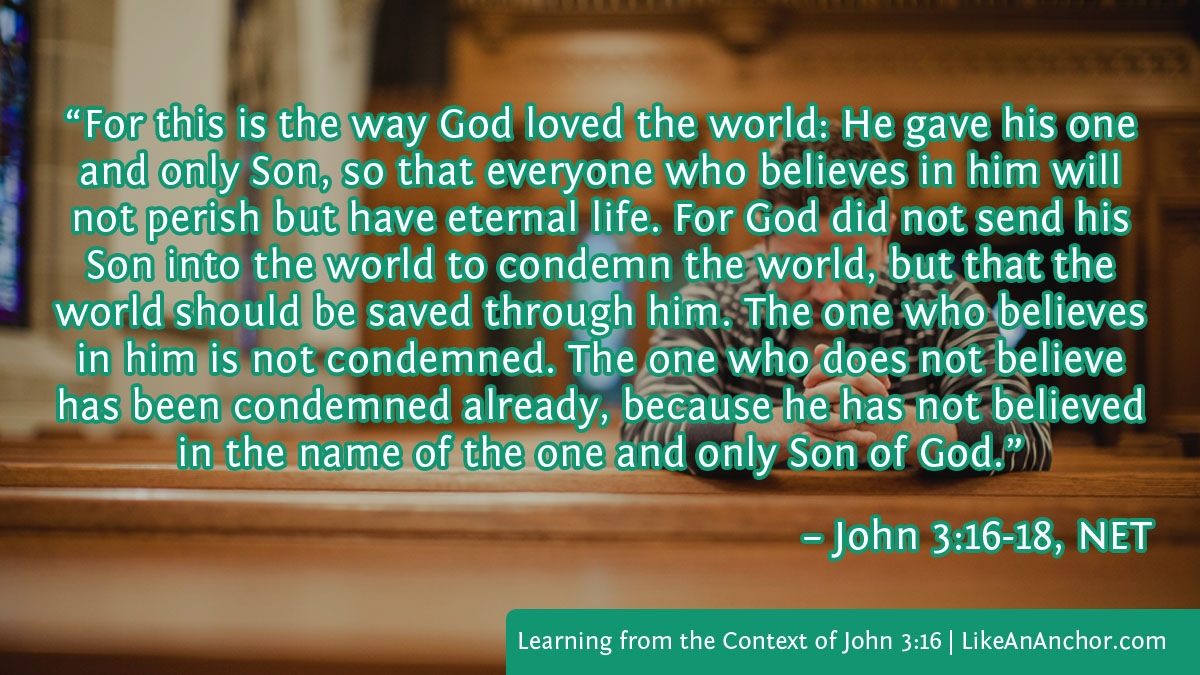
For this is the way God loved (agapao) the world: He gave his one and only Son, so that everyone who believes in him will not perish but have eternal life.

John 3:16, NET

God’s agape isn’t dependent on human response. We’re supposed to respond to His love, but He is agape, expresses agape, and is motivated by agape regardless of how people react to Him. When Jesus told His followers to “love (agapao) your enemy,” He followed it by saying this is part of being like our “Father in Heaven, since he causes the sun to rise on the evil and the good, and sends rain on the righteous and the unrighteous” (Matt. 5:44-45, NET). God also demonstrated His agape for His enemies when Jesus died for us while we were still sinners alienated from and opposed to God (Rom. 5:6-11).

God the Father and Jesus Christ are going to have love that is unconditional, benevolent, and wants what’s best for you regardless of your response to Him. They’ve already demonstrated their agape for everyone by Jesus dying to make reconciliation possible. This universal love does not, however, mean that we don’t have a role to play. We still need to repent, believe, and commit to God if we want to receive the salvation that He offers and to fully participate in His love. There’s a relational aspect to both philia and agape that helps explain the overlaps in meaning between the two words.

Image of people holding hands in a circle overlaid with text from 2 Corinthians 13:11-13, NET version: “Finally, brothers and sisters, rejoice, set things right, be encouraged, agree with one another, live in peace, and the God of love (agape) and peace will be with you. Greet one another with a holy kiss. All the saints greet you.  The grace of the Lord Jesus Christ and the love of God and the fellowship (koinonia) of the Holy Spirit be with you all.” 
Image by Pearl from Lightstock

The Dimension of Emotion

One of the criticisms I hear leveled at philia is that it’s an emotional love, unlike the purportedly more rational and stable agape. This is not a weakness of philia, but it is a characteristic. According to Thayer’s lexicon, Christ tells us to agape, not philia, our enemies “because love as an emotion cannot be commanded, but only love as a choice” (Greek 5368. Phileó, n.d.). This is not, however, the whole story. There are certain people that we are required or encouraged to have philia for as well as agape.

Paul wrote, “If any man doesn’t love (phileo) the Lord Jesus Christ, let him be cursed,” or “anathema” (1 Cor. 16:22, WEB). We must have emotional, friendly, affectionate love for Jesus as well as unconditional, committed love. Far more often, though, the command to love God is expressed with agape. The most important commandment is “Love (agapao) the Lord your God with all your heart, with all your soul, with all your mind, and with all your strength.’ The second is: ‘Love your neighbor as yourself’” (Mark 12:30-31, NET).

We also must have both philia and agape love for other people in the church. The compound word philadelphia (love+brother) is often translated “brotherly kindness” or “brotherly love.” It’s something that we’re commanded to have for our brethren, the other people in God’s church with whom we share fellowship (koinonia) (Rom. 12:10; 1 Thes. 4:9; Heb. 13:1; 1 Pet. 1:22; 3:8). Unlike our enemies, with whom we are not required to share mutual interests or affection, our brothers and sisters in Christ are people that we are supposed to care about.

The Vast Importance of Love

Thus far, I’ve focused a lot on philia because I think it’s often overlooked or minimized in discussions of Biblical love. Both philia and agape are part of faith; character traits that we must add on to the foundation of our commitment to God (2 Pet. 1:5-7). But I want to be careful that examining the importance of philia doesn’t minimize the importance of agape.

Forms of the word agape are used 535 times in the New Testament (eSword search for G25, G26, G27 [agapao, agape, agapetos) in contrast to forms of the word philia appearing 55 times (eSword search for G5384, G5360, G5373 [philos, phileo, philia]). Those numbers don’t include the times philia is part of a compound word (like philadelphia/philadelphus [G5360/G5361, used 7 times), but uses of agape still outnumber philia by quite a wide margin. It’s also the word used in some of the most pivotal discussions of love in the Bible, such as 1 John 2-5.

Image of a Bible laying open in the sunlight, overlaid with blog's title text and the words, "The Bible uses two main Greek words for love: philia and agape. Together, they help us understand God's incredible love for us and the type of love we’re 
supposed to have."
Image by Lamppost Collective from Lightstock

Dear friends, let us love one another, because love is from God, and everyone who loves has been fathered by God and knows God. The person who does not love does not know God, because God is love. By this the love of God is revealed in us: that God has sent his one and only Son into the world so that we may live through him. In this is love: not that we have loved God, but that he loved us and sent his Son to be the atoning sacrifice for our sins.

Dear friends, if God so loved us, then we also ought to love one another. No one has seen God at any time. If we love one another, God resides in us, and his love is perfected in us. … We love because he loved us first.

If anyone says “I love God” and yet hates his fellow Christian, he is a liar, because the one who does not love his fellow Christian whom he has seen cannot love God whom he has not seen. And the commandment we have from him is this: that the one who loves God should love his fellow Christian too.

1 John 4:11-16, 19-21, NET

Every time “love” appears in 1 John, it’s translated from a form of the word agape. Here we see that God is love, that He loves us, that we can love in the same way because of Him, and that if we really love Him we’ll love all of His people as well. We see that godly agape is enabled by God; i.e. we love because He loved.

We should note here that there are also ungodly expressions of agape (Luke 11:43; John 3:19; 12:43; 1 John 2:15), which is why it’s inaccurate to simply define agape as “godly love.” There are even passages that talk about the agape of God in contexts where a clarification likely wouldn’t be necessary if agape was always “of God” (Rom. 5:5; 8:39; 2 Thes. 3:5; 1 John 2:5; 3:17; Jude 1:21). With this caveat, we can say that the New Testament writers almost exclusively focus on the godly version that’s defined in 1 Corinthians 13.

Love is patient, love is kind, it is not envious. Love does not brag, it is not puffed up.  It is not rude, it is not self-serving, it is not easily angered or resentful. It is not glad about injustice, but rejoices in the truth. It bears all things, believes all things, hopes all things, endures all things. Love never ends.

1 Corinthians 13:4-8, NET

We have no such Biblical definition for philia, perhaps because friendly, affectionate love is much easier to understand (and more often explored in secular writings of the time) than unselfish, unconditional love. Paul also tells us in this passage that agape is absolutely essential to the Christian walk, and that it’s even more important than hope and faith (1 Cor. 13:1-3, 13). There are broad definitions we can give for philia and agape, including certain general distinctions between the two, that have an historical, scholarly, and most important biblical basis. What we must not do, however, is make the claim that agape is the highest or only form of godly love just because it sounds good (see Truth Be Told podcast episode, “It’ll Preach, But Is It True?). Philia and agape together—along with related words used by Biblical writers—help us understand God’s incredible love for us. There are some differences between the two, and agape is highlighted as a chief Christian virtue, but the two words also overlap quite a bit, especially in the context of godly love.

References

Bruni, L. (2010). Éros, Philia et Agapè. Pour une théorie de la réciprocité, plurielle et pluraliste [Eros, Philia and Agape. For a Theory of Reciprocity, Plural and Pluralist]. In La gratuité: Eloge de l’inestimable (pp. 389–413). Revue du M.A.U.S.S.

Grant, C. (1996). For the Love of God: Agape. The Journal of Religious Ethics, 24(1), 3–21.

Greek 26. agapé. (n.d.). Bible Hub. https://biblehub.com/greek/26.htm

Greek 5368. phileó. (n.d.). Bible Hub. https://biblehub.com/greek/5368.htm

Holst, J. (2021). Philia and Agape: Ancient Greek Ethics of Friendship and Christian Theology of Love. In S. Hongladarom & J. J. Joaquin (Eds.), Love and Friendship across Cultures: Perspectives from East and West (Singapore, pp. 1–191). Springer Nature Singapore. https://doi.org/10.1007/978-981-33-4834-9

Zodhiates, S. (Ed.). (1992). The Complete WordStudy Dictionary: New Testament. AMG Publishers.


Featured image by Lamppost Collective from Lightstock