Two Lessons From The Good Shepherd

I have started doing some Bible reading with my 18-month-old. I am not sure exactly how much she understands, but since she has developed a keen appreciation for sheep we spent a couple weeks going through Psalm 23 and John 10, and most recently 1 Peter 2:24-25. Now, every time I get out my scripture-writing or Bible study notebooks, she says, “Baa baa!”

In addition to the scripture readings I pick specifically for her, I also read to her the verse of the day from the one-month scripture writing program I’m working on (the ladies’ scripture writing group at my church congregation did “mountains, hills, and cities” last month and “prayer” this month). I tell my toddler that we’re probably not going to find sheep in those verses, but she always says, “Baa baa.” I jokingly told my husband last week that our daughter’s approach to Bible study so far is “Search the scriptures, for in them you will find sheep.”

I’ve been shocked how often her eagerness to hear about “baa baas” is rewarded even when we aren’t specifically studying that topic. I knew that sheep, lamb, and shepherd imagery appears frequently in the Bible, but I had forgotten just how much until she called my attention to it. The English words “sheep” or “lamb” appear 346 times in the New English Translation. That’s a lot of sheep!

As I started this study, I realized that I’d completely forgotten I already wrote three posts in 2023 about shepherds and sheep in the Bible. They were all published in February and March as pre-Passover studies:

Once again, I find myself thinking about sheep about 6 weeks before we’ll be observing the Lord’s Passover (it’s on the night of March 31st this year). As I reviewed those old posts, I almost gave up on writing this one. I hope, though, that my daughter’s innocent, childish enthusiasm for “baa baas” will help me look at the subject with fresh eyes. There are many theological topics we can look at in relation to sheep, including sheep as sacrifices, Christ as the lamb, God as shepherd, symbolism of His people as sheep, and human pastors as shepherds. When talking about sheep in the Bible with a toddler, though, I wanted to focus on a simple and positive image: God as our Shepherd and us as His sheep.

Provision and Protection

The analogy of God as our shepherd and us as sheep teaches us several foundational concepts about God’s character and the ways He relates to us. Two in particular stood out to me as I considered this topic again. Firstly, shepherds provide for and protect the sheep. I would describe this as the primary thing that “the Lord is my Shepherd” teaches us about God.

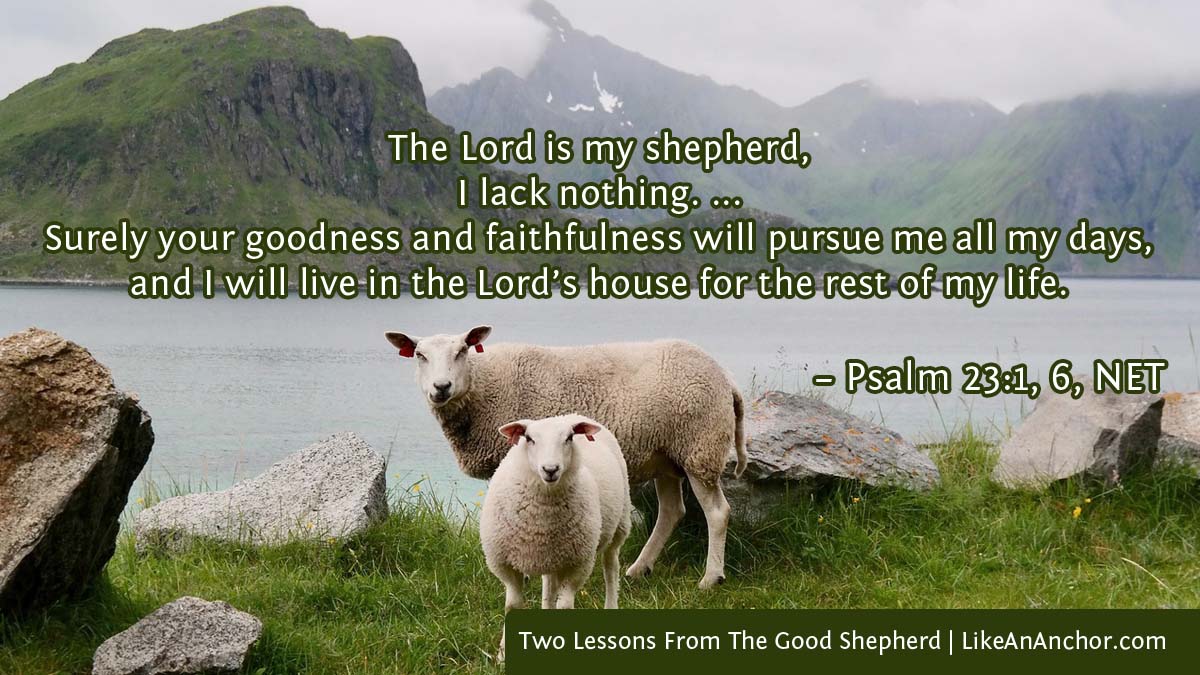
Yahweh is my shepherd;
I shall lack nothing.
He makes me lie down in green pastures.
He leads me beside still waters.

Psalm 23:1-2, WEB

Jesus emphasized provision and protection as well when He was explaining “I am the Good Shepherd.” His sheep are safe, they can find food, and He will give His life to keep them safe.

“I am the door. If anyone enters through me, he will be saved, and will come in and go out, and find pasture. …

“I am the good shepherd. The good shepherd lays down his life for the sheep. The hired hand, who is not a shepherd and does not own sheep, sees the wolf coming and abandons the sheep and runs away. So the wolf attacks the sheep and scatters them. …

“I am the good shepherd. I know my own and my own know me—just as the Father knows me and I know the Father—and I lay down my life for the sheep.

John 10:9, 11-12, 14, NET

Making sure that His sheep are protected and taken good care of is a top priority for God. In the passages in Jeremiah and Ezekiel where He takes Israel’s leaders to account for not being good shepherds, two of God’s primary charges against them is that they did not feed the flock or keep them gathered safely together. Like any good shepherd, God wants His sheep to be well taken care of and He takes direct action to make sure that this is the case. He even goes so far as to lay down his life for the sheep through Jesus’s redemptive sacrifice.

Close Relationship

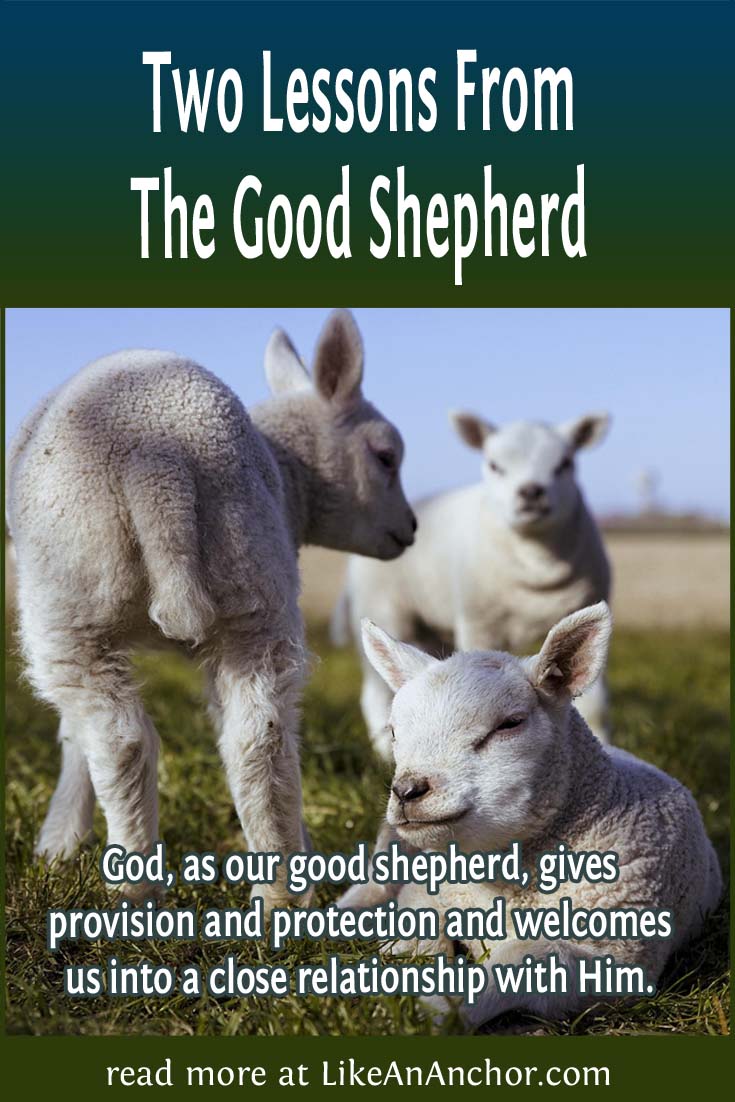
Image of three cute lambs in a field, overlaid with blog's title text and the words, "God, as our good shepherd, gives provision and protection and welcomes us into a close relationship with Him."
Image by Ria from Pixabay

The second core lesson that the Shepherd-Sheep analogy teaches us is that God wants to have a close relationship with His people.

He restores my soul.
He guides me in the paths of righteousness for his name’s sake.
Even though I walk through the valley of the shadow of death,
I will fear no evil, for you are with me.
Your rod and your staff,
they comfort me. …

Surely goodness and loving kindness shall follow me all the days of my life,
and I will dwell in Yahweh’s house forever.

Psalm 23:3-4, 6 WEB

God desires a close personal relationship with His people, both as a church group and as individuals. Psalm 23 reveals David had this type of close relationship with God, and shows us the peace, security, and close dwelling together that we can also have in a relationship with God.

“The one who enters by the door is the shepherd of the sheep. … the sheep follow him because they recognize his voice. They will never follow a stranger, but will run away from him, because they do not recognize the stranger’s voice. …

“I am the good shepherd. I know my own and my own know me—just as the Father knows me and I know the Father—and I lay down my life for the sheep. …

“My sheep listen to my voice, and I know them, and they follow me. I give them eternal life, and they will never perish; no one will snatch them from my hand.”

John 10:2, 4-5, 14, 27-28 NET

Jesus emphasizes the knowing that exists between shepherd and sheep in John 10 as well. One of the things that distinguishes Jesus’s sheep from other people is that we recognize His voice and follow Him. Also, note how closely this point about relationship is connected to protection and provision. Both times Jesus says that He knows His own and they know Him, He also talks about the incredible gifts He is giving us: salvation and eternal life.

He himself bore our sins in his body on the tree, that we may cease from sinning and live for righteousness. By his wounds you were healed. For you were going astray like sheep but now you have turned back to the shepherd and guardian of your souls.

1 Peter 2:24-25, NET

As our good shepherd, God gives provision and protection and welcomes us into a close relationship with Him. Once, we were like sheep who ran away from our shepherd. But our Good Shepherd came to earth, sought us out, gave His life to save us, and now lives again to continue protecting and providing for those who turn back to Him. God as shepherd and us as sheep is a comforting analogy that emphasizes how secure we are in His wonderful hands.


Featured image by Aart Beijeman from Pixabay

The Holy Spirit as a Down Payment

Bible writers love word pictures. They use analogies, metaphors, and parables to help us understand complex topics; e.g. “The kingdom of heaven is like a mustard seed” (Matt. 13:31, NET) and “The Lord is my shepherd” (Ps. 23:1, NET). One of the analogies that we might overlook in English because of translation choices is the description of the Holy Spirit as a down payment.

Many of us who grew up in a church are familiar with the King James Version. We might even have been told it’s the only good translation. One of the issues with that version, though, is that the English language in it dates from 1611. The way that we use English has changed over the centuries, including some word meanings (just ask any high schooler who’s been made to read Shakespeare). Some of the words that were a good choice for translating a specific Hebrew or Greek word in the early 17th century have changed meanings enough that they are now a meaningless or inaccurate translation.

In 2 Corinthians 1:22 and 5:5, and Ephesians 1:14, the Holy Spirit is described as “the earnest.” Currently, that word primarily means “characterized by or proceeding from an intense and serious state of mind” (Merriam-Webster). That meaning did exist as early as the 14th century, but around the 15th century it also came to mean the “portion of something given or done in advance as a pledge” (Etymonline). It is this second, now mostly obsolete, meaning that the KJV translators had in mind when they translated the Greek word arrhabon (G728 ἀρραβών).

Pledges and Payments

Thayer’s dictionary defines arrhabon as “an earnest, i. e. money which in purchases is given as a pledge that the full amount will subsequently be paid.” It is used “for the gift of the Holy Spirit, comprising as it does … both a foretaste and a pledge of future blessedness.” Zodhiates’s dictionary says much the same thing, defining arrhabon as “something which stands for part of the price and paid beforehand to confirm the transaction. Used in the NT only in a figurative sense and spoken of the Holy Spirit which God has given to believers in this present life to assure them of their future and eternal inheritance” (entry 728). We know that God cannot lie about His promises. His nature is a guarantee of that, but He also gives us another pledge–the Holy Spirit–as a down payment on what He promises.

The Greek word arrhabon (G728 ἀρραβών) is derived from the Hebrew word arabon (עָרַב H6162). The Theological Wordbook of the Old Testament (TWOT) points out that this “is one of the few Semitic words which have entered Western languages … . In the NT, arrabon is used of the Holy Spirit who is the ‘pledge of our inheritance'” (entry 1686b). Though this specific Hebrew word is only used in Genesis 38 to describe the pledges Judah gave Tamar (Gen. 28:17-18, 20), the root word and synonyms appear in other places. The TWOT writers point out that “the desire for God himself as one’s ‘security’ is an OT hope. Hezekiah, twittering and moaning like a bird, said: ‘My eyes look wistfully to the heights; / O Lord, I am oppressed, be my security’ (Isa. 38:14, NASB) … . Similarly, Job pleads with Yahweh: ‘Lay down, now, a pledge for me with Thyself; / Who is there that will be my guarantor?’ (Job 17:3).” We want God to be someone we can rely on when He makes a bargain, contract, or covenant with us. And He is.

Sureties for the Future

Image of a woman smiling and looking up in worship, overlaid with blog's title text and the words, "God promises to give His followers eternal life in the future as part of His family, and He gives us the Holy Spirit today as a down payment on that inheritance."
Image by Pearl from Lightstock

Let’s take a closer look at the three verses that describe the Holy Spirit as arrhabon. Two are in 2 Corinthians. Near the beginning of this letter, Paul talked about his plans to visit the congregation. He thought it through and was not vacillating between “yes” and “no” like someone unreliable. Similarly, the message that Paul preached was not contradictory, but full of hope and assurance.

For the Son of God, Jesus Christ, the one who was proclaimed among you by us—by me and Silvanus and Timothy—was not “Yes” and “No,” but it has always been “Yes” in him. For every one of God’s promises are “Yes” in him; therefore also through him the “Amen” is spoken, to the glory we give to God. But it is God who establishes us together with you in Christ and who anointed us, who also sealed us and gave us the Spirit in our hearts as a down payment.

2 Corinthians 1:19-22, NET

God is trustworthy. That’s something which is easy to know intellectually, but harder to make part of our daily lives. I suspect that if we fully understood His faithfulness, it would be nearly impossible to feel worry and doubt. A big part of what the Holy Spirit inside us does is reassure us of God’s presence, reliability, and attention (click here for an article on how the Bible talks about the Holy Spirit). With God indwelling and transforming us through His spirit, we are taking steps every day toward the future that He has promised us.

For we know that if our earthly house, the tent we live in, is dismantled, we have a building from God, a house not built by human hands, that is eternal in the heavens. … Now the one who prepared us for this very purpose is God, who gave us the Spirit as a down payment. Therefore we are always full of courage, and we know that as long as we are alive here on earth we are absent from the Lord—for we live by faith, not by sight. Thus we are full of courage and would prefer to be away from the body and at home with the Lord. So then whether we are alive or away, we make it our ambition to please him.

2 Corinthians 5:1, 5-9, NET

We have received many blessings from God already, but the fullness of His promises have not yet been delivered to us. John touches on this topic in some of his writings as well, saying that “we are God’s children now, and what we will be has not yet been revealed” (1 John 3:2, NET; see 1 John 3:1-3). God has already adopted us into His family, but we do not yet share in the God-family’s spirit nature. After Jesus’s return, then God’s faithful followers will be transformed to become like Him.

Blessed is the God and Father of our Lord Jesus Christ, who has blessed us with every spiritual blessing in the heavenly realms in Christ. For he chose us in Christ before the foundation of the world that we should be holy and blameless before him in love. He did this by predestining us to adoption as his legal heirs through Jesus Christ, according to the pleasure of his will … And when you heard the word of truth (the gospel of your salvation)—when you believed in Christ—you were marked with the seal of the promised Holy Spirit, who is the down payment of our inheritance, until the redemption of God’s own possession, to the praise of his glory.

Ephesians 1:3-5, 13-14, NET

One of the ways we can be certain that God will keep His promise to give us eternal life is because we have already received the Holy Spirit as His down payment on that inheritance. It is incredible that God chooses to share His nature with us and dwell inside us, even while we are still human beings. The down payment of the Holy Spirit is empowering, reassuring, and transformational.

If you liked this post and want to read more, I recommend “What Does It Mean For Each of Us That God Is A Family?” and “Three Ways to Join A Family.”


Featured image by Anggie from Lightstock

The Scriptures on My Wall: Three Encouraging Passages

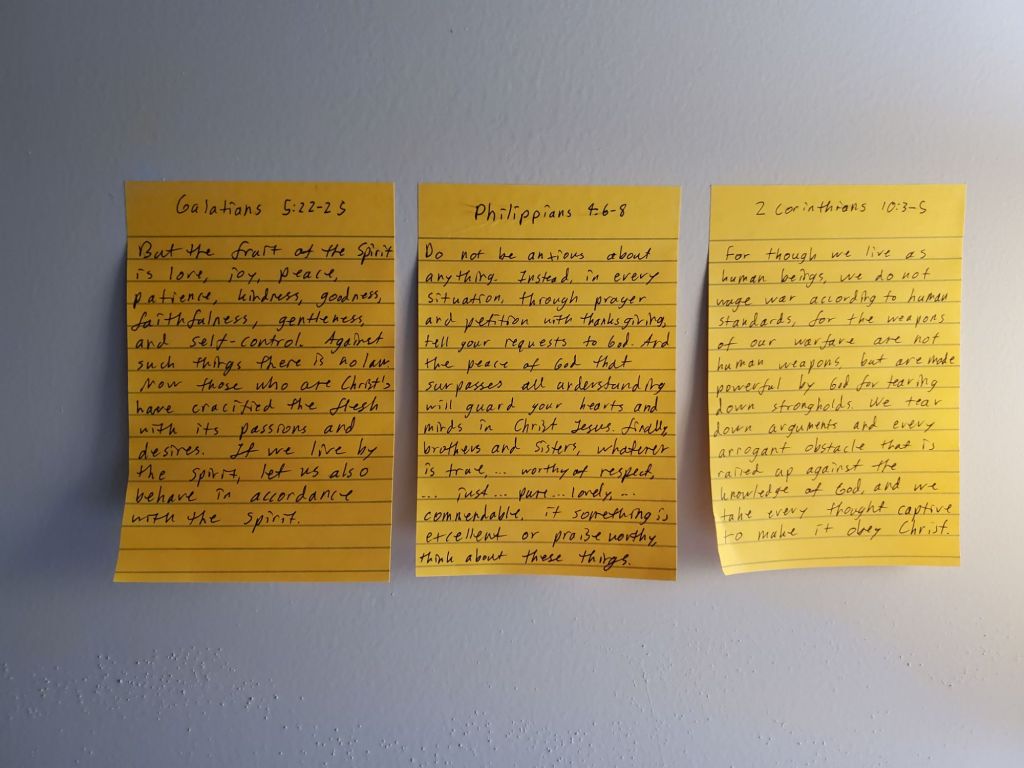
I love having a toddler. For me personally, I think the toddler phase is much easier than the baby phase and it’s amazing to see my daughter’s sweet personality develop as she learns at an astonishing rate. As great as it is, though, toddlers can try your patience. Several weeks ago, I selected three scriptures that I placed on the wall beside my bed so I could see them first thing in the morning as I prayed before starting the day. Those scriptures are Galatians 5:22-25, Philippians 4:6-8, and 2 Corinthians 10:3-5. I thought for today’s post, it would be nice to walk through those three scriptures and think about how they can help us manage our thoughts and emotions in a godly way.

The Fruit of the Spirit

But the fruit of the Spirit is love, joy, peace, patience, kindness, goodness, faithfulness, gentleness, and self-control. Against such things there is no law. Now those who belong to Christ have crucified the flesh with its passions and desires. If we live by the Spirit, let us also behave in accordance with the Spirit.

Galatians 5:22-25, NET

I started out with this verse because it’s a reminder of the type of character we’re supposed to develop as we become more and more like God. When we enter a covenant with God at baptism and become part of His family, He gives us the Holy Spirit as a down payment on our full inheritance in His family (2 Cor. 1:22; 5:5; Eph. 1:13-14; 4:30). God’s spirit inside us transforms us to be like Him, and as we become more and more like Him we will see the fruits of His character more and more prominently in our lives.

Our transformation is a work that God accomplishes, but we are not just passive recipients of that change (Phil. 2:12-13). In fact, we won’t change at all if we don’t take an active part in the relationship. We can’t become like God on our own, but we also won’t become like God if we aren’t working with Him toward that goal. It is our responsibility to “behave in accordance with the Spirit.” Studying the fruit of the Spirit, praying for God’s aid, and cultivating those traits in us is one way to do that.

Taking Thoughts Captive

For though we live as human beings, we do not wage war according to human standards, for the weapons of our warfare are not human weapons, but are made powerful by God for tearing down strongholds. We tear down arguments and every arrogant obstacle that is raised up against the knowledge of God, and we take every thought captive to make it obey Christ.

2 Corinthians 10:3-5, NET

Thoughts often seem like they pop into our heads and there’s nothing we can do about them. It often seems impossible or counter-intuitive to be told that we are in control of what our minds think about. For many of us, thoughts and emotions just happen. For example, we don’t make the conscious decision to get angry when we read a news article or feel anxiety when hearing a strange noise at night.

While our first impulse might be out of our control, we do have the power to direct our thoughts where we want them to go. It’s not easy. That’s why this verse talks about warfare. But we can do it, especially when we are “made powerful by God” and ask Him to help us “take every thought captive to make it obey Christ.”

Peace In Your Mind

Image of three sticky notes on a wall, overlaid with blog's title text and the words, "These three scriptures remind me that inside-out-transformation is possible with God's help. I don't have to be anxious, and I am in control of my thoughts and emotions."

Do not be anxious about anything. Instead, in every situation, through prayer and petition with thanksgiving, tell your requests to God. And the peace of God that surpasses all understanding will guard your hearts and minds in Christ Jesus.

Finally, brothers and sisters, whatever is true, whatever is worthy of respect, whatever is just, whatever is pure, whatever is lovely, whatever is commendable, if something is excellent or praiseworthy, think about these things.

Philippians 4:6-8, NET

Anxiety has been a long-time struggle for me. This verse is a challenging one for me to believe because I have so much experience with having anxiety rather than peace even while praying faithfully and following God. But I also have experienced overwhelming peace that can only come from God. And I know that I have less anxiety when I pray for God’s help and do the hard work of taking control of my anxious thoughts.

This verse goes so well with 2 Corinthians 10:3-5 because it gives us specific things to think about when we take our thoughts captive. You can’t push wrong thoughts out and keep them out unless you replace them with something else.

As Christians, we know that we’re suppose to become like God. That often seems like an impossible goal, but impossible things are possible when God gets involved (Matt. 19:26). Inside-out-transformation happens as we cultivate the fruit of God’s spirit in us, fight with God’s power to take our thoughts captive, and dwell in the peace that He guards us with as we think on things pleasing in His sight.


P.S. For 10 years on my blog, I published a year-end review sharing site stats, most popular posts, etc. This year, I decided to move that into the newsletter. If you’re curious, make sure you subscribe so you’ll get that email when it goes out next week.


Featured image by Corey David Robinson from Lightstock

Song Recommendation: “My Feet Are On The Rock” by I AM THEY (one of my toddler’s favorite Christian songs)

The Two Audiences of 1 Corinthians 1:26-31

In 1 Corinthians 1:26-31, Paul tells his readers, “Think about the circumstances of your call, brothers and sisters. Not many were wise by human standards, not many were powerful, not many were born to a privileged position. But God chose what the world thinks foolish to shame the wise, and God chose what the world thinks weak to shame the strong. God chose what is low and despised in the world, what is regarded as nothing, to set aside what is regarded as something, so that no one can boast in his presence” (1 Cor. 1:26-29, NET). He reminds them that most were not people that are important or special by worldly standards, and this is one of the reasons God chose them.

A sermon I recently heard emphasized that this passage shows God makes a habit of working with people who are considered nothing because that demonstrates His power. This sermon was addressed to people who have been told that they are uneducated, unsophisticated, foolish, and weak by this world’s standards. As I listened to this message, I knew it would be well-received by the people in our small, rural, Midwestern church congregation.

Audience awareness is a major part of my training in rhetoric and writing, so it’s something I think about a lot. As I thought about it in the context of this sermon, I realized that particular message would not resonate the same way with a different audience of more wealthy, more educated, and more cosmopolitan people. That doesn’t mean this scripture isn’t for them, though. There’s encouragement here for the many “foolish, weak, and despised” called-out ones, as well as cautions and reminders for the “not many” wise, powerful, and privileged whom God also chose to call.

Image of a man praying in a church pew overlaid with text from Rom. 12:3, NET version: “For by the grace given to me I say to every one of you not to think more highly of yourself than you ought to think, but to think with sober discernment, as God has distributed to each of you a measure of faith.”
Image by Shaun Menary from Lightstock

Audience One: Those Who Know They Are Nothing

One of the major things that we can see when studying the Bible is that God chooses to work with humble people. You do not necessarily need to be in humbling circumstances to have a humble attitude, but the two often go together. When Jesus was here on earth, He lived as a carpenter’s son and many of the disciples He called were working-class people with only a basic education (e.g. fishermen) or someone in a despised occupation (e.g. tax collector). Most the spiritual leaders at the time and experts in the law did not recognize Him as the Messiah or choose to follow Him.

Paul referenced this truth when he asked the Corinthian brethren–who were struggling with divisions in their congregation (1 Cor. 1:10)–to think about their calling. When God was drawing people in Corinth to follow Christ, “Not many” of the people called “were wise by human standards, not many were powerful, not many were born to a privileged position” (1 Cor. 1:26, NET). Paul invited the Corinthians to remember that “the message of the cross” and the preaching of the gospel seems like “foolishness” to most people in the world, particularly to those who consider themselves wise (1 Cor. 1:18-24). People who believe in Jesus will be called fools by some, but God chose those “foolish” people on purpose.

But God chose what the world thinks foolish to shame the wise, and God chose what the world thinks weak to shame the strong. God chose what is low and despised in the world, what is regarded as nothing, to set aside what is regarded as something, so that no one can boast in his presence.

1 Corinthians 1:27-29, NET

People God chooses to work with don’t already need to be perfect. In fact, we need to recognize that “perfection” is an unachievable goal apart from Him (and one we’ll be working on the rest of our lives). As a popular phrase goes, “God doesn’t call the qualified; He qualifies the called.” Many of the people God chooses to work with are those that others would pass over. When God does amazing things with those sorts of people, it makes others marvel at what He is doing.

When they saw the boldness of Peter and John, and discovered that they were uneducated and ordinary men, they were amazed and recognized these men had been with Jesus.

Acts 4:13, NET

Jesus’s disciples weren’t illiterate or completely uneducated; it is almost certain that they would have attended a synagogue school. However, they “had no formal rabbinic training and thus, in the view of their accusers, were not qualified to expound the law or teach publicly” (NET footnote). God chose to do wonderful things with people who most others wouldn’t have given a second thought. The only thing remarkable about them was that they “had been with Jesus.” That truth provides great encouragement for us today when we feel unqualified, overlooked, foolish, or weak.

Image of a woman reading the Bible overlaid with text from Prov. 26:12, WEB version: “Do you see a man wise in his own eyes? There is more hope for a fool than for him.”
Image by MarrCreative from Lightstock

Audience Two: Those Who Think They Are Something

When Paul addressed the Corinthians, he did not say none of the called were wise, powerful, or respected. The phrase “not many” indicates there were some people in those categories that God chose to use. In fact, as we consider Paul’s life, we see that he was one of the “not many.” In another letter, Paul said that “we are … the ones who worship by the Spirit of God, exult in Christ Jesus, and do not rely on human credentials—though mine too are significant” (Phil. 3:3, NET). He was an educated, respected, zealous Pharisee and a Roman citizen by birth. He was “wise by human standards,” “powerful,” and “born to a privileged position.”

But these assets I have come to regard as liabilities because of Christ. More than that, I now regard all things as liabilities compared to the far greater value of knowing Christ Jesus my Lord, for whom I have suffered the loss of all things—indeed, I regard them as dung!—that I may gain Christ, and be found in him, not because I have my own righteousness derived from the law, but because I have the righteousness that comes by way of Christ’s faithfulness—a righteousness from God that is in fact based on Christ’s faithfulness.

Philippians 3:7-9, NET

Paul realized the truth that is so hard to grasp for people with wealth, education, strength, riches, and other things respectable by human standards. The human qualifications don’t actually mean anything. In God’s eyes, we are just as “wretched, pitiful, poor, blind, and naked” as anyone else (Rev. 3:17, NET; see Rev. 3:14-22). Let’s continue reading a little farther in 1 Corinthians to see what Paul said after what we’ve already quoted.

God chose what is low and despised in the world, what is regarded as nothing, to set aside what is regarded as something, so that no one can boast in his presence. He is the reason you have a relationship with Christ Jesus, who became for us wisdom from God, and righteousness and sanctification and redemption, so that, as it is written, “Let the one who boasts, boast in the Lord.”

1 Cor. 1:28-31, NET (bold italics mark a quotation from Jer. 9:24)

When Paul says, “it is written,” he is referencing a passage in Jeremiah. Those familiar with this passage or who look it up see that the passage addresses this second audience of people who have wisdom, might, and riches but need to understand that those things don’t really matter in the grand scheme of things.

Yahweh says,
“Don’t let the wise man glory in his wisdom.
Don’t let the mighty man glory in his might.
Don’t let the rich man glory in his riches.
But let him who glories glory in this,
that he has understanding, and knows me,
that I am Yahweh who exercises loving kindness, justice, and righteousness in the earth,
for I delight in these things,” says Yahweh.

Jeremiah 9:23-24, WEB

People with worldly recognition for wisdom, might, riches, and privilege need to overcome their pride and realize that those human qualifications don’t make them something special in God’s eyes. The group of people we are talking about as this “second audience” are no more qualified to receive God’s call than the people in the “first audience.” They have a harder time realizing that, though, because pride is more likely to get in the way.

All One Audience

Image of an open Bible, overlaid with blog's title text and the words, When you read that not many wise people are called by God, do you think you're one of the “not many” or one of the “not wise”?
Image by Lamppost Collective from Lightstock

There really aren’t two different audiences for Paul’s words in 1 Corinthians 1 (though the way we preach from this text might change based on who we’re talking to). That’s the truth the second audience needs to realize–they are actually part of the first audience. This can be a very difficult thing for people who think they are “something” to accept.

As Paul continued addressing his Corinthian audience, he returned to the topic of dissentions and quarrels among the believers there. He berated them for forming into camps following specific men. He told them they were immature “infants in Christ” who aren’t even ready yet for hearty spiritual food (1 Cor. 3:1-4). Dissention, jealously, and bragging about which teacher you follow are the sort of foolishness rooted in wrongly thinking that you’re wise.

Guard against self-deception, each of you. If someone among you thinks he is wise in this age, let him become foolish so that he can become wise. For the wisdom of this age is foolishness with God. As it is written, “He catches the wise in their craftiness.” And again, “The Lord knows that the thoughts of the wise are futile.” So then, no more boasting about mere mortals!

1 Corinthians 3:18-20, NET (bold italics mark quotations from Job 5:13 and Ps 94:11)

If we read 1 Corinthians 1:26-31 and think, “I must be one of the ‘not many,'” then we need to be particularly on-guard against self-deception. Later in the same letter, Paul said, “Knowledge puffs up, but love builds up. If someone thinks he knows something, he does not yet know to the degree that he needs to know” (1 Cor. 8:1-2, NET). Whatever qualifications we think we have, boasting about ourselves does not impress God and is completely unfounded considering how much greater He is than us. But if we’re not careful, pride and attachment to worldly things can get in the way of our relationship with God.

Then Jesus said to his disciples, “I tell you the truth, it will be hard for a rich person to enter the kingdom of heaven! Again I say, it is easier for a camel to go through the eye of a needle than for a rich person to enter into the kingdom of God.” The disciples were greatly astonished when they heard this and said, “Then who can be saved?” Jesus looked at them and replied, “This is impossible for mere humans, but for God all things are possible.”

Matthew 19:23-26, NET

There are many things that could serve as obstacles to salvation. Weak and lowly people might think they are beneath God’s attention. Strong and proud people might think they don’t need Him. But obstacles that are impossible for mere humans to overcome don’t stand in God’s way at all! He can and does accomplish salvation for all types of people. We just need to recognize our need for Him and respond to His call, letting go of whatever might stand in our way. No matter what our backgrounds, education status, jobs, nationality, ethnicity, etc. when we compare ourselves to Jesus’s standard we all fall short. We are all the people that Paul addresses in 1 Corinthians as those who have no reason to boast in themselves, but many reasons to praise the Lord.

Just look at yourselves, brothers — look at those whom God has called! Not many of you are wise by the world’s standards, not many wield power or boast noble birth. But God chose what the world considers nonsense in order to shame the wise; God chose what the world considers weak in order to shame the strong; and God chose what the world looks down on as common or regards as nothing in order to bring to nothing what the world considers important; so that no one should boast before God. It is his doing that you are united with the Messiah Yeshua. He has become wisdom for us from God, and righteousness and holiness and redemption as well! Therefore — as the Tanakh says — “Let anyone who wants to boast, boast about Adonai.”

1 Corinthians 1:26-31, CJB

Featured image by Claudine Chaussé from Lightstock

Song Recommendation: “Who Am I” by Casting Crowns

Examining Our Relationship With God’s Restrictions

I’ve been rereading one of my favorite one-year devotional books, and I’d like to start today’s post by quoting part of one devotional entry.

God is holy, and we must conform to His holiness. This means restrictions on our behavior. But when the restraints become the essence of our faith, as they did for the Pharisees, we are far from the heart of God. … Faith is about following His character. That’s the whole point of obedience.

Chris Tiegreen, 365 Pocket Devotions, Day 49

It’s very easy for humans to go to extremes. On the one hand, you’ll meet Christians who build their lives around what they can and cannot do as if keeping the law perfectly can save them. On the other hand, you’ll meet Christians who say they don’t have to be obedient to God’s law because grace covers all that. The truth is somewhere in between. Obedience isn’t what saves us, but it is the right and proper response to receiving salvation. Having the right understanding of our relationship with God helps us have a right understanding of our relationship with His law.

Image of a man reading the Bible overlaid with text from John 14:15, NET version: “If you love me, you will obey my commandments.”
Image by Matt Vasquez from Lightstock

Start With Love

There are certain things that God expects from people who follow Him. It is much like any healthy relationship. I expect people that I am friends with to generally treat me well and follow a basic standard of good conduct, and they expect the same from me. If one of us violated these unspoken “rules” of friendship, the friendship would dissolve or at the very least become more distant. Healthy relationships require things like regular communication, trustworthiness, reciprocity, a way to resolve conflicts, and mutual respect for the other’s needs, morals, and boundaries.

Our relationship with God works the same way, and He doesn’t leave us guessing about how the relationship works. He invites us into a covenant relationship with Him and lets us know exactly what He expects from us as well as what we can expect from Him. It’s actually pretty simple, and can be boiled down into just two commandments:

Jesus said to him, “‘Love the Lord your God with all your heart, with all your soul, and with all your mind.’ This is the first and greatest commandment. The second is like it: ‘Love your neighbor as yourself.’ All the law and the prophets depend on these two commandments.”

Matthew 22:37-40, NET

There are lots of other commands in scripture, of course (both Old and New Testament), but they are all just elaborations on these two expectations. At the most basic level, God’s restrictions on our behavior are all connected to making sure that we love Him and love the people around us in the right way. Remembering that helps us have the right perspective on obedience.

Owe no one anything, except to love one another, for the one who loves his neighbor has fulfilled the law. For the commandments, “Do not commit adultery, do not murder, do not steal, do not covet,” (and if there is any other commandment) are summed up in this, “Love your neighbor as yourself.” Love does no wrong to a neighbor. Therefore love is the fulfillment of the law.

Romans 13:8-10, NET

I like how Paul frames all the “do not” commandments as telling us how to love the way God does. A lot of times people describe God’s laws as restrictive or oppressive or outdated, but at the heart of it all is healthy relationships with God and with other people. He wants what is best for us, and He wants a personal relationship with us. His instructions reflect that truth.

Check Your Heart

Image of a woman reading the Bible, overlaid with blog's title text and the words, "How and why we obey God is a matter of vital importance."
Image by Pearl from Lightstock

God knows what our motives are. He looks inside our hearts and searches our minds to understand us even better than we understand ourselves (1 Sam. 16:7; Jer. 17:5-10). He knows if we’re flippantly disregarding His laws because we don’t care about what He says, and He also knows if we’re obeying from wrong motives.

“Not everyone who says to me, ‘Lord, Lord,’ will enter into the kingdom of heaven—only the one who does the will of my Father in heaven. On that day, many will say to me, ‘Lord, Lord, didn’t we prophesy in your name, and cast out demons in your name, and do many powerful deeds in your name?’ Then I will declare to them, ‘I never knew you. Go away from me, you lawbreakers!’”

Matthew 7:21-23, NET

This has got to be one of the most sobering passages in the entire Bible. Jesus warns us that calling Him Lord is not enough to get into the kingdom of heaven. Even doing wonderful things in His name isn’t enough. Only those who do the Father’s will and are known by Jesus Christ will be in His kingdom.

“I am the good shepherd. I know my own and my own know me—just as the Father knows me and I know the Father …

“My sheep listen to my voice, and I know them, and they follow me. I give them eternal life, and they will never perish; no one will snatch them from my hand. My Father, who has given them to me, is greater than all, and no one can snatch them from my Father’s hand.” 

John 10:14-15, 27-29

Once again, it comes back to relationships. We must listen to Jesus and follow Him, “conforming to His holiness” and “following His character,” as Tiegreen puts it. So, how do you view the restrictions God places on our behavior?

As something you must do perfectly or else you’ll lose your salvation?

As something not worth bothering with?

As guides for how to live in close relationship with God and enjoy all the blessings that accompany adopting His character?

I don’t really like to think of God’s laws as “restrictions.” They do restrict my behavior, but I see them more as guides, guardrails, and insights into God’s character. We keep the law because we’re walking in the spirit; law-keeping is a side-effect of becoming like God. Christians today ought to obey God because we want to be like Him and follow Him faithfully, and His law tells us how to do that.


Featured image by Inbetween from Lightstock

Ideas to Hold Loosely and Closely

I was thinking the other day about the topic of prophecy. Specifically, about how attached some people get to their ideas of how Biblical predictions for the future are going to play out. They want to figure out (or think they already know) when Jesus will return, what the mark of the beast is, which modern nation correspond to names used in prophecy, and other specifics. But I think we need to get comfortable accepting that there are some things we simply don’t know. For some future events, Jesus told His disciples that we are “not permitted to know” the details (Acts 1:6-7). For other things, even though we are permitted to “know the mysteries/secrets of the kingdom of heaven” (Matt. 13:11), it takes time to learn the “deep things of God” and we will never fully understand all there is to know in this human life (Rom. 11:33; 1 Cor. 2:10). With that in mind, I think it is healthy to hold our pet interpretations of prophecies loosely.

I have often wondered how people who are absolutely, 100% sure that God will do things a certain way will react if they’re wrong. Will they miss what God is doing because they are looking somewhere else? Will they get upset with Him if He comes back on a day they weren’t expecting? Will they be so focused on figuring out prophecy that they’ll neglect something more important? And as I wonder these things about other people, I also have to turn these questions back on myself and see if there are any areas where I am doing something similar. For me, it’s not so much about prophecy, but about interpretations of more complex scriptures or less clear points of doctrine. I need to remember that my speculations and pet theories might be wrong.

We must be very careful that the knowledge we (think) we have doesn’t blind us to the reality that we have so much more still to learn (1 Cor. 8:2; 10:12). For things that are speculative, unclear, and/or unrevealed it is the mark of a humble and teachable mind to admit that we don’t really know. We can have ideas that we think are true, and they may even be good ideas solidly grounded in Biblical reasoning, but there are some things that we simply can’t know with 100% certaintly. We should hold those ideas loosely, willing to reconsider them and to give them up if we learn something that tells us we were wrong.

At the same time, there are prophecies, commands, and doctrines that are clearer than others. God gives us promises that He has not yet fully fulfilled, and we can be 100% certain that He will keep those promises. Those are things that we should hold onto tightly, never letting them go or permitting our faith to be shaken. For example, the timing for Jesus’s return is something that we cannot know. If we have ideas for when that might happen, we should hold those ideas loosely. But we so know for certain that Jesus will return and that He will set up God’s kingdom on earth. That is a promise that we should hold close and let it make a home in our hearts.

Image of a man reading the Bible overlaid with text from 1 Thess. 5:21, WEB version:  "Test all things, and hold firmly to that which is good."
Image by Matt Vasquez from Lightstock

Things to Hold Fast, and Things To Let Go

Depending on which English translation of the Bible you’re reading, the phrase “hold fast” is used multiple times in scripture. There are some things that we are told to hold fast to, and there are others things that people are warned against holding onto. On the negative side, the people of ancient Israel were warned not to “hold fast” to the pagan nations living around them (Joshua 23:8-13). Later in ancient Israel’s story, God asked why the people “continually turn away from me in apostasy” and “hold fast to their deception” (Jer. 8:5, NET). By Jesus’s time, the Jewish people had rejected the ways of pagan nations around them, but some were still holding onto a different type of deception.

The Pharisees and the experts in the law asked him, “Why do your disciples not live according to the tradition of the elders, but eat with unwashed hands?” He said to them, “Isaiah prophesied correctly about you hypocrites, as it is written:

This people honors me with their lips,
but their heart is far from me.
They worship me in vain,
teaching as doctrine the commandments of men.’

Having no regard for the command of God, you hold fast to human tradition.”

Mark 7:3-8, NET (bold italics mark a quotation from Isa 29:13)

The Pharisees Jesus spoke with here held tightly to the wrong things. They should have held on tight to God’s commandments, but instead they held fast to human traditions and let the commandments slip away. We need to be careful that we don’t do the same thing by holding so tight to human traditions or ideas (including our own) that we let the most important things slip. Some of the key things that the Bible tells us to hold fast to are

Image of a group of people sitting in church pews, overlaid with blog's title text and the words, "When interpreting the Bible, we must keep a tight hold on things that God has made sure and certain, and a loose hold on our own speculations."
Image by Brown Bag Photography from Lightstock

Holding fast to the right things has a lot to do with staying faithful. No matter what people say or weird ideas that pop into our heads, we need to hold tight to God, to His clear instructions, to His promises, and to our commitment to Him. We must not let any of the less certain things draw us away from that. There’s nothing wrong with studying prophecy and having ideas for how things might happen, or with studying difficult scriptures and doctrinal topics and having thoughts on how we should interpret those. We just need to make sure we are holding on to the right things, keeping a tight hold on things that God has made sure and certain and a loose hold on our own ideas and theories.


Featured image by Pearl from Lightstock