Keeping The Feast As God’s Covenant Community

If you’re reading this when it posts, then today (Sept. 30, 2023), is the first day of the Feast of Tabernacles (Sukkot). As we made preparations to keep this Feast, I’ve been thinking about a book of the Bible that, at first glance, you might think doesn’t have much to do with the holy days. Usually when talking about God’s holy times, we turn to some place like Leviticus 23, which outlines all the days God says are holy to Him. This year, though, I’ve been thinking about Romans.

I’m sure I’ve mentioned before that Paul’s letter to the Romans is one of my favorite books in the Bible. There’s so much depth to it; I think I could spend a lifetime studying it and not fully understand everything. While reading Romans 10 and 11 a few weeks ago, I sketched out some notes trying to visualize the olive tree grafting analogy that Paul uses when discussing how New Covenant Christians and Gentile believers (those who were not ethnically part of Israel) become part of God’s community of faith, and what happened to the Jewish people who did not accept Jesus as the Messiah. Earlier, I also sketched out a chart trying to illustrate the different ways that Paul speaks to Jewish and Gentile converts about God’s law. I turned one into an infographic and one into a sort of flowchart. These visualizations helped me, and I’m sharing them in hope they might be useful to others as well.

Two Paths to Get to Christ

Often, I think Christians make the mistake of thinking that Christianity was a new religion started by Jesus and that the Jews today are still keeping the faith described in the Old Testament. What we ought to realize is that Jesus came as the next step in God’s plan for His people. He was the promised Messiah, and those who accepted Him continued along the path God laid out for His people from Genesis onward. Assuming you believe that Jesus is the Messiah, then those who didn’t believe in Him are the ones who broke off and went a different direction. That’s what Paul is addressing in this section of Romans. 

Brothers and sisters, my heart’s desire and prayer to God on behalf of my fellow Israelites is for their salvation.  For I can testify that they are zealous for God, but their zeal is not in line with the truth.  For ignoring the righteousness that comes from God, and seeking instead to establish their own righteousness, they did not submit to God’s righteousness. For Christ is the end of the law, with the result that there is righteousness for everyone who believes. 

Romans 10:1-4, NET

Paul was a Jewish man who had zeal for God that originally didn’t line up with the truth. He persecuted Christians at first, but when Jesus dramatically revealed Himself to Paul as the Messiah, Paul aligned His zeal with God’s truth. After that, he wanted all of his fellow Israelites to have a similar awakening. At this point, rather than aligning themselves with God’s truth, the way that they were trying to follow His law involved doing things their own way. Christ brings an end to trying to keep the law as a way to establish your own righteousness.

The Greek word for “end” here can mean the end or completion point, but it also means “the end to which all things relate, the aim, purpose” (Thayer, G5056, 1d). Now, remember that when we’re interpreting Paul we need to keep in mind that, as a faithful apostle, he would not contradict one of Jesus’s teachings. Jesus said, “Do not think that I have come to abolish the law or the prophets. I have not come to abolish these things but to fulfill them” (Matt. 5:17, NET). Here, He’s saying that He came “to fulfil, i.e. to cause God’s will (as made known in the law) to be obeyed as it should be, and God’s promises (given through the prophets) to receive fulfilment” (Thayer, G4137, 2c3). Therefore, Paul is not saying that Jesus got rid of the law. He’s pointing out that we don’t become righteous by keeping the law.

Paul taught both Jewish and Gentile Christians. These two groups had different relationships to the law of God as they came into the church. For Jewish Christians, “the law was our schoolmaster to bring us unto Christ, that we might be justified by faith” (Gal. 3:24, KJV). For Gentile Christians (particularly those who weren’t already “God fearers” who’d aligned themselves with the Jewish faith), they came to Jesus by faith first and learned about God’s laws afterwards. You’ll often see Paul telling his Jewish readers that it’s important to keep God’s law on a heart level now and to understand they can’t make themselves righteous, and teaching his Gentile readers to obey God but not accept extra Jewish traditions they’d added on top of the law.

Chart illustrating the ways Paul outlines for Jewish and Gentile Christians to both enter the New Covenant community with God.
Image by Marissa Martin, created with Canva

For Moses writes about the righteousness that is by the law: “The one who does these things will live by them.” But the righteousness that is by faith says … “The word is near you, in your mouth and in your heart” (that is, the word of faith that we preach), because if you confess with your mouth that Jesus is Lord and believe in your heart that God raised him from the dead, you will be saved. For with the heart one believes and thus has righteousness and with the mouth one confesses and thus has salvation. For the scripture says, “Everyone who believes in him will not be put to shame.” For there is no distinction between the Jew and the Greek, for the same Lord is Lord of all, who richly blesses all who call on him. For everyone who calls on the name of the Lord will be saved.

Romans 10:5-6, 8-13 (bold italics in original to mark OT quotes)

Paul uses quotes from the Old Testament to support his thesis that Jewish and Gentle Christians are part of the same spiritual family. God wants all His people in community together, joined into one covenant relationship with Him. For many of the Gentiles, this is the first time they’ve been in covenant with God. For the Jewish believers, the New Covenant was a promise contained in the Old Covenant. Whichever way they came into the family, they’re now both part of that New Covenant with God.

Grown or Grafted into One Tree

So I ask, God has not rejected his people, has he? Absolutely not! For I too am an Israelite, a descendant of Abraham, from the tribe of Benjamin. God has not rejected his people whom he foreknew! Do you not know what the scripture says about Elijah, how he pleads with God against Israel? “Lord, they have killed your prophets, they have demolished your altars; I alone am left and they are seeking my life!” 

But what was the divine response to him? “I have kept for myself seven thousand people who have not bent the knee to Baal.” So in the same way at the present time there is a remnant chosen by grace. And if it is by grace, it is no longer by works, otherwise grace would no longer be grace. What then? Israel failed to obtain what it was diligently seeking, but the elect obtained it. …

I ask then, they did not stumble into an irrevocable fall, did they? Absolutely not! But by their transgression salvation has come to the Gentiles, to make Israel jealous …  Now I am speaking to you Gentiles. Seeing that I am an apostle to the Gentiles, I magnify my ministry, if somehow I could provoke my people to jealousy and save some of them. For if their rejection is the reconciliation of the world, what will their acceptance be but life from the dead?

Romans 11:1-7, 11, 13-15, NET (bold italics in original to mark OT quotes)

Through His prophets, God revealed that He always intended to open up salvation to all nations after the Messiah came. Even before that, He allowed people from non-Israelite nations to join the covenant community if they really wanted. As Paul was writing, though, this broad preaching of the good news to all the nations was a new and exciting thing.

This doesn’t mean God started a brand new family/community, though. He transitioned His family to a new and better covenant, and welcomed new members in. Those who didn’t want to come with Him into the New Covenant got cut out of the community (at least for a little while). I find this easier to wrap my head around with a visualization. If you’re subscribed to my newsletter, you’ve already seen this infographic. I sent it out on Wednesday to give newsletter readers a sneak peak and to ask for feedback on the design.
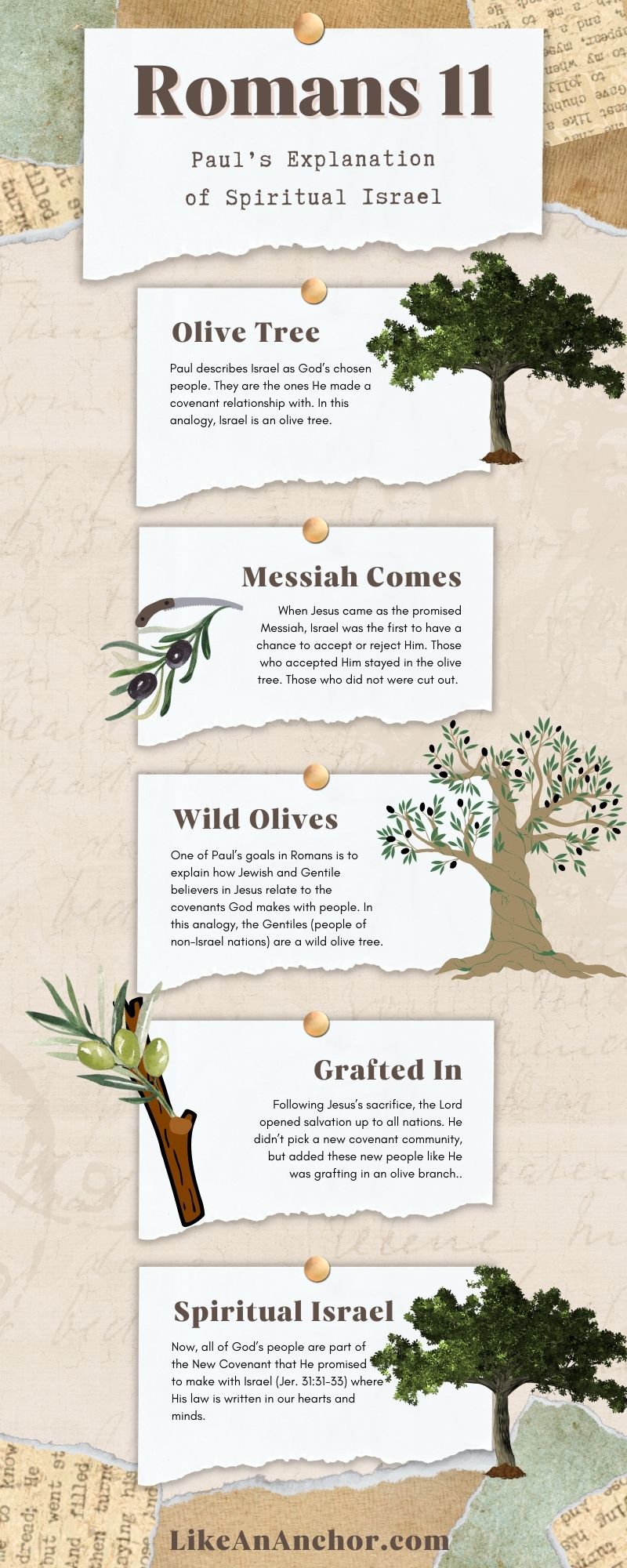
Infographic illustrating the "grafted in" analogy Paul uses for how Jewish and Gentile Christians enter the New Covenant community with God.
Image by Marissa Martin, created with Canva

The Things We Do In God’s Family

Image of ___ with the blog's title text and the words "By celebrating God's Feasts, we're honoring Him as His covenant-keeping people."
Image created with Canva

One of the things that stood out to me when I was reading Misreading Scripture with Individualist Eyes by E. Randolph Richards and Richard James was the way they described Paul’s letters discussing Jewish and Gentile believers. One of the things Paul is doing when writing to believers, including in his Romans letter, is telling them they are part of a new community. In collectivist cultures, people get their identity from a group. Before conversion, Jews and Gentiles were part of different communities with different expectations, beliefs, and codes of conduct. Now, though, they are part of God’s covenant community.

When we’re in God’s community as part of His family, there are certain expectations that come with that. For example, we’re expected to treat God’s name with respect and honor Him with our words and conduct. He expects us to come to Him when we need help rather than turn to something else first. We’re to love the Father and Jesus, and Jesus said if we love Him then we will keep His commandments. Most Christians today already know that this includes the 10 Commandments, but those aren’t the only aspects of God’s law that transfer to the New Covenant. They’re more of a summary.

As already mentioned, Jesus said He came to fill the law and the prophets to their fullest extent, not to abolish them (Matt. 5:17) In some ways, more is expected of us in the New Covenant rather than less. We don’t need to do all the sacrifices since “by one offering he [Jesus] has perfected forever those who are being sanctified” (Heb. 10:14, WEB), but we are expected to obey the law on a heart level and not just a letter level (Matt. 5:17-48). God’s laws and commands describe the things that we do as part of God’s family; the things that He expects from people who have a covenant relationship with Him. His Sabbaths and Holy Days are a key part of that for Spiritual Israel today. They are times when He calls for His children to come together, rejoice with each other and with Him, and learn more about Him. That’s what we’ll be doing for the seven days of the Feast of Tabernacles and the Eight Day that follows, just as Jesus did when He kept this Feast (John 7).


Featured image by Claudine Chaussé

A Time To Return

If I asked you to define “repent” or “repentance,” what would you say?

We know it’s the thing you’re supposed to do when you’ve sinned and you’re coming to God asking for forgiveness. But is it just saying you’re sorry?

In English, “repent” means to express regret and remorse. While the Hebrew and Greek words translated “repent” in the Bible include that aspect of regret, the Biblical concept goes a step farther. Biblical repentance involves change. This change is a movement; an alteration in the direction of your heart and your life. The word image contained in both Hebrew and Greek is to turn away from sin and to turn toward God.

Unpopular Repentance

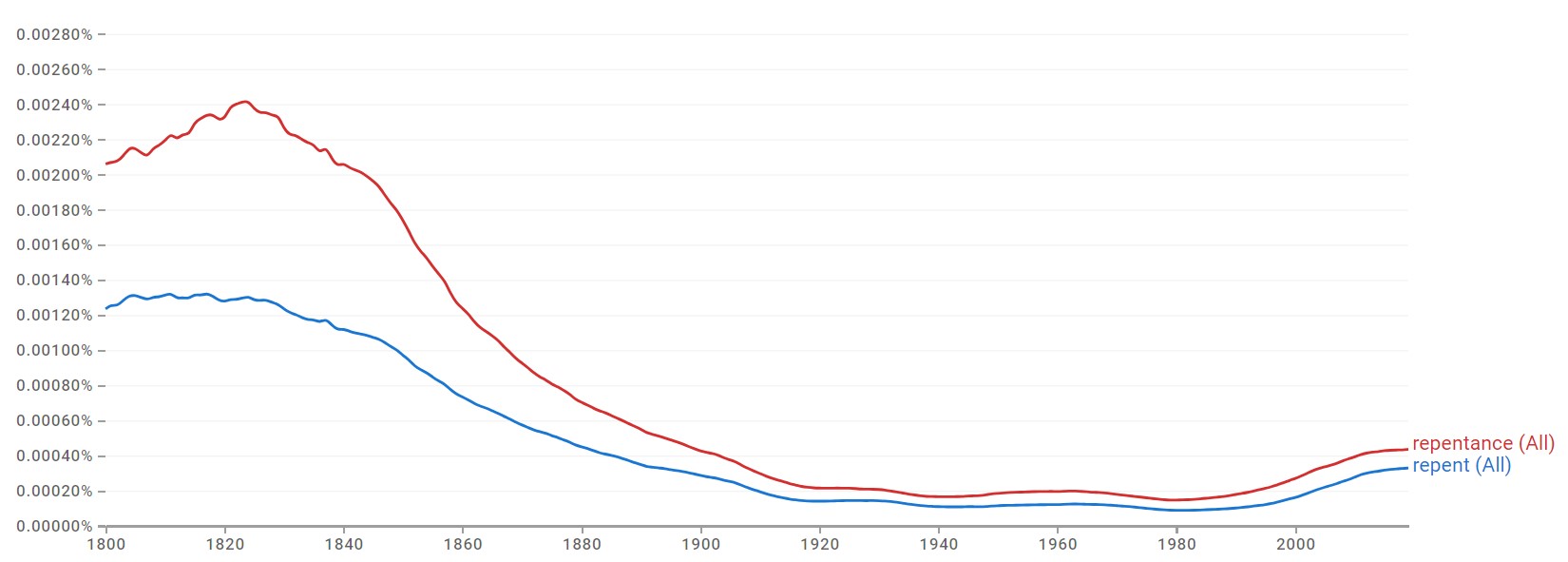
According to Oxford Languages (via Google), “repent” means “feel or express sincere regret or remorse about one’s wrongdoing or sin.” It came into Middle English “from Old French repentir, from re- (expressing intensive force) + pentir (based on Latin paenitere ‘cause to repent’).” There’s also something interesting going on with Google’s tracking for how often this word was used in English-language books between 1800 and 2019.

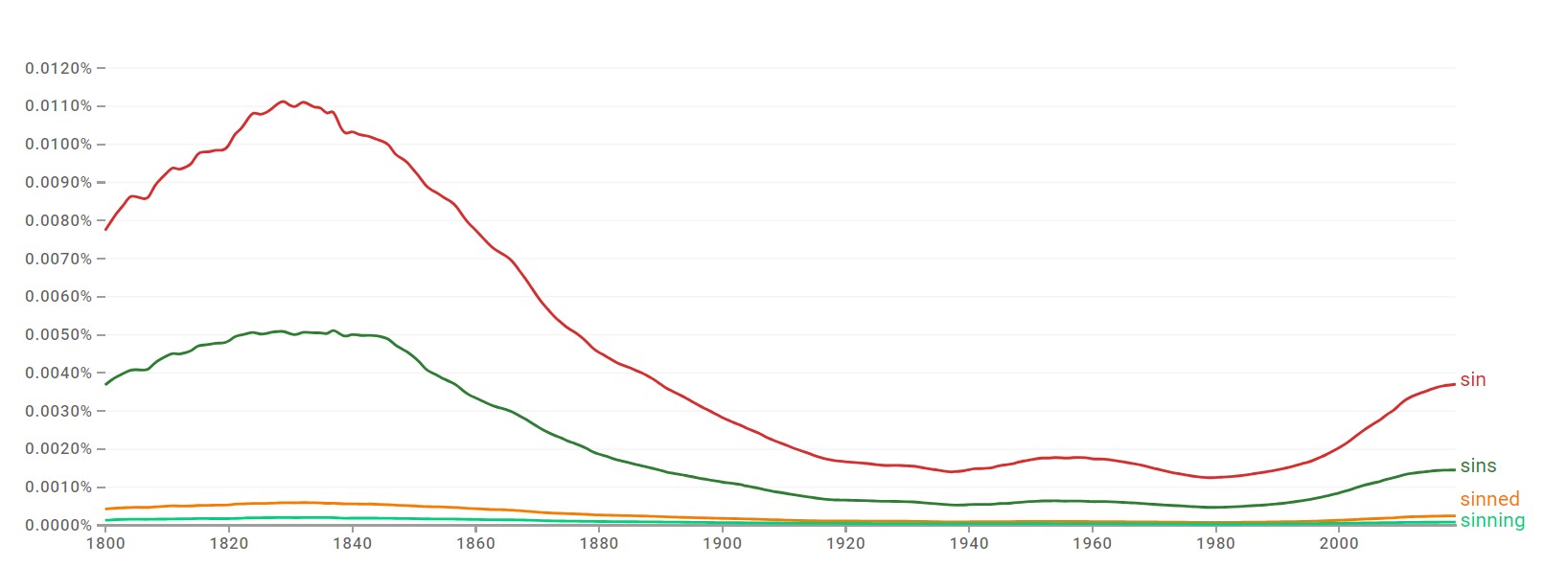
Evidently, repentance is not a popular idea (though I am intrigued by the recent uptick in usage after that slump in the 1900s). I don’t really think it will surprise any of us that “repent” and “repentance” are used less now than they were in the early 1800s. Repentance is something you need to do after you sin, and sin isn’t something we like to think about either. The more moral relativism takes hold in our society, the less people are willing to acknowledge sin is even a real thing since sin is the transgression of (God’s) absolute laws. The chart for “sin” in English language books looks very similar to the one for repentance.

But what about us today? If we’re sincerely following Jesus and love Him, He says we’ll obey His commandments. Commandments are contained in the law of God (Matt. 22:36, 40). The law and commandments are “holy, righteous, and good” (Rom. 7:12), and it is how God lets people know what sin is (Rom. 7:7-8). John says, “Sin is lawlessness” (1 John 3:4, WEB) or “the transgression of the law” (KJV). Paul further adds that “all have sinned” (Rom. 3:23). When Jesus came to this earth, one of His stated purposes was to call “sinners to repentance” (Luke 5:32), and it’s a message His disciples continued to preach (Acts 2:38; 3:19).

Putting all that together, we see that every human being is guilty of sin. Jesus can fix that problem, though. When sinners repent and follow Him, He takes away their sins (John 1:29; 1 John 3:5). Even after that, though, we still have a responsibility to keep His commandments because we love Him. And if we sin, then we need to repent again.

Returning and Changing

In Greek, one word translated “repent” is metanoeo (G3340). It includes the “regret or sorrow” aspect that is captured by the English word “repent,” but it also involves another step. The root words are meta (G3326: to be among or amidst, or to move toward that position) and noeo (G3539: “to exercise the mind, think, comprehend”) (Zodhiates entry G3340). Metanoeo is distinct from regret (metamelomai [G3338]) and includes “a true change of heart toward God” (Zodhiates). Thayer defines metanoeo as “to change one’s mind for better, heartily to amend with abhorrence of one’s past sins” (Thayer entry G3340). There’s a sense of turning around involved, as if when we sin we are walking away from God and when we repent we turn around and go toward Him again.

There’s another word for repentance in the New Testament as well. Zodhiates writes, “Metanoeo presents repentance in its negative aspect as a change of mind or turning from sin while epistrepho presents it in its positive aspect as turning to God” (Zodhiates entry G3340). He also notes that both of these words “derive their moral content … from Jewish and Christian thought, since nothing analogous to the biblical concept of repentance and conversion was known to the Greeks.” To understand what metanoeo and epistrepho (G1994) meant to early Christians, we need to look back at the Hebrew words expressing the same concepts.

Once again, we have two words that can be translated into English as “repent.” One of those, nacham (H5162) is typically only used of God “repenting” in the sense of “relenting or changing,” like He did when he delayed Nineveh’s destruction in response to their repentance (Theological Wordbook of the Old Testament [TWOT] entry 1344). In that story of Nineveh, we also see the Hebrew word more commonly used for human repentance, shub (H7725).

Jonah began to enter into the city a day’s journey, and he cried out, and said, “In forty days, Nineveh will be overthrown!”

The people of Nineveh believed God; and they proclaimed a fast, and put on sackcloth, from their greatest even to their least. The news reached the king of Nineveh, and he arose from his throne, and took off his royal robe, covered himself with sackcloth, and sat in ashes. He made a proclamation and published through Nineveh by the decree of the king and his nobles, saying, “Let neither man nor animal, herd nor flock, taste anything; let them not feed, nor drink water; but let them be covered with sackcloth, both man and animal, and let them cry mightily to God. Yes, let them turn (shub) everyone from his evil way, and from the violence that is in his hands. Who knows whether God will not turn (shub) and relent (nacham), and turn (shub) away from his fierce anger, so that we might not perish?”

God saw their works, that they turned (shub) from their evil way. God relented (nacham) of the disaster which he said he would do to them, and he didn’t do it.

Jonah 3:4-10, WEB

The basic meaning of shub is to turn or return. It is a Hebrew verb used frequently; “over 1050 times” in the Old Testament. While the Hebrew writers use many word pictures to describe repentance, all “are subsumed and summarized by this one verb shub. For better than any other verb is combines in itself the two requisites of repentance: to turn from evil and to turn to the good” (TWOT 2340). Like the Greek words that would later represent the same concept, Hebrew notions of repentance include both regret and turning away from sin and turning toward God. There’s always a sense of change; the verb shub is so connected with turning and change that it is even used of physical movement and coming back to a people or location (TWOT 2340).

The word shub is particularly important in it’s relation to “the covenant community’s return to God,” and one scholar concludes “there are a total of 164 uses of shub in a covenantal context” (TWOT 2340). Covenants are the way that God makes formal relationships with people; if we’re truly following God then we have made a covenant commitment to Him. Under the terms of a covenant, both parties involved have rights and responsibilities. In relation to repentance, both God and humanity have a role to play. The person repenting goes “beyond contrition and sorrow to a conscious decision of turning to God,” God freely extends His sovereign mercy, and then we continue in a commitment that involves “repudiation of all sin and affirmation of God’s total will or one’s life” (TWOT 2340). That concept is found in the Old Covenant, and is reinforced in the New Covenant (Acts 3:19; 26:17-20; 1 Thes. 1:9).

Trumpet Blasts As A Call to Return

In last week’s post, I talked about observing the Day of Trumpets (Yom Teruah). It is one of God’s special holy days, which He commands His covenant people to keep. It is a Sabbath day of complete rest, a day God calls His people to gather together, and “a memorial announced by loud horn blasts” (Lev. 23:24, WEB); “it is a day of blowing trumpets for you” (Num. 29:1, WEB). We traditionally say that in the New Covenant, the Day of Trumpets pictures the second coming of Jesus Christ, which will be heralded by trumpet blasts (1 Thes. 4:15-18).

We can also see the trumpet blasts as a call to alert us today of the need to return to God. In Jewish tradition, the Sabbath day that falls between Day of Trumpets and Day of Atonement (Yom Kippur) is called Shabbat Shuvah, the Sabbath of Return. As we just learned, shuvah/shub is the Hebrew word for repentance. As we move from Day of Trumpets to Day of Atonement, repentance should be on our minds.

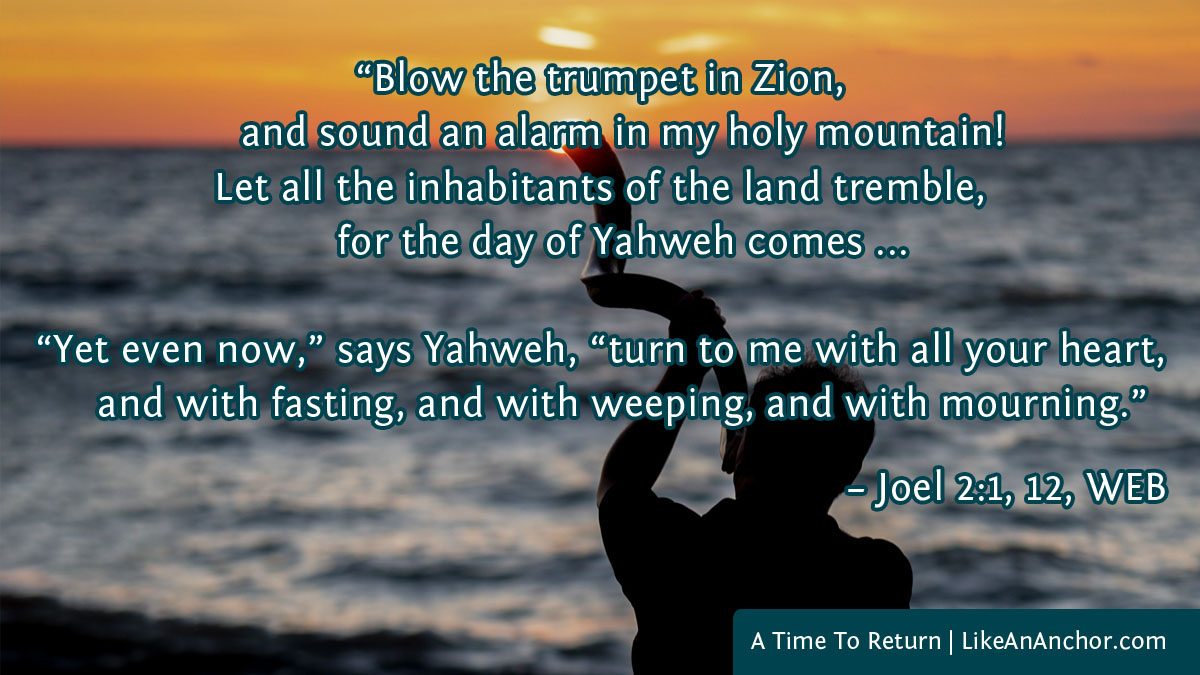
Blow the trumpet in Zion,
    and sound an alarm in my holy mountain!
Let all the inhabitants of the land tremble,
    for the day of Yahweh comes,
    for it is close at hand:
A day of darkness and gloominess,
    a day of clouds and thick darkness.
As the dawn spreading on the mountains,
    a great and strong people;
    there has never been the like,
    neither will there be any more after them,
    even to the years of many generations.

Joel 2:1-2, WEB

As Joel warns, the time before Jesu’s return (the day of Yahweh, or day of the Lord) will be a dark time for the world as a whole. The world is getting worse and worse as His return draws nearer, and Revelation reveals it’s only going to get even worse (like during the soundings of the seven trumpets given to angels; Rev. 8-11). When contemplating the coming of this day, Peter asks a pertinent question: “since all these things will be destroyed like this, what kind of people ought you to be in holy living and godliness?” (2 Pet. 3:11, WEB). He answers by saying that since we look for Jesus’s return, we should “be diligent to be found in peace, without defect and blameless in his sight” and “grow in the grace and knowledge of our Lord and Savior Jesus Christ” (2 Pet. 3:14, 18 WEB). Joel records a similar warning to turn back to following God faithfully.

Yahweh thunders his voice before his army;
    for his forces are very great;
    for he is strong who obeys his command;
    for the day of Yahweh is great and very awesome,
    and who can endure it?
“Yet even now,” says Yahweh, “turn to me with all your heart,
    and with fasting, and with weeping, and with mourning.”
Tear your heart, and not your garments,
    and turn to Yahweh, your God;
    for he is gracious and merciful,
    slow to anger, and abundant in loving kindness,
    and relents from sending calamity.
Who knows? He may turn and relent,
    and leave a blessing behind him,
    even a meal offering and a drink offering to Yahweh, your God.
Blow the trumpet in Zion!
    Sanctify a fast.
    Call a solemn assembly.
Gather the people.
    Sanctify the assembly.

Joel 2:11-16, WEB
Image of four people walking into a church building with the blog's title text and the words "As we're reminded of Jesus's approaching return, God calls us to repentance; to turn away from our own way of doing things and turn toward Him."
Image by Pearl from Lightstock

This year, we will observe the Day of Atonement on September 25, 2023. This is a solemn holy day when God commands us to rest completely and “afflict your souls” (traditionally understood to mean fasting). Reading Joel, I can’t help but notice that the trumpet blasts warning that the Messiah’s return is coming closer and closer also call us to fast and repent. God and the prophet Joel call out to readers, saying, “turn (shub) to Yahweh, your God!”

All of us are getting closer every day either to the end of our lives or to Jesus Christ’s return. One way or another, we have a limited time here on this earth. Keeping the Day of Trumpets and Day of Atonement remind us of that. They also remind us of the wonderful things the Messiah has done and is doing for His people. Because of Jesus’s atoning sacrifice, God graciously removes our sins when we repent, turning our lives around and (re)committing to following Him faithfully. We need that reminder of His awesome mercy, of our total dependence on Him, and of His promise to return and set things on this earth right.


Featured image by Pearl from Lightstock

With The Sound of Trumpets

We begin this year’s fall holy days today (Sept. 16, 2023) with Yom Teruah, the Day of Trumpets (also called Rosh Hoshana). When I think of this holy day, one of the things that comes to mind is a choir song called “With The Sound of Trumpets” that I’ve sung a few times over the years when I was involved in church choirs. It’s a majestic, beautiful song based on passages in 1 Thessalonians and Revelation that describe Jesus returning to earth with trumpet blasts.

The Day of Trumpets is probably the holy day that we know the least about. In Leviticus 23, where God outlines all the holy days for Moses and the people of ancient Israel, He simply says this: “Speak to the children of Israel, saying, ‘In the seventh month, on the first day of the month, there shall be a solemn rest for you, a memorial of blowing of trumpets, a holy convocation. You shall do no regular work. You shall offer an offering made by fire to Yahweh’” (Lev. 23:23-25, WEB). The word “trumpet” or “horn” actually doesn’t appear in the Hebrew. It could more literally be translated “a memorial of loud blasts,” though horn/shofar sounds are what is likely being referenced (NET footnote). The word teruah can include battle cries, shouts of alarm or joy, and blasts of trumpets (BDB H8643).

Numbers adds a little more detail to the instructions for Day of Trumpets, but most of that is focused on the burnt offering and grain offering associated with the holy day. Each of the holy days had specific offerings/sacrifices connected with them. For Trumpets, it was “one young bull, one ram, and seven lambs one year old without blemish” for the burnt offering, each accompanied by a grain offering of “finely ground flour mixed with olive oil.” Then, there was “one male goat for a purification offering to make an atonement for you.” And since Trumpets always falls on the first day of the seventh month in the Hebrew calendar, all this was “in addition to the monthly burnt offering and its grain offering, and the daily burnt offering with its grain offering and their drink offerings as prescribed, as a sweet aroma, a sacrifice made by fire to the Lord” (Num. 29:1-6, NET).

But what about for us, the New Covenant church of God? We should still keep the days that God made holy, because they are important to Him (i.e. they are God’s holy days, not belonging to a single group or time) and because Jesus and His first-century followers kept these days (see “Top 5 Reasons for Christians to Keep God’s Holy Days” and “What Are God’s Holy Days and Why Would We Care?“). However, the sacrifices and offerings in the temple aren’t for us today–Jesus’s perfect sacrifice means there’s no more need for burnt offerings (Heb. 7:26-27; 9:23-10:12). For us, that just leaves, “On the first day of the seventh month, you are to hold a holy assembly. You must not do your ordinary work, for it is a day of blowing trumpets for you” (Num. 29:1, NET).

What Do We Do on the Day of Trumpets?

Aside from the burnt offerings God told Israel to make for each holy day under the Old Covenant, there are three details about the Day of Trumpets that we learn in Leviticus and Numbers.

  1. This day is “a complete rest” (Lev. 23:24, WEB) when “You must not do your ordinary work” (Num. 29:1, WEB). In other words, it is a Sabbath (the Hebrew word shabbâthôn appears in Leviticus).
  2. The Day of Trumpets is “a holy assembly” (Lev. 23:24; Num. 29:1, WEB). In Hebrew, this phrase is qôdesh miqrâ’, a meeting time that God has called and which He makes holy.
  3. This miqra is “a memorial announced by loud horn blasts” (Lev. 23:24, WEB); “it is a day of blowing trumpets for you” (Num. 29:1, WEB). The word translated “loud horn blasts” and “blowing trumpets” is terû‛âh.

In my experience among Sabbath keeping groups, we’ve got the “holy assembly” part down. Every group I’ve attended with has a church service on Day of Trumpets, when we gather as an assembly of believers. Most of us have the Sabbath part down pretty well, too, though I’ve met some who don’t treat this as a day of complete rest. The trumpets part is a little more sporadic; the only group I attended with that consistently blew shofars and shouted with joy on Day of Trumpets was a Messianic group.

I’m consistently puzzled by why it’s not a standard practice among sabbath keepers to blow shofars or trumpets on the Day of Trumpets. I’ve been told that this was just “for Israel” and not us, but we call ourselves spiritual Israel (see Rom. 11) and say that we inherit other parts of the covenant God made with them (though on a higher, spiritual level) so I’m not sure why this would be an exception to that.

Charting the Festival Days

I’ve been thinking a lot recently about a study I did five years ago examining the different Hebrew words for the days that God calls holy to Him. In English, Bible translations might use words like “feast,” “festival,” “assembly,” or “convocation” to translate a few different words, and it’s not always consistent between different translations. This can muddy our understanding of the holy days and the distinctions in how God speaks about them.

For example, we often call all the holy days “feasts” and speak of “Feast of Trumpets” or “Feast of Tabernacles.” But of those two, only Tabernacles is a chag (feast or festival) in Hebrew. Trumpets is a day, yom. Both are mo’ed (appointed seasons). Trumpets and the first day of Tabernacles are miqra (convocations), but not the other six days of Tabernacles (though they’re still part of the chag). The eigth day of/after Tabernacles is a mo’ed, miqra, and atserah (solemn assembly). The only other atserah is the last day of the Feast of Unleavened Bread. We can lose track of these nuances in English.

To help myself keep track of and compare the Lord’s holy times, I made a chart. It lists all the days/observances outlined in Leviticus 23, with extra details drawn from other parts of the Torah, and notes on times the days show up in the New Testament. Here’s a copy of that chart if you’d like to download it:

Looking For The Lord’s Coming

For the spring holy days, it’s easy to find the parallels between Old and New Covenant. Passover pictured God delivering Israel from Egypt, and now it also pictured Jesus giving His life to deliver us from sin. Paul talks about how the Feast of Unleavened Bread pictured putting sin our of our lives and the way to keep the feast on a spiritual level as New Covenant Christians. According to Jewish tradition, Pentecost is the day that God established the Sinai covenant with Israel and delivered the Ten Commandments, then in the New Testament that’s the day He gave the church the Holy Spirit.

The fall holy days are a little less clear; they haven’t been fulfilled yet and Jesus hasn’t explained them to us as clearly as he did the ones connected with His first coming. Traditionally in the churches I attend, we’ve linked the Day of Trumpets with Jesus Christ’s second coming. We also say Atonement pictures God’s triumph over Satan (partly fulfilled by Jesus’s sacrifice), and Tabernacles pictures the millennium spoken of in Revelation and by the prophets. I think those assumptions for what these holy days picture seem reasonable and scripturally supported (but I still like to point out, for accuracy’s sake, that these links aren’t stated directly in the Bible).

Now we do not want you to be uninformed, brothers and sisters, about those who are asleep, so that you will not grieve like the rest who have no hope. For if we believe that Jesus died and rose again, so also we believe that God will bring with him those who have fallen asleep as Christians. For we tell you this by the word of the Lord, that we who are alive, who are left until the coming of the Lord, will surely not go ahead of those who have fallen asleep. For the Lord himself will come down from heaven with a shout of command, with the voice of the archangel, and with the trumpet of God, and the dead in Christ will rise first. Then we who are alive, who are left will be suddenly caught up together with them in the clouds to meet the Lord in the air. And so we will always be with the Lord. Therefore encourage one another with these words.

1 Thessalonians 4:13-18, NET

Trumpets and loud shouts are consistently linked with the events of Revelation leading up to Jesus’s return and with His second coming to earth (e.g. the seven trumpets of revelation and shouts of “hallelujah” and of warning). While there are arguments about the timing for all this and how it might line-up with holy days, the main thing we should notice is that Jesus is coming back. Like the virgins in Jesus’s parable, who didn’t know exactly when the bridegroom would return and waited for a shout to signal His arrival, we’re also waiting and listening for His return.

As we observe God’s holy Day of Trumpets this year, I pray that our hearts will be attuned and open to what He has to teach us through His special holy days. I pray we’ll reignite our anticipation for Jesus’s return, reminding ourselves that the future God promises us is a wonderful one. Sometimes, I think we can forget how great God’s plan is. We either get discouraged by how bad things are in the world today, or we get so used to it and complacent that we don’t really long for Jesus’s return. But Paul writes that even creation itself eagerly awaits the return of Jesus and our transformation as God’s children (Rom. 8:18-25). We can take comfort in God’s good plan for our future, and we should feel excitement about the prospect of our bridegroom-king returning.


Featured image by StockSnap from Pixabay

Song Recommendation: “With The Sound of Trumpets

Approaching God’s Kingdom Like A Child

You know that story from the gospels where Jesus welcomes children to Him and blesses them? And the other one where he calls a child to Him and tells His disciples they must become like children?

Those are some of the most familiar stories from the gospel accounts. And if you spend much time in church, listening to messages online, or reading Christian blogs, articles, and books then you’ve likely heard someone talk about the child-like faith that these stories teach us. We need to believe like little children, we’ve learned, who trustingly accept what God tells us.

I’ve been reading a book called Misreading Scripture with Individualist Eyes: Patronage, Honor, and Shame in the Biblical World by E. Randolph Richards and Richard James (click here to read another post inspired by that book). They have a different reading of the moment where Jesus calls a child to teach His disciples a lesson. It surprised me a little, so I wanted to take another look at these two moments. When we read closely, we realize that while these events might teach us lessons about faith, Jesus highlights a different focus for what we’re supposed to learn.

Who is the greatest?

Matthew and Mark both record a moment when Jesus used a child to teach His disciples a lesson. The disciples had a question about who would be the greatest. In Matthew’s account, they directly ask,  “Who is the greatest in the kingdom of heaven?” (Matt. 18:1, NET). In Mark’s account, Jesus “asked them, ‘What were you discussing on the way?’ But they were silent, for on the way they had argued with one another about who was the greatest” (Mark 9:33-34, NET). It seems likely this was the same incident (both conversations happen after arriving in Capernaum [Matt. 17:24; Mark 9:33]), just with different levels of detail recorded by Matthew and Mark.

 He called a child, had him stand among them, and said, “I tell you the truth, unless you turn around and become like little children, you will never enter the kingdom of heaven! Whoever then humbles himself like this little child is the greatest in the kingdom of heaven. And whoever welcomes a child like this in my name welcomes me.”

Matthew 18:2-5, NET

After he sat down, he called the twelve and said to them, “If anyone wants to be first, he must be last of all and servant of all.” He took a little child and had him stand among them. Taking him in his arms, he said to them, “Whoever welcomes one of these little children in my name welcomes me, and whoever welcomes me does not welcome me but the one who sent me.”

Mark 9:35-37, NET

Often when I hear people discuss this verse and the other story (which we’ll look at in a moment), they say something like, “Jesus tells us to be like little children, so let’s ask ourselves, what are children like?” Then we talk about things like innocence, accepting faith, and trust in the Father. But Jesus isn’t talking about faith, at least not directly. He directly states that He’s talking about humility (and, to be fair, I have also heard teachers point this out). Often, though, we seem to read over this point.

In our culture, we value a child’s simple faith, believing without facts. Aside from the questionable value of believing without facts, the passage isn’t about faith. It is about seeking status and honor. The disciples were arguing about who is greatest, and Jesus urges them to become like children, who are not concerned with worldly status. … Jesus doesn’t mean to “have simple faith” but to show a lack of concern about seeking status.

Misreading Scripture with Individualist Eyes, Richards and James, p. 137

I’m not quite sure where the idea that this passage is about simple faith came from. For one thing, children are curious; they question everything (as anyone can attest who’s fallen into a cycle of “why?” questions when speaking with a child). For another, Jesus very clearly says this lesson is about humility. If you want to be the greatest, then you need to stop worrying about your status and embrace childlike humility. That’s what we’re supposed to learn from this story.

Receive the Kingdom Like A Child

There is one other story where Jesus calls children to Him and then teaches His followers a lesson. Maybe the idea that this is about faith comes from that other story. Matthew, Mark, and Luke all record this account. We’ll read Mark’s to start (it’s similar to Matthew’s, but just a little more detailed).

 Now people were bringing little children to him for him to touch, but the disciples scolded those who brought them. But when Jesus saw this, he was indignant and said to them, “Let the little children come to me and do not try to stop them, for the kingdom of God belongs to such as these. I tell you the truth, whoever does not receive the kingdom of God like a child will never enter it.” After he took the children in his arms, he placed his hands on them and blessed them.

Mark 10:13-16, NET

Once again, Jesus doesn’t mention faith. He does mention receiving “the kingdom of God like a child,” though. Receiving God’s kingdom involves faith (i.e. active trust in God that results in loyal actions), but once again the context can give us more information about the specific lesson Jesus is teaching here.

In two gospels accounts, the lead-in to this event involves people questioning Jesus about Moses’s writings on divorce (Matt. 19:3-12; Mark 10:2-12; Luke records only a shortened version of Jesus’s answer to this question in Luke 16:18). That doesn’t seem all that relevant for the topic of receiving God’s kingdom like a child. Luke, however, prefaces this event by recording one of Jesus’s parables.

He also spoke this parable to certain people who were convinced of their own righteousness, and who despised all others. “Two men went up into the temple to pray; one was a Pharisee, and the other was a tax collector. The Pharisee stood and prayed to himself like this: ‘God, I thank you that I am not like the rest of men, extortionists, unrighteous, adulterers, or even like this tax collector. I fast twice a week. I give tithes of all that I get.’ But the tax collector, standing far away, wouldn’t even lift up his eyes to heaven, but beat his breast, saying, ‘God, be merciful to me, a sinner!’ I tell you, this man went down to his house justified rather than the other; for everyone who exalts himself will be humbled, but he who humbles himself will be exalted.”

They were also bringing their babies to him, that he might touch them. But when the disciples saw it, they rebuked them. Jesus summoned them, saying, “Allow the little children to come to me, and don’t hinder them, for God’s Kingdom belongs to such as these. Most certainly, I tell you, whoever doesn’t receive God’s Kingdom like a little child, he will in no way enter into it.”

Luke 18:9-17, WEB

In Luke’s gospel at least, the context once again is humility. Stop thinking so much of yourself or how you compare to others and be more like a child. We need to get out of our own way. God’s kingdom belongs to those who come to Him with humility, more focused on their relationship with Him than on any worldly concerns like one-upping your neighbor.

From My Youth

The lesson Jesus teaches about receiving God’s kingdom like a child is reinforced by a conversation Jesus has with a wealthy, important young man immediately after blessing the children. This conversation is recorded in all three gospels (Matt. 19:16-30; Mark 10:17-31; Luke 18:18-30). This young man comes to Jesus asking a question we can all relate to, “What shall I do to inherit eternal life?” (Luke 18:18, NET) Jesus tells him to do God’s commandments, and the man counters, “All these things I have observed from my youth. What do I still lack?” (Matt. 19:20, NET).

I relate to this question a lot, particularly in Matthew’s account with the addition of “what do I still lack?” I grew up in church and never left. I certainly haven’t been perfect, but I’ve worked to keep God’s commands from my youth and repented of the (many) times I slipped. I know there’s plenty of perfecting and growing that I need to do. But sometimes it would be nice for God to clearly tell me, “Hey, here’s what you really need to keep working on.”

Jesus looking at him loved him, and said to him, “One thing you lack. Go, sell whatever you have, and give to the poor, and you will have treasure in heaven; and come, follow me, taking up the cross.”

But his face fell at that saying, and he went away sorrowful, for he was one who had great possessions. Jesus looked around, and said to his disciples, “How difficult it is for those who have riches to enter into God’s Kingdom!”

Mark 10:21-23 NET

Sometimes we ask a question about ourselves and discover we don’t really want to know the answer. For this specific young man, Jesus told him he needed to let go of all the stuff he was holding on to, give it away generously, and follow Jesus alone. We don’t know if the young man ultimately heeded Jesus’s advice or not, but based on the fact that he walked away sorrowful it seems that he chose his earthly riches over the kingdom of God.

Now remember, we’re reading this in the context of Jesus saying, “whoever does not receive the kingdom of God like a child will never enter it.” Matthew, Mark, and Luke all expected their readers to go straight from one story to the other. And I suspect they wanted us to notice overlapping themes and lessons. Jesus told people they needed to be more like children. Then this young man comes to Jesus, Jesus tells him to keep the commandments, and the man says he’s been doing that since he was a youth. In other words, since he was a child. But now he knows there’s something missing, and Jesus told him what it was. At some point, he’d started trusting his riches rather than following God.

The disciples were amazed at his words. But Jesus answered again, “Children, how hard it is for those who trust in riches to enter into God’s Kingdom! It is easier for a camel to go through a needle’s eye than for a rich man to enter into God’s Kingdom.”

They were exceedingly astonished, saying to him, “Then who can be saved?”

Jesus, looking at them, said, “With men it is impossible, but not with God, for all things are possible with God.”

Mark 10:24-27, NET

One-Downmanship

In the one story where Jesus teaches a lesson using a child as an example, He’s correcting His disciples for wanting to be the greatest. In the next, He stops His disciples from trying to exclude children and says the kingdom belongs to those like them. For this latter story, all three gospels recording the story immediately move into Jesus’s conversation with a young man who kept the commands from his youth but now trusts in his riches. And in Luke’s account, this all comes after a parable about “people who were convinced of their own righteousness, and who despised all others.”

Taken together, we can start to see patterns emerging from the lessons Jesus teaches. We learn what it means to God for His children to be child-like in a positive sense.

Children (typically) don’t care about status. They don’t look down on others for not being righteous enough. They don’t trust in riches to save them. That’s what we’re to learn from and emulate in children. And, it turns out, that’s one of the lessons Jesus modeled as well.

In his death on the cross, Jesus didn’t consider defending his status something of importance. This is not a repudiation of honor. Note that God honors Jesus for having this value (Phil 2:9). Jesus is modeling a new value: one-downmanship. The world values one-upmanship and honors those who pursue it. The world thinks about who should submit to me. The Christian message is to ponder to whom should I submit. Rather than thinking of those under my authority, we should be only thinking of those under whose authority I am.

Misreading Scripture with Individualist Eyes, Richard and James, p. 172

The way Richards and James phrase this really struck a cord with me. Sometimes (and I say this to my shame), I struggle with feeling like my writings (and me) don’t get the attention they “deserve.” I want to be more important and be recognized for my work. But that’s not the right attitude. That’s not how the children Jesus used to teach His disciples acted, that’s not how Jesus told His people to act (Mark 12:38-40; Luke 14:7-11), and that’s not how Jesus acts or thinks.

Therefore, if there is any encouragement in Christ, any comfort provided by love, any fellowship in the Spirit, any affection or mercy, complete my joy and be of the same mind, by having the same love, being united in spirit, and having one purpose. Instead of being motivated by selfish ambition or vanity, each of you should, in humility, be moved to treat one another as more important than yourself. Each of you should be concerned not only about your own interests, but about the interests of others as well. You should have the same attitude toward one another that Christ Jesus had,

who though he existed in the form of God
did not regard equality with God
as something to be grasped,
but emptied himself
by taking on the form of a slave,
by looking like other men,
and by sharing in human nature.
He humbled himself,
by becoming obedient to the point of death
—even death on a cross!
As a result God highly exalted him
and gave him the name
that is above every name,
so that at the name of Jesus
every knee will bow
—in heaven and on earth and under the earth—
and every tongue confess
that Jesus Christ is Lord
to the glory of God the Father.

So then, my dear friends, just as you have always obeyed, not only in my presence but even more in my absence, continue working out your salvation with awe and reverence, for the one bringing forth in you both the desire and the effort—for the sake of his good pleasure—is God. Do everything without grumbling or arguing, so that you may be blameless and pure, children of God without blemish though you live in a crooked and perverse society, in which you shine as lights in the world.

Philippians 2:1-15, NET

We shouldn’t be concerned about how other people see us, about our status compared to others, or one-upping people around us. Rather, we should focus on using the gifts God has generously given us to serve others in Jesus’s body, the church. If there was ever anyone with the right to lord it over other people, it would have been Jesus, but He did just the opposite. He humbled Himself in service, and it’s His example that we’re supposed to follow.

You’ve probably read Philippians 2:5 before as, “Let this mind be in you, which was also in Christ Jesus” (KJV) but the NET and several other modern translations correctly capture that Paul’s emphasis in this passage is on mimicking Jesus’s attitude toward other people. (For a thorough scholarly analysis of this verse, see Participating in Christ by Michael J. Gorman, where he proposes the translation, “Cultivate this mindset–this way of thinking feeling, and acting–in your community, which is in fact a community in the Messiah Jesus.”) Paul is pointing out that the way God’s people behave in community is vastly different than how people in the world act. Instead, they behave like Jesus who submitted Himself to the Father’s authority, died a humiliating death to pay the penalty for our sins, and told His followers to have the mindset of little children.

Humility is a vital character trait for people who want to be in a relationship with God, for “God opposes the proud, but he gives grace to the humble” (James 4:6; 1 Peter 5:5, NET). In Greek, “oppose” is translated from antitassomai (G498), which means “to range in battle against” (Thayer). If we’re proud and arrogant, then we’re enemies of God rather than loving children. But if we’re humble, then we’re going to focus on the right things. We’ll come to Jesus and relate to our brothers and sisters in the faith like little children.


Featured image by Pexels from Pixabay

Could I interest you in a free book?

I have some good news and some bad news.

The bad news is there’s no blog post this week.

The good news is I have a whole book for you!

I finally heeded all the “you need to have an email newsletter” advice I’ve been reading for years (which was reinforced in an online writers’ summit I attended last week). Now, the only newsletters I subscribe to are the ones from authors who give you a free book when you sign up so you can get a feel for their writing style before you decide if you want to buy a book from them. So I took the very first book I published in 2015, revised, updated, and reformatted it, and I’m giving it away to everyone who signs up for my newsletter.

The editing and reformatting was a little more involved than I’d expected, which is why I didn’t have time to work on a regular blog post this week. I’m hoping the free book will make up for that 🙂 Even if you’ve read this one before, I updated enough that I think it’d be worth your time to redownload it (assuming you liked what you read).

Why a newsletter?

Newsletters help creators keep in touch with people more reliably than social media. If you follow me on Facebook or Pinterest, for example, you probably won’t see all of my posts just because of how the algorithms work. A newsletter will also make it easier for me to share life updates, publishing info, and free resources, giveaways, and discounts. Plus, if any of you want to get in touch with me all you have to do is click “reply” to the email and you can write me a note.

I don’t want to clutter up your inbox, so my plan is to send out two emails a month (or every other week). You’ll get three emails pretty close together right after signing up so we can get to know each other and I can make sure you get your free book, then the frequency will drop down to every two weeks. If you’re subscribed to this blog by email, you’ll still receive weekly emails when I publish a new blog post; the newsletter is separate from that.

Thanks for reading (and thanks if you decide to sign up!). I look forward to hearing what you think of God’s Love Story.


Featured image by Tumisu from Pixabay

Reading the Bible Like It’s A Story You Love

One of the major turning points in my life involved taking a class on the English Bible as literature in my second semester of college for my undergraduate degree. The English Bible class helped me realize I can study the Bible as a scholarly project, I can defend my faith intelligently to other people, and how deeply the Bible in translation influenced the Western literary tradition. It also (along with a Shakespeare class and, more significantly, the Shakespeare professor) helped inspire me to pursue an English degree.

The Bibles that we read in English support this type of scholarly work. The format of pretty much every Bible you can pick up is designed for study and reference. “The addition of chapter breaks in the 13th century and verse numbers in the 16th century” made the standard Bible format “fragmented” into tidbits for cross-referencing different sections and pulling out isolated passages to preach about (“Three Bad Ways We Read the Bible and Three Tips to Improve“).

This is very different from the way we read most books. The only books that typically have similar layouts, references, and annotations are scholarly publications of texts like Shakespeare’s plays or The Iliad. This makes sense in some ways; the Bible is an ancient text and modern readers benefit from notes explaining context. But if you ever had to read a scholarly edition of a literary work, you probably realized that the notes and layout can also get in the way of your reading. For example, by the time you figure out what’s going on with Shakespeare’s language, you might have lost the plot thread.

In contrast, books that we read for enjoyment rarely have cross references and notes. Even non-fiction that is properly cited tucks the notes away in discreet footnotes or endnotes. Fiction may use glossaries at the back for historic context and pronunciation guides, but there’s rarely anything to interfere with the text itself. These books are designed for immersive reading. You can even read older texts immersively if you familiarize yourself with the writing style. For example, when I first started reading 17th and 18th century English literature, I read the introduction and all the notes. Now that I know more about the historical context and the language the writers used, though, I just dive right into the story.

What if we could read the Bible that way? Like it’s a story that we’re eager to lose ourselves in, without verse numbers and center notes getting in the way?

For context, when I say “story” I mean “an account of people and events, real or imaginary.” I am not suggesting that the Bible is fictional when I say that it is written as a story. I mean that this book has a narrative structure. More specifically, there are several metanarratives (overarching stories or big themes) that you can see when reading the whole Bible. I write about one, “A Story of Battle and Victory,” in my new Armor of God Study Guide. We have a harder time seeing those narrative themes if we’re only reading isolated chunks of the Bible.

Bible reading rates are shockingly low among Christians. Part of this is lack of time, but part is also because we’re not sure how to read it or we don’t really want to (more on this later, with data). And when we do read it, often we go to specific parts that make us feel better or which we think will offer guidance when we’re making decision.

The Bible is a book we can turn to for comfort and it does contain vitally important instructions, but it’s not just an instruction manual, a list of laws, or a collection of reassurances. The Bible is how God tells us about Himself, and when we read the whole thing together, we see He’s revealing Himself through a story with central themes of creation and redemption, love, building a family, and founding a kingdom. And I think maybe if we realized that, it would be easier to read the Bible more.

Image of ___ overlaid with text from Romans 15:4, WEB version:  “For whatever things were written before were written for our learning, that through perseverance and through encouragement of the Scriptures we might have hope.”
Image by Ben White from Lightstock

How Jesus Read The Bible

In Jesus’s time, if you wanted to read the Bible you’d have to go to a synagogue and unroll scrolls (assuming you were one of the people allowed to touch those scrolls). There weren’t chapter and verse breaks; only breaks between books. Scripture text was meticulously copied by hand and, as the text is sacred, great care was taken not to introduce mistakes into the text (“The Torah Scroll: How the Copying Process Became Sacred“). The lengthy copying process meant that owning a copy of scripture was out of reach of most individuals or families. Synagogues had copies that rabbis could read aloud to people. We can see an example of reading this type of scroll in the gospels.

Now Jesus came to Nazareth, where he had been brought up, and went into the synagogue on the Sabbath day, as was his custom. He stood up to read, and the scroll of the prophet Isaiah was given to him. He unrolled the scroll and found the place where it was written,

The Spirit of the Lord is upon me,
because he has anointed me to proclaim good news to the poor.
He has sent me to proclaim release to the captives
and the regaining of sight to the blind,
to set free those who are oppressed,
to proclaim the year of the Lord’s favor.”

Then he rolled up the scroll, gave it back to the attendant, and sat down. The eyes of everyone in the synagogue were fixed on him. Then he began to tell them, “Today this scripture has been fulfilled even as you heard it being read.”

Luke 4:16-21, NET (bold italics a quotation from Isa 61:1-2a)

Jesus hadn’t memorized that He’d need to turn to Isaiah 61 to read this verse. He was familiar enough with the whole scroll of Isaiah that He knew were to find this part within a much larger passage near the end of the scroll. And He didn’t only know where to look up passages and read them; He had large sections of scripture memorized. Just in the recorded gospels, we have evidence of Jesus quoting from “parts of the Scripts from all of the books of Law, most of the prophets, and some of the Writing – altogether 23 of the 36 books of the Modern Hebrew Bible” (Evans, 2006b, quoted in Metsämuuronen, 2019). It’s very possible that He had the entire Torah and large portions of the rest of the Old Testament (if not the whole thing) committed to memory.

Most of Jesus’s students and listeners were also Biblically literate, and when He referenced one part of a scripture they likely filled in the context automatically. Jewish children of the day grew up steeped in their religion, keeping the Sabbath and laws, learning from their parents, and frequently hearing scripture. Boys and girls started formal schooling around age six, and likely knew how to read before that (Metsämuuronen, 2019, “How Jesus Learned the Scriptures?”). Everyone learned Torah up to age 13, but only the most accomplished (male) students would go on to deeper studies with rabbis. It’s very likely that Jesus wasn’t one of the students chosen for advanced education since “the Jewish leaders were astonished” by the way He taught “and said, ‘How does this man know so much when he has never had formal instruction?'” (John 7:15, NET).

We don’t really have anything equivalent to this type of learning today. We’re so used to being able to look things up in books or on our phones that we don’t memorize much information. But imagine if you’d spent seven years of your childhood studying the first five books of the Bible. You’d know them as well as you know colors, shapes, multiplication tables up through 10, how to put a sentence together in your native language, and the controls for your favorite video game.

Image of clasped hands resting on an open Bible overlaid with text from Jeremiah 31:33-34, WEB version:  “But this is the covenant that I will make with the house of Israel after those days,” says Yahweh: “I will put my law in their inward parts, and I will write it in their heart. I will be their God, and they shall be my people. They will no longer each teach his neighbor, and every man teach his brother, saying, ‘Know Yahweh;’ for they will all know me, from their least to their greates."
Image by Jantanee from Lightstock

Balancing Bible Reading and Bible Study

To be clear, I’m not saying it’s wrong to study the Bible in sections or by topic. In fact, since the Bible is such a big book, having center cross-references can help us appreciate the connections between different parts of scripture more easily. The chapter and verse numbers make it much easier for people to make sure they’re on the same page (quite literally) when having a Bible discussion, or for someone to follow along with and double-check a teacher. I usually choose to study the Bible thematically/topically, and I share those studies here.

One of the primary ways I relate to the Bible (e.g. my spiritual temperament) is intellectually. But I also sometimes wonder if I approach the Bible too academically and lose touch with the wonder of being in a relationship with God. That’s another aspect of my spiritual temperament: worshiping God with contemplation and adoration. The reference/study format for Bibles doesn’t really support that sort of immersive, story-reading Bible interaction, though.

Several years ago, a Kickstarter caught my eye. “Bibliotheca is an elegant, meticulously crafted edition of the Bible designed to invite the reader to a pure, literary experience of its vast and varied contents,” without any verse numbers or chapter breaks (bibliotheca.co). It was far outside my price range at the time and so I did not back the Kickstarter, but I desperately wanted to. I was reminded of that this past week when I read “Three Bad Ways We Read the Bible and Three Tips to Improve” on Tyndal.com. This article suggests using “a reading Bible” rather than a study Bible, finding a reading group so you’re not studying in isolation, and establishing a “reading rhythm” so you’re regularly reading the Bible.

This article recommends the Immerse Bible, which I was excited about at first but not so much after I checked up on the NLT translation by reading several chapters of Romans (my favorite book to look at when checking the quality of a translation). I think I’ll stick to the Tree of Life version as my reading Bible. The print copy I have still has chapter and verse numbers, but the verse numbers at least are minimized to reduce their impact on the text. Maybe someday I’ll try out Bibliotheca or find another reading Bible I like.

I think it’s important to balance reading straight through the Bible as if it’s a story you love so much you can’t put it down, and studying the Bible deeply like it’s the most important academic research you’ve ever done. By reading through the whole Bible, you gain vital context and the overarching stories/themes. By studying the Bible carefully and reading supportive texts, you can learn historical context, what the words used originally mean, and deepen theological understanding. Both support you in deepening your understanding of the scriptures that God breathed into existence and that He uses to teach us about Himself, what He expects of us, and how He relates to His people.

But evil people and charlatans will go from bad to worse, deceiving others and being deceived themselves. You, however, must continue in the things you have learned and are confident about. You know who taught you and how from infancy you have known the holy writings, which are able to give you wisdom for salvation through faith in Christ Jesus. Every scripture is inspired by God and useful for teaching, for reproof, for correction, and for training in righteousness, that the person dedicated to God may be capable and equipped for every good work.

2 Timothy 3:13-17, NET

The Bible is without doubt the most important book ever written. As followers of God, we’re blessed to know how important this book is and that the text comes straight from Him (through human writers, copiers, and translators). And yet, many people calling themselves Christians aren’t reading the book very much or at all.

Engaging With Something Epic

Image of a man reading a Bible with the blog's title text and the words "I think it's important to balance reading straight through the Bible as if it's a story you love so much you can't put it down, and studying the Bible deeply like it's the most important academic research you've ever done."
Image by Creative Clicks Photography from Lightstock

According to the Pew Research Center, about 63% of Americans currently identify as Christians (“How U.S. religious composition has changed in recent decades“). Yet according to the American Bible Society’s 2023 State of the Bible report, only 39% “of Americans said they used the Bible three or more times per year” (“State of the Bible 2023,” p. 6). Three or four times a year isn’t all that much. For more frequent users, “about 63 million American adults (24%) use the Bible—on their own, outside of a church service—at least once a week” (“State of the Bible 2023,” p. 7). Assuming most of the Bible-readers also identify as Christian, that means less than half the Christians pick up their Bibles at least once every week.

Interestingly, when American Bible Society’s survey asked people if they wanted to read the Bible more, 52% said “yes” (“State of the Bible 2023,” p. 12). When asked what challenges kept them from Bible reading more, relatively few said the layout was difficult or that they found the stories confusing (“State of the Bible 2023,” p. 11). The top reasons were, “Not enough time,” “Don’t know where to start,” and “Lack of excitement about reading it.” I don’t know this for sure, but I wonder if we spent more time talking about the story of the Bible and the big metanarrative themes it might be easier for people to pick up the book, start at the beginning, and get excited about reading the Bible.

One of the theories for why modern people find video games so engaging is because immersive adventures make us feel like we’re part of something bigger than ourselves; we long for “epic meaning” and to be part of an “epic story” (McGonigal, “Gaming can make a better world”). Now, I’m a gamer. I get why games are so engaging and I think the right kinds of games can be encouraging and educational as well as fun. But I don’t go to games for meaning, and I think it’s heartbreaking that as a society, we have lost touch with real-world things that welcome us to be part of something bigger than ourselves.

Do you like epic stories of great battles with good versus evil? God’s calling you to fight alongside Him in one (Eph. 6:10-18).

Do you like sweeping tales of daring and epic romance? Jesus conquered death to ransom His bride, and He wants that bride to include you (2 Cor. 11:2; 1 Tim. 2:5-6; Rev. 19:6-8).

Do you want to be involved in something on a world-saving, eternity-mattering scale? God offers you a position in His kingdom that will last forever, which He’s been preparing since the foundation of the world (Mat. 25:34; Rev. 1:5-6).

I remember the first time I read a Bible, it was a children’s Bible with very simple text and cute illustrations. The authors boiled everything down to big ideas and the main story beats. God created everything. Man fell. God asked people like Noah, Abraham, and the nation of Israel to be in relationship with Him. God rescued Israel from Egypt. Israel rebelled and God sent prophets. Jesus came to save us all, died, and rose again. The New Covenant church is what we’re part of now. Jesus is coming back.

Maybe that’s where we should all start. Not necessarily by reading a Bible for toddlers, but reading with an understanding of the main things that happen in the Bible and what that reveals to us about God. The details are vitally important, but we need the big picture if we’re going to make sense of them. We need the narrative God uses to reveal Himself, His values, and His purpose to understand how we fit into it all and what He expects from us when we’re in a relationship with Him.


Featured image by Pearl from Lightstock

Song Recommendation: “Even So Come” by Chris Tomlin