Psychology Isn’t Enough, but It Sure Helps: The Need for Personal, Spiritual Growth in Christianity

Someone once asked me if there are any aspects of Myers-Briggs® theory that I disagree with. I told them that my main issues have to do with ways it can be misused rather than with the actual theory. But as much as I like this type theory, I also acknowledge that it’s not a complete system for personal growth or even personality. Myers-Briggs® theory just describes how your mind works by talking about the psychological functions that you use most comfortably.

You can use type theory to help you develop those psychological functions, but they’re still not the whole story of your personality. There are other things we layer on top of that like personality traits, lived experiences, and personal beliefs. The functions are like a canvas we paint on; a foundation for building. They’re not the only things that make us who we are.

One of the dimensions that a system of psychological type does not cover is spirituality. That’s not to say that psychologists like Jung (whose work Myers-Briggs® theory is based on) would have denied there’s an essential spiritual component to humans. Far from it! It’s just that type psychology wasn’t designed to be a path in and of itself for spiritual growth. For that, we need something else.

A Connection Between Psychology and Spirituality

I had the idea to write this post last week, when I was listening to a podcast from Joel Mark Witt and Antonia Dodge of Personality Hacker. They’d recently attended an Enneagram workshop where one of the hosts, Uranio Pae, made the statement, “Spiritual work without psychological work is dangerous. Psychological work without spiritual work is incomplete.”


Read more

Titles of Jesus Christ: Our Peace

I think that when we hear Jesus talked about as “Prince of Peace” or “Our Peace,” we usually think of Him making strife cease. We picture Him setting up a world without war and fixing the strife between human beings and God. Those are definitely part of what’s going on, but there’s also a whole lot more. We can dive deeper into what “peace” means — and gain a deeper understanding of who Jesus is and what He is doing — by studying into the Hebrew word shalom.

Shalom is a key Biblical concept. It occurs over 250 timed in the Old Testament, and that’s not counting related words like shalem. It’s most often translated “peace,” though the King James Version uses about 30 different English words. Those include prosperity (Ps. 35:27), rest (Ps. 38:3), safety (Is. 41:3), using shalom as a salutation or greeting (Judg. 18:15; 1 Sam. 25:5), and in reference to someone’s welfare (Gen. 29:6; Ex. 18:7).

The Hebrew word shalom comes from the root verb shalem, which means “completeness, wholeness, harmony, fulfillment.” That’s all included in shalom as well, along with the English meaning of “peace” as an absence of strife. Also wrapped up in this concept is the implicit “idea of unimpaired relationships with others and fulfillment of one’s undertakings (Theological Wordbook of the Old Testament, by Harris, Archer, and Waltke, entry 2401a). It’s a much more nuanced word than we give it credit for in English translations.

Restitution and Healing

Shalom is wholeness — nothing missing, nothing broken. It is a state that humans don’t end up in naturally. God created us perfect, but we’re now fallen people living in a fallen world. Peace is an elusive thing.

There is no soundness in my flesh because of your indignation, neither is there any shalom in my bones because of my sin. (Ps. 38:3, Hebrew word added, all quotes from WEB translation)

Sin is something we’re all guilty of, and it’s something that causes brokenness. We’re not whole or complete, and the covenants that people of the past made with God are broken by humanity’s sin. If you want to fix something that’s broken, missing, or stolen, God requires restitution (shalem in Hebrew) in order to satisfy the requirements of law (Ex. 22:3, 5-6, 12, 14). In order to fix what is wrong with us, the process of restitution required something on a greater level than animal sacrifice or paying some money.

Read more

Titles of Jesus Christ: Firstborn and Heir

Who is Jesus Christ? Some consider Him a prophet, some a teacher who had some good things to say about peace and love, others say He was a madman. As Christians, we know Him as the Son of God who died to save us from our sins, rose again, and continues to be actively involved in our lives. But what does it really mean that He’s God’s Son, and why does that particular title matter to us?

God, having in the past spoken to the fathers through the prophets at many times and in various ways, has at the end of these days spoken to us by his Son, whom he appointed heir of all things, through whom also he made the worlds. (Heb. 1:1-2, all scriptures from WEB translation unless otherwise noted)

Firstborn’s Birthright

In Old Testament times, being a firstborn son was a big deal. You were the bekor (H1060), eldest son  and therefore the bekorah (H1062, birthright) was yours. You received a double portion when the father divided his inheritance (Deut. 21:15-17). There was a special blessing involved (Gen. 27). It was so important that any disruption to this birthright was cause for Biblical writers to take special note (Gen. 25:31-34; 48:9-19; 1 Chr. 5:1-2).

According to a message I recently watched on YouTube titled “Hebrews: Yeshua’s Amazing Qualifications,” the rights of the firstborn traditionally included a few other things as well. The eldest son acted as the family’s spiritual leader, acquired spiritual favor and honor, and inherited the blessings of Abraham. Heirship involved authority over the father’s possessions. Before there was a Levitical priesthood (which Yahweh accepted in place of the firstborns, as noted in Num. 3:12-13, 41; 8:16-18), the firstborn would even act as priest for the family.

Many parallels between Jesus and the Hebrew firstborns are easy to spot. He is the family’s spiritual leader, acting as “head of all things to the church” under the Father’s authority (Eph. 1:15-23). He is also High Priest of an order that supersedes the Levitical order as the Levites superseded what came before (Heb. 7:11-28). And that’s not where the parallels end. Read more

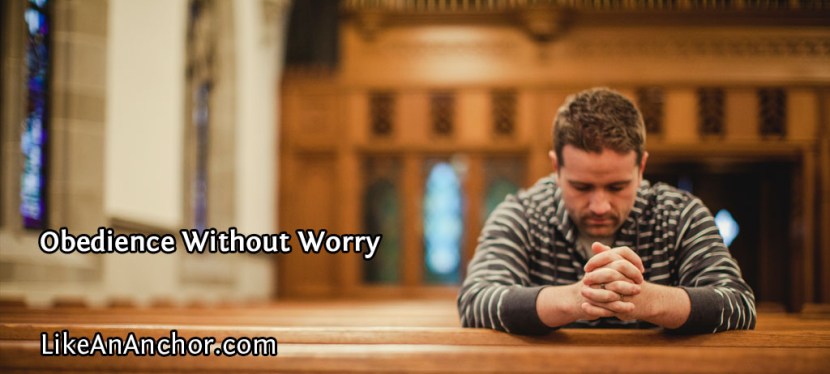
Obedience Without Worry

I recently reread C.S. Lewis’ Mere Christianity, and I’d like to start today’s post with one of the many quotes that stood out to me:

“Handing everything over to Christ does not, of course, mean that you stop trying. To trust Him means, of course, trying to do all that He says. There would be no sense in saying you trusted a person if you would not take his advice. Thus if you have really handed yourself over to Him, it must follow that you are trying to obey Him. But trying in a new way, a less worried way. Not doing these things in order to be saved, but because He has begun to save you already.”

It’s a perfect way of describing the relationship between faith and works. We’re not saved by anything we do, but being saved inspires us to obedience and therefore faith-fueled action.

A Different Perspective on Law

This whole idea also makes me think of Psalm 119, which we were just looking at a couple months ago. The writer of Psalm 119 crafted a beautiful poem that pays homage to God’s law, precepts, and ordinances with every line. It’s a celebration of God’s precious words and of the positive effect following his instructions can have on our lives.

Blessed are those whose ways are blameless, who walk according to Yahweh’s law. Blessed are those who keep his statutes, who seek him with their whole heart. (Psalm 119:1-2, all quotes from WEB translation)

I will delight myself in your commandments, because I love them. I reach out my hands for your commandments, which I love. I will meditate on your statutes. (Psalm 119:47-48)

How I love your law! It is my meditation all day. Your commandments make me wiser than my enemies, for your commandments are always with me. (Psalm 119:97-98)

When was the last time you thought of God’s commandments as a delight? Or felt like exclaiming, “I love His law!” All too often, modern churches describe God’s law either as a burden we’re well rid of or as something we still have to put up with and must fear breaking. The people closest to God, though, have historically seen His words as something precious; a gift given for our good. He is to be obeyed, but not out of a sense of obligation. We obey because we love, and because we are loved.

Read more

Staying Loyal to Our Core Identity as Children of God, and Using It to Create Unity

Who and what are you?

We can all answer this question a variety of different ways. Our identities are multifaceted things — human, female, Christian, daughter, American, writer, friend, white, Midwestern (to give you some of mine). Some are chosen by us, some are given by God, nature, or other people. The things we identify with, wherever those identities come from, shape who are are.

Sometimes our identities might be in conflict with each other, or with those of other people. We need to be able to handle and resolve those conflicts. On the small scale, it might be something like “student” vs. “friend” (such as finding a balance between needing time to study and finding time to maintain friendships). On a larger scale, it might be something like “national” vs. “religious” (such as wanting to uphold your country’s ideals, but finding some of them at odds with your faith, and needing to choose between them). Or it could be an interpersonal situation where you find yourself interacting with people who have different political affiliations, ethnicities, faiths, and priorities than you do.

How we resolve these inner and outer conflicts says something about who we are and what we value. As Christians, we have an identity that is meant to be first in our priorities and underlie every other part of our lives. But we don’t always live as if this is truly the case. Sometimes we choose to put other beliefs and identities first, and if we do that too often it can damage our relationship with our primary identity as children of God.

Staying Loyal to Our Core Identity as Children of God, and Using It to Create Unity | LikeAnAnchor.com
Photo credit: Claudine Chaussé via Lightstock

The Problem of Conflicting Identities

I recently listened to a podcast episode titled “A First Step Toward Racial Reconciliation,” which was an interview with Mark Vroegop. His book Weep with Me: How Lament Opens A Door For Racial Reconciliation is coming out next month. In this interview, he talks about how the church should be the best place to resolve racial differences because “the gospel creates an identity that gets underneath all other identities.” Read more

“A Bride of Conveience” Book Review

As a Jody Hedlund fan, I was thrilled to receive a copy of her newest book A Bride of Convenience to read and review before its release. This is the third book in her Bride Ships series. I’ve also reviewed the other two: A Reluctant Bride and The Runaway Bride.

Pastor Abe Merivale has no intentions of getting married during his five-year mission to spread the gospel in British Columbia. Not even to beautiful Zoe Hart, a former mill-worker among the women to arrive on the latest bride ship. But shortly after their meeting in a hospital, one of Abe’s parishioners shows up and extracts a promise that they’ll find a good home for the infant daughter he hasn’t been able to take care of since his native wife died. Zoe takes to the baby immediately, and Abe finds himself taken with Zoe almost as quickly.

After a series of impulsive decisions, the two find themselves agreeing to a marriage of convenience. Marrying Zoe gives Abe a way to sooth his recent heartache and fulfill his promise to care for the baby, and marrying Abe protects Zoe from a less-desirable match while making it possible for her to keep baby Violet. Abe’s Bishop doesn’t approve of the hasty marriage, though, nor of the half-breed child. Tension and attraction in Abe and Zoe’s relationship rise as they discover this marriage might not be so convenient after all. Read more