History Has Its Eyes On Us

I’m sitting here thinking, “What does one write on Independence Day when one is rather disappointed in the direction one’s country is headed?” Thousands of babies are being slaughtered, we just had the largest mass shooting in US history, there’s a systematized rejection of gender and acceptance of child abuse … the list goes on and on, and our presidential candidates aren’t making things look any better. I wonder if this is something like how Hamilton felt facing the election of 1800.

from sparkitors.tumblr.com

Except I’m not sure which of our current candidates is Burr in this analogy and which is Jefferson. I’m probably just going to not vote at all (side note: for some reason I’ve always felt uncomfortable with/guilty for voting, even though my church doesn’t teach against it. Weird, huh?).

Anyway, this isn’t going to be a depressing post! We’re celebrating Independence Day, and I’m quite certain the best way to do that this year is listening to the Hamilton Original Broadway Cast Recording. It’s on Amazon Prime, Spotify, YouTube — you have no excuse not to listen. Nor any excuse not to think about what you’re listening to.

Hamilton didn’t win 11 out of the record-breaking 16 Tony nominations just because it’s a run-away hit with a unique musical approach. The catchiest music couldn’t have sustained this level of success without a story that resonates deeply with fans. One of the many fantastic things about Hamilton is that it presents the founding father’s as real people. They’re not glorified by rose-eyed historical glasses or torn to shreds by an opposing historical perspective trying to vilify them. They’re just real men with a vision for the future and the necessary skills and commitment to found a country that is now celebrating its  240th birthday. Not too shabby a legacy. So what does that mean for us, real people today who have the chance to influence the course of history?

History Has Its Eye On Us | marissabaker.wordpress.com

A More Accurate Picture of America’s Ethnic Landscape

The only reason I would ever advocate casting with race in mind is for the purpose of historical or cultural accuracy. Now I’m re-thinking even that. A racially diverse cast works perfectly for Hamilton — America of today telling the story of America’s founding. And even though the individual characters’ casting doesn’t match the race of their historical counterparts, a racially diverse group working together to found our country is more accurate than most people think. Peter Salem (hero of the Battle of Bunker Hill), Prince Whipple (who fought alongside Washington), James Armistead (the double-spy who may have “won the revolutionary war”), Wentworth Cheswell (who rode to say “the British are coming” at the same time as Paul Revere) — they were all black, along with many other key figures in America’s founding.

Leslie Odom Jr. (Aaron Burr), Christopher Jackson (George Washington), Daveed Diggs (Marquis de Lafayette/Thomas Jefferson), Phillipa Soo (Eliza Hamilton), Renée Elise Goldsberry (Angelica Schuyler)

Renee Elise Goldsberry, who plays Angelica Schuyler, says that the most beautiful thing about Hamilton is that “it’s told by such a diverse cast with a such diverse styles of music. … We have the opportunity to reclaim a history that some of us don’t necessarily think is our own” (quote from Times article “Why History Has Its Eyes on Hamilton’s Diversity“).

One of the lines in Hamilton is “history has its eyes on me/you.” The founders knew what they were doing was going to make a mark on history, but this phrase can also be true of us today. Every generation has the potential to make its mark on history. Will future Americans look back on us and see a group of people who wouldn’t stand for white-washing of their history any more? or will they see us as complicit in maintaining the accepted historic narrative that all blacks were slaves and all whites were oppressors, even if that means marginalizing blacks who held influential positions at key points in American history?

Redefining The Moral Climate of Our Nation

One of the things Alexander Hamilton is known for is being involved in our country’s first political sex scandal. Perhaps this is one reason he was so often overlooked — he didn’t fit the squeaky-clean mold of a founding father that was popular in history books until very recently (now we seem to be going the other direction, trying to dig up as much dirt as possible on everyone. No one’s ever accused the human race of being balanced, have they?).

History Has Its Eye On Us | marissabaker.wordpress.com

In a post-Clinton age it seems strange to us that when Hamilton’s affair came out the immediate reaction was “Well, he’s never gon’ be President now” (though I’m sure in more historically accurate language). The idea of someone who cheated on his wife and openly confessed it becoming president was unimaginable. Hamilton himself down-played the seriousness of the affair, concentrating on proving he was a virtuous man innocent of the financial crimes he was accused of. Or, as he says in the play, “I have not committed treason, and sullied my good name.” He even wrote that he believed his wife “will approve, that even at so great an expence, I should effectually wipe away a more serious stain from a name, which it cherishes with no less elevation than tenderness. The public too will I trust excuse the confession” (read the full text of Hamilton’s Reynold’s Pamphlet here).

Committed treason he did not, but sully his good name Hamilton certainly did. “Hamilton’s reputation was in tatters,” an article from the Smithsonian says, “Talk of further political office effectively ceased.” Now, 219 years later, can you even imagine living in nation that expects moral behavior from its politicians? Or where the politicians themselves take responsibility for their own behavior? Hamilton was so worried about the possibility of a stain on his reputation that he confessed to an affair. And even though he did down-play its severity in light of the other charges, he still said of the affair, “I bow to the just censure which it merits. I have paid pretty severely for the folly and can never recollect it without disgust and self condemnation.”

It is one of my favorite things about the play Hamilton that Hamilton takes responsibility for the affair, acknowledging that he should have said “no to this.” It doesn’t absolve Maria Reynolds of her role in seducing a married man, but there’s “No Slut Shaming in Hamilton” either (<- that blog post is what prompted me to listen to Hamilton for the first time). Today, we don’t expect people in the public eye to even take responsibility, much less to hold themselves to a certain standard of morality. We’re scandal-hungry and ready to offer judgement on celebrity short-comings, but we don’t expect anything better. Perhaps this trend will continue until there’s no longer any such thing as a socially accepted moral standard, but I hope not. And when history turns its eyes back on us, will they see a generation sliding farther into cultural decay, or one that took a stand and said, “We expect better things of our role-models and leaders”?


There are plenty of other moral, social, and political issues we could discuss. If history’s eyes really are on America today, what would you like to see change for the better in our generation? financial disparity between rich and poor? the foster care system? environmental issues? whether or not to forfeit our second amendment rights? Please share your thoughts in the comments (bonus points for using Hamilton quotes)!

Tarzan of the Apes and Darwinian Racism

I was only planning to read female authors from my Classics Club list this year (since they’re having their Women’s Classic Literature event), but a recent film trailer took me back to Tarzan of the Apes (1912) by Edgar Rice Burroughs. When I first read Tarzan as a young teen, “with the noble poise of his handsome head upon those broad shoulders, and the fire of life and intelligence in those fine, clear eyes” he became one of my (many) literary crushes (Chapter XIII).

While he was “muscled as the best of the ancient Roman gladiators … yet with the soft and sinuous curves of a Greek god,” what impressed me most was that Tarzan taught himself to read from books he found in his human parents’ cabin. He could read and write fluent English by the age of 18, even though the only other language he had any experience with was the limited vocabulary of the fictive “anthropoid apes” who raised him. By the end of the book, he speaks fluent French as well. I consider myself reasonably intelligent, had the advantage of not being raised by apes, and I haven’t even managed to become bi-lingual.

Tarzan of the Apes and Darwinian Racism | marissabaker.wordpress.com
photo credits: “Tarzan” by Sean MacEntee and “Gorilla” by Hendrik Dacquin, CC BY via Flickr

Yet shadowed by these descriptions of a super human Tarzan is a disturbing form of racism. Racism is evident from the moment the first black characters appear in the story, yet it goes far deeper than a matter of antiquated ideas about race popping up in the way a Classics author writes descriptions. Burroughs’ racism in Tarzan represents a mindset heavily influenced by evolutionary ideas about biology and race. Read more

When Should We Value Human Life?

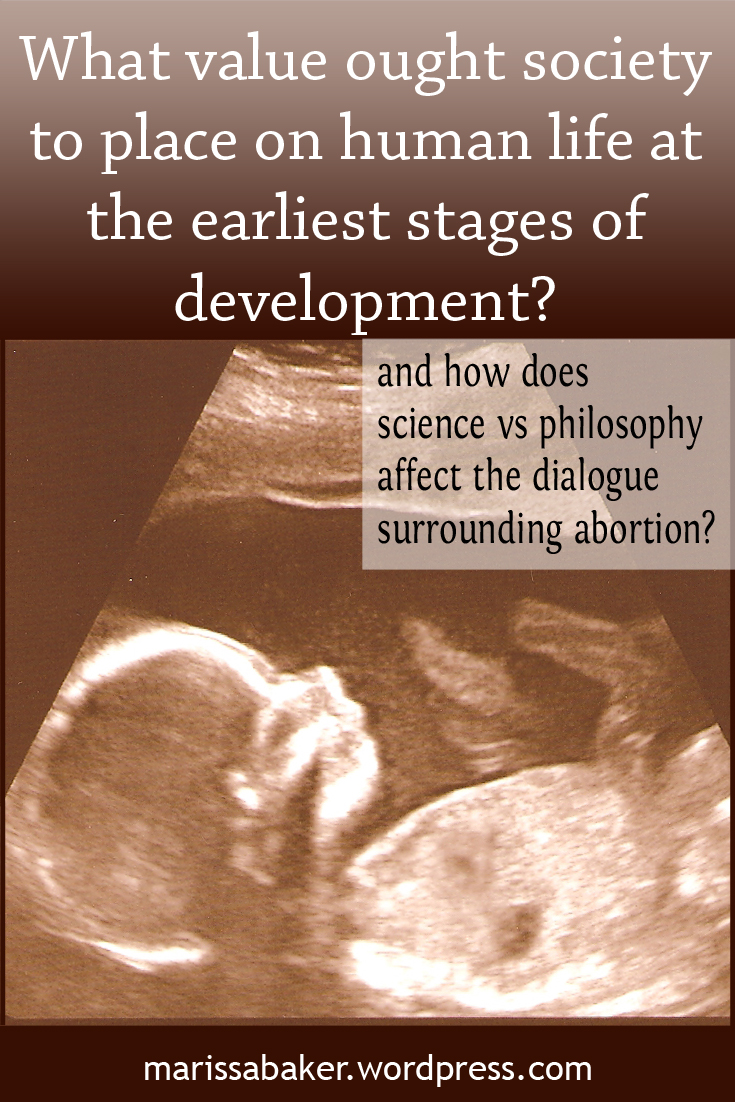
In the abortion debate, one of the things people like to argue is at what point the fetus qualifies as a living human being. Is it when the heart starts beating around 3 weeks? Is it when we can detect higher brain functions at at 22–24 weeks? Is it when the fetus is “viable” without the mother? Or after the baby has been born?

There’s plenty of science to indicate that a unique human entity is created either at the moment of conception or at cellar division about 24 hours later. The zygot, and then the fetus, is alive when a genetically unique cell forms that can grow, metabolize, and respond to stimuli. You can click here to read an excellent white paper on the subject written by Maureen L. Condic, Ph.D, Associate Professor of Neurobiology and Anatomy at the University of Utah School of Medicine. She concludes,

This view of the embryo is objective, based on the universally accepted scientific method of distinguishing different cell types from each other, and it is consistent with the factual evidence. It is entirely independent of any specific ethical, moral, political, or religious view of human life or of human embryos. Indeed, this definition does not directly address the central ethical questions surrounding the embryo: What value ought society to place on human life at the earliest stages of development?

I was on a pro-choice action network website, and they’re perfectly willing to admit that the fetus is alive and that it’s human (click here for the article I was reading). What they contend is that the fetus isn’t a human being yet (they distinguish “human being” from “human”). They also contend that a fetus does not have the right to live parasitically at the expense of its mother if she doesn’t want to carry to term because her person-hood and right to choose is not in dispute. They’ll then turn the argument to the “rights of the woman,” asking why we’re so ready to sacrifice her right to decide whether or not to have a baby on the altar of a fetus’s “hypothetical” right to be born.

Even at this point in the argument, you can see it really isn’t about science or objective fact. The facts are that the fetus is genetically unique, human, and alive from the moment of conception. That’s not in dispute. In reality, the question we should be asking is not, “When does the fetus become human?” but rather, “At what point do we value human life?”

When Should We Value Human Life? | marissabaker.wordpress.com
Photo Credit: “hello in there!” by Adrienne Bassett, CC BY via Flickr

The main leg the pro-life movement has to stand on is convincing society that we should value the life of unborn people so much that killing them is legally considered murder. We can use the science, but ultimately that’s not going to convince people to fight against abortion. People who support the legal right to terminate pregnancies know fetuses are alive — they just don’t think it matters. Our battle needs to be fought on philosophical and moral grounds.

Recent polls show that while more American’s describe themselves as pro-choice than pro-life right now, 51% think abortion should only be legal “under certain circumstances” verses 19% saying legal “under any circumstances (Gallup Polls). Getting into more detail about exactly what this means, we see 84% of Americans want tight restrictions on abortion: 25% say it should be legal in the first 3 months, and the others are divided between only in cases of rape or incest, to save the life of the mother, and not legal at all. (Marist Poll).

The Marist Poll also reports that even though only 13% of respondents favored banning abortion under every circumstance, 60% believe abortion is morally wrong. In today’s America we hate the idea of imposing our morality on other people, but we still do that every day we continue to (rightly!) maintain that murder, rape and pedophilia are wrong. Why is it so hard for us to extend that moral stand to protecting unborn life? And how far are we going to let this go? When we as a society set arbitrary limits on what makes a human life qualify as a human being, we’re on a very slippery slope. In 2011, two researchers in Australia published a paper titled “After-birth abortion: why should the baby live?” I’ve not read the whole paper, but this is the researcher’s own succulent abstract statement of what their work is about:

Abortion is largely accepted even for reasons that do not have anything to do with the fetus’ health. By showing that (1) both fetuses and newborns do not have the same moral status as actual persons, (2) the fact that both are potential persons is morally irrelevant and (3) adoption is not always in the best interest of actual people, the authors argue that what we call ‘after-birth abortion’ (killing a newborn) should be permissible in all the cases where abortion is, including cases where the newborn is not disabled.

While these researchers were not widely supported and later claimed their argument was taken out of context, it was a step in a disturbing trend. Informal evidence suggests college students are increasingly in favor of “after-birth abortions” up to 4 or 5 years old because they believe children that age aren’t “self-aware” yet (never mind that psychologists say children become “self-aware” between 1 to 3 years, usually 18 months).

It’s ridiculous to suggest that a fetus suddenly becomes a human being at 3 months, or at birth, or whatever age you decide to go with, but that he or she isn’t a human being a few minutes, hours, or days earlier. When you take such an argument to it’s farthest extent, you either have to believe human life is precious from conception or arbitrarily define a point at which humans are protected and before which they are not.

While we’re on the subject of valuing human life, I want to point out that a pro-life argument should never be anti-women. As one blogger who works with at-risk women points out, “Abortion isn’t so much about a woman having a choice — but a woman feeling like she has no choice at all.” While I want abortion to be illegal because I firmly believe no human being has the right to decide they can kill another, I also want to create a world where women don’t feel they have to or should have abortions. Where violence against pregnant women who want to keep their child stops. Where people are honest about what actually happens to both the mother and unborn child during an abortion. Where we consider the physical, emotional and psychological risks to the mother and stop pretending abortion is pro-woman.

It is our right and it is our duty to stand up to injustice, to speak out against moral wrongs and fight to correct them. And if we’re Christians, this is doubly the case. We’re called to “choose life, that both you and your descendants may live” (Deut. 30:19). God talks about knowing His people pre-birth and calling prophets and judges “from the womb”  (Judg. 13:5; Is. 49:1, 5; Jer. 1:5; Gal 1:15). Other verses talk about Him forming children inside the womb and being involved in birth (Job 31:15; Ps. 22:9; 139:13; Is 44:2), and about in-womb children reacting like and being treated as people (Gen 25:23; Luke 1:41). For Christians to say that murder is wrong but killing an unborn child is not just doesn’t add-up. There are certain areas in which we cannot be like our culture, and this is one of them.

Searching For Balance

I’ve been rather preoccupied with the idea of Balance lately, both in the world around me and internally. A lack of balance frustrates me so much and yet many people seem to gravitate toward polarities rather than searching for middle ground.

Searching For Balance | marissabaker.wordpress.com
scales credit: StockMonkeys.com

Let’s look at Christianity for a quick example. I’m not sure if this is the case in your churches, but in the groups I attend the question of Sacred Names comes up every once in a while. One the one hand, you have people who only use the Hebrew names like Yahweh and Yeshua and claim others “have rejected the name of their God.” I’ve even heard of people who won’t talk with other Christians unless they can pronounce the sacred names “correctly” (which varies depending on who you talk with). Then on the other hand, you have people who say Sacred Namers have fallen into “a satanic doctrine that leads people into idolatry.”

It just seems so ridiculous to me. To the first claim, if God wanted us all speaking Hebrew He wouldn’t have confused the languages at the tower of Babel. Read more

Grimm’s Laissez-faire Attitude Toward Sexual Coercion

Anyone else still watching NBC’s Grimm? I’m only one episode behind on the current season, but I’m seriously thinking of giving it up entirely. What was once an interesting foray into the dark origins of fairy tales has become a tangle of dysfunctional relationships and plot lines so ridiculous that Rosalee just spent a whole episode voicing my own frustrations with “how/why is this happening?”

More upsetting than the devolving story line, though, is how they writers have been handling the question of rape. Even if you’re not watching Grimm, this discussion matters because the way our entertainment presents issues like sexual violence both reflects and influences prevailing culture.

Love In The Time Of Cookies

It all started way back in season one with the character Adalind. She’s a Hexenbeist (basically a witch). She’s a main antagonist in this first season, and uses her powers to force Hank to see her as a romantic option. He’s basically roofied via magical chocolate chip cookie, but it wasn’t addressed in the show as rape and I doubt the writers even thought of it that way.

This brings us to the first disturbing idea that Grimm keeps coming back to, perpetuating the myth that adult men can’t be victims of rape. Hank wasn’t a victim — he was just a guy who accidentally had sex with someone he didn’t want to. No big deal (never mind that she drugged him and nearly killed him). We wouldn’t overlook this if the characters’ genders were reversed, so why the double-standard?

English and Welsh law didn’t recognize male rape as a crime until 1994. The United States was even farther behind — the FBI’s definition of rape didn’t include male victims until early 2012. I suppose it’s not surprising, then, that the statistics I could find related to male rape were UK-based. Crime reports for 2014 in England & Wales record 3,580 sexual assaults against men. Survivors UK (a male-only support group) estimates that only 2-3% of assaults are actually reported (compared to 10-12% for women). And yet society doesn’t treat it as a problem — Survivors UK had their funding cut completely last year, and most rape hotlines won’t even talk to men. No wonder Hank didn’t want to claim his coerced relationship with Adalind was rape.

It’s Okay If She’s A Witch

Adalind’s actions with Hank are played-off as unwanted sexual aggression rather than an attack, but apparently it’s enough to justify writing her comeuppance as an assault scene. Since the blood of a Grimm can strip a Hexenbeist of her powers, Nick attacks her, pins her to the ground, climbs on top of her, and kisses her so she’ll bite his lip. There’s really no way not to interpret this imagery as sexual. Charity has written an excellent article titled “A Grimm Look at Writers’ Impact on Rape Culture” that addresses this scene in-depth, as well as the after-math that continues comparing Adalind to a rape victim.

The disturbing part about this scene isn’t so much that it’s played as a sexual assault, but rather that no one has a problem with that. This perpetuates the myth that sexually aggressive women are asking for (or even deserve) sexual assault. Nick is the good guy, the hero, and that didn’t change for most viewers after he attacked Adalind. But other people’s bad actions shouldn’t justify “good” people committing unconscionable acts.

Baby Makes It Better

Skip ahead to the end of season three. Adalind has her Hexenbeist powers back, and she hatches a plan to take Nick’s powers away. Much like ingesting a Grimm’s blood can take away Hexenbeist powers, sleeping with a Hexenbeist takes away a Grimm’s abilities to detect Wessen. Adalind uses magic to disguise herself as Nick’s love interest, Juliette, and he sleeps with her. While Adalind doesn’t violently assault him, here’s no denying Nick was coerced into having sex with someone he would have turned down if given a choice. Doesn’t that make it rape?

Now in season 5, Nick is living with Adalind and the child she conceived as a result of her impersonating Juliette. Can you imagine this in reverse? No one asks a woman to move in with a man she wouldn’t have consented to have sex with just because the resulting child needs a father. If someone did write that situation, you can bet there’d be other characters in the show discouraging her from living with her rapist. In Nick and Adalind’s case, however, the farthest any character will go is describing it as “weird.” The writers don’t see their past relationship as rape (see first myth) and, if the number of Nick/Adalind shippers online is any indication, neither do most fans.

I was going to have a “myth” listed for each section, but it doesn’t really work here — no one actually thinks you should move-in with your rapist if there’s a child! It’s insane. And yet, I saw someone online arguing that Nick and Adalind’s relationship is a relatable and realistic portrayal of modern adults in a co-parenting situation after an unexpected pregnancy. I suppose this is what happens when you live in a culture that’s adopted an anything goes (except abstinence) attitude toward sex. The more taboos we tear down, the easier it is to skirt around the ones that remain.


Turning Offense Into Something Useful

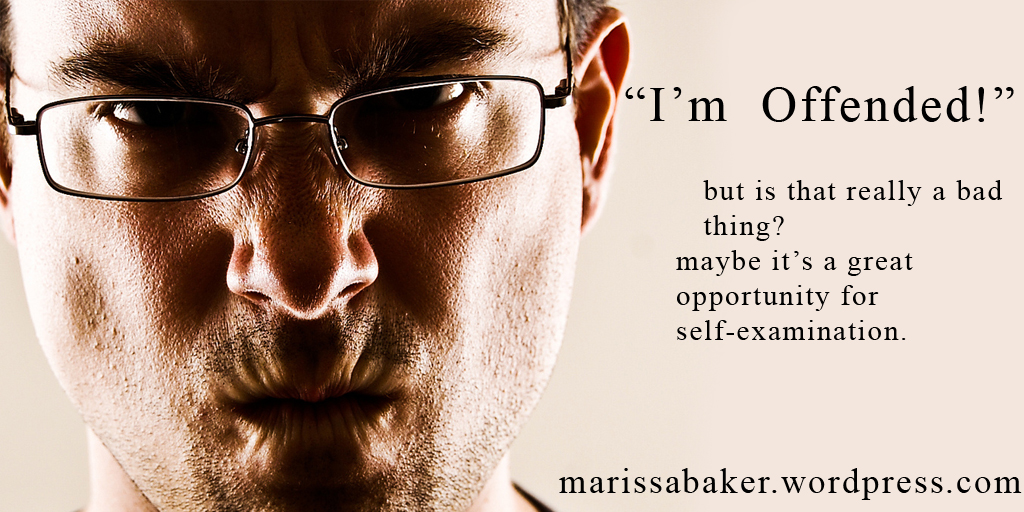
It seems like everyone is offended about something today. Wherever someone voices a decided opinion, there’s someone else reacting to it defensively. In an effort not to offend anyone, we’re turning into a society where we talk around issues rather than addressing them directly. We couch our opinions in careful language like, “From my own personal view …” and “I don’t want to force an opinion on you, it’s just my thoughts that …”.

Why are we so quick to see offense as a bad thing in today’s culture? If it’s just because we don’t like to be made uncomfortable, then we’re missing valuable opportunities for personal growth. Being offended offers a challenge to how we think. For people who are open to questioning, growth, and refinement, being challenged is a good thing. For people who just want to float through life without wondering “why?”, offense is scary.

Turning Offense Into Something Useful | marissabaker.wordpress.com
photo credit for portrait: “Angy Face” by Ryan Hyde, CC BY-SA

The next time you feel offended, don’t look at it as a bad thing. See it as an opportunity for self-examination. It’s a chance to look inside yourself and find out why you’re having such a strong, defensive emotional reaction to what you just saw or heard. Ask yourself things like,

  • Is this important enough to be offended about?
    • If no, why am I so defensive?
    • If yes, how do I turn my offense into something more productive?
  • Am I offended by this because it makes me feel guilty about something I’m doing wrong? (plank in your own eye, speck in your brother’s …)
  • Does anyone else care that I care about this?
  • Would sharing my thoughts on this just stir up unproductive strife? (If yes, don’t do it!)
  • Is the thing I feel offended about something that’s hurting other people?
    • If yes, what can I do to stop it? (For example, being offended that human trafficking exists doesn’t help; you’d need to fight against it or support those who do.)
  • Is the idea/statement that offends me actually true, regardless of how I feel?

Offense is unproductive by itself, but when we feel offended we have a chance to transcend knee-jerk reactions and use it as a tool for self-examination, growth and motivation. We can look inside ourselves and see if our offended reaction points to something we need to change, and we can look outside ourselves for opportunities to actively make the world a better place.