The Vanishing INFJ

I’ve written before about how other types can be friends with an INFJ. But there’s another side to that dynamic: what INFJs are like as friends. We can be fantastic friends — fun, engaging, good listeners, intensely loyal. But sometimes we’re not the best sort of friends and often, that’s the INFJ’s fault.

There are some things I love about being an INFJ personality type. And then there are other aspects which aren’t so nice, and some of those can negatively impact our friendships if we’re not careful. Today, I’m speaking of our tendency to drop out of contact with people.
click to read article, "The Vanishing INFJ?" | marissabaker.wordpress.com
photo credit: Tony Lam Hoang via StockSnap

Unique Mental Wiring

INFJs are a curious mix of mental processes. We’re most comfortable using Introverted Intuition (also called “Perspectives”). This is focused on collecting information about how the world works, processing it internally, and making speculative leaps about what it means. Basically, it’s advanced pattern recognition.

That’s paired with Extroverted Feeling (aka “Harmony”). This mental process is in-tune with other people’s feelings and wants to make sure their needs get met. It’s generally the first mental place INFJs go when trying to make a decision, asking, “How will this affect other people and my relationship with them?” When well-developed in an INFJ, they can be so outgoing and social that they seem like extroverts.

But we might also skip this process and spend more time in our tertiary Introverted Thinking (aka “Accuracy”). That one’s more about analyzing of facts, trying to make things “make sense to me.” It’s also impersonal. When INFJs spend more time inside their heads than on developing our extroverted side, we can stay in an introverted Intuition-Thinking loop.

Distracted By The Inner World

Using our Intuitive and Thinking process together isn’t always a bad thing for the INFJ. Our Extroverted Feeling side is important to develop so we can make decisions more easily, maintain friendships, and experience personal growth. But we to also need alone time to re-charge and it can be a good way to process data. It only becomes a problem sometimes when we get “stuck” in our introverted side. Read more
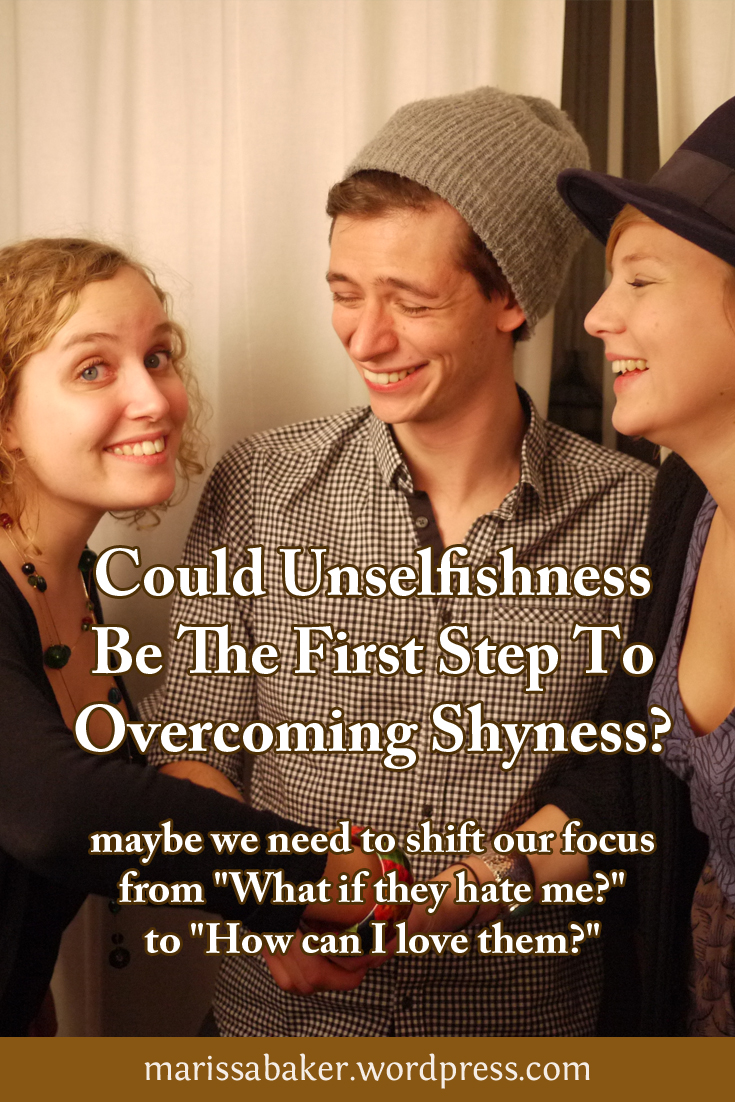
Could Unselfishness Be The First Step To Overcoming Shyness?

Once again, I failed to introduce myself to someone. I’m 27 years old — by now I should have mastered the incredibly complicated art of walking up to someone visiting my own church group and simply saying, “Hi, I’m Marissa. Welcome. What’s your name?”

It would probably come out more as a squeaky “Hi” followed by awkward silence as I frantically tried to come up with words resembling normal small talk.

*sigh* So much for INFJs being “the most extroverted introvert.” Perhaps some INFJs are, but I’m not. I’m shy. I thought it was getting better, but apparently I still need more work battling my social anxiety.

click to read article, "Could Unselfishness Be The First Step To Overcoming Shyness?" | marissabaker.wordpress.com
photo credit: “Viene and friends” by Barry Pousman, CC BY via Flickr

Introversion is healthy for introverts. Shyness … not so much

Despite Google’s antiquated definition of introvert as “a shy, reticent person,” shyness and introversion are far from the same thing. “Shyness is the fear of negative judgment, and introversion is a preference for quiet, minimally stimulating environments” (quote from “Are You Shy, Introverted, Both, or Neither (and Why Does It Matter)?” by Susan Cain). Shyness produces anxiety in social situations, while introversion means you lose energy when around other people. The traits often go together, but extroverts can also be shy.

Introverts who aren’t shy still prefer the inner world of thoughts and ideas to the outer world of people and things, but they’re capable of socializing and even enjoy it. Extroverts who are shy want to spend their time in the outer world, but they’re scared of people.

One of the most genuinely friendly extroverted women I know was once shy. For her, the turning point from shy to social was when she realized her fear of talking was rooted in self-focus. It was about “I’m scared to talk with people,” or “Socializing makes me nervous,” or “What if they don’t like me?” Read more

Maybe The Telephone Isn’t An Enemy

Some of you might think that title is strange, but my fellow introverts will understand. The hours of mental preparation that go into making a two minute phone call. The sense of dread when the phone rings and you aren’t ready to talk with someone. The pressure of sounding engaged and alert while thinking fast enough to avoid awkward silences. Most of us view the telephone in much the same way the Dowager Countess of Grantham does.

some thoughts for introverts. Click to read article, "Maybe The Telephone Isn't An Enemy" | marissabaker.wordpress.comBut I had a truly enjoyable phone conversation with a friend this weekend, and I realized this wasn’t an isolated incident. When he asked for my number my first instinct was panic, then I realized there wasn’t any reason to. I talk with my sister on the phone for hours almost every day. I chat with my dance team when we’re coordinating practice times. I enjoy the unexpected call from my cousin or a select group of friends. Chatting on the phone really isn’t all that scary.

Now, in the interest of full disclosure, I am in many ways a stereotypical introvert in regards to the telephone. We don’t have caller ID on the landline and the calls are rarely for me, so I refuse to answer when it rings unless I recognize the voice and want to talk with them now. My cell phone is set so it doesn’t even ring unless the number is in my contacts list and, in general, I much prefer written communication. There are times, however, when telephones are a preferable method of communication. Read more

An Open Letter to Socially Timid Highly Sensitive People

I’m so excited to share with you my first article published on Introvert, Dear. Read an excerpt below, then follow the “Read More” link for the full article.

Dear fellow highly sensitive person,

Like many of you, I didn’t know I was a highly sensitive person (HSP) for a long while. I just knew I was “different.” For me, this was particularly marked in social situations. Other people went shopping together to unwind, but I felt tense in brightly lit malls bombarded by flashing advertisements, milling crowds, and heavy perfumes. My friends didn’t wince at dances when the music was turned up, they danced harder. My classmates in college seemed like they could relax and focus, while I noticed the flickering lights, the quality of air, the spot on the professor’s shirt, the scratch of pencils on paper.

Sound familiar? If you were like me, you were sure this wasn’t normal—but you weren’t sure what to do about it. I couldn’t understand why it was so hard to get over my shyness and start acting like other people. I had discovered my Myers-Briggs personality type was INFJ when I was preparing to graduate high school as a homeschooler, but it wasn’t until I was floundering through the social landscape of college that I started really researching it. I began at the library, desperately digging through books, looking for ways to cope with my introversion. …. Read More

Conversations That Didn’t Happen

I’m staring out the backseat window watching unplanted fields roll by while having a conversation. It’s going pretty well — we’re exchanging ideas, sharing authentic feelings, clarifying anything that was unclear earlier — in short, it’s the kind of meaningful conversation I crave with people I care about. Only one problem: it’s all happening in my head and the guy I’m talking with has no clue we just had this conversation.

From talking with other INFJs and writing my INFJ Handbook, I know thinking through past and potential conversations is something my personality type does. We tend to favor the world inside our own heads and spend plenty of time there. We’re also interested in people, though, so it makes sense that many of our inner thoughts are about how others might respond to us and what they might think about our ideas.

Conversations That Didn't Happen | marissabaker.wordpress.com
Photo Credits: “Daydreaming” by Lóránt Szabó and “Conversation” by Sharon Mollerus

But living inside your head isn’t just an INFJ thing — a preference for the inner world is one of the main ways we define introversion. With that in mind, I asked a group of introverts on Facebook if they related to this and got some interesting responses from several different personality types. I also mentioned that sometimes I forget which conversations I’ve actually had with people and which ones only took place in my head and that resonated with some but, everyone. Here’s a few of the comments I got (used with permission):

  • “That doesn’t sound like something limited to certain personality types, other than introversion itself. I find myself doing it from time to time. I don’t usually think about others’ feelings or intuit what they are thinking, but the conversations always play out in my head way more than they ever do in real life” (anonymous ISTJ)
  • “Yes, I do! It’s getting harder and harder to distinguish which is the “real” conversation. I know too well how you feel … I don’t think it’s limited to any particular personality type” (anonymous)
  • “Yep, all the time. It’s the really confrontational ones that will get me though. I get really angry at scenarios I have dreamed up in my head” (Charis Tippets Branson, INFJ)
  • “90% of the conversations I have are in my head” (anonymous)
  • “I do that. Though I remember if I’ve actually had those conversations because the imaginary ones were full of remarks I’d never actually say” (Mary Menard)
  • “I do this regularly. It’s especially helpful if it’s a hard conversation that needs to happen. The problem is that I have it all figured out and sometimes forget I didn’t actually have the conversation. Last week I told my husband, ‘So, do I really have to call and talk to her or could I just pray and ask God to tell her for me?’ He said I need to call. 😐 I wrote down what to cover or I get into listening mode and have no idea what I was planning to say” (anonymous INFJ)

Read more

INFJ Overthinking -­ When Our Beautiful Mind Turns Against Us

This is a guest post by John Lindholm, a writer for the Introvert Spring INFJ forum.

INFJs like to look in. Sometimes this habit works against us. Our mind is a busy freeway of thoughts that steer our car off the happy highway. Certain circumstances are particularly disorienting. Our mind twists, turns, and reverses these situations so much that they no longer match up to reality. Here are a few you might recognize:

Small Talk, Big Mistake

INFJ Overthinking -­ When Our Beautiful Mind Turns Against Us, guest post by John Lindholm | marissabaker.wordpress.com
photo credit: “Thinking RFID” Jacob Bøtter

It is no secret that introverts would rather eat a brick sideways than engage in small talk. But I’ve only been offered that choice twice in my life, so the chit chat is unavoidable even to the ghosty­ist INFJ.

It’s even worse when we think our conversation partner is more successful, better looking, or more interesting than we are. When this happens, the chatter milk can sour in an instant.

It starts with rotten self-­talk like, “why am I such a loser compared to him?” Or, “why can’t I just relax and talk like she can?” Or even, “why do I suck at life?” Then the pulverized mind of the INFJ has to throw a few words together to continue the conversation. Not good.

One time, I ran into somebody I hadn’t seen for well over a year. He started with, “I haven’t seen you for a while, so I just wanted to say hi.”

I volleyed, “Yeah, so how have you been?” Not a bad start, but the meter on my coherence tank plummeted as the palaver continued.

When he tried to end things with, “Ok so, I just wanted to say hi,” I again replied, “Yeah, so how have you been?”

Realizing I had repeated myself, I answered my own question. “Good, good, yes right?” It was ridiculous, so I excused myself and retreated to the restroom.

It Will Be All Better When…

For the INFJ, successes that should be celebrated and lead to happiness and further growth can actually lead to frustration, sadness, and even depression. This has a lot to do with “I’ll start my diet on Monday” self­-promising. We tell ourselves,

“Once I get through this social-­event­-stuffed weekend, everything will be perfect.”

“As soon as school ends, I’ll get back to writing my book.”

“I’ll be so happy after I lose these ten pounds.”

This kind of thinking ensures that we’re never where we are. We’re not here, we’re in our head. We’re so busy thinking about what would make us happy that we miss out on the present moment. Since no amount of achievement will evict us from our brain, we’re better off focusing on how to make our head a happier place.

There’s Only One Side: Mine

We INFJs will brood, contemplate, deliberate and ruminate the DNA right out of an idea. Other folks might have an opinion, a passing notion, or even a half­-baked solution. But if they don’t agree with us, they’re wrong.

Or so we think.

We’re awesome at dissecting an issue, but have a hard time accepting opposing points of view. It’s hard for us to trust that others have as much going on between the ears as we do (they probably don’t, but that’s beside the point).

And heaven forbid that people want to speak about a problem without also brainstorming for a solution. I mean, what’s the point in highlighting a fault if we don’t want to fix it, right?

Your Turn…

I’d like to hear from the rest of you INFJs, and from those who love them. What other ways do INFJs overthink or misunderstand social situations? Please share below.

Author Bio: John Lindholm is a middle school math teacher and a writer for the Introvert Spring INFJ Forum (which you are welcome to join). He enjoys writing fiction as well as articles and other pieces about introversion. Check him out at InwardFacingWriters.com.


If you’d like to know more about the INFJ personality type, check out my book The INFJ Handbook. I just updated it with a ton of new information and resources. You can purchase it in ebook or paperback by clicking this link.