Wrestling With Faith: Religion in Marvel’s Daredevil

Before Daredevil premiered on Netflix in April of last year, the closest Marvel’s Cinematic Universe came to portraying a superhero of faith was Captain America’s line, “There’s only one God, ma’am, and I’m pretty sure he doesn’t dress like that” in The Avengers three years earlier. As much as I like and admire Steve Rogers as a character, however, I’m not sure I’d describe him as a man of faith. Certainly he’s a moral man who believes in God, but his faith doesn’t play a major role that we can see on-screen.

Matt Murdock (played by Charlie Cox), on the other hand, is a character defined by his faith. The way he’s portrayed in the Netflix series leaves no doubt that Matt is a staunch Catholic and that his faith influences every decision he makes. The religious elements don’t make Daredevil any less violent (this is not a show for children or squeamish adults), but the series’ engagement with religious themes does make it one of the most intriguing things on screen right now.
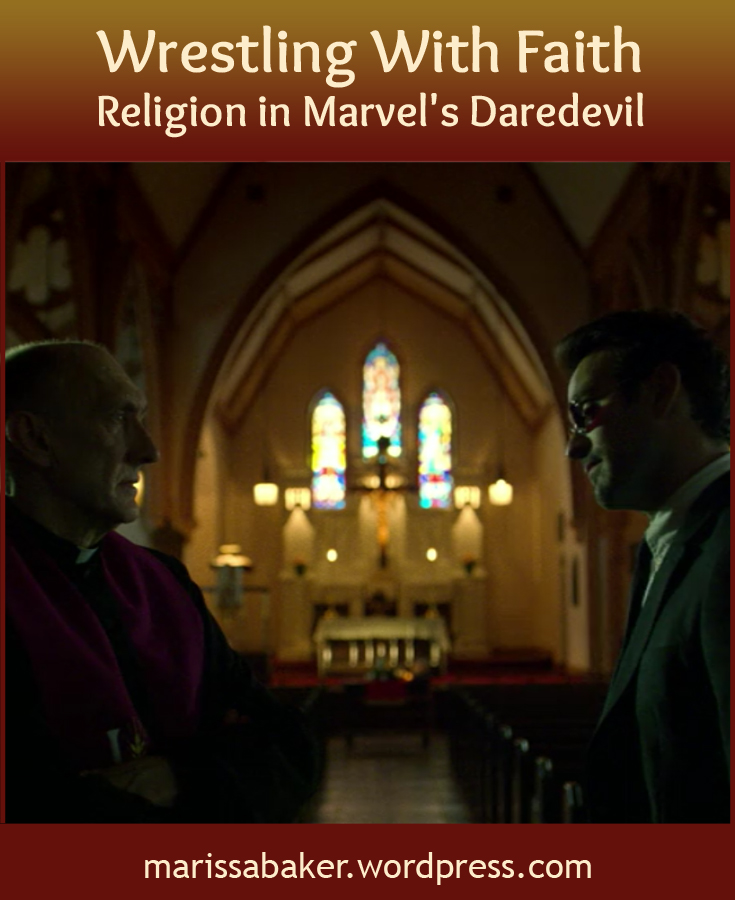
Wrestling With Faith: Religion in Marvel's Daredevil | marissabaker.wordpress.com

It’s rare to see a character portrayed as unabashedly Christian in today’s culture, at least outside of films produced by a faith-based group such as Sherwood Pictures. It’s even rarer to see a man of faith cast as the hero of a gritty drama. Yet Matt Murdock is a practicing Catholic who proclaims his belief on-screen, as well as a seriously impressive superhero.

Quick note: I’ll be honest, I don’t know all that much about Catholicism. I’ve known Catholics and counted several my friends, read a few books written by Catholic authors (both fiction and non-fiction), and encountered some facts about Catholicism in studying British history, but I wouldn’t really consider myself knowledgeable on the subject. If you’re reading this as a Catholic and I say something stupid, please correct me with love in the comments 🙂

Quicker note: this article contains spoilers for both seasons of Daredevil. Spoilers for Season 2 will be clearly noted.

To Kill, or Not To Kill

Everything about Matt’s choices is influenced by his Catholicism. He won’t kill because he firmly believes it is morally wrong. That is explored strongly in the first season, when we learn Matt refuses to kill his enemies and tries his best to prevent others, including his allies, from killing as well. It’s back again in the second season when

SPOILER WARNING

we learn in flashbacks that Matt’s college romance with Electra ended after she asked him to kill the man who murdered his father. A few episodes later, we find out that she has a mission to pull Matt away from the faith that was, in part,why he’s not still fighting alongside Stick. It didn’t work. Matt wasn’t a perfect enough Christian to say no to premarital sex or to leave Electra when she was stealing cars and breaking into people’s houses, but his faith runs too deep for the possibility of murder to not act as a wake-up call.

(end spoilers)

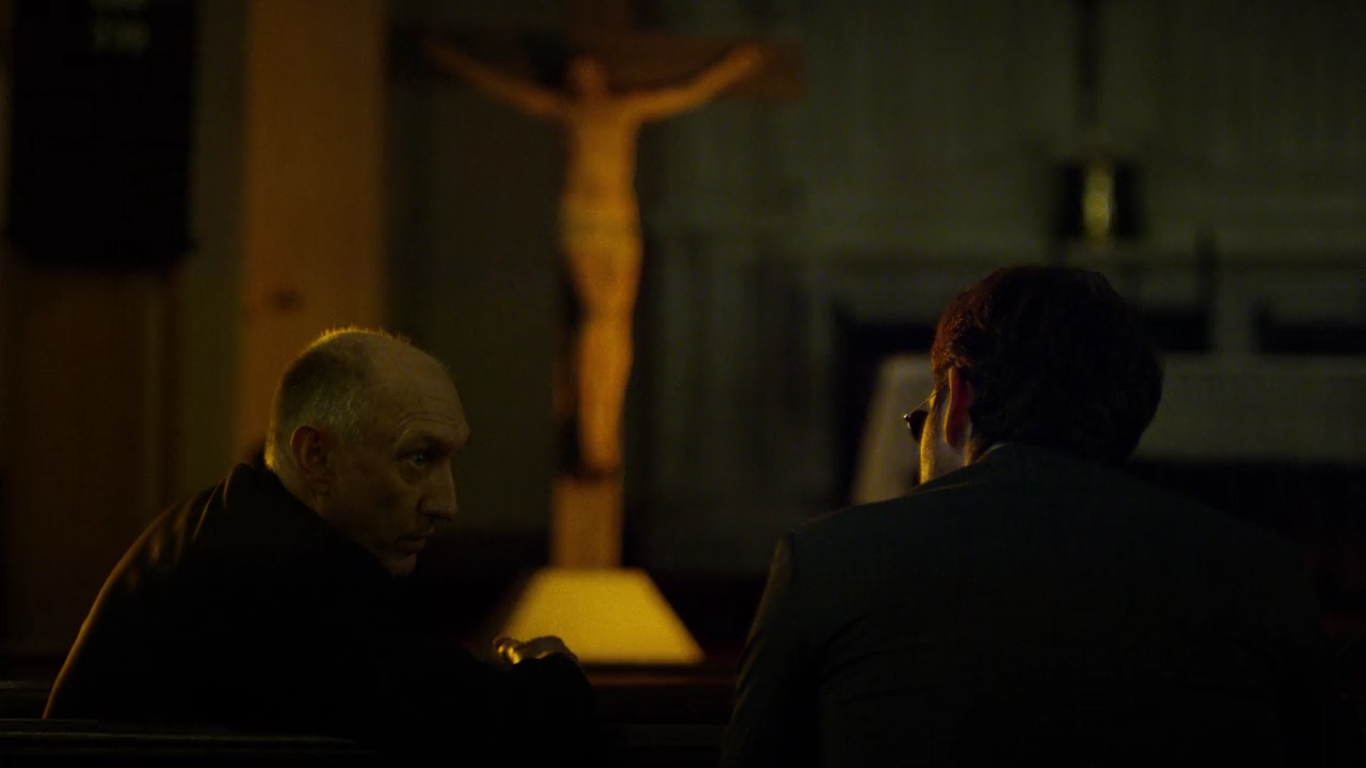
Unlike Batman, who doesn’t (typically) kill because it’s part of his crime-fighting code, Daredevil doesn’t kill because it’s part of his faith. The only way he would consider breaking the law of God that prohibits murder is if he thinks sacrificing his soul would save enough people to make it worthwhile. That’s why he considers killing Wilson Fisk near the end of Season 1. “I know my soul is damned if I take his life,” Matthew says, “But if I stand idle” people “will suffer and die.”
Wrestling With Faith: Religion in Marvel's Daredevil | marissabaker.wordpress.com
Daredevil S1, E9

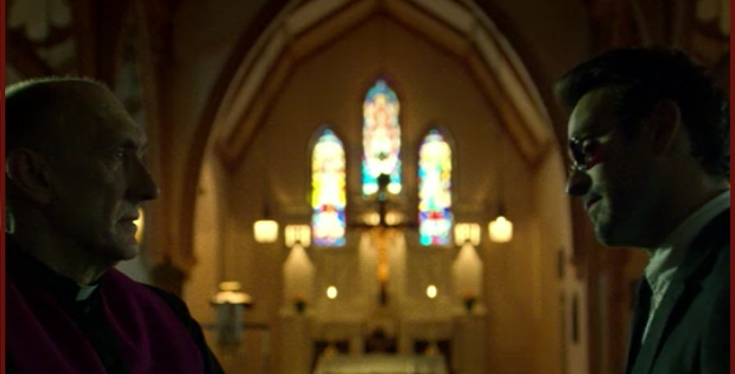
For most action heroes, there wouldn’t even be a question of what to do — you just go out and kill the bad guys. Matt, however, cares about what taking another person’s life says about him. He doesn’t take this question to his bartender or girlfriend though (as an equally introspective but less religious character might). He takes it to his faith in the form of his priest, Father Lantom, who reminds him, “There is a wide gulf between inaction and murder, Matthew. Another man’s evil does not make you good. … the question you have to ask yourself is are you struggling with the fact that you don’t want to kill this man, but have to? Or that you don’t have to kill him, but want to?”

A Question of Motive

In the same conversation where Father Lantom talks with Matt about whether or not Matt should kill Fisk, he also says, “Few things are absolute, Matthew. Even Lucifer was once an angel. It’s why judgment and vengeance… are best left to God. Especially when murder is not in your heart.” When Matt asks how Lantom can know what’s in his heart, the priest responds, “You’re here, aren’t you?” The fact that Matt wrestles with how his faith fits into his mission to fight for justice is one thing that proves he’s a good man. Our motivations matter.

Matt works as a lawyer by day trying to right wrongs within the system, then goes out at night as Daredevil trying to bring justice to the people who were overlooked by the law. In the first episode of Season 2, Matt tells Foggy that the woman they helped as lawyers by recommending a battered women’s shelter would have been murdered by her husband before her escape if Daredevil hadn’t put the man in a hospital. Daredevil goes around fixing the problems that Matt Murdock can’t.

An article that appeared on Slade.com last year said Netflix’s Daredevil understands that Matt’s religion is “essential to his identity … which is what makes the show work.” The article continues, “Murdock’s brutal justice is more than his way of taking personal responsibility for the sins of others; it’s his way of atoning for his own. Murdock’s real superpower, and also his biggest foe, is his Catholicism” (from “Daredevil’s Greatest Superpower Is His Catholicism“). Matt’s religion is what drives him to fight for justice, yet it’s also what makes him question himself at every turn.

Guilt and Redemption

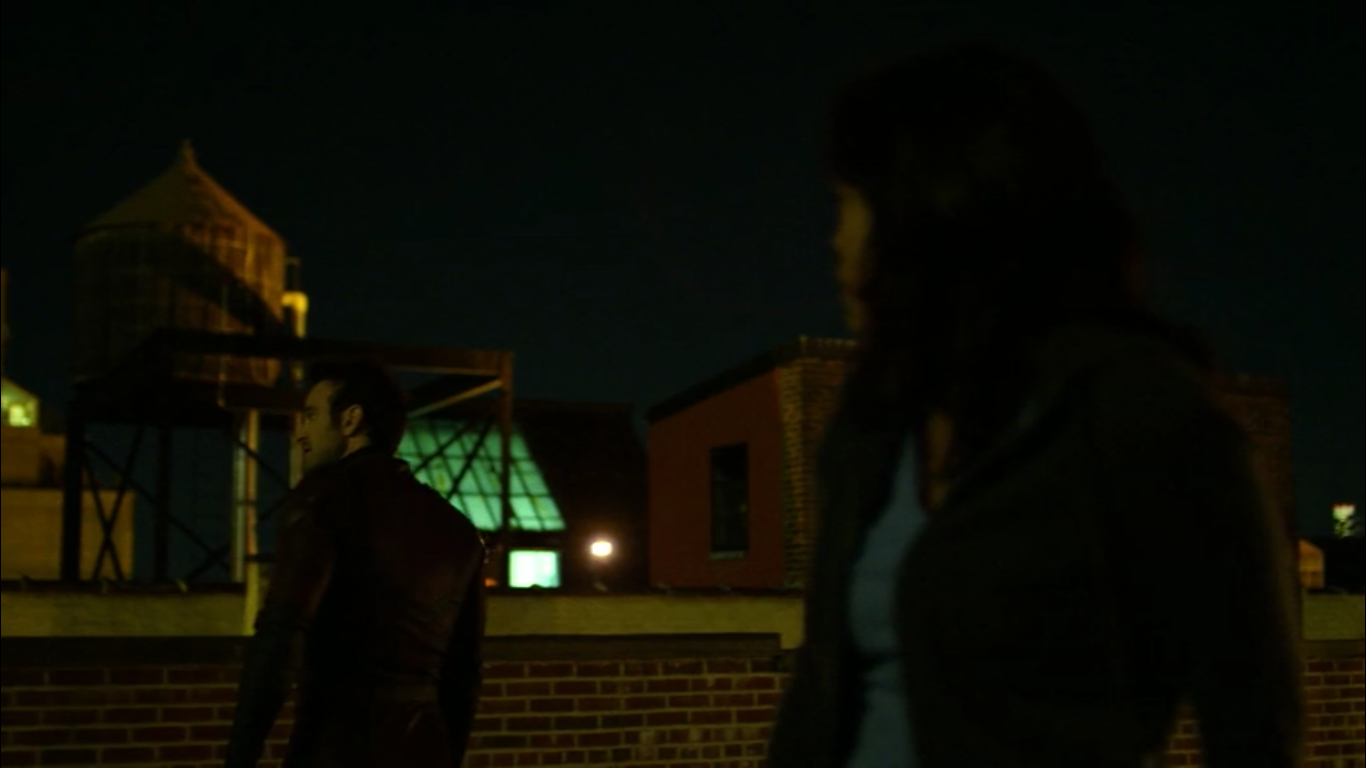
Throughout his crusade, Matt punishes himself as much as the people he’s after. In “Daredevil, Catholicism, and the Marvel Moral Universe,” Leah Schnelbach connects this with “mortification of the flesh.”While Matt Murdock does qualify as a powered-person in the MCU, his powers don’t give him fast healing or make him invincible. To fight evil, “He has to keep getting hit, keep getting wounded. Over the course of the show, we see this process–old wounds reopen, cuts heal slowly, bruises linger, and each fight seems more labored. … The point is that he keeps going anyway” (click here to read the full article). Matt’s only partly joking when he responds to Claire describing him as “blind vigilante who … can take an unbelievable amount of punishment without one damn complaint” by saying, “The last part’s the Catholicism.”
Wrestling With Faith: Religion in Marvel's Daredevil | marissabaker.wordpress.com
Daredevil S2, E10

Mortification of the flesh is a concept very much tied to penance in the Catholic version of Christianity. It’s referenced even more clearly into Daredevil in Season 2, again by Claire (mild spoiler warning). Matt’s beating himself up (metaphorically, this time) for not saving a group of people soon enough. She suggest he take off his “hair shirt” and “start thinking about climbing down off that cross of yours and spending some time with us normal people for a change.” The idea of Matt martyring himself is a theme throughout both seasons.

MAJOR SPOILER WARNING

One of the aspects of Season 2 I found most interesting was the association of Matt with Jesus Christ. He’s not portrayed as a “Christ-figure” per say, but there’s more going on here than just Claire’s overt reference to Matt crucifying himself. Much like I argued when talking about Luke and Vader in Star Wars, we can compare Matt’s insistence that redemption is possible for Electra to God “not wishing that any should perish, but that all should come to repentance” (2 Pet. 3:9, ASV). While Matt is willing to die for her, what’s more poignant is that he’s willing to sacrifice himself by living for her.

I struggled with this scene in the final episode. Why would Matt give up everything he’s working for in Hell’s Kitchen to run away with such a morally dark character as Electra? Upon further reflection, I realized he didn’t intend to abandon his faith by offering to take this action. While being with Electra does bring out the “devil” side of him, he’s not offering to run off with Electra just so he can be free of responsibility or guilt. He wants to do this because of his stated reason — that she “gets” the part of him that no one else understands — and because of the redemption theme running through this season. He has to believe Electra can be good and he’ll give up his own life to help make that possible.

(end spoilers)

Matt’s not a perfect Christian or a perfect Catholic. Some might even question whether or not he qualifies as a “good man” after putting so many people (criminals, yes, but still people) in the hospital. Where do we draw the line? and what is the responsibility of a moral man confronted with evils that he can fight, but isn’t sure at what cost? Those are the sort of questions that Marvel’s Daredevil offers for our consideration. It’s not interested in a sanitized version of Christianity that focuses on faultless people living lives of bliss and, quite frankly, I’m not either. And neither’s the Bible, if the struggles of David, Peter, Paul and so many others are any indication. God never tells us our walk with Him will be without wrestling. It’s how we respond to the crises of faith — the moments where we wonder if all this is worth it — that count.
Save

Fictional MBTI – Scott Lang (ISFP)

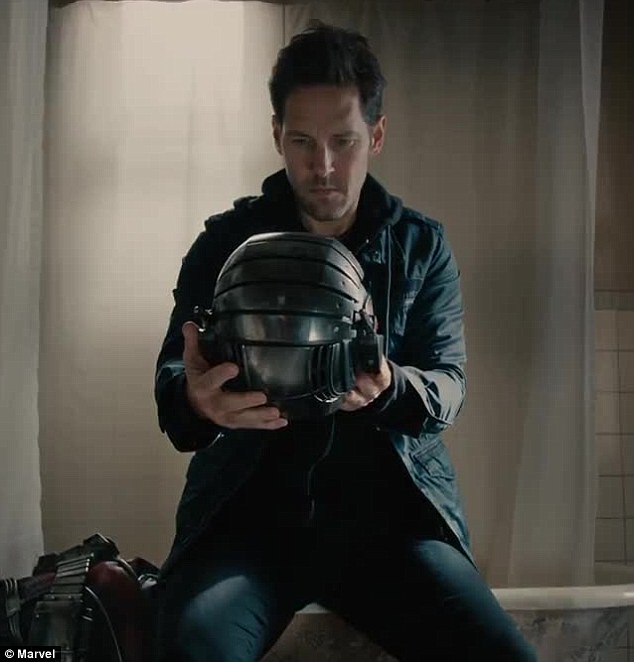
With Captain America: Civil War coming out in just seven weeks, I thought I’d add a post on Scott Lang to my collection of fictional MBTI types. It’s also a pretty good excuse to buy and re-watch Ant-Man.

If you do a quick Google search to see how others on the interwebs are typing Scott Lang, you’ll mostly find ESTP, with a few ISTP, ISFP and one INTP guesses thrown in. One thing all these types have in common is that they’re extroverting their Perceiving process, so that’s where we’re going to start (the P/J preference in an MBTI type refers to how we interact with the outer world).

Sensing vs. Intuition

The S/N preference describes our perceiving function, which is the mental process we use to learn new information. Isabel Meyers wrote that Sensing types “depend on their five senses for perception.” They want to see, touch, and test the information they’re taking in. Subjective or indirect information is less trustworthy, and less interesting, than their own direct experiences. Intuitives, on the other hand, “are comparatively uninterested in sensory reports of things as they are” (Gifts Differing, 57). Intuition is an innovative process that resembles advanced pattern recognition (in Personality Hacker’s words) and focuses on exploring possibilities.

Types that have a “P” in their four-letter name extrovert this mental process. Personality Hacker describes Extroverted Sensing (Se) as a “real-time kinetic” function that’s very in-tune with verifiable details of the outer world. Types with Se high in their function stack are typically very comfortable in their bodies and have a natural talent working with their hands.

Extroverted Intuition (Ne) is the function that ENTP Iron Man leads with. It’s very much about exploring the outer world and trying things just to see what will happen. It actively searches for patterns that haven’t been found and understood yet.

Looking at Scott Lang in Ant-Man (we’re not covering the comics here, just the film), I don’t really see much evidence of him using Intuition. He’ll still have intuition in his function stack (Introverted Intuition is the opposite of Se, so in an SP type that will be either his tertiary or inferior function) but it’s not what he leads with. Just a few examples:

  • Se types are typically very good working with their hands and coordinating their bodies. Scott possesses the skills to burgle houses (quite impressively) even before having the suit. He is also trained as an electrical engineer and we see him doing skilled hands-on work throughout the film.
  • When Scott encounters a challenging safe to crack, he doesn’t explore possibilities or try different things. He relies on what he knows will work from past experience and quickly implements it to bypass the fingerprint scanner and freeze the door. He also doesn’t forget any Sensing details (blows up air mattress for the door to land on, hangs comforter in the door to catch the flying hardware).
  • The “Whose pajamas are these?” question would be irrelevant to Ne, but it’s a detail Se would notice.
  • Scott learns to control the suit and fight fairly quickly by testing it out actively. It become natural to him and he’s soon effortlessly coordinating sensory details (like timing his jump off the servers at Pym Tech to coincide with bringing Antony into position to catch him).

Feeling vs. Thinking

The F/T preference describes how we make decisions about our behavior and what we think the world should look like. Feeling types typically prioritize how a decision lines up with their values and those of society. Feeling is concerned with the emotional impact of a decision. Thinking, on the other hand, “is essentially impersonal” (Gifts Differing, 65). This process seeks objective truth that doesn’t depend on the perspectives of other people

For “P” types, the judging process is internally focused. Introverted Feeling (Fi) types tend to check-in with the emotional impact of a decision by looking inward. They want to “determine what feels the most in alignment with oneself” (Personality Hacker). For them, decisions have to “feel right” and authentic.

Introverted Thinking (Ti) also checks in with the inner reality, but doesn’t focus on authentic feeling. Instead, it prizes things that “make sense.” Whether or not Ti types can objectively explain a decision, it has to line-up with the theory they’ve formulated about how the world works. They are interested in facts, but “chiefly as illustrative proofs” of their ideas (Gifts Differing, 78).

This one was harder for me to pin-down in Scott. The difference between Fi and Ti confuses me, but a couple articles from Personality Junkie helped clear things up (click to read “Introverted Feeling (Fi) vs. Introverted Thinking (Ti)” and “The Laws of P-Types: Fi & Ti Laws“). Prelude Character Analysis’ ISFP vs. ISTP article was also useful.

  • Scott’s infamous VistaCorp burglary was based on what he felt was right, not on logic. There’s an interesting interview on YouTube where Scott talks about this incident. He says he’s tired of having his “name dragged through the mud” by media who don’t recognize why he did what he did. He’s willing to pay the price for his choices, but he wants the world to respond according to his internal value system and recognize VistaCorp was morally culpable.
  • In the film itself, Scott is very careful about how he’s defined. He insists he’s a cat-burglar because “robbery involves threat” and he detests violence. This is not just about specificity and getting facts right — it’s about how he’s seen by others in society and how he feels about himself.
  • When Scott talks about how he sees himself and his subjective view of the world, he defines himself in relation to the kind of man his daughter wants him to be. This is also why he chooses to help Hank Pym. It isn’t about logic — it’s about a “chance to earn that look in your daughter’s eyes, to become the hero that she already thinks you are.”
  • Scott is certainly not suspicious of emotions or hesitant to share and talk about feelings, unlike the typical ISTP (such as Black Widow and Hawkeye, who I’ll eventually write posts about). He’s not very well in-tune with how others will respond, though (unlike an Extroverted Feeling type, such as ISFJ Steve Rogers). For example, when Pym and his daughter are reconciling Scott expresses his appreciation of their feelings, but in doing so ruins the moment.

Extrovert vs. Introvert

The question now becomes what order Scott uses these functions in. Does he lead with his Extroverted Sensing process (ESFP) or with his Introverted Feeling process (ISFP)? There are very few scenes where we see Scott seeking out people so he can re-charge or where he seems focused on the outer world. His internal ides, cares, and identity are what’s important. Those are all marks of an Introvert. For a character whose entire motivation is based on doing what lines up with his internal locus of control, it makes sense for that introverted decision-making function to take center stage. This makes his ISFP function stack:

  • Primary: Introverted Feeling
  • Secondary: Extroverted Sensing
  • Tertiary: Introverted Intuition
  • Inferior: Extroverted Thinking

You can learn a lot about people by how they respond under stress, and in Scott we do see a stress-reaction consistent with Inferior Thinking rather than Inferior Intuition (as would be the case for an ESFP). When stressed out, he doesn’t lose control over sensory details or withdraw and get angry. Instead, he starts asking questions and trying to get back on familiar footing (“Who are you, who is she, what the hell is going on here, and can I go back to jail now?”). Stressed Feeling types also tend to act rather than shut-down, which is what Scott does whenever there are obstacles to his plan or when something traumatic happens (like Antony’s death).

One reason people might not like an ISFP typing for Scott is that this type is consistently stereotyped as too “artsy” to go into a field like engineering or implement logical plans. Yet, Dr. A. J. Drenth notes that SFP types “may find themselves curiously drawn to Investigative subjects like math, science, computer science, engineering, etc.” though it’s not necessarily a good fit for their type. They can do it, like Scott, but they may struggle to fit into the system, become frustrated, and even act out in some way (though not necessarily as illegally as Scott did). You can also find personal accounts from ISFPs who work as chemists, geologists, computer programmers, doctors, and engineers. Personality type describes how someone’s mind works — it doesn’t limit what they can and cannot do with those mental processes.


If you enjoyed this post, check out my other MCU typings:

Bucky Barns – ESTP

Loki – INFJ

Steve Rodgers – ISFJ

T’Challa – ISFP

Thor – ESTP

Tony Stark – ENTP

Save

Grimm’s Laissez-faire Attitude Toward Sexual Coercion

Anyone else still watching NBC’s Grimm? I’m only one episode behind on the current season, but I’m seriously thinking of giving it up entirely. What was once an interesting foray into the dark origins of fairy tales has become a tangle of dysfunctional relationships and plot lines so ridiculous that Rosalee just spent a whole episode voicing my own frustrations with “how/why is this happening?”

More upsetting than the devolving story line, though, is how they writers have been handling the question of rape. Even if you’re not watching Grimm, this discussion matters because the way our entertainment presents issues like sexual violence both reflects and influences prevailing culture.

Love In The Time Of Cookies

It all started way back in season one with the character Adalind. She’s a Hexenbeist (basically a witch). She’s a main antagonist in this first season, and uses her powers to force Hank to see her as a romantic option. He’s basically roofied via magical chocolate chip cookie, but it wasn’t addressed in the show as rape and I doubt the writers even thought of it that way.

This brings us to the first disturbing idea that Grimm keeps coming back to, perpetuating the myth that adult men can’t be victims of rape. Hank wasn’t a victim — he was just a guy who accidentally had sex with someone he didn’t want to. No big deal (never mind that she drugged him and nearly killed him). We wouldn’t overlook this if the characters’ genders were reversed, so why the double-standard?

English and Welsh law didn’t recognize male rape as a crime until 1994. The United States was even farther behind — the FBI’s definition of rape didn’t include male victims until early 2012. I suppose it’s not surprising, then, that the statistics I could find related to male rape were UK-based. Crime reports for 2014 in England & Wales record 3,580 sexual assaults against men. Survivors UK (a male-only support group) estimates that only 2-3% of assaults are actually reported (compared to 10-12% for women). And yet society doesn’t treat it as a problem — Survivors UK had their funding cut completely last year, and most rape hotlines won’t even talk to men. No wonder Hank didn’t want to claim his coerced relationship with Adalind was rape.

It’s Okay If She’s A Witch

Adalind’s actions with Hank are played-off as unwanted sexual aggression rather than an attack, but apparently it’s enough to justify writing her comeuppance as an assault scene. Since the blood of a Grimm can strip a Hexenbeist of her powers, Nick attacks her, pins her to the ground, climbs on top of her, and kisses her so she’ll bite his lip. There’s really no way not to interpret this imagery as sexual. Charity has written an excellent article titled “A Grimm Look at Writers’ Impact on Rape Culture” that addresses this scene in-depth, as well as the after-math that continues comparing Adalind to a rape victim.

The disturbing part about this scene isn’t so much that it’s played as a sexual assault, but rather that no one has a problem with that. This perpetuates the myth that sexually aggressive women are asking for (or even deserve) sexual assault. Nick is the good guy, the hero, and that didn’t change for most viewers after he attacked Adalind. But other people’s bad actions shouldn’t justify “good” people committing unconscionable acts.

Baby Makes It Better

Skip ahead to the end of season three. Adalind has her Hexenbeist powers back, and she hatches a plan to take Nick’s powers away. Much like ingesting a Grimm’s blood can take away Hexenbeist powers, sleeping with a Hexenbeist takes away a Grimm’s abilities to detect Wessen. Adalind uses magic to disguise herself as Nick’s love interest, Juliette, and he sleeps with her. While Adalind doesn’t violently assault him, here’s no denying Nick was coerced into having sex with someone he would have turned down if given a choice. Doesn’t that make it rape?

Now in season 5, Nick is living with Adalind and the child she conceived as a result of her impersonating Juliette. Can you imagine this in reverse? No one asks a woman to move in with a man she wouldn’t have consented to have sex with just because the resulting child needs a father. If someone did write that situation, you can bet there’d be other characters in the show discouraging her from living with her rapist. In Nick and Adalind’s case, however, the farthest any character will go is describing it as “weird.” The writers don’t see their past relationship as rape (see first myth) and, if the number of Nick/Adalind shippers online is any indication, neither do most fans.

I was going to have a “myth” listed for each section, but it doesn’t really work here — no one actually thinks you should move-in with your rapist if there’s a child! It’s insane. And yet, I saw someone online arguing that Nick and Adalind’s relationship is a relatable and realistic portrayal of modern adults in a co-parenting situation after an unexpected pregnancy. I suppose this is what happens when you live in a culture that’s adopted an anything goes (except abstinence) attitude toward sex. The more taboos we tear down, the easier it is to skirt around the ones that remain.


Dark Side or Light?

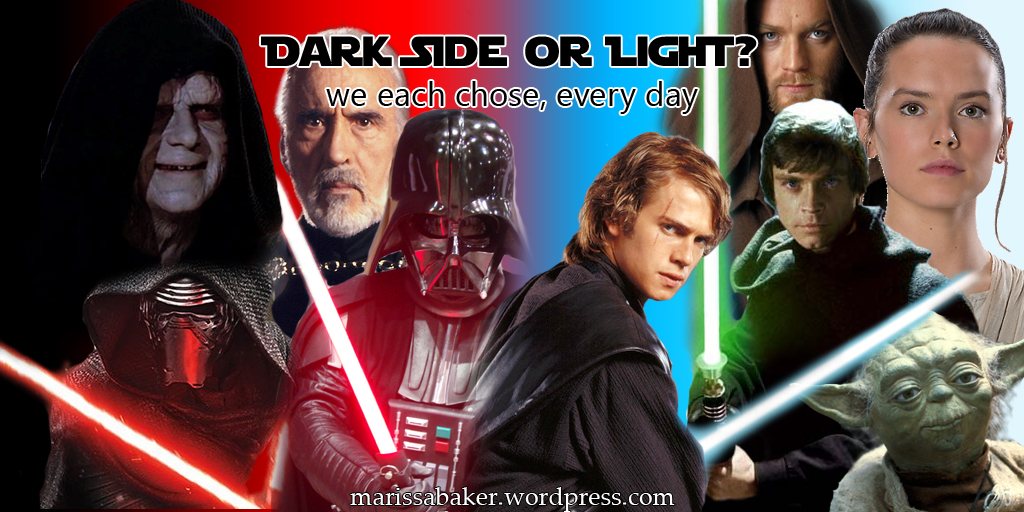
The dark side is quick, easy and powerful. The light side requires commitment, bravery and peace. They are always at odds, always battling in the galaxy as a whole, between groups of people, and even within individual hearts and minds.

Star Wars has always been about the classic battle between good and evil. This same battle rages in our world as well, which is one of the reasons this franchise is so popular. We can all relate to the humanity and struggles of the people in this “galaxy far, far away.” It’s a sort of myth or fairy tale for the modern age. And, like many iconic stories, it can prompt discussions about a variety of topics important today, including faith and religion.

Do you walk on the dark side or the light? | marissabaker.wordpress.com

In Star Wars, the Dark Side is the “quick and easy” path, just as in the Bible the path toward destruction is wide and easy to find. Darkness has a strong, seductive pull which actually mirrors an analogy in Proverbs where evil is compared to a crafty harlot while wisdom is a gentle, godly woman. Like the Bible, Star Wars teaches the Dark Side isn’t better – the good characters resist it and win, the bad characters find that it ruins their lives and the lives of those around them. Read more

Thoughts on Kylo Ren, the Force, and Evil ENFJs

Note: an updated post about Kylo Ren’s Myers-Briggs type can be found on my Star Wars Personalities blog

I saw The Force Awakens on opening night and then again the following Sunday, and was just blown away by how amazing it was. The new characters were a particularly bright spot in this shining film. I loved all the new main characters, but I was surprised to find Kylo Ren the most compelling. I have several thoughts on his powers and his story, but we’ll save those until after the spoiler warning.

Last week in my Star Wars Myers-Briggs chart I did something I wasn’t expecting — I typed Kylo Ren as an ENFJ. Many MBTI fans will argue that NF types don’t make good villains — that they’re too in-touch with other people to hurt them. Even with Hitler as a real-life example of an INFJ bad guy, they still argue that NFs are hard-wired to act for what they believe is the “good” of humanity.Thoughts on Kylo Ren, the Force, and Evil ENFJs | marissabaker.wordpress.com

Spoiler Warning

this post contains Major Spoilers for The Force Awakens, and for other books and films in the Star Wars universe

Read more

Fictional MBTI – Anakin Skywalker/Darth Vader (ENTJ)

Note: an updated version of this post can be found on my Star Wars Personalities blog (click here).

Fictional MBTI - Anakin Skywalker/Darth Vader (ENTJ) | marissabaker.wordpress.comLike many with even a hint of interest in film and/or science-fiction, I’m eagerly awaiting Star Wars Episode 7. In anticipation of its release, I’ve been re-watching all the movies, branching out into the animated series and some of the in-cannon books, and working on a new Myers-Briggs Star Wars chart.

While trying to type Anakin Skywalker, I discovered I’d started writing a blog post within a blog post. And so, rather than waiting until December to start blogging about my Star Wars obsession, I decided to give Anakin his own post. Read more