Still No Oven / Hero Archetypes

Since I am still without an oven, I’m going to depart from my schedule and post something other than a recipe today. The repairman is supposed to come this afternoon so, in lieu of writing about food, I’m going to write about writing.

Over on MarisMcKay.com, I’ve been working on a series of blog posts about character archetypes. I’ve spent too much time on the accompanying images not to try and broaden the audience, so this post will be devoted to heroes and I’ll dedicate Monday’s post to heroines. While collecting the examples of each type, I noticed sci-fi/fantasy may be overrepresented, but that’s what I’m most familiar with and I’ve decided not to apologize for it.

This theory of character development is contained in a book titled The Complete Writer’s Guide to Heroes and Heroines: Sixteen Master Archetypes. The ideas are based on Jung’s theory of collective unconscious. He identified major archetypes that arise from memories of shared human experience and serve as models for personalities.  For this book, the authors suppose that

 At the very core of a character, every hero can be traced back to one of eight major archetypes, as can every heroine. The core archetype tells the writer the most basic instincts of heroes or heroines — how they think and feel, what drives them and how they reach their goals.

Hero Archetypes
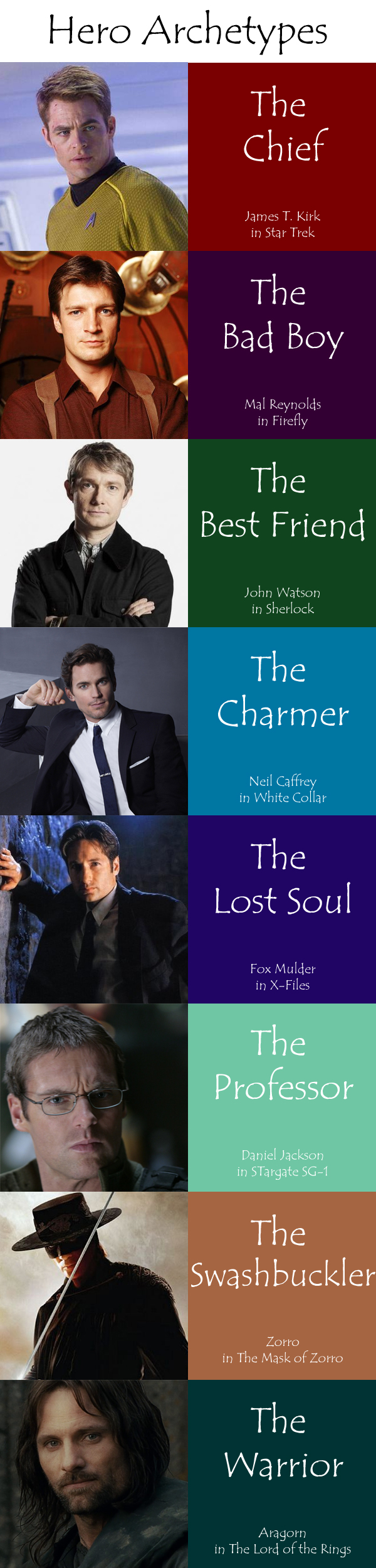
Eight hero archetypesThe Chief His major virtues are that he is goal-oriented, decisive, and responsible. He can also be stubborn, unsympathetic, and dominating. “He is a man who seizes control whenever possible. Active, dynamic, and strong-willed, he urgently needs to fix problems and produce results.” This type of character is not discouraged by challenge, and is typically a born leader or a conqueror type of character.

The Bad Boy This type is succinctly described as “every schoolgirl’s fantasy and every father’s nightmare.” He is typically charismatic, street smart, and intuitive, but is also pessimistic, bitter, and volatile. This character “struts into every room, daring one and all to knock the chip from his shoulder. … All his life, he has been pointed out as a bad example, so he does his best to maintain that reputation.”

The Best Friend “Decent, kind and responsible … He fits in everywhere and is universally liked. Whether he operates out of a sense of duty or genuinely enjoys giving of himself, he is always there.” His main virtues are stability, a supportive nature, and tolerance. His flaws are that he can be complacent, myopic, and unassertive.

The Charmer This is the likable rogue type who can “make you believe in fairy tales” but “is not always there in the ever-after”. He is creative, witty, and smooth, but also manipulative, irresponsible, and elusive.  “Exuding enormous charisma, he showers the people in his life with gifts of laughter and happiness. He is always fun, often irresistible, and frequently unreliable.”

The Lost Soul This character is devoted, vulnerable, discerning, brooding, unforgiving, and fatalistic. He is defined by an isolating event from his past. He “drifts through life with a heavy heart and a wounded spirit. He is dramatic, intriguing, and secretive. … This man has a poet’s voice, an artist’s creative genius, and a writer’s grasp on emotions.”

The Professor Some of my favorite characters — Daniel Jackson, Spock, Sherlock Holmes — share this type. They are “used to being the smartest man in the room,” are experts in their field, and can be absent minded or highly organized. They are analytical and genuine, but also insular, inhibited, and inflexible.

The Swashbuckler This character is an explorer or a daredevil,  fearless and foolhardy. He is exciting but unreliable, capable of finding a solution to any problem, but selfish in pursing his goals. “He loves to leave his mark on every exploit, so he chooses the most rash and flamboyant method of achieving his aim. Impulsive and creative, this man lives for the next adventure.”

The Warrior Tenacious, principled, and noble, this character type is compelled to see justice done. They can be self righteous, relentless, and merciless with their enemies. A character of this type “believes evil cannot go unpunished. He cannot allow the bad guys to walk away, so trouble seems to follow him wherever he goes.” He defends the weak and is the perfect protector.

Writing With Archetypes

I’ve found this book helpful in coming up with ideas for strong characters. For one character, who was disappearing into the background of my finished novel, it’s helped me flesh him out so much that the sequel will be his story. He is a Warrior, and I’m going to layer on some Lost Soul characteristics to make him even more unique.

There is a wide variety within each type, so even if you don’t combine them there is plenty of room for character development. As the writers of this book said, Henry Higgins from My Fair Lady is a chief, like Captain Kirk, but you wouldn’t want him commanding a Starship. If you’re a writer and you can find a copy (the book is out of print, so I use one from the library), I highly recommend this resource.

Fairy Tales

I love fairy tales. When I was little, my exposure to fairy tales was mostly through Disney films (my favorite is Beauty and the Beast, just in case anyone is wondering). I started seriously reading fairy tales just a few years ago, when my favorite English professor loaned me a collection of Celtic Fairy Tales. Since then, I’ve read all the Brothers Grimm tales, many of Andersen’s fairy tales, more Celtic folklore, and collections of French fairy tales including Perrault’s writings.

I’ve been reading some of C.S. Lewis’s essays collected in the book “Of Other Worlds.” I’ve enjoyed reading his fiction (Narnia and the Space Trilogy), as well as Mere Christianity, so it was nice to get insight into his mind and writing process. For the blogt I wrote to post on my writing website tomorrow (yes, I write under a pen name), I turned to one of these essays for inspiration. I liked writing it so much, that I decided to post it here as well.

C.S. Lewis on Children’s Writings

By tracking down a quote on Pinterest, I came across C.S. Lewis’s essay “On Three Ways of Writing For Children” (full text online here). Though I don’t write specifically for children, I like to think that my fantasy novels would appeal to (and be appropriate for) some young people. After all, I can’t be the only child who was reading Jules Verne by age 10 and searching for other stories of the fantastic.

The essay becomes most interesting to me when Lewis addresses the question of what kinds of stories are worth reading as children. Since he wrote children’s fantasy — not because he set out to write for children, but “because a children’s story is [sometimes] the best art-form for something you have to say” — he spends much of the essay defending fairy tales.

If I have allowed the fantastic type of children’s story to run away with this discussion, that is because it is the kind I know and love best, not because I wish to condemn any other. But the patrons of the other kinds very frequently want to condemn it. About once every hundred years some wiseacre gets up and tries to banish the fairy tale. Perhaps I had better say a few words in its defence, as reading for children.

Just as when Lewis was writing (in 1952), modern parents have been banning classic fairy tales. Hansel and Gretle and Little Red Riding Hood are not read because they are “too scary,” but there are other reasons as well. More than 50% of parents wouldn’t “read their kids Cinderella because the heroine spends her days doing housework. Many felt that this theme of female domesticity didn’t send a good message.” The politically incorrect word “dwarves” disqualifies Snow White from polite society. Rapunzel’s kidnapping and imprisonment is “too dark” a theme (actually, it is darker than they think– in the Grimms version she’s not actually kidnapped. Her father gives her to a witch to save his own life).

Whether or not to read fairy tales (and which ones to read) to children is a choice that will vary from parent to parent and also depends on the child. There are plenty of fairy tales I wouldn’t read to a very young or sensitive child (like The Little Mermaid, where she is in agony the entire time she has legs and dies at the end). But on the whole, I tend to agree with Lewis when he said,

Since it is so likely that they will meet cruel enemies, let them at least have heard of brave knights and heroic courage. Otherwise you are making their destiny not brighter but darker. Nor do most of us find that violence and bloodshed, in a story, produce any haunting dread in the minds of children. As far as that goes, I side impenitently with the human race against the modern reformer. Let there be wicked kings and beheadings, battles and dungeons, giants and dragons, and let villains be soundly killed at the end the book. Nothing will persuade me that this causes an ordinary child any kind or degree of fear beyond what it wants, and needs, to feel. …

It would be nice if no little boy in bed, hearing, or thinking he hears, a sound, were ever at all frightened. But if he is going to be frightened, I think it better that he should think of giants and dragons than merely of burglars. And I think St George, or any bright champion in armour, is a better comfort than the idea of the police.

As a child who was deeply afraid of things that go bump in the night, I can wholeheartedly support Lewis’s claim that a “bright champion in armour” is a far better comforter than the police. And if my mind had not been filled with fairy tales, fantasy, and knights in shining armor I would never have dreamed up Jamen and Karielle or Bryant and Aelis (who now live in my in-progress and finished novels) or invented Ves’endlara.

Which fairy tales would you read, or not read to children? As an adult, do you enjoy reading fairy tales?

Sherlock, Roses, and God

prink rose 'Bill Warner'
‘Bill Warner’

I was reading Sherlock Holmes “The Adventure of the Naval Treaty” the other day when I came across a quote about religion. I’ve read maybe a third of the Doyle’s Sherlock stories, but never thought of the character as religious before. In this story, Sherlock has just heard the particulars of a case and walks to the open window, where he plucks a rose.

“There is nothing in which deduction is so necessary as in religion,” said he, leaning with his back against the shutters. “It can be built up as an exact science by the reasoner. Our highest assurance of the goodness of Providence seems to me to rest in the flowers. All other things, our powers, our desires, our food, are really necessary for our existence in the first instance. But this rose is an extra. Its smell and its colour are an embellishment of life, not a conditions of it. It is only goodness which gives extras, and so I say again that we have much to hope from the flowers.”

yellow rose 'Aperitif'
‘Aperitif’

I’ve marveled at the roses growing in my garden as examples of God’s creative work, but not precisely in this light before. Sherlock’s belief that, “It is only goodness which gives extras” fits perfectly with this scripture:

Every good gift and every perfect gift is from above, and cometh down from the Father of lights, with Whom is no variableness, neither shadow of turning.(James 1:17)

How many “extras” has God put in your life? How many gifts has He given that are not necessary for your existence, but make life so much more enjoyable?

Aside from flowers, one of the first things I thought of was books. If all my 1,000+ books disappeared right now I would 1) have the most outrageous panic attack, but 2) life would go on in that I don’t need books to stay alive. Music, fluffy cats, chocolate covered almonds, and the computer I’m typing this with are all “extras.”

red rose 'Mr. Lincoln'
‘Mr. Lincoln’

Considering this, the only thing I can think of to say is:

Praise ye the LORD. O give thanks unto the LORD; for He is good: for His mercy endureth for ever. Who can utter the mighty acts of the LORD? who can shew forth all His praise? (Ps. 106:1-2)

God’s Love Story — PDF online

For this cause shall a man leave his father and mother, and shall be joined unto his wife, and they two shall be one flesh. This is a great mystery: but I speak concerning Christ and the church. - Ephesians 5:31-32The final version of what I’m going to call an “e-booklet” is now online. You can download “God’s Love Story” and read a chapter outline at this link.

Here are a couple excerpts. This first is from the introduction.

One reason we gravitate towards tales of heroism, rescue, and love is that there is a basic need in our souls for a relationship with God and His Son. Stories where the handsome prince rides up and rescues the fair princess speak to our longing to know the Prince of Peace, Who laid His life down to rescue His bride from captivity to sin. Jesus Christ is the most powerful, most loving, and most perfect hero-lover to ever exist, far surpassing even the most ambitious human attempts to fashion a story’s hero. The Bible is a living, dynamic book that includes instruction, history, prophecy, and a revelation of the plan of God which reads like a story. My personal theory as to why the Bible reads like a story is because our idea of what makes a good story comes from the sequential narrative God uses to reveal His plan.

This paragraph is from a discussion in Chapter 5 about the Greek words translated “love.”

While agape is a higher kind of love, I think there is something amazing in recognizing that it is not the only love God has towards us. Before His crucifixion, Jesus told His disciples that after His resurrection, “ye shall ask in My name: and I say not unto you, that I will pray the Father for you: for the Father Himself loveth you, because ye have loved Me, and have believed that I came out from God.” (Joh. 16:26-27). The Father has phileo for those who have phileo for His son. This means the Father Himself has common interests and friendship with those who love and believe in His Son. In this context, it is certainly not a lesser love than agape. Philos is an incredible kind of love to share with the creator of the universe.

I hope those of you who choose to download and read the full e-booklet find it edifying and encouraging. I would love to hear your feedback.

A Love Story

The kingdom of heaven is like unto a certain king, which made a marriage for his son,Matthew 22:2Once upon a time there was a family of two mighty Beings. Their relationship of love was so close that They were often known by a single name. One day, They decided that They wanted to share Their love with others. But instead of creating little robots, They made people who, like themselves, had freedom of choice. They made a beautiful home for these people and created marriage to give Their creation a taste of the relationship they were intended to have with their Creators. The new people were also given one simple rule to follow.

But these people would not follow their Creators’ rule. This made the mighty Beings sad, because They knew that the penalty for not obeying this rule was an eternal, final death which would exclude Their creation from being part of Their family. In Their infinite love, one of these Beings promised to come to the world one day and die in their place.

As the years passed and the people increased in multitude, He chose a special people to whom He spoke and whom He loved more fully and purely than the best of husbands loves his wife. He rescued them from flood, fought against their enemies, and freed them from slavery, but they turned away from Him like an unfaithful wife. He was jealous and angry, but He never stopped loving them. And true to His promise, He did come to their world and took on himself the penalty justice demanded for His people’s wrongs. In doing so, He gained the name of Son and the Being who sent Him became known as the Father.

The first marriage the Son had made with His people, the marriage to which they had been unfaithful, ended with His death. But the love that these Beings had for their creation did not end. His Father brought Him back to life and gave back the power He had before coming to the world They had created. They offered Their creation a new marriage agreement which was faultless and eternal. They offered redemption and an opportunity to live forever with Them as the Son’s beloved bride.

Some people did not believe anyone would dare to die for them. Some did not believe that anyone needed to die for them. But there were others who realized what the Son had done and were so in awe of Him that they devoted their lives to making themselves ready for this marriage. They knew that the One who loved them enough to die for them would return to bring them into His Father’s house as His bride.

It felt as if they waited a long time. But just as He had delivered His people from perils in the past, so did He powerfully aid His bride for the time that she had to be away from Him. And finally, in a triumphal victory over evil and death, He returned to claim the bride who had made herself ready for him.

The wedding feast was grander than anything ever imagined. The family, finally grown according to the plan these Beings envisioned when They first made creation, overflowed with love.

And They lived happily ever after.

This is the short creative piece that I use to introduce my longer study paper/short e-book “God’s Love Story.” I’ll be posting the full text of this paper next weekend.