Three Ways to Join A Family

I’ve started reading a new book that I’m really excited about. Misreading Scripture with Individualist Eyes: Patronage, Honor, and Shame in the Biblical World by E. Randolph Richards and Richard James aims to provide readers in Western cultures with cultural information that’s helpful when properly interpreting the Bible. There’s a lot of topic overlap with Relational Faith by Brent J. Schmidt, which I reviewed earlier this year, and I was eager to see how different authors approached the subject.

Misreading Scripture with Individualist Eyes is a follow-up to Misreading Scripture with Western Eyes: Removing Cultural Blinders to Better Understand the Bible by E. Randolph Richards and Brandon J. O’Brien. That’s one of my favorite non-fiction books and I’ve referenced it several times on this blog (most notably in reference to temples and to women’s roles in church). I heartily recommend Misreading Scripture with Western Eyes and though I’m only 30% finished with Misreading Scripture with Individualist Eyes I suspect it will become a new favorite as well.

The topic I want to share with you today comes from “Chapter 1. Kinship: Being in a Family.” In collectivist cultures, the family is incredibly important. There are three ways to join a family or kinship group: birth, adoption, and marriage. As I read this chapter, it struck me that God uses all three of those methods to describe how we enter into His family.

Image of a group of people holding hands in a circle overlaid with text from 1 Peter 2:17, NET version:  “love the family of believers”
Image by Claudine Chaussé from Lightstock

“I” or “We”

I read a publication from a church once that went to great pains to explain when the Bible says God adopts us into His family, it doesn’t really mean adoption because we’re actually born into His family as His literal children. It’s been years, but I never forgot how irritated I was by that distinction. First, the Greek word does mean adoption, and if the Bible uses both birth and adoption to explain how we become God’s children, why wouldn’t we use both today? Second, I worried how someone who was adopted into their own human family think when reading that this church doesn’t think adoption means you’re really part of the family.

I share this to illustrate one of the ways that we can misinterpret things through a Western, individualist lens. We like things to be neat and separated; you can enter a family through birth or adoption, but not both. We also think of the individual as the basic unit of society rather than family (i.e. we conceptualize ourselves primarily as “I” rather than “we”). Our kinship groups are pretty lose, and no one is really surprised if you get married without intending to have kids or if you don’t have a relationship with your cousins, aunts, uncles, or even siblings and parents. If someone asks, “Who are you?” a Westerner is likely to respond by talking about their personality, achievements, interests, and work rather than by talking about their family and community.

Collectives are defined by the things they share with others, things such as shared blood, shared interests, shared history, shared land, and shared loyalty. They define their core identity as being part of a group, in distinction to other groups.

This is what we mean by collectivism. Collectivist people understand their identity from the group they are part of. It is about identity, which is why people in collective societies live their lives oriented toward their group.

Misreading Scripture with Individualist Eyes, Richards and James, p. 22

Richards and James are careful to point out that these are generalizations; not all collectivist or individualist cultures are identical. But these generalizations help Western individualists understand how different the Biblical culture was than what we’re familiar with today. If you’re one of my readers who lives in a collectivist culture, you probably have a much easier time relating to the collective aspects of Bible culture than a typical American or other Westerner.

Going back to my opening example, we shouldn’t think of the Bible’s explanation for how we become God’s children as something we need to put into one box or the other (i.e. birth vs. adoption). Biblical writers use being born as children and adopted as children to describe the process of becoming part of God’s family. They also use marriage symbolism. It’s not an either-or situation. It’s three analogies to help us understand more about what’ happening here.

Ways to Enter A Family

Suppose you were trying to describe the most beautiful sunset you’ve ever seen. You might give some literal descriptions–it was orange and pink with purple clouds, it was over a wheat field. But you might also decide the literal isn’t doing it justice and use similes, analogies, and metaphors–it was like a beautiful painting, it looked like cotton candy, it gave me the same feeling as when I look out over the ocean. Those metaphors are all very different. Paintings, cotton candy, and oceans are not the same thing. But we can use those different descriptions to describe the same sunset.

I think that’s part of what’s going on when Bible writers describe the way God makes us part of His family. Birth, adoption, and marriage are not equivalent to each other, but they all help us understand the same concept. God is bringing human beings into His family. We are becoming part of His kinship group.

In the biblical world, kinship terms were not tossed about … casually because kinship ordered society. Across the ancient Mediterranean world, one entered into a family, a clan, a tribe by birth, adoption, or marriage.

Misreading Scripture with Individualist Eyes, Richards and James, p. 34

That seems pretty obvious, but what struck me is that these three ways to enter a family are the three ways that God explains how we become His children. By describing the process of us entering God’s family in all three ways, God reinforces how much He wants us as part of His family. He shows that we’re going to become His family in every possible way, with all the rights and responsibilities accorded to those who are born, adopted, or marry into a family.

Birth

Birth was not just a matter of biology, though it included that. Birth was the way ancients received their identity. … When Jesus says to Nicodemus, “Very truly I tell you, no one can see the kingdom of God unless they are born again” (Jn 3:3), he is saying something very profound. To see the kingdom of God, you need to belong to a new family.

Misreading Scripture with Individualist Eyes, Richards and James, p. 38

We receive a new identity when we become Christians. Just as we’re no longer of the world, our primary identity is no longer determined by anything physical (including our human biology). This is an essential step in becoming children of God. Jesus told Nicodemus, “I tell you the solemn truth, unless a person is born of water and spirit, he cannot enter the kingdom of God. What is born of the flesh is flesh, and what is born of the Spirit is spirit. Do not be amazed that I said to you, ‘You must all be born from above'” (John 3:5-7, NET). We must be baptized with both water and the spirit to become children of God. This rebirth into a new family is something the Father accomplished through Jesus Christ.

Blessed be the God and Father of our Lord Jesus Christ! By his great mercy he gave us new birth into a living hope through the resurrection of Jesus Christ from the dead, that is, into an inheritance imperishable, undefiled, and unfading. It is reserved in heaven for you, who by God’s power are protected through faith for a salvation ready to be revealed in the last time.  …

You have been born anew, not from perishable but from imperishable seed, through the living and enduring word of God.

1 Peter 1:3-5, 23, NET

There is great mercy involved in God birthing us into His family. He chose to give us new lives. We were buried with Jesus in baptism, dying to our old selves, and we come up from that water with new life (Rom. 6:1-4; Col. 2:12). As such, God expects that we will then walk in that newness of life, living as children who inherit His character traits. John talks about this frequently in his first epistle.

 Everyone who believes that Jesus is the Christ has been fathered by God, and everyone who loves the father loves the child fathered by him. By this we know that we love the children of God: whenever we love God and obey his commandments. For this is the love of God: that we keep his commandments. And his commandments do not weigh us down, because everyone who has been fathered by God conquers the world. …

We know that everyone fathered by God does not sin, but God protects the one he has fathered, and the evil one cannot touch him.

1 John 5:1-4, 18, NET

When we are born of God (also translated “begotten” or “fathered”), we take on new identity. We become part of His family, we will eventually “be like Him,” and even today we strive to be righteous the way He is righteous (1 John 3:1-10). We keep God’s commandments because we love Him and we know that’s how we do things in this family.

Adoption

Modern Westerners usually adopt so that they (the family) can care for the (young) child. In the ancient biblical world, people adopted so that the adopted son could care for the family. … Families [without an heir] chose a man to adopt as a son because they deemed him worthy of caring for the family. … adoption for this purpose was commonly called “adoption to sonship.” …

Adoption in the biblical world carried very real implications for the kinship of those adopted and the families they joined. The adopted members were placed into the family, they inherited in the family, and these realities shaped their lives and the lives of the family’s descendants.

Misreading Scripture with Individualist Eyes, Richards and James, p. 39, 40, 41

God the Father already has a firstborn Son to inherit all things: Jesus Christ. We’re not adopted to be the heir, but we are adopted to share in the inheritance of our Elder Brother. Adoption describes a process of taking someone who was formerly outside a kinship group and making them part of the family. It’s a good analogy for our relationship with God, particularly for Gentiles. Jewish believers might have thought they already stood to inherit God’s promises and didn’t need adopted into His family (though Paul says that wasn’t true; every New Covenant believer is adopted), but for those without Israelite heritage the imagery of adoption likely brought extra tears of joy to their eyes.

 But when the appropriate time had come, God sent out his Son, born of a woman, born under the law, to redeem those who were under the law, so that we may be adopted as sons with full rights. And because you are sons, God sent the Spirit of his Son into our hearts, who calls “Abba! Father!” So you are no longer a slave but a son, and if you are a son, then you are also an heir through God.

Galatians 4:4-7, NET

For he chose us in Christ before the foundation of the world that we should be holy and blameless before him in love. He did this by predestining us to adoption as his legal heirs through Jesus Christ, according to the pleasure of his will—to the praise of the glory of his grace that he has freely bestowed on us in his dearly loved Son.

Ephesians 1:4-6, NET

Can you imagine how much it would have meant to believers in Rome, Galatia, and Ephesus to read Paul’s letters and learn they’ve received “adoption to sonship” from God Himself? It should still hit us with the same force today. God did not owe us anything because of our birth or ancestry. He chooses us as His heirs, calling each of us to join His family and inherit alongside our elder brother Jesus. This is an incredible blessing, which comes with all the rights (and responsibilities) of being God’s children and legal heirs.

Marriage

The Bible assumes that we understand that marriage forged kinship links between many more people than just the husband and wife. … Ancients made such decisions collectively. Parents and other relatives were deeply involved.

Misreading Scripture with Individualist Eyes, Richards and James, p. 42, 44

Individualists often balk at the idea of arranged marriages, but they were commonplace in the biblical world. And when we think about it, our future marriage with Jesus as Christians follows that same pattern. In a parable, Jesus tells us, “The kingdom of heaven is like a certain king who arranged a marriage for his son” (Matt. 22:2, NKJV). We have veto-power in this arrangement (i.e. we can say we don’t want to marry Jesus) but we don’t get to choose a different bridegroom. We need to trust that the Father knows what is best for us, just like Jesus trusts Him to select who will be part of the Bride.

The analogy of marriage to explain how we become part of God’s family adds another layer of meaning to what we’ve already learned from birth and adoption. In this analogy, the church is the Bride. This means we have specific roles and responsibilities in the family in addition to those of born and adopted children.

We’re to submit to our husband Jesus in everything (Eph. 5:22-33). We’re to make ourselves ready to be “a companion for him who corresponds to him” (Gen. 2:18, NET); “a helper comparable to him” (Gen. 2:18, WEB). We must be absolutely faithful to Him, as Paul pointed out when he said, “I am jealous for you with godly jealousy, because I promised you in marriage to one husband, to present you as a pure virgin to Christ” (2 Cor. 11:2, NET).

Then I heard what sounded like the voice of a vast throng, like the roar of many waters and like loud crashes of thunder. They were shouting:
“Hallelujah!
For the Lord our God, the All-Powerful, reigns!
Let us rejoice and exult
and give him glory,
because the wedding celebration of the Lamb has come,
and his bride has made herself ready.
She was permitted to be dressed in bright, clean, fine linen” (for the fine linen is the righteous deeds of the saints).
Then the angel said to me, “Write the following: Blessed are those who are invited to the banquet at the wedding celebration of the Lamb!” He also said to me, “These are the true words of God.”

Revelation 19:6-9, NET

The Father and Jesus are wholly committed to the project of “bringing many children to glory” (Heb. 2:10, WEB). Even right now, “we are God’s children” and in the future “we will be like him” (1 John 3:1-3, NET). Birth, adoption, and marriage analogies all help us understand how we become part of God’s family.

These analogies also teach us about our roles and responsibilities in God’s family. As God’s born children, we inherit His nature and spiritual DNA, and we ought to become more and more like Him the longer we live. As His adopted children, we inherit a place in His kinship group and become part of His covenants, as well as inheriting the responsibilities that go along with that. And as Jesus’s affianced bride, we’re making ourselves ready to work alongside Him into eternity. The vastness of what God offers us by birthing, adopting, and marrying us is astonishing. We ought to place a very high value on these gifts and live with a consciousness that we are part of God’s wonderful family.


If you would like to purchase Misreading Scripture with Western Eyes or Misreading Scripture with Individualist Eyes, you can click here to visit the Amazon store (please note these are affiliate links, which means I’ll receive a small commission if you click on the link and make a purchase).


Featured image by David Clark Photography from Lightstock

Claiming God’s Promises

Not every single word in the Bible applies directly to each person reading it. It’s all inspired by God and we can learn from it, of course, but not everything applies to everyone directly. For example, some cleanliness laws in the Old Testament were gender specific and some prophecies were delivered to a specific person or group (like the dream warning Nebuchadnezzar he would become like an animal for 7 years).

But we can take this observation too far. We might make the mistake of thinking that because warnings to follow God alone were delivered to ancient Israel they don’t apply to us today. Yet the New Testament confirms we still need to make a choice between darkness and light (Deut. 30:15-20; 1 John 1:5-2:6). This type of thinking can also block us from accepting encouraging promises as well.

Have you ever read one of God’s promises and thought, “That sounds wonderful, but it can’t really apply to me?” I’m sure many of us have. For me personally, I struggle with believing God will answer my prayers the way He promises too (mostly I feel like my prayers for other people aren’t effective). But does that mean God’s promise to hear when we call doesn’t apply to me? Of course not. And I’ve even seen some examples of His direct responses to my prayers. My doubts and anxieties don’t cancel His promises. But they can block me from recognizing or accepting His work with, in, and for me.Claiming God's Promises | marissabaker.wordpress.com

God’s Presence In You

The Holy Spirit is one thing God promises to new believers. Jesus told His disciples the Father would give them the Holy Spirit after He left and we see that promise fulfilled quite spectacularly in Acts 2. As the narrative continues, a pattern emerges where believers receive the gift of the Holy Spirit when they covenant with God at baptism. And it’s made clear that this promise isn’t just for the people of that time. Read more

God’s “Real Children”

So, which ones are your kids? I mean, your real children.”

The parent with adopted kids fights to stay civil. “They’re all my children.”

I’m not adopted nor am I an adoptive parent, but it’s a topic near my heart. Partly because I care deeply about helping children and partly because adoption is how God describes His process of making us His children.

Several years ago, I wrote a blog post addressing a booklet I’d read a couple years before that which claimed adoption wasn’t really how God puts us in His family. They said it was a misunderstanding to say Christians are adopted children of God “rather than His actual begotten sons.” And that thought is still around. Just a few weeks ago, I heard a message where the speaker read Romans 8:14-17 and said, “It’s not adoption it is sonship.”

As you might imagine, I’ve got a couple issues with the idea that teaching we’re adopted by God is the same as saying we’re not His “real children.” For one thing, it implies in way that’s not at all subtle that if you’re adopted you’re not really part of the family. And it’s not okay to say things like that to an audience that very likely includes adopted children (and if it doesn’t, it should. The Bible defines true religion as caring for orphans and there are 3 times as many churches as orphans in the U.S.). But as vital as it is to make sure our words don’t injure others, it’s also important to properly represent God’s teachings through scripture.

God's "Real Children" | marissabaker.wordpress.com
Photo credit: Andrew Branch via StockSnap

Placing As Sons

The word translated “adoption” in New Covenant writings is huiothesia (G5206). It’s a compound formed from the words huios (“son” G5207) and tithemi (“to place” G5087). Paul’s the only Biblical writer to use it and it’s not found in classical Greek either (though the phrase thetos huios is used for “adopted son”). Rather, it’s a technical term referring to a legal and social custom in Greek and Roman society.

This sort of “adoption, when thus legally performed, put a man in every respect in the position of a son by birth to him who had adopted him, so that he possessed the same rights and owed the same obligations” (Spiros Zodhiates The Complete WordStudy Dictionary, entry on G5206). While it can be translated “sonship,” it’s a sonship obtained through an adoption process (not sonship instead of adoption). Read more

God’s Message Through the Aaronic Blessing

At a conference this past December, I attended an excellent seminar by a gentleman named Hal exploring the depth of the Hebrew words used in the Aaronic blessing (I want to credit him, but not sure if he’d want his full name used here, so we’ll just stick with first names). This blessing goes like this in the New King James Version: “The Lord bless you and keep you; the Lord make His face shine upon you, and be gracious to you; the Lord lift up His countenance upon you, and give you peace” (Num. 6:24-26).

God's Message Through the Aaronic Blessing | marissabaker.wordpress.com

These words are lovely in English, but I was awed by how much more incredible they are when you start digging deep into the Hebrew meanings. In this article, we’re going to take a deep-dive into the words originally used to record this blessing. These words illuminate an encouraging, hopeful message that God continues to share with us today.

Read more

Works That Make Faith Live

"Works That Make Faith Live." marissabaker.wordpress.comI’ve been thinking about our role as the body of Christ, particularly in how we relate to other people. In the past two weeks here, I’ve written about and studied the fact that we need to be acting as Christ’s hands and feet in reaching out with compassion, healing, and love. I also wrote about Jesus wanting us to love indiscriminately.

In settling on a new topic for this past week of study, I turned to the last place I’d left my ribbon bookmark. It was James 2, for the verse I quoted last week about respect of persons based on their wealth being a sin. Right after that is the famous “faith without works” passage. That started me wondering, What specific kinds of works are we supposed to be doing as members of the body of Christ?

Faith Without Works

What does it profit, my brethren, if someone says he has faith but does not have works? Can faith save him? If a brother or sister is naked and destitute of daily food, and one of you says to them, “Depart in peace, be warmed and filled,” but you do not give them the things which are needed for the body, what does it profit? Thus also faith by itself, if it does not have works, is dead. (James 2:14-17)

We know from Romans 3:20 that “by the deeds of the law no flesh will be justified,” but these verses in James also show that we cannot claim to have true faith unless it is accompanied by some kind of works. It kind of reminds me of 1 Corinthians 13, where even the best gifts are useless without love.

But someone will say, “You have faith, and I have works.” Show me your faith without your works, and I will show you my faith by my works. … Was not Abraham our father justified by works when he offered Isaac his son on the altar? Do you see that faith was working together with his works, and by works faith was made perfect? And the Scripture was fulfilled which says, “Abraham believed God, and it was accounted to him for righteousness.” And he was called the friend of God. You see then that a man is justified by works, and not by faith only. Likewise, was not Rahab the harlot also justified by works when she received the messengers and sent them out another way? For as the body without the spirit is dead, so faith without works is dead also. (James 2:18, 21-26)

As shown by these examples, the actions we take demonstrate to God whether or not our faith is genuine. Both Abraham and Rahab showed by their works that they believed in God enough to actually follow His orders.

Care For Others

Abraham and Rahab are positive examples of faith supported by works. The discussion opens, however, with a negative example of someone who sees “a brother or sister is naked and destitute of daily food” but does “not give them the things which are needed for the body.” Apparently, it is a sin to not help someone when it is in our power to do so.

It’s a simple idea. If you have two coats, give one to someone without a coat. If you have food, share it with someone who is going hungry (Luke 3:11). The parable of the Good Samaritan teaches that “love your neighbor” includes anyone in our sphere of awareness who needs aid. Simple, but so easy to ignore. Someone else will do it … How do I know they’re really homeless? it could be a scam … That’s what welfare’s for — I pay my taxes.

I’m as guilty of using these excuses as the next person, and they might even be true in some cases. But I suspect God would rather have us error on the side of giving too freely than withholding help from someone who actually needs it.

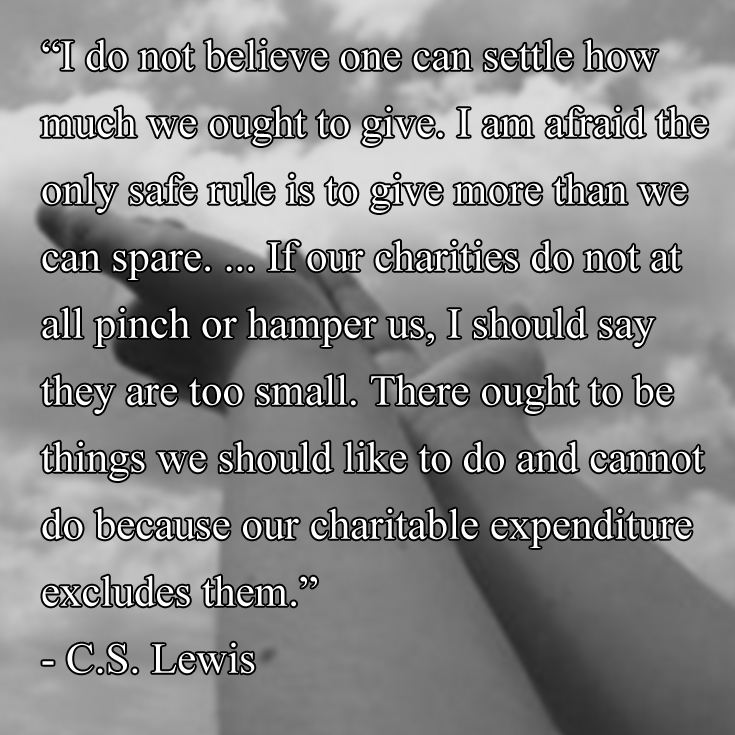
“I do not believe one can settle how much we ought to give. I am afraid the only safe rule is to give more than we can spare. In other words, if our expenditure on comforts, luxuries, amusements, etc, is up to the standard common among those with the same income as our own, we are probably giving away too little. If our charities do not at all pinch or hamper us, I should say they are too small. There ought to be things we should like to do and cannot do because our charitable expenditure excludes them.” – C.S. Lewis

True Religion

"Works That Make Faith Live." marissabaker.wordpress.comIn the first chapter of James, we are given the following definition of religion that pleases God:

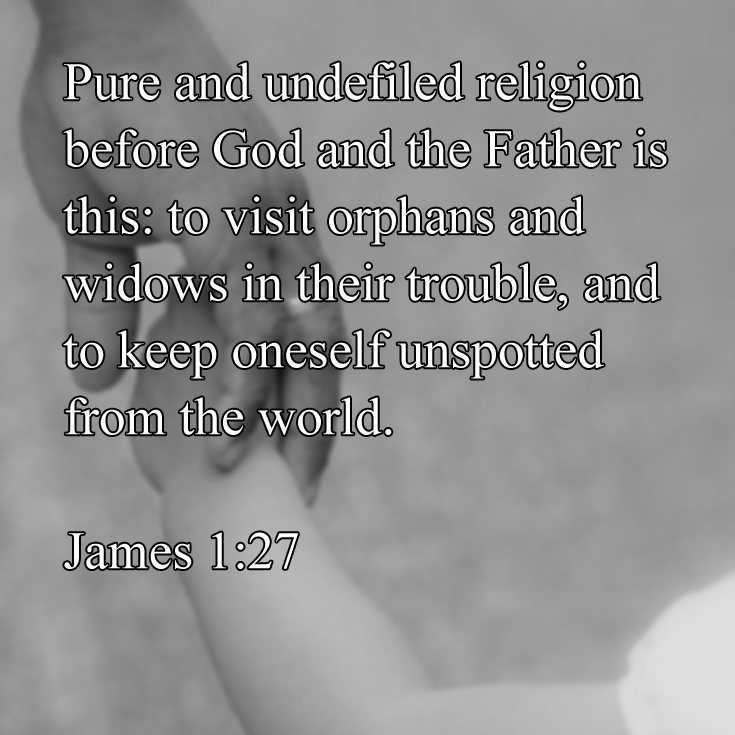
Pure and undefiled religion before God and the Father is this: to visit orphans and widows in their trouble, and to keep oneself unspotted from the world. (James 1:27)

Did you know there are 100,000 legal orphans in the United States and 300,000 Christian churches? That’s 3 churches that profess to follow Christ per child who is waiting for adoption (from iCareAboutOrphans.org). I started crying the first time I read this statistic.

God is in the business of setting “the solitary in families” (Ps. 68:6). Jesus promised, “I will not leave you orphans; I will come to you” (John 14:18). If He’s doing that on a spiritual level, doesn’t it make sense that He would approve of efforts to do something similar on a physical level? Not everyone is in a position where they can adopt — I’m not right now — but we can help by sharing awareness of this need, doing what we can to help families who are able to give children homes, and supporting ministries like Focus on the Family’s Orphan Care Initiative.

Wash yourselves, make yourselves clean; put away the evil of your doings from before My eyes. Cease to do evil, learn to do good; seek justice, rebuke the oppressor; defend the fatherless, plead for the widow. (Is. 1:16-17)

Learning to do good involves speaking out on behalf of people — both old and young — and defending those who don’t have families to protect and care for them. Even if we feel like we can’t “do” anything, we should be praying and speaking up when necessary.

Bear Fruit

The really cool thing is, when we stop focusing on ourselves and focus on helping other people, it benefits us as well.

Is this not the fast that I have chosen: to loose the bonds of wickedness, to undo the heavy burdens, to let the oppressed go free, and that you break every yoke? Is it not to share your bread with the hungry, and that you bring to your house the poor who are cast out; when you see the naked, that you cover him, and not hide yourself from your own flesh? Then your light shall break forth like the morning, your healing shall spring forth speedily, and your righteousness shall go before you; the glory of the Lord shall be your rear guard. Then you shall call, and the Lord will answer; you shall cry, and He will say, ‘Here I am.’  “If you take away the yoke from your midst, the pointing of the finger, and speaking wickedness, if you extend your soul to the hungry and satisfy the afflicted soul, then your light shall dawn in the darkness, and your darkness shall be as the noonday. (Is. 58: 6-10)

God is glorified, and pleased, when we “bear much fruit” by abiding in Jesus Christ and keeping His commandments (John 15:4, 8, 10). The commands involve an active interest in helping other people with the same attitude we would have if serving Jesus Christ directly.

Then the King will say to those on His right hand, ‘Come, you blessed of My Father, inherit the kingdom prepared for you from the foundation of the world: 35 for I was hungry and you gave Me food; I was thirsty and you gave Me drink; I was a stranger and you took Me in; 36 I was naked and you clothed Me; I was sick and you visited Me; I was in prison and you came to Me.’ … ‘Assuredly, I say to you, inasmuch as you did it to one of the least of these My brethren, you did it to Me.’ (Matt. 25:34-36, 40)

The reverse of this is also true — if we ignore people in need, we are ignoring Jesus Christ (Matt. 25:41-46). Godly love, agape, is not passive. It acts for the good of others, even as Christ did when He died for our sins.

For you, brethren, have been called to liberty; only do not use liberty as an opportunity for the flesh, but through love serve one another. For all the law is fulfilled in one word, even in this: “You shall love your neighbor as yourself.” (Gal. 5:13-14)

Our Elder Brother

Since writing about adoption last week, I’ve been pondering related aspects of becoming children of God. I described what is called “adoption” in Romans 8 and 9, Galatians 4, and Ephesians 1 as “the process by which we become God’s children.” There is much more to it, however, and I’m hoping this post will begin to explore our relationship to God and Christ as people who They want to become members of Their family. To do this, I think it is important to spend time studying our Elder Brother, Jesus Christ (see Hebrews 2:9).

Only Begotten

In this was manifested the love of God toward us,  because that God sent  His only begotten Son into the world,  that we might live through Him.   1 John 4:9It should be obvious that our relation to God as His children is different than the relationship Jesus has as His Son. After all, “the Word was with God, and the Word was God” before He became “flesh, and dwelt among us” (John 1:1, 14). As such, John uses a different Greek word to distinguish Jesus Christ from believers who are called children of God. The word is monogenes (G3439), meaning an only child. Zodhiates says the word appears to “serve to distinguish the Sonship of Christ to God from that spoken of other beings, i.g. Adam (Luke 3:38), angels (Job 1:6), or believers (John 1:12).”

For God so loved the world, that He gave His only begotten Son, that whosoever believeth in Him should not perish, but have everlasting life. For God sent not His Son into the world to condemn the world; but that the world through Him might be saved. He that believeth on Him is not condemned: but He that believeth not is condemned already, because He hath not believed in the name of the only begotten Son of God. (John 3:16-18)

Firstborn

Though He is described as the only begotten Son of God, Christ is not intended to be an only child. Rather, God has predestinated us “to be conformed to the image of His Son, that He might be the firstborn among many brethren” (Rom 8:29). The word for “firstborn” is prototokos (G4416), and it is used as a title of Jesus Christ in five NT passages. In all these cases, Zodhiates points out that the word can mean firstborn child, but also and identifies “Christ as the preeminent or ranking member of the group” in Romans 8, and indicates an “an inherent right [to rule] by virtue of His nature” when the word is used in Colossians 1.

In Whom we have redemption through His blood, even the forgiveness of sins: Who is the image of the invisible God, the firstborn of every creature: for by Him were all things created, that are in heaven, and that are in earth, visible and invisible, whether they be thrones, or dominions, or principalities, or powers: all things were created by Him, and for Him: and He is before all things, and by Him all things consist. And He is the head of the body, the church: Who is the Beginning, the Firstborn from the dead; that in all things He might have the preeminence. (Colossians 1:14-18)

One meaning Zodhiates does not discuss is the first one that popped into my head. I would be curious to know why it isn’t in his dictionary, simply because it seems to obvious to me and I wanted to at least read a reason for it’s exclusion.

“Firstborn” implies there are other children. If I did not have siblings, I would be an only child. Since I have a younger brother and sister, I am a firstborn. Similarly, Christ being called the “firstborn of the dead” reassures me that He is not the only one who will be resurrected, simply the first. Calling Him the “firstborn among many breathren” gives me hope that I might be counted worthy to be one of His younger siblings.