Breastplate of Righteousness

When we’re going into spiritual warfare, we need spiritual armor. As we talked about in last week’s post on the Girdle of Truth, God is the one who gives us this armor. He doesn’t invite us to do battle and then leave us defenseless.

take up the full armor of God, in order that you may be able to resist in the evil day, and having done everything, to stand. Stand therefore, girding your waist with truth, and putting on the breastplate of righteousness. (Eph. 6:13-14, LEB)

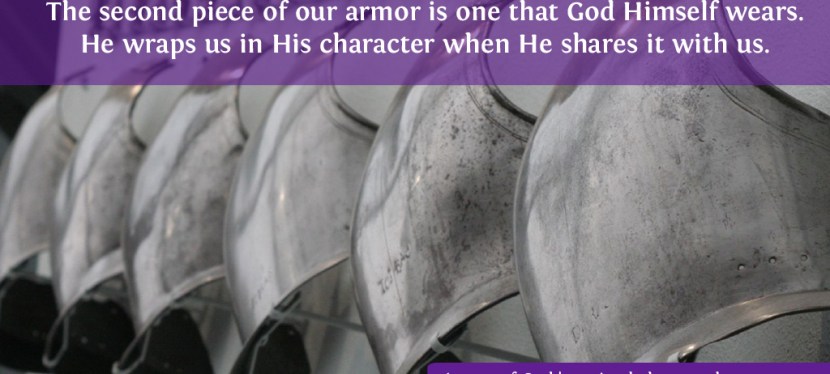
The second piece of our armor is a breastplate of righteousness. In a physical soldier’s armor, this is the part of the armor that protects the front and back of the torso. It’s keeping your spine, internal organs, and especially your heart and lungs safe.

Breastplate of Righteousness | marissabaker.wordpress.com
Photo credit: Thomas Quine, CC BY via Flickr

Keeping Your Heart

For us, righteousness serves much the same protective function. In a broad sense, the word dikaiosune (G1343) means being in a “condition acceptable to God.” It also refers to “the doctrine concerning the way in which man may attain a state approved by God” (Thayer’s Dictionary). Righteousness involves the condition of your heart and state of your character.

Oh that there were such a heart in them, that they would fear me, and keep all my commandments always, that it might be well with them, and with their children forever! (Deut. 5:29, WEB)

God has always been interested in wining His people’s hearts. That desire is at the core of Him asking us to follow Him in righteousness, which is why Jesus didn’t destroy the Law when He came. Rather, He revealed the full expression and intent behind God’s law — that we might develop His character and become like Him (Matt. 5:17-20, 48).

Armor God Wears

Speaking of becoming like God, the Breastplate of Righteousness is a piece of armor that He actually wears.

He put on righteousness as a breastplate, and a helmet of salvation on his head. He put on garments of vengeance for clothing, and was clad with zeal as a mantle. (Is. 59:17, WEB)

The breastplate we’re talking about isn’t just something God gives us to wear. It’s also something that He wears Himself. This is truly armor of God what He’s sharing with us. Read more

The Girdle of Truth

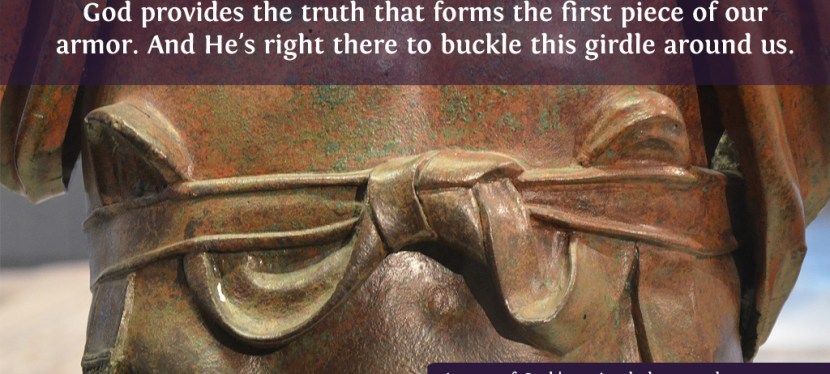
The first piece in the armor of God is a girdle, or belt, of truth. We’re told, “Stand therefore, girding your waist with truth” (Eph. 6:14, LEB). Girdles hold an interesting place in scripture. There are five Hebrew words used to talk about things you can belt around your waist (Easton’s Bible Dictionary).

Some girdles were used as a purse or pockets. Others to belt your clothes on. Different types of girdles were part of a soldier’s attire (2 Sam. 20:8), worn by princes and important people (Eze. 23:15), or by priests (Ex. 28:4, 8; 29:9). Girdles often symbolize strength and readiness. But what does it mean to have a girdle made of truth?

The Girdle of Truth | marissabaker.wordpress.com
Photo credit: JESHOOTS.com via StockSnap

Where We Get Our Girdle

Truth in a Christian context is defined by God. The truths that come from Him aren’t subjective and don’t fluctuate. They’re reliable. And they’re what we put on like a belt around our waists as we prepare for spiritual battle.

Jesus gives a succinct definition of truth in His prayer recorded in John 17. He prays to the Father, “Sanctify them in your truth. Your word is truth” (John 17:17, WEB). The words of God are precious; the only reliable source of truth.

Give diligence to present yourself approved by God, a workman who doesn’t need to be ashamed, properly handling the Word of Truth. (2 Tim. 2:15, WEB)

When we’re looking for truth, we look to God’s Word — both in the Bible and in the person of His son Jesus Christ. Jesus is the Word (John 1:1-3, 14) and He also is “the way, the truth, and the life” (John 14:6). He provides the truth that forms the first piece of our armor. Read more

Stand

We’ve been talking about the foundations of spiritual warfare for the past couple weeks as we work towards studying the armor of God. In Ephesians 6, Paul tells us to “be strong in the Lord,” which is the starting point for engaging in spiritual battles. He also tells us what we’re up against and warns us to be vigilant against our Adversary. Before he gets into how we put on the armor of God, though, there’s one more point he emphasizes.

Paul says the reason we put on the armor of God is so “that you may be able to stand against the wiles of the devil” (Eph. 6:11. WEB). And once he describes our adversaries in verse 12, he says this again.

Therefore put on the whole armor of God, that you may be able to withstand in the evil day, and, having done all, to stand. (Eph. 6:13, WEB)

Stand | marissabaker.wordpress.com
Photo credit: Jamie Street via StockSnap

What It Means To Stand

The Greek word translated “stand” is very similar to our English word. They both mean someone actually standing on their feet and also carry more metaphorical meanings as well. For example, in English we say someone “stands up for what they believe” and mean that they have a firm, courageous stance on a subject.

In Greek, histemi (G2476) carries ideas of firmness and reliability. Thayer’s dictionary says it means firmly establishing something in a certain place. It also means setting something in balance (like establishing a just system of weights for currency). Another meaning is standing immovable and reliable, as in the foundation of a building. And finally, histemi carries the idea of being safe, sound, and unharmed as well as ready or prepared. Someone standing in this way is steadfast and doesn’t hesitate or waiver. Read more

The Importance of Spiritual Vigilance

Last week, we started a series of posts on spiritual warfare. Following the outline Paul gives us in Ephesians, we began with “be strong in the Lord, and in the strength of His might” (Eph. 6:10, WEB). Knowing where we get the strength to fight a spiritual war lays the groundwork. The next point is realizing what we’re up against.

Put on the whole armor of God, that you may be able to stand against the wiles of the devil. For our wrestling is not against flesh and blood, but against the principalities, against the powers, against the world’s rulers of the darkness of this age, and against the spiritual forces of wickedness in the heavenly places. (Eph. 6:11-12, WEB)

No wonder we need to be strong in the Lord! Those are adversaries we can’t even see, much less fight on our own. Thankfully, God doesn’t expect us to.

The Importance of Spiritual Vigilance | marissabaker.wordpress.com
Photo credit: Pearl via Lightstock

The Battle Is Won

When Jesus came to this earth as a human, lived a sinless life, then died for our sins, He assured Satan’s defeat. It’s such a sure thing that scripture talks of Satan (whose name means “adversary”) as having already been defeated even though he still has a little while to keep influencing people here on earth (Rev. 12:12).

having stripped the principalities and the powers, [Jesus] made a show of them openly, triumphing over them in it. (Col. 2:15, WEB)

Shortly before His crucifixion, Jesus told His followers that the “Prince of this world” was about to be cast out (John 12:31). Other verses speak of Christ having “led captivity captive” (Eph. 4:8; Ps. 68:18) and of binding Satan to destroy his kingdom (Luke 11:17-23). Those all point to the truth that Jesus has already sealed our Adversary’s fate.

Since then the children have shared in flesh and blood, [Jesus] also himself in the same way partook of the same, that through death he might bring to nothing him who had the power of death, that is, the devil, and might deliver all of them who through fear of death were all their lifetime subject to bondage. (Heb. 2:14-15, WEB)

Jesus has brought the devil to nothing. The Adversary can seem pretty scary at times, but ultimately, he can’t win. Jesus made certain that God wins this fight. So really all we need to do if we want personal victory is to stay on the winning side.

But The Threat Is Out There

All this isn’t to say we shouldn’t have a healthy level of caution. Just because Satan’s defeat is assured doesn’t mean he can’t still affect us. He’s a very real threat and underestimating him can leave us in a vulnerable position. The Adversary is a roaring lion, not a declawed house cat. Read more

What Does It Mean To Be Strong In The Lord?

Ephesians 6 is the most famous passage talking about spiritual warfare. And because I’ve been rolling the idea of doing a study series on the armor of God/spiritual warfare around in my mind for some time now, it makes sense to start there. So let’s jump right in.

Finally, my brethren, be strong in the Lord, and in the power of his might. (Eph 6:10, KJV)

Before we can start getting ready to fight a spiritual battle, we must recognize where the strength to do such a thing comes from. On our own, we couldn’t fight spiritual adversaries. We need to “be strong in the Lord” to do that. But what does being strong in Him really mean?

Becoming Empowered

The word translated “be strong” is endunamoo (G1743). It comes from a combination of the word en (G1722), which is a preposition meaning in, by, or with, and dunamoo, which is a form of dunamis (1411). Dunamis means “inherent power,” such as Jesus used to perform miracles (Luke 8:46). So this word in Ephesians means to be filled with inherent, active, achieving power. And because we’re strong “in the Lord,” it’s the same kind of power He has.

I can do all things through Christ, Who empowers me. (Phil. 4:13, HBOO)

We, who have no hope of standing up against a spiritual onslaught on our own, can do “all things,” including spiritual warfare, when Jesus empowers us. That means the One who can cast out devils with a word and who saw Satan fall like lightning from heaven (Luke 10:17) isn’t just fighting on our behalf. He’s sharing His power with us so we can fight alongside Him.

Read more

Battling Our Thorns In the Flesh

We’ve all “sinned, and come short of the glory of God” (Rom. 3:23, KJV). We know this, and repenting of those sins in our pasts and accepting Jesus as our savior to wash them away was a first step in becoming Christian. Even after conversion, though, we’re not perfect. God keeps forgiving us when we repent, but we still fall short of perfect obedience. I think it’s also fair to say all or most of us have struggled with some sins more than others.

I’m sure we can all think of someone else like this. Someone who you’d think has been in the church long enough to “get over” their bitterness, or lust, or covetousness, or whatever the particular problem is. But if we think about it, many of us are in the same boat. We’re often more understanding toward our own struggles, but we still have them. Or perhaps we’re even harder on ourselves than we are on others.click to read article, "Battling Our Thorns In the Flesh" | marissabaker.wordpress.com

So what do we do? How do we deal with our own sin struggles and react to those around us when they come short of God’s commands?

The Simple Answer

There are several ways people with a tendency toward a certain sin might react. They could ignore and hide it, ashamed to have thoughts and desires they know are wrong. They might flaunt it, choosing to live in sin because “that’s just how I am.”

The problem with the first is we have to face our struggles and talk about them with God, at the very least. You can’t overcome something you’re ignoring. With the second, the problem is that people who are openly and willfully sinning can’t be allowed to stay in the church (1 Corinthians 5). If you’re going to follow Christ, you have to stop practicing immorality. Read more