Looking for Jesus in All the Right Places

When Jesus was 12 years old, he and His “parents went to Jerusalem … for the Feast of the Passover,” as they did every year in obedience to the instructions in God’s law (Luke 2:41-42). After the Passover and the week-long Feast of Unleavened Bread (Chag haMatzot), his parents went a whole day’s journey home before realizing Jesus wasn’t with the traveling group and they’d lost the Son of God in Jerusalem. They went back, and searched for three days before finding Him in the temple. When Mary chided Him for making them so anxious, Jesus said they should have been able to figure out where He was.

But he replied, “Why were you looking for me? Didn’t you know that I must be in my Father’s house?”

Luke 2:49, NET

I wonder how many times when we’re running around anxiously wondering, “Where’s God when I need Him?” that we’re also looking in the wrong places. The “right place” isn’t a physical location, though; there isn’t an easy-to-find landmark spot for us to start our search like the temple in Jerusalem where Mary and Joseph found Jesus. For us, the task of looking for Jesus is both much simpler (because He is available anywhere) and also in some ways more challenging (since it’s not just about going to a certain place and doing a certain thing).

Seeking the Father and Son

A more literal translation of Jesus’s words to His parents would be, “Didn’t you know that I must be about the things of my Father?” (TLV). The “verse involves an idiom that probably refers to the necessity of Jesus being involved in the instruction about God” (NET footnote), which I suspect is why the Complete Jewish Bible opts for the translation, “Why did you have to look for me? Didn’t you know that I had to be concerning myself with my Father’s affairs?” The reason that so many modern translations say, “in my Father’s house” is because “the most widely held view today takes” the idiom used here “as a reference to the temple as the Father’s house” (NET footnote).

Whichever translation we think is correct, the basic meaning is the same. Jesus could be found associated with the things God was doing in the location where people who follow God gather. Even today, it is true that if we want to connect with God that is often easiest to do when associating ourselves with other believers. That’s not the only thing that’s involved in searching for Jesus or the Father, though.

“No one can come to me unless the Father who sent me draws him, and I will raise him up at the last day.”

John 6:44, NET

Jesus replied, “I am the way, and the truth, and the life. No one comes to the Father except through me.”

John 14:6, NET

We need the Father to open our eyes and invite us into the family if we want to get to Jesus, and then it’s through Jesus that we’re given access to God the Father at a level of intimacy that people who lived before Christ came in the flesh never had and relatively few people have today. Jesus and the Father are welcoming us into their oneness (John 17) and when we faithfully follow the Son, we have a relationship with the Father as well (1 John 2:22-24). We must seek Them both together.

The Temple of God Today

Back when 12-year-old Jesus went missing, He could be found at the temple. However, “the God who made the world and everything in it, who is Lord of heaven and earth, does not live in temples made by human hands” (Acts 17:24, NET), especially now that the veil separating the holy places of God and regular people is done away through Christ (Matt. 27:50-51; Eph. 2:13-19). Now, we are the temple of God.

For we are the temple of the living God, just as God said, “I will live in them and will walk among them, and I will be their God, and they will be my people.”

2 Corinthians 6:16, NET quoting Lev.26:11-12

Do you not know that you are God’s temple and that God’s Spirit lives in you?

1 Corinthians 3:16, NET

These verses tell us two things. One: if we are called by God to be part of His church and we’ve accepted that invitation, we are part of God’s temple and His spirit lives in each of us. Two: all the believers together make up God’s temple today (“you” is plural in Greek; “temple” is singular). If we’re seeking Jesus, we need to seek Him on both an individual and a cooperative level. The Lord wants to live in the midst of His people (Zec. 2:10-13), and being able to build each other up as we seek the Lord together is one of the most important reasons for God’s people to gather as a community of faith (Heb. 10:19-25). That community could be just “two or three assembled” in the Lord’s name (Matt. 18:20), or it could be a church group of hundreds.

Invited to be with the Lord

When Jesus was here on earth, He issued invitations to come to Him, seek Him, and become His friends. They’re not the first invitations from the Lord either; Jesus was making God more widely accessible, but God has always wanted relationships. Those same invitations are still open today, echoing down through thousands of years.

Pay attention and come to me.
Listen, so you can live.
Then I will make [an eternal covenant with] you,
just like the reliable covenantal promises I made to David.

Seek the Lord while he makes himself available;
call to him while he is nearby!

Isaiah 55:3, 6, NET (with footnote translation for v. 3)
Looking for Jesus in All the Right Places | LikeAnAnchor.com
Image by Pexels from Pixabay

Most of the Lord’s instructions for seeking Him involve “how” not “where.” We’re told to seek “diligently” (Prov. 8:17), with “prayer and worship” (Jer. 29:13), and “with all your heart and soul” (Deut. 4:29; 1 Chr. 28:9). And we ought to do this persistently and repeatedly, too–ask, and keep on asking; seek, and keep on seeking; knock, and keep on knocking (Matt. 7:7-8; Luke 11:9-10). But no matter how persistent you are, you’re also going to have trouble finding Him if you’re not looking in the right places.

We learn about God primarily through His word and His spirit, so it’s important to seek Him in the pages of the Bible and ask for understanding. There’s no substitute for reading God’s words (or listening ; I know several people who learn best from audio Bibles). We also learn about Him, and how to be like Him, though interactions with other believers. We are each part of God’s temple, but we’re not the only part and if at all possible it’s vital that we stay in contact with other Christians. So the next time you feel yourself wondering, “Where is God?” try looking in His word, seeking Him in prayer, and/or talking with a fellow believer. It may feel like it takes a while before He responds, but if we seek Him the way He tells us to in the places where He says He can be found, God will not fail to let us find Him.

Featured image by Jantanee via Lightstock

The Beginning of Being Like God

As we draw closer to the Passover and continue examining ourselves (as I talked about in last week’s post) I keep thinking about how vital our understanding of God is to understanding ourselves. Paul tells us to examine, evaluate, and discern ourselves (1 Cor. 11:28-32), but in order to do that we need the help of God’s spirit, as Paul talks about earlier in 1 Corinthians. To see ourselves clearly and know what needs to change (and how to make that change), we need a wisdom that we can only get by understanding God.

Understanding, Wisdom, and Fear

I like to study 1 Corinthians at this time of year because (as I wrote about in more detail a couple years ago), this epistle references the Exodus story, Passover, and the Feast of Unleavened Bread over and over. Before Paul begins talking directly about Passover, he expands on the idea that the wisdom of God is very different than what human beings speak of as wisdom (1 Cor. 1:18-31, quoting Jer. 9:23-24). Knowing and understanding the Lord is far more important than having wealth, power, or worldly wisdom. Echoing a sentiment expressed throughout scripture, Paul tells us a proper perspective on God is where true wisdom begins.

The beginning of wisdom is to fear the Lord,
and acknowledging the Holy One is understanding.

Proverbs 9:10, NET

The idea that we ought to fear a God of love seems odd to many of us, mostly because we think of fear in the sense of being terrified of something scary, dangerous, or bad. But I think the more we learn about God, the more we realize that our love for Him must also be mixed with awe, reverence, and even fear. A devotional book that I’ve been reading puts it this way:

when we approach the Holy One with casual familiarity, we do not take Him as seriously as we ought, and we do not take our sin as seriously as we ought. Fear–not of punishment but of the overwhelming greatness of God–sees Him correctly. When this fear grips us, we begin to understand the enormity of the gospel and of our God. That understanding begins to rearrange our lives. And that is what wisdom is all about.

CHRIS TIEGREEN, 365 POCKET DEVOTIONS, DAY 40

Understanding God leads to wisdom, which leads to us changing our lives. The more we know Him, the more we’ll want to be like Him, and the more clearly we’ll see what we need to keep working on in order to move closer to that goal. Wisdom begins with fearing the Lord, and change happens as we start to become wise.

Knowing God through His Spirit

After Paul explains that God’s people don’t often seem wise in the world’s eyes (and if they do, they’re not supposed to glory/boast about it), he starts to talk about “the wisdom of God hidden in a mystery.” God has decided to share with us deep, wonderful things that other people haven’t even imagined, and he has “revealed these to us by the Spirit” (1 Cor. 2:7-10, NET).

For who among men knows the things of a man except the man’s spirit within him? So too, no one knows the things of God except the Spirit of God. Now we have not received the spirit of the world, but the Spirit who is from God, so that we may know the things that are freely given to us by God. And we speak about these things, not with words taught us by human wisdom, but with those taught by the Spirit, explaining spiritual things to spiritual people. … we have the mind of Christ.

1 Corinthians 2:11-13, 16, NET

This is where we get wisdom–from God’s spirit working inside us and making our minds like Christ’s mind. The closer we draw to God the more we understand Him, and the more we understand Him the more in awe we are. And the more all of that comes together as we grow and change and learn, the more we become like God.

Wisdom Can Change Us

Real, godly wisdom is an incredible thing. Last year, I spent months studying and writing about wisdom in a series of 10 posts. We could write whole books about Godly wisdom, but a quick summary of the things God reveals about His wisdom can be found in James’s epistle.

Who is wise and understanding among you? By his good conduct he should show his works done in the gentleness that wisdom brings. … the wisdom from above is first pure, then peaceable, gentle, accommodating, full of mercy and good fruit, impartial, and not hypocritical. And the fruit that consists of righteousness is planted in peace among those who make peace.

James 3:13, 16-18, NET

A proper perspective on God is the starting place for this kind of wisdom. And much like fear is the beginning of wisdom, I think we can also say that wisdom is a beginning to being like God. Notice how much of this description of godly wisdom involves character traits we can develop and/or actions that we can take. If we want to examine ourselves, this is an excellent place to start. As we consider God’s goodness and greatness, learning more and more about who He is and how we can be like Him, we ought to meditate on the characteristics of His wisdom. Every aspect of “the wisdom from above” is a part of God; are they also a part of us?

Featured image by Pearl via Lightstock

Examining Ourselves by Examining God

Every year before Passover, Christian and Messianic Jewish believers who follow Jesus’s instruction to keep this day “in remembrance of me” also follow Paul’s instruction to examine ourselves. Before we eat the unleavened bread and drink the wine as Jesus did “on the night in which he was betrayed,” we must examine ourselves. It’s a serious matter, for “the one who eats and drinks in an unworthy way eats and drinks judgment to himself if he doesn’t discern the Lord’s body” (1 Cor. 11:23-31. WEB).

As I ponder the question of self-examination today, about 4 weeks before Passover, I’m struck by something Job says near the end of the book bearing his name. After all his trials, all the discussions with his friends, and all of God’s replies, Job says,

I had heard of you by the hearing of the ear,
but now my eye has seen you.
Therefore I despise myself,
and I repent in dust and ashes!”

Job 42:5-6, NET

It’s easy to look at ourselves and think we’re doing okay unless something comes along to shake up that self-perception. Job thought he was a righteous man. He was even right about that, as God points out when He describes Job as “a blameless and upright man” at the beginning of the story (Job 1:8, NET). But Job still had room for improvement, and the more he learned about God the more fully he realized how much he still had to learn. The better we can see God, the less impressive we are to ourselves.

Heading Toward His Perfection

It is important to regularly “put yourselves to the test to see if you are in the faith; examine yourselves!” (2 Cor. 13:5, NET). We can’t accurately evaluate ourselves, though, unless we understand the standard we’re measuring ourselves by. In other words, if we don’t have some idea of what we are supposed to be we don’t know how well we’re doing.

See what sort of love the Father has given to us: that we should be called God’s children—and indeed we are! For this reason the world does not know us: because it did not know him. Dear friends, we are God’s children now, and what we will be has not yet been revealed. We know that whenever it is revealed we will be like him, because we will see him just as he is. And everyone who has this hope focused on him purifies himself, just as Jesus is pure.

1 John 3:1-3, NET

God is calling us into His family and we are His children right now. We’re also growing and changing, becoming more and more like Him. At least, that’s what should be happening. And if we’re going to examine ourselves to see how much progress we’re making on becoming like God, we need to know what it means to be like Him. We won’t achieve perfection in this life, but we should be heading there. And if we want to know what perfection looks like, we just need to look to God for an example of how we’re supposed to be.

Glimpsing His Unsearchable Riches

I keep talking about the need to see and understand God as if that’s something we could actually do as human beings. While we are invited to know Him in an increasingly familiar way, part of knowing Him involves realizing that our minds can’t warp themselves around His fullness. His thoughts are not like our thoughts (Is. 55:8-9) and “the riches both of wisdom and the knowledge of God” are so deep we’ll never plumb them all (Rom. 11:33).

I find this an encouraging realization. We’re never going to hit a point where there’s nothing left to work on, no way to grow, or nothing more to learn. The more we follow God, the more we get to engage with Him in a dynamic, growing relationship.

But just as it is written, “Things that no eye has seen, or ear heard, or mind imagined, are the things God has prepared for those who love him.” God has revealed these to us by the Spirit. For the Spirit searches all things, even the deep things of God.

1 Corinthians 2:9-10, NET

By God’s spirit inside us, we get an increasingly clear picture of what it means to be like God. We even get to put on “the mind of Christ” (1 Cor. 2:6-16). The better we know Him, the better we understand who we are meant to be and what we are supposed to do on the way toward being that person. That’s why I say that if we want to examine ourselves, we need to “examine” God. Self-examination is vital, but that process isn’t all about us even though the word “self” is in there. It’s about becoming like God.

To Fix Ourselves or to Be Like God

Putting on God’s nature often goes against our ingrained impulses. We are so used to reacting in certain ways (like anger if someone shouts at us, or spite if we’re ill treated) that trying to fix our human nature might seem impossible. And it is if we try to do that on our own. Thankfully, we’re not on our own and we don’t have to start from scratch.

“We have two options: we can try to reform the sinful human nature, or we can ask God for His nature. The former approach has never in history proven successful. Our only remaining option is to ask God.”

Chris Tiegreen, 365 Pocket Devotions, Day 78

Trying to make ourselves like God without putting on His nature is a futile endeavor. We need a more drastic change than just trying to be good or nice people. It reminds me of a C.S. Lewis quote, where he talks about the need to transform rather than just improve. Using the sort of agricultural analogy Jesus was so fond of in His parables, Lewis says,

“If I am a field that contains nothing but grass-seed, I cannot produce wheat. Cutting the grass may keep it short: but I shall still produce grass and no wheat. If I want to produce wheat, the change must go deeper than the surface. I must be ploughed up and re-sown.”

C.S. Lewis, Mere Christianity, book IV chapter 8

Returning to the topic of self-examination, the goal of that is not to fix ourselves by our own efforts. It’s to look for evidence of Jesus Christ in us (2 Cor. 13:5). It’s to identify areas where we’re not yet like God and ask Him to change us. The focus should be on God–who He is and who He wants us to be in Him–as much (or even more) than on ourselves.

The more we learn about God and seek to know Him, the more clearly we see ourselves. When we turn away from the Lord, our minds can deceive us into thinking we’re something different than we are. But when we turn to the Lord, who can “probe into people’s minds” and “examine people’s hearts,” we can then see ourselves as He sees us (Jer. 17:5-10, NET). We may, like Job, abhor what we see and need to repent, but there are blessings that follow something like that because God responds so positively to sincere repentance. When we look at ourselves in light of God’s goodness and realize we still aren’t perfect, it leads to humility. And when we take that humble attitude to God and ask Him to share His mind and nature with us, He will respond to our self-examination by transforming us.

Featured image by Inbetween via Lightstock

Finding Treasures, New and Old, in the Pages of Scripture

Have you ever been reading a familiar part of the Bible–one of the gospels, for example–and came across something you’d never noticed before? I don’t know how many dozens of times I’ve read Matthew, and just a few weeks ago I noticed a verse that I don’t think I’ve ever thought about before. It comes right after a collection of several parables about the kingdom of heaven, and Jesus says,

“Have you understood all these things?” They replied, “Yes.” Then he said to them, “Therefore every expert in the law who has been trained for the kingdom of heaven is like the owner of a house who brings out of his treasure what is new and old.”

Matthew 13:51-52, NET

As I’ve pondered this verse over the past few weeks while studying the kingdom of God, one thing that jumps out at me is the importance Jesus puts on the old and the new. Treasuring both seems like a different recommendation than what some other scriptures teach us about how to relate to the old and the new. But Jesus also makes this sound like something we’re supposed to do. An “expert in the law” (also translated “scribe” or “Torah scholar/teacher”) who is trained (or “discipled”) for the kingdom seems like someone who has paid close attention to Jesus’s teachings and understand them. So how can we imitate this disciple-scholar’s approach to the kingdom of God?

An Old and New Commandment

Describing someone who is trained or discipled for the kingdom as bringing out old and new treasures can seem strange in light of Jesus’s other teachings. The parables of the new patch on an old garment and new wine in old wineskins make it seem like the new and old is incompatible (Luke 5:36-39). Later, Paul writes about cleaning out the old so we can be new, and of the old passing away because we are new in Christ (1 Cor. 5:7; 2 Cor 5:17). Part of figuring out this puzzle involves asking the question, “Old and new what?” because not all these passages are talking about the same old and new things. In addition to keeping that in mind, I think the key to unlocking this mystery is found in John’s writings:

Dear friends, I am not writing a new commandment to you, but an old commandment which you have had from the beginning. The old commandment is the word that you have already heard. On the other hand, I am writing a new commandment to you which is true in him and in you, because the darkness is passing away and the true light is already shining.

1 John 2:7-8, NET

Jesus did not do away with the old commandments and words of God (Matt. 5:17-20). He did, however, bring something new to add to it, including a new covenant which would supersede the old (Heb. 8-9). Part of participating in this new covenant involves us cleaning old things that are incompatible with godliness out of our lives (that’s what Paul was talking about in the Corinthians passages). It also involves properly balancing and appreciating the new and old treasures of God’s word.

Called into the New, Founded on the Old

People often think of Christianity as something new that Jesus started. The way scripture talks about it, though, “Christian” is just a new name applied to believers who were continuing to follow the teachings of the one true God and align with His unfolding plan as Jesus revealed the next steps. Our faith’s roots aren’t found in the first century C.E.–they’re found “in the beginning” when God created the heavens and the earth. Jesus coming as the Messiah was the next step in the plan God had laid out even before He laid the foundations for the earth (Matt. 25:34; Eph. 1:4; 1 Pet. 1:20).

As part of His work here on earth, Jesus revealed more fully how to worship God and invited us to “serve in the new life of the Spirit and not under the old written code” (Rom. 7:6, NET). Now, is Paul saying here that the old has no value? “Absolutely not!” Rather, he argues that “we uphold the law” when we live by faith” (Rom. 3:31; 6:15; 7:7).

For God, who said “Let light shine out of darkness,” is the one who shined in our hearts to give us the light of the glorious knowledge of God in the face of Christ.

2 Corinthians 4:6-7, NET

The work God is doing in us and the knowledge He gives us are amazing treasures. Part of this treasure of understanding involves an appreciation of the value both of the new and old things that God has given His people. Through His extraordinary power and mercy, we are called into a new thing founded on very old truths.

Finding and Keeping Kingdom Treasures

If we go back to the kingdom of heaven parables that Jesus shared before making the statement where we started this post, we find that He talked about treasure there, too.

“The kingdom of heaven is like a treasure hidden in the field, which a man found and hid. And because of his joy, he goes out and sells all that he has and buys that field.

“Again, the kingdom of heaven is like a merchant searching for fine pearls. Upon finding a pearl of great value, he went out and sold all that he had and bought it.” …

Then He said to them, “Therefore every Torah scholar discipled for the kingdom of heaven is like the master of a household who brings out of his treasure both new things and old.”

Matthew 13:44-46, 52, TLV

God’s kingdom is a treasure so precious we should be willing–and even joyful–to give up whatever is needed to get the kingdom (Matt. 10:21; Luke 18:22). And we should be collecting and treasuring things related to the kingdom, such as the “treasures of wisdom and knowledge” hidden in Jesus (Col. 2:3, see also Matt. 6:19-21). As we continue to learn and grow, let’s appreciate the rich history of our faith and our own personal experiences, as well as the new things God teaches and the glorious future He has planned.

Featured image by Oliver Eyth from Pixabay

Shining as Lights on Fire for God

If we want light in our homes today, we just have to turn a light switch and the lamp comes on. Back in Bible times, though, a lamp involved fire. You had a container for the oil, a wick to carry that oil, and when the wick was lit the fire gave light. In the familiar parable of the 10 virgins, the reason they needed to have oil was to keep the fires in their lamps burning.

In this parable, 10 virgins take lamps and go out to meet the bridegroom. I assume they were friends of the couple, probably the women who watched with the bride as she waited for her groom to arrive on an unknown day at an unspecified time (in keeping with Jewish tradition). The five foolish virgins took lamps, but not extra oil. The five wise ones had lamps and extra oil. When the bridegroom took longer to arrive than they’d expected, all ten of them fell asleep.

When the shout announcing the bridegroom’s arrival woke them, the wise virgins had enough oil to keep the flames in their lamps burning but the unprepared women’s lamps were going out. In the time it took them to run out and buy more oil, the “bridegroom arrived and those who were ready went in with him to the wedding banquet. Then the door was shut.” When the other virgins showed up and knocked, they did not get in. They weren’t even recognized (Matt. 25:1-13).

Jesus ends this parable by saying, “Therefore stay alert, because you do not know the day or the hour.” It’s one of the kingdom of heaven parables (like we talked about last week) which teaches us something about what we must do if we want to be citizens of God’s kingdom. In this case, one thing it teaches is that we need to be prepared, with our lamps burning and properly fueled.

We’re Supposed to Shine Like Lamps

The idea of Jesus’s followers having or being light comes up more than once in the gospels (Matt 5:14-16, to mention one). We’re supposed to shine as lights, having been illuminated by Christ’s light.

“No one after lighting a lamp puts it in a hidden place or under a basket, but on a lampstand, so that those who come in can see the light. Your eye is the lamp of your body. When your eye is healthy, your whole body is full of light, but when it is diseased, your body is full of darkness. Therefore see to it that the light in you is not darkness. If then your whole body is full of light, with no part in the dark, it will be as full of light as when the light of a lamp shines on you.”

Luke 11:33-36, NET

Jesus’s intention after “lighting” us is not to hide us in a cellar or snuff us out with a basket or bowl (NET footnotes). He wants us visible, shining with His light. Therefore, we need to be constantly watchful to make sure the light in us does not become darkness (the “therefore see to it” instruction is an ongoing, “present imperative” [NET footnote]). Like our eyes take in light to let us see, our minds take in Christ’s word to let us live in His light. Internalizing His words puts light inside us too, so it can shine out. If we internalize other (especially ungodly) things, though, that can change the way we shine. What we let into our eyes, hearts, and lives matters to God and it can affect the way our lamps are burning before Christ’s return.

Fueling our Lamps with the Word

If we want to fill our eyes with light and keep our lamps well fueled, we have a source for light readily available. Whether you use print Bibles, apps, or search online, for most of us in the modern world God’s word is right at our fingertips. The more time we spend with His word, the more exposure we get to the Light.

Your word is a lamp to walk by,
and a light to illumine my path.

Psalm 119: 105, NET

Your instructions are a doorway through which light shines.
They give insight to the untrained.

Psalm 119:130, NET

For the commandments are like a lamp,
instruction is like a light

Proverbs 6:23, NET

One of the ways that we fulfill Jesus’s instruction to shine as lights in the world is by internalizing the light that God has given us through His word. “God is light, and in him is no darkness at all,” so if we want to walk with Him in the light we need to listen to Him (1 John 1:5-7, NET). Getting “dressed for service” and keeping our “lamps burning” as we watch for the Master’s return (Luke 12:35-38) involves filling our minds with God’s commands, instructions, and teachings while asking Him to help us understand His mind through His spirit. It is only by spending time in God’s Light that we can be light (Ps. 36:9; 43:3).

Clothed With Jesus’s Light

When writing his second letter to Timothy, Paul urged him “to rekindle God’s gift” because “God didn’t give us a spirit of fear but of power and love and self-control” (2 Tim. 1:6-7, NET). The spirit in us is like a fire, and we can either stir it up (i.e. rekindle) or let it die down to coals. That’s up to us. God gives us His spirit and His word, but whether or not we are on fire for Him is a choice we get to make.

And do this because we know the time, that it is already the hour for us to awake from sleep, for our salvation is now nearer than when we became believers. The night has advanced toward dawn; the day is near. So then we must lay aside the works of darkness, and put on the weapons of light. Let us live decently as in the daytime, not in carousing and drunkenness, not in sexual immorality and sensuality, not in discord and jealousy. Instead, put on the Lord Jesus Christ, and make no provision for the flesh to arouse its desires.

Romans 13:11-14, NET

The statement “our salvation is now nearer than when we became believers” is as true for us today as it was for Paul’s first readers. The work God the Father and Jesus began in us will come to completion either with our deaths or at Christ’s return (Phil. 1:6), and that time is getting closer each day. We mustn’t waste any more time before we put off darkness and clothe ourselves instead with the true Light of Jesus Christ (John 1:4-5; 8:12; 9:5; 12:46). The more time we spend with Him and becoming like him, the more we will shine as lights on fire for God.

Featured image by Hans Benn from Pixabay

The Kingdom of God is Like …

I’ve written two posts now on the kingdom of God, and I feel like we’re still only scratching the surface as we talk about “Living for the Present and Coming Kingdom” and “Unexpected People in the Kingdom of God.” As we seek to understand God’s kingdom and our role in it both now and in the future, one of the most helpful places to look is the gospel parables. Jesus began many of His parables, particularly in Matthew’s account, by saying, “The kingdom of heaven is like,” and then providing an illustration. We can still read these parables today if we’re curious to learn what God’s kingdom is like according to the One who the Father has put in charge of ruling it.

When explaining the parable of the sower to His followers, Jesus said, “The secret of the kingdom of heaven has been given to you” (Mark 4:11, NET). That’s what’s hidden inside these parables, and this secret is given to us as well if we also listen carefully to the Master’s words. Today’s post is a long one, but I think it’s important to try and look at all these parables together rather than splitting them up into a two-part post.

Something Small that Grows

One of the things Jesus taught in his parables was that the kingdom of God (a phrase used by Mark and Luke), also called the kingdom of heaven (by Matthew), starts out small. With Jesus’s first coming, the kingdom He introduced was not showy or big.

He gave them another parable: “The kingdom of heaven is like a mustard seed that a man took and sowed in his field. It is the smallest of all the seeds, but when it has grown it is the greatest garden plant and becomes a tree, so that the wild birds come and nest in its branches.”

He told them another parable: “The kingdom of heaven is like yeast that a woman took and mixed with three measures of flour until all the dough had risen.”

Matthew 13:31-33, NET

Like the tiny mustard seed in the garden or the yeast hidden in 47 pounds of flour (NET footnote), God’s kingdom wasn’t all that noticeable at first. Even today, you’d have no idea it’s here unless you know where to look. One day, though, it will spread to cover the whole earth just as the tiny mustard seed grows into a 10- or 25-foot high plant (depending on which species Jesus was talking about) and yeast spreads to fill all the bread dough.

A Field of Wheat and Weeds

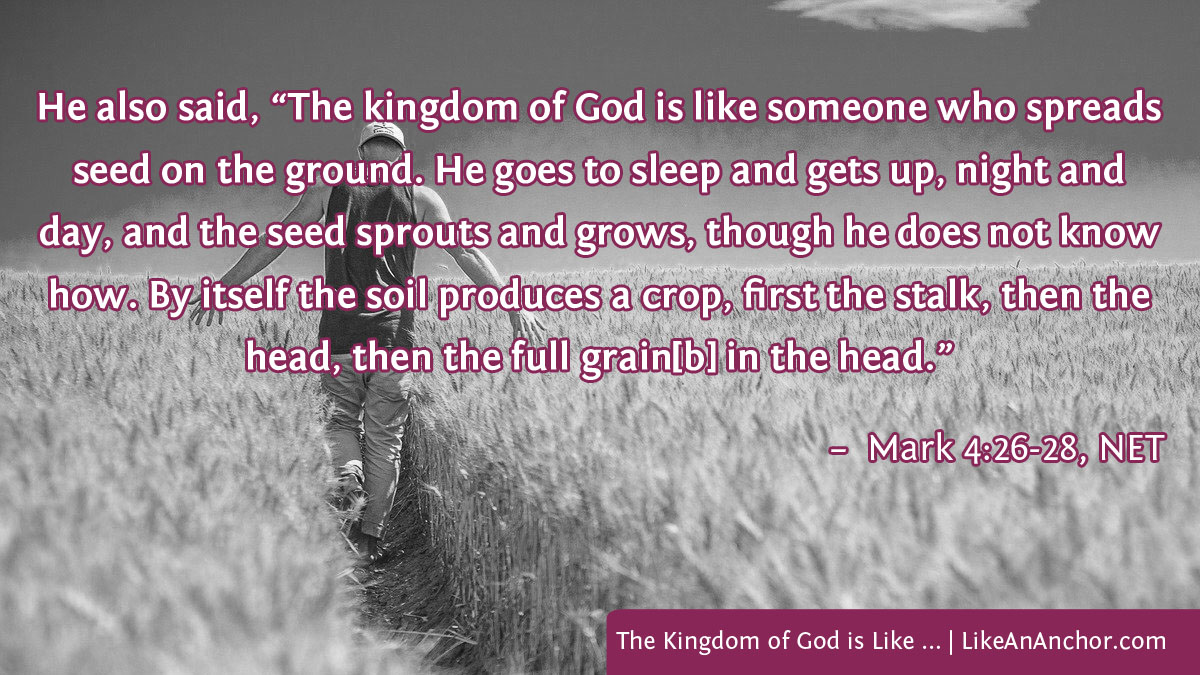
The idea of the kingdom as a growing seed extends into other parable as well. It grows behind the scenes, in ways people don’t understand until the harvest (Mark 4:26-28). It starts out as seeds of the Word sown into the world, which can then take root in human hearts (Mark 4:1-20). And it’s like a field where good seed grows alongside weeds.

He presented them with another parable: “The kingdom of heaven is like a person who sowed good seed in his field. But while everyone was sleeping, an enemy came and sowed darnel among the wheat and went away. When the plants sprouted and produced grain, then the darnel also appeared. So the slaves of the landowner came and said to him, ‘Sir, didn’t you sow good seed in your field? Then where did the darnel come from?’ He said, ‘An enemy has done this!’ So the slaves replied, ‘Do you want us to go and gather it?’ But he said, ‘No, since in gathering the darnel you may uproot the wheat along with it. Let both grow together until the harvest. At harvest time I will tell the reapers, “First collect the darnel and tie it in bundles to be burned, but then gather the wheat into my barn.”’”

Matthew 13:24-30, NET

Jesus later explains that “the field is the world and the good seed are the people of the kingdom. The poisonous weeds are the people of the evil one” (Matt. 13:38). This puts the kingdom in a broader perspective than we might usually think of, starting from the very beginning when God first “planted” people on earth and the devil first began corrupting them. This parable also talks about the time of the end, when God will sort good from bad, which connects it to the parable of the net Jesus shares a little later (Matt 13:47-50).

A King Who Trusts His Bondservants

The way that God will sort people out at the end of the age is a central theme in several of Jesus’s parables of the kingdom In one of these parables, Jesus says, “The kingdom of heaven is like a landowner” who hired workers for his vineyard throughout the day and then paid them all the same wage (Matt. 20:1-16). Though he gave everyone exactly what he’d promised, the people who’d worked longest and hardest protested it wasn’t fair. The landowner replied kindly, reminding the men that they’d received what was agreed on and asking, “Are you envious because I am generous?” It’s a beautiful illustration of how God’s mind works differently than ours, and how much He wants to give people good things. Those who decide to follow Him later in their lives or closer to the end of the age will be given the exact same blessings He offers to those who’ve followed Him for decades.

God’s kingdom is full of mercy, but we must not forget there is also justice. You can’t have just one–justice and mercy always work together. “The kingdom of heaven is like a king who wanted to settle accounts with his slaves,” and who freely forgave one slave’s enormous debt simply because they asked for mercy. But when that slave devalued the gift and refused to show mercy to others, the mercy given to him was taken back (Matt. 18:23-35). God deeply desires to show us mercy, but His justice also demands that there are consequences if we refuse to respond to His mercy in the right and proper ways (specifically, in this parable, by showing that same mercy to other people).

God entrusts us with a responsibility to live in a certain way while we’re here on the earth. The kingdom, which we’re part of now as we wait for Jesus to return, “is like a man going on a journey, who summoned his slaves and entrusted property to them.” The slaves (or bondservants, depending on the translation) who did anything productive with what the king gave them are rewarded abundantly; only the slave who did nothing to demonstrate his faithfulness is thrown out (Matt. 25:14-30). God deeply desires a good, eternal outcome for us, but a big part of how we’re judged is determined by us and how we choose to respond to what He is doing in our lives right now.

A Wedding

My favorite analogy for the kingdom of God is found in two parables (as well as other scriptures, which I talk about in my book God’s Love Story). In the first of these parables, Jesus said, “The Kingdom of heaven can be compared to a king who gave a wedding banquet for his son” (Matt. 22:2, NET). Just that phrase holds a lot of meaning, especially when we think of Revelation 19 and the wedding celebration of the Lamb. The main point of this parable, though, isn’t to talk about the marriage so much as who will be there.

He sent his slaves to summon those who had been invited to the banquet, but they would not come. … Then he said to his slaves, ‘The wedding is ready, but the ones who had been invited were not worthy.”

Matt. 22:3, 8, NET

You can click here to read the whole parable. As in several other parables we’ve looked at, Jesus is talking about the need for us to properly respond to God’s invitation if we want to be in the kingdom. There’s also a level of preparation involved, as the king expected all the guests to dress in wedding clothes for His banquet. It’s similar to the parable of the 10 virgins in Matthew 25, where “those who were ready went inside” with the bridegroom “to the wedding banquet,” while the unprepared were shut out (Matt. 25:10-12, NET).

The Most Valuable Treasure

Jesus’s parables reveal how much He and the Father want to have all people in their kingdom, while also revealing we have a lot of influence over whether or not we’re actually included in that kingdom. God’s kingdom requires commitment and preparation from us, along with a change in our hearts to become more like God. He makes all of that possible and offers us ongoing forgiveness and support as we follow Him, but we do have to make the choice to actually live His way of life. With the importance of that commitment in mind, two more parables highlight the fact that all the effort we put into following Jesus’s command to “above all pursue his kingdom and righteousness” (Matt. 6:33, NET) will be worth it.

The kingdom of heaven is like a treasure, hidden in a field, that a person found and hid. Then because of joy he went and sold all that he had and bought that field.

Again, the kingdom of heaven is like a merchant searching for fine pearls. When he found a pearl of great value, he went out and sold everything he had and bought it.

Matt. 13:44-46, NET

The more fully we grasp the true value of the kingdom of God, the more we realize that nothing else can possibly compare to it. Paul gives us an illustration of what this looks like in real life when he counted the cost of following Christ and concluded that the rewards will be so amazing any suffering we endure will be overshadowed (see Romans 8 and Philippians 3). Today, all of us who’ve received God’s invitation to follow Him have the chance to understand “the secret of the kingdom of heaven,” just like those disciples to whom Jesus spoke these parables so many years ago. Let’s use what we learn to live as part of His kingdom and pursue a faithful relationship with Him.

Featured image by Pearl via Lightstock