3 Keys to Biblical Motherhood

I wasn’t quite sure what today’s post would be about until I’d been working on it for nearly a week. I knew I wanted to look at motherhood in the Bible, then as I studied three things gradually stood out to me as key points the Biblical writings emphasize. Society often places a ton of pressures on mothers to be perfect, and in the church it’s often described as the most important thing a woman can do.

For most of my life, when I studied women’s roles in the Bible and in the church, I was trying to find hints for what is expected of unmarried women without children. That’s a bit challenging, because instructions are often addressed to wives or talk about children. Now that I’m married and pregnant, though, all those verses are suddenly more relevant. I find it encouraging to study the Bible and see God really expects three basic things from mothers: pray for their kids, love their kids, and teach/train them in God’s way of life.
Image of a woman's and a toddler's feet overlaid with text from Psalm 127:3, WEB version: "Behold, children are a heritage of Yahweh. The fruit of the womb is his reward."
Image by Brimstone Creative from Lightstock

Praying For Children

I’ve long been fascinated by God’s interactions with the patriarch’s wives. He’s called the God of Abraham, Isaac, and Jacob, but He’s also the God of Sarah, Rebecca, Leah, and Rachael and we have record of Him interacting with the women as well as the men (God spoke directly with Sarah and Rebecca [Gen. 18:9-15; 25:20-26] and Leah’s name choices imply a relationship with Him [Gen. 29:31-35]) . Interestingly, all these interactions are related to their roles as mother. God definitely talks to and works with women who aren’t mothers as well, but for many women who talked with God, their interactions with Him involve their children. Either they’re asking for a child, or God’s telling them they’ll have a child, or they’re seeking God’s help with a child.

Christians are under no obligation to get married or have kids if they don’t want to (there are even verses where Paul counsels it could be best to remain single), but the Bible assumes that the majority of people will marry and that they’ll want to have kids. As we discussed in last week’s post, God loves children and He cares deeply about how His people raise the children that He gives to them as a gift.

She was in bitterness of soul, and prayed to Yahweh, weeping bitterly. She vowed a vow, and said, “Yahweh of Armies, if you will indeed look at the affliction of your servant and remember me, and not forget your servant, but will give to your servant a boy, then I will give him to Yahweh all the days of his life, and no razor shall come on his head.” …

When she had weaned him, she … brought the child to Eli [the priest]. She said, “Oh, my lord, as your soul lives, my lord, I am the woman who stood by you here, praying to Yahweh. I prayed for this child, and Yahweh has given me my petition which I asked of him.”

1 Samuel 1:10-11, 24-27, WEB

I love that God listens to women’s prayers or even just thoughts for and about their children. We see this first in Hagar’s story, where she was clearly worried about her son but doesn’t even have to make a specific prayer for God to respond to her plight (Gen. 16:6-15; 21:8-21). We see it in Rebecca, who had a question about her pregnancy that God personally responded to (Gen. 25:20-26). We see it in Hannah (whose story I just quoted), who asked God for a son and received exactly what she requested (1 Sam. 1:1-2:11). From the many examples of praying mothers in the Bible and God’s careful attention to their prayers, we can see that praying for children is a key part of Biblical motherhood.
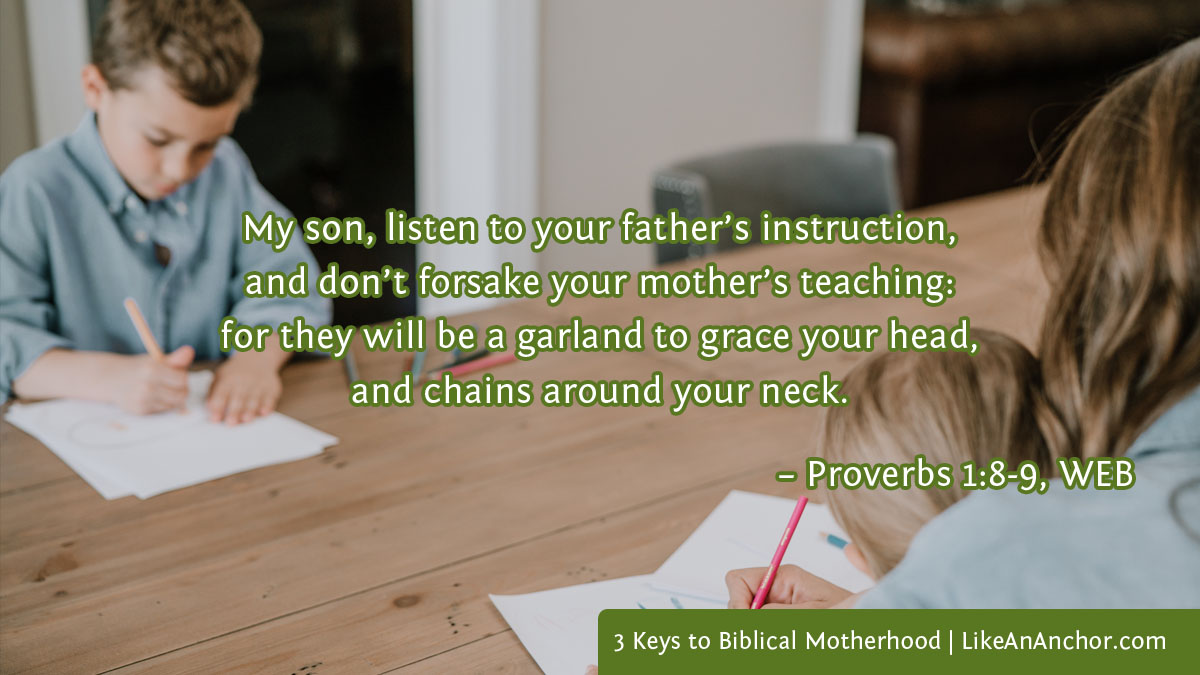
Image of a mother coloring at a table with her son and daughter, overlaid with text from Prov. 1:8-9, WEB version: "My son, listen to your father’s instruction, and don’t forsake your mother’s teaching: for they will be a garland to grace your head, and chains around your neck."
Image by Brimstone Creative from Lightstock

Teaching Your Children

My husband and I were both homeschooled, and we’re planning to homeschool our children as well. I’m so excited about this, particularly now that I have teaching and tutoring experience working with everyone from 5-year-old beginning readers to teens struggling with homework to Ph.D. candidates looking for editing help on their dissertations. I love teaching and I’m excited to teach my children and discover their learning styles.

One of the things that the Bible assumes (and commands!) is that fathers and mothers will both be teaching, training, and disciplining (disciple-ing) their children. When we look at Moses’s words in Deuteronomy about passing on God’s teachings to children, we can remember that his audience was “all Israel” (Deut. 1:1; 5:1). That’s the whole assembly of the congregation, men and women.

Therefore you shall lay up these words of mine in your heart and in your soul. You shall bind them for a sign on your hand, and they shall be for frontlets between your eyes. You shall teach them to your children, talking of them when you sit in your house, when you walk by the way, when you lie down, and when you rise up. You shall write them on the door posts of your house and on your gates; that your days and your children’s days may be multiplied in the land which Yahweh swore to your fathers to give them, as the days of the heavens above the earth.

Deuteronomy 11:18-21, WEB

When you have kids, God expects you to make His way of life part of their everyday learning. Even if you don’t homeschool, you’re still responsible for teaching your children the word of the Lord. That goes for both mothers and fathers.

My son, keep your father’s commandment,
    and don’t forsake your mother’s teaching.
Bind them continually on your heart.
    Tie them around your neck.

Proverbs 6:20-21, WEB

Mothers taught both boys and girls (for example, all of Proverbs 31 is “The words of king Lemuel; the revelation which his mother taught him). There’s a good chance that Jesus’s mother Mary was His primary teacher, since she was from a priestly family and spent time in the home while Joseph would have been busy with his work as a carpenter (Metsämuuronen, 2019). Jewish children of Jesus’s time grew up steeped in religious tradition, learning prayers, keeping Sabbath and the feasts, and eating kosher foods. They were likely taught “the contents of the main scriptures and proverbs” and learned how to “read something” from their mothers before beginning formal schooling at the age of six or seven (Metsämuuronen, p. 5). If there was a local synagogue, both boys and girls would have gone there to learn Torah until around age thirteen. If not, it was the parents’ responsibility to continue their schooling.

Teaching and training children in God’s way of life is still a responsibility for parents, regardless of how else their children are being taught things more traditionally considered school subjects. It’s not something we can leave to chance or hope they learn through osmosis at church or from our examples. We need to be intentional about it. As such an important responsibility, teaching and training children is a key aspect of Biblical motherhood.

Love the Children
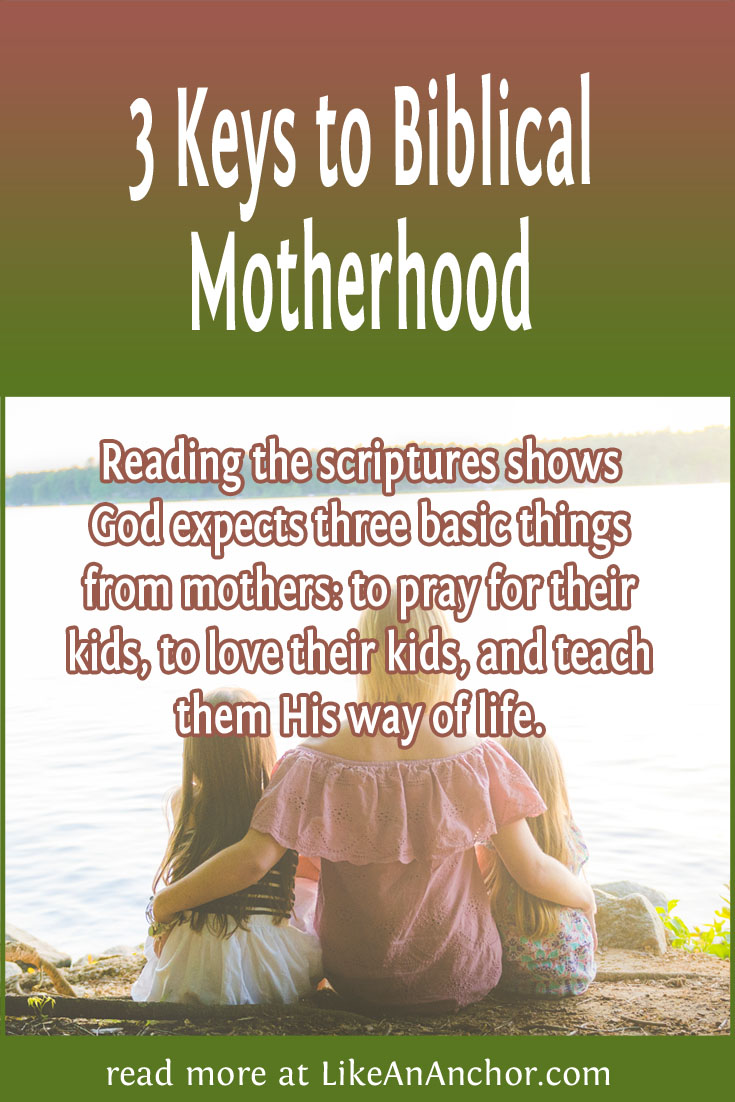
Image of a mother sitting by a lake with two little girls, overlaid with blog's title text and the words, "Reading the scriptures shows God expects three basic things from mothers: to pray for their kids, to love their kids, and teach them His way of life."
Image by Anggie from Lightstock

Praying for their children is something we see mothers in the Bible do. Teaching their children is something they were commanded to do. Another command, which involves older mothers teaching new mothers, is to love our children.

But as for you, communicate the behavior that goes with sound teaching. … Older women likewise are to exhibit behavior fitting for those who are holy, not slandering, not slaves to excessive drinking, but teaching what is good. In this way they will train the younger women to love their husbands, to love their children, to be self-controlled, pure, fulfilling their duties at home, kind, being subject to their own husbands, so that the message of God may not be discredited.

Titus 2:1, 2-5, NET

It seems a little odd that the older women have to train the younger women how “to love their children.” We tend to think that love is something that just happens and people don’t need to work on it, especially for women with their maternal instinct. There are also hints in the Bible that it’s natural and normal for women to cherish their own children (Is. 49:15-16; 1 Thess. 2:7). But just like we learn to love a spouse more fully and deeply (rather than simply settling for impulsive, romantic love), we can also learn how to love our children better.

I know there’s a lot involved in being a good mother, but I suspect most of it is going to fall into these broad categories (based not just on Bible study, but practical observations of and conversations with mothers I know and admire). It’s kind of like how the entire law is fulfilled by truly following the command to love God and love your neighbor (Matt. 22:35-40; Rom. 13:8-10). If we’re praying for our children, teaching them God’s way, and loving them truly, then maybe the rest is simply details on how to do that properly.


Featured image by Pearl from Lightstock

Putting “Spare the Rod” In Context

I’ve been reading through Proverbs in the evenings lately, and recently one of the verses about disciplining children caught my eye. There are several, but this one reads, “Folly is bound up in the heart of a child: the rod of discipline drives it far from him” (Prov. 22:15, WEB). As I read this, I wondered if rather than a rod for beating this might refer to a rod like shepherds use, as in “Your rod and your staff, they comfort me” (Ps. 23:4, WEB).

When we think about this topic, you might be more familiar with the phrase, “spare the rod, spoil the child.” This isn’t actually in the Bible but comes from a 17th-century poem by Samuel Butler called “Hudibras” where the context is whipping a lover to “raise passion.” How that particular poem ended up associated with Proverbs (to the point that I found an article published in an academic journal misquoting this phrase as Prov. 13:24) is a befuddling mystery. The Proverb with the closest phrasing reads, “One who spares the rod hates his son, but one who loves him is careful to discipline him” (Prov. 13:24, WEB).

Despite the phrase confusion with Butler’s poem, there are Proverbs about rods of discipline and children. In addition to the two we looked at, there’s also “Don’t withhold correction from a child. If you punish him with the rod, he will not die. Punish him with the rod, and save his soul from Sheol” and “the rod of correction gives wisdom, but a child left to himself causes shame to his mother” (Prov. 23:13-14; 29:15, WEB). Historically, these have been used to justify corporal punishment, even in some cases things that today we’d (correctly, in many cases) label child abuse. But it clearly does recommend disciplining your children in some way, so we need to be careful not to go to the other extreme either and never discipline at all.

As I think about this, particularly now that I’m pregnant with a little baby of my own, I wonder what useful lessons we can learn from these proverbs. I want to take a closer look at their historical interpretation as well as the Hebrew words used. We’ll also look at other Bible verses that talk about interacting with children to put the verses from Proverbs in their larger context.

Image of a mom and dad reading to two little girls overlaid with text from Deut. 6:6-7, NET version: "These words I am commanding you today must be kept in mind, and you must teach them to your children and speak of them as you sit in your house, as you walk along the road, as you lie down, and as you get up."
Image by Marcus from Lightstock

Jewish and Early Christian Perspectives on Discipline

One of the things I wanted to start out with was trying to figure out how people of Jesus’s day might have interpreted these scriptures from proverbs. As I mentioned in my post a couple weeks ago about putting scripture in context, you can use Google Scholar to search for academic articles on pretty much any subject you like. For this topic, I searched “corporal punishment of children in first century judaism.” Not all the resulting articles were available to read for free, but I found a few that shed some light on this topic.

Ancient context for Proverbs

Beginning with the earliest textual evidence covered by the articles I found, John Fitzgerald (2008) examines texts from Sumerian, Assyria, and Egypt to put the Proverbs discussion into an ancient perspective. He assumes that the author of proverbs refers to beating children–particularly boys–with a literal rod, in the tradition of other ancient texts which discuss beating and caning students and even locking them up in stocks if they misbehaved. He cites Proverbs and the apocryphal Book of Sirach as evidence that “the practice of whipping one’s children for disciplinary purposes was widely practiced among the ancient Israelites and Second Temple Jews” (p. 301).

With those background assumptions established, Fitzgerald turns to a comparison of Proverbs 3:11-12 and Hebrews 12:5-6. In the Masoretic Hebrew text, this verse speaks of a father disciplining his children. In the Septuagint, quoted by the author of Hebrews, the text speaks of whipping a child. However, Fitzgerald does point out that the author of Hebrews “stresses sonship and discipline, not corporal punishment per se,” though he maintains painful punishment is implicit in the text (p. 313). It is interesting to compare the Biblical texts and Jewish writings with other cultural practices of the same time, but I do not think that the other texts can offer proof that Jewish families followed their neighbors’ example or that God expected them to. More often when God instructs His people on regarding the example of other nations, He’s saying not to do as they do (Deut. 12:29-31; Josh. 23:6-8). We can’t use the other ancient instructional texts as definite proof that the ancient Israelites practiced the same type or degree of corporal punishment (though there is evidence of corporal punishment being used in some way).

The New Testament period

On the topic of education of children in the New Testament period, Margaret Y. MacDonald (2012) points out in an introduction to “Special Issue on Children and Childhood in Early Judaism and Early Christianity” that examinations of early Christian ideas on children and childrearing should also take into context the Greek and Roman world of the time as well as Judaism. Particularly “for the first two centuries CE, the use of the categories of Judaism and Christianity is in many ways misleading and problematic” because there is so much overlap between the two traditions” (no page numbers). These overlaps between the two traditions include the Jewish and Christian “approach to education” and “emphasis on the authority of parents and obedience of children.”

One of the articles in this special issue examines the Dead Sea Scrolls for texts related to children’s education. In this article, Cecilia Wassen (2012) highlights that at least this one Jewish sect instructed a teacher called the Examiner “to teach the children ‘[in a spi]rit of hu[mi]lity and lov[ing-kindness]’ and ‘not keep a grudge against th[em] with wrathful an[ger]’” (p. 357, brackets in original). This case where a teacher was “admonished to be gentle to his young students is a sharp contrast to Roman teaching methods and to one case from the Mishna (a written collection of Jewish oral traditions) where a teacher “who had beaten a student to death” was absolved from guilt (p. 357). It appears that in the first century, much like today, there were sharp differences in interpretations of the Biblical instructions to train up children to follow God’s way of life. Some teachers were admonished to be gentle and exercise loving kindness, while others were allowed to beat children.

Modern views on discipline

Taking a more modern look at this topic, Tamar Morag (2011) examines current laws on corporal punishment in the United States and Israel through a historic-religious lens, arguing that Puritan and Protestant interpretations of the Bible have protected parental rights to physically punish children in the U.S. while Jewish interpretations have moved away from corporal punishment. For the U.S., historic interpretations were largely driven by the notion of original sin and the need for punishment and correction to drive evil out of the child. That view isn’t really found in Judaism, and educators in Israel have different views on the verses in Proverbs.

Morag cites Yitzhak Levi, a minister of education writing in 1993, and his interpretation of the verse “He that spares his rod hates his son, but he that loves him chastises him early.” Levi wrote that, “‘love’ and not ‘hate’ is the higher virtue. What does ‘he who loves’ do? He . . . knows how to anticipate things so that he will not need to use the rod. This educational approach is better, and conveys love for the child” (qtd. in Morag, p. 355-6). Another writer, this time a judge, concluded that “rod” refers to “tongue-strapping” (p. 357). That’s not to say there aren’t any interpretations of these verses in modern Judaism that support corporal punishment, but it is the interpretations against physical punishment that became law in modern Israel.

Citations:

Image of a mom drawing with her daughter and son overlaid with text from Prov. 22:6, NET version: "Train a child in the way that he should go, and when he is old he will not turn from it."
Image by Brimstone Creative from Lightstock

What is a “Rod”?

In Morag’s article comparing religious influence on laws regarding corporal punishment of children in the United States and Israel, she blames Puritan/Protestant emphasis on “abiding by the literal text of the Scriptures” for the focus on physically punishing children (p. 348). Perhaps it’s my own U.S. Christian upbringing influencing this, but I also think there is great value in taking the Bible at face-value and interpreting (at least parts of it) literally. However, being able to do that depends on a few things. First, we need to determine if the author intended the passage to be literal (as there are plenty of figurative and allegorical things in the Bible). Second, we need to be working with a correct translation.

The literal meaning of an English word does not necessarily match the literal meaning of a Hebrew word it’s translating, particularly when the Hebrew carries nuances not present in English. Our cultural and linguistic biases could also get in the way, and something we might think is a literal interpretation of scripture could be far off from the original meaning. For example, the KJV “Thou shalt beat him with the rod, and shalt deliver his soul from hell” (Prov. 23:14) could be read as corporal punishment keeping children from an ever burning hellfire, but in Hebrew the word sheol simply means “the land of the dead” (Morag p. 348). This verse is about discipling a child so they’ll live and not die, rather than commenting on the eternal fate of the child’s soul. In this case, a translation choice and assumptions made about the afterlife dramatically change the potential “literal” readings of the passage.

In the book of Proverbs, the verses that speak of disciplining a child with a “rod” use the Hebrew word shêbeṭ (H7626). This is an interesting word with a range of meanings including “rod, staff, branch, offshoot, club, sceptre, tribe” (Brown, Driver, Briggs). It is also the same word used of a shepherd’s rod in Psalm 23. Depending on the context, it can refer to a rod for correction, a weapon, a shepherd’s tool, or a ruler’s scepter as a mark of authority (Theological Wordbook of the Old Testament [TWOT] 2314a). The TWOT highlights a connection between smiting and ruling authority. They also state that the use of shêbeṭ in Proverbs is as “the symbol of discipline, and failure to use the preventative discipline of verbal rebuke and the corrective discipline of physical punishment will end in the child’s death.” Though “rod” is a perfectly acceptable translation, I can’t help but wonder how different our modern English interpretations of these proverbs might be if an early translator had decided that “authority to correct” was a better translation than “rod.”

In the verses that speak of beating with this rod, the word for “beat” is nâkâh (H5221). It basically means “smite, strike, hit, beat, slay, kill,” with a range of meanings that include a single slap on the face, clapping hands before a king, beating or scourging as punishment, or even to strike someone dead in warfare, murder, or by accident (TWOT 1364). Again, I wonder how our views on this topic might be different today if the KJV translators had said something like “Don’t withhold correction from a child, for if you slap him with your authority to discipline, he will not die” rather than “Withhold not correction from the child: for if thou beatest him with the rod, he shall not die” (Prov. 23:13, KJV).

Image of a woman's and a child's feet as they sit together overlaid with text from Psalm 127:3, WEB version: "Behold, children are a heritage of Yahweh. The fruit of the womb is his reward."
Image by Brimstone Creative from Lightstock

Contextualizing the Verses About Children

So far, we’ve looked at historic and linguistic contexts for the verses in Proverbs. Now, let’s look at them in relation to other Bible verses that talk about how parents ought to relate to children. Interestingly, Proverbs is the only book that talks about using a rod on your children. Overall, the Biblical emphasis is on teaching and good discipline. There are a lot of scriptures in this section, but I think quoting them all rather than just summarizing them will be the best way to get a clearer picture of the Biblical teachings on this topic.

Hear, Israel: Yahweh is our God. Yahweh is one.  You shall love Yahweh your God with all your heart, with all your soul, and with all your might. These words, which I command you today, shall be on your heart; and you shall teach them diligently to your children, and shall talk of them when you sit in your house, and when you walk by the way, and when you lie down, and when you rise up. 

Deuteronomy 6:4-7, WEB

Train up a child in the way he should go,
    and when he is old he will not depart from it.

Proverbs 22:6, WEB

Foolishness is bound up in the heart of a child,
but a rod of discipline will drive it far from him.

Proverbs 22:15, TLV

Don’t withhold correction from a child.
    If you punish him with the rod, he will not die.
Punish him with the rod,
    and save his soul from Sheol.

Proverbs 23:13-14, WEB

A rod and reproof impart wisdom,
but a child who is unrestrained brings shame to his mother.

Proverbs 29: 15, NET

Children, obey your parents in the Lord, for this is right. Honor your father and mother,” which is the first commandment accompanied by a promise, namely, that it will go well with you and that you will live a long time on the earth.”

Fathers, do not provoke your children to anger, but raise them up in the discipline and instruction of the Lord.

Ephesians 6:1-4, NET (bold italics mark quotations from Exod 20:12 and Deut 5:16)

Children, obey your parents in everything, for this is pleasing in the Lord. Fathers, do not provoke your children, so they will not become disheartened.

Colossians 3:20-21, NET

As you know, we treated each one of you as a father treats his own children, exhorting and encouraging you and insisting that you live in a way worthy of God who calls you to his own kingdom and his glory.

1 Thessalonians 2:11-12, NET

This saying is trustworthy: “If someone aspires to the office of overseer (episkopos, bishop, church leader) , he desires a good work.” The overseer then must be above reproach … He must manage his own household well and keep his children in control without losing his dignity.

1 Timothy 3:1-2, 4, NET

say the things which fit sound doctrine, … that older women [should be] … teachers of that which is good, that they may train the young wives to love their husbands, to love their children,

Titus 2:1, 3-4, WEB

We could also look at other verses that show the high value God places on children. In the Old Testament, God was horrified and disgusted that people would even think of killing their own children in sacrifice to other gods, and He strictly forbid it (Lev. 18:21; Deut. 12:30-31; Jer. 19:4-5). He notices children even when they’re inside the womb (Gen. 25:22-24; Ps. 71:5-6; 139:13; Is. 44:2; Jer. 1:4-5). Scripture also teaches God’s people that we should see our children as a gift that comes from Him (Gen. 33:5; Psalm 127:3-5).

When His disciples tried to keep babies and children from coming to Jesus, He rebuked them and welcomed the little ones (Matt. 19:13-15; Luke 18:15-17). Peter pointed out that God is granting repentance and giving the promise of the Holy Spirit not only to those He calls, but to their children as well (Acts 2:39). Paul told us that the Lord sees His people’s children (even if they only have one believing parent) as holy to Him (1 Cor. 7:14). Children are precious in God’s eyes, and He cares deeply about how we treat our own children and other children we come into contact with. Most especially, He wants us to teach our children His way of life for their benefit.

Concluding Thoughts

Image of a dad holding a little girl's hand as she walks, overlaid with blog's title text and the words, "Exactly how to raise godly children is a hotly debated topic, but one thing that is clear is the Biblical emphasis on loving, disciplining, teaching, and nurturing children to follow God's way.
Image by Shaun Menaryfrom Lightstock

Without the verses in Proverbs, we might not even think the Bible allows or encourages corporal punishment. The emphasis overall is on guiding, teaching, and nurturing children to follow God’s way. Discipline is a key part of that, but discipline that is in keeping with love and does not anger or discourage children. The proverbs verses serve more, I think, to show that the Bible teaches certain types of corporal punishment can be included in discipline when appropriate rather than to say everyone should beat their children.

Clearly, the degree to which corporal punishment should or can be used is an ongoing debate and has been for centuries. The Essenes sect responsible for the Dead Sea scrolls advocated gentle teaching and correction methods, while another Jewish group absolved from guilt a teacher who beat his student to death (Wassen, 2012). Some Bible verses talk about discipline and instruction of children without mentioning corporal punishment, while proverbs of Solomon advocate it as an option (though I think it’s also worth mentioning that Solomon’s child we have details about didn’t turn out so great [1 Kings 11:43-12:19]).

That there should be clear expectations for behavior and logical consequences for disobedience is borne out by psychological research into child development. This research “consistently finds that logical consequences are related to improved behavior and mental health in children” (Psychology Today, “When Gentle Parenting Doesn’t Work”). It’s also in keeping with Biblical admonitions like, “Train a child in the way that he should go, and when he is old he will not turn from it” (Prov. 22:6, NET). I also think the type of discipline used should take the individual child into account. For me, I really didn’t care if I was spanked, but if Dad looked disappointed or Mom took away my books for a day those were meaningful consequences. In contrast, you can also find people who say they were glad their parents spanked them because that was the consequence that made sense to them.

If you were looking for a clear answer like “here’s exactly how you should discipline and raise children in a godly way,” I’m afraid I don’t have that. I’m also not here to make public my and my husband’s decisions we’re making about child rearing. I just wanted to study this topic this week, and share some food for thought. God places a high emphasis on parental responsibility, which includes teaching your children about His way and raising them to follow Him, as well as studying to determine how that should be done. It’s a weighty, precious responsibility.


Featured image by David Clark Photography from Lightstock

Approaching God’s Kingdom Like A Child

You know that story from the gospels where Jesus welcomes children to Him and blesses them? And the other one where he calls a child to Him and tells His disciples they must become like children?

Those are some of the most familiar stories from the gospel accounts. And if you spend much time in church, listening to messages online, or reading Christian blogs, articles, and books then you’ve likely heard someone talk about the child-like faith that these stories teach us. We need to believe like little children, we’ve learned, who trustingly accept what God tells us.

I’ve been reading a book called Misreading Scripture with Individualist Eyes: Patronage, Honor, and Shame in the Biblical World by E. Randolph Richards and Richard James (click here to read another post inspired by that book). They have a different reading of the moment where Jesus calls a child to teach His disciples a lesson. It surprised me a little, so I wanted to take another look at these two moments. When we read closely, we realize that while these events might teach us lessons about faith, Jesus highlights a different focus for what we’re supposed to learn.

Who is the greatest?

Matthew and Mark both record a moment when Jesus used a child to teach His disciples a lesson. The disciples had a question about who would be the greatest. In Matthew’s account, they directly ask,  “Who is the greatest in the kingdom of heaven?” (Matt. 18:1, NET). In Mark’s account, Jesus “asked them, ‘What were you discussing on the way?’ But they were silent, for on the way they had argued with one another about who was the greatest” (Mark 9:33-34, NET). It seems likely this was the same incident (both conversations happen after arriving in Capernaum [Matt. 17:24; Mark 9:33]), just with different levels of detail recorded by Matthew and Mark.

 He called a child, had him stand among them, and said, “I tell you the truth, unless you turn around and become like little children, you will never enter the kingdom of heaven! Whoever then humbles himself like this little child is the greatest in the kingdom of heaven. And whoever welcomes a child like this in my name welcomes me.”

Matthew 18:2-5, NET

After he sat down, he called the twelve and said to them, “If anyone wants to be first, he must be last of all and servant of all.” He took a little child and had him stand among them. Taking him in his arms, he said to them, “Whoever welcomes one of these little children in my name welcomes me, and whoever welcomes me does not welcome me but the one who sent me.”

Mark 9:35-37, NET

Often when I hear people discuss this verse and the other story (which we’ll look at in a moment), they say something like, “Jesus tells us to be like little children, so let’s ask ourselves, what are children like?” Then we talk about things like innocence, accepting faith, and trust in the Father. But Jesus isn’t talking about faith, at least not directly. He directly states that He’s talking about humility (and, to be fair, I have also heard teachers point this out). Often, though, we seem to read over this point.

In our culture, we value a child’s simple faith, believing without facts. Aside from the questionable value of believing without facts, the passage isn’t about faith. It is about seeking status and honor. The disciples were arguing about who is greatest, and Jesus urges them to become like children, who are not concerned with worldly status. … Jesus doesn’t mean to “have simple faith” but to show a lack of concern about seeking status.

Misreading Scripture with Individualist Eyes, Richards and James, p. 137

I’m not quite sure where the idea that this passage is about simple faith came from. For one thing, children are curious; they question everything (as anyone can attest who’s fallen into a cycle of “why?” questions when speaking with a child). For another, Jesus very clearly says this lesson is about humility. If you want to be the greatest, then you need to stop worrying about your status and embrace childlike humility. That’s what we’re supposed to learn from this story.

Receive the Kingdom Like A Child

There is one other story where Jesus calls children to Him and then teaches His followers a lesson. Maybe the idea that this is about faith comes from that other story. Matthew, Mark, and Luke all record this account. We’ll read Mark’s to start (it’s similar to Matthew’s, but just a little more detailed).

 Now people were bringing little children to him for him to touch, but the disciples scolded those who brought them. But when Jesus saw this, he was indignant and said to them, “Let the little children come to me and do not try to stop them, for the kingdom of God belongs to such as these. I tell you the truth, whoever does not receive the kingdom of God like a child will never enter it.” After he took the children in his arms, he placed his hands on them and blessed them.

Mark 10:13-16, NET

Once again, Jesus doesn’t mention faith. He does mention receiving “the kingdom of God like a child,” though. Receiving God’s kingdom involves faith (i.e. active trust in God that results in loyal actions), but once again the context can give us more information about the specific lesson Jesus is teaching here.

In two gospels accounts, the lead-in to this event involves people questioning Jesus about Moses’s writings on divorce (Matt. 19:3-12; Mark 10:2-12; Luke records only a shortened version of Jesus’s answer to this question in Luke 16:18). That doesn’t seem all that relevant for the topic of receiving God’s kingdom like a child. Luke, however, prefaces this event by recording one of Jesus’s parables.

He also spoke this parable to certain people who were convinced of their own righteousness, and who despised all others. “Two men went up into the temple to pray; one was a Pharisee, and the other was a tax collector. The Pharisee stood and prayed to himself like this: ‘God, I thank you that I am not like the rest of men, extortionists, unrighteous, adulterers, or even like this tax collector. I fast twice a week. I give tithes of all that I get.’ But the tax collector, standing far away, wouldn’t even lift up his eyes to heaven, but beat his breast, saying, ‘God, be merciful to me, a sinner!’ I tell you, this man went down to his house justified rather than the other; for everyone who exalts himself will be humbled, but he who humbles himself will be exalted.”

They were also bringing their babies to him, that he might touch them. But when the disciples saw it, they rebuked them. Jesus summoned them, saying, “Allow the little children to come to me, and don’t hinder them, for God’s Kingdom belongs to such as these. Most certainly, I tell you, whoever doesn’t receive God’s Kingdom like a little child, he will in no way enter into it.”

Luke 18:9-17, WEB

In Luke’s gospel at least, the context once again is humility. Stop thinking so much of yourself or how you compare to others and be more like a child. We need to get out of our own way. God’s kingdom belongs to those who come to Him with humility, more focused on their relationship with Him than on any worldly concerns like one-upping your neighbor.

From My Youth

The lesson Jesus teaches about receiving God’s kingdom like a child is reinforced by a conversation Jesus has with a wealthy, important young man immediately after blessing the children. This conversation is recorded in all three gospels (Matt. 19:16-30; Mark 10:17-31; Luke 18:18-30). This young man comes to Jesus asking a question we can all relate to, “What shall I do to inherit eternal life?” (Luke 18:18, NET) Jesus tells him to do God’s commandments, and the man counters, “All these things I have observed from my youth. What do I still lack?” (Matt. 19:20, NET).

I relate to this question a lot, particularly in Matthew’s account with the addition of “what do I still lack?” I grew up in church and never left. I certainly haven’t been perfect, but I’ve worked to keep God’s commands from my youth and repented of the (many) times I slipped. I know there’s plenty of perfecting and growing that I need to do. But sometimes it would be nice for God to clearly tell me, “Hey, here’s what you really need to keep working on.”

Jesus looking at him loved him, and said to him, “One thing you lack. Go, sell whatever you have, and give to the poor, and you will have treasure in heaven; and come, follow me, taking up the cross.”

But his face fell at that saying, and he went away sorrowful, for he was one who had great possessions. Jesus looked around, and said to his disciples, “How difficult it is for those who have riches to enter into God’s Kingdom!”

Mark 10:21-23 NET

Sometimes we ask a question about ourselves and discover we don’t really want to know the answer. For this specific young man, Jesus told him he needed to let go of all the stuff he was holding on to, give it away generously, and follow Jesus alone. We don’t know if the young man ultimately heeded Jesus’s advice or not, but based on the fact that he walked away sorrowful it seems that he chose his earthly riches over the kingdom of God.

Now remember, we’re reading this in the context of Jesus saying, “whoever does not receive the kingdom of God like a child will never enter it.” Matthew, Mark, and Luke all expected their readers to go straight from one story to the other. And I suspect they wanted us to notice overlapping themes and lessons. Jesus told people they needed to be more like children. Then this young man comes to Jesus, Jesus tells him to keep the commandments, and the man says he’s been doing that since he was a youth. In other words, since he was a child. But now he knows there’s something missing, and Jesus told him what it was. At some point, he’d started trusting his riches rather than following God.

The disciples were amazed at his words. But Jesus answered again, “Children, how hard it is for those who trust in riches to enter into God’s Kingdom! It is easier for a camel to go through a needle’s eye than for a rich man to enter into God’s Kingdom.”

They were exceedingly astonished, saying to him, “Then who can be saved?”

Jesus, looking at them, said, “With men it is impossible, but not with God, for all things are possible with God.”

Mark 10:24-27, NET

One-Downmanship

In the one story where Jesus teaches a lesson using a child as an example, He’s correcting His disciples for wanting to be the greatest. In the next, He stops His disciples from trying to exclude children and says the kingdom belongs to those like them. For this latter story, all three gospels recording the story immediately move into Jesus’s conversation with a young man who kept the commands from his youth but now trusts in his riches. And in Luke’s account, this all comes after a parable about “people who were convinced of their own righteousness, and who despised all others.”

Taken together, we can start to see patterns emerging from the lessons Jesus teaches. We learn what it means to God for His children to be child-like in a positive sense.

Children (typically) don’t care about status. They don’t look down on others for not being righteous enough. They don’t trust in riches to save them. That’s what we’re to learn from and emulate in children. And, it turns out, that’s one of the lessons Jesus modeled as well.

In his death on the cross, Jesus didn’t consider defending his status something of importance. This is not a repudiation of honor. Note that God honors Jesus for having this value (Phil 2:9). Jesus is modeling a new value: one-downmanship. The world values one-upmanship and honors those who pursue it. The world thinks about who should submit to me. The Christian message is to ponder to whom should I submit. Rather than thinking of those under my authority, we should be only thinking of those under whose authority I am.

Misreading Scripture with Individualist Eyes, Richard and James, p. 172

The way Richards and James phrase this really struck a cord with me. Sometimes (and I say this to my shame), I struggle with feeling like my writings (and me) don’t get the attention they “deserve.” I want to be more important and be recognized for my work. But that’s not the right attitude. That’s not how the children Jesus used to teach His disciples acted, that’s not how Jesus told His people to act (Mark 12:38-40; Luke 14:7-11), and that’s not how Jesus acts or thinks.

Therefore, if there is any encouragement in Christ, any comfort provided by love, any fellowship in the Spirit, any affection or mercy, complete my joy and be of the same mind, by having the same love, being united in spirit, and having one purpose. Instead of being motivated by selfish ambition or vanity, each of you should, in humility, be moved to treat one another as more important than yourself. Each of you should be concerned not only about your own interests, but about the interests of others as well. You should have the same attitude toward one another that Christ Jesus had,

who though he existed in the form of God
did not regard equality with God
as something to be grasped,
but emptied himself
by taking on the form of a slave,
by looking like other men,
and by sharing in human nature.
He humbled himself,
by becoming obedient to the point of death
—even death on a cross!
As a result God highly exalted him
and gave him the name
that is above every name,
so that at the name of Jesus
every knee will bow
—in heaven and on earth and under the earth—
and every tongue confess
that Jesus Christ is Lord
to the glory of God the Father.

So then, my dear friends, just as you have always obeyed, not only in my presence but even more in my absence, continue working out your salvation with awe and reverence, for the one bringing forth in you both the desire and the effort—for the sake of his good pleasure—is God. Do everything without grumbling or arguing, so that you may be blameless and pure, children of God without blemish though you live in a crooked and perverse society, in which you shine as lights in the world.

Philippians 2:1-15, NET

We shouldn’t be concerned about how other people see us, about our status compared to others, or one-upping people around us. Rather, we should focus on using the gifts God has generously given us to serve others in Jesus’s body, the church. If there was ever anyone with the right to lord it over other people, it would have been Jesus, but He did just the opposite. He humbled Himself in service, and it’s His example that we’re supposed to follow.

You’ve probably read Philippians 2:5 before as, “Let this mind be in you, which was also in Christ Jesus” (KJV) but the NET and several other modern translations correctly capture that Paul’s emphasis in this passage is on mimicking Jesus’s attitude toward other people. (For a thorough scholarly analysis of this verse, see Participating in Christ by Michael J. Gorman, where he proposes the translation, “Cultivate this mindset–this way of thinking feeling, and acting–in your community, which is in fact a community in the Messiah Jesus.”) Paul is pointing out that the way God’s people behave in community is vastly different than how people in the world act. Instead, they behave like Jesus who submitted Himself to the Father’s authority, died a humiliating death to pay the penalty for our sins, and told His followers to have the mindset of little children.

Humility is a vital character trait for people who want to be in a relationship with God, for “God opposes the proud, but he gives grace to the humble” (James 4:6; 1 Peter 5:5, NET). In Greek, “oppose” is translated from antitassomai (G498), which means “to range in battle against” (Thayer). If we’re proud and arrogant, then we’re enemies of God rather than loving children. But if we’re humble, then we’re going to focus on the right things. We’ll come to Jesus and relate to our brothers and sisters in the faith like little children.


Featured image by Pexels from Pixabay

Maybe Quarantine’s Not The Problem. Maybe It’s Highlighting Things That Were Already Problems

I’m afraid this won’t be a very uplifting post. I do plan to end on a hopeful note, but I’m going to be talking about things that simply aren’t easy topics. These are some things I’ve been thinking about since the quarantine started, and I think it’s important to talk about them. I wanted to put that warning here, though, since I understand if you’re trying to avoid reading anything that might drag your mood down any further considering how much negativity we’re hearing right now.

Quarantine is being blamed for all kinds of things such as, “It’s ruining my life,” “It’s causing domestic violence,” “It’s making me hate my kids,” and “It’s causing a mental health crisis” (general examples, not actual quotes from anyone I know). Now, there’s no denying that the stress of a pandemic, and the changes resulting from efforts to stop the spread, are putting increased pressures on our lives. But maybe the quarantine isn’t causing all these issues. Maybe it’s making them so much worse that we’re finally noticing them on a wider scale.

It’s All About Me

One of the most disturbing things to come out of this quarantine (for me at least) is the realization that so many people don’t care about helping others if it inconveniences them. They don’t want to stay home because they feel healthy, and they don’t care that they could possibly spread the infection and lead to more deaths. “I have rights! If people weren’t so panicked they’d never have infringed on how I do things. It’s ridiculous that I have to stay home because other people are sick.”

This is so short-sighted I have a hard time wrapping my head around it. Suppose, for the sake of argument, that this coronavirus really has been blow out of proportion and is no more serious than the flu. Even if that were true (and the facts so far say it’s not), if you could save just one life by obeying the stay at home order why wouldn’t you want to do that? and also take reasonable precautions when you do go out to avoid becoming infected or carrying the illness to someone else? Read more

What Does It Mean For Each of Us That God Is A Family?

“See how great a love the Father has given to us, that we should be called children of God!” You can feel the excitement and awe about this fact in John’s words. It’s an incredible thing to realize that “now we are the children of God” and in the future “we will be like him; for we will see him just as he is” (1 John 3:1-2, WEB).

One of the greatest truths we can realize about the nature of God and the Christian faith is that God is a family and He is inviting us to become part of that family. God’s most-used analogies for how He relates to us are family-based, focusing on marriage and children. Both the Father and Son deeply desire a relationship with us and to make us part of Their family. In fact, as far as we can tell, that’s the main reason They created people in the first place.

Unity and Oneness

People ask me on this blog and also in-person why I don’t use the word “Trinity” to describe the nature of God. It’s not a description God uses for Himself and I think “God-family” is a more scripture-based phrase, so that’s why. I think we should stick as close as possible to using the analogies and descriptions that God uses to reveal Himself when we’re talking about who He is and how He relates to us. Read more

Walking Across Sea World

Because yesterday was Father’s Day, I want to share with you a little (true) story I wrote for the Encouraging Dads Project. Those of you who follow my Facebook page might have seen it before, but I hadn’t shared it on the blog yet.

This story goes out with a big “Thank You!” to all the dads and father figures making positive differences in their children’s lives. Even the “little things” you’re doing mean more than you realize.

Me and Harpy in 2002

My father dislikes shopping of any kind. Gift shops are particularly pointless. We just paid how much to get in, and now they want us to buy overpriced junk just because it’s got their logo on it? I don’t think so!

I share that so you’ll understand how rare it was to have him inside a gift shop, let alone offering to buy something in it. The setting is Sea World Ohio, a well-nigh forgotten theme park along Geauga Lake near the city of Aurora. Summer sun beat down on the pavement, sending trickles of sweat down my dad’s back as he pulled two little princesses around in a red wagon. My sister and I had been treated to an orca show at Shamu Stadium, sent through a playground with a sea of ocean-colored plastic balls, and given the chance to pet stingrays. And now, we needed stuffed animals.

I’m not talking about just any stuffed animal. It was a pure white harp seal pup nearly as large as I was at 5 or 6 years old. He had big brown eyes and a friendly smile. He was perfect, except for one thing. The only one left in the gift shop had a big stain discoloring his side.

If there was one thing my father disliked more than buying overpriced promotional items, it was buying defective overpriced promotional items. But let me tell you what Daddy didn’t do. He didn’t tell me I was stupid for wanting that stuffed seal. He didn’t tell me I wasn’t worth getting the best seal Sea World had to offer. And he didn’t tell me to suck-it up and live without the seal either. Instead, he sent a message that has stuck with me my entire life.

Daddy walked to the opposite end of a 50-acre theme park to retrieve a better version of my baby seal. At the time, he probably just thought he was doing a nice, and rather inconvenient, thing for his little girl. But he was doing so much more than that. He told me I was valued. He told me that he listened when I talked about things I wanted. He told me he’d go above and beyond to make me happy. All by walking across a theme park to pick up a stuffed animal.

In the grand scheme of things, a stuffed seal isn’t the most impressive present a dad could buy for his daughter. But the love behind that gift solidified Harpy’s position as my favorite toy. He slept in my bed, went on vacations, and attended slumber parties with me for about ten years after Daddy walked across Sea World for him. Now, another 10+ years down the road he’s a bit fragile and has lost some of his fluffiness and most of his white color, but I’ll never get rid of him.

We remember the big moments with our dads because of the intangible things that go along with them. My dad gave me other gifts. But this one sticks in my memory because it was a visible reminder of the sort of things he did, and still does, every day in the many ways he took care of me and told me I was precious to him.

This article originally appeared on Encouraging Dads.com, January 2017.

Save

Save