Evelina: A Darker Look At Courtship

When I first read Evelina, my observation was that Frances Burney’s style “represents a shift nearing the latter part of the 18th century from fiction as a didactic tool to fiction as a pleasurable reading experience.” While I’m good as saving my literary observations (I have copies of everything I wrote in college), I’m apparently not very good at taking my own advice. This is the first time I’ve read Evelina for pleasure rather than analysis

I chose Evelina for a reread on my Classics Club Book List, and it also fits neatly into the Classics Club’s year-long Women’s Classic Literature Event (Tweet about it with #ccwomenclassics). The first time I read Evelina was in Spring 2010 for an upper-level course on The Early British Novel. Though I didn’t hate any of the other 4 books in this course, Burney’s little epistolary novel from 1778 was by far my favorite.

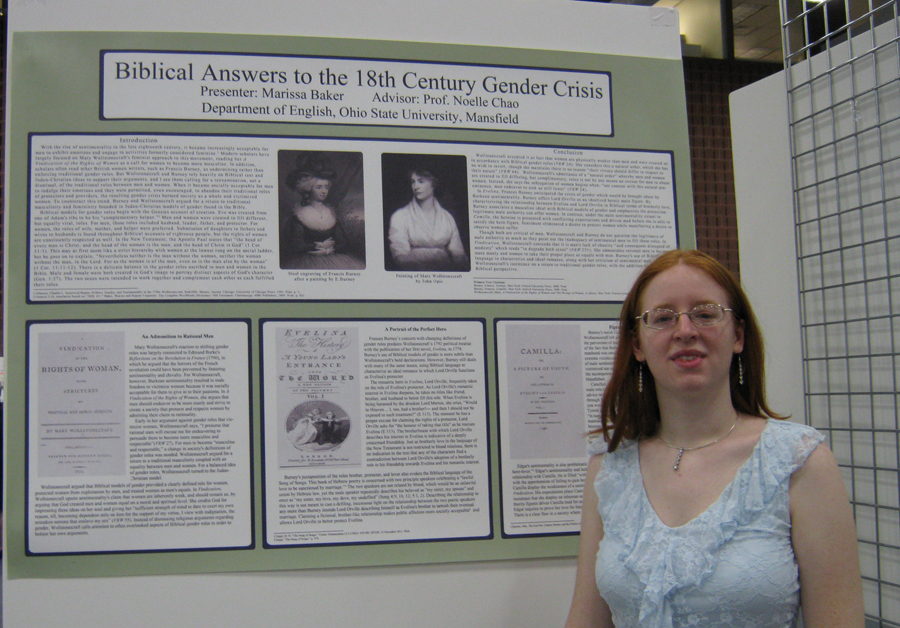
It’s no wonder, then, that when our professor asked me and one other student if we’d like to read more Burney in an independent study I said “yes.” We read Cecelia (1782) and Camilla (1796) – both weighing in at a solid 900+ pages. Then we branched out into Ann Radcliffe with The Romance of the Forest. That lead me to my first undergraduate research project titled “Unmanned Heroes: 18th Century Female Writers and Male Sentimentality. That turned into a 25-page research paper titled “Biblical Answers to the 18th Century Gender Crisis” (click on the title if you’d like to read this), which led me back to reading Evelina academically.
Reading "Evelina" for #ccwomenclassics | marissabaker.wordpress.com
Me at the Denman Undergraduate Research forum in 2012

Now, 4 years later, I’m back reading Evelina and enjoying it more than ever. Frances Burney was a fantastic (and, sadly, under appreciated) writer. Though Evelina was first published anonymously, Burney never hid the fact that she was a female writer. Her novels were quite popular with the general reading public and in artistic circles even during a literary age we often think of as belonging only to “dead white man.” Her style and success paved the way for writers like Jane Austen. In fact, Austen took her title Pride and Prejudice from a scene in Burney’s second novel, Cecilia, and when Austen’s father was seeking publication for that novel he described it as “about the length of Miss Burney’s Evelina.”

Comparing Burney to Austen (another favorite writer of mine), there are clear similarities, especially in Evelina. Both writers focus on a young woman who “marries up” by the end of the novel. Both critique society and social norms with a thinly-veiled sarcastic wit. But the differences are at times even more striking than the similarities. Nowhere in Austen will you find a scene like the one in Evelina when Captain Mirvan impersonates a highwayman and drags Madam Duval into a ditch where he terrifies her for sport. And, though Austen does have her Mr. Willoughbya and Mr. Wickhams, you’ll not find any of her main characters in situations so dangerous as Evelina’s.

Throughout the course of the novel, Evelina is persecuted by a man named Lovel, hounded and even kidnapped by Sir Clement, affronted by a staring Lord (in front of his fiancee), and rudely accosted by strange men at Vauxhall. To quote an essay by Judith Newton that appeared in a 1976 edition of Modern Language Studies, there are few places Evelina can go “without being forced, intruded upon, seized, kidnapped, or in some other way violated.” Newton describes this persecution as a “woman’s fate” once she entered into the marriage market in the 1700s, and points out that Burney “is one of the few writers in the century to take the discomfort of it seriously.”

Indeed, while I’ve frequently thought I might like to visit Jane Austen’s England, Burney’s is much less appealing. It’s populated with aggressive and vulgar people, the public places are unsafe without a large party and/or male protection, and it’s painfully obvious how vulnerable and option-less women were without family and fortune to their name. But it also feels more real. Sense and Sensibility came out in 1811 and Pride and Prejudice in 1813 – a scant 33 and 35 years after Evelina. Things had changed, but not that much. Much as I love Austen, I wonder if Burney was in some ways the braver novelist for calling out her contemporary society on its darker sides.click to read article, "Evelina: A Darker Look At Courtship" | marissabaker.wordpress.com
Click here to get a copy of Evelina. Please note that this is an affiliate link. This means that, at no additional cost to you, I will receive a commission if you click on the link and make a purchase.


A Little Princess and Cinderella

Last week, I compared A Secret Garden to my favorite fairy tale, Beauty and the Beast. The subject of this week’s Classics Club post, A Little Princess by Frances Hodgson Burnett, has fairy tale elements which are even more obvious.click to read "A Little Princess and Cinderella" | marissabaker.wordpress.com

It’s pretty much the exact same story as Cinderella — an only child whose sweet disposition is unaffected by being spoiled is left in the care of an unkind woman after her father’s unexpected death. The austere and jealous guardian transforms the girl into a servant who lives in an attic and makes friends with rodents and birds. Eventually, a wealthy man swoops in and rescues her (Tweet about it).

There are even jealous “step-sister” figures in the form of some of the girls at the school (we’re looking at you, Lavinia). And you could call Ram Dass a “fairy godmother” of sorts, since he transforms Sara’s dingy attic into a princess room simply because he notices she’s so kind and wants to do something nice for her. It’s a key fairy-tale trope — eventually Magic (or it’s human equivalent) will step in and set things right if only you’re a good person.

Read more

The Secret Garden and Beauty and the Beast

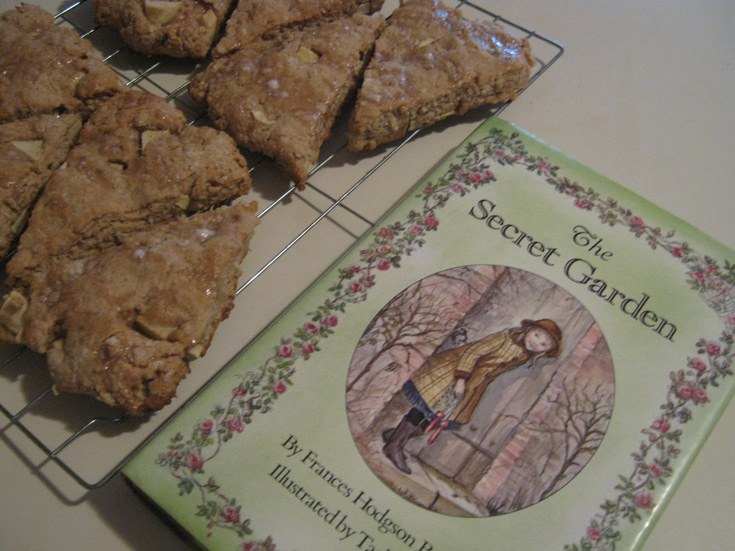
I suppose there might be better ways to spend a Sunday than baking scones, reading and blogging about books and watching Star Trek, but I really can’t think of any right now. They’re cinnamon apple oatmeal scones, and the books are by Frances Hodgson Burnett, and it’s classic Trek with Kirk, Spock and McCoy. Does it get any better?

The Secret Garden #ccwomenclassics | marissabaker.wordpress.com

Both The Secret Garden and A Little Princess are re-reads on my Classics Club book list. They were some of my favorite books as a child, and my sister and I watched the film adaptations over and over when we were younger. Since they also qualify for the Women’s Classic Literature event, I decided to make them my first classics reads for the new year.

I can’t tell you how much I wanted a secret garden. Actually, I never really outgrew that — I’m sure gardens surrounded by high stone walls covered with ivy are more alluring than ones just sitting out in the front yard where anyone can see them. That garden with its hidden door is probably why The Secret Garden was always my favorite of the two books. That and the fact that there were boy characters — books with just girls in them are nice, but books with boys and girls are better even when there isn’t a hint of romance. Read more

The Power of Fiction

The Power of Fiction | marissabaker.wordpress.com
bg image: “mountain of books” by Ginny, CC BY-SA

Fiction affects society, for good or ill, often as much or more than real-life situations. If Charles Dickens had lectured about the plight of real-life orphans in London, would it have had the same effect as writing Oliver Twist? Or to use an example I see as very negative, would as many people have been obsessed with an essay about BDSM as they were with 50 Shades of Gray?

Fiction is powerful. We talked about this a couple weeks ago, but all in a positive light since I was arguing that fiction has value. It can also have a more negative influence as well, which is why I think both writes and readers have a responsibility to self-censor. It’s not up to someone to tell writers not to write a certain kind of book or discuss a specific topic, or to tell readers what they can and cannot read. But it is a good idea (particularly if you’re a Christian) to think carefully about the reading and writing choices we make.

Writer Responsibility

On March 31, 1750, Samuel Johnson published what has become one of the most famous statements in regards to the potential of fiction. While I don’t agree with his arguments against imaginative invention of the fantastic (I write fantasy, after all), this passage intrigues me:

if the power of example is so great as to take possession of the memory by a kind of violence, and produce effects almost without the intervention of the will, care ought to be taken that, when the choice is unrestrained, the best examples only should be exhibited; and that which is likely to operate so strongly should not be mischievous or uncertain in its effects.”

I think what Johnson is saying is that authors have a responsibility not to use the power they weld to influence their readers negatively. Responsible authors exercise a form of self-censorship, which doesn’t necessarily mean they shouldn’t talk about complex or even “bad” ideas. But fiction can be enormously influential, and authors should be conscious of the fact that what they are writing has the potential to fill their readers’ minds.

Writers of fiction set out to create a story that draws readers in, and once this happens the readers are under the writer’s influence. Johnson thought that, “the best examples only should be exhibited” so that there is nothing “mischievous or uncertain” in fiction’s effect. I don’t think we need to go that far, but we should be mindful of the power we have to influence readers.

Reader Responsibility

As readers, we should also be mindful of what we expose our minds to, remembering that we’re giving our reading material the opportunity to change or influence our thinking. I came across a great article titled “Self Censorship Better Than Book Banning” a few weeks ago about teaching your children how to make good decisions about their reading material instead of trusting the schools or government to ban “inappropriate” books (which will be defined differently for each individual).

This is pretty much what my mother did, though I wasn’t required to talk about every book with her after reading it (I usually did anyway, so she didn’t really need a rule). The only time I remember my mother taking away a book was when I broke down sobbing one day and confessed that I was having trouble dealing with the main character losing her father to cancer. There were a few other books that she strongly recommended I give up, and I usually (eventually) agreed with her. Harry Potter was “banned” in our house when it first came out, and that’s the only book I can remember being specifically told not to read.

It seems to have worked for the most part. There are books I wish I hadn’t read (and a few I’m sure that I really I shouldn’t have been reading), but for the most part I’m glad I had that freedom. It helped teach me to think for myself, which, to reference John Keating from Dead Poets Society, is the goal of good education.

Why I Sponsor Children

“I’d like to help, but …”

photo from Unbound.org

We fill-in-the-blank with a wide variety of things for a whole host of reasons, but today I want to talk about giving to charities. I saw a discussion on an INFJ Facebook group several months ago asking which charities other INFJs support. INFJs are considered one of the “save the world” personality types, as evidenced by the fact that two of the most famous INFJs were Mother Theresa and Gandhi. Many of the INFJ profiles you’ll read online talk about how INFJs often find work in non-profits and support charities. But even among a group of INFJs, there were plenty of people talking about the fact that they never donate to anything.

Now, there are perfectly understandable reasons for not giving money and I would never suggest you donate money that you don’t have. But if you have the means and desire to help, excuses like “I don’t trust charities” or “I don’t have the time” don’t hold up well in my mind. You can donate your time and money within your own community so you can see exactly what effects your efforts are having. There are also charities with good reputations who use their money wisely — you just have to look for them. And after that initial time-outlay of finding a charity you like, getting online to send money takes about a minute.

Personally, I like to sponsor children. I use Unbound, but as far as I know Compassion International is a great option as well. This is the perfect fit for me for several reasons:

  • I’m making a difference now, on an individual level for this child and their family
  • I’m affecting the future, because children become the adults that shape their countries
  • I get to build a relationship with the people I’m helping, through letter-writing

I guess the main thing I want to do today is encourage you to think about the impact you’re having on this world for good. It can be in any number of ways — serving in our church groups, going out of your way to make someone smile, donating money or food stuffs, volunteering your time, sponsoring a child … the list just goes on and on. I want to leave you with a quote from C.S. Lewis that convicted me to start finding more ways to give, though I still think I fall short by these standards.

I do not believe one can settle how much we ought to give. I am afraid the only safe rule is to give more than we can spare. In other words, if our expenditure on comforts, luxuries, amusements, etc, is up to the standard common among those with the same income as our own, we are probably giving away too little. If our charities do not at all pinch or hamper us, I should say they are too small. There ought to be things we should like to do and cannot do because our charitable expenditure excludes them.”– C.S. Lewis, Mere Christianity

Baby, It’s Cold Outside

You might have noticed a lack of blog post last Monday. I’d been planning to write something about a book I recently read called A Return to Modesty by Wendy Shalit, but came down with pneumonia. The only reason there were posts on the past two Saturdays is that they were already written (it seems like whenever a Bible study comes together really well so I have an extra Sabbath post ready “just in case,” something comes up that gives me a reason to use it).

It’s been nearly two weeks now and I still don’t feel fully recovered (much better, though!). So instead of a thoughtful book review, I want to talk to you about a song that’s been stuck in my head. Or rather, a specific version of the song.

You’re no doubt familiar with the song “Baby It’s Cold Outside.” You might even have heard Idina Menzel and Michael Bublé’s new cover already, but if you haven’t seen the video yet please take a few seconds to at least glance at it, since that’s a big part of what I want to talk about.

Apparently they’ve tried to turn this song into a cute family-friendly version for the holidays. If you close  your eyes, though, it still sounds like a man trying to seduce a woman. But then you open your eyes and see a cute little pre-adolescent kids acting out the roles. In the words of Jubal Early, does that seem right to you?

In the original score, written in 1944 by Frank Loesser, the two singing parts are called “wolf” and “mouse,” with a male voice usually singing “wolf” and a female voice usually singing “mouse” (thought not always — did you know Joseph Gordon Levit could sing?). Actually, it turns out we can talk about Wendy Shalit’s book after all, since she mentions “Baby, It’s Cold Outside” in her modesty book.

Now this song is very stereotypical because certainly not all men are hungry wolves and not all women reticent mice. Indeed, I’ve known quite a few hungry woman and mousey men. However, the simple fact remains that a young woman in 1948 had a hundred and one reasons to say no to sex, if she wanted to say no, and those reasons were credible. The story we are told today is that all these reasons, such as a father waiting up for you, were oppressive to women. And yet in their absense we can appreciate how an earlier generation of girls was made powerful by them. (A Return to Modestly, p.55)

If she’d seen this music video, though, I’m not sure Miss Shalit would have put her discussion of it under the heading “Girls Who Can’t Say No” as a contrast between today’s culture and that of 1948 (the year Loesser sold the rights to MGM). I think she might have moved the discussion to one of the many passages in her book where she talks how much we as a culture sexualize our children. For one thing, she draws a parallel between assigning sex-education classes to younger and younger students and increasing levels of student-on-student sexual violence in schools.

The associative link between the disenchanting of sex and increased sexual brutality among children works like this: if our children are raised to believe, in the words of the New Jersey kindergarten teacher, that talking about the most private things is “no different from talking about an elbow,” they they are that much more likely to see nothing wrong in a certain kind of sexual violence. (A Return to Modestly, p.19)

Now, I’m not saying this cute little music video is going to lead to increased levels of sexual assault among children. Rather, it bothers me as part of a trend that portrays young children in more and more sexualized ways. Most people I know would hope their 10- or 11-year-olds didn’t understand what’s going on in this song — they wouldn’t be encouraging them to sing it. And if this little boy was older, I’m not sure which interpretation of the song this performance would make me lean towards. Does “mouse” want to stay but feels she should leave, and “wolf” is persuading her to do what she wants? Or is “mouse” really trying to get away, and “wolf” is blocking her escape? Depends on how you sing the song, and how you feel about the line “What’s in this drink?” that was cut from the video, but not the version on Idina Menzel’s CD.

Am I over-thinking this? Perhaps. But it saddens me how many people think this is just a cute little video and don’t seem to see the potential implications of two children singing what is a rather adult song. Sure they’re adorable and talented, but was it a good idea for the adults who were in charge of creating this music video to use them like this? I really don’t think so.