Isaiah Study: Replacing Fear With Joy

As we continue our now two-month study of Isaiah 40-66, I want to connect two of the themes I noted in my very first post at the start of this study. That list of themes included (among other things) “Reminders to ‘fear not!'” and “Joy in our relationships with God.” We already talked about joy in connection to the Sabbath covenant, but there’s a lot more joy here as well. These last 27 chapters of Isaiah record an extended dialog where God shares His feelings, desires, and plans for the future. A large part of those plans and desires have to do with working out wonderful things for His people. We have nothing to fear, and great cause for joy, when we’re in a relationship with God.

Fearless Joy for the Future

Isaiah wrote during a time of upheaval in his country. Israel fell to invading Assyrian armies and, while God delivered Judah for a time in response to righteous King Hezekiah’s prayer, Isaiah warned Jerusalem’s fall would come as well. We can understand why the people already in exile and those who knew captivity was coming might feel abandoned by God. At the same time, we can also see God’s perspective on that crisis–His rebuke for those who abandoned Him, His disgust for idolatry, His reminders of His power and justice, and His desire to dwell with and bless a people who follow Him faithfully. As part of His commitment to justice and salvation, He promises a New Covenant and a new type of relationship; one where He and His people won’t drift apart.

It’s really amazing. After all of the grief we put God through when we sin (Gen 6:5-6); after all the heartbreak of watching the people who covenanted with Him as His bride run off after other gods (Jer. 3:20; 5:7; Is. 54:4-8), He still loves us and wants a relationship with us. He wants that relationship so much Jesus died to replace the Old Covenant marriage with a better covenant and better promises (Rom. 7:1-6; Heb. 8:6-10).

The Lord Yahweh’s Spirit is on me,
    because Yahweh has anointed me to preach good news to the humble. …
    to comfort all who mourn,
to provide for those who mourn in Zion,
    to give to them a garland for ashes,
    the oil of joy for mourning,
    the garment of praise for the spirit of heaviness …

Everlasting joy will be to them.
“For I, Yahweh, love justice.
    I hate robbery and iniquity.
I will give them their reward in truth
    and I will make an everlasting covenant with them.”

Isaiah 61:1, 3,8, WEB

This section of Isaiah has a very hopeful, Messianic message. There are so many prophecies in here looking forward to Jesus’s first coming as well as His second coming. There’s a new covenant, a new marriage relationship, and a new earth that (from our perspective today) have already started happening and will reach fulfillment soon. By “soon” I mean in the same sense that the apostle John did when he said “these are the end times.” We don’t know exactly when Jesus will be back, but His coming is now “nearer to us than when we first believed” and we ought to be making ourselves ready. The promise of His coming should feel real to us, and we should react with fearlessness and joy, just as God’s people are told to do in Isaiah.
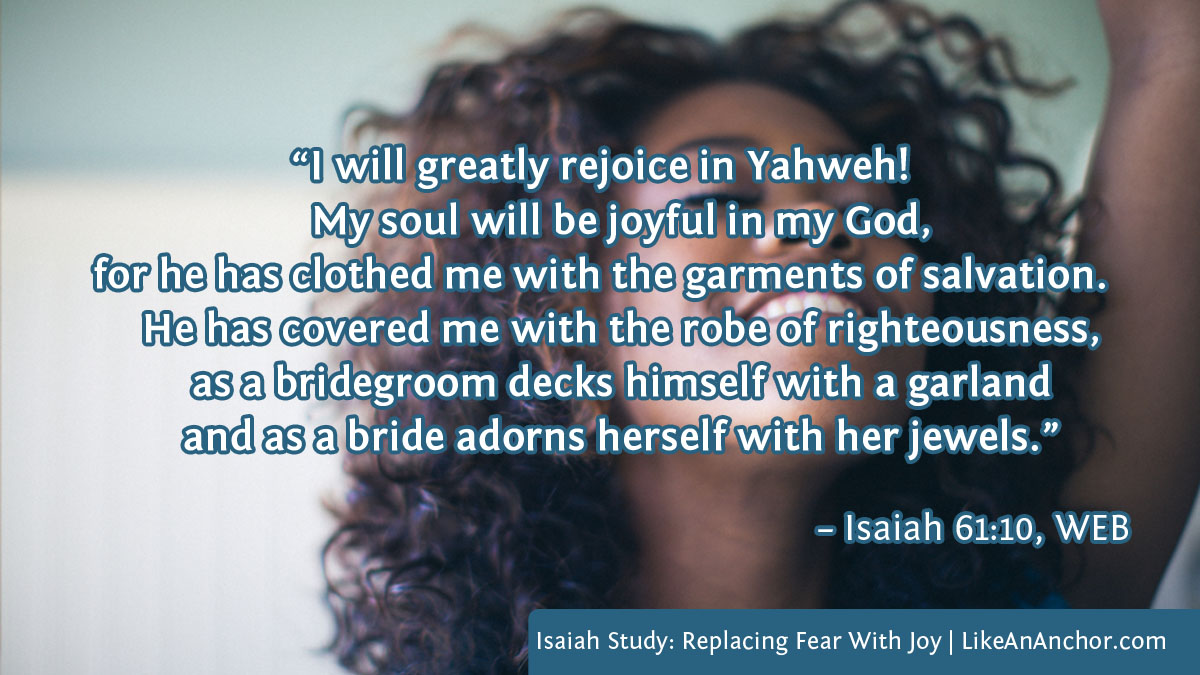
Image of a smiling woman worshiping overlaid with text from Isaiah 61:10, WEB: "I will greatly rejoice in Yahweh! My soul will be joyful in my God, for he has clothed me with the garments of salvation.   He has covered me with the robe of righteousness, as a bridegroom decks himself with a garland and as a bride adorns herself with her jewels.”
Image by Pearl from Lightstock

No Fear of Anyone Who’s Not God

Isaiah chapters 40-66 open with messages of comfort and punishment, a call to prepare the way for the Lord (a prophetic passage pointing to John the Baptist declaring the Messiah), and reminders of God’s sovereignty. He’s incomparable, irreplaceable, and all powerful. Knowing this about God should make us treat Him with the sort of respect, awe, and reverence that’s often called “fearing the Lord.” Knowing that this powerful One calls us His people and promises to help us also gives us joy and confidence. When we fear God, we don’t need to fear anything or anyone else.

“‘You are my servant, I have chosen you and have not cast you away.’
Don’t you be afraid, for I am with you.
    Don’t be dismayed, for I am your God.
    I will strengthen you.
    Yes, I will help you.
    Yes, I will uphold you with the right hand of my righteousness. …
For I, Yahweh your God, will hold your right hand,
    saying to you, ‘Don’t be afraid.
    I will help you.’
Don’t be afraid, you worm Jacob,
    and you men of Israel.
    I will help you,” says Yahweh.
    “Your Redeemer is the Holy One of Israel”

Isaiah 41:9-10, 13-14, WEB

Similar wording shows up again and again in this section of Isaiah. The words, “Don’t be afraid, for I have redeemed you. … Don’t be afraid, for I am with you,” also come with a reminder that Yahweh created us and He is our God (Is. 43:1, 5, WEB). Similarly, God reminds us that He is the only true God and Creator while saying, “Don’t fear, neither be afraid” to the people who say, “I am Yahweh’s … and honor the name of Israel” (Is. 44:8, 5, WEB). Again, God says, “Don’t be afraid, for you will not be ashamed. Don’t be confounded, for you will not be disappointed” as He promises, “my loving kindness will not depart from you, and my covenant of peace will not be removed” (Is. 54:4, 10 WEB).

God doesn’t ask us to pretend the bad things never happened, just like He didn’t pretend Israel wasn’t going through terrible times. Instead, He says in Isaiah 51, “Yahweh has comforted Zion … and I will establish my justice for a light to the peoples.” He promises, “my salvation will be forever, and my righteousness will not be abolished” (Is. 51:3, 4, 6, WEB). He also asks why we would fear any oppressor when the God of the universe is on our side? He could stretch out the heavens and break the seas; why wouldn’t He be able to deliver? Why would we doubt His promise that “Those ransomed by Yahweh will return, and come with singing to Zion. Everlasting joy shall be on their heads. They will obtain gladness and joy. Sorrow and sighing shall flee away”? (Is. 51:11, WEB).
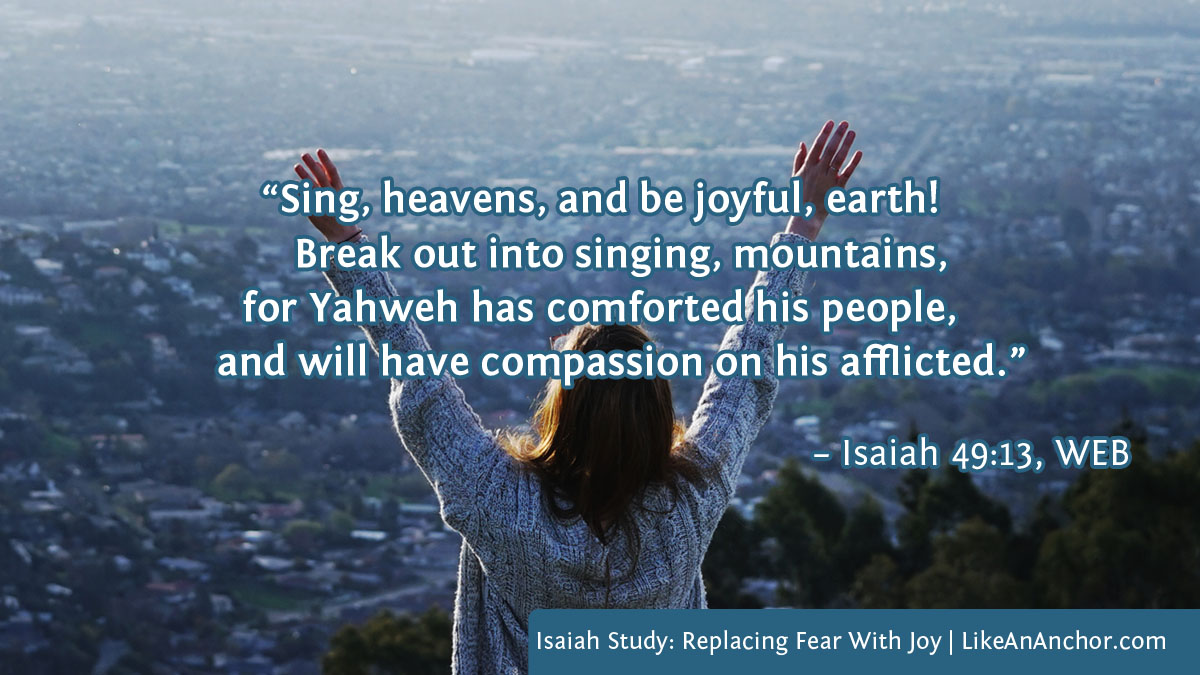
Image of a smiling woman worshiping overlaid with text from Isaiah 49:13, WEB: “Sing, heavens, and be joyful, earth! Break out into singing, mountains,
for Yahweh has comforted his people, and will have compassion on his afflicted.”
Image by Ruby-Rose from Lightstock

The Joy of Salvation

As we look more closely at the declarations of joy in this part of Isaiah, we see that it’s connected with God’s power and deliverance over and over again. We “shout joyfully” to “give the Lord the honor he deserves” (Is. 42:11-12, WEB). Messengers are told to shout with joy as they proclaim that God is on His way with deliverance and salvation (Is. 48:20-21; 52:7-9). God assures His people that there’s no way He’ll get them to the point of deliverance and then fail to follow-through. Rather, His “servants will rejoice” and “sing for joy of heart” (Is. 65:13-19; 66:9-11).

Image of a man sitting on a beach next to a Bible with the blog's title text and the words "We have nothing to fear, and great cause for joy, when we're in a relationship with God."
Image by Aaron Kitzo from Pixabay

For as the rain comes down and the snow from the sky,
    and doesn’t return there, but waters the earth,
    and makes it grow and bud,
    and gives seed to the sower and bread to the eater;
so is my word that goes out of my mouth:
    it will not return to me void,
    but it will accomplish that which I please,
    and it will prosper in the thing I sent it to do.
For you shall go out with joy,
    and be led out with peace.
The mountains and the hills will break out before you into singing;
    and all the trees of the fields will clap their hands.

Isaiah 55:10-12, WEB

Joy and salvation are connected several times in the Old Testament’s more poetic writings. David wrote, “My soul shall be joyful in Yahweh. It shall rejoice in his salvation” (Ps. 35:9, WEB). After David sinned, his repentant prayer included the request, “Restore to me the joy of your salvation” (Ps. 51:12, WEB). Earlier in Isaiah, he writes about joyfully drawing water “out of the wells of salvation” (Is. 12:3, WEB). Similarly, Habakkuk declares, “I will be joyful in the God of my salvation!” (Hab. 3:18, WEB). This link between joy and salvation is essential for understanding God’s commands to rejoice. Even if there are things in our lives that might make joy seem impossible, they can never negate the deep, lasting joy that comes from knowing God saves us.

The promise of joy and salvation includes everyone who responds to God’s invitation to join His family. In Isaiah, God speaks to “the foreigners who join themselves to Yahweh” and “everyone who keeps the Sabbath from profaning it, and holds fast my covenant.” The promise isn’t exclusive; God welcomes everyone who wants “to serve him, and to love Yahweh’s name, to be his servants.” For these people, God promises, “I will bring these to my holy mountain, and make them joyful in my house of prayer.
Their burnt offerings and their sacrifices will be accepted on my altar; for my house will be called a house of prayer for all peoples” (Is. 56:6-8, WEB). That’s an amazing promise, and it’s one that we get to be part of today.

Featured image by Inbetween from Lightstock

Isaiah Study: The Potter and the Clay

As we continue our study of Isaiah 40-66, I want to look at an analogy that’s also used earlier in this book and by the prophet Jeremiah. If you go back and read the first post in this Isaiah study, you’ll see one of the key themes that I wanted to study more was “God as a potter, with us as His clay.” To dig into this analogy deeply, it’s helpful to look at the other messages God gave His prophets using the same word picture.

God’s description of Himself as the Potter and us as His clay also links to some other themes we’ve looked at in this series. Because God is Incomparable and Irreplaceable, He has the power to do what He likes with His creation. Part of what He’s doing relates to The Contrast Between Righteousness and Wickedness and The Lord’s Desire for Justice. He’s working with us to shape us the way that a potter works with clay to turn it into something beautiful and useful.

Danger in Disrespecting the Potter

The first time God describes Himself as a potter in Isaiah is in chapter 29. This passage comes before the section we’ve been studying, but it’s a message to the same people and gives us important background for the theme we’re looking at today.

The Lord says,
“These people say they are loyal to me;
they say wonderful things about me,
but they are not really loyal to me.
Their worship consists of
nothing but man-made ritual.
Therefore I will again do an amazing thing for these people—
an absolutely extraordinary deed.
Wise men will have nothing to say,
the sages will have no explanations.”
Those who try to hide their plans from the Lord are as good as dead,
who do their work in secret and boast,
“Who sees us? Who knows what we’re doing?”
Your thinking is perverse!
Should the potter be regarded as clay?
Should the thing made say about its maker, “He didn’t make me”?
Or should the pottery say about the potter, “He doesn’t understand”?

Isaiah 29:13-16, NET

This passage is an indictment against people who think they know better than God. They’re arrogant. They substitute their own rituals for the type of worship God commanded and they think their plans are so clever God won’t figure them out or try to stop them. This is the same attitude that Jesus rebuked the Pharisees and experts in religious law for having when He came to earth the first time (Mark 7:2-13).

It’s a trap we can fall into as well. If God tells us to do something and we decide that something else would be better, then we’ve become disloyal to God. We’ve become like pottery telling the potter He didn’t make us and He doesn’t understand what’s best for us. It’s insane, and yet we try this all the time. We think, “Well, maybe God didn’t really mean it like that.” Or we say, “Yeah, but if He knew what my life’s like He’d make an exception.” Or maybe, “Sure He said that then, but this will work better now.” It’s is a very dangerous attitude.

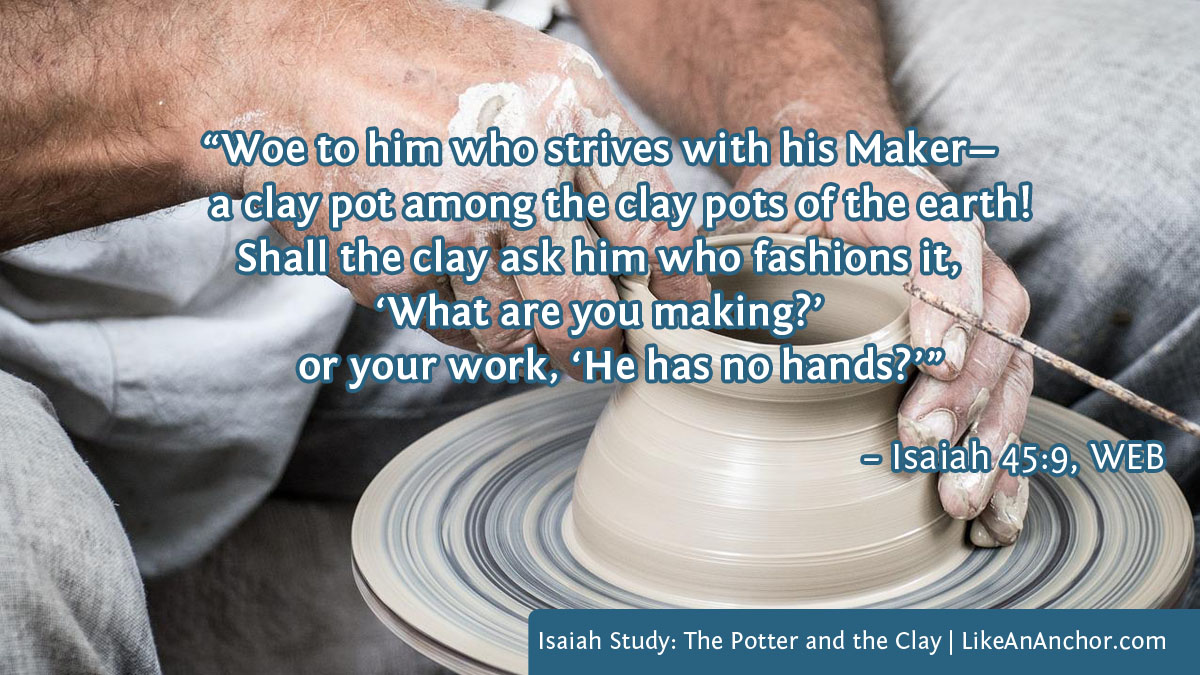
One who argues with his Creator is in grave danger,
one who is like a mere shard among the other shards on the ground!
The clay should not say to the potter,
“What in the world are you doing?
Your work lacks skill!”
Danger awaits one who says to his father,
“What in the world are you fathering?”
and to his mother,
“What in the world are you bringing forth?”
This is what the Lord says,
the Holy One of Israel, the one who formed him,
concerning things to come:
“How dare you question me about my children!
How dare you tell me what to do with the work of my own hands!
I made the earth;
I created the people who live on it.
It was me—my hands stretched out the sky.
I give orders to all the heavenly lights.

Isaiah 45:9-12, NET

I quoted this chapter early on my Isiah study as well, in the post titled “God is Incomparable and Irreplaceable.” Here, God says, “I am Yahweh, and there is no one else. Besides me, there is no God” (Is. 45:5, WEB). He’s the Creator who made human beings, invited us into covenant relationship with Him, and makes plans that will surely come to fruition. He’s not a human who makes mistakes, or tells lies, or says they’ll do something then can’t follow through. And even though He loves us deeply, there is danger in disrespecting and underestimating Him. As His creation, we need to respect the Creator and remember how we fit into the universe.

God’s Right to Shape the World

Isaiah isn’t the only Bible writer to use a pottery analogy. During Jeremiah’s ministry, God sent him to watch a potter working. Jeremiah went to the potter’s house as instructed and watched as the clay the potter worked with became misshaped, so the potter reworked it into a different type of vessel. As Jeremiah looked on, God spoke to him.

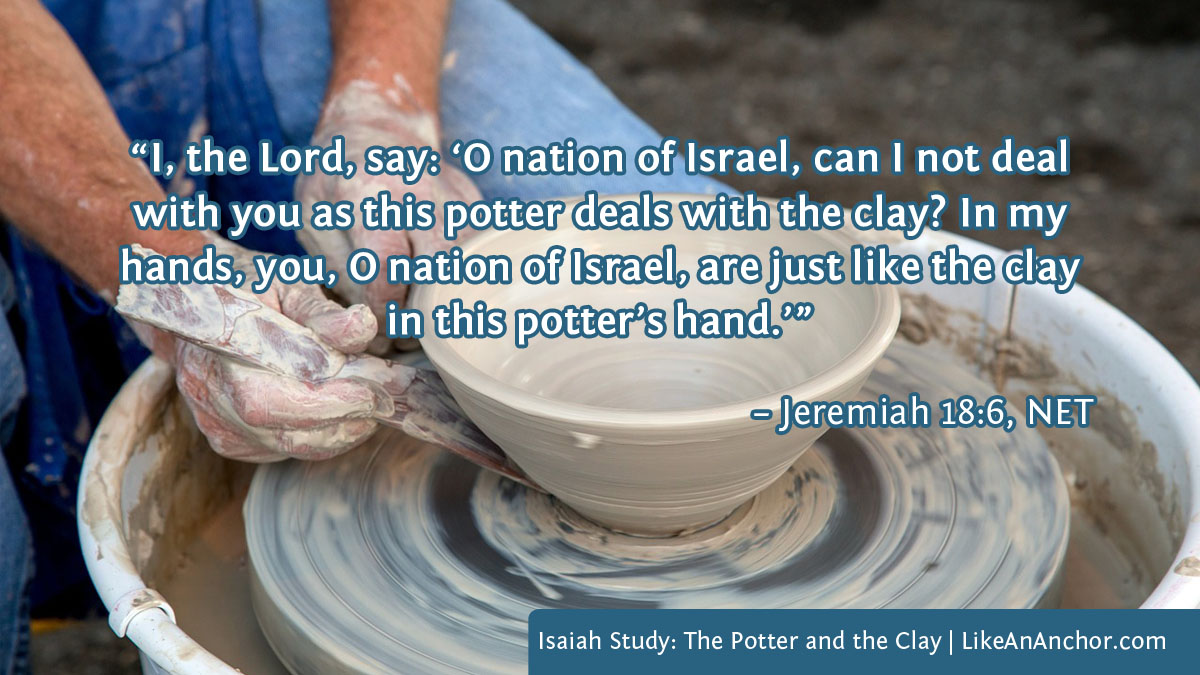
Then Yahweh’s word came to me, saying, “House of Israel, can’t I do with you as this potter?” says Yahweh. “Behold, as the clay in the potter’s hand, so are you in my hand, house of Israel. At the instant I speak concerning a nation, and concerning a kingdom, to pluck up and to break down and to destroy it; if that nation, concerning which I have spoken, turns from their evil, I will repent of the evil that I thought to do to them. At the instant I speak concerning a nation, and concerning a kingdom, to build and to plant it; if they do that which is evil in my sight, that they not obey my voice, then I will repent of the good with which I said I would benefit them.”

Jeremiah 18:5-10, WEB

God has the absolute right to dispense His justice according to His righteousness. If you remember the article from a couple weeks ago, “Isaiah Study: The Lord’s Desire for Justice,” then you’ll recall that God’s justice involves His governing authority, His desire to make things right in the world, His law, and His offer of salvation. Like a potter has the authority to turn clay into a simple bowl, a practical cup, or an elaborate vase, so does God have the authority to shape the future. We have free will, yes, but the choices we make are contextualized by God’s decisions about how the world works.

You will say to me then, “Why does he still find fault? For who has ever resisted his will?” But who indeed are you—a mere human being—to talk back to God? Does what is molded say to the molder, “Why have you made me like this? Has the potter no right to make from the same lump of clay one vessel for special use and another for ordinary use?

Romans 9:19-21, NET (bold italics a quotation from Isa 29:1645:9)

The context for this statement is Paul explaining how Israel and the Gentiles fit into the New Covenant (Rom. 9-11). Though we’re not getting into that topic today, the statement is one we’d do well to ponder. God’s authority does not negate our own free will nor excuse us from our responsibility to live in accordance with His law. If we ever feel like He’s not being fair or He did something wrong, the problem lies in our limited perception.

When you think about it, it’s the height of arrogance to think that just because we don’t understand what God’s doing that He’s wrong to do it. While it’s often challenging to trust God with the future, it’s something we need to do for our own sanity if nothing else. “One who quarrels with his Maker, like a pot among the pots of the earth” is not going to have peace (Is. 45:9, TLV).

Walking in the Potter’s Ways

God doesn’t ask anything unreasonable or mysterious from us. It’s just that our human reasoning and arrogance get in the way of us accepting His sovereignty and trusting Him with our futures. Even as I write this, a small part of me bristles at the idea of someone else telling me, “Here’s how the world works, so here’s how you should live your life.” Mostly, though, knowing that God’s expectations are clear is a relief.

He has told you, O man, what is good,
and what the Lord really wants from you:
He wants you to carry out justice, to love faithfulness,
and to live obediently before your God.

Micah 6:8, NET

It’s kind of weird–usually I find it comforting to know God’s in control and that He shows me how to live a good life, yet there are still times part of me wants to go my own way. Paul talked about a similar struggle in Romans; our “fleshy” human desires conflict with the spirit-filled life we’re called to live (Rom. 7:1-8:4). That pull between flesh and spirit–between our “old man” and the new work God’s doing in us –is something every Christian battles. We can win this fight with God’s help, though, and “the righteous requirement of the law may be fulfilled in us, who do not walk according to the flesh but according to the Spirit” (Rom. 8:4, NET). Then, we’ll be working with the Potter instead of resisting His work.

You meet him who rejoices and does righteousness,
    those who remember you in your ways.
Behold, you were angry, and we sinned.
    We have been in sin for a long time.
    Shall we be saved?
For we have all become like one who is unclean,
    and all our righteousness is like a polluted garment.
We all fade like a leaf;
    and our iniquities, like the wind, take us away.
There is no one who calls on your name,
    who stirs himself up to take hold of you;
for you have hidden your face from us,
    and have consumed us by means of our iniquities.

But now, Yahweh, you are our Father.
    We are the clay and you our potter.
    We all are the work of your hand.
Don’t be furious, Yahweh.
    Don’t remember iniquity forever.
Look and see, we beg you,
    we are all your people.

Isaiah 64:5-9, WEB

This is the final section of Isaiah that talks about God as a Potter. Here, Isaiah shows the right way for us to respond to God as He works with, molds, and shapes us. We need to remember, as God does, that we’re made of clay and dust (Job 10:9; Ps. 103:14). No matter how much we might think of ourselves, we’re still little compared to God. We don’t know the future and our ideas about what should happen aren’t always right. We need to trust our Creator to work things out for the best and to work with us to make us our best. If we’ve done something that “misshapes” us in God’s hands, we can still choose to come back to Him for loving correction. He’ll meet those who seek righteousness where they are and then keep working with us to shape us into something beautiful.

Featured image by Inbetween from Lightstock

Isaiah Study: Are We Ever Abandoned By God?

The answer to this title’s question might seem obvious. Some people will read, “Are we ever abandoned by God?” and immediately say, “Of course not!” And yet for others, the opposite answer might seem equally obvious. Many people feel like God abandons them, at least part of the time, and others feel like He’s never really been there at all. We know intellectually that God sees all and says He never leaves us, but sometimes it might still feel like we’ve been abandoned.

The good Christians answer to this conundrum is summed up in the famous footprints poem. We might feel like God has left us alone during the worst times of our lives. However, if we imagine the record of our lives as footprints in sand and see only one set during trying times, then we shouldn’t think God left us to walk alone. As the poem’s final line says, “When you saw only one set of footprints, / It was then that I carried you.”

I love this poem and I think there’s a lot of truth in it. However, it’s not the only answer to why some people feel like God is far away. There are times when He is right alongside us but we have trouble seeing Him because our trials are so bad. Others times, though, He seems distant because we’ve pushed Him away. He hasn’t abandoned us in that sort of situation, but we might not be walking near Him anymore. It’s this second scenario that we’re going to focus on today as we continue our study of Isaiah.

Over the last couple months, we’ve been studying themes in Isaiah 40-66. These are the last 27 chapters of the book, and they’re a record of an extended dialog where God speaks candidly about His feelings, desires, and plans. If you go back and read the very first post, you’ll see I made a list of key themes for further study. That list included “Covenant faithfulness; God never abandons His people” and “Sins push God away from us and we need to own-up to that.” These two points might seem contradictory, but studying Isaiah helps us see how both are accurate.

Image of a woman studying her Bible overlaid with text from Isaiah 60:10, 15, NET version: “Even though I struck you down in my anger, I will restore my favor and have compassion on you. ...
You were once abandoned and despised, with no one passing through, but I will make you a permanent source of pride and joy to coming generations.”
Image by MarrCreative from Lightstock

Sins that Lead To Separation

In Isaiah’s time, Israel was in the midst of a “stormy period marking the expansion of the Assyrian empire and the decline of Israel” that eventually led to “captivity at the hands of Babylon” (“Intro to Isaiah” from the NIV Study Bible). The people of Israel probably thought they had good reason to accuse God of abandoning them. How could He let this happen? Where did He go? God answers this question here in Isaiah 40-66.

Look, the Lord’s hand is not too weak to deliver you;
his ear is not too deaf to hear you.
But your sinful acts have alienated you from your God;
your sins have caused him to reject you and not listen to your prayers.
For your hands are stained with blood
and your fingers with sin;
your lips speak lies,
your tongue utters malicious words.
No one is concerned about justice;
no one sets forth his case truthfully.
They depend on false words and tell lies;
they conceive of oppression
and give birth to sin.

Isaiah 59:1-4, NET

The problem isn’t God. It’s with the people who stopped aligning themselves with His just character. They feel rejected and abandoned by God because they first rejected and abandoned Him. They alienated Him by embracing sins, injustice, lies, and oppression. They left Him like an unfaithful wife running off and having sex with other men. Finally, God had enough. He wanted a divorce–an end to this particular covenant He had with Israel.

This is what the Lord says:
“Where is your mother’s divorce certificate
by which I divorced her?
Or to which of my creditors did I sell you?
Look, you were sold because of your sins;
because of your rebellious acts I divorced your mother.
Why does no one challenge me when I come?
Why does no one respond when I call?
Is my hand too weak to deliver you?
Do I lack the power to rescue you?
Look, with a mere shout I can dry up the sea;
I can turn streams into a desert,
so the fish rot away and die
from lack of water.
I can clothe the sky in darkness;
I can cover it with sackcloth.”

Isaiah 50: 1-3, NET

From God’s perspective, Israel was the one who wasn’t responding. They’re the ones who left Him. In another part of Isaiah 40-66, God says, “you burdened me with your sins; you made me weary with your evil deeds” (Is 43:24, NET). Their evils were so terrible that God says He could not relent from His judgement on them (Is. 57). That did not, however, mean there was no hope. As we learn here in Isaiah as well as other prophecies, God already had plans to set up a new covenant. The author of Hebrews says that God found fault with the people He’d made the first covenant with and so He decided to set up a better covenant based on better promises (Heb. 8:7-13). We’ve seen the fulfilment of this prophecy already, when Jesus Christ came to earth.

Image of a man reading a Bible overlaid with text from Isaiah 59:1-2, 20 WEB: "Behold, Yahweh’s hand is not shortened, that it can’t save; nor his ear dull, that it can’t hear. But your iniquities have separated you and your God, and your sins have hidden his face from you, so that he will not hear. ... 
A Redeemer will come to Zion, and to those who turn from disobedience in Jacob.”
Image by Anggie from Lightstock

Reconciliation and Remarriage

In Isaiah, God’s promise of a new covenant is closely connected to the Servant Song prophecies pointing ahead to the Messiah, Jesus Christ. Two of these describe Him as “a covenant for the people” (Is. 42:6; 49:8). The Messiah ushers in a New Covenant, and the promise of His coming reinforces the promise that God will not abandon His people permanently. The punishment and separation were only temporary. There’s a way to fix it, and God promised to do just that.

“Don’t be afraid, for you will not be put to shame.
Don’t be intimidated, for you will not be humiliated.
You will forget about the shame you experienced in your youth;
you will no longer remember the disgrace of your abandonment.
For your husband is the one who made you—
the Lord of Heaven’s Armies is his name.
He is your Protector, the Holy One of Israel.
He is called ‘God of the entire earth.’
Indeed, the Lord will call you back
like a wife who has been abandoned and suffers from depression,
like a young wife when she has been rejected,” says your God.
“For a short time I abandoned you,
but with great compassion I will gather you.”

Isaiah 54:4-7, NET

Notice the marriage imagery here that’s undoing the divorce we saw earlier. The one who created us, our Husband, is the one redeeming us from the death penalty of sin and welcoming us into a new marriage covenant. Along with that, He gives us a new name that we talked about in more detail a few weeks ago in the article on the “new thing” God is doing.

You will be called by a new name
that the Lord himself will give you.
You will be a majestic crown in the hand of the Lord,
a royal turban in the hand of your God.
You will no longer be called, “Abandoned,”
and your land will no longer be called “Desolate.”
Indeed, you will be called “My Delight is in Her,”
and your land “Married.”
For the Lord will take delight in you,
and your land will be married to him. …

They will be called, “The Holy People,
the Ones Protected by the Lord.”
You will be called, “Sought After,
City Not Abandoned.”

Isaiah 62:2-4, 12

As we read through this story of divorce and marriage; of separation and reconciliation, we see that for a short time God did “abandon” His people. That abandonment wasn’t a real/permanent situation, though, and it was prompted by them abandoning Him first. He was so committed to fixing this breach between Himself and His people that Jesus came and died for us. That’s how even in the midst of discussing the truth that sin separates us from Him, God can also say, “I will not forsake them,” ” my covenant of peace will not be removed,” and “I will make an everlasting covenant with you” (Is. 41:17; 42:16; 54:10; 55:1-3). In the same section of scripture where He describes where the separation came from (our sins), God also shows where the reconciliation comes from.

Image of a smiling woman with her hand raised in worship overlaid with text from Isaiah 54:10, WEB: “’For the mountains may depart, and the hills be removed;
but my loving kindness will not depart from you, and my covenant of peace will not be removed,’ says Yahweh who has mercy on you.”
Image by Pearl from Lightstock

Never Abandoned

You might be wondering what this dramatic story laid out in Isaiah has to do with us today. We’re living about 2,000 years past the start of the New Covenant. We were never literally part of this first covenant marriage, divorce, and new covenant reconciliation that ancient Israel went through; we started out as part of the New Covenant. This is still the history of our faith, though. We’re part of the whole grand love story that God is writing, even though we come in near the end.

We can see the grand metanarratives outlined through the Bible play out on a smaller scale in our individual lives as well. If we push God away and reject His covenant, we can read the words written to ancient Israel in Isaiah’s time and realize that we’re the ones who cause our disconnect from God. Then we can also read the encouraging reconciliation passages, and realize that God wants us to come back to Him. He has not abandoned us and He will not leave us alone–He wants us in a relationship with Him even if we’ve messed up and need to ask His forgiveness when we come back.

Image of a man sitting on a beach with the blog's title text and the words "When God talks about abandoning His people, it’s always temporary and He’s not the one who walks away first. He wants us in a relationship with Him even if we've messed up and need to ask His forgiveness when we come back."
Image by Aaron Kitzo from Lightstock

“Turn your ear, and come to me.
    Hear, and your soul will live.
    I will make an everlasting covenant with you, even the sure mercies of David.” …

Seek Yahweh while he may be found.
    Call on him while he is near.
Let the wicked forsake his way,
    and the unrighteous man his thoughts.
Let him return to Yahweh, and he will have mercy on him,
    to our God, for he will freely pardon.

Isaiah 55:3, 6-7, WEB

God values law, righteousness, and judgement, yet connected with all of that comes His love of justice, mercy, and reconciliation. He’s grieved when we sin, which causes separation, and He’s overjoyed when we repent and come back. Like the compassionate father in Jesus’s parable who ran to meet his prodigal son (Luke 15:11-32), God is eager to welcome us back into a relationship with Him. He intends for the covenant we’ve entered with Him to be an everlasting one.

Near the beginning of this post, I quoted the start of Isaiah 59: “Behold, Yahweh’s hand is not shortened, that it can’t save; nor his ear dull, that it can’t hear. But your iniquities have separated you and your God, and your sins have hidden his face from you, so that he will not hear” (Is. 59:1-2, WEB). If you keep reading through to the end of that chapter, you come to this statement about a redeemer:

“A Redeemer will come to Zion,
    and to those who turn from disobedience in Jacob,” says Yahweh.

“As for me, this is my covenant with them,” says Yahweh. “My Spirit who is on you, and my words which I have put in your mouth shall not depart out of your mouth, nor out of the mouth of your offspring, nor out of the mouth of your offspring’s offspring,” says Yahweh, “from now on and forever.”

Isaiah 59:20-21, WEB

God wants us to be in such a close relationship with Him that we’ll never feel abandoned. As Jesus said when He told His disciples that He would send them the Holy Spirit, “I will not leave you orphans. I will come to you” (John 14:18, WEB). When we’re keeping covenant with God, there’s such a close relationship that His spirit dwells inside us. And if we have drifted away, we can repent and come back to the close relationship that God offers His beloved people.

I also want to mention that there are times we may feel abandoned by God even when we haven’t done anything wrong. Jesus lived a perfect, sinless life and when He hung on the cross He cried out, “My God, my God, why have you forsaken me?” (Matt. 27:46; Mark 15:34). God the Father did not abandon Jesus, but Jesus was in so much agony that it felt as if He were alone and He raised His voice in an anguished lament. Sometimes that’s how we feel, too. In those times, we can take comfort in the fact that Jesus empathizes with this feeling and that God has not truly abandoned us (Heb. 4:14-16; 13:5-6). His promises of help and redemption still apply, and He will make good things happen for us in the end.

Featured image by Inbetween from Lightstock

Song Recommendation: “I Am Not Alone” by Kari Jobe

Isaiah Study: The Lord’s Desire for Justice

Since starting a university master’s program two years ago, I’ve participated in several diversity trainings and class assignments that prompted us to evaluate our core values. One thing I realized is that while a buzz-word like “equity” just makes me feel tired since I’ve heard it so much, the idea of “justice” stirs a deep desire for things in the world to be right. I think many of us (perhaps even most of us) want fairness and justice. We feel there’s a way things should be, and we’re irritated when that isn’t the case. We hate injustice, especially if it’s directed at us but often if we see it happening to others as well.

In Mere Christianity, C.S. Lewis proposes that our sense of right and wrong is a clue pointing to God’s existence and revealing His nature. Even in our modern age of moral relativism, people still have some idea of how the world “should” be (though different groups often dramatically disagree about what that looks like). Many of us still have in mind “some kind of Law or Rule of fair play or decent behaviour or morality or whatever you like to call it” (Lewis) that hints at a larger ideal to strive toward. Lewis expands on this recognition of a need for justice when he talks about his time as an atheist.

My argument against God was that the universe seemed so cruel and unjust. But how had I got this idea of just and unjust? A man does not call a line crooked unless he has some idea of a straight line. What was I comparing this universe with when I called it unjust? If the whole show was bad and senseless from A to Z, so to speak, why did I, who was supposed to be part of the show, find myself in such violent reaction against it? …

Of course I could have given up my idea of justice by saying it was nothing but a private idea of my own. But if I did that, then my argument against God collapsed too— for the argument depended on saying that the world was really unjust, not simply that it did not happen to please my private fancies. Thus in the very act of trying to prove that God did not exist—in other words, that the whole of reality was senseless—I found I was forced to assume that one part of reality—namely my idea of justice—was full of sense

C.S. Lewis, Mere Christianity, Chapter 1

Lewis maintains that knowledge of justice points to the existence of a God who embodies justice, and the Bible supports that. Scripture reveals that God is deeply concerned with justice and that it’s one of His driving motivations. This shows up clearly in Isaiah 40-66, the passage of scripture we’ve been studying over the past couple months. These last 27 chapters of Isaiah record a message from God where He speaks candidly about His desires, motivations, and plans. If you go back and read the very first post, you’ll see I made a list of key themes from this section of scripture to study more extensively. One of those themes was that “God is motivated by justice.”

Image of an oasis in a desert overlaid with text from Isaiah 40:27-29, WEB: "“Why do you say, Jacob, and speak, Israel, ‘My way is hidden from Yahweh, and the justice due me is disregarded by my God?’ Haven’t you known? Haven’t you heard? The everlasting God, Yahweh, the Creator of the ends of the earth, doesn’t faint. He isn’t weary. His understanding is unsearchable. He gives power to the weak. He increases the strength of him who has no might.”
Image by HarveyMade from Lightstock

Justice, Righteousness, and Judgement

“Justice” is a complex word when we’re working with Hebrew to English translations. In the King James Version, “justice” appears 5 times in this section of Isaiah and it’s translated from tsedeq (H6664 and H6664); a word that WEB translates “righteousness.” In the WEB translation, “justice” is used 14 times and it’s translated from mishpat (H4941), which the KJV translates as “judgment.” So we have two Hebrew words here, and three different English translations. That’s not really surprising if you’ve compared Old Testament translations or studied Hebrew even a little bit. Hebrew has a smaller pool of available words than English, and relies on context and word pictures to paint pictures that we might use half a dozen English words to express.

When I’m trying to understand the nuances of a Hebrew word, I like to look it up in the Theological Wordbook of the Old Testament (TWOT). This resource says the root word for tsedeq “basically connotes conformity to an ethical or moral standard” (entry 1879). It has to do with justice and “rightness,” and it’s connected to righteously living in accordance with God’s law. It’s also closely connected with God. He is righteous and just, and so His commands are as well. The TWOT says there’s a “forensic” and legal aspect to tsedeq. When people break His commands, God is righteous to punish them for it. He is also righteous when He provides “salvation as vindication,” acting to clear our names in a legal sense.

Mishpat and its root shapat (TWOT entry 2443) are concerned with “the process of government.” While shapat is often translated “judge,” it really includes all the functions of a proper government–not just what we think of as the “judicial branch.” It’s also closely connected with a ruler; the law and the one giving the law aren’t separated the way we do today. God’s role as ruler, judge, and lawgiver are all connected. When we see mishpat translated “justice,” that’s the best word available in English to represent a concept with “at least thirteen related, but distinct, aspects of the central idea” related to judicial government, authority, and legislation (TWOT entry 2443c). In connection with God, justice involves “the just claims of God. God, who is Lord, can demand and He does demand” (Koehler, qtd. in TWOT). God wants things to be right in the world, and He’s the one who tells us what right, just, and correct looks like.

Image of a woman with her arms raised in worship overlaid with text from Psalm 987:1-2, WEB translation: "Yahweh reigns! Let the earth rejoice! Let the multitude of islands be glad! Clouds and darkness are around him. Righteousness (tsedeq) and justice (mishpat) are the foundation of his throne."
Image by Ruby-Rose from Lightstock

The Justice-Bringing Messiah

That was a long introduction, but it gives us a lot to think about in regards to justice. While justice does involve our ideas of fairness and what’s right, it’s also more than that. In the Bible, real justice is connected to God’s character, authority, and laws. It’s also a central concept in this section if Isaiah, and it underlies all the other topics we’ve discussed so far. “God is Incomparable and Irreplaceable,” and His justice is a key part of His character. There is “Joy in the Sabbath Covenant With God” in part because His sense of rightness involves rewards for acting justly and walking with Him. When we are “Looking Toward the Messiah,” we see that a big part of Jesus’s role in both His comings involves satisfying God’s justice. God’s activity in “Doing A New Thing” involves bringing justice to all the nations in the future. Finally, “The Contrast Between Righteousness and Wickedness” that God describes involves how each group does or does not align with His justice.

We can see how integral this idea of justice is from the very beginning of the message in Isaiah 40-66. This section of scripture opens with God saying that He has punished sins and now He will pardon them. It says God is a ruler brining reward and recompense to His kingdom. No one can compare to Him; other so-called rulers are nothing (Is. 40:1, 10-26). Even in the verses where mishpat and tsedeq aren’t used directly, we can clearly see themes of authority, law, righteousness, and justice. With those aspects of God’s character in mind, how can people possibly say, “My way is hidden from Yahweh, and the justice due me is disregarded by my God?” (Is. 40:27, WEB).

In reality, the “justice due” to us isn’t something we should want because “all have sinned” and “the compensation due sin is death.” However, “the gift of God is eternal life in Christ Jesus our Lord” (Rom. 3:23; 6:23, LEB). When we looked at the Servant Song prophecies a few weeks ago, we only briefly touched on the role of the Messiah in bringing justice but it’s an important part of Jesus’s mission. Just look at how many times justice is mentioned in this first Servant Song.

 “Behold, my servant, whom I uphold,
    my chosen, in whom my soul delights:
    I have put my Spirit on him.
    He will bring justice to the nations.
He will not shout,
    nor raise his voice,
    nor cause it to be heard in the street.
He won’t break a bruised reed.
    He won’t quench a dimly burning wick.
    He will faithfully bring justice.
He will not fail nor be discouraged,
    until he has set justice in the earth,
    and the islands wait for his law.”

Isaiah 42:1-4 WEB

This is one of the Servant Songs quoted in the New Testament; Matthew references it when showing his readers how Jesus’s actions on earth link back to prophecies from the Old Testament (Matt. 12:15-21). Jesus’s actions in healing and helping people demonstrated His commitment to justice. He also highlights justice as one of ” the weightier matters of the law” when talking with the Pharisees (Matt. 23:23).

Image of a woman studying her Bible overlaid with text from Matt. 12:17-18, 20, NET translation: This fulfilled what was spoken by the prophet Isaiah: “Here is my servant whom I have chosen, the one I love, in whom I take great delight. I will put my Spirit on him, and he will proclaim justice to the nations. ...
He will not break a bruised reed or 
extinguish a smoldering wick,
until he brings justice to victory.”
Image by Pearl from Lightstock

God’s Love for Justice

We see further evidence of God’s love for justice in another prophecy that’s sandwiched between the Servant Songs in Isaiah 50:4-11 and Isaiah 52:13– 53:12

“Listen to me, you who follow after righteousness,
    you who seek Yahweh. …

“Listen to me, my people;
    and hear me, my nation,
for a law will go out from me,
    and I will establish my justice for a light to the peoples.
My righteousness is near.
    My salvation has gone out,
    and my arms will judge the peoples. …
my salvation will be forever,
    and my righteousness will not be abolished.”

Isaiah 51:1, 4-6, WEB
Image of a woman's hand turning pages in a Bible with the blog's title text and the words "God’s desire for justice drives Him on to  accomplish 
salvation and share His righteousness with the world. "
Image by Delanie from Lightstock

Notice how close the connection is between justice, righteousness, salvation, and God’s law. God loves justice, as He says very clearly near the end of Isaiah: “For I, Yahweh, love justice” (Is. 61:8, WEB). When we love the God of Justice, we’ll also want to practice justice. Without justice, we don’t have a relationship with God.

Behold, Yahweh’s hand is not shortened, that it can’t save;
    nor his ear dull, that it can’t hear.
But your iniquities have separated you and your God,
    and your sins have hidden his face from you,
    so that he will not hear. …

They don’t know the way of peace;
    and there is no justice in their ways.
They have made crooked paths for themselves;
    whoever goes in them doesn’t know peace.
Therefore justice is far from us,
    and righteousness doesn’t overtake us.
We look for light, but see darkness;
    for brightness, but we walk in obscurity. …

Yahweh saw it,
    and it displeased him that there was no justice.
He saw that there was no man,
    and wondered that there was no intercessor.
Therefore his own arm brought salvation to him;
    and his righteousness sustained him.
He put on righteousness as a breastplate,
    and a helmet of salvation on his head.

Isaiah 59: 1-2, 8-9, 15-17, WEB

You might want to take some time and read all of Isiah 53 here; it’s got a lot to say about how upset God is when there’s no justice and how motivated He is to fix that problem. He wants the people He’s in a relationship with to “Maintain justice and do what is right” (Is. 56:1-2). He also wants His people to receive justice–to have Him as their good and righteous ruler acting with authority to make justice happen. His desire for justice drives Him on to accomplish salvation and share His righteousness with the world. We benefit every day from God’s desire for justice and His love of righteousness.

Featured image by Inbetween from Lightstock

Isaiah Study: The Contrast Between Righteousness and Wickedness

If you’ve been following this blog for the past month and a half, you know we’ve been studying Isaiah 40-66. After six weeks, you might think we’re starting to run out of material, but that’s not the case. I feel like we’re only about halfway through mining the rich treasure trove of the last 27 chapters of Isaiah. This section of the book is an extended dialog where God speaks about redemption and reconciliation, but that isn’t the only thing He talks about.

In the first post for this study, I made a list of key themes that I want to study more extensively in this section of scripture. The list included (among other things) a sharp contrast between prosperity for the righteous and no prosperity for the wicked. This is also connected to another theme that runs through this section of scripture: the importance of obedience. Since God’s nature and character are unchanging (Mal. 3:6; Heb. 13:8), we can conclude that He cares just as much about this topic today as He did thousands of years ago when He talked with Isaiah. Therefore, reading these words and figuring out what message He had for His people then can also help us learn what He wants to say to us today.

Outcomes for the Righteous and Wicked

In Isaiah 40-66, there are several passages showing a sharp contrast between two groups of people. On the one hand, you have the righteous people who listen to God, treat Him with respect, and follow His commandments. On the other hand you have the people who disregard God’s words, spurn Him and profane His ways, and disobey His commands. God discusses the outcomes of these two groups in clear-cut language.

This is what the Lord, your Protector, says,
the Holy One of Israel:
“I am the Lord your God,
who teaches you how to succeed,
who leads you in the way you should go.
If only you had obeyed my commandments,
prosperity would have flowed to you like a river,
deliverance would have come to you like the waves of the sea.” …

“There will be no prosperity for the wicked,” says the Lord.

Isaiah 48:17-18, 22, NET

I’m sure this message put Isaiah’s readers in mind of the blessings and cursing section of Deuteronomy. Near the end of that book, Moses reminded the people of Israel about the blessings God promised for faithfulness to His covenant and the curses that would come upon them if they disobeyed (Deut. 28-30). Isaiah’s original readers were in the position Moses talked about when he said, “When you have experienced all these things, both the blessings and the curses I have set before you, you will reflect upon them in all the nations where the Lord your God has banished you” (Deut. 30:1, NET). Now, the people of Isaiah’s day had an opportunity to turn back to God, receive deliverance, and inherit the prosperity that comes with obeying God’s commands.

The curses that God lays out in Deuteronomy and the statement in Isaiah that “There will be no prosperity for the wicked” are straightforward facts. It’s not a threat so much as it is a revelation about how the world designed by God works. If you do things that align with God’s righteous character, your life will turn out better than if you live wickedly. Sometimes, this rule is difficult for us to see evidence of. It often looks like people who disobey God have all the good things while righteous people are beset by trails.

We’re not the first people to wonder why there seems to be so much evidence contradicting this rule of “prosperity for the righteous/no prosperity for the wicked.” David, Asaph, and Jeremiah all said they saw evildoers prospering, and they wrested with how those observations might relate to God’s promises. All three concluded that the answer is found by looking at the end result of people’s lives (Pss. 37; 73; Jer. 12). No mater how prosperous the wicked seem, they often lead bitter and violent lives and–unless they repent and change (Ezek. 18)–they will be cut off from God in the end.

Similarly, David, Asaph, Jeremiah, and many other people throughout history wondered why righteous people struggle when God said they will prosper. Here again, we need to consider the end result. Even when following God, there will still be ups and downs in your life. Things might even seem downright terrible (just look what happened to some of the people in the faith chapter), but ultimately God works all things out for good in the lives of those He calls into His family (Rom. 8:28). Even during the midst of trials, the righteous can have peace that transcends outward circumstances. Interestingly, the word translated “prosperity” in Isaiah 48 is shalom, which is more typically translated “peace” and also means “wholeness.” The righteous get a sense of “wholeness” that comes from being in relationship with God. The wicked, having rejected God, do not.

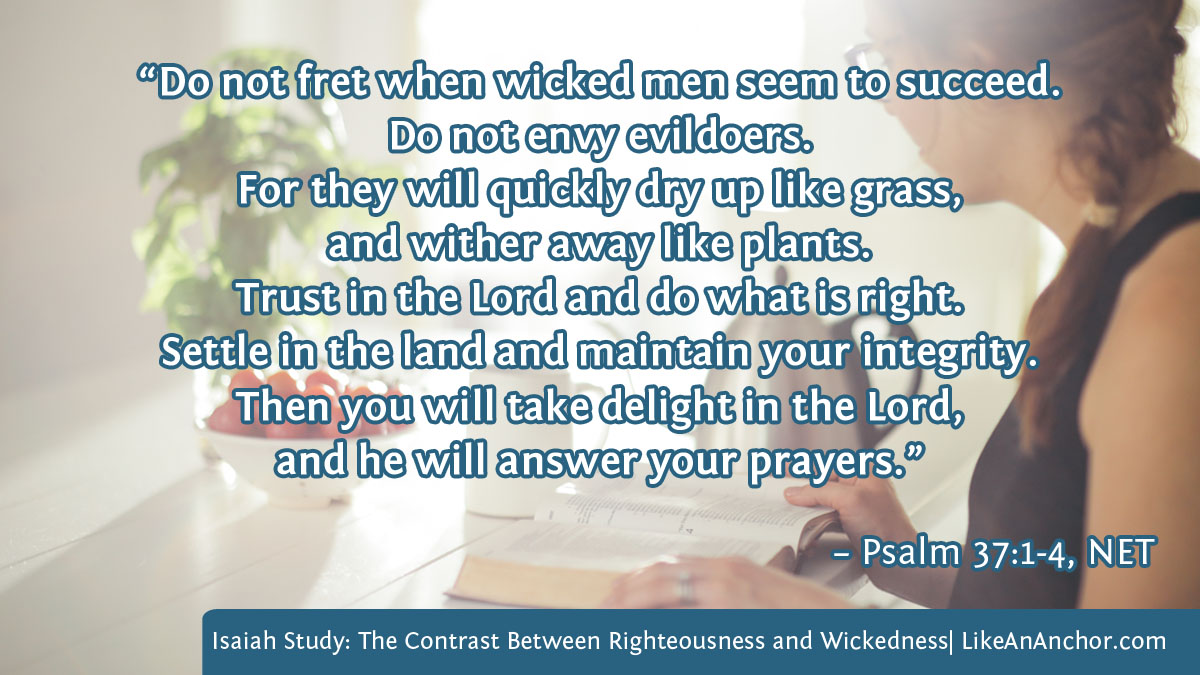
Image of a woman studying her Bible overlaid with text from Psalm 37:1-4, NET version: "“Do not fret when wicked men seem to succeed. Do not envy evildoers. For they will quickly dry up like grass,
and wither away like plants. Trust in the Lord and do what is right. Settle in the land and maintain your integrity. Then you will take delight in the Lord, and he will answer your prayers.”
Image by MarrCreative from Lightstock

The Importance of Obedience

God wants us to follow Him with genuine hearts–hearts on which the New Covenant is written. This covenant is not engraved on stone tablets like the kind Moses carried down from Mount Sinai, but on “tablets of human hearts” (2 Cor. 3:1-3; Heb. 8:7-10). Our hearts. And when our hearts are following God, that results in obedience from the inside-out. We’ll walk in His ways because we’re being transformed by His spirit. Just as in Isaiah’s day, God is looking for obedience that shows our hearts are in the right place.

This is what the Lord says,
“Promote justice! Do what is right!
For I am ready to deliver you;
I am ready to vindicate you openly.
The people who do this will be blessed,
the people who commit themselves to obedience,
who observe the Sabbath and do not defile it,
who refrain from doing anything that is wrong.”

Isaiah 56:1-2, NET

As we discussed in the post about Sabbath-keeping in Isaiah 40-66, we find an abundance of joy and blessings when we walk in covenant with God and do the things He commands. There’s a special relationship between God and the people who sincerely follow Him. Even though He loves everyone with a selfless, beneficent desire for their good, His familial/friendship love is reserved for those who commit to living in relationship with Him.

For the high and lofty One who inhabits eternity,
whose name is Holy, says:
“I dwell in the high and holy place, with him also who is of a contrite and humble spirit,
to revive the spirit of the humble,
and to revive the heart of the contrite.” …
“I create the fruit of the lips:
Peace, peace, to him who is far off and to him who is near,”
says Yahweh; “and I will heal them.”
But the wicked are like the troubled sea;
for it can’t rest and its waters cast up mire and mud.
“There is no peace,” says my God,
“for the wicked.”

Isaiah 57:15, 19-21, WEB

As in the verses we looked at earlier, God reveals a sharp contrast between the wicked and righteous. One prospers, one does not. One is full of peace, the other has none. Having peace/wholeness and experiencing blessings is a natural state for those who walk in relationship with God. Even if their circumstances aren’t great right now, they know things will work out for good in the end and their relationship with God can give them a supernatural peace.

In contrast, the wicked don’t enjoy the peace and prosperity that comes with being in relationship with God. They’re not necessarily stuck in that state, though. God is always eager for people to reconcile with Him and if they do, God promises, “None of his transgressions that he has committed will be remembered against him” (Ezek. 18:22, WEB). There’s always the opportunity for us to move from one category to the other (Ezek. 18; 33).

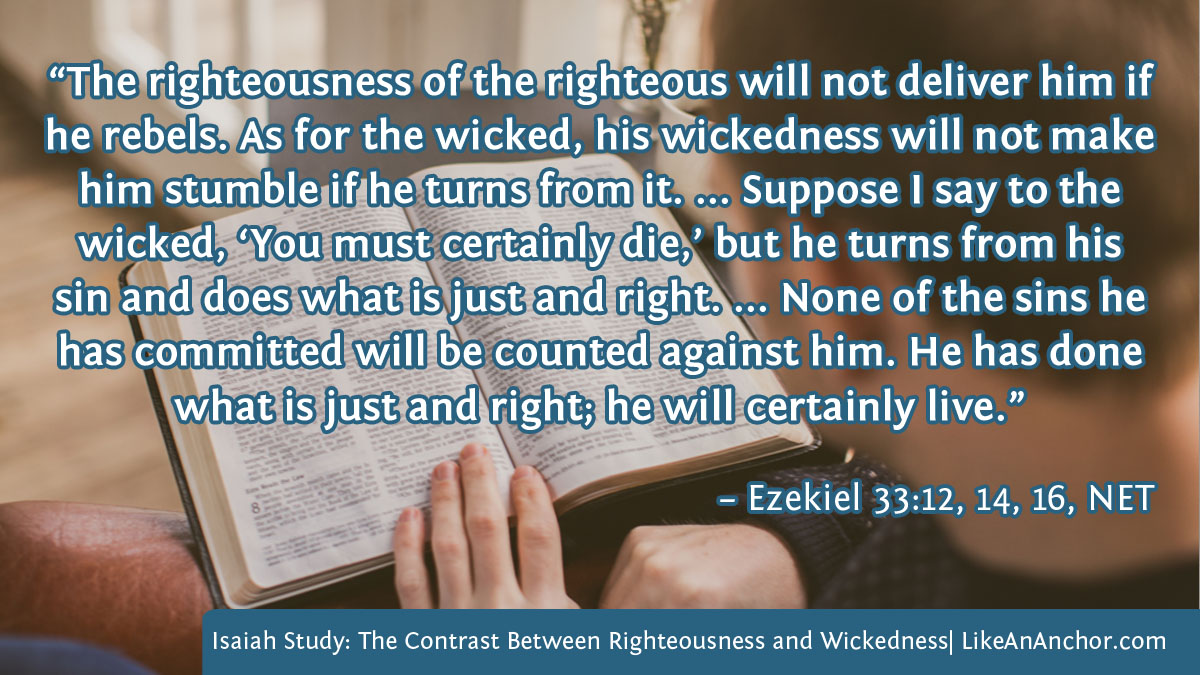
Image of a man studying his Bible overlaid with text from Ezekiel 33:12-16, NET version: “The righteousness of the righteous will not deliver him if he rebels. As for the wicked, his wickedness will not make him stumble if he turns from it. ... Suppose I say to the wicked, ‘You must certainly die,’ but he turns from his sin and does what is just and right. ... None of the sins he has committed will be counted against him. He has done what is just and right; he will certainly live.”
Image by Anggie from Lightstock

Hoping and Praying for Good Outcomes

The sharp contrast between long-term outcomes for the righteous and wicked might seem harsh. But as I mentioned before, what God lays out here and in other passages throughout the Bible is simply a revelation about how His world works. He designed and created the universe, and He has the “inside scoop” on how to live in a way that results in a good outcome. We can either listen to Him or reject His counsel. Either way, we’ll reap the consequences (good or bad) that He tells us about beforehand.

“But you who forsake Yahweh,
    who forget my holy mountain,
    who prepare a table for Fortune,
    and who fill up mixed wine to Destiny;
I will destine you to the sword,
    and you will all bow down to the slaughter;
because when I called, you didn’t answer.
    When I spoke, you didn’t listen;
but you did that which was evil in my eyes,
    and chose that in which I didn’t delight.”

Therefore the Lord Yahweh says,
    “Behold, my servants will eat,
    but you will be hungry;
behold, my servants will drink,
    but you will be thirsty.
Behold, my servants will rejoice,
    but you will be disappointed;
Behold, my servants will sing for joy of heart,
    but you will cry for sorrow of heart,
    and will wail for anguish of spirit.”

Isaiah 65:11-14, WEB
Image of a man praying with the blog's title text and the words " In Isaiah 40-66, God draws a sharp contrast between the outcomes for those who live righteous and wicked lives. One enjoys peace and prosperity, the other does not unless they repent and change."
Image by Shaun Menary from Lightstock

These aren’t the sort of feel-good, reassuring verses that we like to spend our time reading. If it just said, “My servants will eat, drink, rejoice, and sing for joy of heart,” then we might spend a lot more time reading Isaiah 65. But it also contains information about what will happen to those who forsake God, ignore His voice, and do things He calls evil. And those verses give us pause, as they should.

When we read these hard verses, it’s an opportunity to take a look at ourselves. If we see ourselves in any of those descriptions, then we can repent and recommit to following God with our whole hearts. He is always eager to hear sincere repentance and grant forgiveness. He also offers us help through His own indwelling Spirit, His words written in our hearts, and His energetic working inside us to accomplish salvation (John 14:16-7, 26; Phil. 2:12-13). We’re not left alone on this journey. Jesus and the Father work in us, and apply their righteousness to us (Jer. 23:6; 2 Cor. 5:21; 1 Pet. 2:24).

These verses might also make us think about others and grieve because we don’t want these terrible things to happen to anyone. That is also a godly response. God “desires all people to be saved and come to full knowledge of the truth” (1 Tim. 2:4, WEB). He is “not wishing that anyone should perish, but that all should come to repentance” (2 Peter 3:9, WEB). When we wish that people wouldn’t need to go through such terrible things, it’s a desire God shares. And even though we can’t make people come to God–He’s the one who opens eyes and draws hearts to Him (John 6:44; 14:6)–we can share our hope with people around us and pray for others to come to know God (1 Peter 3:15-16; 1 Tim 2:1-4).

We can also take comfort from scriptures like these in Isaiah. When we’re walking with God, we are among those blessed by His favor. These good, comforting, and encouraging words are for us. He teaches us how to succeed. He sends deliverance over us like ocean waves. He vindicates us, revives us, heals us, and gives us peace. He fills us with joy. There is a “day of vengeance of our God” proclaimed in this section of Isaiah, but it is also “the year of Yahweh’s favor,” filled with comfort, provision, and joy for the Lord’s people who faithfully follow Him (Is. 61).

Featured image by Inbetween from Lightstock

Song Recommendation: This Is The Year (Isaiah 61) by Deborah Kline-Iantorno & Vince Iantorno

Isaiah Study: Doing A New Thing

Today’s article is the fifth blog post since I started studying Isaiah 40-66. In the first post, I made a list of key themes that I want to study more extensively in this section of scripture. The list included (among other things) the message that God is doing and making something new. This theme is very closely connected to the one we discussed in last week’s post about looking toward the Messiah. It’s also connected with another point we touched on a few weeks ago; that one way God proves He is God is by revealing His new plans to the prophets before they happen.

I can only imagine how awed Isaiah must have been to receive this revelation. How encouraging it must have been to learn that God has such an amazing plan to set things right; to realize that a Messiah would soon come to usher in the salvation of the world! I wonder how much of the timing he understood. Did Isaiah know we’d still be reading these words thousands of years later, joining him in marveling at all that God has done in the past and will do in the future? Peter seems to think he did.

Concerning this salvation, the prophets sought and searched diligently. They prophesied of the grace that would come to you, searching for who or what kind of time the Spirit of Christ, which was in them, pointed to, when he predicted the sufferings of Christ, and the glories that would follow them. To them it was revealed, that they served not themselves, but you, in these things, which now have been announced to you through those who preached the Good News to you by the Holy Spirit sent out from heaven; which things angels desire to look into.

1 Peter 1:10-12, WEB

Here, Peter tells us that people like Isaiah did know they were speaking to us–we who know the Messiah and have received His salvation. Peter was also among those to whom Jesus said “many prophets and kings desired to see the things which you see, and didn’t see them, and to hear the things which you hear, and didn’t hear them” (Luke 10:24, WEB; see also Matthew 13:14-17). The prophets didn’t see everything as clearly as we do know. God has revealed to us things so glorious that the angels desire to look into them. We see His future plan for “glories that would follow” more clearly, particularly as we look back on the prophets’ words about the new things God still has in store for us.

Declaring a New Way to Save

At the end of the first Servant Song prophecy, God says, “Behold, the former things have happened and I declare new things. I tell you about them before they come up” (Is. 42:9, WEB). That’s one of the main things that God is doing in this section of Isaiah. There’s so much emphasis on the Messiah and on the new things God will do through Him. Jesus’s coming changed things dramatically for God’s people. Once we were sinners condemned to death, now we’re redeemed from that penalty. Once we were under the Law as a “guardian” of our conduct; now we keep the Law from the heart on a spiritual level (Gal. 3:23-25; Rom. 8:1-14). Once we saw God’s plan only dimly, now He’s revealed it to His people more clearly (Matt. 13:10-11; 1 Cor. 2:9-10; Eph. 3:4-6; 1 Pet 1:10-12).

When Isaiah’s original readers heard God “declare new things” about the Messiah, Jesus’s first coming was still in the future. At this time, God told Israel “from this point on I am announcing to you new events” (Isa. 48:6, NET). Knowing there’s a Messiah bringing a new way to save isn’t news for us anymore–from our perspective, He arrived here on earth nearly 2,000 years ago. However, we can still get excited for what His coming meant for us and for other new things that God is planning.

Look, I am about to do something new.
Now it begins to happen! Do you not recognize it?
Yes, I will make a road in the wilderness
and paths in the wastelands.
The wild animals honor me,
the jackals and ostriches,
because I put water in the wilderness
and streams in the wastelands,
to quench the thirst of my chosen people,
the people whom I formed for myself,
so they might praise me.

Isaiah 43:19-21, NET

The context for this passage is redemption. God is revealing that He will rescue Israel from the Babylonians, but then the language shifts to declaring a future redemption as well. The “road in the wilderness” and God’s work with the wild animals foreshadows Millennial imagery in Isaiah 65 (which we’ll get to later in this post). God began His new work of bringing peace to earth with Jesus’s first coming, and He’s still working on that exciting project today as we–and all of creation–await Jesus’s second coming.

For I consider that our present sufferings cannot even be compared to the coming glory that will be revealed to us. For the creation eagerly waits for the revelation of the sons of God. For the creation was subjected to futility—not willingly but because of God who subjected it—in hope that the creation itself will also be set free from the bondage of decay into the glorious freedom of God’s children.

Romans 8:19-21, NET

Something New For Us

In addition to God’s new revelations about how He plans to save and transform the world, He also revealed something new that’s happening in each of us. He promises He’ll give His people new names as He does the part of His new work that takes place inside each of them.

For the sake of Zion I will not be silent;
for the sake of Jerusalem I will not be quiet,
until her vindication shines brightly
and her deliverance burns like a torch.
Nations will see your vindication,
and all kings your splendor.
You will be called by a new name
that the Lord himself will give you.
You will be a majestic crown in the hand of the Lord,
a royal turban in the hand of your God.
You will no longer be called, “Abandoned,”
and your land will no longer be called “Desolate.”
Indeed, you will be called “My Delight is in Her,”
and your land “Married.”
For the Lord will take delight in you,
and your land will be married to him.

Isaiah 62:1-4, NET

Here, we’re told two of the new names God gives to the people He’s working with. We’re also told “you will be called by a new name that the Lord himself will give you.” If we were just looking at this verse on its own, we might think that refers to the new names Hephzibah (“My Delight is in Her”) and Beulah (“Married”). However, we also learn more about other new names in the book of Revelation. Jesus mentions two of His letters to the seven churches.

To the angel of the church in Pergamum write the following: … The one who has an ear had better hear what the Spirit says to the churches. To the one who conquers, I will give him some of the hidden manna, and I will give him a white stone, and on that stone will be written a new name that no one can understand except the one who receives it.’

Revelation 2:12, 17, NET

To the angel of the church in Philadelphia write the following: … The one who conquers I will make a pillar in the temple of my God, and he will never depart from it. I will write on him the name of my God and the name of the city of my God (the new Jerusalem that comes down out of heaven from my God), and my new name as well.

Revelation 3:7, 12, NET

The first new name mentioned is highly individual; only the person who receives the name even knows what it is. The second new name is one that we’ll share with Jesus Christ. I don’t want to get too off-track from today’s topic, so we’ll keep this discussion about names brief. For now, let’s remember that names in Hebrew thought are closely tied to a person’s reputation and character. When God puts His name on us, He’s trusting us with His family’s reputation and claiming us as people who are like Him.

God also has a long history of giving new names to people He works closely with, including Abraham, Sarah, Israel, Peter, James, John, and Paul (Genesis 17:4-5, 15-16; 32:28; Mark 3:16-17; Acts 13:9). There’s something very special about getting a new name from God, and it seems that it has to do with receiving a new position in life. New names come with a new way of living or a new attainment of something that God is working on in us. It’s fitting, then, that we’re told we’ll get new names when God is handing out rewards to faithful people after Jesus returns to this earth. That’s also when we’ll be revealed as the glorious children of God (Rom. 8:18-24).

New Heavens and New Earth

Isaiah has a lot to say about the Millennial reign of Jesus Christ and the new earth which will follow. In Revelation 20, we’re told that after Jesus’s second coming Satan will be locked away for a thousand years, the faithful will rise from the dead, and they’ll “be priests of God and of Christ, and will reign with him one thousand years” (Rev. 20:6, WEB). Then in Revelation 21-22, we learn of “a new heaven and a new earth” that will come after that. We don’t get many details about what the Millennium or the world after that will look like here in Revelation, but we learn more through God’s descriptions through Isaiah of His future holy mountain (Isaiah 2:1-4; 11:1-10).

“For, behold, I create new heavens and a new earth;
    and the former things will not be remembered,
    nor come into mind.
But be glad and rejoice forever in that which I create;
    for, behold, I create Jerusalem to be a delight,
    and her people a joy.
I will rejoice in Jerusalem,
    and delight in my people;
and the voice of weeping and the voice of crying
    will be heard in her no more.
    “No more will there be an infant who only lives a few days,
    nor an old man who has not filled his days;
for the child will die one hundred years old,
    and the sinner being one hundred years old will be accursed.
They will build houses and inhabit them.
    They will plant vineyards and eat their fruit.
They will not build and another inhabit.
    They will not plant and another eat:
for the days of my people will be like the days of a tree,
    and my chosen will long enjoy the work of their hands.
They will not labor in vain
    nor give birth for calamity;
for they are the offspring of Yahweh’s blessed
    and their descendants with them.
It will happen that before they call, I will answer;
    and while they are yet speaking, I will hear.
The wolf and the lamb will feed together.
    The lion will eat straw like the ox.
    Dust will be the serpent’s food.
They will not hurt nor destroy in all my holy mountain,”
    says Yahweh.

Isaiah 65:17-25, WEB

Isn’t this an incredible picture of the future? This is what we have to look forward to after Jesus returns to earth. It’s this future that we’ll be picturing when we observe Sukkot (the Feast of Tabernacles) in just a few months. Given the connection between Sukkot and the Millennial reign of Jesus Christ, it’s fitting that the last thing the Lord says in Isaiah about His new heavens and new earth relates to God’s holy calendar and His Sabbath days. This verse also connects to our post about Sabbath-keeping in Isaiah 40-66.

“For just as the new heavens and the new earth I am about to make will remain standing before me,” says the Lord, “so your descendants and your name will remain. From one month to the next and from one Sabbath to the next, all people will come to worship me,” says the Lord.

Isaiah 66:22-23, NET

These verses promise that in the midst of all this newness, there will also be a reliable stability. God is still on His throne. His character and the way He wants to do things are not going to change. We’ll still have patterns of worship to follow. We’ll still have relationships with Him, though they will then be closer than ever before.

We know Jesus is coming back, but it’s easy to let that slip our minds as we go through our day-to-day lives. But if we hold onto the vision in Isaiah and other future-pointing passages of scripture, we can also hold onto the excitement of being part of the “new thing” God is doing. And that can help us stay encouraged and joyful as we move forward into the future.

Featured image by Inbetween from Lightstock

Song Recommendation: “The Holy City” by Stanford Olsen and The Tabernacle Choir

Bonus song I found while searching for a different “New Heaven, New Earth” song: “Новое небо” by Simon Khorolskiy