How To Clean A Temple

We’ve talked about how to build up spiritual temples and the fact that the churches today need a good temple cleaning, but not much about the practical how-to for cleaning temples. Back when there was a physical temple standing, God gave specific instructions about how to purify the temple and clean it when things got dirty. You couldn’t just throw some soapy water across the floor and say, “Clean!” Today, we are the temple of God, and He has set in place ways of cleaning us out as well.
How To Clean A Temple| marissabaker.wordpress.com

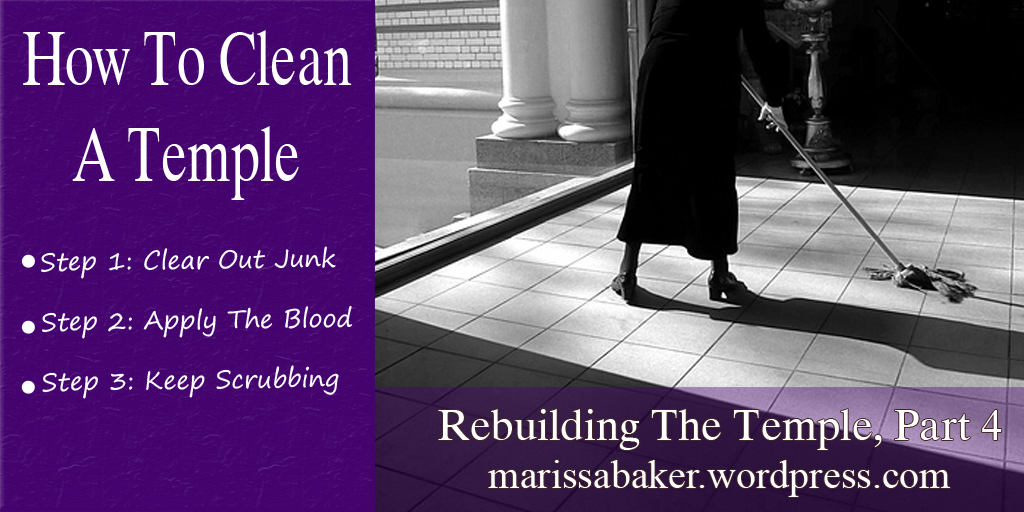
Step One: Clear Out Junk

One of the most complete Old Testaments accounts we have of cleansing a temple took place in the days of king Hezekiah.

In the first year of his reign, in the first month, he opened the doors of the house of the Lord and repaired them. Then he brought in the priests and the Levites, and gathered them in the East Square, and said to them: “Hear me, Levites! Now sanctify yourselves, sanctify the house of the Lord God of your fathers, and carry out the rubbish from the holy place. For our fathers have trespassed and done evil in the eyes of the Lord our God; they have forsaken Him, have turned their faces away from the dwelling place of the Lord, and turned their backs on Him. They have also shut up the doors of the vestibule, put out the lamps, and have not burned incense or offered burnt offerings in the holy place to the God of Israel. (2 Chr. 29:3-7)

And they gathered their brethren, sanctified themselves, and went according to the commandment of the king, at the words of the Lord, to cleanse the house of the Lord. Then the priests went into the inner part of the house of the Lord to cleanse it, and brought out all the debris that they found in the temple of the Lord to the court of the house of the Lord. And the Levites took it out and carried it to the Brook Kidron.
Now they began to sanctify on the first day of the first month, and on the eighth day of the month they came to the vestibule of the Lord. So they sanctified the house of the Lord in eight days, and on the sixteenth day of the first month they finished.
Then they went in to King Hezekiah and said, “We have cleansed all the house of the Lord, the altar of burnt offerings with all its articles, and the table of the showbread with all its articles. Moreover all the articles which King Ahaz in his reign had cast aside in his transgression we have prepared and sanctified; and there they are, before the altar of the Lord.” (2 Chr. 29:15-19)

I find it very interesting that, in addition to purifying the house and cleansing it (presumably with water and blood) the priests had to carry out debris and rubbish. There were things inside the temple defiling it that needed to be thrown out before the other purification could take place.

This puts me in mind of two incidents that took place during Jesus’ ministry. In several Bibles I’ve read, the section heading here reads “Jesus Cleanses The Temple.”

Now the Passover of the Jews was at hand, and Jesus went up to Jerusalem. And He found in the temple those who sold oxen and sheep and doves, and the money changers doing business. When He had made a whip of cords, He drove them all out of the temple, with the sheep and the oxen, and poured out the changers’ money and overturned the tables. And He said to those who sold doves, “Take these things away! Do not make My Father’s house a house of merchandise!” Then His disciples remembered that it was written, “Zeal for Your house has eaten Me up.” (John 2:13-17)

This happened in John chapter 2, at the first Passover during Jesus’ ministry. That means one of the very first things He did as part of His ministry was throw certain things and people out of God’s temple. It was a pivotal moment, and it didn’t just happen once. A very similar incident occurs right before His last Passover.

Then Jesus went into the temple of God and drove out all those who bought and sold in the temple, and overturned the tables of the money changers and the seats of those who sold doves. And He said to them, “It is written, ‘My house shall be called a house of prayer,’ but you have made it a ‘den of thieves.’” (Matt. 21:12-13)

Look how important this was to Jesus. He made a whip to drive out sheep, oxen and people. He poured the exchangers’ money onto the floor, and threw tables over. He probably raised His voice as He ordered out people who’d made His father’s house a vehicle for personal gain. He spent the time leading up to two Passovers before His sacrifice, which fulfilled all the blood sacrifices of the Old Testament, throwing defiling elements out of the temple.

Is there anything that needs thrown out of our lives before God can really start to work with us? The temple today is in our minds, so that’s where we need to look. Anything inside us that is crowding God out of His temple must be thrown out. Jesus can help with that if we ask Him, but – like the priests in Hezekiah’s day – we have to be willing to carry out the rubbish and dump it somewhere it won’t come back.

Step Two: Apply The Blood

Back in the Old Testament, the physical temple had to be cleaned and purified before God would put His presence there. Even when the first tabernacle was built and things started out exactly as God commanded, purification was a daily necessity. I suspect this was because people were involved, and no matter how hard we try we still can’t keep things clean enough for God on our own.

And you shall offer a bull every day as a sin offering for atonement. You shall cleanse the altar when you make atonement for it, and you shall anoint it to sanctify it. (Ex. 29:36)

As Israel fell into sin, the temple was often neglected. Throughout history, it was forgotten by Israel, defiled with idols, and ravaged by conquers. Whenever Israel came back to God, the temple needed fresh purification.

Thus says the Lord God: “In the first month, on the first day of the month, you shall take a young bull without blemish and cleanse the sanctuary. The priest shall take some of the blood of the sin offering and put it on the doorposts of the temple, on the four corners of the ledge of the altar, and on the gateposts of the gate of the inner court. And so you shall do on the seventh day of the month for everyone who has sinned unintentionally or in ignorance. Thus you shall make atonement for the temple. (Ezk. 45:18-20)

The animal sacrifices used to purify the physical temple were a stand-in pointing to how Jesus’s sacrifice would purify His people. “It is not possible that the blood of bulls and goats could take away sins,” but Jesus was able with one offering” to have “perfected forever those who are being sanctified” (Heb. 10:4, 14).

Remember that the tabernacle and then the temple layouts were divided into different sections. In the book of Hebrews, it talks about how there was a main section of the tabernacle where the priests served throughout the year, and then the Holy of Holies which the high priest could only enter once a year on the Day of Atonement (Yom Kippur).

Now when these things had been thus prepared, the priests always went into the first part of the tabernacle, performing the services. But into the second part the high priest went alone once a year, not without blood, which he offered for himself and for the people’s sins committed in ignorance; the Holy Spirit indicating this, that the way into the Holiest of All was not yet made manifest while the first tabernacle was still standing. It was symbolic for the present time in which both gifts and sacrifices are offered which cannot make him who performed the service perfect in regard to the conscience — concerned only with foods and drinks, various washings, and fleshly ordinances imposed until the time of reformation. (Heb. 9:6-10)

What’s really interesting is that in the Greek, there’s one word to describe the entire temple complex and another word to describe the inner sanctuary or Holy of Holies. It’s this second word, naos, which is used when talking about us as the temple of God. The book of Hebrews tells us there is a spiritual version of the Holy of Holies in heaven, where Christ presented His blood to atone for our sins, but each Christian today is also a type of spiritual Holy of Holies.

And according to the law almost all things are purified with blood, and without shedding of blood there is no remission. Therefore it was necessary that the copies of the things in the heavens should be purified with these, but the heavenly things themselves with better sacrifices than these. For Christ has not entered the holy places made with hands, which are copies of the true, but into heaven itself, now to appear in the presence of God for us; not that He should offer Himself often, as the high priest enters the Most Holy Place every year with blood of another — He then would have had to suffer often since the foundation of the world; but now, once at the end of the ages, He has appeared to put away sin by the sacrifice of Himself. (Heb. 9:22-26)

The high priest was the only one ever allowed into the Holy of Holies, just as Jesus Christ was the only one who could clean the spiritual temple. The law requires blood purification of holy things, and Jesus is the only one who’s blood is precious enough to cleans a polluted spiritual temple. Accepting Him as our Savior and asking Him to wash away our sins is a vital step in cleaning the spiritual temple.

Step Three: Keep Scrubbing

As the great High Priest over the church today, Jesus is the only one with a right to come into the temple and clean it out. We can help as best we can, but we must never forget that He’s the one doing the cleansing. It was His sacrifice that removed sin once and for all, and He’s the one continually working to clean His people.

looking for the blessed hope and glorious appearing of our great God and Savior Jesus Christ, who gave Himself for us, that He might redeem us from every lawless deed and purify for Himself His own special people, zealous for good works. (Tit. 2:13-14)

John the Baptist testified of Jesus Christ that He would baptize His people “with the Holy Spirit and fire” (Luke 3:16). When we accept Jesus Christ as our savior and are baptized in His name, we’re washed with His blood and covered in the spirit of God. That’s just the beginning of our purification process, though.

Husbands, love your wives, just as Christ also loved the church and gave Himself for her, that He might sanctify and cleanse her with the washing of water by the word, that He might present her to Himself a glorious church, not having spot or wrinkle or any such thing, but that she should be holy and without blemish. (Eph. 5:25-27)

The church today is God’s temple – His personal dwelling place – and we must do all we can to set it to rights by working on ourselves individually and collectively under the Headship of our High Priest Jesus Christ. The closer we draw to Christ and the more we point others to Him, the cleaner this temple will get.

Back in the Old Testament, the priests were assisted by Levites whose “duty was to help the sons of Aaron in the service of the house of the Lord, in the courts and in the chambers, in the purifying of all holy things and the work of the service of the house of God” (1 Chr. 23:28). This was supposed to keep happening on a continual basis. In much the same way, we have to continue repenting when we fall short and continue submitting to the refining process Christ is accomplishing in our lives.
How To Clean A Temple| marissabaker.wordpress.com

credits for photos used in blog images:


Obstacles To Temple Building (Lessons from Haggai, part three)

Both letters to the Corinthian church remind them, “You are the temple of God.” Each member of Christ’s church is a temple, and we’re being built up into a spiritual house of God. This applies to the body as a whole, as well as to individuals.

We’ve been spending time in the book of Haggai the past couple weeks, talking about God’s challenge to the people who were neglecting His temple and what we can do about building up the temple we have today. Like those of us in the modern churches of God, the people of Haggai’s time faced a number obstacles to temple building. They let these obstacles discourage them for many years, but it turns out they weren’t really anything to worry about. Once the people turned back to God and started working on what He commanded, the obstacles didn’t seem so significant.

Obstacles To Temple Building | marissabaker.wordpress.com

Droughts

This isn’t so much an obstacle as it is a result of neglecting the temple in the first place. God tells the people their lives lacked good things “because of My house that is in ruins, while every one of you runs to his own house” (Hag. 1:9).

Therefore the heavens above you withhold the dew, and the earth withholds its fruit. For I called for a drought on the land and the mountains, on the grain and the new wine and the oil, on whatever the ground brings forth, on men and livestock, and on all the labor of your hands.” (Hag. 1:10-11)

Confronted with these struggles, the people might have said, “We can’t build God’s house while so many bad things are happening.” It would have been an understandable reaction from a human perspective. Nothing we do is bearing fruit, so why bother with the temple? God wouldn’t be happy if that falls apart like everything else. But in reality, all the problems they were seeing came as a result of neglecting the temple.

In our own lives, we often find ourselves discouraged from contributing in our local churches, or distracted by other worries from building-up the people around us. We might think we have very little time or ability to contribute to  God’s temple because there’s so much other stuff going on, and often going wrong. In reality, if we prioritize God’s temple, the other things in our lives will start to fall into place (or at least get easier to deal with because we have God on our side).

Then Haggai, the Lord’s messenger, spoke the Lord’s message to the people, saying, “I am with you, says the Lord.” So the Lord stirred up the spirit of Zerubbabel the son of Shealtiel, governor of Judah, and the spirit of Joshua the son of Jehozadak, the high priest, and the spirit of all the remnant of the people; and they came and worked on the house of the Lord of hosts, their God (Hag. 1:13-14)

We need to let God “stir up” our spirits. Focusing only on things that are going wrong in our lives, and then trying to fix them without working on God’s temple, is just going to make things worse.

Comparisons

The previous temple had been the one built by Solomon. Physically speaking, it was the most glorious temple ever built for God. The people working on this new temple knew they couldn’t approach that magnificence, and it was discouraging.

Who is left among you who saw this temple in its former glory? And how do you see it now? In comparison with it, is this not in your eyes as nothing? Yet now be strong, Zerubbabel,’ says the Lord; ‘and be strong, Joshua, son of Jehozadak, the high priest; and be strong, all you people of the land,’ says the Lord, ‘and work; for I am with you,’ says the Lord of hosts. ‘According to the word that I covenanted with you when you came out of Egypt, so My Spirit remains among you; do not fear!’ (Hag. 2:3-5)

You’ll hear something similar today in the church – people looking back to a time when the church was larger, or had more money, or seemed more influential, or had more respect in U.S. Culture. But God doesn’t want His people looking backwards except for productive reasons.

We can learn from past mistakes or take encouragement from past examples of God’s goodness, but being paralyzed in the present because you’re living in the past is unacceptable. God is moving us toward a great and glorious future, and that’s where we must look if we want His blessing now as we build the temples of our lives and churches.

Unstable Foundations

Whatever you’re building, it has to start with a firm foundation. The temple of God is no exception.

“For thus says the Lord of hosts: ‘Once more (it is a little while) I will shake heaven and earth, the sea and dry land; and I will shake all nations, and they shall come to the Desire of All Nations, and I will fill this temple with glory,’ says the Lord of hosts. ‘The silver is Mine, and the gold is Mine,’ says the Lord of hosts. ‘The glory of this latter temple shall be greater than the former,’ says the Lord of hosts. ‘And in this place I will give peace,’ says the Lord of hosts.” (Hag. 2:6-9)

These passages are prophetic, reaching beyond the completion of that physical temple to a new house constructed by God Himself. Part of it is being fulfilled today, as we are “being built up a spiritual house, a holy priesthood” (1 Pet. 2:5), and part will be fulfilled in the future.

but now He has promised, saying, “Yet once more I shake not only the earth, but also heaven.” Now this, “Yet once more,” indicates the removal of those things that are being shaken, as of things that are made, that the things which cannot be shaken may remain.
Therefore, since we are receiving a kingdom which cannot be shaken, let us have grace, by which we may serve God acceptably with reverence and godly fear. For our God is a consuming fire. (Heb. 12:26-29)

The author of Hebrews looked back to these verses in Haggai when talking about our future kingdom. To get there, we’re going to have to go through “shakings.” In my Messianic congregation, the Rabbi has given several messages where he reminds us that “everything which can be shaken will be shaken.” In other words, things that are not firmly grounded on Jesus Christ will topple over.

Unclean Hearts

Sometimes, we ourselves can be the obstacles standing in the way of building up a people that glorifies God. Other people can also act as obstacles, of course, but we have to be very careful to make sure we’ve gotten any beams out of our own eyes before trying to pick slivers out of someone else. We must examine our own hearts for uncleanness before we can hope to help others who are engaged in temple building.

And Haggai said, “If one who is unclean because of a dead body touches any of these, will it be unclean?”
So the priests answered and said, “It shall be unclean.”
Then Haggai answered and said, “‘So is this people, and so is this nation before Me,’ says the Lord, ‘and so is every work of their hands; and what they offer there is unclean. And now, carefully consider from this day forward: from before stone was laid upon stone in the temple of the Lord – since those days, when one came to a heap of twenty ephahs, there were but ten; when one came to the wine vat to draw out fifty baths from the press, there were but twenty. I struck you with blight and mildew and hail in all the labors of your hands; yet you did not turn to Me,’ says the Lord. (Hag. 2:13-17)

This takes us right back to where we started this chapter. If bad things are happening in our lives, it should prompt us to engage in self-examination and turn back to God – not stop building up God’s house.

What sort of things do you see holding the church back from growth? what steps could we take to overcome them?

Obstacles To Temple Building | marissabaker.wordpress.com

credits for photos used in blog images:

  • Roadblock” by Greg Westfall, CC BY via Flickr
  • Roadblock” by Olle Svensson, CC BY via Flickr

Building Up Temples (Lessons from Haggai, part two)

Inspired by Haggai’s message to those rebuilding the temple in 520 B.C., we started a conversation about the state of the church in last week’s post. Via Haggai’s prophecy, God challenged His people about their choice to neglect rebuilding His temple. Sadly, today, there is a similar neglect in building up the individuals in God’s church, who are described as His temple. We talked about that last week, though. This week, we’re going to talk about what to do about it.

Edification

Having challenged the people with their lack of productivity, God again asks them to consider their ways.

Thus says the Lord of hosts: “Consider your ways! Go up to the mountains and bring wood and build the temple, that I may take pleasure in it and be glorified,” says the Lord. “You looked for much, but indeed it came to little; and when you brought it home, I blew it away. Why?” says the Lord of hosts. “Because of My house that is in ruins, while every one of you runs to his own house. (Hag. 1:7-9)

For us in the spiritual temple, we need to be careful to maintain a balance between individual growth and serving the body. Though our lives depend on developing a close, personal relationship with God, He never intended for us to act in isolation. Rather, the more we become like Christ, the more we should want to serve our brethren. Focusing only on building your own house is selfish, and is not pleasing to God.

In the Greek New Testament, every time we’re told to edify one another, it’s related to the idea of building a house. The Greek word for house is oikos (G3624), and it’s the root word for oikodomeo (G3618). This word literally means “to be a house builder,” and is translated “build,” “edify,” and “embolden.” This connection even exists in English – the word “edify” is related to “edifice.”

having been built on the foundation of the apostles and prophets, Jesus Christ Himself being the chief cornerstone, in whom the whole building, being fitted together, grows into a holy temple in the Lord, in whom you also are being built together for a dwelling place of God in the Spirit. (Eph. 2:20-22)

We know Jesus is ultimately the Builder who is creating His church (Matt. 16:18). He builds the house, has more glory than the house, and rules us “as a son over His own house” (Heb. 3:1-6). He does, however, have people within the house working with Him as He builds us up.

For we are God’s fellow workers; you are God’s field, you are God’s building. According to the grace of God which was given to me, as a wise master builder I have laid the foundation, and another builds on it. But let each one take heed how he builds on it. For no other foundation can anyone lay than that which is laid, which is Jesus Christ. (1 Cor. 3:9-11)

This principle works on an individual as well as a group level. You are a temple of God, and you are part of the House of God. Everything that you build must be founded on Jesus Christ, or it’s not going to last. In contrast, if we commit to building up God’s temple properly, He will be pleased and glorified. As we talked about last week, it’s not just the responsibility of people in leadership positions, either. We’re all to be teaching and building up one another.
Building Up Temples | marissabaker.wordpress.com

Where to Build?

Any good building has to start with a good foundation. With God’s spirit in us and the Son of God as our foundation, we have all the tools we need to build well in the eyes of God. He’s given us the opportunity to build something glorious, if we’ll take it.

For no other foundation can anyone lay than that which is laid, which is Jesus Christ. Now if anyone builds on this foundation with gold, silver, precious stones, wood, hay, straw, each one’s work will become clear; for the Day will declare it, because it will be revealed by fire; and the fire will test each one’s work, of what sort it is. (1 Cor. 3:11-13)

We get out of our walk with God what we put into it. If we give Him the perishable, useless stuff of our lives – the stubble left over after we do what we want – then our house will burn back down to the foundation and we’ll have to start over. But if we give Him our best, we will endure and be rewarded.

If anyone’s work which he has built on it endures, he will receive a reward. If anyone’s work is burned, he will suffer loss; but he himself will be saved, yet so as through fire. Do you not know that you are the temple of God and that the Spirit of God dwells in you? (1 Cor. 3:14-16)

God’s glory once filled the tabernacle and the physical temples, and He wants to fill His temple today as well. But He won’t dwell in a defiled, falling-apart temple. It is our responsibility as His temples and as His church to put our best effort into making this building something fit for God’s use.

What Next?

I don’t want to end this post without actually giving some practical steps we can take to help rebuild God’s temple. Principles are good, but what does it really look like to edify other people and to build on the foundation of Jesus Christ?

  • Don’t shy away from talking about spiritual things. There’s often a tendency when we get together for church to chat, gossip, and just share what’s been going on since we saw each other last. But if we’re there with people who love God to honor God, we should be talking about Him at least a little, right?
  • Avoid negativity whenever possible. If you’ve had a terrible week and you need to vent, go ahead and give people the opportunity to comfort and encourage you. But if everything coming out of your mouth is critical, complaining, or pessimistic you’re not helping anyone (including yourself). It takes about 5 positive comments to balance out 1 negative remark. What ratio are you offering God’s temple?
  • Stop thinking small in terms of what the church is. The church isn’t United Church of God, or Living Church of God or whatever your local church calls itself. The church is every individual within the Body of Christ, and that’s where we need to be serving and edifying.
  • Study the Bible, especially Jesus Christ’s example. Corporate growth starts with individual growth, and individual growth starts with developing a relationship with Jesus Christ. He’s the foundation we have to build on, and the One who builds us up.

What would you add to this list? please share in the comments below!

Building Up Temples | marissabaker.wordpress.com

Credits for photos used in blog images:

Consider Our Temples (Lessons from Haggai, part one)

The book of Haggai largely concerns rebuilding on the site of Solomon’s temple, which was destroyed in the Babylonian invasion chronicled in 2 Kings 25 (around 586 B.C.). A group of Jewish exiles under the leadership of Zerubbabel returned to the land in 536, but by the time Haggai wrote in 520 they’d not yet rebuilt the temple.

Considering that the church today is called God’s temple, I wondered what spiritual parallels there might be between Haggai’s call for obedience in rebuilding the the temple, and us today. This book begins by quoting people who said it wasn’t yet time to build God’s house (Hag. 1:2). God challenged them whether it was right for them to have spent the past 16 years on their own projects instead of His temple (Hag. 1:3-4)

Now therefore, thus says the Lord of hosts: “Consider your ways! You have sown much, and bring in little; you eat, but do not have enough; you drink, but you are not filled with drink; you clothe yourselves, but no one is warm; and he who earns wages, earns wages to put into a bag with holes.” (Hag. 1:5-6)

Let’s suppose for a moment that this isn’t just talking to the people tasked with rebuilding God’s temple 2,500 years ago – that this is speaking to the church today as a spiritual temple. What is it telling us?

Consider Our Temples | marissabaker.wordpress.com

Sowing

you have sown much, and bring in little

In one of Christ’s parables, sowing seeds in a field is compared to spreading God’s world (Mark 4:14-20). Many churches are good at the sowing part – we scatter the gospel out over the internet, radio, television and into people’s homes as magazines. Truly, we “have sown much.”

The first part of this phrase applies to us, so what about the second? We’ve sown, but is it bearing fruit as God intended, “some thirtyfold, some sixty, and some a hundred”? I think the state of the church and the world today answers this question for us. Churches are divided, scattered and squabbling. Growth is down, and the world has lost respect for Christianity.

“Do you not know that you are the temple of God and that the Spirit of God dwells in you? If anyone defiles the temple of God, God will destroy him. For the temple of God is holy, which temple you are.” (1 Cor. 3:16-17)

If our efforts aren’t bringing forth the fruits they should, perhaps we should follow the instructions in Haggai to consider our ways in regards to God’s temple. The defilement Paul talks about in 1 Corinthians doesn’t come from an attack on God’s temple from the outside. It comes from within individuals — those of us who aren’t keeping our hearts and minds pure as we follow after Christ — and it hurts the temple as a whole.

Eating

you eat, but do not have enough

One of the ways the Bible talks about the World of life is as nourishment, comparing it to food. Jesus Himself, the living Word, is called the Bread of Life (John 6:35). If we’re studying our Bibles and going to church then we are eating from the words of God, but are we eating enough?

For though by this time you ought to be teachers, you need someone to teach you again the first principles of the oracles of God; and you have come to need milk and not solid food. For everyone who partakes only of milk is unskilled in the word of righteousness, for he is a babe. But solid food belongs to those who are of full age, that is, those who by reason of use have their senses exercised to discern both good and evil. (Heb. 5:12-14)

If we’re not studying more deeply on our own, and if the teachers in the temple aren’t providing strong meat, then God’s church won’t grow. It won’t have enough food.

Drinking

you drink, but you are not filled with drink

Though it does require some action on our part, the blood of Jesus Christ’s sacrifice is the only way to cleanse a defiled, polluted temple. The law requires blood purification of holy things, and the only sacrifice precious enough to cleanse a spiritual temple was that of Jesus Himself (Heb. 9:22-24).

Then Jesus said to them, “Most assuredly, I say to you, unless you eat the flesh of the Son of Man and drink His blood, you have no life in you. Whoever eats My flesh and drinks My blood has eternal life, and I will raise him up at the last day. For My flesh is food indeed, and My blood is drink indeed. He who eats My flesh and drinks My blood abides in Me, and I in him. (John 6:53-56)

1 Corinthians 11 helps clarify this by quoting Jesus at the Passover, saying, “This cup is the new covenant in My blood. This do, as often as you drink it, in remembrance of Me” (1 Cor. 11:25). To drink of Jesus Christ, we have to enter into covenant with the One who gave His life for His temple. It can’t just be lip-service either or sipping at the cup but not letting Him in. We have to be “filled with drink.”

Clothing

you clothe yourselves, but no one is warm

We often say the “poor, blind and naked” church of Laodicea represents the end-time church (Rev. 3:17-18). It follows, then, that if we are living in the end times we should expect to see Laodicean attitudes in our lives and churches. Jesus wouldn’t have sent this letter if it wasn’t a very real issue that we need to recognize and take steps to correct.

We don’t like to think about this, though, so we say the Philadelphian and Laodicean eras overlap and that we’re Philadelphians living in a Laodicean world. But the letters weren’t written to the world – they were written to us. A self-assured comment that, “Well, at least I’m not a Laodicean,” sounds an awful lot like, “I am rich and have need of nothing.” We say we’re clothed, but many in the church are not warmed.

If a brother or sister is naked and destitute of daily food, and one of you says to them, “Depart in peace, be warmed and filled,” but you do not give them the things which are needed for the body, what does it profit? (James 2:5-1)

This example works on a spiritual as well as a physical level. If someone is hungering after the word of God and yearning for the warmth of companionship with brethren, we’re not helping them by simply handing them a pamphlet or ignoring them while we hang out with our friends. We have to be the type of temple that can truly fill those needs for nourishment and warmth.

I dare say the Laodiceans weren’t literally walking around in the nude, but they were missing a key component of spiritual clothing. In Rev. 19:8, it says the bride’s white garment “is the righteous acts of the saints.” Perhaps these righteous actions are what is missing in the lives of those in churches where “no one is warm.”

Working

he who earns wages, earns wages to put into a bag with holes

The person described in this part of Haggai is working, but to no effect. Everything he struggles to earn is immediately lost because it’s not stored properly.

Do not lay up for yourselves treasures on earth, where moth and rust destroy and where thieves break in and steal; but lay up for yourselves treasures in heaven, where neither moth nor rust destroys and where thieves do not break in and steal. For where your treasure is, there your heart will be also. (Matt. 6:19-20)

Even if we’re working on things that could be good and useful, it’s not beneficial unless we’re doing it for God. We should be His workmen, serving the High Priest in His temple. Paul tells us to present ourselves to God as able and willing workers (2 Tim. 2:15). It’s impossible to work for God without earning wages which will endure into the next world, but it’s equally impossible to lay up treasure for ourselves if we are not working for the things of God.

Consider Our Temples | marissabaker.wordpress.com

Ever since reading Haggai, I can’t get the subject of rebuilding temples off my mind. I think it’s clear to most of us today that the church isn’t everything that it could, or should, be as the body of Jesus Christ. We lay blame in all sorts of places — church leadership, other organizations, the state of the world today — but those excuses only go so far. If we believe that nothing can stand against us while God is on our side, then these obstacles lose their power. If we believe that the church is defined as the individuals who make of the body of Jesus Christ, then the state of the church is the responsibility of each individual.

I plan to spend quite a bit of my study time over the next few weeks on this topic, and I expect it will fill at least two more blog posts. I invite you to join me in diving into God’s word, studying what He has to say about His temple, and praying for the state of His church.

What’s one change you think is key to strengthening God’s church? Comment below!


What Is A Minister?

So many people, across every Christian denomination, are becoming fed-up with church. Last week, we talked about how part of the reason people say they leave the church is how badly they were treated by fellow believers. Another reason people give for leaving, or at least rejecting “organized religion,” is how they’ve been treated by the ministry.

What is a Minister? | marissabaker.wordpress.comI’ve been blessed in that I’ve had both good and bad experiences with people in ministry roles. I know others who have only seen exploitative, authoritarian, or otherwise bad examples of the ministry. To keep hold of our faith, sometimes we have to be able to look past men like this and cling fast to God. We can’t fall into the trap of blaming Him for what people do. In fact, He’s probably upset even more upset than we are. How would you feel if someone started mis-treating your children while saying that they served you?

Seeing so many examples of what the ministry shouldn’t be leads some to think perhaps there shouldn’t be a ministry or human leadership roles in the church at all. There are too many scriptures that talk about the proper role of ministers, though, for me to agree. Rather, it make me ask, “Ideally, what does God want the ministry to do?” and “How can we recognize a true minister?” If we can answer those questions, perhaps we can encourage the people who do have leadership and teaching abilities towards being the kind of ministers God wants so see. Perhaps some of us can even fill those roles.

Puts Christ First

Jesus Christ is the Head over all things to the church (Eph. 1:22) and the Head of each individual (1 Cor. 11:3). A true minister will acknowledge Christ as his Head, and also respect Christ’s role as your Head.

Not that we have dominion over your faith, but are fellow workers for your joy; for by faith you stand. (2 Cor. 1:24)

Good ministers also recognize that any authority they do have comes from Jesus. He is the One who appoints ministry roles in order that His people might grow towards perfection and be edified in unity (Eph. 4:11-16).

And I thank Christ Jesus our Lord who has enabled me, because He counted me faithful, putting me into the ministry (1 Tim. 1:12)

I dare say no one has had an experience quite like Paul’s conversion and calling, but everyone in a ministry role owes their appointment to Jesus Christ. If their allegiance lies anywhere else, then they are not a true minister. As believers we cannot build on any foundation other than Jesus Christ, and as teachers we cannot lay any other foundation and expect to prosper (1 Cor. 3:11-13).

Not A “Hireling”

I’m of two minds regarding the paid ministry. One the one hand, it is clear in scripture that the people who serve God’s people are supposed to be supported by the brethren. On the other hand, it seems that (in the church as well as in the world) the more money involved the more likely people are to become corrupt.

If we have sown spiritual things for you, is it a great thing if we reap your material things? If others are partakers of this right over you, are we not even more? Nevertheless we have not used this right, but endure all things lest we hinder the gospel of Christ. Do you not know that those who minister the holy things eat of the things of the temple, and those who serve at the altar partake of the offerings of the altar? Even so the Lord has commanded that those who preach the gospel should live from the gospel. (1 Cor. 9:11-14)

Paul did not choose to live off the churches’ money and generosity, but he would have had every right to do so. Similarly, when Jesus sent the 70 out to preach He told them to dwell as guests in one house “eating and drinking such things as they give, for the laborer is worthy of his wages” (Luke 10:7). Paul uses the same phrase in 1 Timothy when explaining why elders deserve respect (1 Tim. 5:17-18).

What is a Minister? | marissabaker.wordpress.com
( Paul Woods, via Flickr, CC BY-NC-SA)

The problems are more likely to arise, I think, when ministers are hired and paid by a corporation rather than supported by their local churches. To be fair, I have seen good and bad ministers in both independent and corporate churches, but I do think the corporate ministry is more likely to attract more of the sort of people who are in it for the prestige, politics, and paycheck.

But a hireling, he who is not the shepherd, one who does not own the sheep, sees the wolf coming and leaves the sheep and flees; and the wolf catches the sheep and scatters them. The hireling flees because he is a hireling and does not care about the sheep. (John 10:12-13)

Again, I want to stress that not all paid ministers have this attitude. I do think, however, that a system in which ministers are dependent on a corporate group for money and assignments rather than being connected to a local congregation is more likely to produce “hirelings” who are not invested in truly caring for Christ’s sheep.

Helpers of Your Joy

We already quoted 1 Corinthians 1:24, which describes the ministry’s role as “fellow workers for your joy.” The King James Version renders this “helpers of your joy.” There are times for correcting those who teach other doctrines and rejecting heretics “after the first and second admonition,” as Paul told Timothy and Titus (1 Tim. 1:3-8; Tit. 3:10-11). Discipline and rule is not a minister’s main role, though. A minister’s influence in a congregation should bring joy and peace. If someone needs corrected, it should be done with the respect due a family member (1 Tim. 5:1-2).

When Paul gives instructions to Timothy and Titus, he tells them to remind the brethren of our foundation in Christ, to teach and encourage, to exercise godliness, to shun profanity and nonsense, and to live peaceably (1 Tim. 4:6-7; 2 Tim. 2:14-16; Tit. 2:1-15). Basically, they were to do what Paul himself did — teach the brethren and equip them with the tools needed so they could draw closer to God and not “be corrupted from the simplicity that is in Christ” (2 Cor. 11:3).

Therefore, my beloved, as you have always obeyed, not as in my presence only, but now much more in my absence, work out your own salvation with fear and trembling; for it is God who works in you both to will and to do for His good pleasure. (Phil. 2:12-13)

Notice that Paul wanted this church group to be able to work toward salvation without his help or presence, recognizing that it was God who worked in them. This didn’t eliminate the need for Paul’s role, but it meant they weren’t supposed to be dependent on any human minister. Other believers, including the ministry, can help us on the road to salvation, but they are not the One “who works in you” (1 Cor. 3:4-11).

That is the key to what make a true minister — they seek God first, and do everything they can to make sure the people they serve also seek God first and develop a relationship with Him. Really, it just means they are doing the same thing that every believer should be doing. They are showing love and helping their brethren in the best way they can using their specific gifts. There is much more to a minister’s role than this, but this is where everything has to start.

First Do No Harm

Let-nothing-be-doneOften cited as part of the Hypocratic Oath, “First do no harm” is a motto of good doctors everywhere (thought is was actually written by an Englishman named Thomas Sydenham). The sentiment is one we in the church would do well to emulate.

Time and again I read or hear things like this: “I still love God, but I’ll never go back to a church again. The people are too cruel/hypocritical/shallow/judgmental.” One or two people saying this could perhaps be explained away, but it’s not just a few disgruntled individuals. It is becoming an epidemic.

A new commandment I give to you, that you love one another; as I have loved you, that you also love one another. By this all will know that you are My disciples, if you have love for one another. (John 13:34-35)

This sort of love is the very definition of doing no harm, since agape always seeks the well-being of its object. So what does it say about the church’s track-record of keeping this commandment when we are driving people away from church?

Love Your Neighbor

To get an increased sense of how serious God is about the need for us to love our neighbors as ourselves, and our brethren the way that Christ loves us, lets look at James 2.

If you really fulfill the royal law according to the Scripture, “You shall love your neighbor as yourself,” you do well; but if you show partiality, you commit sin, and are convicted by the law as transgressors. For whoever shall keep the whole law, and yet stumble in one point, he is guilty of all. (James 2:8-10)

We can’t tell ourselves, “Well, it’s okay if I don’t love everyone since its not like I’m murdering them.” This is not to belittle how serious murder is, but as far as you’re concerned not loving someone is just as serious a violation of God’s law (James 2:11-13).

You have heard that it was said to those of old, ‘You shall not murder, and whoever murders will be in danger of the judgment.’ But I say to you that whoever is angry with his brother without a cause shall be in danger of the judgment. (Matt. 5:21-22)

Someday, we will have to answer to God for every time we were angry with someone for no reason, every time we looked down on them, every time we treated them with disdain — in short, we will answer for every time we did not show God’s love in our interactions with other people. That’s a sobering (perhaps terrifying) thought.

Don’t Hinder Them

Though the phrase “do no harm” is not found in scripture, we do see several verses that express the same sentiment. God instructs us to put the welfare of others first and do all we can to not hurt them.

Let nothing be done through selfish ambition or conceit, but in lowliness of mind let each esteem others better than himself. Let each of you look out not only for his own interests, but also for the interests of others. Let this mind be in you which was also in Christ Jesus (Phil. 2:3-5)

Part of Jesus Christ’s mindset was to help, not hurt, those He came into contact with. He put His people’s needs above His own to the point of dying for them. Following His example, we must also focus on helping, not hindering, our brethren.

 But why do you judge your brother? Or why do you show contempt for your brother? For we shall all stand before the judgment seat of Christ. For it is written: “As I live, says the Lord, every knee shall bow to Me, and every tongue shall confess to God.” So then each of us shall give account of himself to God. Therefore let us not judge one another anymore, but rather resolve this, not to put a stumbling block or a cause to fall in our brother’s way. (Rom. 14:10-13)

In our dealings with other believers, one of our first priorities should be not giving them reason to stumble in their walk with God. Instead, we should be focused on building each other up.

Importance of Well-Doing

It is not enough to “do no harm,” though that is a good first step. It is also important to actively do good. On His last Passover as a human being, Jesus told His disciples that the Father is glorified when they “bear much fruit,” which is one of the signs that they are indeed followers of Jesus (John 15:8). We can say we’re following Jesus, but if we aren’t bearing some kind of good fruit then we are not glorifying God.

What does it profit, my brethren, if someone says he has faith but does not have works? Can faith save him? If a brother or sister is naked and destitute of daily food, and one of you says to them, “Depart in peace, be warmed and filled,” but you do not give them the things which are needed for the body, what does it profit? Thus also faith by itself, if it does not have works, is dead. (James 2:14-17)

This isn’t just James giving us an example of the kind of works we are supposed to do (e.g. help destitute brethren). He’s also making a comparison that tells us faith without works is as useless and empty as talk and no action.

You see then that a man is justified by works, and not by faith only. Likewise, was not Rahab the harlot also justified by works when she received the messengers and sent them out another way? For as the body without the spirit is dead, so faith without works is dead also. (James 2:24-26)

Rahab did have faith, but it wasn’t effectual until shown by her works. She could have just sat in her house believing “the Lord your God, He is God in heaven above and on earth beneath,” but she would have died along with everyone else in Jericho if she hadn’t taken action to help God’s people (Josh 2:9-11).

In Luke 10, Jesus was discussing the two greatest commandments with a lawyer who had a questions about the command to “love your neighbor as yourself.” When he asks, “and who is my neighbor?” Jesus replied by telling the story of the Good Samaritan. In this parable, a Jewish man is beaten and robbed and the spiritual leaders of the day declined to help him. It was a Samaritan — someone the Jews had no dealings with (John 4:9) — who saved the Jewish man’s life. At the end of the parable, Jesus asks, “So which of these three do you think was neighbor to him who fell among the thieves?” The lawyer says, “He who showed mercy on him.” Then Jesus said to him, “Go and do likewise” (Luke 10:36-37). The answer to the lawyer’s question is that we are obligated to love and help anyone who needs us, even if we don’t like them and especially if they are our brethren.

Do not be deceived, God is not mocked; for whatever a man sows, that he will also reap. For he who sows to his flesh will of the flesh reap corruption, but he who sows to the Spirit will of the Spirit reap everlasting life. And let us not grow weary while doing good, for in due season we shall reap if we do not lose heart. Therefore, as we have opportunity, let us do good to all, especially to those who are of the household of faith. (Gal. 6:7-10)

We’re supposed to do good and help others whenever we have the opportunity. That’s part of what love is, and love is essential in the type of church Christ is building. The closer we get to being the church that Christ is aiming for when He says “I will build My church,” the more likely we will be to welcome people toward God rather than push them away.
Download God's Love Story at https://www.smashwords.com/books/view/577523