The Foundation: Faith Toward God

Here on my blog, we’re going through a study of foundational principles. The writer of Hebrews tells us our goal is to become mature Christians who can handle strong spiritual “meat,” but first, we need to have a foundation in place that’s firmly grounded on Jesus Christ.

Therefore, leaving the discussion of the elementary principles of Christ, let us go on to perfection, not laying again the foundation of repentance from dead works and of faith toward God, of the doctrine of baptisms, of laying on of hands, of resurrection of the dead, and of eternal judgment. And this we will do if God permits. (Heb. 6:1-3)

Without these foundational doctrines, we aren’t able to grow. We need to make sure our foundation is stable, and then we can go on to maturity in Christ. Read more

The Foundation: Repentance From Dead Works

In the book of Hebrews, the writer tells his readers they have become “dull of hearing.” They should be teachers, but they haven’t yet grasped “first principles of the oracles of God.” He wants them to move forward, while standing strong on the foundation they have developed as mature Christians (Heb. 5:11-14). We should do that as well, but we can’t go on until we’ve checked that we actually have the foundation we need.

Therefore, leaving the discussion of the elementary principles of Christ, let us go on to perfection, not laying again the foundation of repentance from dead works and of faith toward God, of the doctrine of baptisms, of laying on of hands, of resurrection of the dead, and of eternal judgment. And this we will do if God permits. (Heb. 6:1-3)

Here, the writer lists six things that are foundation principles of the Christian faith. If we don’t have these, we can’t go on to perfection. Read more

Dancing the Night Away

12233525_10153726823613234_114218666_n
me and my sister

This post will be a bit random. I’m writing on Sunday, after a few hours sleep following a dance we got back from just before 3:00 in the morning. And that was after staying up past midnight the evening before talking about Myers-Briggs with someone who just learned he’s an INFJ. Dancing and typology being two of my favorite things, I’m happy. Add the fact that many of my good friends were at the dance, and I’m delighted.

On the topic to typing people, sometimes people online ask me, “How do you find out the personality types of so many people?” It’s really not all that difficult to bring up in conversation. When people ask what are your hobbies/interests or how you spend your time, I often bring up this blog and/or mention psychology. Then I just ask people if they’re taken a Myers-Briggs test. People love to talk about themselves, so it’s not usually all that hard from there. If they’re a good enough friend and haven’t taken the test yet, just point them to Personality Hacker. If you’re really ambitious, guess their personality once they have the result but before they tell you (the reaction is great if you’re right).

Taking this in a different direction, I think I’ve hit a personal growth milestone. My shyness/social anxiety really only showed up once last night. Once! And a week ago I raised my hand and said something in church (this is accepted/encouraged at my Messianic congregation, but I haven’t done anything like that in the 3 years since I graduated college and there wasn’t mandatory class participation). I think I’m actually starting to conquer a fear that’s been a part of me for so long. For INFJs, this sort of personal growth usually involves tapping into your secondary function, Extroverted Feeling, and I feel like I’m doing that with more consistency and confidence. The dance was a a great place to realize this, since it’s a setting which could have made me intensely uncomfortable a few years ago.

What about you? have you attended any events or had any experiences lately that highlighted some area where you’ve grown as a person?

Giving God More Than The Leftovers (Lessons from Malachi)

In most Bibles, Malachi is the last book in the Old Testament, leading directly into the Gospels. It’s an intensely personal book where the Lord challenges His people regarding the way they worship Him. This happened some time after the temple rebuilding described in Haggai and Zechariah — long enough for the spirit of revival to wear off and the people to grow lax in their worship.

Malachi’s call to return to God comes before the first coming of Christ, but it’s equally relevant as we wait for His second coming. Like Israel at this time, we could slip into lax, lukewarm worship that doesn’t honor God and won’t qualify us to live in His family.

Honoring God

God opens this book with the words, “I have loved you.” He’s writing a letter to Israel, and that’s the first thing He says. The very next thing is Israel’s question, “In what way have You loved us?” (Mal. 1:2). It’s a common, heart-breaking theme in the scriptures — God loves us, but we don’t love Him back and we won’t even admit the problem is ours.

“A son honors his father, and a servant his master. If then I am the Father, where is My honor? And if I am a Master, where is My reverence? says the Lord of hosts to you priests who despise My name. Yet you say, ‘In what way have we despised Your name?’ You offer defiled food on My altar, but say, ‘In what way have we defiled You?’ By saying, ‘The table of the Lord is contemptible.’ And when you offer the blind as a sacrifice, is it not evil? And when you offer the lame and sick, is it not evil? Offer it then to your governor! Would he be pleased with you? Would he accept you favorably?” says the Lord of hosts. (Mal 1:6-8)

When we offer God our time, money, and/or efforts on a level that wouldn’t be acceptable to other humans, we’re demonstrating contempt for God. If you rush through prayer in a way that would be rude if you called up your Dad on the phone, then you dishonor God. If you volunteer to help out with something at church and turn in a performance that wouldn’t be good enough for your boss at work, you dishonor God. He deserves our best, not our leftovers.

You also say, ‘Oh, what a weariness!’ and you sneer at it,” says the Lord of hosts. “And you bring the stolen, the lame, and the sick; thus you bring an offering! should I accept this from your hand?” says the Lord. “But cursed be the deceiver who has in his flock a male, and takes a vow, but sacrifices to the Lord what is blemished — for I am a great King,” says the Lord of hosts, “And My name is to be feared among the nations. (Mal. 1:13-14)

We know from the story of the widow’s mite that God respects sincere offerings, however small. But we also know from the story of Ananias and Sapphira that pretending to give God one thing and then trying to slip in something of lesser value is abhorrent to Him.

Warnings for Priests

Malachi's Message | marissabaker.wordpress.comI think about this when I see a minister stand up in front of his congregation and say he just pulled an old message out of his files for today. A message about one of your old messages, which you freely admit you just cycle through every once in a while, just doesn’t seem like giving God your best. It’s something we all have to beware of — any time we set things we’re doing for God at a lower priority we’ve fallen into a dangerous attitude.

“And now, O priests, this commandment is for you. If you will not hear, and if you will not take it to heart, to give glory to My name,” says the Lord of hosts, “I will send a curse upon you, and I will curse your blessings. Yes, I have cursed them already, because you do not take it to heart.” (Mal. 2:1-2)

These messages to priests can apply to all of us. After all, Peter tells use we’re a “priesthood” being built up to serve God (1 Pet. 2:5, 9). However, the warnings are more serious the more responsibility a person has in the household of God. “For everyone to whom much is given, from him much will be required” (Luke 12:48).

“For the lips of a priest should keep knowledge, and people should seek the law from his mouth; for he is the messenger of the Lord of hosts. But you have departed from the way; you have caused many to stumble at the law. You have corrupted the covenant of Levi,” says the Lord of hosts. “Therefore I also have made you contemptible and base before all the people, because you have not kept My ways but have shown partiality in the law.” (Mal. 2:7-9)

God has little patience for leadership that fails His people, as evidenced by Jesus Christ’s reaction to the scribes and Pharisees. He even said if we can’t do better than the religious leaders of His day, then we will not enter God’s kingdom (Matt 5:20). These were people who memorized the Old Testament, tithed regularly, and were held in high regard for their religious learning, yet Jesus said that people like them won’t be part of His family because their attitudes were wrong.

Doing Better

So much of the minor prophets’ messages to ancient Israel put me in mind of our nation today. We started out with at least the intention of being a Godly country, but we don’t even a have that any more. In addition, many of the churches have become slack in keeping the law of God.

Yet from the days of your fathers you have gone away from My ordinances and have not kept them. Return to Me, and I will return to you,” says the Lord of hosts. “But you said, ‘In what way shall we return?’ “Will a man rob God? Yet you have robbed Me! But you say, ‘In what way have we robbed You?’ in tithes and offerings. You are cursed with a curse, for you have robbed Me, even this whole nation.” (Matt. 3:7-9)

When we turn away and refuse to render “to God the things that are God’s” (Matt. 22:21), we bring a curse on ourselves. To do better and “return to God,” we have to turn completely away from sin and start serving God.

We live in a world that says evil is good (Mal. 2:17), that boasts of pride and wickedness (Mal. 3:15), oppresses the innocent, and regards not God (Mal. 3:5). Our lives as part of God’s church — His temple — must be a sharp contrast to this attitude.

“Behold, I send My messenger, and he will prepare the way before Me. And the Lord, whom you seek, will suddenly come to His temple, even the Messenger of the covenant, in whom you delight. Behold, He is coming,” says the Lord of hosts. “But who can endure the day of His coming? And who can stand when He appears? For He is like a refiner’s fire and like launderers’ soap. He will sit as a refiner and a purifier of silver; He will purify the sons of Levi, and purge them as gold and silver, that they may offer to the Lord an offering in righteousness. (Mal. 3:1-3)

God’s not going to let His people stay polluted by the world. I believe this prophecy is being fulfilled now — that Jesus Christ, our High Priest, is in His temple right now purifying His servants. If we learn through this refining process to serve God in righteousness, we will be part of His family. We have to acknowledge our shame and guilt, turn around, and begin serving God as we never have before. We need to stop being scared and live boldly for Jesus, meeting together to encourage each other and built up the temple.

Then those who feared the Lord spoke to one another, and the Lord listened and heard them; so a book of remembrance was written before Him for those who fear the Lord and who meditate on His name. “They shall be Mine,” says the Lord of hosts, “On the day that I make them My jewels. And I will spare them as a man spares his own son who serves him.” Then you shall again discern between the righteous and the wicked, between one who serves God and one who does not serve Him. (Mal. 3:16-18)

A Faith For Me

A couple weeks ago, Personality Hacker released a podcast about personality types and religions. They spent much of their time talking about faith traditions in the United States and how different personality types gravitate towards different religious expressions. As an example, they talk about the personalities attracted by Baptist and Presbyterian faiths. FP types are more likely to gravitate toward the Baptist faith, which values “personal faith expression.” Since Presbyterians are “more organized as a collective” with “codified belief systems,” that tends to attract FJ and TJ types. TP types are the most likely to leave a religion, and don’t fall neatly into either of these example categories.

It’s a fascinating topic, though at first it seems rather obvious. Of course different personality types are attracted to different types of religions. Someone who isn’t comfortable without outward displays isn’t going to join a Pentecostal group. Someone who hates rules and ritual won’t become Catholic. At Personality Hacker, they boiled it down to a question of whether or not your faith encourages and allows you to use the dominant aspect of your personality.

“If your driver process is not being respected, honored or allowed to manifest … you will eventually leave” — Antonia Dodge

ESFJs and ENFJs lead with Extroverted Feeling, and they’ll leave a faith tradition that doesn’t encourage harmony among the members. INTPs and ISTPs lead with Introverted Thinking, and they’ll leave a faith that doesn’t make rational sense. And so different types gravitate towards different religions, or move away from religion, when they aren’t allowed to be themselves.

A Faith For Me | marissabaker.wordpress.com

Let’s switch gears for a minute. One of the core aspects of Christianity is the belief that we’re right and everyone else is wrong. That’s overly simplistic, but if you’re a worshiper of the Christian God, then you also have to believe that He’s the only true God. Even the demons know this (James 2:19). There are other things that people worship as a god, but the Bible is very clear that 1) Christians shouldn’t run after other gods and 2) those “gods” aren’t on anything like the same level as our God.

You shall worship no other god, for the Lord, whose name is Jealous, is a jealous God (Ex. 34:14)

Know this day, and consider it in your heart, that the Lord Himself is God in heaven above and on the earth beneath; there is no other (Deut. 4:39)

This might be the least talked about truth in Christianity. We don’t want to offend non-Christians and we’re not sure how to handle doctrinal conflicts with other Christian groups. So we talk about finding the religion that “works for you,” or a “faith tradition that expresses who you are.” If really pushed to admit it, though, I think most Christians will say they believe their particular brand of Christianity is more right than the others.

Jesus Christ isn’t the Head of many different churches, though. He’s the head of one true Church which is composed of His called-out people scattered throughout many different groups. There are many groups out there who claim to be part of this one true church, but are they? What does a true church look like?

A Faith For Me | marissabaker.wordpress.com

As I think about the topic of personality types in religion, I’ve reached a sobering conclusion. If your brand of Christianity is driving a certain personality type away, there’s something wrong with it. We tend to assume that if people are leaving church there’s a problem with them, and in some cases that may be. However, if all INTPs and INTJs (or any other personality types) are leaving that means this particular church is failing to engage a group of God’s children.

God created all personality types, and He wouldn’t command a worship style that excludes some of His children. Any religion claiming to be true worship of the one true God must have room for all personalities, just as it has to include both men and women. God wouldn’t give people a personality type that isn’t compatible with worshiping Him, so if certain types are driven away because they are not “respected, honored or allowed to” use their gifts, then there must be something wrong with how we humans are constructing our churches.

How To Clean A Temple

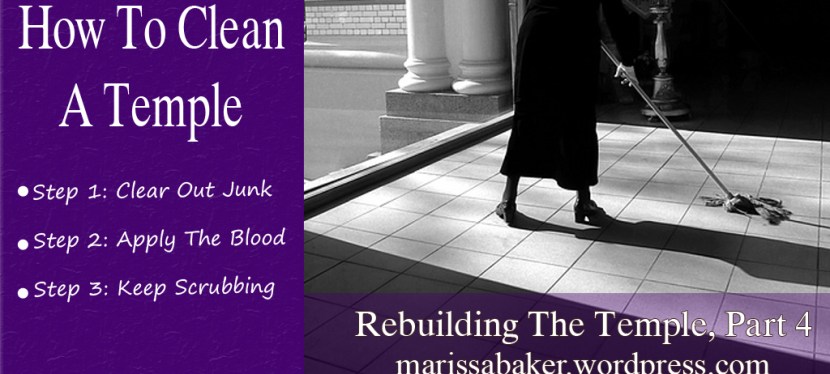
We’ve talked about how to build up spiritual temples and the fact that the churches today need a good temple cleaning, but not much about the practical how-to for cleaning temples. Back when there was a physical temple standing, God gave specific instructions about how to purify the temple and clean it when things got dirty. You couldn’t just throw some soapy water across the floor and say, “Clean!” Today, we are the temple of God, and He has set in place ways of cleaning us out as well.

How To Clean A Temple| marissabaker.wordpress.com

Step One: Clear Out Junk

One of the most complete Old Testaments accounts we have of cleansing a temple took place in the days of king Hezekiah.

In the first year of his reign, in the first month, he opened the doors of the house of the Lord and repaired them. Then he brought in the priests and the Levites, and gathered them in the East Square, and said to them: “Hear me, Levites! Now sanctify yourselves, sanctify the house of the Lord God of your fathers, and carry out the rubbish from the holy place. For our fathers have trespassed and done evil in the eyes of the Lord our God; they have forsaken Him, have turned their faces away from the dwelling place of the Lord, and turned their backs on Him. They have also shut up the doors of the vestibule, put out the lamps, and have not burned incense or offered burnt offerings in the holy place to the God of Israel. (2 Chr. 29:3-7)

And they gathered their brethren, sanctified themselves, and went according to the commandment of the king, at the words of the Lord, to cleanse the house of the Lord. Then the priests went into the inner part of the house of the Lord to cleanse it, and brought out all the debris that they found in the temple of the Lord to the court of the house of the Lord. And the Levites took it out and carried it to the Brook Kidron.
Now they began to sanctify on the first day of the first month, and on the eighth day of the month they came to the vestibule of the Lord. So they sanctified the house of the Lord in eight days, and on the sixteenth day of the first month they finished.
Then they went in to King Hezekiah and said, “We have cleansed all the house of the Lord, the altar of burnt offerings with all its articles, and the table of the showbread with all its articles. Moreover all the articles which King Ahaz in his reign had cast aside in his transgression we have prepared and sanctified; and there they are, before the altar of the Lord.” (2 Chr. 29:15-19)

I find it very interesting that, in addition to purifying the house and cleansing it (presumably with water and blood) the priests had to carry out debris and rubbish. There were things inside the temple defiling it that needed to be thrown out before the other purification could take place.

This puts me in mind of two incidents that took place during Jesus’ ministry. In several Bibles I’ve read, the section heading here reads “Jesus Cleanses The Temple.”

Now the Passover of the Jews was at hand, and Jesus went up to Jerusalem. And He found in the temple those who sold oxen and sheep and doves, and the money changers doing business. When He had made a whip of cords, He drove them all out of the temple, with the sheep and the oxen, and poured out the changers’ money and overturned the tables. And He said to those who sold doves, “Take these things away! Do not make My Father’s house a house of merchandise!” Then His disciples remembered that it was written, “Zeal for Your house has eaten Me up.” (John 2:13-17)

This happened in John chapter 2, at the first Passover during Jesus’ ministry. That means one of the very first things He did as part of His ministry was throw certain things and people out of God’s temple. It was a pivotal moment, and it didn’t just happen once. A very similar incident occurs right before His last Passover.

Then Jesus went into the temple of God and drove out all those who bought and sold in the temple, and overturned the tables of the money changers and the seats of those who sold doves. And He said to them, “It is written, ‘My house shall be called a house of prayer,’ but you have made it a ‘den of thieves.’” (Matt. 21:12-13)

Look how important this was to Jesus. He made a whip to drive out sheep, oxen and people. He poured the exchangers’ money onto the floor, and threw tables over. He probably raised His voice as He ordered out people who’d made His father’s house a vehicle for personal gain. He spent the time leading up to two Passovers before His sacrifice, which fulfilled all the blood sacrifices of the Old Testament, throwing defiling elements out of the temple.

Is there anything that needs thrown out of our lives before God can really start to work with us? The temple today is in our minds, so that’s where we need to look. Anything inside us that is crowding God out of His temple must be thrown out. Jesus can help with that if we ask Him, but – like the priests in Hezekiah’s day – we have to be willing to carry out the rubbish and dump it somewhere it won’t come back.

Step Two: Apply The Blood

Back in the Old Testament, the physical temple had to be cleaned and purified before God would put His presence there. Even when the first tabernacle was built and things started out exactly as God commanded, purification was a daily necessity. I suspect this was because people were involved, and no matter how hard we try we still can’t keep things clean enough for God on our own.

And you shall offer a bull every day as a sin offering for atonement. You shall cleanse the altar when you make atonement for it, and you shall anoint it to sanctify it. (Ex. 29:36)

As Israel fell into sin, the temple was often neglected. Throughout history, it was forgotten by Israel, defiled with idols, and ravaged by conquers. Whenever Israel came back to God, the temple needed fresh purification.

Thus says the Lord God: “In the first month, on the first day of the month, you shall take a young bull without blemish and cleanse the sanctuary. The priest shall take some of the blood of the sin offering and put it on the doorposts of the temple, on the four corners of the ledge of the altar, and on the gateposts of the gate of the inner court. And so you shall do on the seventh day of the month for everyone who has sinned unintentionally or in ignorance. Thus you shall make atonement for the temple. (Ezk. 45:18-20)

The animal sacrifices used to purify the physical temple were a stand-in pointing to how Jesus’s sacrifice would purify His people. “It is not possible that the blood of bulls and goats could take away sins,” but Jesus was able with one offering” to have “perfected forever those who are being sanctified” (Heb. 10:4, 14).

Remember that the tabernacle and then the temple layouts were divided into different sections. In the book of Hebrews, it talks about how there was a main section of the tabernacle where the priests served throughout the year, and then the Holy of Holies which the high priest could only enter once a year on the Day of Atonement (Yom Kippur).

Now when these things had been thus prepared, the priests always went into the first part of the tabernacle, performing the services. But into the second part the high priest went alone once a year, not without blood, which he offered for himself and for the people’s sins committed in ignorance; the Holy Spirit indicating this, that the way into the Holiest of All was not yet made manifest while the first tabernacle was still standing. It was symbolic for the present time in which both gifts and sacrifices are offered which cannot make him who performed the service perfect in regard to the conscience — concerned only with foods and drinks, various washings, and fleshly ordinances imposed until the time of reformation. (Heb. 9:6-10)

What’s really interesting is that in the Greek, there’s one word to describe the entire temple complex and another word to describe the inner sanctuary or Holy of Holies. It’s this second word, naos, which is used when talking about us as the temple of God. The book of Hebrews tells us there is a spiritual version of the Holy of Holies in heaven, where Christ presented His blood to atone for our sins, but each Christian today is also a type of spiritual Holy of Holies.

And according to the law almost all things are purified with blood, and without shedding of blood there is no remission. Therefore it was necessary that the copies of the things in the heavens should be purified with these, but the heavenly things themselves with better sacrifices than these. For Christ has not entered the holy places made with hands, which are copies of the true, but into heaven itself, now to appear in the presence of God for us; not that He should offer Himself often, as the high priest enters the Most Holy Place every year with blood of another — He then would have had to suffer often since the foundation of the world; but now, once at the end of the ages, He has appeared to put away sin by the sacrifice of Himself. (Heb. 9:22-26)

The high priest was the only one ever allowed into the Holy of Holies, just as Jesus Christ was the only one who could clean the spiritual temple. The law requires blood purification of holy things, and Jesus is the only one who’s blood is precious enough to cleans a polluted spiritual temple. Accepting Him as our Savior and asking Him to wash away our sins is a vital step in cleaning the spiritual temple.

Step Three: Keep Scrubbing

As the great High Priest over the church today, Jesus is the only one with a right to come into the temple and clean it out. We can help as best we can, but we must never forget that He’s the one doing the cleansing. It was His sacrifice that removed sin once and for all, and He’s the one continually working to clean His people.

looking for the blessed hope and glorious appearing of our great God and Savior Jesus Christ, who gave Himself for us, that He might redeem us from every lawless deed and purify for Himself His own special people, zealous for good works. (Tit. 2:13-14)

John the Baptist testified of Jesus Christ that He would baptize His people “with the Holy Spirit and fire” (Luke 3:16). When we accept Jesus Christ as our savior and are baptized in His name, we’re washed with His blood and covered in the spirit of God. That’s just the beginning of our purification process, though.

Husbands, love your wives, just as Christ also loved the church and gave Himself for her, that He might sanctify and cleanse her with the washing of water by the word, that He might present her to Himself a glorious church, not having spot or wrinkle or any such thing, but that she should be holy and without blemish. (Eph. 5:25-27)

The church today is God’s temple – His personal dwelling place – and we must do all we can to set it to rights by working on ourselves individually and collectively under the Headship of our High Priest Jesus Christ. The closer we draw to Christ and the more we point others to Him, the cleaner this temple will get.

Back in the Old Testament, the priests were assisted by Levites whose “duty was to help the sons of Aaron in the service of the house of the Lord, in the courts and in the chambers, in the purifying of all holy things and the work of the service of the house of God” (1 Chr. 23:28). This was supposed to keep happening on a continual basis. In much the same way, we have to continue repenting when we fall short and continue submitting to the refining process Christ is accomplishing in our lives.

How To Clean A Temple| marissabaker.wordpress.com

credits for photos used in blog images: