God’s Questions for A Faithless People

I often think when reading the Old Testament prophets that it’s as if God could be speaking to us today. We don’t live in a whole nation claimed by God and governed by His laws (as physical Israel was) but believers today are spiritual Israel — the people who belong to God (Rom. 2:28-29; Eph. 2:12-13). When God talks to His wayward, complaining people in history, those words can also resonate with those of us who follow Him today but perhaps aren’t doing as good a job of that as we should be.

Micah’s book starts out with an alarm cry. “Listen, all you nations! Pay attention, all inhabitants of earth!” As a result of His people’s rebellion, the Lord is going to come with great destruction to crumble, split, and melt the earth (1:2-5). A spiritual infection has spread even into the “leadership of my people” (1:9), and that cannot go uncorrected. Wicked schemes run rampant in the land and it will result in disaster (2:1-3). Though people say, “The Lord’s patience can’t be exhausted— he would never do such things,” He will not put up with lying, stealing, defrauding, and persecuting the innocent forever (2:7-11).

Reading this, I can’t help but think of the world today. Outside the church, society is crumbling and the world’s going crazy. Injustice, lack of integrity, and disregard for God’s ways runs rampant. And, to our shame, it’s not much better in some churches. We have plenty of excuses for the way things are — often boiling down to something along the lines of it’s too hard to follow God today, He doesn’t really care what we do, or it’s enough if we’re good in our own way — but those excuses don’t stand up well in the face of God’s questions. God offers hope as well as judgement, though, and I think we can learn much from that message today.

God Will Judge

We know from scripture God will judge the world, but sometimes we forget He will also judge His own household. Nearly 2,000 years ago, Peter wrote, “it is time for judgment to begin, starting with the house of God” (1 Pet. 4:17, all scriptures from New English Translation). That’s still happening today, and it was happening before Peter, too. There are things God’s people ought and ought not to do, and He will hold us accountable.

I said,
“Listen, you leaders of Jacob,
you rulers of the nation of Israel!
You ought to know what is just,
yet you hate what is good
and love what is evil.
You flay my people’s skin
and rip the flesh from their bones.

Micah 3:1-2

James warns that teachers “will be judged more strictly” (3:1), and the same seems true for other leaders among God’s people as well. We’re each responsible for our own actions, but leaders are also responsible for the people who listen to them. When someone misleads the people of God, all those who are disobedient face judgement but the fault lies most with the leaders (Micah 3).
God's Questions for A Faithless People | LikeAnAnchor.com
Image by Free-Photos from Pixabay

God’s Questions

After hearing of such judgement and disaster, the people’s objection from 2:7 might seems a reasonable one to some of us. God is loving, patient, and merciful — He wouldn’t really do that! And then when it turns out He’s different than we expect or want Him to be, those objections might then turn to complaints that God isn’t fair or that His expectations are unreasonable (something we also hear today). God has an answer to that.

Listen to what the Lord says:

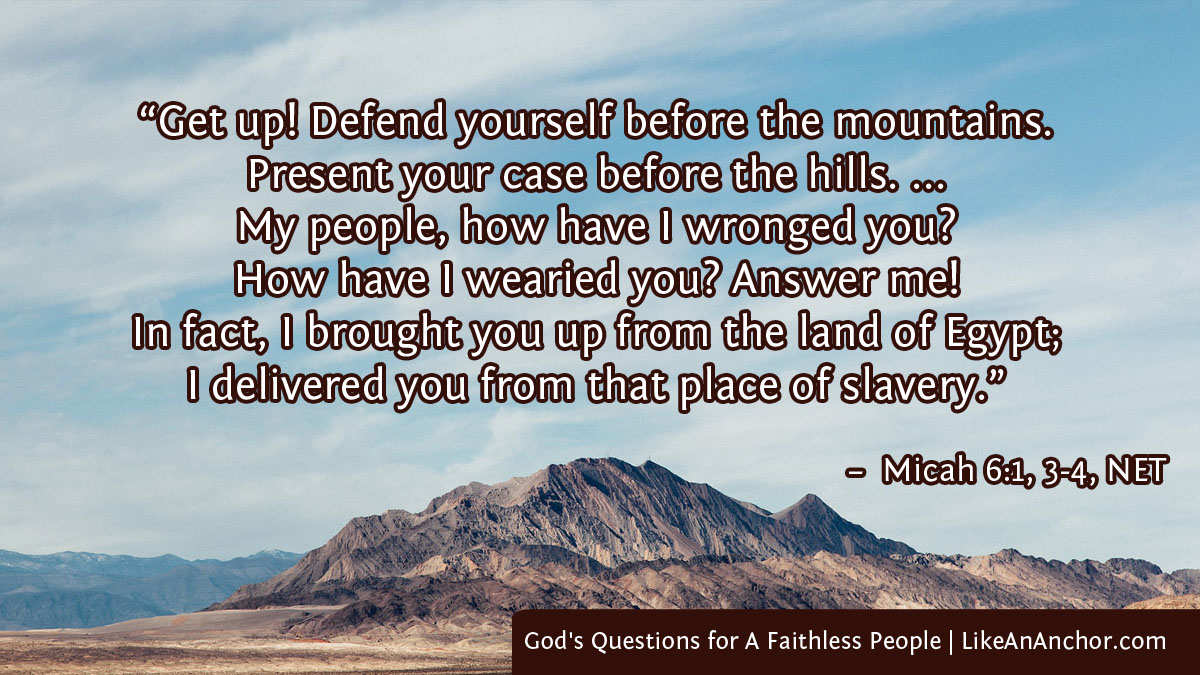
“Get up! Defend yourself before the mountains.
Present your case before the hills.”
Hear the Lord’s accusation, you mountains,
you enduring foundations of the earth.
For the Lord has a case against his people;
he has a dispute with Israel!
“My people, how have I wronged you?
How have I wearied you? Answer me!
In fact, I brought you up from the land of Egypt;
I delivered you from that place of slavery.
I sent Moses, Aaron, and Miriam to lead you.
My people, recall how King Balak of Moab planned to harm you,
how Balaam son of Beor responded to him.
Recall how you journeyed from Shittim to Gilgal,
so you might acknowledge that the Lord has treated you fairly.”

Micah 6:1-5

God’s not the one who broke the covenant. If anyone has cause to bring an accusation against someone else, it’s God against the people. And though the language would change if used today (e.g. we no longer personify mountains as witnesses to treaties, as they did in the ancient Near East [NET footnote to v. 1]), God could say much the same thing to many modern Christians. Hasn’t He given and done so much for us? Is what He asks in response so unreasonable?

He has told you, O man, what is good,
and what the Lord really wants from you:
He wants you to carry out justice, to love faithfulness,
and to live obediently before your God.

Micah 6:8

There is Plenty of Hope

Following God really isn’t all that complicated. He tells us what He expects from us, Jesus lived an example of faithfulness, and then He died to cleanse us from the sins that we do commit. God is clear with His expectations, and He’s got a sort of “safety net” to save us if we slip; all we need to do is repent and move forward in renewed, faithful obedience. We’re the ones who complicate things, or perhaps more accurately the world makes following God seem confusing and difficult. But if we keep walking with Him, there are better days ahead.

God's Questions for A Faithless People | LikeAnAnchor.com
Image by David Mark from Pixabay

And in future days the Lord’s Temple Mount will be the most important mountain of all;
it will be more prominent than other hills.
People will stream to it.
Many nations will come, saying,
“Come on! Let’s go up to the Lord’s mountain,
to the temple of Jacob’s God,
so he can teach us his ways
and we can live by his laws.”
For instruction will proceed from Zion,
the Lord’s message from Jerusalem.
He will arbitrate between many peoples
and settle disputes between many distant nations.
They will beat their swords into plowshares,
and their spears into pruning hooks.
Nations will not use weapons against other nations,
and they will no longer train for war.
Each will sit under his own grapevine
or under his own fig tree without any fear.
The Lord of Heaven’s Armies has decreed it.
Though all the nations follow their respective gods,
we will follow the Lord our God forever.

Micah 4:1-5

This promise is still for the future. We can look forward to the time when Christ will rule as David’s heir (Mic. 5:2-9) and the whole world will have peace. Until then, we ought to follow the prophet’s example here in saying no matter what the other peoples of the earth do, we will follow God. In Hebrew, it is more literally “walk in the name of our God,” which involves recognizing His “authority as binding over” your life (NET footnotes to v. 4-5). Living as a Christian can’t be a half-hearted commitment. God wants your whole heart, and in light of how much He loves us that doesn’t seem an unreasonable request.

Featured Image by JPierre Desvigne from Pixabay 

Titles of Jesus Christ: David’s Son

Over and over in the gospels, people cry out to Jesus, “Have mercy on us, you son of David!”

Why is the Messiah’s title as David’s son the one that blind men and a Canaanite woman latched on to as they asked for healing? (Matt. 9:27; 15:22; 20:30-31; Mark 10:46-48; Luke 18:35-39). Why did the people shout, “Hosanna to the son of David!” when Jesus entered Jerusalem, and why did that make the chief priests and the scribes so indignant? (Matt. 21:9, 15; Mark 11:10). What is the significance of this title?

It would be easy to gloss over Jesus’ title as David’s son, simply taking it as fulfillment of a few prophecies that said Messiah (the Hebrew equivalent to “Christ,” which means “anointed”) would come from King David’s descendants. But the Biblical writers treat this as a highly significant fact, and I think it’s worth looking into more closely.

Fulling A Covenant Promise

I’ve talked about the covenant aspect of Jesus being descended from David in several posts already, including “Inheriting Covenants.” The Lord made a covenant with David that He would establish his offspring’s kingdom forever, and that connected with the promise of Messiah (2 Sam. 7:12-15).

Yahweh has sworn to David in truth. He will not turn from it: “I will set the fruit of your body on your throne. If your children will keep my covenant, my testimony that I will teach them, their children also will sit on your throne forever more.” (Ps. 132:11-12, all verses from WEB translation)

David’s descendants eventually fell into disobedience and lost the physical kingdoms of Israel and Judah. But Jesus — a sinless, obedient son of David — inherited the covenant promise. According to Peter, David actually knew that would be the end result of God’s promises to him about his descendants. Read more

Titles of Jesus Christ: Our Peace

I think that when we hear Jesus talked about as “Prince of Peace” or “Our Peace,” we usually think of Him making strife cease. We picture Him setting up a world without war and fixing the strife between human beings and God. Those are definitely part of what’s going on, but there’s also a whole lot more. We can dive deeper into what “peace” means — and gain a deeper understanding of who Jesus is and what He is doing — by studying into the Hebrew word shalom.

Shalom is a key Biblical concept. It occurs over 250 timed in the Old Testament, and that’s not counting related words like shalem. It’s most often translated “peace,” though the King James Version uses about 30 different English words. Those include prosperity (Ps. 35:27), rest (Ps. 38:3), safety (Is. 41:3), using shalom as a salutation or greeting (Judg. 18:15; 1 Sam. 25:5), and in reference to someone’s welfare (Gen. 29:6; Ex. 18:7).

The Hebrew word shalom comes from the root verb shalem, which means “completeness, wholeness, harmony, fulfillment.” That’s all included in shalom as well, along with the English meaning of “peace” as an absence of strife. Also wrapped up in this concept is the implicit “idea of unimpaired relationships with others and fulfillment of one’s undertakings (Theological Wordbook of the Old Testament, by Harris, Archer, and Waltke, entry 2401a). It’s a much more nuanced word than we give it credit for in English translations.

Restitution and Healing

Shalom is wholeness — nothing missing, nothing broken. It is a state that humans don’t end up in naturally. God created us perfect, but we’re now fallen people living in a fallen world. Peace is an elusive thing.

There is no soundness in my flesh because of your indignation, neither is there any shalom in my bones because of my sin. (Ps. 38:3, Hebrew word added, all quotes from WEB translation)

Sin is something we’re all guilty of, and it’s something that causes brokenness. We’re not whole or complete, and the covenants that people of the past made with God are broken by humanity’s sin. If you want to fix something that’s broken, missing, or stolen, God requires restitution (shalem in Hebrew) in order to satisfy the requirements of law (Ex. 22:3, 5-6, 12, 14). In order to fix what is wrong with us, the process of restitution required something on a greater level than animal sacrifice or paying some money.

Read more

Titles of Jesus Christ: Firstborn and Heir

Who is Jesus Christ? Some consider Him a prophet, some a teacher who had some good things to say about peace and love, others say He was a madman. As Christians, we know Him as the Son of God who died to save us from our sins, rose again, and continues to be actively involved in our lives. But what does it really mean that He’s God’s Son, and why does that particular title matter to us?

God, having in the past spoken to the fathers through the prophets at many times and in various ways, has at the end of these days spoken to us by his Son, whom he appointed heir of all things, through whom also he made the worlds. (Heb. 1:1-2, all scriptures from WEB translation unless otherwise noted)

Firstborn’s Birthright

In Old Testament times, being a firstborn son was a big deal. You were the bekor (H1060), eldest son  and therefore the bekorah (H1062, birthright) was yours. You received a double portion when the father divided his inheritance (Deut. 21:15-17). There was a special blessing involved (Gen. 27). It was so important that any disruption to this birthright was cause for Biblical writers to take special note (Gen. 25:31-34; 48:9-19; 1 Chr. 5:1-2).

According to a message I recently watched on YouTube titled “Hebrews: Yeshua’s Amazing Qualifications,” the rights of the firstborn traditionally included a few other things as well. The eldest son acted as the family’s spiritual leader, acquired spiritual favor and honor, and inherited the blessings of Abraham. Heirship involved authority over the father’s possessions. Before there was a Levitical priesthood (which Yahweh accepted in place of the firstborns, as noted in Num. 3:12-13, 41; 8:16-18), the firstborn would even act as priest for the family.

Many parallels between Jesus and the Hebrew firstborns are easy to spot. He is the family’s spiritual leader, acting as “head of all things to the church” under the Father’s authority (Eph. 1:15-23). He is also High Priest of an order that supersedes the Levitical order as the Levites superseded what came before (Heb. 7:11-28). And that’s not where the parallels end. Read more

The Benefits of Living In Covenant With God

In his letter to believers in Rome, Paul asked, “If God is for us, who can be against us?” He goes on to explain that God, who gave up His own son for us, will freely give us everything we need. And because God is all powerful and the One who has final say in judgement, nothing can separate us from His love even if the trials we face kill us (Rom. 8:31-39).

Is that a contradiction? One moment Paul says nothing could stand against us, then suddenly he’s talking about us being killed? It might seem odd at first, but Paul’s focus isn’t on the people of God avoiding physical trials and suffering. Physical protection and healing can (and often do!) happen, but that is not our main concern.

 Who will separate us from the love of Christ? Will trouble, or distress, or persecution, or famine, or nakedness, or danger, or sword? As it is written, “For your sake we encounter death all day long; we were considered as sheep to be slaughtered.” No, in all these things we have complete victory through him who loved us!

Romans 8:35-37, NET, with  quotation from Ps 44:22

Paul quotes from a psalm that laments the deaths of God’s covenant people and asks God not to reject them forever (Ps. 44:17-26). It seems that Paul would tell the Psalmist, and us, that suffering does not mean God has forsaken us. In fact, we “have complete victory” even in the midst of all that.

Bold, Rational Confidence

I don’t want to deal with trouble (G2347, thlipsis, tribulation and affliction that’s external), distress (G4730, stenochoria, great distress, particularly inner distress), persecution (G1375, diogmos, pursuit, persecution), famine (G3042, limos), nakedness (G1132, gumnotes, total lack of clothing), danger (G2794, kindunos, peril), or sword (G3162, machaira, a sword for slaughter or execution). I dare say none of us do. But Paul makes it sound like it wouldn’t be a big deal. And he should know, considering all he went through (2 Cor. 11:23-28). When Paul talks about suffering as a Christian, he speaks from experience.

For I am convinced that neither death, nor life, nor angels, nor heavenly rulers, nor things that are present, nor things to come, nor powers, nor height, nor depth, nor anything else in creation will be able to separate us from the love of God in Christ Jesus our Lord.

Romans 8:38-39, NET

Paul’s confidence isn’t just based on hear-say. It is based in faith as well as first-hand experience. To quote Adam Clarke’s commentary, “The confidence expressed by the apostle at the end of this chapter is as rational as it is bold.” This section of Romans is a brilliant piece of writing and a glorious affirmation that those who trust God have nothing to worry about. We’ve already more than won the battle through the victory of Him who loves us.

Faithful To The Covenant

That kind of makes it sound like there’s nothing left for us to do, though, and that is not the overall message of Romans. Going back to the Psalm that Paul quotes from, we find a line that reads, “All this has come on us, yet we haven’t forgotten you. We haven’t been false to your covenant” (Ps. 44:17, WEB). Paul’s background was that of a Jewish rabbi, and in their writings they often quote part of an Old Testament passage and assume their readers will connect the present argument to that passage’s larger context. Paul is writing about covenants, and he expects us to understand that.

With that in mind, I think the parallel Clarke draws is a sound one. He writes, “We abide faithful in the new covenant of our God; and He is faithful who has promised to support and make us more than conquerors; i.e. to give us a complete triumph over sin, and death, and hell, not leaving one enemy unsubdued” (commentary on Rom. 8:37). It reminds me of something else Paul wrote in another letter.

This saying is trustworthy:
If we died with him, we will also live with him.
If we endure, we will also reign with him.
If we deny him, he will also deny us.
If we are unfaithful, he remains faithful, since he cannot deny himself.

2 Timothy 2:11-13, NET

There’s a reciprocal aspect to our relationship with God. It’s actually connected to grace, though that’s too big a topic to dive into now (here’s a link to a great booklet on the subject). His faithfulness is a constant, but we can’t reap the benefits of it without being in covenant with Him and remaining faithful ourselves.

Remember to Ask For Help

God is eager to help His people, but we have to be willing to let Him. It seems strange that we’d ever reject God’s help, but a story from one of Judah’s kings shows that it does happen. Asa was one of the good kings who “did that which was good and right in Yahweh his God’s eyes” (2 Chr. 14:2-4, WEB). He demonstrated a reliance on God when his enemies attacked, praying for and receiving deliverance (2 Chr. 14:9-15). After this, God sent a prophet to tell him, “Yahweh is with you, while you are with him; and if you seek him, he will be found by you; but if you forsake him, he will forsake you” (2 Chr. 15:2, WEB). This isn’t anything so crude as a “you scratch my back, I’ll scratch yours” bargain. There’s covenant obligations in relationship, as we’ll see shortly.

The writer of Chronicles tells us “the heart of Asa was perfect all his days” (2 Chr. 15:17, WEB). We also know that he and the people of Judah “entered into the covenant to seek Yahweh, the God of their fathers, with all their heart and with all their soul” (2 Chr. 15:12, WEB). But even so, something happened. In the 36th year of Asa’s reign, he turned to the king of Syria to handle a problem with the king of Israel instead of turning to God. After this happened, God sent a seer to remind Asa where his trust should have been and explain why things didn’t work out so well (2 Chr. 16:1-7).

“Weren’t the Ethiopians and the Lubim a huge army, with chariots and exceedingly many horsemen? Yet, because you relied on Yahweh, he delivered them into your hand. For Yahweh’s eyes run back and forth throughout the whole earth, to show himself strong in the behalf of them whose heart is perfect toward him. You have done foolishly in this; for from now on you will have wars.”

2 Chronicles 16:8-9, WEB

Asa’s heart was perfect, and so God was eagerly looking out for opportunities to act on his behalf. He had already spotted this situation, but Asa decided not to ask for help and instead trust himself, a pattern which continued the rest of this life (2 Chr. 16:10-13). Asa lost the help available from God because he did not ask for the benefits of being in covenant with God.

God is Eager To Hear From You

I wonder how often we miss out on God’s eagerness to show Himself strong on our behalf simply because we don’t think to ask. Maybe the main thing we need to do in order to have Paul’s perspective on life’s extreme challenges is to turn to God and ask Him for help. God has a different perspective on things than we do, and sometimes He sees the things that seem most overwhelming and challenging to us in a completely different way (this is a major lesson of Job).

You don’t have, because you don’t ask. You ask, and don’t receive, because you ask with wrong motives, so that you may spend it on your pleasures.

James 4:2-3, WEB

Just before the “If God is for us, who can be against us?” passage, Paul says that even if we don’t know what to pray the Spirit will fill in the gaps so long as we turn to God. He also assures us, “We know that all things work together for good for those who love God, for those who are called according to his purpose,” and points us to focus on our future glory as children of God (Rom. 8:28-30, WEB).

Nothing can separate us from Christ’s love. Nothing can vanquish us because He has already won the pivotal battle of the war we’re fighting. We need to stick close to Him (i.e. love him with a perfect heart and stay faithful to the covenant) because it’s in Him that “we are more than conquerors” (Rom. 8:37, WEB). Beyond that, all we need to do to have Paul’s confidence is to remember to always turn to God and ask Him to share His help, strength, and perspective with us. Confidence and peace, knowing that God will not abandon you, is one of the chief benefits to living in covenant with God.

Featured image credit: Aaron Kitzo via Lightstock

How the Lord Meets with Us: Examining Jesus Christ’s Role as Intercessor

After writing last week’s post about coming to the Father through Jesus, I started studying the words “intercessor” and “mediator.” Interestingly, I found that in Hebrew the word used for “intercession” also means to encounter, come between, and meet with. It’s used in a variety of contexts, but I focused on the ones that related to how God interacts with us here on earth.

There are multiple ways that God can interact with humans. Two of those interactions involve rewarding good and punishing evil. We see the word for “intercession” used in both these contexts. This confused me at first, but as I studied it I found something that is very exciting and encouraging about how the two meanings connect.

Meeting With Punishment

The Hebrew word paga (Strong’s H6293) means “to encounter, meet, reach, entreat, make intercession” (BDB definition). Here’s one place it’s used in Exodus, when Moses and Aaron were talking with Pharaoh.

They said, “The God of the Hebrews has met with us. Please let us go three days’ journey into the wilderness, and sacrifice to Yahweh, our God, lest he fall on us with pestilence, or with the sword.” (Ex. 5:3, WEB)

“Fall on us” is translated from the word paga. We might paraphrase, “Let us worship God, or He’ll meet us with punishment.” It seems strange to have the same word as “intercession” used for meeting someone with pestilence or sword. Intercession tends to be seen as a more positive thing. If we head over to Isaiah’s writings, though, this starts to make more sense.

Read more