Here’s What Your Myers-Briggs® Type Can and Can’t Tell You

It’s no secret I’m a big fan of Myers-Briggs®. I’ll defend it against people who say it’s useless, write and re-write posts trying to come up with the simplest introduction to function stacks ever, and spend my time musing about how type influences both real people and fictional characters. But as much as I like the Myers-Briggs® system of personality types, I also know there are things it’s not meant to do.

In fact, applying Myers-Briggs® wrongly is one of the biggest reasons it has come under so much criticism. For example, you can find quite a few articles online that argue Myers-Briggs® is basically useless in a work environment. They’ll tell you it’s not a good indicator of job performance nor is it all that useful for screening potential employees. But that shouldn’t come as a surprise, considering those aren’t the test’s purpose. And it’s unfair to dismiss a test for not doing something it wasn’t meant to do in the first place.
Here's What Your Myers-Briggs Type Can and Can't Tell You | marissabaker.wordpress.com
Photo credit: Brodie Vissers via StockSnap

So what is the Myers-Briggs® test supposed to tell you? And just how much can we apply what we learn from finding our type to real life?

This Is Your Brain On Decision Making

The Myers-Briggs® test is designed to measure how people’s minds work. It describes their preferred mental processes or “cognitive functions” (to use the technical term). Contrary to what so many critics of the test think, it doesn’t force people into dichotomies. Rather, each type has a “stack” of preferred functions. So an ENFJ type isn’t someone who’s 100% extroverted, intuitive, feeling, and judging. They’re a type that prefers making decisions with Extroverted Feeling, learning new things with Introverted Intuition, and then also uses Extroverted Sensing and Introverted Thinking to a lesser extent (click here to learn how we get from the four letter type to the functions).

These characteristics of Myers-Briggs® theory means that taking the test can help you: Read more
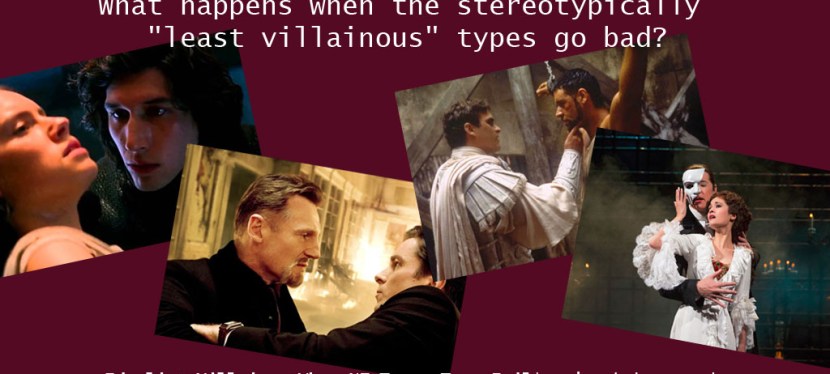
Idealist Villains: When NF Types Turn Evil

A few weeks ago I observed something curious in one of the personality type groups I frequent on Facebook. One member started a discussion about what kind of villain different personality types would be and there were a few types they didn’t even list. Their assumption was that most Feeling types wouldn’t become villains and especially not NF or FP types.

Rather than bask in the knowledge that we’re the lest villainous type a surprisingly high number of NFs jumped into the comments to defend our ability to turn evil. Most of their comments went something like this: “Well, I wouldn’t personally be a villain, but I could be because *insert reasons.* And on top of that, *insert fictional or real name* is a villain of my type.” I laughed at the number of INFJs who reminded people that Hitler was an INFJ while at the same time reassuring people they don’t feel Hitler-ish tendencies themselves.Idealist Villains: When NF Types Turn Evil | marissabaker.wordpress.com

Who Gets To Be The Villain?

I dare say when most people think about villains, they think of a detached mastermind. There’s a ridiculously high percentage of NT type villains (and correspondingly few NT heroes; it’s even harder to find heroic INTJs in fiction than it is to find NF villains). In real life, of course, people of any personality type can lean more towards the best version or the worst version of their type. No one personality type is inherently “better” than any other. However, society does stereotype certain characteristics associated with types as better or worse.

Prioritizing other’s safety over your own, a characteristic most commonly associated with FJ types, is often seen as a heroic trait. Hence, we see characters like Captain America with an ISFJ personality type. But what if you have an ISFJ character who decides only a certain group of people (or even just one person) is more valuable and it’s their duty to protect them? Suddenly the heroic trait doesn’t seem so safe any more. Especially when you consider the prime example of a villainous ISFJ is Norman Bates from Psycho. Read more

All Your Heart, Mind, and Soul: ENFP Christians

This is the second post in a series talking with Christians of different personality types. When you start discussing faith with different personality types, you notice not all the personalities feel equally valued and understood in Christian churches. If Christianity is a faith meant for all people why aren’t we doing a better job of connecting with all personality types?

Our walks with God don’t all look the same. We’re influenced by our backgrounds, variations in beliefs, and individual personalities. And even though the goal is for us all to become “like God,” that doesn’t mean we become indistinguishable from each other. God created great variety in people and I believe He did that for a reason. So let’s spend today’s post hearing from and talking about the unique perspectives of ENFP Christians.

Identifying With The Bible

While some ENFPs have a favorite Bible character, others couldn’t pick just one. Charity said, “I don’t really ‘identify’ with any of them, since we’re different people who have had different experiences, but my inner feminist always liked Mary sitting at the feet of Jesus, and Jesus telling Martha that she was where she should be (instead of preparing food in the kitchen!).” Dorien said he couldn’t choose just one and identified more with some during different seasons, “But I love the characters who experience the Love of God very deep: The woman trapped in idolatry. John – with his intimate relationship with Jesus. David – which name means The Beloved and was still chosen, even when He made mistakes.”

Personally, I’ve always found Peter very relatable and wonder if he might have been an ExFP type. I was glad to see two ENFPs list him as one of the characters they relate. Rielle elaborated on Peter the most, saying, “I can relate to him often not thinking (or seeming like it at least) before he speaks.” She also likes the way he “gets so involved in everything and is just so interested in what Jesus says.” Read more

Personality Types in Star Wars Rebels

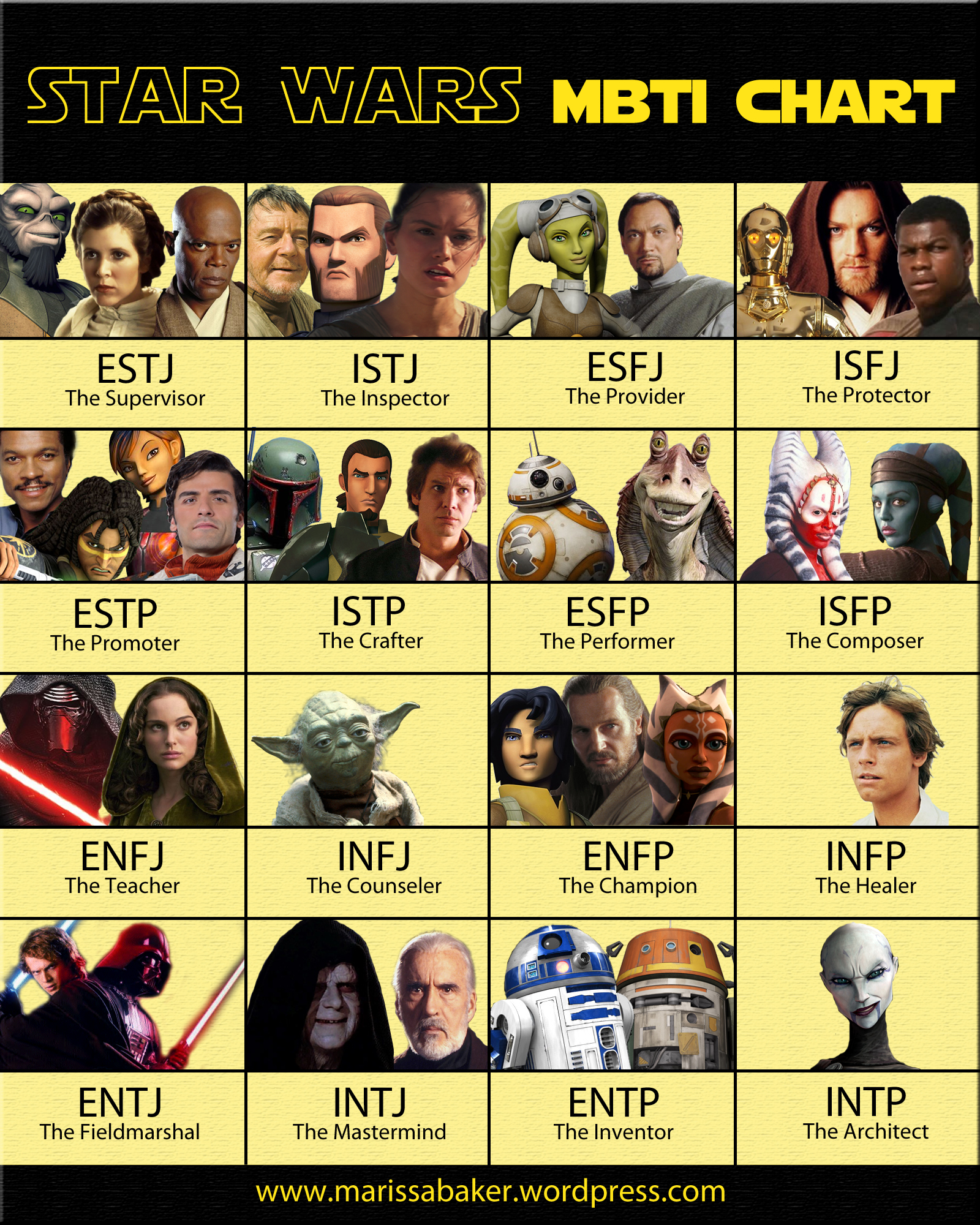
Note: an updated version of this chart and expanded discussions about Star Wars characters’ Myers-Briggs types can now be found on my other blog Star Wars Personalities.

Star Wars Rebels is my new favorite TV show. It’s been around since 2014, but I just started watching it last month. Now I’m caught up and eagerly awaiting the rest of season 3. Being an Myers-Briggs enthusiast as well as a Star Wars fan, my thoughts naturally turned toward analyzing the main characters’ personality types and updating my Star Wars MBTI chart.

Like The Clone Wars, Rebels is an animated series set in the Star Wars universe. While I enjoyed The Clone Wars (especially Ahsoka’s story line and Anakin’s character development), there are plenty of filler episodes, most of the humor is aimed at a young audience, and it’s a bit daunting at 121 episodes. Rebels, on the other hand, has a much tighter story arc and it’s aimed at a more mature audience (still a kids show, but fewer things that will have adults wincing or rolling their eyes).

click to read article, "Personality Types in Star Wars Rebels" | marissabaker.wordpress.com

After The Force Awakens came out last year I published a Star Wars MBTI Chart, which I present again here with Rebels characters added. For this post, I’m focusing on the Ghost‘s crew with one recurring character thrown in (Ahsoka also appears in Rebels, but she’s already been typed). I’d love to include Grand Admiral Thrawn, but I think I’ll wait until his new in-canon novel is released later this year.

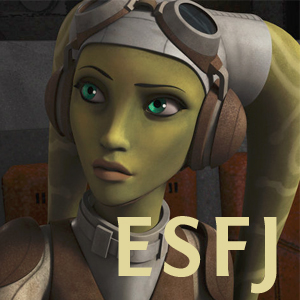
Hera Syndulla – ESFJ

Hera Syndulla - ESFJ. Visit marissabaker.wordpress.com for more Star Wars Rebels personality typesHera is a fantastic example of an SFJ type. She has that Si-Fe blend of prioritizing other people’s good while working to maintain social order. As an extrovert, she’s a talkative, people-focused character who teaches Ezra “if all you do is fight for your own life then your life is worth nothing.” It’s a belief she lives by as well.

SFJ characters are stereotyped at the “mother” figure and we get to see why in the way Hera leads and cares for her crew, especially in the first two seasons. As is typical of a dominant Extroverted Feeling type, she puts extra effort into maintaining harmony among her crew (such as sending Zeb and Ezra on a wild meiloorun chase so they can bond in S1E2).

After Hera’s rebels become more involved with the rebellion, we see that she’s the only one who’s really concerned with working in a larger movement. If you read A New Dawn, you see her focus from the very beginning has been on working to save the entire galaxy. This is partly an SJ’s commitment to order, partly an Fe type’s concern for people. But I think it’s also a little bit of her tertiary Extroverted Intuition looking at the larger picture and future implications of their actions. Read more

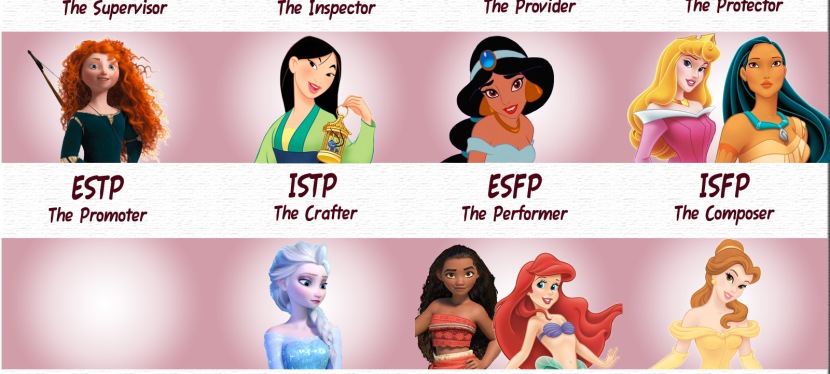
Part Two: “Unofficial” Disney Princesses MBTI Chart

Last week, I updated an old post called The Missing Disney Princesses with a brand new MBTI Chart featuring the 14 official princesses (well, technically there are 11 official princesses, plus Anna and Elsa who have their own line, and Moana who hasn’t been crowned yet. So it was more like the “Official + New/Popular Princesses Chart”).

There are other Disney women, though, who’ve been completely snubbed by the Disney princess line-up and I wanted to include those as well. I had them on a separate chart in my previous post and I wanted to follow that pattern this time as well. Eilonwy and Alice were the most requested characters I left out last time, so I’m adding them. And I’ve also added a character no one asked about from my favorite underappreciated Disney films — Maid Marion from Robin Hood.Updated Disney Princesses MBTI Chart, Part Two | marissabaker.wordpress.com

Note: I’m not using anything from sequel films (just to help narrow-down the typing choices), so that’s why you won’t see Ariel’s daughter Melody (for example). I also type using cogitative functions. If you’re not familiar with that aspect of Myers-Briggs theory, click here and here for a two-part introduction. Read on for detailed explanations for why I chose these types for the unofficial princesses, and click here for the post about the other princesses.

Read more

Updated Disney Princesses MBTI Chart

A couple years ago, I made a Myers-Briggs chart called The Missing Disney Princesses that quickly became one of the more popular posts on my blog. Now (finally!!!) I get to update it to include our new princess, Moana.

But I’m not just adding Moana to my chart. I’m also moving around a few of the other princesses. Last time, my focus was on showing that we don’t see all the personality types represented by the Disney princesses. Both Intuitive and Thinking types are under represented among Disney’s ladies. That’s still the case, but this time my focus is on explaining why I typed each princess the way I did.

In the two years since publishing the last chart, I’ve learned more about Myers-Briggs typing. I’ve also re-watched several of these movies, considered comments from readers on the previous post, and asked advice from fellow personality type and Disney enthusiasts. In response, I’ve re-typed several characters (which is noted and explained in the individual character discussions).Updated Disney Princesses MBTI Chart | marissabaker.wordpress.com

Note: I type using cogitative functions. If you’re not familiar with that aspect of Myers-Briggs theory, click here and here for a two-part introduction. Read on for detailed explanations for why I chose these types for each character. Read more