Part Two: “Unofficial” Disney Princesses MBTI Chart

Last week, I updated an old post called The Missing Disney Princesses with a brand new MBTI Chart featuring the 14 official princesses (well, technically there are 11 official princesses, plus Anna and Elsa who have their own line, and Moana who hasn’t been crowned yet. So it was more like the “Official + New/Popular Princesses Chart”).

There are other Disney women, though, who’ve been completely snubbed by the Disney princess line-up and I wanted to include those as well. I had them on a separate chart in my previous post and I wanted to follow that pattern this time as well. Eilonwy and Alice were the most requested characters I left out last time, so I’m adding them. And I’ve also added a character no one asked about from my favorite underappreciated Disney films — Maid Marion from Robin Hood.Updated Disney Princesses MBTI Chart, Part Two | marissabaker.wordpress.com

Note: I’m not using anything from sequel films (just to help narrow-down the typing choices), so that’s why you won’t see Ariel’s daughter Melody (for example). I also type using cogitative functions. If you’re not familiar with that aspect of Myers-Briggs theory, click here and here for a two-part introduction. Read on for detailed explanations for why I chose these types for the unofficial princesses, and click here for the post about the other princesses.

Read more

Myers-Briggs: Fad or Science?

Friends who know I blog about Myers Briggs types sometimes send me links to people critiquing the MBTI and ask what I think. The arguments in videos like “Why the Myers-Briggs test is totally meaningless” and articles such as “Goodbye to MBTI, the Fad That Won’t Die” tend to follow a similar pattern and hit the same points:

  • Kathryn Brigs and Isabel Briggs Myers had no formal training.
  • The test doesn’t allow for complex personalities or that someone can be a little bit of an extrovert and a little bit of an introvert at the same time.
  • Similarly, the judging-perceiving, thinking-feeling, and sensing-intuition “scales” don’t allow for people who use both.
  • About 50% of people who take the test twice within 5 weeks get different results.
  • Test fails to predict success in various jobs and doesn’t provide meaningful data.
  • The test remains popular because it only gives positive results. These results are vague and hard to argue with, much like astrology and pseudoscience.

Disclaimer: some of the links in this post are affiliate links. This means that, at no additional cost to you, I will receive a commission if you click on the link and make a purchase on that website.

Setting aside the first arguments for now, I think these points are a good criticism of some of the free tests going around which make people pick just between the four letter groups. None of this, however, takes into account the science behind Myers-Briggs. In fact, if the critics would bother reading Isabel Myers’ book Gifts Differing,* they would find most of their points have nothing to do with actual Myers-Briggs theory.Myers-Briggs: Fad or Science? | marissabaker.wordpress.com

The Truth About Extroverts and Introverts

The video I linked above correctly states that Jung’s theory allowed for people who didn’t fit neatly into a single category. But then they say Kathryn Briggs and Isabel Myers “took Jung’s types but slightly altered the terminology and changed it so every single person was assigned only one possibility or another. You couldn’t be a little bit of an extrovert or a little bit of an introvert.”

In fact, this a complete misrepresentation of Myers-Briggs theory. Read more

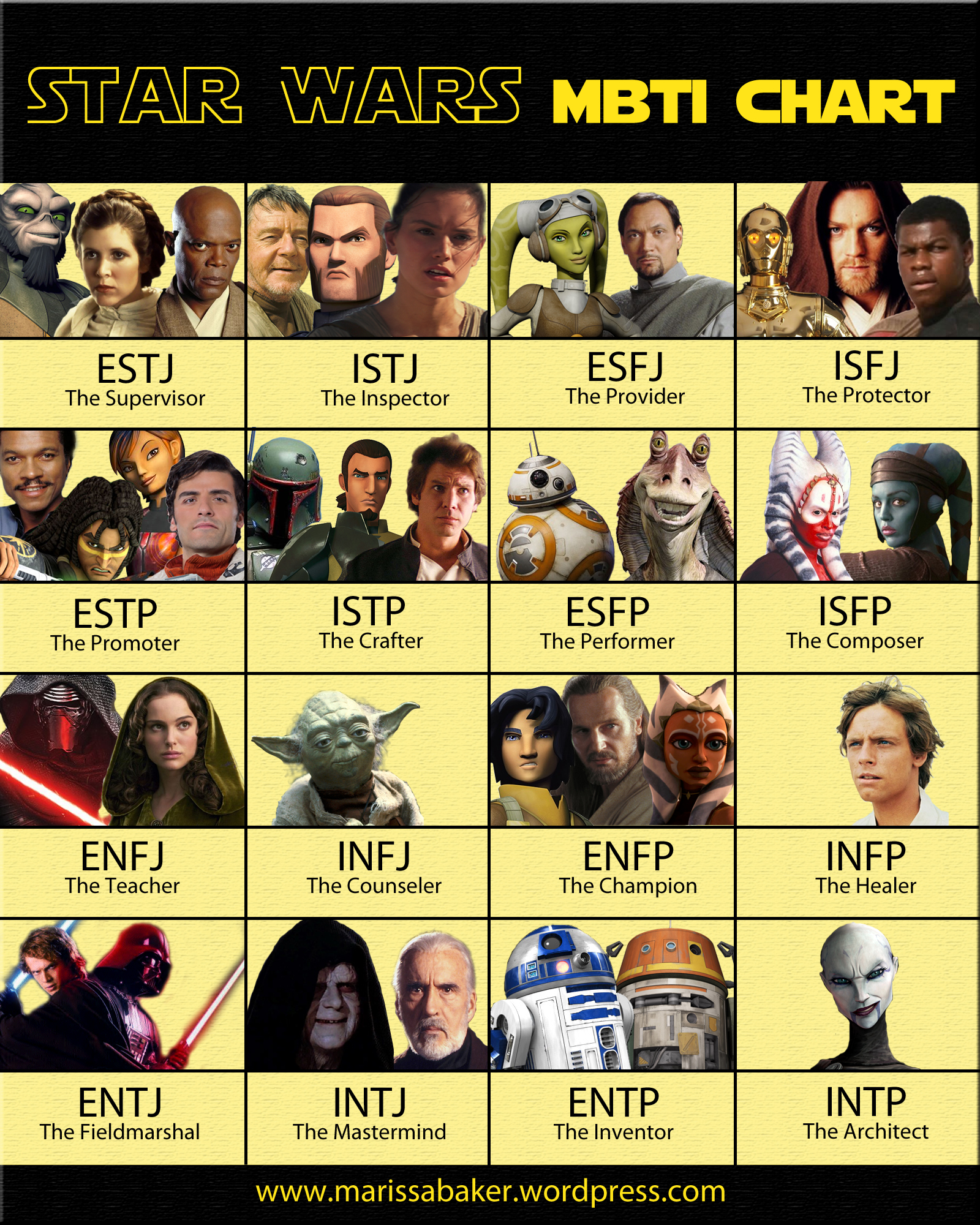
Star Wars MBTI Chart

Note: an updated version of this chart and expanded discussions about Star Wars characters’ Myers-Briggs types can now be found on my other blog Star Wars Personalities.

My Star Wars obsession has lain dormant for 10 years, buried under delta shields, gate addresses, consulting detectives, and madmen in blue boxes. As The Force Awakens, so has the part of me that used to spend hours on Star Wars message boards debating casting news and plot points for the prequels trilogy. I’ve seen it twice now — once opening night and then again yesterday.

I know the fact that most of the EU is no longer cannon has irritated/incensed some people, but at least it’s easier to catch-up on what’s in-cannon now. I’ve been watching Clone Wars (which I thoroughly enjoy) and reading some of the novels, so those will figure into this typing chart.

Readers have been so happy with my Disney princesses chart trying to sort characters by their actual type rather than shoe-horn one into each category that I decided to do something similar for Star Wars. Share it with your friends, spread it around Pinterest, comment with what you like and dislike. For interested parties, I’ve added some of my reasons for typing each character this way below the chart. Enjoy 🙂

Update January 2017: I’ve updated  the chart with characters from Star Wars Rebels. Click here to visit the post analyzing their personality types.click to read article, "Personality Types in Star Wars Rebels" | marissabaker.wordpress.com

Read more

Finding Your Real Myers-Briggs® Type

It’s so easy to take a pseudo-Myers-Briggs® test on the internet. You can click through a quick quiz, get your result and think, “Wow, I guess that does sound like me.” A few weeks later, you might stumble across another short quiz and take it again. Maybe you get a different answer and the description still sounds like you. Now you’re wondering whether this whole Myers-Briggs thing is all it’s cracked up to be, and if it is, then why were your results different?

This is one of the reasons Myers-Briggs tests have come under fire from critics who don’t really understand how the Myers-Briggs Type Indicator (MBTI®) is supposed to work. They look at the short little quizzes with generic feel-good results, and say it’s too simple and unreliable. But if you dive into the theory behind Meyers-Briggs, and especially cognitive functions (click here for an introduction to type functions), you start to realize how helpful the MBTI can be as a tool for understanding yourself and other people.

One of the principles of Myers-Briggs theory is that people only have one type, which stays consistent throughout their lives. You grow and develop within your type, but you don’t change from an INFP to an ENFJ to an ISTP or any other combination of letters. So with that in mind, how can you find your true type with so many conflicting results floating around?Finding Your Real Myers-Briggs® Type | LikeAnAnchor.com

Take A Good Test

Disclaimer: some of the links in this post are affiliate links. This means that, at no additional cost to you, I will receive a commission if you click on the link and make a purchase on that website.

If you can’t take the official MBTI, there are a few decent substitutes out there on the internet. My favorite by far is Personality Hacker’s Genius Style test.* They ask for an e-mail address, but it is free. One of my favorite bloggers, Susan Storm, also recently released a test. You can click here to take that.

Similar Mind’s Jungian test is another I’ve recommended (note from May 2017: recent changes to the test questions may skew results. You might want to try HumanMetrics instead). Some people really like the test from 16Personalities, but it’s not my favorite. These tests all give you a series of questions which are designed to learn what cognitive functions you use, then give you a four-letter test result.

I’d recommend starting with the Personality Hacker test, and then taking one or both of the other tests to compare results. Try not to read the full results of one test before you take the others — you want to take each one as unbiased as you can. If they all give you the same result, that’s a pretty good indication you’ve found your personality type. If they’re different, though, it’s time to start reading.

Compare Results

Now that you have one or more personality type results, start reading descriptions of your potential personality type(s). Here are some excellent resources:

Read the descriptions for each of your type results. Even if you only got one result, it’s a good idea to look at similar types that use some of the same cognitive functions. Here are a few guidelines for which other types to look up based on your test results.

If you test as an …

  • Introvert, read about the type which is opposite you on the J/P scale. The J/P preference describes how we interact with the outer word through our extroverted function, so an IJ type actually leads with a perceiving process and an IP type leads with a judging process. This can affect test results.
  • EJ, take a look at the type opposite you on the S/N scale. The tests found that you lead with an extroverted judging/decision making process, but might not have accurately found your introverted secondary process.
  • EP, take a look at the type opposite you on the F/T scale. The tests found that you lead with an extroverted perceiving/learning process, but might not have accurately found your introverted secondary process.
  • SFJ or NFJ, read results from ENFJ, INFJ, ISFJ, and ESFJ. These types all use Extroverted Feeling, and can often be mistaken for each other. Shy ESFJs and ENFJs can be mis-typed as introverts, and outgoing ISFJs and INFJs can be mis-typed as extroverts.
  • NT types, read the type opposite you on the E/I preference. ENT- types, especially ENTJs, are among the most “introverted extroverts” and might mis-type.

Think About Stress

Most tests look at your primary and secondary function — the driver and co-pilot processes that lead in our personality. This makes sense, since other functions are less well developed and we don’t use them as much unless we’re stressed. When we’re trying  to discover our true type is, though, how we react under stress is a good indication of which type matches us best.

Good type descriptions will also talk about the inferior function. An excellent book on this topic is Was That Really Me? How Everyday Stress Brings Out Our Hidden Personality* by Naomi Quenk.

Keep In Mind …

No personality test result is going to be a 100% perfect match. You’re looking for the one that fits you best. You will find elements of other descriptions that sound like you, but there should be one that fits better than the others. Pay close attention to descriptions of how your type uses cognitive functions. Descriptions of INFJ and INFP types, for example, sound similar but they lead with very different mental processes.

Good luck on your journey of self discovery! There’s a plethora of resources out there that can help you, including type-based Facebook groups and forums where you can talk with people of different types to see how they think. And if there’s anything I can help with, just ask!

*indicates affiliate links

Featured image credit: StockSnap via Pixabayy

Save

Learning from Our Stress Function – Inferior Sensing

Disclaimer: some of the links in this post are affiliate links. This means that, at no additional cost to you, I will receive a commission if you click on the link and make a purchase on that website.

When we’re talking about someone’s personality type in the Myers-Briggs system, we usually discuss their primary and secondary functions (also called mental processes). An INFJ, for example, leads with a process called Introverted Intuition (a perceiving/learning function), which is supported with Extroverted Feeling (a judging/decision making function). An ENTP, on the other hand, leads with Extroverted Intuition, supported by Introverted Thinking. Using Personality Hacker’s car model,* we can compare our primary function to an adult driving a car, and the secondary function to a second adult navigating in the passenger seat.

Each type also has a tertiary function (the opposite of their secondary function), and an inferior function (the opposite of their primary function). These are less well developed. In the car model, our tertiary function is like a 10-year-old sitting behind the co-pilot, and the inferior function is like a 3-year-old sitting behind the driver. The two processes you use most are more visible, and they define your personality as others typically see it, but our less developed functions play a significant role as well. Today, we’ll be looking at types which use Sensing as an inferior function.

Learning from Our Stress Function - Inferior Sensing | marissabaker.wordpress.com

Everyday Life

ENTPs, ENFPs, INFJs, and INTJs usually rely on their dominant Intuition and then, to a lesser extent, their Thinking and Feeling functions. Inferior Sensing can, however, still show up in their everyday lives, often through hobbies and interests that don’t seem to quite fit with the more visible aspects of their personalities.

Often, dominant Intuitive types will excel in one or more particular area that requires using Sensing to notice details and interact with physical things in the world around you. This could be something like doing your own accounting, specializing in a certain kind of cooking, or maintaining a nice garden. It could also be a more active hobby like horseback riding, hiking, or team sports for the extroverts. Listening to music, attending concerts, and reading escapist literature is also popular.

Characteristics of Inferior Sensing

ENTPs and ENFPs use dominant Extroverted Intuition, which makes Introverted Sensing their inferior function. In her book Was That Really Me?* Naomi Quenk says inferior Introverted Sensing displays the following traits (I’ve put the traits of Si-dominant ISFJs and ISTJs in parenthesis):

  • Withdrawal and depression (Solitude and refection)
  • Obsessiveness (Attention to facts and details)
  • Focus on the body (Awareness of internal experience)

INFJs and INTJs also lead with an intuitive function. They primarily use Introverted Intuition, so that makes Extroverted Sensing their stress function. Here are the traits Quenk associates with inferior Extroverted Sensing (and their counterparts in Se-dominant types like ESTPs and ESFPs).

  • Obsessive focus on external data (Focus on external data)
  • Overindulgence in sensory pleasures (Seeking sensual/aesthetic pleasure)
  • Adversarial attitude toward the outer world (Delight in the outer world)

As you can see, there are similarities in how a dominant Sensing type and an inferior Sensing type use their sensing functions. In the case of ENFPs, ENTPs, INFJs, and INTJs however, sensing is poorly developed and rarely used effectively.

Stress Reactions

Though Sensing plays a role in the everyday lives of ENFPs, ENTPS, INTJs, and INFJs, it shows up most often when these types are stressed. The sort of stressors we usually think about (running out of time, feeling overwhelmed, grief, etc.) can all trigger an inferior function episode. Some extra things that intuitive types are sensitive to include someone pointing out a sensing/factual mistake, physical exhaustion, and having to keep track of lots of details at once.

Both introverted and extroverted intuitive types have have trouble with focusing on their bodies too much when stressed. Dominant Sensing types are usually comfortable in their own skins and enjoy sensory experiences like eating nice food or drinking a good wine. But stressed intuitives might develop hypochondria and blow any sort of medical concern out of proportion, or over-indulge by eating and drinking too much. They can also binge on other sensory pleasures, like obsessively gaming or watching too much TV to escape the outer world (Quenk p.197-201, 245-521).

Stressed intuitives often retreat from the world. It seems particularly hostile when we’re stressed, and all the incoming sensory data is simply too much to handle. The extroverted types will isolate themselves and fall into depression, while introverts tend to get angry, suspicious and hostile (I also know ENFPs who get angry when stressed, and INTJs who get depressed. It’s not just an Introvert/Extrovert thing).

Getting Out of Stress

Not everyone gets out of  their stress reaction using the same techniques. For INFJs and INTJs, as for many introverts, “space and a low-pressure environment” are key to returning to equilibrium. Quenk also notes that “INTJs and INFJs agree that the worst thing others can do when they are in this state is to give them advice or try to fix the problem” (p. 207). When stressed, we’re not processing things logically and if you try to convince us that how we feel isn’t valid, we don’t take it well. Eventually some Introverted Intuitives want someone to talk with, especially INFJs, but not at first.

Extroverted Intuitives also need significant amounts of alone time. They really need people to “back off and avoid patronizing them.” They’re more likely than introverts to talk it out with other people, but, like the INFJs and INTJs, ENTPs and ENFPs just need someone to listen, not try to fix things. ENFPS in particular eventually want someone to validate their feelings and reassure them (Quenk p. 258).

Getting out and taking a walk or exercising is often helpful for all the types using inferior Sensing. Introverted types prefer to do this alone, while extroverts might want more company. Quenk says that extroverted types are also more likely use getting adequate sleep, eating good food, and doing something relaxing to climb out of a grip experience (p. 258), but I can say from experience that some INFJs also find that useful.

Learning From the Inferior

Integration of the inferior function into everyday life generally happens in mid-life. However, Intuitive types can start learning to use their Sensing function any time. Isabel Meyer suggested that every type exercise all four of their functions when making a decision. Your dominant Intuition is able to gather and generate possibilities, which is great for creative problem solving. When we add Sensing, instead of ignoring it, we can start to use more of an impartial, realistic approach to problem solving. It’s useful for finding out exactly what the problem is so we can use our intuition to solve it (Meyers, Gifts Differing*, 197).

Introverted Intuitives who integrate their Sensing function often find enjoyable ways of indulging their sensing side through hobbies, and become more comfortable with their outer environment and with other people (p. 209). Extroverted Intuitives who integrate their inferior Sensing give themselves permission to slow down and enjoy life. They also start to tap into their introverted side and enjoy times of quite reflection (p. 260). Both types experience less guilt as they mature. They also start to take better care of themselves, and often become self-aware enough to avoid many grip experiences (p. 210, 261)
Learning from Our Stress Function - Inferior Sensing | marissabaker.wordpress.com

credits for pictures used in blog images:

  • My Shadow” by Scarleth Marie, CC BY via Flickr
  • Shadow” by Nicola, CC BY via Flickr

*indicates affiliate links

Some INFJ Thoughts on ENTPs

Some INFJ Thoughts on ENTPs | marissabaker.wordpress.comI suspect that, much like you’re not supposed to have favorite relatives, you’re not supposed to have favorite personality types. One of the core tenets of type-theory is that no type is better than another. And yet … I do have some favorites. ENFJ, ENTJ, INFJ, INTJ, INTP, ISTP, ESTP, ENTP …

Strangely enough, it’s not necessarily related to my interactions with a type in real life. In person, I can find common ground with most personality types depending on the individual person and the circumstances of our meeting. So when I talk about my favorite personality types, it requires an addendum that I am friends with and like people of all types (for example, my best-friend-who’s-not-a-relative doesn’t fit any of the types I listed above).

Still, there’s something about certain personality types that is irresistibly intriguing. I know several ENFJs, and the friendship and genuine communication that can exist between them and INFJs is truly amazing. I love talking with INTPs and INTJs because their minds are so incredibly keen and they challenge me to really think deeply about things. And then there’s the ENTPs ❤

ENTP Type

David Keirsey, and many other type psychologists, describe the ENTP personality type as the “soulmate” for INFJs. Of course, type compatibility in relationships is much more complicated than that, but I can definitely see why. At least, I think I can. I haven’t actually met a self-confirmed ENTP in real life. I know a guy who is either ENTP or ENFP, and knew someone I think was ENTP. Other than that, my interactions with them have all been online. Although, if fictional character’s count, we all know some that are (probably) ENTP:

(note: there are female ENTPs, just as there are male INFJs. They’re just more rare, and hence harder to find.)

ENTPs are characterized by high energy, “compelling enthusiasm,” independence, their pursuit of possibility, a constant string of projects that command their attention, and being “startlingly clever” (Isabel Myers, Gifts Differing p.106-108). There’s individual variation within all types, and Isabel Myer specifically says that

“Extroverted intuitives are hard to describe because of their infinite variety. Their interest, enthusiasm, and energy pour suddenly into unforeseeable channels like a flash flood, sweeping everything along, overwhelming all obstacles, carving out a path which others will follow long after the force that made it has flowed on into other things ” (Gifts Differing, p.106).

INFJs and ENTPs

Maybe what Myers talks about in the above quote is one reason INFJ’s like ENTPs so much. We have plenty of ideas, but struggle with moving them into the real world. We want to make big contributions, but we have trouble putting ourselves out there. We want to pour ourselves into people, but have limited energy for social interactions. So the idea of partnering with someone who specializes in active idea exploration in a big way is very attractive. Please tell me I’m not the only INFJ who has thought it would be wonderful to be the Pepper Pots to someone’s Tony Stark? (note: I’m not typing Pepper as an INFJ, just using it as an example.)

Some INFJ Thoughts on ENTPs | marissabaker.wordpress.comLooking closer at the two types, we see similarities in their function stacks that also helps explain the compatibility:

  • INFJ: Introverted Intuition, Extroverted Feeling, Introverted Thinking, Extroverted Sensing
  • ENTP: Extroverted Intuition, Introverted Thinking, Extroverted Feeling, Introverted Sensing

Both types lead with Intuition, but use that function in different ways. Intuition is a perceiving process, which has to do with how we take in and process new information. It’s close enough for the two types to understand each other, but different enough to compliment instead of overlap.

The two middle functions for both types are the same, just in a different order. Thinking and Feeling are both judging processes, which means they affect how we make decisions and what we believe the world “should” look like. INFJs and ENTPs approach this in a way that is easy for the other type to understand, but they are strong in different areas.

Their inferior functions are both sensing, but one is extroverted and one introverted. Our inferior functions typically show up when we’re stressed, so having different inferior functions means that different things stress these two types out. That can be really useful if you want someone who can help you out of stress instead of getting pulled in with you. It’s also important that they’re not exact opposites, since types who use intuition as their inferior function can get stressed-out by dominant intuitives (e.g. an ISFJ who is stressed by change might find it uncomfortable to spend much time with an ENTP).

What about you? anyone else want to confess they have favorite personality types? 🙂

Click here to check out my e-book, The INFJ Handbook, for more information and insight into the INFJ personality type
Available in the Amazon Kindle Store

Save