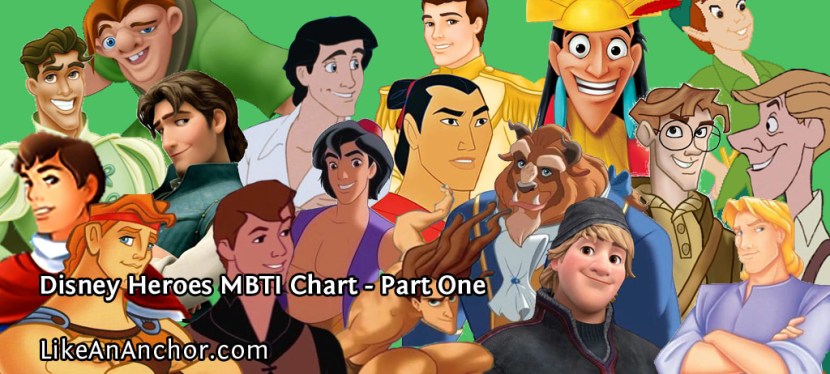
Disney Heroes MBTI Chart – Part One

I like typing fictional characters because they offer good examples for how the different types can show up in “real life.” This project, though, is mostly for fun. I’ve written posts typing Disney princesses and heroines. I’ve got a two part post on this blog typing Disney villains. Seems like it’s about time for the Disney princes and heroes to get their own posts as well.

There are so many Disney princes and heroes who could go on this list that I had to make some tough choices about who to include. My criteria are as follows: the characters appear in an animated Disney film, they’re human (sorry Simba, Tramp, and Pongo), they’re fairly popular/well-known, and I’ve seen the movie they star in. I’ve organized them alphabetically, then put half in this post and half in a second post that will come out on Wednesday.Disney Heroes MBTI Chart - Part One | LikeAnAnchor.com

I don’t like using stereotypes of any Myers-Briggs type as a basis for typing characters, but I’m afraid that’s what I’ve done in some of these descriptions. When the characters development doesn’t go really deep and we have just a few key characteristics to base our typing on, you have to try and match them with defining traits of a personality type. Unfortunately, sometimes that means relying on an overly simplistic view of each type. Just wanted to make that disclaimer before we dive into talking about Aladdin, the Beast, Prince Eric, Flynn Rider, Hercules, John Smith, Kristoff, Kuzco, and Li Shang. Read more
Here’s How Each Personality Type Can Change The World

Every personality type has something incredibly valuable to offer the world. Each comes with a slightly different way of learning new information, seeing the world, making decisions, and interacting with others. And that means that we each have the potential to positively impact the world in different ways.

A person’s Myers-Briggs® type doesn’t explain everything about them. But it does describe how our minds work, and that can give us an idea of how each type can use their strengths to make the world a better place.

For this list, I’ve paired the types that use the same primary and co-pilot functions together. For example, both ESFJ and ISFJ use Extroverted Feeling and Introverted Sensing as their preferred functions, just in a different order. If you’re new to Myers-Briggs® theory or want a quick refresher, you can click here for a quick intro to how functions work.

ESFJ and ISFJ

ESFJs and ISFJs change the world by connecting with and supporting other people, as well as preserving and passing on valuable lessons of the past. 

Having Extroverted Feeling as either their primary or co-pilot function gives SFJ types a strong desire to help and support other people. They tend to personalize everything they do and care so deeply about others that they may forget their own needs while selflessly serving those around them. They’re also really good at picking up on what other people are feeling.

With Introverted Sensing as either their primary or co-pilot function, SFJs have a strong desire to learn from the past. It’s the function that helps us make sure we remember what was learned in our personal and collective histories so we don’t keep repeating failures as we go forward.

ENFJ and INFJ

ENFJs and INFJs change the world by bridging gaps between people who have different perspectives and offering a vision for what the future could look like on both personal and societal levels. Read more

Personality Type Myth-Busting: Are Certain Personality Types Less Intelligent Than Others?

If you’ve done much reading about Myers-Briggs® types, you’ve probably come across the claim that Intuitives are smarter than Sensors. Or perhaps you’ve seen people talk about Thinking types being more intelligent than Feeling types.

Both of these ideas are untrue. They’re based on inaccurate stereotypes about the types and/or misunderstandings about the unique sort of intelligence that each type uses. In reality, every personality type is intelligent and no one type is smarter than any other. They do have different kinds of intelligence, though, and there are situations where one type might appear smarter than others just based on what skills the situation calls for.

Are Certain Personality Types Less Intelligent Than Others? | LikeAnAnchor.com
Photo credit: Marianne Sopala via Pixabay

The Problem of Measuring Intelligence

The idea that Sensing types aren’t smart is actuality based on something Isabel Meyers mentions in her book Gifts Differing. She said that Intuitive types tend to score higher on IQ tests. What people who spread this rumor miss is that she also pointed out that the structure of IQ tests puts Sensors at a disadvantage which has nothing to do with whether or not they’re smart. Read more

Here’s Why I Don’t Like The Way David Keirsey Talked About Personality Types

One of the most influential names in personality theories surrounding Myers-Briggs® types is David Keirsey. His book Please Understand Me II was one of the first I read when I decided to study personality theory because it was so widely recommended.

The more I studied Myers-Briggs types, though, the less comfortable I felt with Keirsey’s version and the more questions I had. Was his insistence on grouping the 16 types into 4 categories really all that useful? Is the practice of giving each type nicknames doing more harm than good? Why did he seem to ignore Jungian psychological functions? I started to think maybe he’s not the best resource for studying Myers-Briggs, though he does offer an interesting perspective on how the 16 types might relate to historic 4 type systems.

I’ve debated quite a bit whether or not to actually write this post. But I’ve been reading Personality Type: An Owner’s Manual by Lenore Thomson, who is a former managing editor of the Junginan journal Quadrant and who has taught courses on psychological types at the C.G. Jung Foundation in New York City. In her discussion of the ITP and IFP types, she voiced some of the same frustrations with Keirsey that I’ve felt, particularly in regard to how he talks about the SP types.

  • If you’d like to get a copy of Thomson’s book, click here. Please note that this is an affiliate link, which means that, at no additional cost to you, I will receive a commission if you click on the link and make a purchase.

Keirsey’s Focus on SP Types

I do want to start out by saying that I know Keirsey’s intentions were good in how he described SP types. He saw himself as “championing” the SPs (who he called “Artisans”) more than any other type because his parents, brothers, and many of his friends were Artisans. In addition, much of his work for 30 years as a family therapist was spent working with Artisan children who gave their parents and schools a hard time when they were noisy and restless or didn’t finish assignments.

My long association with and understanding of Artisans of all ages has enabled me to be more useful to them than to others of different temperament. I think Artisans ought to be enjoyed for what they are instead of condemned for what they are not, something that can also be said of the other three temperaments. (Keirsey, Please Understand Me II, p. 33)

While I agree with the sentiment, I think that some of Kersey’s theories did a disservice to SP types by constraining them into an art-making, hedonistic stereotype. There’s so much more to them than that, and I think by simply focusing on their shared SP traits we lose a lot of the nuances of these four types. I doubt this was his intention, but that’s how people seem to have used/misapplied his theories. Read more

Why Is It So Hard For Certain Personality Types To “Just Get Over It”?

You know when you’re struggling with something bad that happened to you and someone says, “Just get over it,” but you know it’s not that simple? For some reason, this particular hurt lodged deep inside and letting go seems well-nigh impossible.

For this post, I’m not talking about a hurt like grief over losing someone you love. We know why things like that are hard to “get over,” and in many cases it wouldn’t be appropriate to move on quickly. Most people recognize that hurts of that sort require time to heal and grieve. I’m talking about interpersonal hurts that might seem “little,” but have a big impact anyway. For example…

  • You express an authentic part of yourself (like your happy, fun-loving side), then people assume that’s all there is to your personality.
  • You receive 99% positive feedback about a project, but that 1% haunts you anyway.
  • You help someone out of the goodness of your heart, but others misinterpret your motives.
  • You decide to open up to someone, then lie awake at night worrying about their reaction.

Hurts like this touch on the core of who we are and/or our relationships with other people. These hurts are often deeply individual, and others might not understand them. If you don’t care what other people think of you, then you’re not going to understand why someone else is so upset about the one person in their life who’s a critic. If you find it easy to adapt to different social situations, you might not understand why someone’s so upset about not being able to express their true self all the time.

The reason why things like this can hurt us so deeply is often nuanced and complicated, but it has a lot to do with how we use the Feeling sides of our personalities. Everyone has a Feeling side (whether or not there’s an F in your four-letter Myers-Briggs® type), and we each use this part of our personality a little differently. Read more

Disney Villains Myers-Briggs Chart – Part Two

Last week I posted my chart with Disney villains Myers-Briggs types. It turned into such a big post that I finally split it in half — Sensing types in Part One and Intuitive types today in part two (some of you probably saw the whole post last week. It was live for a few hours before I decided splitting it up would be more manageable). To re-cap, here’s my criteria for which villains are included in this chart:

  • All Primary Members of the Disney Villains franchise show up here, except Chernabog.
  • I then added a few other popular villains, paying special attention to the villains from films where I’ve already typed a Disney heroine.
  • To keep the number of villains manageable, I decided not to type any of their side-kicks or secondary villains.
  • I’m only typing the animated versions. This is mostly to maintain consistency, since sometimes the type changes in live-action reboots (such as Maleficent becoming more INFJ when she got her own film).

Disney Villains Myers-Briggs Chart | marissabaker.wordpress.com

As I mentioned last week, if you compare this chart to the ones I made for Disney Princesses, you’ll see they’re almost opposite each other. The spots on the chart that stood empty for the Princesses (ENFJ, INTJ, INTP) now have at least one occupant and some of the spots bursting with princesses don’t have any villains at all. The biggest trend seems to be Feeling types equal “good” and Thinking types equal “evil” (which really bugs me, but that’s a rant for another time).

There’s not much to go on for typing some of the villains. They’re often caricatures of personality types rather than fully-fleshed out characters. By necessity, associating a villain with a certain types means looking at the most negative stereotypes of that type. But Disney typing is fun, so even when we don’t have much to work, I’m going to take a guess at the character. You’re welcome to shout-out in the comments about what you do and don’t like! Have fun 🙂

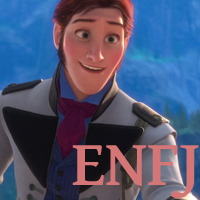
Hans — ENFJ

Hans - ENFJ. Visit marissabaker.wordpress.com for more Disney villain typesI love NF type villains. They’re not the typical choice for a fictional bad guy and their motives aren’t always immediately understandable, which is part of makes them an unexpected and unpredictable character.

  • Fe: Types that lead with Fe often have the easiest time connecting with people. Which means they can be the most charming, manipulative villains you’ll ever see. Hans’ entire plan is based on charming one of the sisters into marrying him (which he does easily by creating an instant connection with Anna). He’s also writing a narrative that makes him “the hero that’s going to save Arandel” as he manipulates all Elsa’s advisors until they’re begging him to be king.
  • Ni: This shows up in his long-term thinking. As the youngest of 13 brothers, he decided that taking over a different kingdom was better than the life he could see continuing on in the future at home.
  • Se: Typically a fun-loving and risk-taking aspect of personality, which helps him charm Anna initially and also shows up in his physical skills like dancing and swordfighting.
  • Ti: Logic is not an ENFJ’s strongest suit. Hans’ entire plan rests on getting people to feel the way he wants them to rather than not on something concrete and he doesn’t have a backup plan.

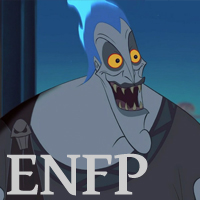
Hades — ENFP

Hades - ENFP. Visit marissabaker.wordpress.com for more Disney villain typesThere’s little disagreement that Disney’s Hades is an NP type and none at all that he’s an extrovert. People just can’t agree on Thinking or Feeling. Both ENxP types lead with Ne, so it comes down to whether he uses Fi/Te (ENFP) or Ti/Fe (ENTP) to make decisions. Read more