Disney Villains Myers-Briggs Chart – Part One

It’s finally here! The baddest evildoers to ever oppose animated Disney heroism — now with Myers-Briggs types. There are a lot of villains that show up in Disney stories so I had to whittle it down to a fairly short list. Here’s my criteria:

  • All Primary Members of the Disney Villains franchise show up here, except Chernabog.
  • I then added a few other popular villains, paying special attention to the villains from films where I’ve already typed a Disney heroine.
  • To keep the number of villains manageable, I decided not to type any of their side-kicks or secondary villains.
  • I’m only typing the animated versions. This is mostly to maintain consistency, since sometimes the type changes in live-action reboots (such as Maleficent becoming more INFJ when she got her own film).

Disney Villains Myers-Briggs Chart | marissabaker.wordpress.com

If you compare this chart to the ones I made for Disney Princesses, you’ll see they’re almost opposite each other. The spots on the chart that stood empty for the Princesses (ENFJ, INTJ, INTP) now have at least one occupant and some of the spots bursting with princesses don’t have any villains at all. The biggest trend seems to be Feeling types equal “good” and Thinking types equal “evil” (which really bugs me, but that’s a rant for another time).

There’s not much to go on for typing some of the villains. They’re often caricatures of personality types rather than fully-fleshed out characters. By necessity, associating a villain with a certain types means looking at the most negative stereotypes of that type. But Disney typing is fun, so even when we don’t have much to work, I’m going to take a guess at the character. You’re welcome to shout-out in the comments about what you do and don’t like! Have fun 🙂

  • Please note: there were so many villains to type that I split them up into two blog posts. Part One covers the Sensing Type villains and Part Two will cover the Intuitive types.
  • One more note: I mostly type by function stacks, so if you’re not familiar with that part of Myers-Briggs theory you can click here to read The Simplest Guide To Myers-Briggs Functions Ever.

Lady Tremaine — ESTJ
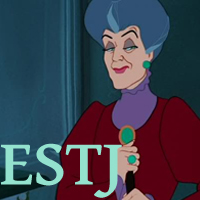
Lady Tremaine - ESTJ. Visit marissabaker.wordpress.com for more Disney villain typesMost people type her as a TJ type (at least in the animated version), but beyond that there isn’t any agreement about her I/E or S/N preference. I’m pretty sure she’s a Sensor, but I’ve gone back and forth between introvert and extrovert. I’ve gone with extrovert because she’s very inclined to take-charge in the outer world and we don’t really see her spending any time alone.

  • Te: The opening narration describes her as “cold, cruel, and bitterly jealous of Cinderella’s charm and beauty.” While not a fair representation of TJ types, “heartless” is an accusation stereotypically leveled against them, especially women. She’s very outwardly judgemental and her communication consists of authoritative orders.
  • Si: My guess is that Lady Tremaine married Cinderella’s father for security. She already had a “good family” so she wasn’t social climbing. While we do see her trying to forward her daughters’ interests, it’s not really as part of a N-type’s long-term planning. She’s working within traditional roles to control and manipulate people.
  • Ne: A pattern-recognition function, Extroverted Intuition helps Lady Tremain put the pieces together and realize Cinderella was the mystery woman at the ball.
  • Fi: As an inferior function, Introverted Feeling can show up as outbursts of emotion and a fear of feeling. Lady Tremain is a very detached character, never showing her feelings for the people around her unless it’s in an angry outburst.

Queen of Hearts — ESTJ

Queen of Hearts - ESTJ. Visit marissabaker.wordpress.com for more Disney villain typesThe Queen of Hearts is one of the more exaggerated Disney villains. ESTJ nicknames include Supervisor, Executive, Overseer, and Enforcer. Take that to a villainous extreme and you just might get someone who lops off subordinates’ heads when things don’t go as they ordered. Read more
Here’s What Your Myers-Briggs® Type Can and Can’t Tell You

It’s no secret I’m a big fan of Myers-Briggs®. I’ll defend it against people who say it’s useless, write and re-write posts trying to come up with the simplest introduction to function stacks ever, and spend my time musing about how type influences both real people and fictional characters. But as much as I like the Myers-Briggs® system of personality types, I also know there are things it’s not meant to do.

In fact, applying Myers-Briggs® wrongly is one of the biggest reasons it has come under so much criticism. For example, you can find quite a few articles online that argue Myers-Briggs® is basically useless in a work environment. They’ll tell you it’s not a good indicator of job performance nor is it all that useful for screening potential employees. But that shouldn’t come as a surprise, considering those aren’t the test’s purpose. And it’s unfair to dismiss a test for not doing something it wasn’t meant to do in the first place.

Here's What Your Myers-Briggs Type Can and Can't Tell You | marissabaker.wordpress.com
Photo credit: Brodie Vissers via StockSnap

So what is the Myers-Briggs® test supposed to tell you? And just how much can we apply what we learn from finding our type to real life?

This Is Your Brain On Decision Making

The Myers-Briggs® test is designed to measure how people’s minds work. It describes their preferred mental processes or “cognitive functions” (to use the technical term). Contrary to what so many critics of the test think, it doesn’t force people into dichotomies. Rather, each type has a “stack” of preferred functions. So an ENFJ type isn’t someone who’s 100% extroverted, intuitive, feeling, and judging. They’re a type that prefers making decisions with Extroverted Feeling, learning new things with Introverted Intuition, and then also uses Extroverted Sensing and Introverted Thinking to a lesser extent (click here to learn how we get from the four letter type to the functions).

These characteristics of Myers-Briggs® theory means that taking the test can help you: Read more

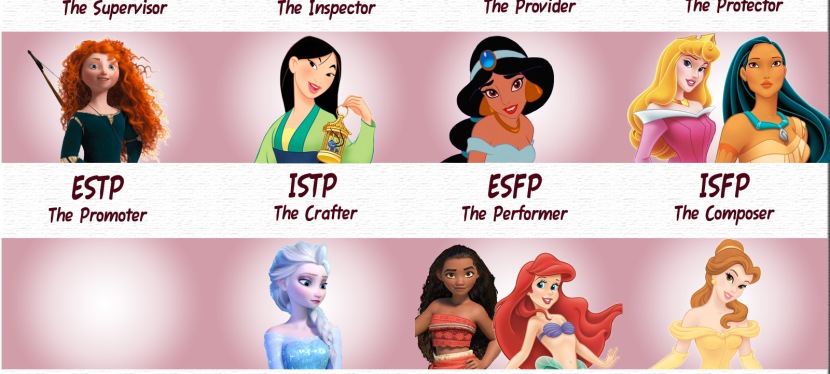
Part Two: “Unofficial” Disney Princesses MBTI Chart

Last week, I updated an old post called The Missing Disney Princesses with a brand new MBTI Chart featuring the 14 official princesses (well, technically there are 11 official princesses, plus Anna and Elsa who have their own line, and Moana who hasn’t been crowned yet. So it was more like the “Official + New/Popular Princesses Chart”).

There are other Disney women, though, who’ve been completely snubbed by the Disney princess line-up and I wanted to include those as well. I had them on a separate chart in my previous post and I wanted to follow that pattern this time as well. Eilonwy and Alice were the most requested characters I left out last time, so I’m adding them. And I’ve also added a character no one asked about from my favorite underappreciated Disney films — Maid Marion from Robin Hood.Updated Disney Princesses MBTI Chart, Part Two | marissabaker.wordpress.com

Note: I’m not using anything from sequel films (just to help narrow-down the typing choices), so that’s why you won’t see Ariel’s daughter Melody (for example). I also type using cogitative functions. If you’re not familiar with that aspect of Myers-Briggs theory, click here and here for a two-part introduction. Read on for detailed explanations for why I chose these types for the unofficial princesses, and click here for the post about the other princesses.

Read more

Updated Disney Princesses MBTI Chart

A couple years ago, I made a Myers-Briggs chart called The Missing Disney Princesses that quickly became one of the more popular posts on my blog. Now (finally!!!) I get to update it to include our new princess, Moana.

But I’m not just adding Moana to my chart. I’m also moving around a few of the other princesses. Last time, my focus was on showing that we don’t see all the personality types represented by the Disney princesses. Both Intuitive and Thinking types are under represented among Disney’s ladies. That’s still the case, but this time my focus is on explaining why I typed each princess the way I did.

In the two years since publishing the last chart, I’ve learned more about Myers-Briggs typing. I’ve also re-watched several of these movies, considered comments from readers on the previous post, and asked advice from fellow personality type and Disney enthusiasts. In response, I’ve re-typed several characters (which is noted and explained in the individual character discussions).Updated Disney Princesses MBTI Chart | marissabaker.wordpress.com

Note: I type using cogitative functions. If you’re not familiar with that aspect of Myers-Briggs theory, click here and here for a two-part introduction. Read on for detailed explanations for why I chose these types for each character. Read more

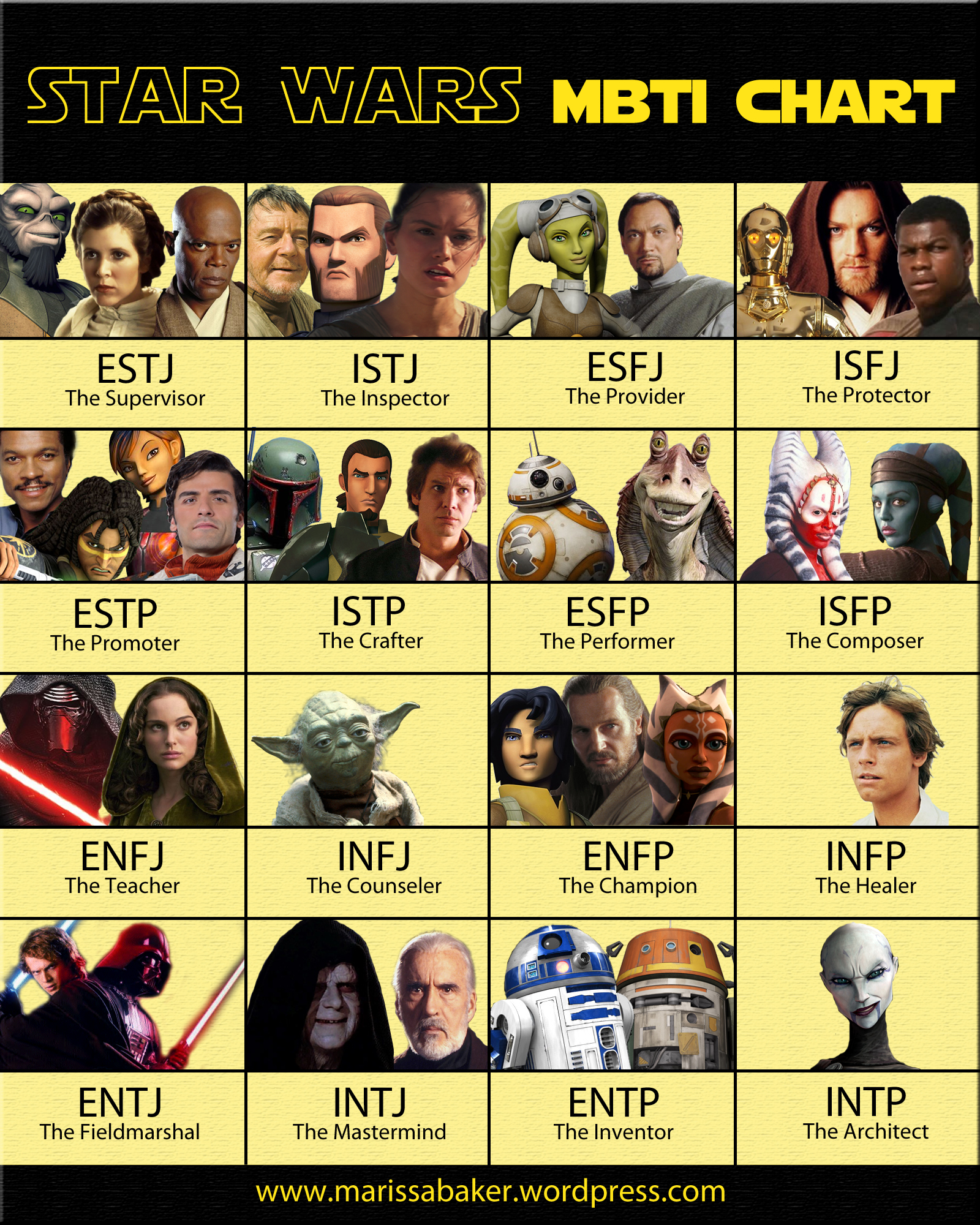
Star Wars MBTI Chart

Note: an updated version of this chart and expanded discussions about Star Wars characters’ Myers-Briggs types can now be found on my other blog Star Wars Personalities.

My Star Wars obsession has lain dormant for 10 years, buried under delta shields, gate addresses, consulting detectives, and madmen in blue boxes. As The Force Awakens, so has the part of me that used to spend hours on Star Wars message boards debating casting news and plot points for the prequels trilogy. I’ve seen it twice now — once opening night and then again yesterday.

I know the fact that most of the EU is no longer cannon has irritated/incensed some people, but at least it’s easier to catch-up on what’s in-cannon now. I’ve been watching Clone Wars (which I thoroughly enjoy) and reading some of the novels, so those will figure into this typing chart.

Readers have been so happy with my Disney princesses chart trying to sort characters by their actual type rather than shoe-horn one into each category that I decided to do something similar for Star Wars. Share it with your friends, spread it around Pinterest, comment with what you like and dislike. For interested parties, I’ve added some of my reasons for typing each character this way below the chart. Enjoy 🙂

Update January 2017: I’ve updated  the chart with characters from Star Wars Rebels. Click here to visit the post analyzing their personality types.click to read article, "Personality Types in Star Wars Rebels" | marissabaker.wordpress.com

Read more

Finding Your Real Myers-Briggs® Type

It’s so easy to take a pseudo-Myers-Briggs® test on the internet. You can click through a quick quiz, get your result and think, “Wow, I guess that does sound like me.” A few weeks later, you might stumble across another short quiz and take it again. Maybe you get a different answer and the description still sounds like you. Now you’re wondering whether this whole Myers-Briggs thing is all it’s cracked up to be, and if it is, then why were your results different?

This is one of the reasons Myers-Briggs tests have come under fire from critics who don’t really understand how the Myers-Briggs Type Indicator (MBTI®) is supposed to work. They look at the short little quizzes with generic feel-good results, and say it’s too simple and unreliable. But if you dive into the theory behind Meyers-Briggs, and especially cognitive functions (click here for an introduction to type functions), you start to realize how helpful the MBTI can be as a tool for understanding yourself and other people.

One of the principles of Myers-Briggs theory is that people only have one type, which stays consistent throughout their lives. You grow and develop within your type, but you don’t change from an INFP to an ENFJ to an ISTP or any other combination of letters. So with that in mind, how can you find your true type with so many conflicting results floating around?Finding Your Real Myers-Briggs® Type | LikeAnAnchor.com

Take A Good Test

Disclaimer: some of the links in this post are affiliate links. This means that, at no additional cost to you, I will receive a commission if you click on the link and make a purchase on that website.

If you can’t take the official MBTI, there are a few decent substitutes out there on the internet. My favorite by far is Personality Hacker’s Genius Style test.* They ask for an e-mail address, but it is free. One of my favorite bloggers, Susan Storm, also recently released a test. You can click here to take that.

Similar Mind’s Jungian test is another I’ve recommended (note from May 2017: recent changes to the test questions may skew results. You might want to try HumanMetrics instead). Some people really like the test from 16Personalities, but it’s not my favorite. These tests all give you a series of questions which are designed to learn what cognitive functions you use, then give you a four-letter test result.

I’d recommend starting with the Personality Hacker test, and then taking one or both of the other tests to compare results. Try not to read the full results of one test before you take the others — you want to take each one as unbiased as you can. If they all give you the same result, that’s a pretty good indication you’ve found your personality type. If they’re different, though, it’s time to start reading.

Compare Results

Now that you have one or more personality type results, start reading descriptions of your potential personality type(s). Here are some excellent resources:

Read the descriptions for each of your type results. Even if you only got one result, it’s a good idea to look at similar types that use some of the same cognitive functions. Here are a few guidelines for which other types to look up based on your test results.

If you test as an …

  • Introvert, read about the type which is opposite you on the J/P scale. The J/P preference describes how we interact with the outer word through our extroverted function, so an IJ type actually leads with a perceiving process and an IP type leads with a judging process. This can affect test results.
  • EJ, take a look at the type opposite you on the S/N scale. The tests found that you lead with an extroverted judging/decision making process, but might not have accurately found your introverted secondary process.
  • EP, take a look at the type opposite you on the F/T scale. The tests found that you lead with an extroverted perceiving/learning process, but might not have accurately found your introverted secondary process.
  • SFJ or NFJ, read results from ENFJ, INFJ, ISFJ, and ESFJ. These types all use Extroverted Feeling, and can often be mistaken for each other. Shy ESFJs and ENFJs can be mis-typed as introverts, and outgoing ISFJs and INFJs can be mis-typed as extroverts.
  • NT types, read the type opposite you on the E/I preference. ENT- types, especially ENTJs, are among the most “introverted extroverts” and might mis-type.

Think About Stress

Most tests look at your primary and secondary function — the driver and co-pilot processes that lead in our personality. This makes sense, since other functions are less well developed and we don’t use them as much unless we’re stressed. When we’re trying  to discover our true type is, though, how we react under stress is a good indication of which type matches us best.

Good type descriptions will also talk about the inferior function. An excellent book on this topic is Was That Really Me? How Everyday Stress Brings Out Our Hidden Personality* by Naomi Quenk.

Keep In Mind …

No personality test result is going to be a 100% perfect match. You’re looking for the one that fits you best. You will find elements of other descriptions that sound like you, but there should be one that fits better than the others. Pay close attention to descriptions of how your type uses cognitive functions. Descriptions of INFJ and INFP types, for example, sound similar but they lead with very different mental processes.

Good luck on your journey of self discovery! There’s a plethora of resources out there that can help you, including type-based Facebook groups and forums where you can talk with people of different types to see how they think. And if there’s anything I can help with, just ask!

*indicates affiliate links

Featured image credit: StockSnap via Pixabayy

Save